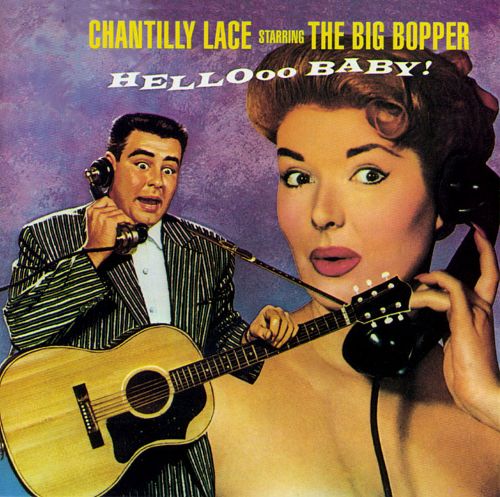
Why Is This Restaurant Playing The Big Bopper?

by James Wallace Harris, Sunday, March 31, 2019

Susan and I went out to breakfast this morning. She wanted to try this new place called Staks. One of those storefront restaurants where you order at the counter and sit down and wait for your food. (A trend I don’t like.) What surprised me was the music they played at 7:30am, oldies like “Rock Around the Clock,” “The Wanderer,” “Chantilly Lace,” “He’s So Fine,” and “Dawn” – all songs from when we were growing up.

We sat at a booth with high backs covered with green plastic. In the middle of the room were sterile white metal tables and chairs occupied by younger people, including three late twenty-something couples with babies in highchairs. I wanted to ask them what they thought about the music. I was grooving to oldies, but were they? Was it just Muzak to their ears? The staff was all teens and young twenty-somethings. Why were they being forced to listen to old people’s music all day? I assume some industrial designer imagined both the decor and music together believing old fashioned breakfasts went with old-fashioned music. There were no vegetarian or gluten-free options on the menu – that would remind people of now and break the illusion.

Just to check if I wasn’t the only one noticing this trend I found this at the Chicago Tribune, “Nostalgia has taken over food and pop culture because we can’t help but fall for it.” Google also gave me “4 Ways to Use Nostalgia to Grab Your Customers’ or Members’ Attention.” Of course, marketers have been selling us American Graffiti and Happy Days leftovers for decades.

I can understand a fondness for life between WWII and the Vietnam war because that’s when I grew up. Susan and I were the only music-age-appropriate customers in Staks. Susan still knows all the words to those songs. Why should our nostalgia be piped into younger generations? My parents hated rock ‘n’ roll. I have to work mighty hard to find songs from the 21st-century that I love. And the song I do find to love, tend to sound like songs from my past. My parents like music built around vocalists, horns, and woodwinds. I grew up with vocalists, guitars, bass, and drums. Modern music fans love processed vocals mixed with computer-generated tones and sampled clips.

My theory is every generation has a sound they are pop culturally programmed to resonate with during their teenage years. I assume in half-a-century the young people that were sitting in the middle of the room will be in booths listening to music from their generation wondering why another industrial designer brought it back.

By the way, here’s a 21st-century song I love. I’ve probably played it two dozens times today. It shows I shouldn’t think every generation is stuck in their own musical hole. It still doesn’t explain why I see young people wearing t-shirts with The Beatles, Jimi, or The Grateful Dead pictured on them. I never wore a shirt with Benny Goodman’s face and doubt I’ll wear a Rilo Kiley advertisement.

Finally, why is it easier for younger generations to embrace older generations of music than it is for older generations to keep up with the music coming from younger generations? There are plenty of places to eat and drink that feature contemporary music. I just don’t go in them anymore. Why? I’ve heard many in my generation say they feel invisible around younger people, and that made them feel old. I’ve got to admit I stopped paying attention to newer trends, so they are invisible to me. Maybe it’s mutual.

My guess is those under 30 kids in Staks never even noticed the music.

JWH

The Elegance of Quiet Science Fiction Films

by James Wallace Harris, Friday, March 29, 2019

Advantageous (2015) is the kind of quiet science fiction film I love. It was directed by Jennifer Phang, who co-wrote it with Jacqueline Kim, the star of the film. Advantageous is currently streaming on Netflix and I have no memory of it ever coming to the theater (even though it has an 83% Rotten Tomatoes rating). I watched this movie with my friend Annie. She thought the show was only okay, but I loved it. But then my favorite science film is Gattaca. I prefer quiet science fiction movies without chases, explosions, and dazzling special effects. Annie prefers more action.

Advantageous is set in the near future where AI are taking jobs from people. Advantageous is about Gwen Koh (Jacqueline Kim) who is the spokesperson for a rejuvenation corporation who is being fired for looking too old. Gwen is desperate to get another job to keep paying for the expensive schooling for Jules (Samantha Kim), her daughter. In this future, the unspoken belief is its better to give jobs to men because if too many of them were unemployed it would cause civil unrest. Gwen feels Jules can only have a future if she has an elite education, and she’s willing to do anything give her daughter a future.

I don’t want to spoil the film, but let’s just say that Advantageous explores a number of popular current science fiction themes in written science fiction. The film is set in an unnamed city with a breathtaking skyline of ornate skyscrapers that are occasionally hit by terrorist explosions. The citizens of this future passively ignore these attacks as a powerful government deals with them without alarm. We are shown other flaws in this tomorrowland just as quietly. This is a utopian world that is beginning to reveal hairline cracks.

One requirement of enjoying quiet science fiction films is reading between subtle lines. It helps to be well-versed in written science fiction. Gwen is given a decision to make, a “Cold Equations” or “Think Like a Dinosaur” decision. If you don’t know these classic science fiction short stories you might not appreciate the impacts of her choice. The ideas in Advantageous have been explored in great detail in written science fiction. That makes me wonder if movie-only Sci-Fi fans will pick up on the finer points of this story.

Manohla Dargis over at the New York Times was less enthusiastic about the film than me:

Ms. Phang, who wrote the script with Ms. Kim, throws a lot into her movie — ideas about maternity, identity and technologies of the female body swirl alongside nods to the French New Wave — without always connecting the pieces. Eventually, a picture emerges that at times suggests a strange if alluring mash-up of “Stella Dallas” and Michel Foucault, with a smidgen of Jean-Luc Godard’s “Alphaville” and a hint of Margaret Atwood’s “The Handmaid’s Tale.” Ms. Phang has a way with spooky moods and interiors, and as a performer, Ms. Kim makes a fine accompanist, though she’s tamped down too much. It’s a kick to see how effectively Ms. Phang has created the future on a shoestring even if she hasn’t yet figured out how to turn all her smart ideas into a fully realized feature.

I thought Advantageous was fully realized. It set up all the science fictional speculation and then dealt with them in a satisfying way. It just didn’t cover everything explicitly, but quietly implied what we needed to know. Maybe that’s why this movie is an unknown gem. Too many filmgoers want action and obviousness. I watched the film last night and I’m already wanting to see it again. I’m sure there are little delights I’ve missed. Quiet films are perfect for meditation, they keep unfolding with additional viewing and contemplation.

JWH


Love, Death + Robots: What is Mature Science Fiction?

by James Wallace Harris, Monday, March 25, 2019

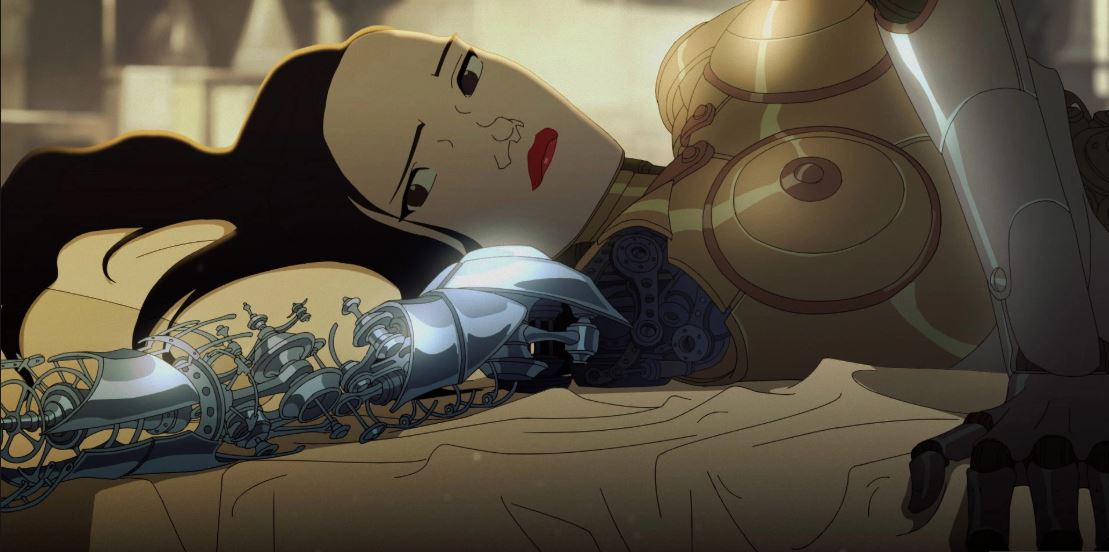
Love, Death + Robots showed up on Netflix recently. It has all the hallmarks of mature entertainment – full frontal nudity, sex acts of various kinds, gory violence, and the kind of words you don’t hear on broadcast TV or in movies intended for younger audiences. There’s one problem, the maturity level of the stories is on the young adult end of the spectrum. 13-year-olds will be all over this series when it should be rated R or higher.

When I was in high school I had two science fiction reading buddies, Connell and Kurshner. One day Kurshner’s mom told us almost in passing, “All that science fiction you’re reading is so childish. One day you’ll outgrow it.” All three of us defended our belief in science fiction, but Mrs. Kurshner was adamant. That really bugged us.

Over the decades I’d occasionally read essays by literary writers attacking science fiction as crude fiction for adolescents. I vaguely remember John Updike caused a furor in fandom with an essay in The New Yorker or Harpers that outraged the genre. I wish I could track that essay down, but can’t. Needless to say, at 67 I’m also starting to wonder if science fiction is mostly for the young, or young at heart.

I enjoyed the 18 short mostly animated films in the Love, Death + Robots collection, but I have to admit they mostly appealed to the teenage boy in me, and not the adult. Nudity, sex, violence, and profanity doesn’t equate with maturity. But what does? I’ve known many science fiction fans that think adult literary works are equal to boredom.

So what are the qualities that make science fiction mature? I struggled this morning to think of science fiction novels that I’d consider adult oriented. The first that came to mind was Nineteen Eighty-Four by George Orwell. Orwell died before the concept of science fiction became common, but I’m pretty sure he never would have considered himself a science fiction writer even though he used the tricks of our trade. Margaret Atwood doesn’t consider herself a science fiction writer even though books like The Handmaid’s Tale are both science fiction and mature literature. Other mature SF novels I can think of are The Road by Cormac McCarthy, Earth Abides by George R. Stewart, and Never Let Me Go by Kazuo Ishiguro. These are all novels that use science fiction techniques to tell their story but were written by literary writers.

Of course, I could be howling at the moon for no reason. Most television and movies are aimed at the young. Except for Masterpiece on PBS and a few independent films, I seldom get to enjoy stories aimed at people my own age. Which brings me back to the question: What makes for mature fiction? And it isn’t content that we want to censor from the young. If we’re honest, nudity, sex, violence, and profanity are at the core of our teenage thoughts.

Mature works of fiction are those that explore reality. Youth is inherently fantasy oriented. The reason why we’re offered so little adult fiction is that we don’t want to grow up and face reality. The world is full of reality-based problems. We want fiction that helps us forget those problems. Getting old is real. We want to think young.

Love, Death + Robots appeals to our arrested development.

Love Death + Robots - robots

I’m currently reading and reviewing the 38 science fiction stories in The Very Best of the Best edited by Gardner Dozois. I’m writing one essay for each story to discuss both the story and the nature of science fiction in general. I’ve finished 10 stories so far, and one common aspect I’m seeing is a rejection of reality. These stories represent what Dozois believes is the best short science fiction published from 2002-2017. On the whole, the stories are far more mature than those in Love, Death + Robots, but that’s mainly due to their sophistication of storytelling, and not philosophy. At the heart of each story is a wish that reality was different. Those wishes are expressed in incredibly creative ways, which is the ultimate aspect of science fiction. But hoping the world could be different is not mature.

Science fiction has always been closer to comic books than Tolstoy, Woolf, or even Dickens. And now that many popular movies are based on comic books, and the whole video game industry looks like filmed comic books, comic book mentality is spreading. The science fiction in Love, Death + Robots is much closer to its comic book ancestry than its science fiction ancestry, even though many of the stories were based on original short stories written by science fiction writers. Some reviewers suggest Love, Death + Robots grew out of shows like Robot Carnival and Heavy Metal.  Even though Heavy Metal was considered animation for adults, it’s appeal was rather juvenile.

I know fully well that if Netflix offered a series of 18 animated short science fiction films that dealt with the future in a mature and realistic way it would get damn few viewers. Even when science fiction deals with real-world subjects, it seldom does so in a real way. Maybe it’s unfair to expect a genre to be mature that wants to offer hope to the young. Yet, is its hope honest? Is it a positive message tell the young we can colonize other planets if we destroy the Earth? That we can solve climate change with magical machines. That science can give us super-powers. That if we inject nanobots into our bloodstream we can be 22 again. That don’t worry about death because we’ll download your brain into a clone or computer. Doesn’t science fiction often claim that in time technology will solve all problems in the same way we rationalize to children how Santa Claus could be real?

Actually, none of the stories in Love, Death + Robots offered any hope, just escape and the belief you can sometimes shoot your way out of a bad situation. But only sometimes.

Maybe that’s not entirely true, one story, “Helping Hand” by Claudine Griggs is about a very realistic situation that is solved by logical thinking. Strangely, it’s the only story by a woman writer. A “Cold Equations” kind of story. That’s a classic 1954 short story written by Tom Godwin where the main character has to make a very difficult choice.

My favorite three stories (“When the Yogurt Took Over,” “Alternate Histories” and “Three Robots”) were all based on stories by John Scalzi and have kind of zany humor that provides needed relief from the grimness of the other tales. I actually enjoyed all the short films, but I did tire of the ones that felt inspired by video game violence. Even those films like “Secret War” and “Lucky Thirteen” which aimed for a little more maturity, rose higher than comic books, but only to pulp fiction.

The two films based on Alastair Reynolds stories, “Zima Blue” and “Beyond the Aquilla Rift” seemed to be the most science fictional in a short story way. I especially like “Zima Blue” for its visual art, and the fact the story had an Atomic Age kind of science fiction feel to it. So did the fun “Ice Age” based on a Michael Swanwick story. Mid-Century science fiction is really my favorite SF era. Finally, “Good Hunting” based on a Ken Liu has a very contemporary SF feel because it blends Chinese myths with robots. World SF is a trending wave in the genre now.

I’m still having a hard time pointing to mature short SF, ones that would make great little films like in Love, Death + Robots. Maybe “Good Mountain” by Robert Reed, which I reviewed on my other site. I guess my favorite example might be “The Star Pit” by a very young Samuel R. Delany, which is all about growing up and accepting limitations. Most of the films in Love, Death + Robots were 8-18 minutes. These stories might need 30-60. It would be great if Netflix had an ongoing anthology series of short live-action and animated science fiction because I’d like to see more previously published SF stories presented this way. Oh, I suppose they could add sex, nudity, violence, and profanity to attract the teenagers, but what I’d really want is to move away from the comic book and video game plots, and into best better SF stories we read in the digests and online SF magazines.

JWH


Chocolate and Back Pain

by James Wallace Harris, Monday, March 18, 2019

I doubt many people will associate chocolate with back pain, but I’ve experienced a connection. I’ve been dealing with spinal stenosis for many years and I’ve learned how to control it with diet and exercise because pills that fight pain and inflammation bother my stomach. I’ve learned that food can cause inflammation. I hate this idea because it’s all my favorite foods that indirectly add to my back pain. Inflammation causes the stiffness and numbness which leads to pain. Most people learn to relax back pain with an anti-inflammation pill, but if you pay attention, avoiding certain foods also has an anti-inflammation effect.

I was doing great this year. I’ve been on 16:8 intermittent fasting since 9/21/18, and off junk food since 1/1/19. About ten days ago I started experimenting with a few minor treats. However, one thing led to another and I fell off the wagon, binging on chocolate for two days. What stopped me was stomach pains. As I’ve gotten older, my stomach has gotten wimpier. Not only had I gotten my back almost pain free and a good deal more limber, but also stabilized my stomach into its quiet state. Going off my diet quickly let me know that value of eating healthy.

I don’t know why, but in recent years my stomach has become extra sensitive to two of my most loved foods: peanut butter and chocolate. When my stomach started hurting I immediately quit my chocolate binge. That’s when I realized that my back had taken quite a setback, proving how much diet contributes to inflammation. I was back to walking hunched over with a slight limp. Just last week I commented to myself that I was feeling much sprier in ages.

When I feel good, I become weak to temptation.

Needless to say, I’m back on my diet. I keep thinking what I eat shouldn’t affect inflammation that much, but it does. I created the above headline to sound absurd hoping to entice people to read this essay. However, I searched on this title and lo and behold, other people are writing about chocolate and back pain too.

I hate having to give up everything I love to eat. But I feel like Pavlov’s dog. Certain foods now come with a kick in the gut or whack to the back. The trouble is I can only remember my conditioning for so long before temptation strikes again. I’m hoping I can remember the miserable stomach pains I felt Saturday and the back pains from yesterday.

JWH


Volunteer Librarians

by James Wallace Harris, Saturday, March 9, 2019

A couple weeks ago I went with my friends Mike and Betsy to a book signing for The Watch on the Fencepost (a pleasant cozy mystery) by Kay DiBianca. Mike had worked with Kay for years and I went along because this was Kay’s first book, written after she retired, something I’ve always wanted to do. Kay introduced Mike and me to her audience as former librarians, suggesting we might be experts on books. Mike and I worked in a university library back in the 1980s, but as clerks, not librarians. At the time, we both wanted to become librarians, but it required moving out of town to get a Master’s of Library Science degree, something hard to do since we both had wives with jobs too. To become a librarian where we worked required an MLS to get the job and then another master’s in a useful subject area to keep it.

Mike and I were never qualified to call ourselves librarians so we’re always embarrassed when that title was bestowed on us. We both left the library to go into computers, but I think we each wished we had become librarians. Now that we’re retired I’ve noticed that many of our hobbies require librarian-like skills. I’m starting to think of ourselves and others that share our hobbies as volunteer librarians.

I haven’t worked in a library for almost four decades, but back then they had several main departments:

  • Acquisitions
  • Cataloging
  • Circulation
  • Reference
  • Periodicals
  • Binding & Repairs
  • Government Documents
  • Special Collections

My new hobby of scanning old science fiction fanzines for the Internet Archive involves acquisitions, cataloging, periodicals, repair, and special collection skills. Mike and I’s project for the Classics of Science Fiction involves reference skills like indexing, making rules for the title and author entries, using online databases, and linking to standardized catalogs. Each of us collects books and periodicals. Mike is much better at cataloging his collection in the GoodReads database. Mike would have made a great librarian because he is so extremely detailed oriented.

I think of my scanning project as collecting and preserving documents that are disappearing. There’s a very librarian-like appeal to it. Mike and I used to work with cataloging periodicals using OCLC and Mark II records. I wonder if these are still in use today? (I just checked and they are.) Now that we’re building our own databases of records we’re concerned about standards and interoperability with other database systems. We’re designing our system so titles and authors entries follow exact rules. Like libraries using the OCLC system, we’ve decided to piggyback our efforts on a more universal system, which is the Internet Science Fiction Database (ISFDB.org). ISFDB.org is a vast worldwide effort of volunteer librarians indexing and cataloging all books and periodicals related to science fiction and fantasy.

We don’t want to reinvent the wheel. It’s better to join larger efforts. That’s why I’m noticing volunteer librarians building what I believe will one day become the Library of Planet Earth. Right now countless systems, collections, databases, indexes, bibliographies, are springing up on the internet, usually by groups with special interests. They seldom work together, but someday they will. For example, I think it’s very logical that Wikipedia, ISFDB.org, WorldCat, Internet Archive, and other separate systems start cross-referencing everything about science fiction. Everything I upload to the Internet Archive is already cataloged in ISFDB and has entries in Wikipedia. I can already see that Wikipedia will become the Card Catalog of the emerging Planet Earth Library.

Other scanners preserving pulp magazines use Galactic Central which works to index all stories in pulp magazines and related periodicals. It overlaps with science fiction but covers other genres. Sometimes I wish Galactic Central had features of ISFDB, and sometimes I wish ISFDB had features of Galactic Central. Before computers, lone bibliographers compiled lists and 3×5 card stacks by hand and then published them in printed indexes that had to be annually updated. Now all their work is being done by volunteer teams that build huge datasets in the cloud that update in real-time. Eventually, I see these systems merging into super-systems. For example, one day there will be one database that catalogs every short story ever published.

If you pay attention to the information you get on the internet, you’ll start noticing the volunteer librarians. Wikipedia is both volunteer encyclopedists and volunteer librarians. If you’ve ever used Discogs or MusicStack or All Music then you’ve seen the work of volunteer music librarians. Every subject hobby has them.

Some people just have a natural urge to collect, catalog, preserve, index, and organize diverse kinds of recorded knowledge. It’s a kind of hoarding of historical artifacts. We don’t want civilization to Marie Kondo itself and throw out all the tidbits of knowledge that keep piling up. In a way, volunteer librarians are like the dream mechanism in our heads at night that decides which memories are worth keeping. We can’t save everything, but we can try.

Volunteer librarians don’t need library science degrees, just a strong urge to collect,  catalog, and preserve.

JWH