Cross Generational Music Appreciation

By James Wallace Harris, March 14, 2016

In his new book, The Song Machine: Inside the Hit Factory, John Seabrook begins by telling how his young son took over the car radio during their morning ride to school. Seabrook loves music and wanted his son to love his music, but the kid was adamant that he wanted his own music. I remember doing this to my dad back in the late 1950s. I’m sure all of us have been on both sides of that divide of music generations. Seabrook decided to get into his son’s music, and ended up writing a fascinating book.

How much cross generation listening goes on? Don’t most people bond with the music from their teenage and college years and then essentially stop listening to new stuff when the next generation annoys them with their music? In recent years though, I’ve noticed that some kids have embraced a few bands, songs and albums from my generation, the 1960s. I belong to their grandparents’ times. Are these kids rebelling against their parents’ by listening to the music their parents rejected?

My generation (who knew the Who could be so prophetic) has become terribly nostalgic for music history, seemingly to never tire of documentaries like, The Wrecking Crew, Muscle Shoals, 20 Feet From Stardom, Standing in the Shadows of Motown, Big Star: Nothing Can Hurt Me, Searching For Sugar Man, Atlantic Records, and Respect Yourself: The Stax Years. Just last week I watched documentaries on Fats Domino and Carole King. I’d watch more if I could find them. It’s funny, but this music is the one bridge I have with my Fox News watching conservative friends. We hate each other for our politics but commune over music.

But if I tell my peers I have Katy Perry or Nicki Minaj on my playlists they laugh at me. But if I tell them I’ve been listening to Ronnie Spector or Dionne Warwick it sparks a memory fest. And if tell them I’m been playing Peggy Lee or Lena Horne, a few of them will perk up. Among my music loving buddies who do cross generations, they generally travel backwards. I guess the young people I meet with Jimi Hendrix T-shirts are traveling backwards in time too. I don’t know why older folks look down on the music of younger generations. I have a number of friends who stopped listening to new music around 1975, and no matter what I play for them, I can’t seem to get them to move forward in time.

That’s a shame because musical creativity didn’t stop in the 1970s. Seabrook writes specifically about pop music (Katy Perry, Ke$ha, Rihanna, KPOP, American Idol, Denniz Pop, Max Martin, Dr. Luke, Ester Dean) and how they make hits with computers and teams of creative personnel that collaborate with the performing artist. There are no singer-songwriters here. No bands that play all their instruments. Producers are the emperors of the studio, hiring up to a dozen people to write a song. But wouldn’t that be true back in the Motown era if everyone who added anything to a song got credit? The Song Machine was absolutely fascinating to me, even though I’m not from that generation. It annoys me that my friends won’t give new music a chance, and probably refuse to read this book.

the-song-machine-john-seabrook

All this cogitation about cross generation listening has made wonder about many things. How do kids today choose what they listen to from past generations? And why? Are they mesmerized by tunes in movies and end up chasing them down? Have they found LPs at Granny’s or Goodwill, which inspired them to dig up an old record player, curious about the tunes on those strange black discs? This morning I was wondering why young people remember The Beatles, but not The Byrds. Is there any reason for one generation to remember the pop culture from another generation? Has classic rock become the elevator music of today, and Beatles songs became ear worms boring into young brains? Do they teach The Beatles in school? Maybe kids clicked past nostalgia shows on PBS and got hooked. I don’t know what percentage of today’s generation discover old music, but is there any reason to expect them know about my music, or even like it? And why don’t I ever hear them express their love for The Byrds—my favorite band from the 1960s?

Mr Tamborine Man - The ByrdsTurn Turn Turn - The Byrds

At the moment I’m listening to a collection of 1950s songs on Spotify because I caught an episode of American Masters on PBS about Fats Domino. One thing I didn’t know, Fats was as popular as Elvis for a short while during the 1950s, but people now remember the 1950s belonging to Elvis. That makes me think there are some people like me, who remember their decade of music differently. I hardly play The Beatles anymore, but I play music from the 1960s constantly. Bob Dylan, The Byrds, Motown, San Francisco rock and pre-1965 Brill Building pop dominate my memories. If I made list of my favorite songs, I bet there would be a couple hundred songs from the 1960s at the top of my list before I even listed my first Beatles tune.

And I loved The Beatles, but I loved other artists from the 1960s more. Should I encourage young people to discover their music? Should schools teach 1960s music like they teach classical music in music appreciation courses? As I got older I sought out popular music that came out before the 1960s, going back into the 1950s, 1940s, 1930s and even the 1920s. I crossed genres into jazz, country, big band, folk, pop, world, opera and classical. I suppose some of the kids who are discovering The Beatles are doing that today.

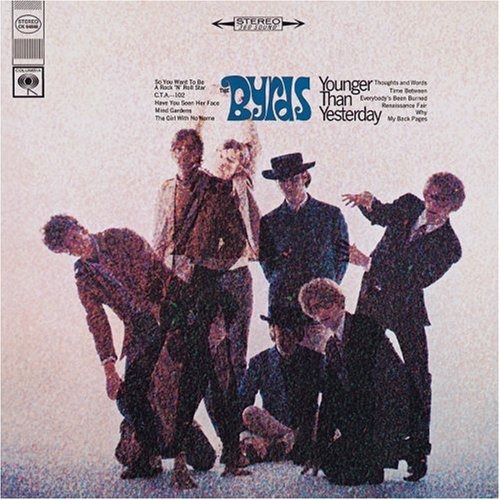
Fifth Dimension - The ByrdsYounger Than Yesterday - The Byrds

When does pop culture become history? When does memory become nostalgia? They used to play Fats Domino songs like I’m listening to as I write on the weekends in 1962, on WQAM and WFUN, and called them “Oldie Goldies” even though they were less than ten years old. Now they’re over sixty. People from my generation go to concerts today performed by acts they grew up with, even though those artists are even a generation older than us. I’m not keen on seeing dinosaur rock. I love remembering those performers when they were young, vibrant and in their times. On Facebook I have friends who post photos from parties where they act like they are still in high school. That’s cool. But should they listen to some new music too? It’s really hard to give up the pop culture that imprinted on us as teens.

I’m not sure there are reasons to require listeners to cross generational divides. When I watch “People Are Awesome” videos on YouTube I realize the current generation have plenty to keep them busy, more than I ever had. Now is always more important than the past—or the future. On the other hand, I’ve switched from Fats to “Jealous” by Ester Dean, playing it over and over. It’s definitely not from the 1950s! I’m too old to live in the times in which this song belongs, but Dean’s voice and melody touches my heart in a way that I wish I could.

Nortorious Byrd Brothers - The Byrds Sweetheart of the Rodeo - The Byrds

Do the young today long to visit my era in the same way I wish I could be young now? The Beatles were tremendously exciting, but were they more exciting than the groups now? Why are the sounds of The Byrds, Buffalo Springfield, and Jefferson Airplane still siren calls that hold me back in time? If I stopped listening to the songs that tie me to the past, could I modernize my brain by only playing new songs on Spotify?

I often think about my future when my body will be fading out of existence and my mind barely floats in reality. I’ve often thought listening to music on headphones while I die would be a great way to go. Will I be listening to seventy year old songs? More and more, the songs on my main Spotify list are newer ones. I play my tunes on random play. Will I leave reality hearing 1965, or 2037? Wouldn’t it be weird if I lived long enough to live The Sixties again?

JWH
How To Review Science Fiction?

by James Wallace Harris, Saturday, March 12, 2016

I’ve been reading science fiction for over fifty years—mainly for fun and entertainment—but also to speculate about reality in a way that science and philosophy do not. Now that I’ve written a book review for SF Signal, and working on another one, I’m wondering about how to approach book reviewing. I’m not interested in describing new books and then judging them by a rating scale. Any book I take the time to write about will be one I’m recommending. What fascinates me is why a book grabs me in the first place. After reading a couple thousand science fiction novels, I would think science fiction has nothing new to say to me, but it does.

No matter how many times an old idea is used in a new novel, some writers find new angles to examine. To be perfectly honest though, most writers don’t. Most new novels bought by publishers (as oppose to self-published novels) are pretty good at telling their story, and should find readers to admire them if they get the right promotion. What I look for is a book where the writer uses their story to express a philosophy about literature or science, or both.

How you tell a story conveys your philosophy about storytelling. If you bring attention to how the story is told, you’re making a statement, if you write solid prose that enchants the reader without drawing attention, you aren’t. The approach to science fiction takes two paths also. The first is to take a tried and true science fictional concept that readers love and work it into an appealing new story. The second, which is much harder, is to invent a new concept, or find a novel way to look at an old concept.

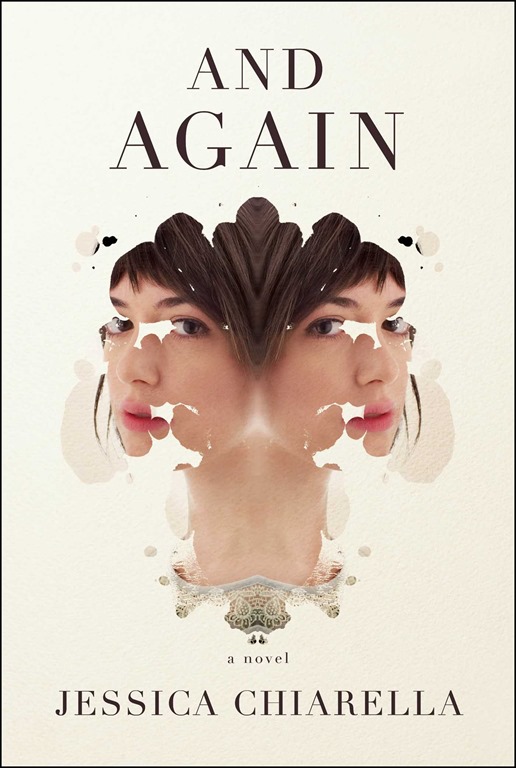
And Again by Jessica Chiarella

The novel I just finished, And Again by Jessica Chiarella, takes a standard literary device of telling four 1st person accounts in a round robin fashion. These people have new cloned bodies, which is her science fictional idea. Cloning is not a new concept. What Chiarella does new is make their stories very personal. There’s no plot. No heroes. The world doesn’t need saving. There’s no war between the normal folk and the clone folk. All Chiarella does is to ask: If you had a new body because you wore out your old one, how would it feel to start life over again. I found her four characters engaging, realistic and revealing. A novel worthy of recommending. But how do I review And Again to prove that it is interesting to would-be book buyers? Is my word good enough? I wouldn’t think so. What details could I offer as evidence? And would giving those details spoil the story?

I wrote a piece for SF Signal called “The Cutting Edge of Science Fiction” that was about how ideas are the cutting edge of science fiction. I believe there’s a period after science makes a discovery when science fiction writers can speculate about the possibilities of that discovery before further scientific research kills off or validates those ideas. I called that the cutting edge of science fiction. Unfortunately, the readers thought I meant the cutting edge of science fiction were specific books, and missed my idea. (By the way, the lesson I learned from this is don’t list books if they aren’t meant to be a best-of list. Because people ignore the narrative and see only the list, and think it’s a list of great books. My list had some stinker novels, but I was only listing them for their ideas though.)

Where I believe Chiarella was being an innovative science fiction writer (and I’m not sure her publisher is promoting her as such) is by her take on the clone story. Generally cloning is used in science fiction to explore the big ideas of serial immortality, brain downloading, new forms of humanity and rejuvenation. Clone stories often make for complicated SF murder mysteries or intricate mysteries of lost identities. Chiarella takes a rather mundane approach. It appears her characters had portions of their brain transplanted in a accelerated grown clone body. That side-stepped a bunch of philosophical issues. (Did the person die in the transfer, how can we download a mind, etc.)

This puts Chiarella in that zone I call the cutting edge—after the science of cloning, but before we know the limits of brain transplants. Until science proves that brains can’t be transplanted, it’s a viable science fictional concept. However, her setting is contemporary Chicago. Her characters’ stories are ordinary as New Yorker short stories. Other than how they got their new bodies, there’s no science fiction. So is the story science fiction? I think it is. How do I prove that in a review?

What I’d like to prove is my theory about science fiction. I think a story should be labeled science fiction if the storytelling is in the style of science fiction, or if it explores a science fictional idea. I don’t think And Again uses science fictional storytelling techniques, but I’m not sure how to prove that. It’s completely literary. However, her story is based on a science fictional concept.

I’m not sure if readers of SF Signal want to hear all of this in a book review. I often write long-winded pieces, that fairly often toss off comments that annoy people, like “Can Science Fiction Save Us?” Such extended wool-gathering bores the average site visitor hoping to discover a new book they want to read. Most review readers want something short, to the point, and convincing. Which makes me think I need to learn how to say what I have to say in many fewer words. But I’ve got to write more than, “Hey this book is great, read it.”

For my blog I can write anything I feel like. But now that I’m teaching myself how to review science fiction books I’ve been studying various websites and magazines, and have noticed that they each present a certain style in their reviews. Print magazines are confined by space. Web pages are scanned by hyper-readers in 20-second visits. I wish I had both the writing ability, and the scholarly knowledge to write book reviews like I read in The New York Review of Books. Their reviews are so educational that just reading a couple of columns overwhelms my brain with new knowledge.

I’m playing a game at SF Signal. For decades I’ve concentrated on classic science fiction. This year I’m trying to discover new novels that are published in 2016 that I think will be on reviewers “Best SF of 2016” lists in December. I think And Again has a chance, if SF reviewers consider it science fiction.

[This took 11 paragraphs. Could I have said it in 4?]

JWH

Training Pandora–Sarah Jaffe Station

By James Wallace Harris, March 8, 2016

I started a new station on Pandora today based on Sarah Jaffe. The first song they gave me was “Pretender Pt. 1” – an early song by Jaffe that I liked, but one I didn’t want the station to play. With Pandora you get to thumbs up and thumbs down songs. It’s important to train Pandora to play the exact sound you want for the station you imagined. I wanted my Sarah Jaffe station to play only music by women singers, but with edgy music, and creative arrangements. I tend to like tempo changes in these kinds of songs too. I didn’t want the standard singer-song writer fare.

Here are five songs by Sarah Jaffee that I want Pandora to seed the radio station. I was able to add “Glorified High,” “Sucker for Your Marketing,” and “Mannequin Women via the “add variety” button.


Training Pandora is weird. Sometimes you have to thumb down songs you actually like if you want to create a very specific sounding radio station. Sometimes Pandora never gets what I’m going for, and I have to delete the station. For Sarah Jaffe Radio I had to immediately thumbs down any male singer. And I had to thumbs down any plain song, especially those that focused mainly on the lyrics. I was after unique musical arrangements for female vocalists, songs that tended to be upbeat, but not necessarily rock, pop or punk. If you listen to the five videos above, you’ll get what I mean.

Here’s the first one Pandora found that matched close to what I wanted, “Too Insistent” by The Do.


“Caribou” by April March appealed to me because of the music and it’s in French.


Another one, which was a bit soft on the music, but I counted because it seemed different, “Little Jealousy” by Sonia Montez.


So far Pandora is getting closer to what I want, but not perfect. I’m amazed at how many songs it can find that I like by people I have never heard. When I find a song I really love, I add it to my Spotify “All My Favorites” playlist. I use Spotify most of the time to just play my favorite music. Spotify does have curated discovery features I like, but Pandora is more effective.

So far my best trained Pandora station is “Quicksilver Messenger Radio.” It takes me back to the late 60s and early 70s, finding songs I missed back then, but ones I would have loved if I had unlimited money for record buying back then. My worst failure is my “Pavane pour une infante défunte” Radio seeded by Ravel’s classical orchestra composition. I just can’t convince Pandora to find my similar moody classical pieces. Maybe there’s nothing like it. I like very few classical works, so it’s hard to please me. I was hoping Pandora would find those classical performances that moved me as much as the Ravel.

Pandora has a far smaller library of music than Spotify. My Sarah Jaffe station has yet to play any more songs by Sarah, so I wonder if it has the license to play them. It just came up with a Florence & The Machine song, “Blinding” – which is exactly the kind of song I wanted. Pandora is learning. I wish it had a more quantifying rating. I’d give “Blinding” five thumbs up.

JWH

If The 2016 Election Was A Novel It Would Win A Pulitzer

By James Wallace Harris, March 7, 2016

If back in 2012, you read a science fiction novel about the 2016 U.S. presidential election that perfectly described what’s going on this year, would you have believed it? The primaries are proof positive that truth is stranger than fiction. What writers could have imagined such a bizarre farce? Donna Tartt, Philip Roth, Jonathan Lethem, Joyce Carol Oates,  Toni Morrison, Tom Wolfe, E. L. James, Tom Robbins, Cormac McCarthy, Thomas Pynchon? Hell, I think Finnegan’s Wake would be easier to understand.

And just think, if in ten years someone does write a novel about this election, could it ever capture its weirdness?

We don’t even know how the plot unfolds, or what the ending will be. There’s plenty of time for even bigger amazements.

And what about history? Was the 1932 election this crazy? Remember Theodore H. White? He wrote a series of books called The Making of the President series (1960, 1964, 1968, 1972). I wonder if I read those books now, would this election seem less unique and strange to me?

Wikipedia has a nice summary of the 1964 election, the first I remember in any detail. The article is not too long, but hints at a rather complex race during similarly polarized time in our nation.

The one thing 2016 is teaching me is how different I am from my fellow citizens. There are millions of people wanting candidates to be president that I can’t even conceive of anyone wanting for their leaders.

I think 2016 is the first time I’ve actually experienced Future Shock.

JWH