The Secularization of the Undead

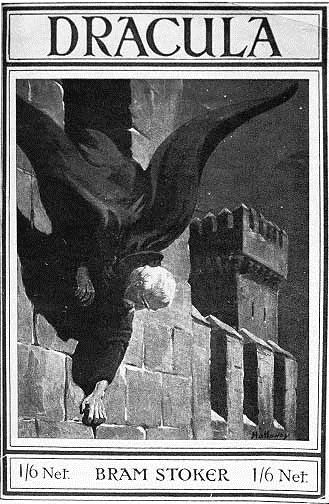
If you only know vampires, werewolves and zombies from modern fiction you won’t understand what I am about to say.  If you haven’t read Dracula by Bram Stoker this essay won’t mean much.  The origins of all the famous species of undead in fiction are shadowed in long forgotten myths.  They come from a time in human history were good and evil meant something very different than what it does today.  Primitive people saw reality created by two forces – the divine and evil.  The phrase the Devil made me do it wasn’t just some cop-out excuse for shirking responsibility.  People were either filled by the spirit of God or possessed by Satan.  To modern believers, God or Devil, at best influence people.  They bargain.  Even the most ardent feel they have free will to choose.  In the past that wasn’t always so.
dracula

As an atheist I don’t believe in the supernatural, but that doesn’t mean I don’t see it everywhere in people’s minds.  In Bram Stoker’s Dracula, vampires were pure evil, to be avoided at all costs – even to the point of committing suicide.  Whereas modern vampires are sex objects, and even the worse of them aren’t evil in the old sense.  As society moves away from religious beliefs, it is transforming its ancient symbols and myths.  This can be seen clearly by reading books about vampires in the 19th century, and then watching how the role of the vampire has changed through the 20th century and into the 21st.

A distinction we should make is between morality and ethics—the two main systems of determining right and wrong.  Legal systems are a strange hybrid of the two.  For most of history morality was defined by God and people were expect to follow his rules.  That’s the original definition of morality   As society became more secular people became philosophic, and right and wrong was hammered out with logic and rhetoric to eventually become ethics.  Ethics is the system by which humans decide what is right and wrong.  Many secular people still use the word morality, so it’s also being transformed.  There are even scientists who seek to find moral origins in biology and animal behavior.  But I’ll use morality in its original intent, as rules handed down by a divine being.

Vampires were immoral immortal creatures.  They were agents of Satan, and represented the flow of evil forces permeating the world.  Evil is seen as an absence of divine force, and its actions are in opposition to moral laws.  Modern vampires have become secularized so they are no longer evil or agents of evil, but they can be unethical.  We have also secularized the words good and evil.  Good used to mean the divine, and evil the lack of God, or the force of Satan.  Now good means many things, but it’s taken on a political correctness to mean what is socially acceptable.  Bad and evil, mean something different too.  Evil has taken on the connotation of something extremely bad, or extremely unethical.  Hitler was evil.  By the old definition of evil, that would have meant Hitler was an agent of Satan, working for the forces of evil.  By modern standards he was a psychopath that killed millions of people through his own intent and not the Devil’s.

There are philosophical problems here.  If God is all powerful, how can evil exist?  Does God allow Satan his domain in reality, or does Satan have his own power that God can not touch?  In Bram Stoker’s Dracula evil is darkness, without any goodness, that does have its own power.  Characters in the story protect themselves from evil by embracing God.  Thus the defensive power of the cross and holy water.

The undercurrent of Stoker’s Dracula is sex.  His Victorian novel was not allowed to be explicit, but it was obvious enough.  Evil conquers the virtuous through sex.  In modern stories, sex is still the major theme, but it’s been converted.  Sex is no longer evil, and neither is sex with a vampire.

Modern vampires can be good, and even seek to regain their souls, but this isn’t because divine forces won the war with the undead.  As women were emancipated in the 20th century and gained both political and sexual freedom, they no longer needed the protection of males, and they escaped the prison of being the icons of virtue.  Women writers refashioned vampires and the other undead minions for their own purposes.  Women writers have decided the undead are hot, and they have cleaned them up ethically, and made them into objects of sexual desire.  Stoker believed Victorian women should be protected from vampires.  Modern writers have made vampires into the ultimate bad boys of desire, very fuck-worthy, and perfectly suited to become Mr. Right.

Strangely, most modern male readers and writers would prefer that vampires stay ethically bad or even evil so it’s socially acceptable to kill as many as possible with no guilt.  We still like the Victorian attitude of the only good vampire is a staked vampire.  Action fiction demands a bad guy to be killed, so the soulless undead make great targets for first person shooters.  But even here, the undead have been secularized.  They are no longer agents of Satan, but just plain vanilla bad guys.  If the story was a morality tale it would require that the protagonists be moral, and the theme of the story would be morality, and that’s disappeared too.

Vampires were the first to become love objects, but slowly all the undead, even the gruesome looking zombie, are being transformed into protagonists of romantic interest.  It appears the whole pantheon of the undead have become symbolic figures in stories of teenage angst over sex and violence.  Any psychoanalysis of this fictional evolution would take book length studies requiring years of research.   For instance, one aspect to explore is immortality.  In the old days of God, immortality was conferred by the divine.  I doubt many believe in real vampires, but they do reflect a desire for another path to long life.  One where you keep your body and live a very long life on Earth.  Earthly life has become a secular heaven.

These stories have been further secularized by writers coming up with pseudo-scientific reasons to explain the undead and their powers.  But if we were a completely scientific society vampires, werewolves and zombies wouldn’t exist at all, even in fiction.  As an atheist I have little interest in the undead other than to see them as literary symbols.  It means as long as we have stories about the undead, then we have audiences and readers desiring aspects of the supernatural for some psychological reason or another.  We like to think it’s all childlike fun for goose-bumpy making tales but I worry that they are a kind of Freudian desire for things we can’t have.

JWH

My War On Ads!!!

Is it me, or am I seeing an explosion of ads on the internet?  First it was on page ads, then pop-up ads, then double pop-up ads, and now we’re seeing new kinds of animated ads attacking us from the  bottom up, or expanding out from the sides of our web pages.  We’re forced to see video ads that demand 30 seconds of our precious time – when will it be 60 seconds?  This sucks.  If I had to watch ten 30-second ads a day, that would be 300 a month, or 1.5 hours a month devoted to waiting to see content.  I’m getting old, and time counts, because it’s running out.

Everywhere I look there is bait to trap me into viewing ads.  Are we intelligent beings seeking information, or just gerbils being trained to click on ads.

ad-traps

Again, is it me, or is the web content changing, so as to trick us into seeing more ads by offering more prurient content?  Many sites are sexing up their article come-ons, either with sexy photos, or with outrageous titles, or tempting us with juicy tidbits of gossip, to get us to click to read, only to force us to wait through one or more ads before rewarding us with their lame-ass stories.  Often a promised video news story is shorter than the ads I have to watch to pay to see it, and often that news is seldom worth seeing.

I completely understand that nothing in life is free and I have to pay for my lunch, but some techniques used by contemporary publishers are just so damn annoying that it makes me want to avoid their wares completely and the products they advertise. 

This morning The Mail promised me story about adult elephants rescuing a drowning baby elephant, but when I clicked to see the video they asked me which ad I wanted to watch.  Neither were appealing, so I just closed the window.  If they had had an ad for something I’m interested in I might have watched, but most ads are for things I completely don’t care about.  The time it takes to watch them are a complete waste of my life.

That’s what I do more and more, close the window or tab, rather than see the ads.  I’ve even thought about going back to paper magazines to learn about the world, because web page ads are ruining the internet for me.

Demanding Our Attention

I understand that reading on the web requires seeing ads.  Ad supported sites are the norm.  However, the visual bombardment of ads on landing on a web page seems to be escalating to the point that I wished I could tell Chrome and Google to ban some sites for the rest of my life.  The other day I went to a site that resized the screen to blow up ads on the right and left, and along the bottom of my screen.  And pop-up windows with ads is becoming the norm.  And audio ads that automatically turn on are growing in popularity too, even though they are extremely annoying.

Advertisers are finding ways to capture our attention and not let it go until we’ve seen what they want us to see.  I hate that.  I wish there was some way to send you the finger online.

I’ve learned from growing up reading newspapers and magazines how to tune out passive ads.  And I’ve tried Chrome extensions like AdBlockPlus, but it doesn’t work perfect, and I’m not really sure it’s kosher.  I’m willing to pay for my supper, if it’s reasonable.  That’s the trouble with internet ads, they aren’t reasonable.  Neither, are television ads.  Or phone soliciting.  Because I don’t subscribe to cable, I get over-the-air TV, which is chock full of ads. 

A big portion of my retirement life is avoiding ads.  It’s becoming a war.

Ads want our attention, and that’s understandable.  If only I only had to watch or read ads for things I was interested in.  The advertising world is based on grabbing our attention, but I can’t believe all the expense they go to in gaining our attention is practical.  How many people actually buy something because of an ad?

What we need is a new ad paradigm. 

Information in Slide Shows

A common trick now is to have a sensational topic that involves 12, or 15 or 25 pages of slides.  Each segment of the list involves reloading the page, and thus regenerating ads.  Isn’t this just web page trickery to add counts to their ad counters?  Part of the problem is not the advertisers, but the publishers.  All too often content on the web is geared to making us click.  Just how much worthy news do we need each day.  Certainly not enough to fill millions of web sites.

We’re just rats in the maze being taught to click.  That’s not good for us, or for people selling stuff.  I want people who have something worthy to sell to succeed, but find success with people who need and want their products.  I hate that the internet has become a click factory generating economic activity.

Man, we really need a new ad paradigm.

How Could Things Be Different?

Aren’t web cookies, the NSA, credit card transactions and cash register scanners already supposed to know what I buy?  Why can’t I log into a web site daily and see ads meant just for me and earn some kind of ad income credits to be automatically spent as I go to web pages during the day?  They could see I’ve already prepaid and let me look at their content without annoying me.

I’m willing to pay not to see ads.  I subscribe to Rdio, Netflix, Amazon Prime, Spotify, Warner Instant Classics so I don’t have to see ads.  I also subscribe to Hulu Plus, and they force me to see ads, which seems incredibly unfair.  I’m seriously thinking of canceling them because of this.  If I pay for a subscription I should NOT have to see ads.  I also subscribe to The New York Times, and their site does have ads, but so far they aren’t too annoying.  Yet, every time they interrupt my reading with a pop-up, I think about cancelling my subscription.

There’s got to be a better way.  However, I don’t think Advertising Age disciples are thinking in that direction.  Generation Like, as one PBS documentary called our young people of today, not only accept ads, but embrace them, becoming marching morons for advertisers and these kids don’t even understand the phrase “selling out.”  Our modern world has become so Orwellian in ways that George Orwell failed to foresee.  He thought only communism would use Newspeak to conquer the masses, not understanding that capitalism would use it too.

In my war against ads and telemarketers, I feel like I’m Winston from Nineteen Eighty-Four always seeking ways to avoid the view screens of Big Brother.  John Varley wrote the classic paranoid science fiction story about machine intelligence called “Press Enter _” back in 1984.  In it, his character moves off the grid and won’t use anything electrical to escape from an evil intelligence living on the net.  Is that the only way to escape the advertising world?

Take Up the Cause!

Watch what you click.  Don’t encourage the enemy.  Close those windows.  Don’t go to sites that take advertising too far.  And please some of your brilliant tech gurus, invent some way for people to market their wares to people who want them without making billions of us not have to see trillions of ads we don’t want to see.

JWH – 5/14/14

Forgotten Science Fiction: All Flesh Is Grass by Clifford D. Simak

I’m not sure how many young science fiction readers know about Clifford Simak.  When I was growing up, he wasn’t a top tier SF writer, but a legendary author of City and Way Station.  He was loved well enough for the Science Fiction Writers of America to select Simak as their third SFWA Grand Master.  If you look at his list of novels, there’s not many famous ones besides City and Way Station.  He won a Hugo for Way Station, and Hugos for the novelette “The Big Front Yard” and his short story, “Grotto of the Dancing Deer,” which also won a Nebula.  I remember seeing Simak at a science fiction convention when he was pretty old, and was surprised by how little attention he got from the younger fans.  I thought he was great.

all-flesh-is-grass

Clifford Simak wrote a different kind of science fiction.  A kinder, gentler science fiction.  His characters were adults, ordinary people from the mid-west, and his stories often had the feel of small any town America.  City, a fix-up novels of  eight short stories written from 1944-1951, was a hauntingly beautiful series of tales told by intelligent dogs and robots about the legends of long gone humans.  You just don’t get more sense of wonder than that.

I read several of his “other” novels from the SFBC in the 1960s, but I’ve forgotten those.  Then in recent years I’ve read The Visitors (1980) and Cosmic Engineers (1939) for the Classic Science Fiction online book club.  I really liked The Visitors for its unique take on an alien invasion.  So for this month, we’re reading All Flesh is Grass from 1965.  It’s one of Simak’s many novels that don’t even have an entry in Wikipedia.

all-flesh-is-grass-1978

That’s too bad, because All Flesh is Grass is pretty good, and it has an interesting distinction – it’s about a small town that wakes up to find itself enclosed in a dome—yeah, like the Stephen King novel and TV series, Under The Dome, from 2009.   King had started his novel in 1972 and tried again in 1982.  I have no idea if King knew about the Simak book, but they have similar themes too—being cut off from the world makes people act different, and of course, there’s the mystery of who put the dome over the town and why?

I’ve always been fascinated by authors who think up similar ideas separately and then to see how they execute them.  Often the idea itself dictates much of the story.  If you were going to write a story about a group of humans enclosed in a dome,  wouldn’t you pick a small town?  Wouldn’t you use ordinary people, but involve the local politician, police and doctor?  Wouldn’t everyone be wondering why, and be upset because of the disruption in their lives?  Wouldn’t there be scenes of outsiders and insiders talking to each other at the wall?  I did search the internet to find an essay on dome stories, but didn’t find one.  I did find several forums where people mentioned other dome stories.  It’s a growing micro-sub-genre.

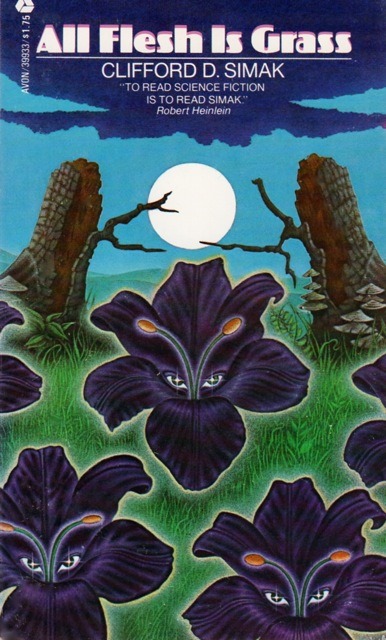
All Flesh Is Grass is a difficult book to describe.  Note the covers.  The top one is from the first edition hardback.  The second is the 1978 paperback edition I read.  But look at the cover from this British edition.  They obviously want to promote the book as science fiction, but it’s not your typical SyFy adventure story, so the publishers tacked on a cover that visually translate science fiction to the contemporary mind.

all-flesh-is-grass-spaceship

There are no space ships in All Flesh is Grass.  It’s about a failed real estate agent, Brad Carter, who lives in a small town, Millville,  that gets caught up in a mystery one day when he’s driving out of town and his car hits an invisible barrier.  Like The Visitors, All Flesh Is Grass is about a different kind of alien invasion, and if you look at the first two covers you will get hints as to what the invaders are like.  But they don’t invade Earth in spaceships.  Simak’s story feels more like one Ray Bradbury would have written in the 1950s, with a touch of Philip K. Dick.  It’s a kind of science fiction that has disappeared—as far as I know.

When I was growing up and reading science fiction in the 1960s as a teen, certain books had a quaintness to them.   Authors like E. E. Smith, Edmond Hamilton, and Ray Cummings wrote stories that seemed very old.  They wrote pulp stories from the 1930s.  Their style of writing, common phrases, wording, slang, etc. was just old enough to feel out-of-date old fashioned.  1965 Simak reads that way now.   Not like 1930s, because the story has a definite 1950s feel.  And the ending is painfully hokey.  Yet, All Flesh Is Grass was a pleasure to read, at least for me.  I’m just curious if anyone born after 1980 would find it fun.

Science fiction seems to change every decade like society.  Pop culture is always evolving and mutating.  Reading Simak’s science fiction feels so quaint, like looking at an Amish town, or characters out of a 1940s black and white movie.  But All Flesh is Grass is still about the awe of making first contact, still about encountering something that’s very alien.  Still imagining unimagined possibilities.  Simak’s mind goes way beyond little green men in flying saucers.

Ultimately, All Flesh is Grass is slight.  A 254 page paperback that was quickly written and quickly read.  That’s the problem with most science fiction, even today—it’s churned out.  King’s Under the Dome is 1088 pages.  Modern science fiction readers want long stories, either big books, or at least trilogies.  Today we remember authors by the series they write.  The novels I’ve been writing about as Forgotten Science Fiction were stand alone stories, that were short, quickly written for a few bucks.  They were consumed and forgotten.

Yet, I remember these old SF books from the 1950s, 1960s and 1970s, and so do a few others, like my blogging friend Joachim Boaz at Science Fiction and Other Suspect Ruminations.  They are a unique art form.  The ones I like, and I think my friends at the book club like too, are the ones that use science fiction as a way to think about certain kinds of ideas.  The stories are more like The Twilight Zone and The Outer Limits than Star Wars or modern science fiction.  I have to admit they aren’t great literature, and maybe their appeal is only nostalgic, yet, they wonder about reality in the same way I did growing up.

JWH – 5/14/14

Finding Vivian Maier–The Emily Dickinson of 20th Century Photography

This afternoon I saw a fantastic documentary, Finding Vivian Maier, about a person I’ve never heard of who deserves widespread fame.  Her name was Vivian Maier, and she was a nanny most of her life, and it wasn’t until she died that John Maloof, a young writer discovered she was also a photographer when he bought a box of her negatives at auction.  Vivian Maier, who was quite secretive about her private life, was not reclusive like Emily Dickinson, but she hide her art away, and the documentary even questions whether or not if Maier would have liked her pictures shown.  Maloof estimates he’s eventually accumulated 150,000 thousands of her negatives.  The documentary ends up being about many things, including Maloof’s tenacity of tracking down Vivian’s legacy and making it known.  He has her photographs on display in galleries around the world, and has published two art books of Maier’s work, with another coming out soon.

Maier died in 2009, and Finding Vivian Maier isn’t even the first documentary about her.  There’s another documentary, Vivian Maier: Who Took Nanny’s Pictures, directed by Jill Nicholls for the BBC that was rereleased in the U.S. as The Vivian Maier Mystery.  Maier was also the subject of other short films, and many news reports and essays.  Her story is so great that it’s impossible not to retell.

I don’t think I can tell her story better than these films I’ve found at YouTube.  If you get the chance, see Finding Vivian Maier at the theater, because her photographs are beautiful blown up on the big screen.  Maier mostly took street photos in New York City and Chicago, but did take an eight-month round the world trip by herself.  The bulk of her photographs were taken in the 1950s, 1960s and 1970s, and she captured a unique view of history.  Her photographs are gorgeously composed of daily life on the run.  Probably many of her subjects never knew they were being photographed.

I highly recommend watching these YouTube clips full screen.  Be sure and set the resolution to 1080p or 720p.  Maier also took many 8mm films.  These are interesting, but not beautiful like her black and white photos taken with a mid-format Rolleiflex camera.  Her Rollei photographs blow up on the big theater screens magnificently.  Maier also took color 35mm pictures too, but I like the black and white pictures best.  The film also shows huge crowds flocking to her exhibits.  I’ve love to go see them.  I’m surprised I’m so late discovering her, but then I think most people haven’t yet either.

Just look at the many images here.  The number of pictures taken is tremendous, and the variety of subjects is astounding.

Watching Finding Vivian Maier evokes all kinds of philosophical questions about art and life.  Why did she take so many photographs and not print or try to get them exhibited?  Like one documentary commentator said, for many of her images, the only time she saw them was when she pressed the shutter release, and even then she was probably looking at the scene and not the composing screen.

Maier is like the existential God who created the universe and then walks away from his creation.  Despite all the mystery surrounding Maier, it finally comes down to the art standing on its own.  Her images are captivating, haunting, riveting, compelling, and all the words you can imagine that say they make you want to look and look and look.

Vivian-Maier

JWH – 5/13/14

The Impact of Atheism on Well-Manicured Lawns

When I think of good Christians I think of close-knit families with spotless houses and beautiful lawns.  The most successful people I know, those whose lives are full of love and happiness, are my Christian friends, because I equate big loving families with social success.  These same people have great houses and yards.  Most of my non-believing friends tend to be childless, and like myself, self-centered, and our homes and yards show a difference.  Its odd, but I think our philosophical differences are reflected how our lawns compare.  My neighbors with the best lawns seem to be family oriented and Christian, whereas my own lawn is weedy and chaotic.  And the lawns of my Christian friends who don’t have children seem to fall in between.

The history of western civilization and Christianity has been one long war with nature.  Christians believe they have dominion over the Earth and wish to subdue nature.  That’s reflected in their lawns and gardens.  A well ordered yard reflects a well ordered mind, or so we thought.

lawn2 

The faithful think atheists are amoral, but most ardent nonbelievers I know tend to be liberal with strong beliefs about improving society, helping the needy and living ethical lives, but sometimes our personal habits reflect disorder.  Atheists I would contend, lean towards embracing nature, rather than ruling over it.  If I had my druthers I’d let my yard run wild and encourage more wildlife to settle in it.  We use to have a fox that lived in my neighborhood that would run through my backyard, but sadly it was killed by a car.  I’m not totally crazy—I don’t want nature coming in my house, but as long as fellow creatures don’t attack me, I don’t mind sharing my yard with as many plants, animals and insects as the natural ecology allows.

I want a Darwinian lawn.  I also want a lawn that helps the Earth and our species.  I want to lawn to helps other species from going extinct.  I want to coexist with nature and not dominate it.

I’ve often wondered about landscaping my yard so it would be perfectly adaptable to our changing climate.  I’d like the plants and other living things to adapt to the emerging weather patterns so I wouldn’t have to fertilize and water anything.  I’m not sure my neighbors and zoning czars would think about that though.  However, as soon as the perils of climate change are accepted by good Christians and they realize they must be stewards of the Earth and not conquerors, they might change their minds too.

For all their talk of heaven, Christians embrace life on Earth.  Deep down they aren’t the kind of people who commit suicide or pull the plug when the going gets tough.  They fight for life to the bitter end—and when it becomes all too obvious that they are committing species-cide they might change their minds.   We atheists accept personal extinction, but we hate the thought of humans dying off.  One day, both sides of the spiritual divide might agree on a new approach to lawn care.

For every gallon of gas you burn the warmer you make it for your descendants.  For every pesticide you add to the environment the more you poison your children, their children, and their children’s children, and so on until the Earth is cleaned up.  Denying manmade climate change is denying your own sins against the Earth, and the crimes you are committing  today will burden far more than three generations.  Easy Christianity has convinced millions to shirk their debts, because isn’t sin incurring debts to others? 

Okay, I’m an atheist, so I can’t expect you to speak my language, so let me try to speak yours.  One Christian book that impressed me was The Cost of Discipleship by Dietrich Bonhoeffer.   Modern Christianity has made the pardon of sins way too easy.  There has to be more to grace than just claiming belief.  What humanity has done to planet Earth is one giant cross that we must all bear.   You can’t escape your sins by denying they exist anymore than running away from them by believing.  We live by our actions, and any grace you seek must be earned by how you live and not how you think.

JWH – 5/12/14