iStories: The Short Story Hit List 100 Weekly

Let’s face it, the heyday of the short story as a popular art form was decades ago, probably as far back as when F. Scott Fitzgerald got rich and famous selling stories to the Saturday Evening Post and Colliers.  Except for would-be writers, required reading for students, fan fiction fanatics and a damn few diehard short story lovers, the marketing of short stories is almost invisible to the average citizen of our pop culture country.  Is the short story art form unpopular because readers don’t like them or because short stories are so poorly marketed?

The short story art form hangs on by a thread, like the art forms of poetry and playwriting.  I expect the remaining for-profit scifi, fantasy, mystery and literary magazines to die off in the next 5-10 years unless something drastically changes.  The question is, can a drastic change be made?

Is there anything that can be done to revive the short story art form to popularity?  The first question to ask is:  What do the popular art forms have that the unpopular ones don’t?  Movies, television shows, songs, video games and novels are the most popular art forms in our world today, ranked roughly in that order.  A single movie, TV show, song, game or book can be admired and loved by millions of fans, and wide consumption in these artistic endeavors are routine.  When was the last time a short story was popular enough to have a 1,000 readers in one week?  How many people actually read the short story in each issue of The New Yorker?

Besides legions of fans, the most important factor that popular art forms have and short stories don’t are Hit Lists.  Movies, TV shows, songs, games and books are extremely well reviewed, charted, rated and ranked by sales and popularity.  Each art has legions of critics working hard to stay current and teach how each example of their craft fits into an overall history. 

Every week we are well informed about the most successful premieres of each art.  Hell, weekend movie sales figures often get touted on the national morning news shows, and sometimes on the nightly news.  Book readers all know about The New York Times Bestseller lists.  We have the Nielsen ratings for TV shows and the Billboard 100 for pop songs.  There are countless websites and magazines that track the success of computer games.  And songs are marketed by hits on the radio and on online stores like iTunes.

As a culture we love keeping up with what’s popular, but is what’s popular just the stuff we track with Hit Lists?  I think so.  If short stories were ranked weekly would they gain popularity?  I think they might, but many factors would have to come into play.

Most important, the Short Story Hit List 100 would have to be weekly and track all genres of short stories.  Separating them out into story types is deadly.  We don’t rank blockbuster movies or best selling books by topic.  The Oscars and Emmys aren’t divided up by genre.  It would be a total water cooler buzz kill to divide short stories out into special interest groupings.  A hit story must be one that people want to read and talk about because of its popularity, not because it puts the reader into a sub-culture.

Next, its vitally important that short stories be sold as singles, and not part of albums (magazines or anthologies).  Few people like to buy a magazine full of unknown short stories.  It’s like getting a free music CD with a music magazine – most of the songs are mediocre and the CD is a disappointment.  People want hits, and that has to apply to short stories too.

For short stories to make a comeback they need a marketing site like iTunes.  They need to be sold for 99 cents in a standard digital format like MP3 songs.  Unfortunately, ebook readers, smart phones and computers use a variety of ebook formats that hurt the concept of making short stories popular, so the iStories site needs to offer all the possible formats but hide the dirty details from the buyers.  Fictionwise.com illustrates well how this is possible.

Ultimately, this universal format needs to be DRM free so short stories can be easily stolen and shared – or if they have to have a DRM, then it needs a mechanism for limited sharing between friends.  Unfortunately, the unethical viral marketing of copyrighted material is too good of a selling tool to ignore.  And I think in the future, this universal digital short story format should be roomy enough to contain graphics, music, video and audio readings.  In other words readers can read the story, listen to the story read on audio, read with eyes and listen with ears at the same time, read the story with background music turned on or off, and see illustrations or photos to enhance the story.  But this super ebook format isn’t an issue right now.

Short stories need to get away from printed formats as their premiere venues (but nice chapbook editions will make excellent marketing additions to the overall sales, and we can think anthology and story collection sales as long term publishing).  The primary publishing format should be for ebook readers and smart phones.  Like I said, short stories should be sold as singles with the goal of creating hits.  Collections and anthologies should be left to the book world to market because they would hurt creating hit short stories.

The key to revitalizing the short story art form is creating hugely popular stories that will become the topic of conversation between people all over the nation.  People share both the experience and love of movies, TV shows, books, song and video games.  When was the last time you were in a conversation about a short story?  When was the last time a group of people at your office discussed a short story they had all read?  This happens all the time with movies and TV shows, and to a lesser extent books, songs and video games.

One of the major factors against marketing short stories is there are too many of them on the net for free.  Free is incredibly bad for revitalizing the short story art form.  Bad editors, no editors and no editing has created a glut of short stories on the Internet.  No one likes to listen to amateur musicians or mediocre bands.  Every time you play a song you want it to be a great song.  When you go to the movies you expect to be blown away.  When you read a book you want to find one that has deep emotional impact. 

To revitalize the short story art form will require a seal of approval either attained by popularity or critics.  Our imaginary iStories site cannot be a slush pile for the common reader to wade through.  Nor should its editors have to select from a tremendous slush pile to find stories to promote on the site.  Stories should be submitted by agents or professional editors that can be trusted.  There needs to be some kind of farm team looking for talent to feed into the system.  I would think existing print and online magazines could play the role as the iStories systems develops, but eventually I expect magazines to die off.  Thus professional editors would become talent scouts and agents for stories.

A theoretical iStories site should also limit the number of new stories released each week, and find ways to publicize the best.  New ways to promote stories should be invented.  They need corporate backers like film studies or record companies but I doubt existing book publishers would take on this role.  It might be left to magazines – so The New Yorker and Asimov’s Science Fiction would campaign to get their stories noticed, and bring attention back to their business.

We have to get away from depending on fiction magazine sales and magazine subscriptions because those marketing methods are no longer successful at making short stories popular.  Buying a magazine is like buying an unknown album with the hope of finding a hit song, especially when you aren’t familiar with any of the artists.  Buying a magazine subscription is like buying a bunch of unknown albums hoping to find several hit songs.  200 channels with nothing to read, huh?  People want smash hits.

I doubt my ideas about revitalizing the short story art form will ever happen, but at least I’m making a point about creating a popular art form.  Look at the short video and how YouTube is promoting them.  Until there is a way to sell hit videos they will never become a major art form, but they could.  Most people go to YouTube and similar sites and look at the most watched videos hoping to discover something really fun.  Yesterday I discovered the Muppets version of “Bohemian Rhapsody” because almost six million people have watched it.  That clue paid off because the video was excellent entertainment.

Back in the 1910s, 1920s and 1930s short stories were popular enough that they were the topic of social discussions.  If you watch the credits of old movies you’ll often see movies based on short stories.  Newsstands were filled with hundreds of short story magazines.  Short story reading was a popular evening pastime until radio slowed it down and television practically killed it off.  In fact, television is what replaced the short story for people looking for after work diversion.

Short stories are not mini-novels.  The best are jewels of intense fictional expression that are a unique art form.  Sadly, they are a dying art form.  Because of iPods, iPhones, Kindles, Nooks, and other electronic gadgets that people carry around, short stories have another chance to become popular again.  Short stories can be read quietly anywhere on an iPhone, or even listened to in an audio edition.  They must compete with songs, audio books, novels, movies, videos, computer games and television shows in this small venue, but there is room to compete well if short stories were marketed correctly.

And by correct marketing I mean as singles.  Unless people are saying to their friends, “Have you read the new short story by so and so,” to their friends, short stories will be doomed to an ever shrinking fan base.

How to Start

If all the ebook sites, like Amazon’s Kindle home page, Barnes and Noble Nook, the Sony Reader, and the general ebook fiction sites like Fictionwise.com, eBooks.com, eReader.com would create a section for short stories and a mechanism to track their sales, that would be a big start.  It would help even more if they would offer spin-off sites that specialized in short stories.

Another angle of attack would be if online magazines maintained a hit list of their most popular stories ranked by web visitor hits.  They might need to program mechanisms to keep authors or fans from constantly reloading the page to produce fake hits.  And they need to track hits from all their backlog of stories and not just the current issue.  It would be important to provide numbers so popularity could be gauged against stories at other online magazine sites.  And like songs, and even movies, sometimes it takes weeks or months to have a breakout hit.

We’d also need critics that specialize in reviewing short stories, and ones that would be also willing to track many short story web sites and tally the numbers each week to give attention to the stories getting the most attention each week across the web.

If short story reading ever did catch on again, it would be fantastic if magazines like Entertainment Weekly devoted a section to them like the do movies, DVDs, books, music and television.

It would be a tremendous help if best of the year anthologists like those who compile the Best American Short Stories and the various yearly genre anthologies if they would maintain a blog about their ongoing efforts to select stories, even to the point of showing how they tally competing stories as they are discovering them.  We need as much PR as possible on stories climbing the charts, so to speak.

Unfortunately, most fiction magazines are monthly, bi-monthly or quarterly, and hit stories need to be tracked weekly, or even in real time.  Web sites that change their content less than weekly get ignored and forgotten.

It would help greatly if a social bookmarking site like StumbleUpon created a short fiction section for tracking popular short fiction reading.  On the other hand such sites help promote free reading, and that competes with our goal.

The biggest success for revitalizing short stories is if a company would create a web site like Audible.com, or an online store like iTunes just for the sale of short stories.  They should sell both ebook editions and audio narrated editions of short stories.  I’d suggest a standard price too, 99 cents for either ebook editions for reading with the eyes, or audio editions for reading with the ears.  Short story are longer than songs, so some marketing folk might want to price them higher, but they are usually experienced only once, so they should be far cheaper than renting a movie.

Readers can help too.  If you read a great story share it with your friends.  Talk about it.  Tell them where to buy it.  I know this might be painful, but get in the habit of buying short stories, and avoid free stories.  If you read and enjoy free stories at online magazines at least donate money, but it would be better if you supported a paid-subscription site.  Flooding the market with free stories ruins the market and hurts the art form.  Don’t promote free stories, it dilutes the market for selling stories.  Don’t read stories that haven’t been accepted by an editorial process and edited unless you’re part of a writing workshop group or critiquing stories for a friend.  Even fan fiction could be improved by these rules.

Authors like providing free copies of their short stories on the web to help promote their work in general.  This might be good for their career but it has produced so many professionally written short stories for free on the net that short story fans no longer want to buy stories.  Many fans now expect to find a copy of any short story they want for free and there are web sites to track free fiction to help them. 

Free stories are bad for the short story art form in the long run and maybe an additional reason why print magazines subscriptions are declining even faster in recent years.  Maybe free stories should only be those that are older than one year, or five years, and don’t compete with new sales.

If you love short stories and want to promote the art form then do whatever you can to help short story writers and publishers make money.  I tend to doubt the short story market will be revived, but now is the time to try because of the switch to Internet publishing and ebook reading.

JWH – 11/28/9

Inventions Wanted: Universal Photo Database

I often wish I had photographs of certain people or places from my past.  I constantly damn myself for not chronicling my life better.  I’ve even wondered if anyone else might have photographed those people and places.  This gave me an idea for a great invention, the Universal Photo Database (UPDB).

I have lots of old photos of my mother and father, and some of my grandparents, with a few of my aunts and uncles and my cousins.  If there was a UPDB, I could submit my pictures to it, along with the names of the people in the photos.  Then if anyone in the world put in a search, for example “George Delany Harris,” my father, they’d find the photos I uploaded.  It’s not likely people would be searching for him, but he was in the Air Force for twenty-four years and maybe old service buddies wondering what happened to their old pal would.  On the other hand, other people might have photos of my dad that I’d like to see.

Jimmy-Patty-Becky-Jody-Christmas-1958

[Jim Harris (me), Patty Piquet (spelling?), Becky Harris (my sister) and Jody in front of house in Lake Forest subdivision, Hollywood, Florida, Christmas, 1958.]

When I was growing up, we’d often go outside to take the photos to have good light.  Us kids would stand on the sidewalk in front of the house, often grouped in gangs of friends.  Photos for the UPDB could also be tagged by location, such as Maine Avenue, Homestead Air Force Base.  My sister and I had a bunch of friends on that street but no photos, so maybe Arthur or Alice, or Gary and Gerry, if such a UPDB existed could post their family photos, and if I searched on “Maine Avenue” and “Homestead Air Force Base” and (1961 or 1962) I’d find them.

Or I could search for “Lake Forest” “Hollywood, Florida” 1958-1963 and I could find photos of the old subdivision where I grew up.  Facebook has accidently created a beginning of a UPDB for the Lake Forest (Hollywood, FL) Historical Appreciation Society.  The group has 90 photographs, some of which seem to come from the era when I lived there, so obviously, this idea of mine might have widespread appeal because there are other people feeling nostalgic for that neighborhood too.  Multiply that desire by millions and billions of people and you’ll see the potential.

Patty---Mike---Becky-April-1959

[Patty Piquet (spelling?), Michael Kevin Ralph and Becky Harris (my sister) in front our house in Lake Forest subdivision in Hollywood Florida, April, 1959.  Patty and Mike, are y’all out there?] 

The tremendous popularity of Facebook is due to nostalgia I think, but so far its technology is based on simple groupings allowing people to reconnect with old acquaintances.  A UPDB with key fields based on names, locations and dates would redefine our interest in the past, and it could be used for other purposes other than wistful remembering.  Think what it would mean to biographers, writers and reporters?

My favorite science fiction writer is Robert A. Heinlein.  What if every fan photo, interview photo, magazine photo, fanzine photo, convention photo ever taken of Heinlein was uploaded into the UPDB along with information, memoirs, interviews, etc. linked to the photos, wouldn’t that create a wonderful library of information for researchers and fans to study?

Also, how often do you find old family photos where you don’t know all the folks in the shot?  Uploaded those photos to the UPDB and someone might identify the mystery faces.  Or how often do you clean out old closets and drawers and throw away ancient photos?  That’s history buried in the landfill – ain’t that a crying shame?  Every photo is a snapshot of reality from a unique time and space location, and who knows what value it might contain.

Most libraries have a special collections department that collects local photos, but they are impossible to use without visiting each collection in person.  Imagine if all the special collection photos where uploaded to the UPDB?  Or old archive photos from newspapers and magazines?  Or all the school photo annuals?

Imagine if Google Maps was cross-referenced to the UPDB where you could zoom in and see photos based on location and time period?  What a fantastic mash-up that would make.  Now that we live with pocket telephones that have built-in cameras, wouldn’t it be easy to create photo diaries of our lives?  Especially ones with GPS tech built in that could date/time/location stamp each photo?

When I was growing up, buying a roll of film for the Kodak Brownie was a rare event.  For most years of my life I doubt there were no more than 2-3 photos taken of myself, and some years none.  There is a small chance I’m in other people’s photos.  During the decades of my parents life, they probably went years without being photographed.  And their parents and grandparents were probably only photographed a handful of times during their whole lifetime.  If we don’t make an effort now, those photographs will soon disappear.

On the other hand, the current digital generation will have hundreds, if not thousands of photographs of themselves, so they will overwhelm the UPDB and techniques will be needed to weed out the photos worth saving.  One of my favorite blogs, Times Goes By written by Ronni Bennett has a top masthead of 10 photos of Ronni taken across her life that makes a wonderful timeline image.  I wish that everyone I meet on the web had a linked page with a similar timeline photo of themselves.  At minimum, each person should have a photo for each year of their life.  Go look at Ronni’s photos – doesn’t that time dimensional aspect add so much to your immediate impression of her?

Everyone is amazed by what the Internet does now – I’m waiting to be blown away by what it will do in five years, or ten years.  Imagine and contemplate what Facebook could be in 2015?  or 2025?  Picture me singing and smiling like Al Jolson, “You ain’t seen nothing yet!”

JWH – 11/25/9 (My birthday – age 58)  

The Weight of Paper

Nanny, my grandmother on my mother’s side, was born in 1881 and grew up before the automobile, airplane, radio and silent film.  She watched all the technology emerged that in my boyhood I took for granted, like electricity, the telephone, refrigerators, cloth washers and dryers, air conditioners, etc.  She died a couple years after Neil and Buzz landed on the Moon. 

My mother was born in 1916 and grew up with the radio, at a time when movies morphed from silent pictures into talkies, watched the television age emerge, drove across the country before the interstate highway system was built, and lived long enough to see computers become personal, phones stored in pockets and the world wired for computer networks, although she refused to own a cell phone or computer. 

I was born in 1951, and I’m not sure if I’ve seen as much dramatic cultural change as those two women, but I grew up in front of a TV, watching the advent of the space age, the computer age and the digital age, and if I live long enough I might see far more dramatic transformations.  They both lived to 91, and if I could live as long, I will see the world change as much as they did from 1881 and 1916 until 1951.

Computers are changing the way we all live, but have they changed us as much as the automobile, airplane, radio, movie and television?  Current digital technology often makes me dislike the way I used to do things, even though I feel strong nostalgia for how things were. Take reading for instance, all aspects of my reading habits have changed in my lifetime.  I now listen to books on an iPod, or read them printed on small digital screens like in Star Trek.  For a more specific example, my wife is nagging me about my magazine collection, housed in two six foot high bookcases. 

I love magazines, and spent six years working in a Periodicals department at a university library.  My home library contains hundreds of issues from dozens of titles.  Even Susan asks, “Can’t you get them on online?”  I stopped reading newspapers years ago, and I might stop reading magazines soon.  I prefer audio books now, even though I spent my whole life as a bookworm, and 99% of the words I read with my eyes each day come through my computer screen.  I even listen to magazines, like The New Yorker, and prefer it to reading.

The weight of a single sheet of paper is almost unnoticeable, but the weight of twelve shelves of magazines is quite heavy.  Since we had new flooring put in this month, I had to move four bookcases of books, and two bookcases of magazines and the weight of that paper was almost backbreaking.  How many trees went into making all that paper?  What was the impact on the environment?

Awhile back, to do my bit to fight global warming, I started going paperless, and cut my magazines subscriptions from over 20 to just 2 (Sky and Telescope and Rolling Stone – what an odd couple, huh?).  But I kept all my old issues hoping to get the maximum reading value someday, and maybe even clip the best articles to scan into my computer.  I’m at point in time when I’m shifting away from one kind of living, with paper, and moving into another way of life, without paper. 

I still buy an occasional mag at the bookstore, but even that makes me feel guilty, because that means my pile of unfinished magazines keeps growing, and more trees were cut down.  I tend to flip through a magazine and read the shorter pieces and tell myself that I’ve just got to find time for those great longer pieces someday, but I seldom do.  The weight of paper can also be measured in time, and I have a huge amount of time theoretically reserved for that reading.  Throwing all those magazines out will reduce the weight of possessions and free up a lot of imagined obligated hours, probably in the thousands.

I have nice long runs of Sky and Telescope, Astronomy Magazine, New Scientist, Scientific American, National Geographic, Smithsonian, Popular Photography and many others.  I like to think of them as my reference library, but honestly, I rarely refer to them.  Reading online has become my habitual way of info-gathering.  And since I often read online articles about the dwindling subscriber base to newspapers and periodicals, I’m guessing there are many people like me.  If only they made a Kindle-like reading device with a large full-colored screen, I’d probably do 100% my eye reading from online sources.

But I must also emphasize the shift from eye reading to ear reading has been very important to me.  That’s another paradigm shift, and I think it scares people in the literacy profession.

Throwing away my magazine collection would be like throwing away the past.  According to Wikipedia, general interest magazines started in 1731 with The Gentleman’s Magazine, so will we see the era of the printed magazine end before it’s 300th anniversary?  When I was born the pulp magazine format was dying and the science fiction and fantasy digest magazine was beginning.  Today those digests are disappearing and a new crop of online SF/F magazines are emerging.  Read Jason Sanford’s recent survey of these new short story venues for emerging writers of fantastic fiction.  Will getting published be as exciting?  It will certainly be easier to send copies to your friends.

Today I read “Ten things mobiles have made, or will make, obsolete.”  Among the ten items was paper, (also included were pay phones, landline home phones, MP3 players, netbooks, small digital cameras, handheld game consoles, wristwatches and alarm clocks).  It’s quite easy to read on an iPhone, whether it’s a book, short story, magazine article or news item.

There is also talk that the United States Postal Service is failing.  I can understand why, because only 1 piece of mail in 15 is something I actual need, and even that piece could be eliminated by electronic billing.  Nearly everything I get in my mailbox goes right into the recycling bin.  This is especially a shame for all those fancy full-color catalogs, resources terribly wasted because I don’t even flip through their pages.

The era of paper might be nearing its end.  The more effort I put into recycling the more I realize that most paper trees die in vain, and their lives would be better spent absorbing carbon dioxide.  I will agonize over all the people in paper related industries who will lose their jobs, but the history of the world is change, and nothing stays the same.

If I lived until 2042, to become 91 like my mother and grandmother, I might see the end of newspapers, magazines and books.  I’ll probably see the passing of paper photographs, 8-16-35-70mm film formats, LPs, CDs, DVDs, BDs and any other form of audio-visual physical storage.  Stranger still, I might see the end of libraries and bookstores.  Everything will be digital, and the net will be a universal library.  Newsstands are already disappearing fast.  Bookstore business is still growing, but if the Kindle and its kin catch on, that will change too.  And libraries aren’t what they used to be.

The age of wasting natural resources should end in our lifetimes, either from changing our lifestyles to avoid the worst of global warming, or by adapting to the new environments that global warming brings into existence.  It is impossible to know the future.  It is impossible to know what black swan changes are in store for us.  The folks of 1881 could not picture 1916 much less 1951 and 2009 is beyond anything anyone could imagine from the 19th century, so I can’t really predict 2019 or 2042.

However, when was the last time you put a coin in a pay phone or a letter in a letter box?  How many other things have you stopped doing in recent years that you haven’t even notice you stopped doing?  It’s easy to be amazed by new inventions, but will we even notice when the weight of all that paper is gone?

JWH – 11/24/9

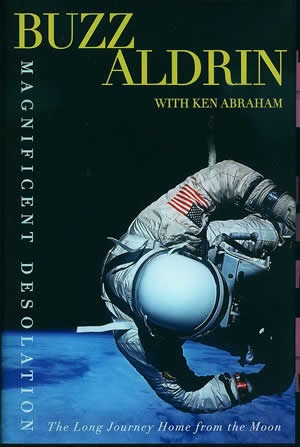
Magnificent Desolation by Buzz Aldrin

I’ve read other memoirs by the Apollo astronauts who went to the Moon, most of whom wrote about their tremendous efforts to become space jocks and their stories always peaked with their lunar adventures.  Buzz Aldrin second autobiographical book starts with the Apollo 11 landing and quickly wraps that adventure up, because his book is about the second half of his life, the forty years of life after being a famous man who landed on the Moon.  Aldrin had an exciting first half of life before becoming the “second” man to walk on another world.  He went to West Point, flew jet fighters in the Korean War, got a PhD at MIT, became a NASA astronaut and blasted into orbit on the Gemini 12 space mission, getting to do one of the early space walks.

MagnificentDesolation

So after coming home from the Moon and spending a year touring the world and being famous, Buzz Aldrin had a tough second act to follow his first.  His book chronicles his decline into depression and alcoholism, and it’s not a pretty story.  The real magic of his life appears to be recovering from his early success and starting over, especially his amazing luck of finding Lois Driggs Cannon, his third wife who helped him rediscover a purpose in life that has carried him forward these last twenty plus years.  It’s the Buzz Aldrin 2.0 that I find the most fascinating.

Of all the Apollo astronauts, Buzz Aldrin is the only one that has stayed in the limelight making a career campaigning for space exploration.  This is the tragic part of Magnificent Desolation, and maybe not one Buzz intended to portray.  Aldrin is completely gung-ho on space travel – the trouble is the rest of the world isn’t ready to follow his lead.  Why have we never left low-Earth orbit since 1972?  It took less than 10 years to get to the Moon starting from scratch, but with all the fantastic technology we have today, we can’t seem to get back to the Moon, much less go further.  Why?  Well, it’s not for Buzz’s heroic effort in trying.

I believe the portion of the population who are space travel true believers is so small that they don’t have the political critical mass to make Aldrin’s dream come true.  I’m not even sure 1/10th of 1 percent of the world’s population, or 7 million people are space advocates.  The Planetary Society doesn’t state how many members it has, but I’m guessing it’s in the low hundred thousands range.  The National Space Society, is even smaller.  In other words, the core group of humanity that seriously wants for humans to live in space is probably another magnitude smaller, 1/100th of 1 percent, or 700,000, and probably much less.

Buzz Aldrin has a tremendous uphill battle to convince the world to spend the money on manned missions to the Moon and Mars when only .01 percent of the population really cares.  Even if you add in all the the heavy duty science fiction fans, I doubt the number grows beyond .1 percent of the population.

Aldrin has hitched his star to the space tourism philosophy, which I have never bought.  Magnificent Desolation is current through late 2008 or early 2009, so Buzz reports on all his friends in the private space exploration business, the people who keep the dream alive, but it’s like what Aldrin states in the book, it only takes a rocket going 2,000 mph to achieve sub-orbital success, but it would take a spacecraft going 17,000 mph to make orbit. 

Can private space programs launch that kind of leap in technology?  We know the minimum required, an Atlas rocket like John Glenn road to fame.  The minimum to get to the Moon is a Saturn 5 – can anyone really imagine a private company funding that kind of expense?  If there’s a better way to space don’t you think someone would have found it in the last forty years?  Rocket technology seems to be the sole technology for heaving people off Earth.  Many space advocates campaign for the space elevator, but that technology is far more fantastic than real.

I grew up with the Mercury, Gemini and Apollo astronauts – they were my childhood heroes.  I thought NASA was blazing a trail to a future where science fiction would become real, but that hasn’t happened.  We have the technology to colonize the Moon and Mars now, and we have pioneers who are ready to go, we just don’t have the patrons to pay their way to the stars.  Buzz Aldrin still dreams the dream, and so do I, and a lot of other space enthusiasts, but I don’t think there’s enough of us to make a political or financial difference.

The only force that inspires the tax payers of America to send missions beyond low-Earth orbit is international politics.  We went to the Moon because of the Russians.  I believe President Bush announced the Vision for Space Exploration and the plans for Project Constellation in 2005 because China, Japan and India were making their own plans to send their citizens to the Moon.  However, President Bush’s vision didn’t impassion America like John F. Kennedy did in 1961. 

I think most Americans feel “been there, done that” and don’t see the point of returning to the Moon.  Even the majority of science fiction fans don’t pine for new missions to the final frontier.  For forty years we’ve been great at planning new manned space exploration, but no country or company is willing to spend the big bucks.  Space travel still excites and inspires legions of kids, but most somehow lose the dream as they get older because the political climate never seems to change.

Buzz Aldrin could have called his book Magnificent Ambitions, because space travel true believers feel that spawning a branch of humanity that lives off Earth and eventually colonizes other worlds in this system before moving on to other stellar systems is the ultimate purpose of our species.  I think many of us space travel true believers have been depressed, like Buzz, since the success of the Apollo Moon landings because the United States didn’t go on to greater missions. 

The phrase “to infinity and beyond” was the funny rallying cry of Buzz Lightyear, a cartoon character, but that’s how space travel believers feel.  The fascinating question about the 21st century is whether or not the rest of humanity will take up the challenge.  I don’t think the political leaders of China, India and Japan are space travel true believers.  Since 1945 there have been two spectacular ways for a nation to prove they are great – exploding an atomic bomb or developing a space program.  Nationalism isn’t a good force for long term space patronage because citizens eventually feel such wealth should be spent on programs closer to home.

JWH – 11/20/9  

She Had a Mind Like an Intel Core i7

As I get older, I realize my mind is slowing down. I was never a quad-processor kind of thinker, but I’d like to believe my brain could chug along like a good ole AMD X2 chip.  Now my thoughts feel like they are powered by the original Pentium.  I’m starting to pay attention to the people around me, and realize we have unequal minds when it comes to gray matter CPU speeds.  I’m also wondering if working with machines is pushing everyone to think faster. 

In our culture, we mostly judge people by their covers, but when it comes to brain power we’re as diverse as our physical features, and we seldom take that into account when communicating.  In a classroom of third graders or even a college calculus class, all the students are expected to learn the same material at the same pace.  Is that fair?  When I was a kid I had supercomputer ambitions.  It took decades to accept my brain was just ordinary, like computers built to run Microsoft Office.

At work I’m a computer geek, and friends envy my tech knowledge.  I’m thankful I’m good at something because I’m so bad at everything else.  My brain struggles to remember the names of the people I already know, and it seldom remembers new names, but I’m surprised at how fast I learn technical tidbits.  But even that ability is eroding with age.

The other day I was helping a young women who had asked me about putting words on photos in Microsoft Word – something I didn’t know how to do within Word.  Her hands flew over the keys showing me her project and files, and I was amazed by how fast she could think, type and traverse folders with keyboard shortcuts.  I pulled up Google and searched on her problem and found a good solution, but before I could tell her anything, she read over my shoulders what to and was ready to go.  This girl had a mind like an Intel Core i7. 

I could tell her young brain, about a third in age of my rusty noggin, could process input far snappier than I could.  I admired and envied her fast thinking, wishing I was young again, because now is a fabulous time to be young working with computers.  On the other hand, I have to worry about slower thinkers, and the fact that I’m slowing down myself.

Is it me, or does the world feel like it’s speeding up?  Aging has me feeling like a lethargic cold blooded lizard living among fast thinking mammals.  My wife often gets impatient with my slow mental processing and tries to finish sentences for me.  This is why I love blogging – I can take as much time as I want to put my thoughts together.

Speed of thought is relative though.  Usually people complain that I go too fast when I help them with their computers, so I have to slow down.  When helping most people I show them the routine, let them walk through it once on their own, and then they are usually good for solo flying.  Some people I have to repeat the steps 2-3 times.  Occasionally I get people who have no knack for computers and I can show them how six times, let them write the steps down exactly, watch them four more times and then they still call me back 15 minutes later.  Often I have to learn on-the-spot how to solve the problem people want me to teach them, but few people notice how I do this.  Google is the magic word, folks. 

On one hand, I worry about these people who don’t seem to be adapting well to the machine age.   I admire the ones who refuse to run at gigahertz speeds and reject interfacing with machines.  I think I stand between two generations, the ones who lived without computers and didn’t need them, and the next generation of cyborgs that think like a CPU co-processor.  

But computer literacy doesn’t always run along generational lines.  Even though it seems we’re forcing everyone in our society to use a computer, not everyone is a PC or a Mac.  My friend Laurie, who is a scholar of reading literacy, hates that other skills add the word “literacy” behind their noun to refer to their minimum standard of expressing knowledge, so we need to think of another term for people who work well with computers – cyberbiotic?

As much as I admire fast thinking, I also have to worry if speeding thoughts aren’t the best way to think.  Has anyone notice how fast they edit TV shows and movies today, with the average length of film cut getting shorter and shorter over the years?  This makes the action go faster and faster.  I can’t watch The Amazing Race anymore because its quick edits are jarring to me.  When I watch an old movie from the 1930s, the pace suggests their time had calmer thoughts, and the long meandering sentences in a 19th century novel implies even more leisurely thinking.

I think it’s unfair that practically everyone has to use a computer in their jobs in the 21st century.  Computers do enhance creative pursuits, but does every task need to be computerized?  It’s as if we’re all adapting to living inside a new digital reality.  Will this cause us to breed humans with faster and faster minds to keep up with computer evolution?

I’m not sure the average person ever thinks about the speed of thought, but it’s obvious one of the inequalities of life that we suffer.  And I’ve noticed not all young people are fast thinkers either.  In the old days, when kids had learning disabilities they were called slow.  When everything speeds up, will people with average ability be considered slow too?

Minds are not like computers, but there are many fascinating comparisons.  Fast thinking can be compared to having a brain like the latest Intel chip, while old minds can be likened to the ancient 386 CPU.  Human memory is a far cry from computer RAM, because computing would be impossible if machines had recall times and error rates of gray matter memory.  Now that my memory is slipping away, I know that memory is often more important than processing speed.  I can still think fairly fast, but it often takes me hours to recall specific words and names.  The computers in the Apollo space capsule that went to the Moon were less powerful than the computers in today’s cheap telephones.  Efficient programming and accurate memory can overcome major CPU limitations.

I’ll bet a person with a slow mind but good memory can beat out a fast mind with a poor memory in many job categories.  But there are other factors, such as Howard Gardner’s theory of multiple intelligences.  A person with a mathematical mind can pursue careers that average Jacks and Jills can’t.  Nor would gimpy math minds want to have to work with numbers.  I wanted to be an astronomer when I was a kid, and got through high school physics, college calculus and several college physics courses before I ran out of mathematical momentum.  I also wanted to follow in the footsteps of Bob Dylan, but I have zero point zero musical ability.

If I had been tested in the 7th grade and told about the limits of my brain, and informed that I could be an astronomer if I was willing to practice math two hours a day, would my life have been different?  The mind is like a muscle, it can be improved with exercise – like I pointed out in “10,000 Hours to Greatness.”  This really is a case of “If I knew then what I know now.”

We all hear about kids in other countries that must grind through hours of study to keep up with the standard.  Now that everyone is competing with machines, will everyone have to run faster and faster?  Maybe I could have pushed myself to work harder as a kid to become an astronomer, but will future kids compete with AI astronomers?

We all hear about how our educational system is in crisis, whether that’s true or news media chicken-littling, I think it’s a mistake to make an educational system that essentially tries to be one size to fit all.  Would kids try harder if you customized their curriculum to fit their personal ambitions, matched to their brain speed and the amount of time they wish to practice?

Politically we like to think we live in an egalitarian society.  And as growing adolescents we like to think we can be anything we want when we grow up.  Socially we like to think we live in a classless society and can marry whomever we wish.  Our churches teach us to believe that God created us all equal.  Good or bad, I think we’re diversely unequal in our ambitions, the speed of our thoughts, and how much attention time we can apply to any task.

As I make my to-do list of projects I want to pursue in my waning years, I think I’m far more realistic because of this knowledge about my limitations than when I was young daydreamer planning what I could do with my life.

Maybe I’m just feeling sorry for myself and my slowing mind.  Maybe it’s the way of the world for every new generation to speed past their elders, and for the elders to crab about the speeding youngsters.  I turn 58 in eleven days, which is still pretty young, but I’m already looking forward to living in a retirement community where things move at a slower pace.  Hell, if I move to the land of the ancient, they’ll think I have an Intel Core i7 mind, at least for awhile.

JWH – 11/14/9