The Distance Between Us

by James Wallace Harris, 5/3/25

Even if we embrace in a mighty bear hug, we cannot get close enough for our minds to touch. Whatever consciousness might be, each person is alone in their head. Would telepathy soothe that existential solitude?

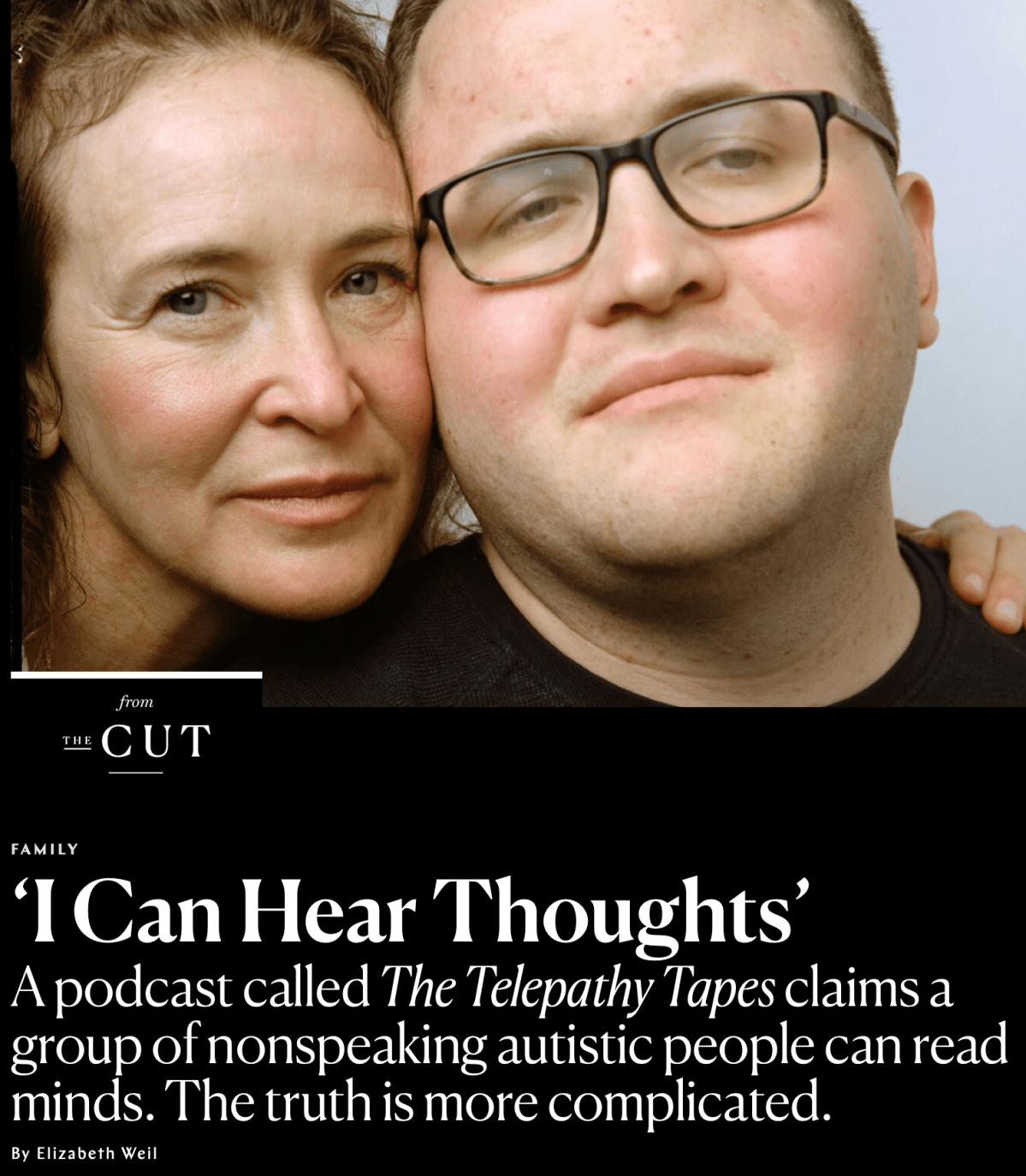
I Can Hear Thoughts” by Elizabeth Weil in the latest issue of New York Magazine reports on the viral podcast The Telepathy Tapes. (This article is behind a paywall, but if you haven’t visited the site recently, it might allow a free read. I read it via Apple News+. I find that subscription well worth the monthly $12.99 because it lets me read content behind hundreds of paywalls.)

The story is about a mother and her autistic son who appear to use telepathy. She started a podcast, which turned into a movement. The story is about how parents of nonverbal autistic children are desperate to know what their children think. For some, it goes much deeper than that. They want confirmation that a fully developed and aware human soul is trapped in a body that can’t communicate.

Often, one or more parents will sacrifice their normal lives to find some way to communicate with their nonverbal children. Many have spent years working with facilitated communication, leading to varying degrees of success. Sometimes such efforts produce startling results, results that appear to suggest telepathy.

Most scientists discredit these efforts. Studies show that autistic individuals respond to physical cues, variations on Clever Hans. However, some researchers suggest that something else might be at play. These researchers study consciousness, some with rather far-out theories about consciousness. Some researchers in consciousness want to leave the idea of telepathy open as a possibility, but see The Telepathy Tapes discrediting their research.

One of the most touching parts of the story is when Elizabeth Weil realized her journalistic queries brought doubt to the people she was interviewing. That their hope depended on absolute belief. I believe that issue is one of the fundamental reasons why our country has turned conservative and against liberal thinking. People are desperate to believe things science rejects, so they prefer to jettison science rather than their beliefs.

“I Can Hear Thoughts” is a beautiful piece of journalism about heartbreakingly sad lives. This story touches on many deep philosophical issues. Researching consciousness is at the cutting edge of science, philosophy, and even religion.

People desperate to save religion from science grasp any theory to rationalize their beliefs. The appeal of the Telepathy Tapes is the hope that communicating with profoundly autistic people will lead to proof of undiscovered spiritual dimensions. Dimensions that could be studied by science.

It’s a shame that this article is behind a paywall. I fully understand that New York Magazine needs to finance its publication. If you only consume free journalism on the web or YouTube, you are subsisting on a substandard diet of information. I wish more of my friends subscribed to Apple News+ so I could share articles with them.

I’m trying to wean myself off of crap news. The only way to do that is to pay for quality information. Apple News+ connects you with over 400 publications at a practical price.

JWH

Has Telepathy Become an Extinct Idea in Science Fiction?

By James Wallace Harris, Tuesday, February 17, 2015

Science fiction is a genre that generates far out ideas. Science fiction writers often imagine new concepts to structure into their plots. Some invented concepts are embraced by the genre and become subgenres – like space marines and military SF. Concepts like time travel, galactic empires and hyperspace travel become memes that spread to the outside world at large. At other times, real world topics, like nuclear winter and warp drives, get incorporated back into science fiction.

The Demolished Man - Signet

This gets me to wondering. Are there science fictional concepts that become extinct? Do ideas come in and out of fashion? I ask this because I’m reading The Demolished Man (1952) by Alfred Bester, which is about telepathy in society. Does anyone believe in telepathy anymore? Back in the 1950s there was a boom in ESP/Psi stories. Belief in mind reading and psychic powers have been around for thousands of years, probably crossing over from religions and beliefs in magic of our earliest ancestors. In the 1940s and 1950s, I figure SF psi-power stories became popular with the development of the idea of next stage humans, mutants or advanced aliens. For some reason people assume evolutionary advancements will confer ESP, even if it isn’t logical. Since the 1950s whenever television or movie science fiction like The Twilight Zone, The Outer Limits, Star Trek and Star Wars wanted to present advanced humans or aliens, they’d give those characters the ability to read minds or telekinetic powers.

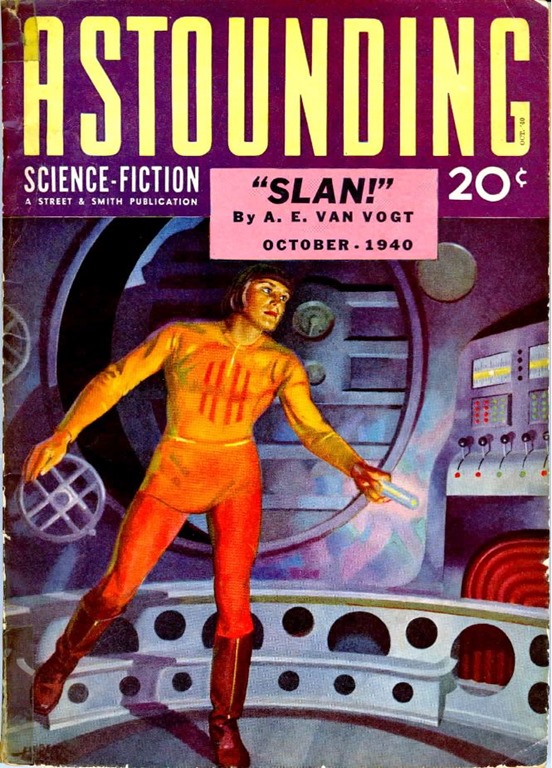
What’s strange is we hardly read about ESP and telepathy anymore – at least in science fiction. I’m sure the ideas are still popular with fans of the occult, but not science fiction. A nice chronicle of  the use of telepathy in science fiction can be found at The Science Fiction Encyclopedia. However, checking with GoodReads I find that telepathy is still very popular with fantasy novels and paranormal romances. If you look at their list of telepathy novels very few are science fiction, and most are the classics like Slan, More than Human, Odd John, Zenna Henderson’s The People stories, and the #1 book is The Demolished Man. However, I might be wrong about telepathy becoming extinct in fantasy fiction – just check out this list of 1650 books at SciFan. However, even the titles that are science fiction, most are fantasy based.

slan-astounding oct1940

At The Science Fiction Encyclopedia they suggest that telepathy as a theme in science fiction has fallen off because of the rise of cyberspace. We now picture ourselves using computers to connect to each other. That theory feels right. One day iPhones might be implanted into our heads, and that sounds more realistic than brain cells evolving radio frequency transmitters and receivers. Technological telepathy is well underway with machine-body interfaces to allow thoughts to control muscles.

childhoods_end

So why was psi-power science fiction so popular in the 1950s science fiction? Some people claim its because John W. Campbell, Jr., the editor of Astounding Science Fiction pushed the idea of psionics on his authors because it was his pet belief. Others claim Charles Fort influenced writers like Robert A. Heinlein and L. Ron Hubbard. Others claim it was the Rhine experiments in the 1930s that got the ball rolling. The 1950s was a weird time in America, with “true stories” of UFOs, ESP, Bridey Murphy, and Edgar Cayce inflaming the public with nutty ideas. After the atomic bomb became famous in 1945, I think people start believing anything was possible with the help of science. Science fiction got people thinking about intelligent life on other worlds, life that might be far superior in intellect to our own. We started imagining what humans could become with the help of mutation, genetics and machines.

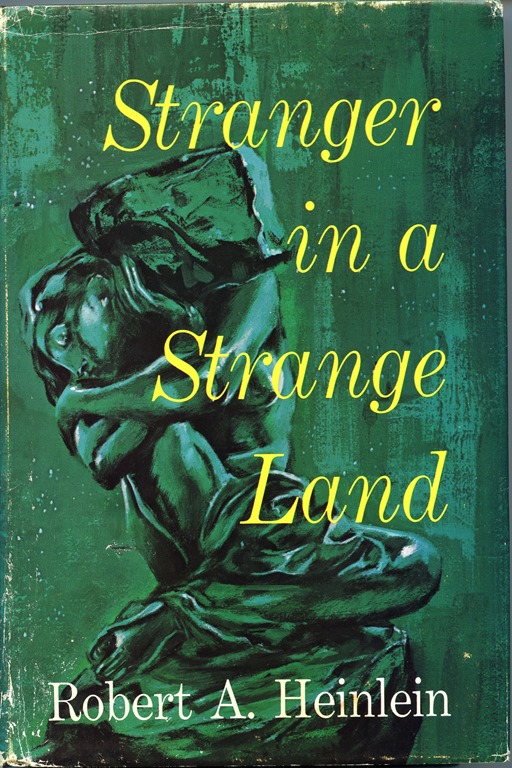
stranger in a strange land - 1961

I think the idea of psi-powered humans peaked in 1961 with Stranger in a Strange Land by Robert A. Heinlein, where Heinlein featured an ordinary man raised by advanced aliens capable of learning amazing feats of brain power. For me, the idea died with Dying Inside by Robert Silverberg in 1972, which showed a lonely, pathetic telepath surviving on the margins of society.

I don’t know what caused it, but for some reason I woke up in the 1970s and rejected all speculation about the paranormal. The idea of ESP just became silly. I think the reality distortion field of the 1960s wore off. Even in 1977, with Close Encounters of the Third Kind being a wonderful film, the idea of UFOs seemed just as silly too. UFOs and ESP became concepts embraced by cranks. After the Apollo Moon missions ended in 1972 and the Viking landers made it to Mars, space travel took on a realism that made 1950s science fiction seem quaint. Starting with Neuromancer in 1984, cyberpunk fiction just changed everything in the genre. We’ve been overwhelmed by the impact of computers and nanotechnology ever since. We find magic and power in machines, not minds.

Psi-powers and mutants have been replace by exploring posthumanism. And if you think about it, there are many concepts once popular in science fiction that are slowly becoming extinct. Beside Psi-powers, the idea of mutants seldom shows up. We don’t talk much about WWIII or nuclear wars. Even though the population of real robots is growing in the real world, we don’t see many robot stories anymore either. Interstellar had a nice robot. We seem to imagine AI machines being embedded into our technology rather than Asimovian robots.

I can’t say if psi-powers were just a story idea, or if people really believed back in the 1950s that humans would one day evolve to have such amazing abilities. Maybe the kids of that era hoped to grow up to be Superman and fly. If I had to guess, I would say many SF fans back then did believe in Slans, because many people today want to believe in life-extension, artificial intelligence, downloading brains and human-machine mind connections. Over time we’ll discover what’s really possible, and then many of the beliefs about those concepts will die off too, like belief in ESP powers today.

p.s.

In the late 1980s I had a BBS devoted to science fiction and I brought up the topic of telepathy and ESP then. I assumed everyone believed it a dead topic by that time, but I was proven wrong. Many of the members of my bulletin board became enraged by my attack of telepathy. They passionately wanted to believe in extrasensory perception. I wonder if that’s going to happen again with this essay?

Table of Contents