by James Wallace Harris, 7/10/23
This essay is about remembering something that never happened and the theories I’ve developed to explain my memory hallucination.
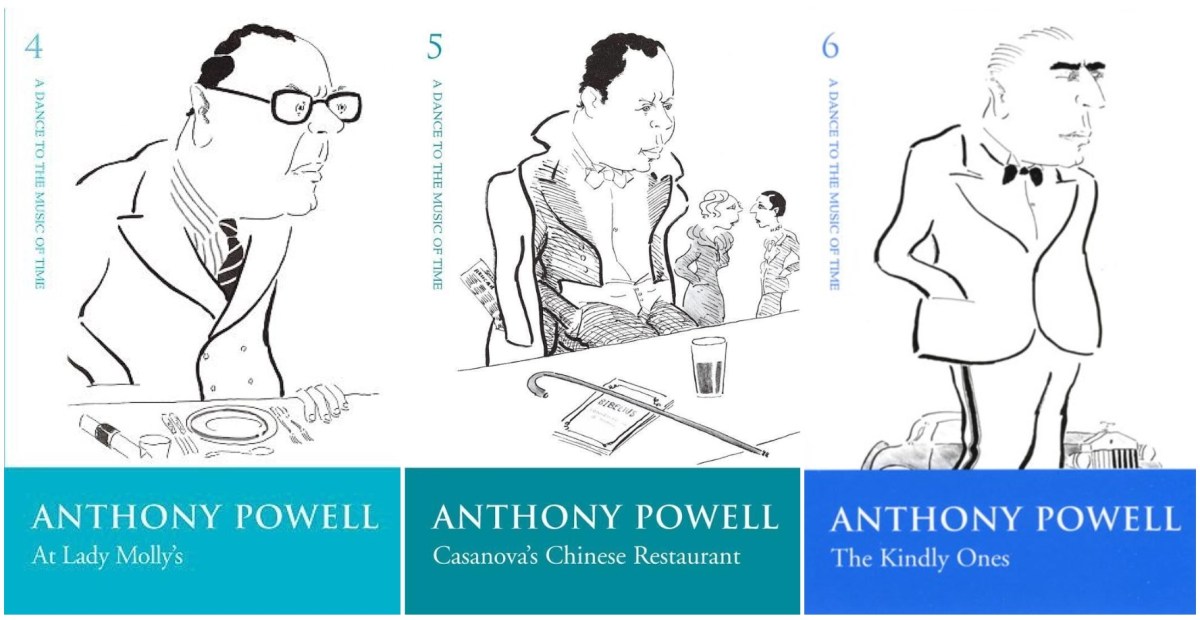
While reading The Kindly Ones by Anthony Powell, the sixth novel in a twelve-novel series called A Dance to the Music of Time, I had the constant feeling I had read it before. Several scenes throughout the novel seemed so familiar that I felt like I had studied them over several readings. I always assumed it was because I had twice watched the four-part miniseries based on the books. I’m sure that accounts for the general sense I’ve read The Kindly Ones before, but not the intense sense of remembering specific scenes. Yesterday I replayed the portion of the miniseries that deals with the most remembered scene and it merely skims over a very long detailed scene in the book.
A Dance to the Music of Time is about Nick Jenkins and his life from the 1920s through the 1960s. It’s not a Roman à clef but Anthony Powell based Nick on his own life. It’s a fictional exploration of memory, so it’s rather ironic that I’m having memory problems reading it.
There were many scenes that felt I had read before, but I just assumed they were in the miniseries. However, one scene was intensely vivid and familiar. It was the long scene where Nick Jenkins met Bob Duport years after Nick had had an affair with Duport’s wife Jean That affair was chronicled in an early novel in the series. So those pages recall events that happened in earlier novels, but it also has much new information that wasn’t in the earlier novels. The most vivid scene involved Nick wanting to avoid the subject of Jean, but Bob slowly getting around to talking about her. Bob starts describing the men he knew Jean had affairs with and what they were like. Bob kept making a case that Jean was attracted to men who were assholes and even admits to being one himself. Nick doesn’t know if Bob is intentionally insulting him or accidentally torturing him.
In recent years I have become distrusting of my memory for many reasons. The first is, memories often feel faulty. But that sense of faultiness is the kind we associate with dementia. I’m now exploring memory delusions.
I’ve read a number of books about the limitations of memory, and I’ve come to assume memories are unreliable. The best book I’ve read on this is Jesus Before the Gospels by Bart D. Ehrman. You wouldn’t think a book about Jesus would be the best place to learn about the limitations of memory, but it’s the best I’ve found.
If the television miniseries wasn’t where I acquired my pre-knowledge of that scene in The Kindly Ones, where did it come from? My first thought was to wonder if I had read the book before? I checked my reading log, a listing of books I’ve read since 1983, and it wasn’t there. Now, there have been times when I forgot to record a book read, but I don’t think that happened in this case. Why would I read the sixth book of a series out of order?
Another possibility is I listened to it in my sleep. Books 4-6 are in a combined edition on my Audible edition, a total of 21 hours. Theoretically, I could have fallen asleep and my unconscious mind heard it. This happens all the time. But I wake up, usually, in minutes, but no more than an hour, and shut off the book. I always scroll back to a scene I’m positive I listened to the day before. I’m almost positive I didn’t let this whole book play while I was sleeping with The Kindly Ones. Because of an overactive bladder, the longest stretch I can sleep at night is two hours.
I do have a wild and crazy theory. What if certain human experiences become part of what Jung called our collective unconscious? I know this is New Age woo-woo, but it’s a thought. It might explain why some people think they are reincarnated, or some instances of Deja vu.
I have two less wild theories, ones I think might be closer to the truth. One involves prediction, and the other involves resonating with tiny universal fragments.
The novels in A Dance to the Music of Time feel like an autobiography. The novel series is not a Roman clef, but they were inspired by Powell’s own life and the people he knew. I’m thinking they create such a detailed sense of Nick Jenkins, especially after six novels, that when I got to the scene with Bob, I felt like I was Nick, and the encounter felt so real that I had experienced it as if I was remembering it.
The second theory is somewhat like the basis of holograms. If you cut one up, it will still show the whole picture, just fuzzier. Even a tiny fragment of a hologram will still show the entire image, but just very fuzzy. This second theory suggests that any scene involving a man meeting the husband of the woman he had an affair with will trigger a resonating memory response. I can’t recall any specific similar scene in fiction or real life that matches this, but that doesn’t mean I haven’t and just don’t remember it.
This hologram fragment theory might explain all Deja vu experiences. Our mind remembers things in generalized tokens, and sometimes we confuse the token from one event with another. If you think about this, you’ll probably recall this happening to you. The other day I asked Susan if I had gotten the mail, and she said, yes, you got a book. I said, no, that was yesterday. I was quite positive. I even convinced Susan that it was true. A few hours later I remembered that yesterday was the 4th of July and there was no mail. I have a “got the mail” token in my brain and it makes me feel like I’ve always gotten the mail. But it’s not really specific to any single event of getting the mail.
A recent episode of 60 Minutes on Google’s AI called Bard offers another theory. Bard was asked to explain inflation, which it did, and offered five books on the subject with descriptions of the books. When CBS fact-checked that list days later they discovered the books didn’t exist. CBS asked Google about this. They were told this was an AI phenomenon called hallucination. Evidently, AIs will just make up shit whenever they feel like it. Maybe what I experienced was a memory hallucination.
Google’s Bard performed another scary feat. It taught itself to read and write in a language it wasn’t trained on, and without being asked. Maybe my brain just tricked me into thinking I had read this book before?
And there’s one last idea. Last night I dreamed of a variation of an episode of a TV show Susan and I watched last evening. The dream didn’t involve characters from the TV show, but people I know. But the dream put me, and people I know in the same exact situation. Have you ever wondered how our brain can generate so much endless dream content? What if the same mental mechanism that generates dreams also creates our memories and beliefs? What if that mechanism works like Bard?
I’ve always liked Roman à clef fiction, or fiction that is highly biographical. I’ve always been obsessed with memory. I’m ready to finally read Proust, who is the authorial authority on fictionalizing memory. Some people compare Anthony Powell to Proust, others hate that comparison. Proust fans don’t think Powell was heavy-duty enough. I think they each had their own approach to remembering their life. Powell may have been an extrovert and Proust an introvert, and the differences in their prose were caused by that and not the quality of writing. But I also think the differences involve the different ways of how memory works.
JWH
 Auxiliary Memory