Avoiding Mirages in Reality Created By Words

by James Wallace Harris, 10/12/25

Humanity is plagued by delusions generated by words. We struggle to distinguish between words that point to aspects of reality and words that point to fictional mirages. In other words, we can’t differentiate between what is real and shit we make up.

I’m partial to an unverified quote attributed to James Michener, “The trick to life is to make it to 65 without being either a drunk or insane.” Sanity is notoriously hard to define. Many of us can stay sober until 65, but do any of us stay sane till then? Don’t we all end up seeing things that aren’t there? Don’t we all embrace cherished delusions to cope with life?

Of course, you will disagree with me. We all know what we believe is real.

Language allows us to be self-aware and manipulate reality, but don’t many of our words point to theoretical concepts that don’t actually exist in reality?

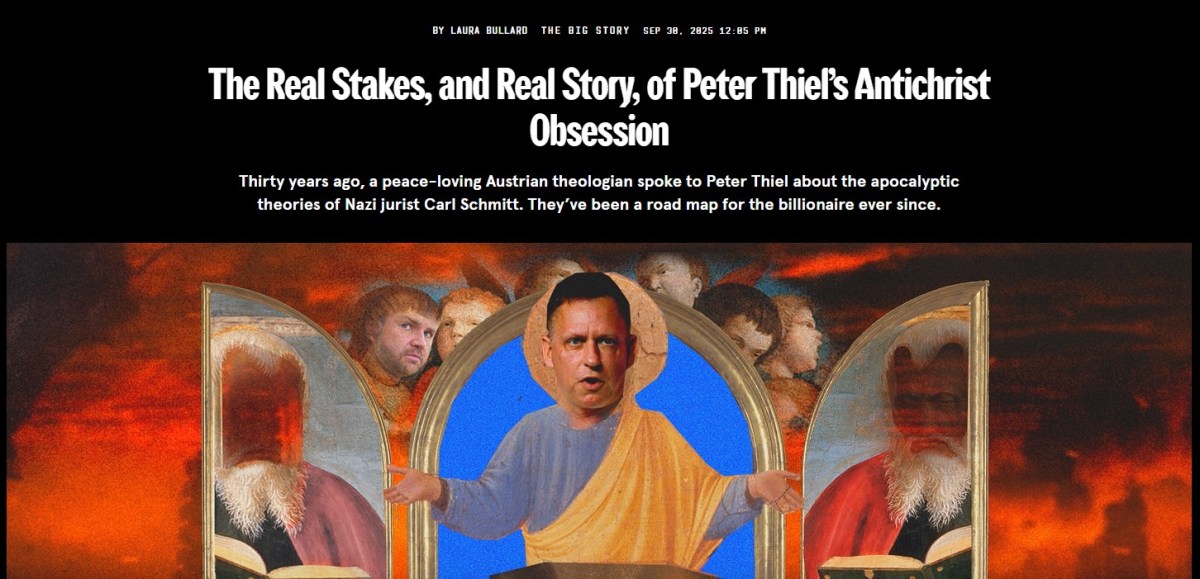
I recently read “The Real Stakes, and Real Story, of Peter Thiel’s Antichrist Obsession” in Wired Magazine. [Nearly everything I read is behind a paywall. I use Apple News+ to access hundreds of magazines and newspapers that exist behind a paywall. Wired shows the entire article for a few seconds. If you immediately right-click and select Print, a copy of this article can be read in your printer preview window. If you don’t catch it the first time, refresh the page. Or read other articles about this.]

Recently, Peter Thiel gave a four-part lecture on the Antichrist and the Apocalypse. In her Wired article, Laura Bullard attempts to decipher what Thiel is preaching.

By Thiel’s telling, the modern world is scared, way too scared, of its own technology. Our “listless” and “zombie” age, he said, is marked by a growing hostility to innovation, plummeting fertility rates, too much yoga, and a culture mired in the “endless Groundhog Day of the worldwide web.” But in its neurotic desperation to avoid technological Armageddon—the real threats of nuclear war, environmental catastrophe, runaway Al—modern civilization has become susceptible to something even more dangerous: the Antichrist.


According to some Christian traditions, the Antichrist is a figure that will unify humanity under one rule before delivering us to the apocalypse. For Thiel, its evil is pretty much synonymous with any attempt to unite the world. “How might such an Antichrist rise to power?” Thiel asked. “By playing on our fears of technology and seducing us into decadence with the Antichrist’s slogan: peace and safety.” In other words: It would yoke together a terrified species by promising to rescue it from the apocalypse.


By way of illustration, Thiel suggested that the Antichrist might appear in the form of someone like the philosopher Nick Bostrom—an Al doomer who wrote a paper in 2019 proposing to erect an emergency system of global governance, predictive policing, and restrictions on technology. But it wasn’t just Bostrom. Thiel saw potential Antichrists in a whole Zeitgeist of people and institutions “focused single- mindedly on saving us from progress, at any cost.”

So humanity is doubly screwed: It has to avoid both technological calamity and the reign of the Antichrist. But the latter was far more terrifying for the billionaire at the podium. For reasons grounded in Girardian theory, Thiel believed that such a regime could only—after decades of sickly, pent-up energy—set off an all-out explosion of vicious, civilization-ending violence. And he wasn’t sure whether any katechons could hold it off.

Thiel draws theology from the Bible, philosophy from studying with René Girard, and apparently combines them with ideas from Carl Schmitt, a political theorist from Nazi Germany, to create a rather bizarre warning about our future.

Because Thiel is a billionaire, he’s able to spread his beliefs widely. And because our society is overpopulated with people searching for meaning, we have a problem.

I’ve been collecting news stories and sorting them into two categories. The first deals with delusions that affect individuals. The second collects reports showing how we’re failing as a species. I could have filed this Wired article under both.

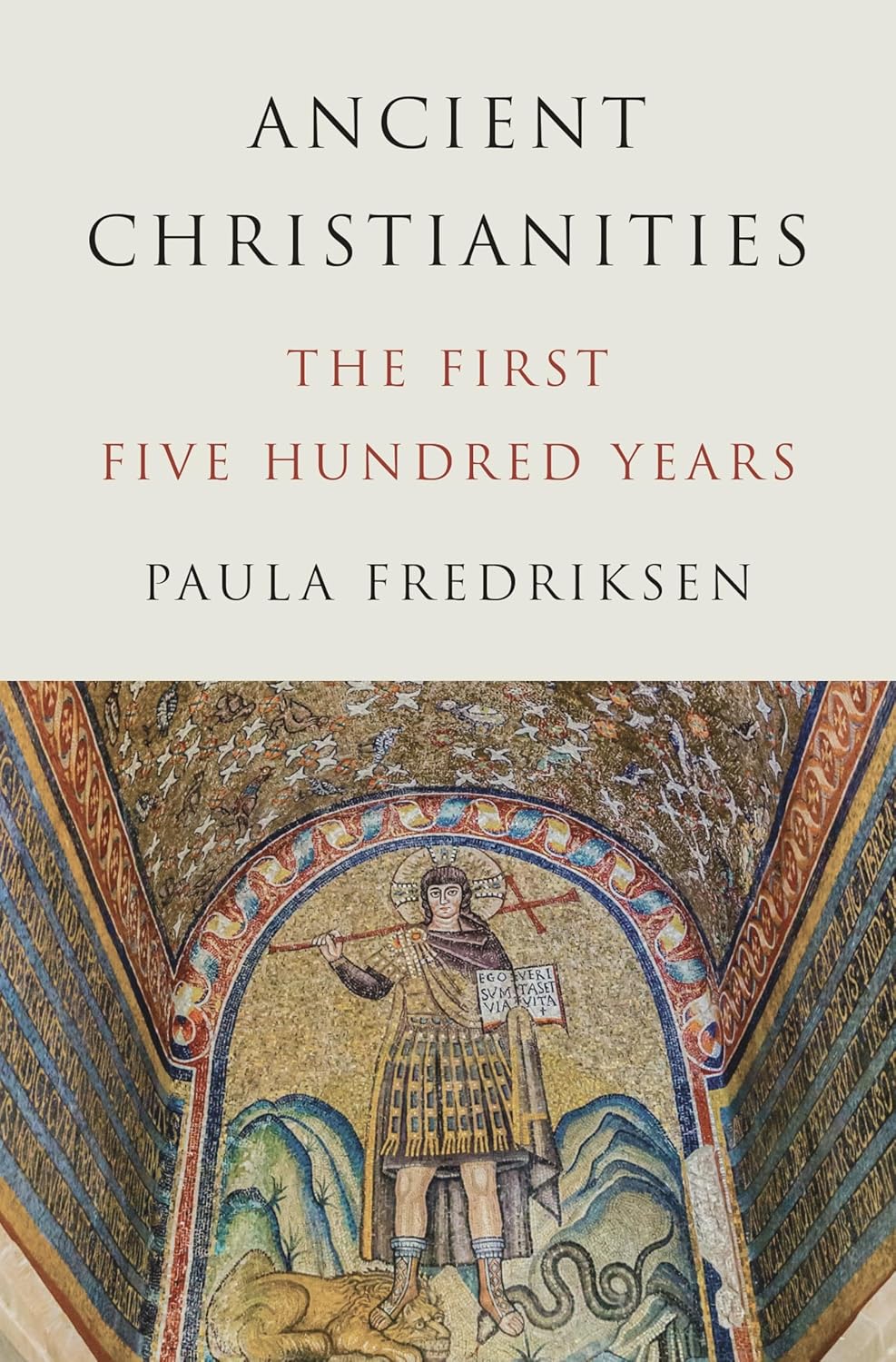
Whether as individuals or as a species, we act on false assumptions about reality. We often assume things to exist that don’t. Such as the Antichrist, or for that matter, The Christ. There may or may not have been a historical person we call Jesus. That may or may not have been his name. The concept of Christ was created over several generations of his followers. It has no real existence in reality. And neither does the Biblical Apocalypse or Antichrist. Those concepts have been redefined repeatedly over twenty centuries.

Among the thousands of Christian denominations that have existed over the past two millennia, there is no consensus on what Jesus preached or what is meant by the term Christ. In other words, there is no common denominator between Christians. This is because their beliefs are imaginary concepts that each individual redefines for their own use in words.

Religious beliefs are fine as long as they remain private to an individual, but when they are used to shape reality, they become dangerous. I often read about people who want to use their beliefs to make others conform to their illusions. That disturbs me.

But I’m only now realizing why. It represents a failure of language. Language is useful as long as words point to aspects of reality. The closer words stay to nouns and verbs that have a one-to-one relationship with things or actions within reality, the safer we are. It’s the words we fight over their definitions. That’s when things get dangerous.

Peter Thiel’s bizarre philosophy becomes dangerous when he can get others to accept his definitions. As I read news stories, I see this validated time and again. How many Russians and Ukrainians would be alive today who died because of Putin’s mirage of words? Look at any war, political conflict, or personal argument, and you can often trace it back to the ideas of one person.

Even my words here will incite some people.

As my last years fade away, I struggle to comprehend the years living in this reality. I’m starting to see that most of the confusion comes from interpreting words. The more I approach my experiences with the Zen-like acceptance of what is, the calmer things get. Eastern religions took a different approach to reality. In the West, we work to shape reality to our desires. Eastern philosophers teach that we should accept reality as it is. There are also dangers to that approach.

The reality is that humans create climate change. Many people can’t accept that reality. They use language that creates a mirage that many want to believe. That is one form of action. It’s a way of manipulating the perception of reality. That will actually work for those people, for a short while.

The weakness of our species is that we manipulate the perception of reality instead of actually making real changes in reality.

That’s how I now judge the news. A plane crash is a real event, not a mirage. But how often are men seeking power describing something real?

JWH

Paradise Lost – What if Our World is Heaven?

by James Wallace Harris, 6/15/25

If I ignore the depressing news on my screens, I can step out of my front door and view a beautiful world. Looking at the photo above, do you see heaven or hell? We seldom consider Earth a paradise, but we all experience moments of beauty and serenity, as well as moments of pain and suffering. We spend our lives avoiding the one and seeking the other.

For most of my life, I felt like I was climbing a hill towards my dreams, but now, in my seventies, it feels like I’m sliding down that hill. I wonder if I’ve been chasing fantasies while ignoring reality. There is a book of conversations with Philip K. Dick called What If Our World Is Their Heaven? I’ve often wondered if we were living in heaven and didn’t know it, or worse, what if we were living in heaven and were turning it into hell.

Over the last several years, theories have been proposed that our universe is an artificial reality. I’ve always objected to that idea, but it asks a fascinating philosophical question: If we’re living in a synthetic reality, did we choose to be in it? Why would we want to experience so much pain and suffering?

I’ve always believed our existence is a Darwinian reality where everything happens due to randomness. If I believed in God, I would have to ask: Why do you make us suffer?

Hinduism and the concept of reincarnation also suggest something interesting. That belief system claims we are souls coming to this reality to evolve, and suffering is a teaching tool.

Whether we are here by accident or choice, it still leaves the question: Why do we suffer? If our pains are due to the luck of the draw, how do we make the best of a bad situation? If we’re in some kind of cosmic classroom, what are we supposed to learn? And if we’re a participant in a monstrous computer game, how do we win?

Is it delusion to think our place in the universe is anything other than an accident?

Because an algorithm observed me read one story on coping with life in my seventies, they have sent me many more. I’ve seen list after list of the personality traits of those who survive well and those who don’t. I can’t help but wonder if there is a correlation between belief and how we survive.

Do people who believe life has no purpose succumb quicker than those who think we do? And even if we accept that we’re living a Darwinian existence, aren’t there two approaches to that, too? Isn’t existentialism a positive choice over naturalism or fatalism?

Even people of rock-solid faith die horrible deaths. Few people escape this world without suffering. If suffering is so integral to existence, what is its purpose?

JWH

A Personal God of My Own

by James Wallace Harris, Wednesday, March 1, 2017

Sometimes I wish I had a personal God for amicable chats when I have insomnia in the wee hours. Lying in the darkness, I often wish I had someone to share philosophical thoughts. I picture this personal God like a kid’s imaginary friend, or even a big pooka rabbit, like the one Jimmy Stewart conversed with in Harvey. I imagine my imaginary deity as a mashup of Mark Twain, Robert Sheckley, and Kurt Vonnegut. Maybe this God should look like Clarence the guardian angel, clueless and hapless. (Again, a Jimmy Stewart reference.) I suppose my guardian angel could look like the suave Dudley (who looked like Cary Grant), but that wouldn’t be as funny. Loretta Young would make a sexy guardian angel, and I can picture her being very insightful.

(I wonder how many people under 60 get my angelic movie references?)

female-god1

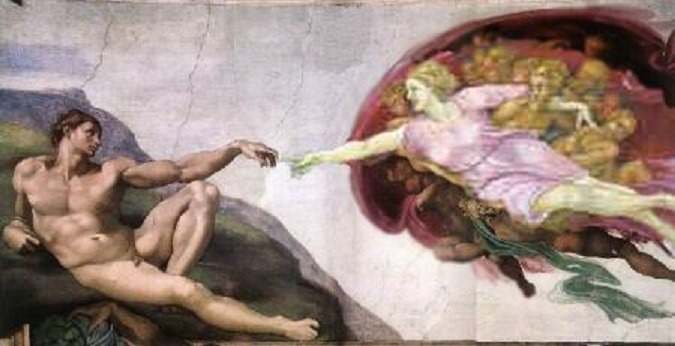
I once dreamed I had sex with God and was shocked (in the dream) to discover God was a woman. She was a stout matronly female in her sixties, with big soft bosoms, who looked somewhat like an older Sophia Loren. In this dream, I’m having very pleasurable sex with this zaftig lady, and my reaction was fucking an older woman was a lot of fun, especially one so jolly – but then I realize she was God. Seeing my shock she laughed at me with a deep throaty laugh, like the laugh my father’s mother had. I’ve always wondered what Freud would have made of that dream.

I was in my forties at the time. When I woke I was a little embarrassed to be enjoying a sex dream with a grandmotherly woman. (It didn’t bother me she was God.) I’ve had some very strange dreams over the years, and I’ve run into God before – but not as this woman.

So I suppose my personal God could be a she. I might even prefer that. When I first thought of having a personal God the name Fred popped into my mind. A good, no-nonsense name. I could have some great conversations with a God named Fred. But I sort of like God being a woman. Probably, I’ll call her Gladys or Gloria.

I’ve been an atheist since I was eleven years old. I remember my mother making me go to church as a kid, and me trying hard to believe. I even asked to be baptized thinking it would let me see what everyone claim to see. But after nothing was revealed, I took the path of unbelieving. I’ve never been the kind of atheist that advocates disbelief. I know too many people who find great comfort in theism to ever want to take it away.

And when I say I’m an atheist, I mean I have no doubts. God does not exist for me. When I talk with God, I know I’m pretending. It’s better than talking to myself, but not by much.

I believe we are all bubbles of consciousness that have accidently emerged into this infinite sea of random reality. I use the word reality because I don’t believe the universe is everything. I believe reality is quite indifferent to us and infinite in all directions and dimensions. People want a God because they want a father figure. They want their lives to mean something. When I think of my imaginary personal God, I’m really pretending I’m talking to reality. I know reality isn’t listening and doesn’t give a shit, but I like to pretend otherwise.

Many of my atheist friends would like to talk to God too, to curse the creator for all the suffering they see and experience. I’m not that way. I’d like to thank God for my existence. I used to have a lot of questions, but I’m satisfied now with what I know and don’t know. There are some things I’d like to kid ole Gladys about, though.

Like last night, I had friends over to watch A Man Called Ove, and at one point in the film, I glanced to my left and noticed my friend’s foot. It was beautiful. And I don’t mean in a sexual fetish way, but in an existential existence way. Gladys, why is one portion of reality more beautiful than another? Why are we here and not nothing? Why is the foot more aesthetically appealing than other objects in the den? You can be very weird at times. Your sense humor can be so trying – I can understand how I got old, fat, and bald – but why not shut off the sex drive as we age? Very funny, Gladys.

I accept the random nature of existence. I even accept what I fear and don’t want. So I’m content without God, but bantering with a personal God could be satisfying. It would be fun to have Gladys to chat about the beauty and absurdity of this existence.

“By the way Gladys, can you explain Donald Trump? That’s really going too damn far!”

JWH

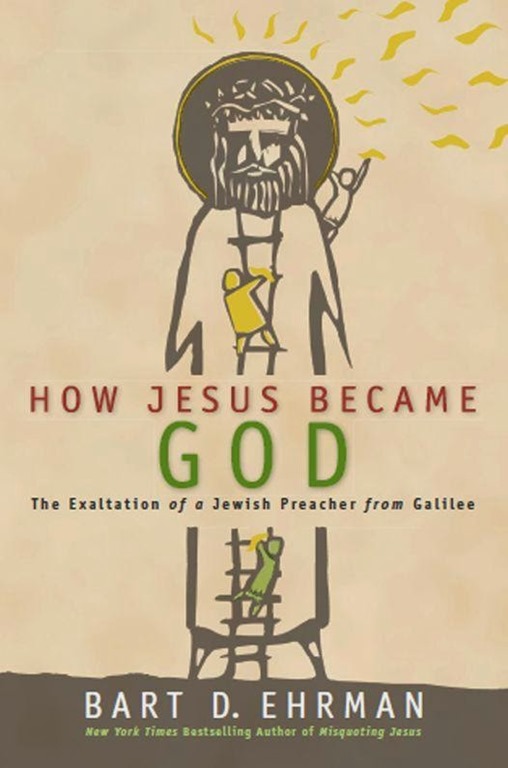
How Jesus Became God by Bart D. Ehrman

There once was a guy named Jesus.  He sounded like a pretty cool guy if you believed some of the savings he was supposed to have said.  Then his followers made him into God, and people became more interested in what was said about him, rather than what he said.  That’s too bad.  Bart D. Ehrman, has written a book that explains how Jesus became God after he died, and then became God while he was alive, and then became God before he was born, and then became God before any of us were born.  Ehrman’s book could have also been called When Jesus Became God, and to a very minor degree, it could have been called Why Jesus Became God.

I would have entitled it, Too Bad Jesus Became God.
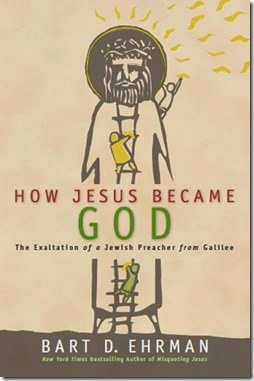
How Jesus Became God

How Jesus Became God is a history book.  It’s not about theology, but many readers will find it undermines their beliefs.  To be fair, Ehrman bends over backwards, constantly explaining how and why he’s writing history, wanting to avoiding any theological implications.  We’ll never know the theological truth in this life, but we can get ever closer to the historical truth.  By summarizing how the followers of Jesus changed their opinions about the man they worshipped in the decades and early centuries after his death, we don’t learn anything new about Jesus, but a whole lot about the history of Christianity.  Because Jesus left no primary sources about what he believed, we can never know anything about the man, all we can know is what other people thought about him long after he died.

I’m afraid when the faithful read this book they will bring their beliefs to the reading and that will distort what Ehrman has to say.  Ehrman  stands outside of Christian faith and ask the question:  How did Jesus become God?  He is a historian, so he makes no assumption whether Jesus is actually God or not, but analyzes what we know about early Christians to decide how they made Jesus into a God.  Ehrman uses textual analysis to date each idea about Jesus that emerged after his death, and to pick through the paltry facts like a CSI detective hoping to find additional clues.  Ehrman tries to answer two main questions.  First, did Jesus think of himself as God or divine?  Second, studying the writings of Paul, the four Gospels, and Acts, Ehrman asks, when did his believers think Jesus became God – at his resurrection, his Baptism, his conception, or from the beginning of all time?

Bart D. Ehrman introduces his book at Huffington Post.  It’s a good summary to read if you’re thinking about buying the book.  He opens with:

Jesus was a lower-class preacher from Galilee, who, in good apocalyptic fashion, proclaimed that the end of history as he knew it was going to come to a crashing end, within his own generation. God was soon to intervene in the course of worldly affairs to overthrow the forces of evil and set up a utopian kingdom on earth. And he would be the king.

It didn’t happen. Instead of being involved with the destruction of God’s enemies, Jesus was unceremoniously crushed by them: arrested, tried, humiliated, tortured, and publicly executed.  And yet, remarkably, soon afterwards his followers began to say that — despite all evidence to the contrary — Jesus really was the messiah sent from God. More than that, he was actually a divine being, not a mere human. And not just any divine being. He was the Creator of the universe. After long debates among themselves they decided that he was not secondary to the one God of Israel, the Lord God Almighty himself. On the contrary, he was fully equal with God; he had always existed for eternity with God; he was of the same essence as God; he was a member of the Trinity.

How did that happen? How did we get from a Jewish apocalyptic preacher — who ended up on the wrong side of the law and was crucified for his efforts — to the Creator of all things and All-powerful Lord? How did Jesus become God?

To Christians, Jesus is God, but to historians, Jesus is no different from any human in history.  Ehrman is studying the theologians and not the theology.  If you are willing to take How Jesus Became God as a purely history book it’s quite fascinating and illuminating about the early development of Western civilization.  If you are a believer, this book could be painful because it treats Christianity no different from pagan mythology that also existed in the first centuries of the common era.

I hope this won’t be insulting to Christians, but most of the ones I know aren’t very intellectual about their theology.  Most, just want to believe in God, an afterlife, heaven, and the promise they will meet their dead kin and friends again.  How that happens is inconsequential to them.  That’s why modern Christianity is based on faith and belief.  Reading How Jesus Became God will show there is a complex history of theology to how belief in believing evolved.  Ehrman makes an excellent case that while Jesus was alive, and even just after he died, Christians believed you had to do good deeds to get into heaven, and that Jesus did not think of himself as divine.  It took decades, centuries even, to evolve the theology that Jesus was Christ who existed since the beginning of time as God and believing in him will earn you eternal life in heaven.

This book is about how the followers of Jesus went from thinking of Jesus as a human being to thinking of him as the Trinity.  Ehrman documents this from what we know from history.  Unfortunately, most of what we know comes from The New Testament, Apocrypha writings, and Gnostic texts.  Ehrman’s history is really close textual readings because we have few outside sources about these events.  Christians might appreciate Ehrman’s careful delineations between the writings of Paul, the four Gospels, and Acts.  What it comes down to is Paul, and the writers of the four gospels had different ideas on when Jesus became God – resurrection, Baptism, conception or the beginning of time.  Then the early church fathers argued over these concepts for centuries.

That might seem like meaningless quibbling to most believers, but it does explain why the four Gospels differ.  The Gospel of Mark doesn’t include the story of the virgin birth, but that’s because it suggests that Jesus became divine at the resurrection.  The writers of Matthew and Luke seem to imply Jesus became divine at Baptism or conception.  To have Jesus become divine at conception you need the virgin birth tale.  The author of John recreates the ontology of Genesis to put Jesus as God back at the beginning of time.

Now I’m an atheist, but I find all of this fascinating.  And I might have a different take on Ehrman’s book, but since I’m not widely read in Christian history, I don’t know how common my questions are.  Jesus and his disciples were lower class folk, who were probably illiterate and spoke Aramaic and Hebrew.  The writers of the Gospels were educated, literate, and spoke and wrote Greek.  I’m wondering if they knew about Greek philosophy and if their theology is a mixture of Hebrew mythology, stories about Jesus, and Greek philosophy.  Is The New Testament a cold front of religion meeting the warm front of philosophy?

By the way, we’re leaving Ehrman and moving into my own ideas.  I’m into science, but science wasn’t invented yet.  At the time of evolution of The New Testament people had very few tools to understand reality.  The first, and oldest tool is religion.  Religion basically says “God did it” to any question about the mystery of reality.  Why is there thunder?  It’s a god.  How did the universe start?  God created it.  In terms of understanding the truth, religion offers no validity or real answers.  It’s all speculation and wild ideas.

Then came philosophy.  Philosophy assumes humans can figure out how things work.  Philosophy starts observing reality for clues, but all too often it comes up with bizarre theories for answers, and eventually these are contrived into elaborate beliefs.  Because philosophy uses logic and rhetoric, it gives the impression that it’s intellectually superior to religion, even though most of its answers about reality are hardly better than religion.  However, logic is sexy, so believers prefer philosophical answers over the dictates of religion, which is basically, “God did it.”  Paul is the Plato of Christianity, and Jesus is his Socrates.  And the guy who wrote The Gospel of John is out there, way out there, both mystical and philosophical, like one of the Pythagoreans.

From my perspective, Paul is the real creator of Christianity, but he lost control of his religion to the later writers of The New Testament.  What Ehrman’s book does is try to chronicle how these later writers change the scope of Christian theology.  Even more fascinating is the Gnostic gospels, which appear to try to take Christianity in even stranger directions.  What became Orthodox Christianity in the first four centuries of the common era is what worked best at selling a belief that took hold of the Western world for the next sixteen centuries.

Modern day believers of Christianity believe because they hear a few ideas in childhood that are so powerful it overwhelms all their thinking.  What Ehrman’s book attempts to do is explain how these memes got created.  Many other writers of Christian history attempt to do this too, but Ehrman seems to be particularly good at it, with clear writing, sensible logic and a humble attitude.  Ehrman has written a series of books that reflect a lifetime of careful research that explain how and why The New Testament was written.  He’s very knowledgeable about The Old Testament, but The New Testament is his specialty, his life’s work.

Most Christians aren’t interested in an intellectual history of their faith.  Their religion gives them a wonderful sense of community, beliefs that comfort them in life, and faith that assures them they won’t die, so they know they will meet their departed loved ones in the next life.  However, there are Christians, especially evangelicals and fundamentalists who are profoundly interested in the intellectually validity of their beliefs and will go to extremes to validate their faith.  Ehrman’s book will cause these people problems.  This gets back to my point about philosophy.  Philosophy appears to reveal the truth, but it doesn’t.  Science is the only system we’ve invented yet that reveals consistencies in reality that we can accept as being true.  What we’re experiencing now is the cold front of philosophy banging into the warm front of science.

What Ehrman brings to the table is history, a discipline that is far more consistent than philosophy, but still not science.  The fundamental faithful are strong adherents of philosophy, which includes rhetoric and logic.  They are confident these tools reveal the truth of reality.  But science is showing them that their philosophy is a very poor tool for understanding the truth of this reality.

What Ehrman has accidently taught me is fundamentalists love philosophy because The New Testament is a product of philosophy, and not religion.  The Old Testament was pure religion.  The New Testament is a hybrid of religion and philosophy, with the later writers of The New Testament being the most philosophical.

And it’s not that philosophy can’t be a useful tool, but it’s only useful if it incorporates the rigors of science.  Science depends on logic, and to a degree rhetoric, but is actually about consistency of observations.   Science, for the most part, can’t be used to verify theology, because most theology involves the metaphysical, which can’t be observed, tested, and is not falsifiable.

Christianity met up with Greek philosophy again when it kicked the Muslims out of Spain.  But that’s not part of Ehrman’s book.  I’ve always thought that was Christianity’s first encounter with Greek philosophy, but now I’m thinking different.  The New Testament writers were the first influence of Greek philosophers on Christianity, they just didn’t mention their educational background.

It would be fantastic to have a time machine and track down the real Jesus and give him a copy of The New Testament and How Jesus Became God.  I get the feeling he’d probably read them and say, “Hey, these stories are about a guy with my name,” and never notice they were about him.

I’m am reminded of stuff I’ve read by Karen Armstrong and Robert Wright, especially in A History of God and The Evolution of God.  The God of The Bible has gone though quite a lot of changes himself.  He’s a combination of several gods that slowly evolved over a very long period of time.  Each time one people would conquer another people, their gods would merge, or one would supplant the other.  To me, Jesus became God because Christianity supplanted older religions and had to incorporate or bury older deities, creeds, traditions, etc.  Jesus essentially becomes the new God that usurps the Jewish God of The Old Testament, in the same way Yahweh supplanted earlier gods like El, Asherah and Baal.

The early Christians had to do this to succeed and thrive, and boy did they thrive.  But it sure is sad that they lost Jesus along the way.  It would be interesting to compare the revisionists techniques in the Quran and The Book of Mormon to see how they try to supplant Christian theology.

I wish Jesus had written down his ideas like Plato.  To me, humans are interesting, gods are not.

JWH – 7/8/14