Is This Cartoon Sexist?

by James Wallace Harris, Tuesday, January 1, 2019

I told my wife I was going to put this cartoon on my Facebook page and she said I shouldn’t because it might be considered sexist. It’s a cartoon by Alex Gregory whose work appears exclusively in the New Yorker. You can read an interesting bio of Gregory and a description of his work methods at A Case of Pencils, a blog devoted to New Yorker cartoonists.

I didn’t post the cartoon on Facebook because I’m now worried it could be sexist, but I wasn’t sure either. I asked a few women friends and some said it was okay and some weren’t sure. None took offense. So I went looking for definitions to “sexist” online. I was surprised by how many different definitions I found.

  • referring to women’s bodies, behavior, or feelings in a negative way
  • a person who believes that particular jobs and activities are suitable only for women and others are suitable only for men
  • suggesting that the members of one sex are less able, intelligent, etc. than the members of the other sex
  • a person who believers their gender is superior and says unfair things about the other gender, or assumes that only one gender as a certain trait
  • relating to or characterized by prejudice, stereotyping, or discrimination, typically against women, on the basis of sex
  • a person with sexist views
  • if you describe people or their behavior as sexist, you mean that they are influenced by the beliefs that the members of one sex, usually women, are less intelligent or less capable than those of the other sex and need not be treated equally
  • relating to, involving, or fostering sexism, or attitudes and behavior toward someone based on the person’s gender
  • involving sexism and the belief that men and women should be treated in a different way

By studying these definitions I might need a Supreme Court ruling to know if this cartoon is sexist or not. Part of the humor of this cartoon is it plays around with all of these issues. It assumes the stereotype that men are usually in the car and women are looking in the window. Just reversing roles is funny. If the man wore hotpants and the woman a suit, it would be a different kind of funny even without a caption. The cartoon is making generalizations about men and women behaviors, but are those generalizations negative? Is it an absolute generalization? Few people are prostitutes or hire them, so maybe it’s making no absolute assessments about either gender. However, many people, including myself, see prostitutes as victims of a sexist society.

I think the first thing we should ask: Does it offend anyone? Now I can’t answer that because I don’t know how all seven-plus billion people on Earth think. The next question: Could it offend anyone? And this is my present quandary. I don’t want to offend anyone, nor do I want to be perceived as sexist. The prudent solution: never generalize about gender. I shouldn’t be writing this essay and I shouldn’t post anything on Facebook that could ever be construed as dealing with gender differences.

I feel sorry for comedians, humorists, and cartoonists. This morning I read “These 13 Jokes From ‘Seinfeld’ Are Super Offensive Now.” I have to admit I thought them funny back in the nineties. So much of humor is observational generalizations.

But here’s the thing, almost everyone along the gender spectrum likes to occasionally generalize about others on the spectrum. This cartoon is funny to some people because it makes observations that coincide with their personal observations. We have a natural ability for organizing patterns into behavioral traits. We see certain kinds of clouds and we think it’s going to rain. We see certain prices on a menu and decide a restaurant is expensive. We see a movie preview with a superhero and we assume it’s based on a comic book. All of these can be false assumptions, so this ability creates a lot of prejudices.

What is this cartoon assuming? Even here I can’t say for sure. Everyone will see something different. My assumption is women think men don’t listen and wouldn’t it be funny if some women are so horny to be heard that they will pay for a professional male listener. However, I know men who feel women don’t listen, and a reverse of this cartoon could work for them. There are stories about prostitutes with Johns who pay just for conversational companionship.

Cartoons about prostitution generally involve men who can’t get laid paying women for sex. Should men consider such cartoons as demeaning to them? I would never use a prostitute. Should I be offended by the possible suggestion that all men would? Or will some women be offended at the suggestion that some women would be willing to pay to be heard? And will psychiatrists feel offended if they think their profession is a kind of prostitution?

I would guess that many women would say they know plenty of men who are poor listeners so the idea of paying a man to be attentive to their conservation all night long could be funny. Is that an insult to men? I know plenty of men who complain about having to listen to their wives and girlfriends, so this cartoon should be funny to them, but will it offend women in general? The reason why I even have this cartoon is one of my male friends thought it insightful because he feels his girlfriends talk too much. I thought it funny because so many women I know seem to like me because I’m willing to listen. I thought I could be that guy in the cartoon.

Maybe the humor is even simpler. Maybe its saying men want sex and women want conversation. Many married couples might agree, but does a portion of the population seeing humorous validity mean its not offensive to couples where the woman wants sex and the man conversation?

And where’s the inequality? Is it offensive to desire talk more than sex?

But you never know what words will do. For example, when I wanted a copy of this cartoon I searched on Google for “Male Prostitute” and selected the Images tab. I got copies of the cartoon but I also got mug shots of male prostitutes. It didn’t even occur to me what those words could also bring up. That’s the thing about worrying about offending, we never know the full consequences of words.

(Now I worry about what kind of ads I’ll be seeing in the next few days.)

JWH
 

2018 Year in Reading

by James Wallace Harris, Sunday, December 30, 2018

I read 44 books this year. More than the 36 I read in 2017, but less than the 55 I read in 2016. I aim for a book a week average, so I’m off my pace. See “Year in Reading” for links to my past summaries.

My reading goal for this year was to read less science fiction and more classic literary novels and nonfiction. I wanted to keep science fiction to just one book a month but failed. I ended up reading 29 science fiction books, including 12 anthologies. This was my year of reading science fiction short stories.  I need to give up making reading goals.

Book of the Year

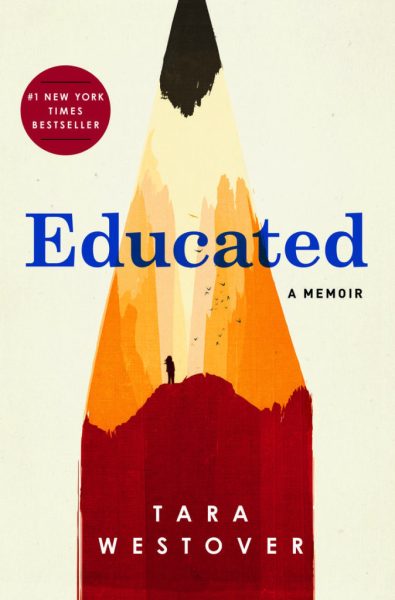
west_9780399590504_jkt_all_r2.indd

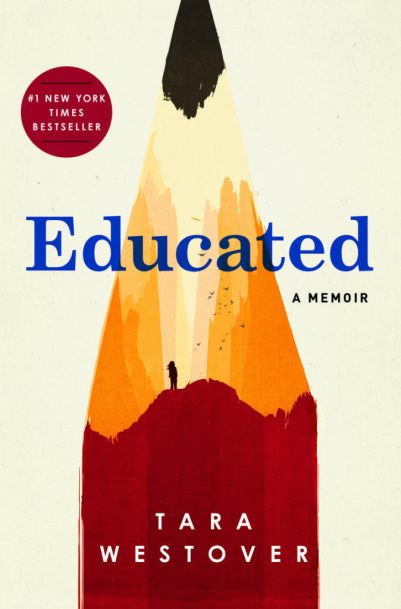
Educated is so dazzling that I still wonder if it’s true. Tara Westover has written a stunning memoir of growing up without any K-12 schooling, almost no homeschooling, and yet ends up getting a Ph.D. at Cambridge. Along the way she also goes to Harvard.

Runner-up is The Fifth Risk by Michael Lewis who reports on Donald Trump’s impact on the Department of Energy, the Department of Agriculture and the Department of Commerce. His book provides abundant evidence why conservative philosophy against big government is simple-minded insanity.

Favorite Novel I Read This Year

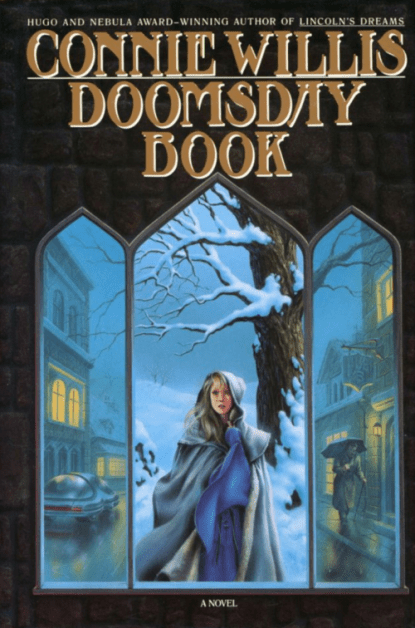
Doomsday Book by Connie Willis 500

For years I’ve avoided reading Connie Willis’ 1992 Hugo Award-winning novel Doomsday Book because of its size. It’s about a young woman time traveler, Kivrin, who is sent back to research life in the Middle Ages, at a small hamlet near Oxford. The book is riveting, and I highly recommend the audiobook edition because the writing is beautiful to hear. This tale is slow, very slow, but I couldn’t stop listening. The story is not meant to be action-pack exciting. Time travel in science fiction usually involves big loud plots, but Connie Willis makes her story very quiet and personal with an abundance of significant tiny details.

Favorite 2018 Novel I Read This Year

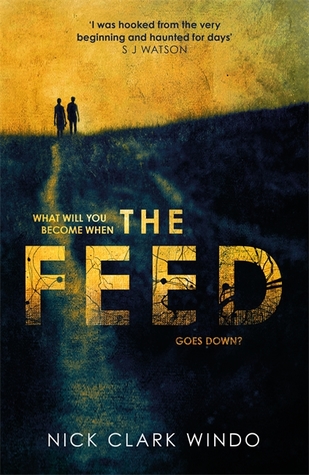
The Feed by Nick Clark Windo

I only read two 2018 novels this year, and the other Semiosis by Sue Burke was excellent too. The Feed is hard to describe without giving away too many plot points. It’s a literary post-apocalyptic SF novel like Station Eleven or The Road. And it’s somewhat deceptive. It starts out as a fantastic story about a future technology called the feed, which builds internet access right into everyone’s head. Our world becomes a very different place, and I would have loved to read a whole novel about the possibilities. However, Windo is only setting us up for another story, because the narrative quickly jumps six years in the future where civilization has collapsed because of the feed technology.

There were times in this novel I wanted to stop listening because the story got too slow and even weird. But I’m thankful now that I stuck with it. Before we get to the end of this book, Windo uses many science fictional themes in wonderful ways to tell a complex but very human story.

Again, I highly recommend the audiobook version. Nick Clark Windo is an actor, and the story is told in a dramatic fashion. The dialog is movie-like rather than book-like as if Windo pictured performing this story rather than writing it. Windo and Clare Corbett are the narrators, who switch between the male and female point of view characters. Both are perfect for this story.

Books Read 2018

Robert Silverberg editor The Science Fiction Hall of Fame Volume One Audible 1970
Jules Verne Journey to the Center of the Earth Audible 1864
Mari/Brown Ocean of Storms Audible 2016
Asimov/Greenberg editors The Great SF Stories #1 (1939) Hardback 1979
Alfred Bester The Demolished Man Audible 1952
Asimov/Greenberg editors The Great SF Stories #2 (1940) PDF 1979
Ben Bova editor The Science Fiction Hall of Fame Volume Two A Audible 1973
Bart D. Ehrman The Triumph of Christianity Audible 2018
David Grann Killers of the Flower Moon Scribd Audiobook 2017
Jessica Bruder Nomadland Scribd Audiobook 2017
Asimov/Greenberg editors The Great SF Stories #3 (1941) PDF 1980
Elizabeth Stroud Anything is Possible Scribd Audiobook 2017
Jack McDevitt The Long Sunset Kindle ebook 2018
Ben Bova editor The Science Fiction Hall of Fame Volume Two B Audible 1970
Scott Kelly Endurance Scribd Audiobook 2017
Jonathan Strahan The Best Science Fiction & Fantasy of the Year Volume Eleven Audible 2017
Douglas Adams The Hitchhiker’s Guide to the Galaxy Scribd Audiobook 1979
Nnedi Okorafor Binti Scribd Audiobook 2015
Robert L. Forward Dragon’s Egg Scribd Audiobook 1980
Robert Silverberg Sailing to Byzantium YouTube Audio 1985
Gene Wolfe The Fifth Head of Cerberus YouTube Audio 1972
Samantha Silva Mr. Dickens and His Carol Scribd Audiobook 2017
Asimov/Greenberg editors The Great SF Stories #4 (1942) PDF 1980
Asimov/Greenberg editors The Great SF Stories #5 (1943) PDF 1981
Nancy Kress Beggars in Spain Audible 1993
George Saunders Lincoln in the Bardo Audible 2017
Jonathan Strahan The Best Science Fiction & Fantasy of the Year Volume Twelve Audible 2018
Asimov/Greenberg editors The Great SF Stories #6 (1944) PDF 1981
Edgar Pangborn A Mirror for Observers Trade paper 1954
Elizabeth Moon The Speed of Dark Audible 2002
Rebecca Solnit Men Explain Things To Me Kindle ebook 2014
Connie Willis Doomsday Book Audible 1992
Zora Neale Hurston Their Eyes Were Watching God Audible 1937
Tara Westover Educated Scribd 2018
Murray Leinster The Forgotten Planet Audible 1954
Alec Nevala-Lee Astounding Audible 2018
Sue Burke Semiosis Scribd 2018
Nate Blakeslee American Wolf Scribd 2017
Adrian Tchaikovsky Children of Time Audible 2015
Robert A. Heinlein Friday Audible 1982
Michael Lewis The Fifth Risk Kindle ebook 2018
Asimov/Greenberg editors The Great SF Stories #7 (1945) Paperback 1982
Nick Clark Windo The Feed Scribd Audiobook 2018
David Sedaris Calypso Audible 2018
Jeff Flake Conscience of a Conservative Scribd Audiobook 2017

I assume I’ll continue reading science fiction anthologies next year. There are annual best-of-the-year anthologies for science fiction short stories starting with 1939. I began this year with reading 1939 stories and have read my way forward in time. I’m currently reading 1946 stories. I’d like to get to 1960 by the end of next year. However, starting with 1949 there are two anthologies for each year, and for a few years in the 1950s, three each year. I might only make it to the mid-1950s.

Other than gorging on short science fiction, I’ll make no promises for 2019.

JWH

The Most Recommended Books of 2018

by James Wallace Harris, Friday, December 28, 2018

I love December because of all the best-books-of-the-year lists. I used to compile all the lists I could find into a spreadsheet to identify the most loved books of the year. But for the last two years, Emily Temple at Literary Hub has performed that task for me and collected far more lists than I would ever have the patience to track down. See: “The Ultimate Best Books of 2018 List” where she aggregated 52 lists from 37 publishers totaling 880 separate titles. If you scroll all the way down to the bottom of the page you’ll find links to all those lists.

Temple found two books that were on 19 of the 52 lists, My Year of Rest and Relaxation by Ottessa Moshfegh and There There by Tommy Orange, both novels, and both will be available to listen to on Scribd 1/3/19. With such universal acclaim, I believe I’ll have to try them. I can say, when I’ve read books that have been on most of the best-of-the-year lists, they have always been intensely good. The wisdom of the crowds does works.

Best 3 SF novels 2018

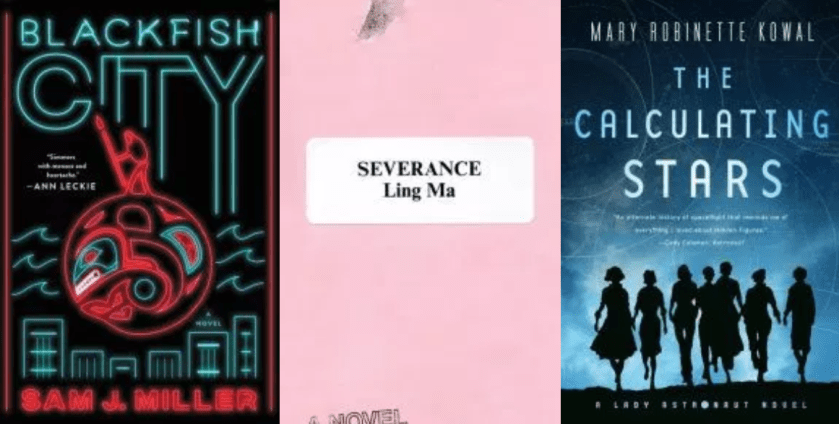
I did compile 6 best science fiction books of the year lists to create a similar style report, see “Best of the Best Science Fiction 2018.” Strangely, Emily’s work did not overlap with my lists of best-science-fiction of 2018. My top discovery, Blackfish City by Sam J. Miller was on 5 of the 6 lists I found, but on none of Temple’s lists. However, Severance by Ling Ma was on 4 of the 6 lists I found, and 7 of the 52 lists she found. I don’t think she used any of the best science fiction book lists I used. If she had included those 6 lists, Severance would have been on 11 lists, putting it very high in Temple’s ultimate list. She did include some lists for fantasy books, but not science fiction. My final list had 8 books that had been on at least 3 of the 6 lists. Temple’s cutoff for her final list were all books that had been on at least 3 of the 52 lists. That means several science fiction books I discovered would have made Temple’s final list.

Because Temple missed the science fiction books, I’m tempted to do my own list of nonfiction books that were on the most best-of-the-year lists. Her top nonfiction book was Educated by Tara Westover, which I’ve read and loved. It was on a total of 16 lists.

west_9780399590504_jkt_all_r2.indd

JWH


The Artificial Geminid Meteor Shower

by James Wallace Harris

Sometimes it’s easy to be fooled especially when you think you know more than you do. Last week my wife came inside one evening and told me there were strange lights in the trees. She wondered if they could be fireflies this late in the year. So I went out to look too. There were random green lights, but I thought they were above the trees, way up in the sky, and they were in patches of sky not blocked by bare tree limbs.

“I wonder if they could be meteors?” I asked Susan.

“I don’t think so.”

“But the Geminid meteor shower was supposed to happen around this time of year. It was on the news.”

“But they don’t look like shooting stars,” she replied sounding skeptical.

They looked like little tiny flashes of green. And occasionally, a tiny white streak.

“Maybe because we’re in the city they don’t show up well.” I could see Orion and the green flashes were in the right area for Gemini, although I couldn’t see the constellation. And every once in a while there was a small white streak. “Maybe they’re leftover dust from the main shower.”

The more I looked at them, the more they looked like something way up in the sky, like in the upper atmosphere. But then I have bad eyes.

Susan seemed doubtful. And we finally went in.

The next day I read about the meteor shower but I couldn’t find any descriptions that described glittering green lights and flashes. I told Susan about my research. She seemed more convinced. The next night we looked again, but the sky was clear. Susan told our neighbor EJ about my theory.

On the third night, Susan was outside and texted me “The meteors are back.” She also texted our neighbor and he got his wife and kid up. By the time I came outside, they were laughing at me. EJ said those were his laser Christmas lights. I was disappointed my theory was wrong. And EJ ribbed me that he got his son out of bed for nothing.

I should have been embarrassed for making such a silly mistake, but those lights really looked like they were high up in the sky. So I argued I made the best assumption with the evidence I had. And I still think I saw a couple of real meteors mixed in, the short white streaks.

I’ve been out in the country and seen a real meteor shower, which is quite dramatic, so I shouldn’t have been fooled. But this was an interesting lesson. It made me wonder what people thought of meteor showers before they knew about astronomy. Guessing what the mysterious lights were in the sky made me feel a tiny bit of awe. It’s a shame they were laser lights. They did look really cool.

Here’s the 2019 Meteor Shower Calendar from IMO (International Meteor Organization). I’m going to get everyone out in the backyard for the next one, which will be January 3-6th, for the Quadrantids. Although, the Ursids are still active.

JWH

Reading Science Fiction Year-By-Year

by James Wallace Harris

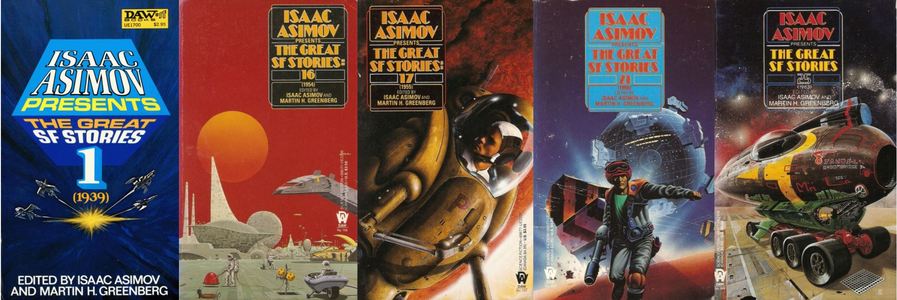
Back in February, I started reading The Great SF Stories series of 25 books edited by Isaac Asimov and Martin H. Greenberg. They collect the best short stories of the year, starting with 1939 and running through 1963. I’m now reading on volume 8 covering 1946. I even started a discussion group hoping other people might join me. 27 people joined, but so far only a couple people have made comments, and only George Kelley has begun to read the books in order too.

George started first with reading Best SF Stories series edited by Everett F. Bleiler and T. E. Dikty that ran 1949-1959, which he’s since finished. He felt science fiction stories in the 1950s were better than those stories from the 1940s. Many older fans consider 1939 the beginning of the Golden Age of Science Fiction and the 1950s was science fiction’s Silver Age, but I have to agree with George, science fiction gets progressively better each year. I’m looking forward to reaching the 1950s.

Reading science fiction year by year is very revealing. For example, in 1946 many of the stories were about how to live with the atomic bomb. During the war years, there were a handful of stories that predicted atomic bombs, atomic energy, dirty bombs, nuclear terrorism, and how atomic age technology would impact society.

Science fiction had to change after August 1945 because of the reality of atomic weapons. What’s interesting is we remember the predicting stories like “Blowups Happen” (1940) and “Solution Unsatisfactory” (1941) by Robert Heinlein, “Nerves” (1942) by Lester del Rey,  and “Deadline” (1944) by Cleve Cartmill, but we don’t remember “Loophole” by Arthur C. Clarke and “The Nightmare” by Chan Davis, both from 1946. “The Nightmare” is of particular interest to us today because it’s about monitoring the trade in radioactive elements and the construction of atomic energy plants.

Probably the most prescience story I’ve read so far is “A Logic Named Joe” (1946) by Murray Leinster. Computers were still human calculators in 1946, so Leinster calls a computer a logic. He imagines a future where there’s a logic in every home, all connected to huge databases. And he foresees people would consult their logic for all kinds of information from the weather to how to murder your wife. He even imagines routines to keep kids from looking up stuff they shouldn’t. Leinster imagines banking, investing, encyclopedic knowledge, and all the other stuff we do with the internet.

The story itself is about an emergent AI named Joe begins to process the data himself and answers questions on his own that science and society have yet to know. Imagine if Google could tell you a great way to counterfeit money? Or how to invent something that would make you a billionaire. In other words, Leinster imagines disruptive technology. He even imagines kids searching for weird kinds of porn when the nanny-ware breaks.

If you’d like to see which science fictions stories were the most popular for each year, use this new tool we’ve set up that uses the Classic of Science Fiction data. Books come from over 65 lists recommended SF, and short stories come from over 100 anthologies that reprinted the best science fiction from the past.

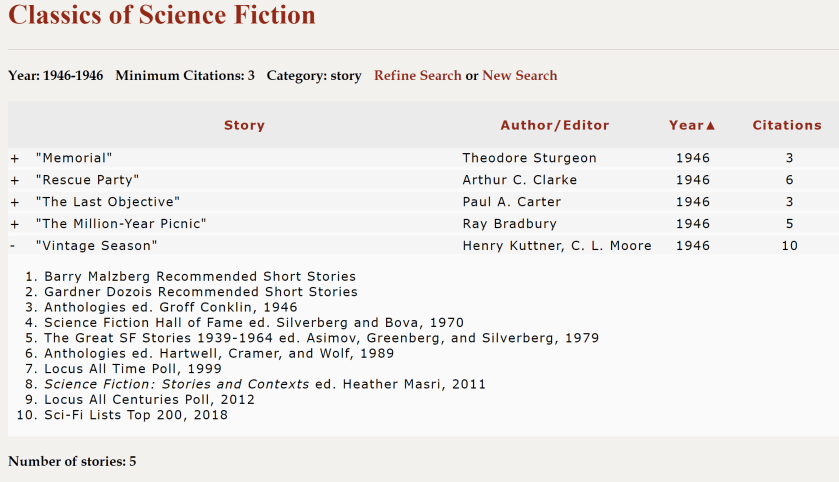
To see the most remembered short SF from any year, just set the min and max year to the same year. Check the story radio button. And change the citations from 1 for all stories to 16 for the absolute best. Hit search. You can sort the columns by clicking on the column headings. For example, there are a total of 22 short stories remembered by our citation sources for 1946. For the Classics of Science Fiction Short Stories, we used a cutoff of 5 citations. That meant only three stories were remembered well enough from 1946 to meet our standards. However, you can set your own criteria. The most remembered story from 1946 is “Vintage Season” by Henry Kuttner and C. L. Moore, which had 10 citations. Here’s the CSFquery set to a minimum of 3 citations. You can see the citation sources by clicking on a title line.

1946 with a minimum of 3 citations

Notice “A Logic Named Joe” isn’t on the list. How can this be after I praised it so highly? Here’s a list of all the places it’s been anthologized. For some reason, it’s never made it in any of the great retrospective SF anthologies. That’s a shame.

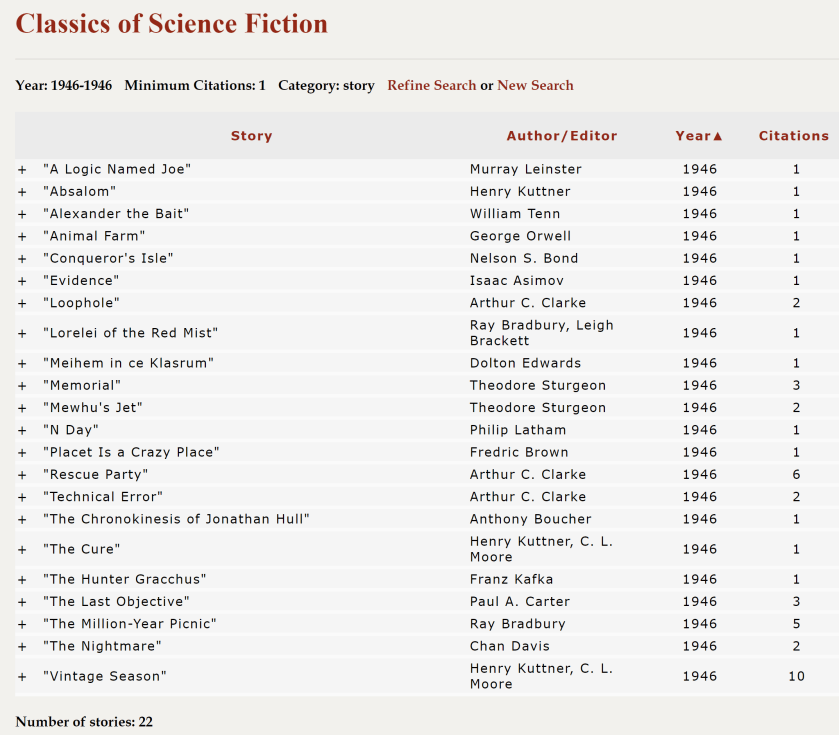
Here’s the same query but with citations set to 1, which gives all the cited SF stories for 1946. I now have to worry that other stories with only 1-4 citations might deserve to be remembered.

1946 with a minimum of 1 citations

JWH