How Many Books Would You Have to Buy to Manipulate Amazon’s Author Rank Page?

How many friends would a writer need to buy their books to get on Amazon Author Rank page?

Amazon says it’s Amazon Author Rank pages are based on hourly sales.  The New Times Best  Seller list seems based on weekly sales.  We don’t know if Amazon is basing their rankings on hourly total sales, or the weekly sales looked at hourly.  So I’m speculating here.  I sorely wished Amazon gave the actual number of books sold.  That would be fascinating.

Let’s say there are 730 hours in a month on average.  If a book sells a million copies in one month, it’s selling at 1370 books an hour.

There is 168 hours in a week, so if a book sells a million copies in one week, then it’s selling 5,952 copies an hour.

It would be very expensive to manipulate the Author Rank page if books are selling that fast.  However, few books sell in the millions.

Let’s drop down into the Science Fiction Author section for books, not Kindle sales, where we see many less famous authors, and book sales are less furious.  Would it be possible to affect the Author Rank at this level?

My favorite science fiction author is Robert. A. Heinlein.  He’s currently #34 on this list (#36 when I started writing).  How many books would we have to buy in one hour to bump him to the #25 spot?  Heinlein has been dead for a long time, so it’s surprising his continual sales are so high.

heinlein-author-rank 

How successful is #34 on this list?  Amazon represents book sales for all of America.  So in any given hour how many people think, “Wow, I’m in the mood for a Heinlein book?”  What if that number is 25 books?  That’s a rate of 219,000 books a year.  If he sold 100 an hour that would be 876,000 books.  Remember, these rankings are based on sales of all books sold by the author.  My guess is Heinlein sells between 25-100 books an hour.  That’s just a hunch. 

And what if the #25 position author sold just 50 books to get to that position?  If I could talk 25 people into buying Heinlein books Saturday morning at 10am Eastern time, would his sales rank jump in the 11 o’clock hour to #25? 

Maybe the #25 position is selling 100-400 books an hour – too many to manipulate easily, but almost any news about Heinlein on TV, or in  magazines, or even on the Internet, could sell that many books.

Let’s imagine Heinlein is profiled on CBS Sunday Morning.  This won’t happen, but it might for a newer science fiction writer.  Such a lucky bit of press could send her to the top of the Science Fiction list for Authors, or even put her on the main Author Rank list.

The current author at the bottom of the Science Fiction Author Rank page is Mark Kalina with a single 99 cent ebook, Hegemony.  It shouldn’t even be on this list because I picked the Books list rather than the Kindle list, however, there he is with a single self published novel.

I’m thinking it doesn’t take too many book sales to get on this list, but it takes a lot of sales to get near the top.

I’m curious why Lois McMaster Bujold is at #63.  Bujold is a very popular writer with many award winning books in print.  Sales of all those books add to her Author Rank sales totals.  So why are many unknown writers selling Kindle books beating Bujold in the rankings?  My only guess is science fiction sells very few books per hour.  So an ebook author selling several $1.99 titles out sells a major author selling many physical books from $7.99 to $25.

I really can’t believe Heinlein is outselling Bujold.  I hear far more people talk about reading Bujold than Heinlein.

Either that, or Amazon Author Rank Beta isn’t working very well.

Selling ebooks cheap must be big business.  It might also imply that the science fiction book marketplace is very tiny.

Does this mean selling $1.99 ebooks leads to more fame and profit than selling physically printed books that sell for much more money per copy?

I really wished Amazon would put the total sales with the rank numbers.  Like:

Robert A. Heinlein #34 (127 books sold from 27 titles, for $13,750)

JWH – 10/15/12

The Implications of Amazon’s Author Rank Page

Amazon has a beta program for ranking book sales by author that is somewhat controversial, at least with some writers, according to the LA Times.

Amazon says the rankings are based on all books sold by an author updated hourly .  I assume it’s total sales for the previous hour, and not total cumulative sales.  This is a new, never before seen, way to look at book sales I think.

Before the Internet,  the premier best seller list for books was the New York Times Best Sellers list.  If a you got on it, you were made as a writer.  Now there are zillions of best seller lists, but probably the most important one is Amazon.com sales ranking for all books.  Amazon is such a powerhouse at selling books that their sales rankings are a national poll showing the reading interests of the American public.

Amazon is now taking the book buying pulse of Americans based on an author’s sales hourly.  That’s kind of cool.
amazon-author-ranking

However, Amazon isn’t the be-all-end-all of bookselling, as John Scalzi so carefully points out.

Among my online book club friends, they commonly complain that Amazon’s new Author Rank list doesn’t reflect 1) quality of writing, 2) their favorite writers or 3) the best authors according to whoever.   But was that ever the point of best seller lists?

I think we need to take the Amazon Author Rank pages with several grains of salt.  Let’s assume they don’t reflect true U.S. sales, writing quality or best of anything.  Let’s just assume it’s a Gallup Poll for what readers are buying every hour of the day, what do the various Author Rankings tell us?  In polling, the quality of the poll depends on the sample size, and Amazon’s sale figures are a huge sample size.

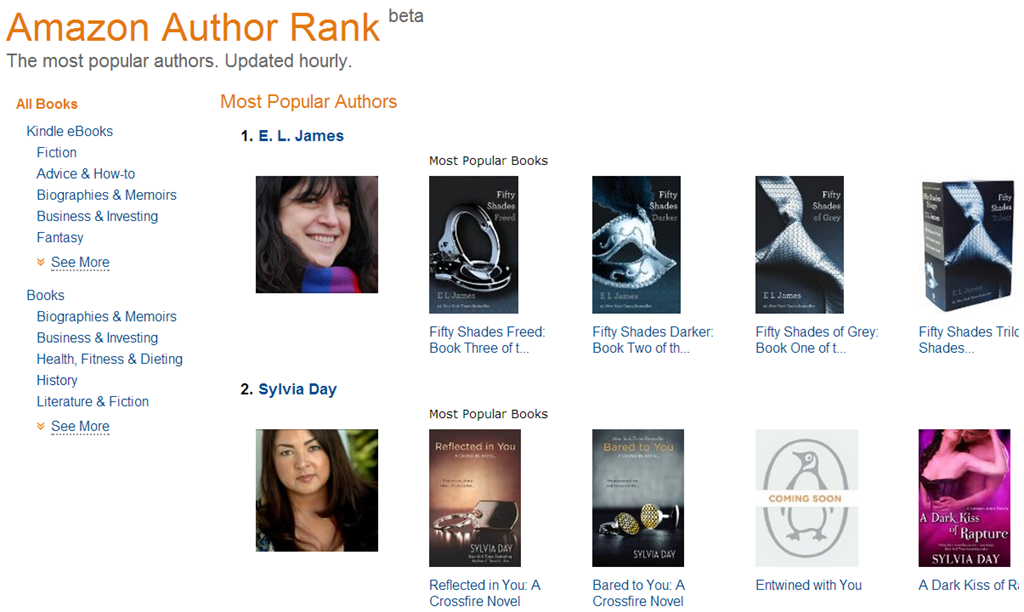
The fact the E. L. James is the #1 best selling author at Amazon (her books 4, 5, 6 on the current NY Times combined list), and Sylvia Day is #2 (#1 on NY Times) is very revealing.  It bugs me that people criticizes Amazon’s Author Ranking system as a huge failure because they hate E. L. James for whatever reason, but usually because they think she’s a bad writer.  Big fucking not the deal.  Talk about not seeing the forest for the trees.  Americans are gobbling up James’ erotic novels like there’s no tomorrow, so what does that mean?

We’ve long heard the truism – sex sells – and boy is this proof.  I just finished a book Mrs. Robinson’s Disgrace, about sexual repressed Victorian English society of 1858, but the success of E. J. James makes me wonder if we’re not just as repressed 154 years later?  I know I’m going to be shot down for being sexist, but are the huge sales of erotic and romance novels bought by women telling us something about women in general that’s not being reported in the news and literature.  In another 154 years will future writers explain all the clues were there in our times about some huge gender issue we’re not recognizing now?

Romance, mystery, fantasy writers dominate the main Amazon Author Ranking.  Men read these genres, but I think the general impression is these kinds of books mostly appeal to women.  I’m not saying writers on the list don’t appeal to men (how many women read Andrew Peterson) but one impression from studying the list over the past couple days is books women readers love dominate book sales.  I know this is unscientific, but study the list and tell me what you think.  And I think I’ve read more than once that women really do buy more books than men.

My favorite genres writers are pretty much a no-show on the overall author rank list.  I love science and science fiction.  And please don’t point to all the fantasy books and say science fiction is well represented.  The Amazon Author Rankings change hourly, so it’s hard to generalize about what it reveals.  Philip K. Dick started out at #18 when the LA Times wrote it’s piece.  He was #50 yesterday and #84 this morning, and #93 right now as I write this.  Two days ago Amazon had a ebook sale on several PKD’s ebooks for $1.99 each.  I’m pretty sure that got him on the list.

See, the rankings aren’t about writing quality but so many other factors.  It’s very revealing about how to sell books.  Here are some other factors I see contributing from watching the Author Rankings.

  • Movies sell books (Argo, Perks of Being a Wallflower, and Cloud Atlas authors are on this list because of them)
  • Writing a popular book series that stay in print (many example)
  • Being a very popular writer with many books in print (Stephen King and Nora Roberts)
  • Writing a current bestseller (Bill O’Reilly and Martin Dugard’s Killing Kennedy)
  • Writing something sexy (E. L. James, Sylvia Day, Gillian Flynn)
  • Being a mega best selling writer with a new book (J. K. Rowling)
  • Winning the Nobel Prize in Literature (Mo Yan)
  • Having a TV series on HBO (George R. R. Martin, Charlaine Harris)
  • Being a fictional writer on TV (Richard Castle)
  • Writing about heaven (M. D. Eben Alexander III, Todd & Colton Burpo, Mary C. Neal)
  • Amazon puts your books on sale (Philip K. Dick)
  • You’re an innovative self-publisher (Hugh Howey)

But that doesn’t explain all.  How come Octavia Butler, who died several years ago, come in at #20 on the Author Rankings at this moment?  And she is #1 on the Science Fiction author rankings.  Butler was a ground breaking African-American science fiction writer whose reputation is still growing.  Are enough kids being assigned to read her books in school a possible consideration for her being on the list at the moment?  I don’t know, but I would like to know.

That’s the thing about studying the Author Rankings.  I want to know why these authors are popular at given given moment.  Some writers are just perennial best sellers with a huge backlist of books that are constantly selling.  I have never heard of Debbie Macomber (#28) in my life, but I’ve discovered from the Author Ranking list she’s sold more than a 100 million books and been on the New York Times Best Seller list 55 times.  I have to ask myself if I’m missing out by never having read one of her books.

I love the idea of sub-cultures, and I think every genre and sub-genre, appeal to different sub-cultures of American readers.  Reading the Amazon Author Rankings makes me want to try new authors and genres out just to see what I’m missing.

The main page for Amazon Author Rank Beta is for all books.  But you can drill down into Kindle and Books, and then pick a one of these sub-headings:

  • Biographies & Memoirs
  • Business & Investing
  • Health, Fitness & Dieting
  • History
  • Literature & Fiction
  • Mystery, Thriller & Suspense
  • Religion & Spirituality
  • Romance
  • Science Fiction & Fantasy
  • Self-Help
  • Teens

Where’s Science, Math & Technology?  Or Non-fiction?  Some categories have sub-categories, like Science Fiction & Fantasy are broken into two separate categories.  But they aren’t accurate.  I don’t consider The Game of Thrones series by George R. R. Martin to be science fiction.  But the advantages of having sub-groups, and even sub-sub-groups is to reveal the popularity of more authors.  The Science Fiction category under Science Fiction & Fantasy shows the continual success of such classic SF writers as Asimov #23, Heinlein #29, Niven #41, Herbert #45, Clarke #83.  It’s great these old writers still appeal to new readers – but it also shows a long list of emerging new writers.  Because of playing with the author rankings, I bought The Complete Atopia Chronicles by Matthew Mather, a writer I’ve never heard of before.  And I shall return to try out more new writers when I finish reading it.

If I was a budding young author I’d be sorely tempted to start writing a genre series based on a continuing character, even though I strongly dislike reading such books.  If your goal is to make money, this technique seems to boost your chances for success.  It must also mean that bookworms love series and continuing characters.

I wish Amazon would expand the lists beyond 100 slots.  I’d love to see the Top 1,000 authors or titles in Amazon’s listings, but for most people that would be too many.  However, if they just expanded it to the Top 200 so many more writers would get noticed.  Adding 100 more slots would make a tremendous difference.

To see what I mean, look at Sci-Fi Lists Top Sci-Fi Books.  Then look at the Next 100 List.    If you are familiar with the classic books of science fiction, you’ll see why expanding the list to 200 entries is so important.

The more I play with Amazon’s Author Rank page, the more fun I have with it.  But then I’ve always been fond of lists.

JWH – 10/14/12
Why Does Hulu Plus Show Commercials?

I used regular Hulu.com off and on for over a year before subscribing to Hulu Plus.  I was used to the commercials and accepted them.  I don’t expect to get anything for free.  However, when I started paying $7.99 a month I assumed the commercials would disappear.  That didn’t happen.  Why?  Here’s what they wrote at the Hulu site:

“We include advertisements in Hulu Plus in order to reduce the monthly subscription price of the service. Premium content — especially from the current TV season — is not only expensive to make and license, but we also want to compensate our content partners fairly for the valuable entertainment they provide.”

hulu-plus

I imagined that Hulu Plus would be like a premium cable channel and be commercial free.  That’s turned out to be a false assumption on my part.  But is my assumption that ads are natural for free content, but paid content should be ad free not valid?  I’m watching the same shows, so why am I paying $7.99 a month?  What am I getting that makes the plus in Hulu Plus?

To get the free Hulu I have to watch it through a computer.  Until my HTPC died, I had a computer to watch web content on my big screen TV.  I also used this computer to record shows.  It was like a home built DVR.  Until I replace it, I’ll have to reply on a Roku box to see web content on TV, but the Roku doesn’t offer free Hulu, just Hulu Plus.  So essentially I’m paying $7.99 to stream through the Roku.

I had assumed and hoped when I sprang for Hulu Plus the commercials would go away.  Boy was I wrong.  Now that I’m using Hulu more, the commercials stand out.  They are getting annoying, especially since they seem to show the same ones over and over.

I love streaming Netflix because a hour TV show is only about 42 minutes.  On Hulu Plus they aren’t back to a full hour, but I’m losing sleep because I’m staying up later every night because of the commercials.  Commercials that I hate to watch.

Hulu Plus is a marginal service for me.  I gave up cable years ago.  I love watching TV shows on DVD and Netflix streaming, but if I want to watch anything current I have to watch it live over broadcast TV, pay Amazon $1.99-2.99 an episode, or get it from Hulu Plus.  So my $7.99 pays for a five week window to watch current shows.  If I miss Revolution on Monday nights at 9pm, I can still watch it for five weeks.  I can do it for free on the computer and pay for my supper by watching commercials.

Or I can pay $7.99 a month, AND WATCH COMMERCIALS, if I want to use my Roku box connected to my TV.  I won’t shout that’s unfair, because that’s how Hulu plays the game.  I’ve just got decide if I want to pay twice for the convenience.

It is true Hulu Plus has more shows, and for some shows, complete runs instead of the most most recent five episodes.

I’ve read that Hulu Plus streams at 720p instead of 480p, and that is indeed worth some money.

This still doesn’t answer why Hulu Plus, a premium service, has commercials.  That bugs me.

I’ll use it for a month or two, and see if I get addicted to it, but I tend to think I’m going to cancel my subscription.  I really hate paying for commercials.

Hulu Plus should be free if we have to watch commercials.  It’s only delayed broadcast TV, and unlike DVR TV shows, we can’t skip over the commercials.

JWH – 10/9/12

The Circle of Life–Coming Back to Where We Started

My sister Becky once remarked that we started off life living pretty much in one room, and then we spread into several rooms as we become toddlers, and then out of the house as we become kids, then off to school to find our group friends, and slowly we travel further and further from home, making more and more friends, but then as we get older, we travel less, and we start having fewer friends, and then we start staying in our house all the time, and finally we end up in one room again.

the-road-we-travel-400

If you live long enough you end up back in a crib with people changing your diapers.

My friend Peggy has started hanging out with other people in their sixties, at a dance club that’s a lot like a high school hangout.  Her friends have created a new subculture around old tunes and dances they learned in their teens. 

Many older people I know have begun reconnecting with childhood friends and schoolmates through Facebook.  We have an urge to return to friendship groups like we had in K-12.

Nostalgia means returning home.  I’ve reached an age when my peers look backwards.

I’ve also noticed something else about getting older – people want less from life.  Back in high school and college we all had such big ambitions about what we wanted to do when we grew up.  Now we want less and less.  We want to retire.  We often return to the hobbies we loved while growing up.

I’m reading books and watching television with the same passion I had in junior high.  And my passion for new music is much like I felt for music in the 1960s.  I listen to it alone in my room just like I did in 1965, and find the same immense pleasure  I once did.  Somehow I didn’t pass back through the phase of listening in groups of friends getting stoned.

I do feel somewhat different from other friends my own age – I like new music, and they dwell on the oldies, or stuff that sounds like it could have been on the charts in 1961-1969.  I know this will sound sacrilegious, but listening to The Killers at the moment is more meaningful than replaying The Buffalo Springfield.  I don’t think none of us are the same, or can become who we were, but so many of us are swimming towards the past like lemmings.

My older friends divide into two distinct groups:  those with children and those without.  The ones with children and grand children follow a different circle of life than those childless.  When I talk to friends with children, our conversations often remind me of talking to my parents and grandparents.  Talking to my friends without kids, often feels like we’re still back in tenth grade.

My wife Susan, and some of my other lady friends have gotten into watching TV shows from the 1950s and 1960s again.  I think we all are drawn to different aspects of the past we loved so dearly.  Or does watching old shows just recreate old feelings?

In my book clubs, we often talk about our favorite books, movies and TV shows from childhood.  All of us Baby boomers have commonality even though we’re all extremely different.  We will relive the 1960s one day at a time, each a 50th anniversary.

And getting old means becoming weak again like a child.  I can no longer lift and do things I once did.  Eventually we’ll get too old to drive, and finally we’ll get too old to even take care of ourselves.  Dementia and Alzheimer’s is like evolving mentally backwards.

Even sex seems to diminish, like we’re returning to a kind of re-virginal state.

It’s also hard to befriend people in a different part of the circle of life.  When we’re kids we play with other kids, when we’re teens, we hang out in gangs of teenagers, when we move away from home, we hang out with other single people, when we get married we hang out with other married people, when we have kids, we hang out with other people with kids.

I’m not old yet, but I already feel the urge to fly south to live in a 55 Plus community.

Should I fight this urge?  Or should I just go with the flow?  Do I have a choice?

If you’re around my age, 60, are you feeling this too?

JWH – 10/8/12

Climate Change Observations #1

Here’s a week’s reading about climate change happening now.

  1. The Face of Climate Change: Walloped Wildlife and Flowers in the Colorado Rockies
  2. Scientists Adopt Tiny Island as a Warming Bellwether
  3. Climate change helps local man set Arctic sailing record
  4. Warming Lakes: Barometers of Climate Change?
  5. Climate-change denial getting harder to defend
  6. Climate change may force evacuation of vulnerable island states within a decade
  7. Dutch Drinking Water May Be Hurt by Changing Climate, Pollution
  8. Polling climate change in thirteen countries
  9. Climate Change And Seafood Supply: Developing Countries Most Vulnerable To Ocean Acidification
  10. Pentagon Study Cites Climate Change as National Security Threat
  11. Climate Victims Deserve a Hearing, Whether Here or in The Hague
  12. Climate Change’s Effect On Marine Life Will Leave Winners And Losers
  13. Climate change cripples forests
  14. Global Warming Is Already Causing Loss of Life and Damage to the Economy Around the World: New Report
  15. Climate change is already damaging global economy, report finds
  16. Research reports climate change could cripple Southwestern forests
  17. Are we wrong about climate change?
  18. Carbon Feedback From Thawing Permafrost Will Likely Add 0.4°F – 1.5°F To Total Global Warming By 2100
  19. Unanimous vote to support climate change refugees
  20. Climate Change Offers Grim Long-Term Prognosis for Seafood

I have Google Alerts configured to send me links to anything published about “climate change” every day.  Often the daily update links to climate change deniers, or just to articles about climate change in general, but frequently enough, it finds articles that relate stories about places around the world where climate change is happening now.  The links above are just a week’s worth of stories I found interesting.  I get many more links total.

I am not a scientist, but like Bob Dylan’s famous line, “You don’t need a weather man To know which way the wind blows,” I feel keeping the pulse of what’s happening is revealing.  I’ve given up thinking humanity will work on limiting climate change, so now I’m just an observer.  Go configure a Google Alert for yourself and read the stories.   [Or for that matter, create an alert on any topic and just watch it.  It’s a real learning experience.]

And there’s more than one story happening.  The political fight against even believing that global warming is happening is fascinating.  It’s the forces of greed versus the forces of science.  It’s a story of how delusion works wonders on minds who refuse to listen.  It’s a story of psychological warfare and FUD.

I don’t know what will happen.  However, if the liberals are wrong, the worst that happens is we spend billions making America very energy efficient.  If the the conservatives are wrong, millions die and suffer.  In making a moral decision, it’s not about who is right, but the harm you cause by thinking you’re right.

JWH – 10/7/12