A Nonbeliever in Church

The only time I go to church anymore is for weddings and funerals.  Sadly, I had to attend a funeral today, and sat through a Catholic mass.  The church was beautiful, and very restful to sit in.  I liked the music, especially the pipe organ, and a song they sang that sounded like “Danny Boy.”  But being an atheist, it was very uncomfortable to listen to the words they preached.

The priest gave a loving sermon, except that the message sounded crazy to me.  The resurrection and  everlasting life was mentioned over and over again, almost hammered into the audience, until I felt that Christianity is a cult based on the fear of death.  I can understanding people fearing oblivion, I can understand people wanting to see their loved ones again, I just can’t believe in an afterlife.

death_of_a_cyborg

[Source Shorra]

Atheism has taught me to accept death, and the fact that my life on Earth is finite.  I find it very scary that everyone around me believes they won’t die and will leave Earth for someplace else when their natural body ceases to function.  Now I don’t want to argue with these people.  I’m not sure I want to take away this deep rooted fantasy, but it depresses me that so many people choose to reject this Earthly reality.

Christianity preaches two main tenets:  Jesus will forgive you of your sins and give you everlasting life.  That’s quite a sales pitch.  Quite a promise.  Atheism is just the opposite.  Atheism says you must own up to your sins and you will die.  No wonder it’s not a popular philosophy.

I’m not trying to sell atheism, you must find your way into disbelieving on your own.  But I will answer some questions that my faithful friends always ask me.

First, I don’t believe atheism leads to immorality.  To live without religion requires embracing ethics.  I believe all people commit unethical acts – sins if you will.  I don’t think our sins should be forgiven.  I think we should all work to overcome our sins in this lifetime, to become ethical.  That we must learn to be better people through education and understanding, through scientific knowledge.

Second, this life is all we get.  If something bad happens to us, its not due to powerful supernatural beings, either God or Satan.  Bad things happen to good people because of accident, or the acts of bad people.  This reality is full of random events beyond our control.  It’s nobody’s fault, except for when people hurt each other.  If you are killed by a drunk driver it’s not an act of God, but of a drunk driver.  If you are killed by a crazy person going on a shooting spree, it’s because of a crazy person and not Satan.  It is our responsibility to create a world where there are no drunk drivers or crazy people with guns.  Most of what happens to us in life is beyond our control.  Badness which we can control but don’t, is sin.  Swearing allegiance to a supernatural being is no free get-out-of-jail card.

Global warming is an example.  It’s a tremendous sin.  We need to own up to it.  We need absolve this sin through our own good actions.  It’s a debt humanity has incurred.  It’s a debt we all should pay.  Saying you believe in Jesus to get everlasting life is wrong on two accounts.  First, it’s skipping town to avoid your debt.  Second, it’s delusional.

While sitting through the funeral service today I tried to imagine what an atheist funeral would be like.  We would grieve for the departed, but we wouldn’t pretend their existence continued.  We’d celebrate their life, and promise never to forget them, but I think we’d all sit quietly toting up their sins and judge our passed kin or friend on whether or not they forgave themselves.

But the best thing we could do is accept people for who they were.  To me, the sin of religion is it whitewashes reality.

JWH – 10/25/13
Why Do We Remember the Beat Generation?–Three Films

Why have three movies about Jack Kerouac and pals come out in the last couple of years?  Is a Beat Generation renaissance blooming?  Last year, in 2012, On the Road finally showed up.  It seemed like a long time in the making, especially for a 1957 novel that had so much cultural impact.  Within the next month, most people will have two more movies about the Beats to go see on the big screen, Kill Your Darlings (Oct 16), about a 1944 murder that has been written about so much that it’s become a Beat version of Rashomon, and a movie version of Kerouac’s book, Big Sur (opens Nov 1).

On the Road, the movie, set the stage and re-introduced all the main characters.  On the Road, the book, covers events from 1947-1950, and introduces us to fictionalized versions of Jack Kerouac, Neal Cassady, Lu Anne Henderson Cassady, Carolyn Cassady, Allen Ginsberg, William Burroughs, Lucien Carr, John Clellon Holmes, Herbert Hunke, and many others who would show up in various novels and biographies of the Beats.

Many of these characters knew each other for years, and many of them had been involved in the 1944 murder of David Kammerer by Lucien Carr.  This murder figured in many later books by various Beat writers, and now a movie specifically about the mysterious stabbing has been made with Daniel Radcliffe as Allen Ginsberg, Dane DeHann as Lucien Carr, Jack Huston as Jack Kerouac, Ben Foster as William S. Burroughs, and Michael C. Hall as David Kammerer.  I’m not sure what modern movie goers will think of this ancient mystery, especially if they don’t know all the Beat players.

This paragraph from Wikipedia promises a lot for the film and portends that it’s a serious effort to understand the Beats.

The Telegraph granted the film a score of three out of five stars, stating that, "Unlike Walter Salles’s recent adaptation of On The Road, which embraced the Beat philosophy with a wide and credulous grin, Kill Your Darlings is inquisitive about the movement’s worth, and the genius of its characters is never assumed". Reviewing Kill Your Darlings after its showing at the 2013 Sundance Film Festival, critic Damon Wise of The Guardian lauded the film for being "the real deal, a genuine attempt to source the beginning of America’s first true literary counterculture of the 20th century." Kill Your Darlings, wrote Wise, "creates a true sense of energy and passion, for once eschewing the clacking of typewriter keys to show artists actually talking, devising, and ultimately daring each other to create and innovate. And though it begins as a murder-mystery, Kill Your Darlings may be best described as an intellectual moral maze, a story perfectly of its time and yet one that still resonates today." Wise awarded the film four out of five stars. Justin Chang of Variety wrote, "A mysterious Beat Generation footnote is fleshed out with skilled performances, darkly poetic visuals and a vivid rendering of 1940s academia in "Kill Your Darlings." Directed with an assured sense of style that pushes against the narrow confines of its admittedly fascinating story, John Krokidas’ first feature feels adventurous yet somewhat hemmed-in as it imagines a vortex of jealousy, obsession and murder that engulfed Allen Ginsberg, William S. Burroughs and Jack Kerouac in the early days of their literary revolution."

I’m very excited to see this movie because I’ve read so much about these events, but how close can we get to the truth with a film made almost 70 years after the events?  Doesn’t the movie just become another Rashomon witness?  Does the movie have something real to say?  Are the Beats famous enough with modern young people to entice them to buy tickets?  Or have the Beats, a tiny literary subculture I’ve had a life-long fascination for, become Entertainment Weekly famous?

On the Road is always the start, the gateway drug to Beat addiction.  However, I always thought On the Road, The Dharma Bums and Big Sur make an elegant trilogy, so I’m wondering why no one made The Dharma Bums into a film first?  Big Sur is a strange novel, a self-portrait of self-destruction.  Big Sur was Kerouac’s way of signing off, of distancing himself from being crowned King of the Beats.  Why did they make it now?

Look at this first movie trailer:

This preview promises adventure, romance and sex, as if the story is just a continuation of On the Road.  That’s totally misleading for Big Sur, because that book is about the end of the road.  I’m worried they are just trying to create a Beat mania just about the false glamor and not about the real substance. 

Look at this preview instead:

This is closer to how I remember the book.  Kerouac spends much of his time alone, drinking and brooding, trying to think his way out of his slow Thunderbird suicide.

Big Sur, the book, came out in 1962, after Kerouac’s brief encounter with fame, and is somewhat the subject of the book.  It briefly reunites us with Allen Ginsberg, Neal and Carolyn Cassady from On the Road, and , Gary Snyder, Alan Watts, Philip Whalen and others we first met in The Dharma Bums, and introduces us to Lawrence Ferlinghetti, founder of City Light Books, a famous Beat bookstore.  I once met Gary Snyder at one of his poetry readings, so this puts me two degrees of separation from all my Beat heroes – or anti-heroes.  I was also a fan of Alan Watts and read several of his books on Buddhism and Zen that were popular back in the 1960s and 1970s.  Someone needs to make a movie of the Six Gallery poetry reading like Kill Your Darlings, another major beat event, and then make a film version of The Dharma Bums, to give just the Kerouac slant.  We need the middle part of the story before we get to Big Sur or Satori in ParisKill Your Darlings should be considered a prequel to Road novels.

Just when I thought the Beats were going to be forgotten, movie makers and readers are rediscovering them.  I’m not sure what to make of this.  Is The Beats movement a real literary movement with genuine insight, or was it just a bunch of wild people that us quiet folk like to remember?

JWH – 10/23/13

I Am Retired!

Finally, after many years of planning and dreaming, I am retired.  I started work with my current employer November 14, 1977, but got my first hourly job back in November, 1967.  A month before I turned 16, my mother told me I had to get a job within two weeks of my birthday.  I did.  I worked 25-33 hours a week while I was in high school.  My first job was at the Kwik-Chek in Coconut Grove, Florida – a Winn-Dixie grocery store.  My starting pay was $1.40 an hour, but I lucked out and minimum wage zoomed to $1.70 before I left a year later.

And before getting an hourly job, I had worked at mowing lawns, babysitting and two different paper routes.  But I was no Horatio Alger, Jr.  I hated work – it impinged on my childhood freedoms.  I had many jobs between 1967 and 1977, but getting my job at Memphis State University in 1977 coincided with getting married in 1978.  I couldn’t just quit a job anymore and move on.  I had to settled down.

I always imagined I’d quit that job, never dreaming I’d stay 36 years.  Instead I assumed Susan and I would move on to another city and state.  We never did.  But working for the state for all those years paid off with a nice pension.  Plus working at a university was wonderful.  In those ten years between my first job and the last, I worked many types of jobs and discovered all the kinds of work I didn’t like.

It took me over ten years to finish college.  I ended up working with computers because I had so many computer courses, but ultimately I finished my major in English.  I started taking computer courses in 1971 when they were still using punch cards and batch processing programs on an IBM 360 mainframe.  I studied FORTAN, Assembly and COBOL.  But by the time I got my first real programming job in 1987, I was hired to develop a dBASE III program for a Novell network of microcomputers.  After web servers came out, I converted my programs to HTML/ASP/VBScript running on IIS using MS SQL Server.  Those programs I developed in 1987 are still running.  I wonder how long they will last?  In 20-40 years, will someone still be maintaining them?

It’s strange to think that from now on I have no job to go to when I get up in the mornings.

Well, no regular job.  My plan is to write novels.  That’s my new career.  I shall be my own employer.  I hope I shall make myself work long hours and be very productive.

JWH – 10/22/13

Rethinking My Kindle Magazine Subscriptions–And Electronic Magazines in General

Years ago I cancelled all my magazine subscriptions to go paperless.  I was finding plenty to read on the Internet for free, and I was experimenting with services like Zinio, which offers electronic magazines.  Then I got a Kindle and iPad and subscribed to Kindle magazines at Amazon.  I liked I could subscribe by the month, and quit any time.  But like paper editions of magazines, I often didn’t keep up, and unread back issues piled up.  So I cancelled my Kindle subscription to The Rolling Stone.  I thought I’d have all my back issues to read when I got some free time, but once you cancel, you can’t download the issues, even for the ones I’ve “bought.”  If you had previously downloaded an issue it stayed on my iPad.  Unfortunately, I discovered there were many I never downloaded, even though their cover image was in my library listing.

See, I was thinking all those back issues were mine to read whenever I wanted, even if I wanted to wait years.  But that wasn’t the case.  I’m not bitching about Amazon’s licensing restrictions, I’m just reporting how things work.  It turns out that when I re-subscribed I could go back and download those previously subscribed issues.  In other words, you can get past back issues if your currently subscribing and paid for them previously, but they aren’t accessible when you aren’t paying the current monthly fee.

Reading on the iPad wasn’t bad, but I had an iPad 2, the one before the Retina Display, and reading small print was a bitch.  Using a tablet for both bookshelf and reader has it’s drawbacks.  When I upgraded to iOS 7 and v. 4 of the Kindle Reader, it zapped my collection of old magazines, telling me I needed to download them again.  I had just cancelled my Kindle subscription of The Rolling Stone, because I had started getting the paper copy again, and thus I couldn’t re-download my old issues.

Okay, I thought, the reason I subscribed to the paper copy of The Rolling Stone was to get access to the complete archive online.  Well, that didn’t work out either.  The online viewer for The Rolling Stone has one of the worst screen readers I’ve ever used.  It magnifies better than the iPad, but moving around the page and between pages is just flat out horrible.  I can’t believe many people would take the time to read old copies of RS online.

[Update 10-18-13 – the RS online reader looks great on my 24″ iMac at work.  For some reason the reader controls and the bottom of the page are removed from my Windows 7/Chrome browsing.  I also tested it on Ubuntu 13.10, with Firefox on a 1280×1024 screen.  It worked better than Windows 7/Chrome but not as nearly as good as Mac/Safari.  Unfortunately, I don’t have a Mac at home.  I need to test Windows 7/IE and iPad 2 when I get home.  Maybe there’s hope.]

What’s funny is the reader that comes with the complete archive on DVD is much better, but still clunky.  They’ve had that reader for years.  The current online reader won’t even show the bottom of the page on my 23” 1920×1080 screen.  It’s a huge step backward.

You know what? It turns out the old fashion paper magazine is the real winner here.  Damn, technology goes down in flames.

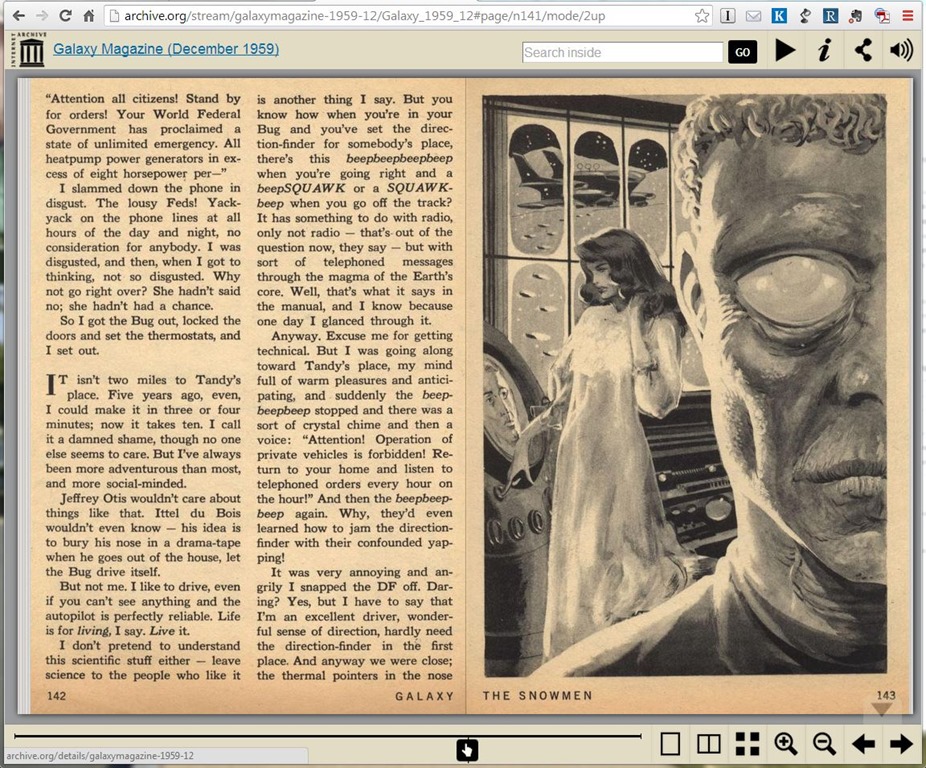
Now it is possible to create an elegant screen reader that shows old magazines, just look this December, 1959 issue of Galaxy Magazine at Archive.org.  If the folks at The Rolling Stone used this program to show it’s back issues I’d be in periodical heaven.

galaxy-mag

[Click to enlarge]

Now I’d love to have a complete back run of Galaxy Magazine in this format.  It would be better than owning all those shelves of moldy pulp paper copies.  And it would be great to have them on a modern tablet with 2560 x 1600 pixels screen.  The Archive.org reader works very well on my iPad, making it the most comfortable way to read this classic SF mag.

The ideal way to read magazines would be to have a large, very high resolution tablet, with the complete archive of a magazine online, and an excellent viewer app.  That way the environment benefits, and we wouldn’t be bothered by shelves and shelves of old magazines to maintain.

Right now I’m very disappointed with the electronic versions of The Rolling Stone, either tablet version or online version.  Reading the paper version is the easiest technology.  That’s a shame.  I was so looking forward to doing some serious reading of past years of The Rolling Stone.  Now that I start my retirement years next Wednesday I’ve got some real reading time.

JWH – 10/17/13

Why Don’t Politicians Have PhDs in Economics?

It seems like every politician in Washington KNOWS the absolute solution to our economic problems.  But how do they know?  The Tea Party has Washington gridlocked because they claim to know, but is their knowledge based on anything substantial?  Are their opinions backed by something other than wanting to promote Christianity and pay less taxes?  How many politicians have advanced degrees in economics, government and political science?

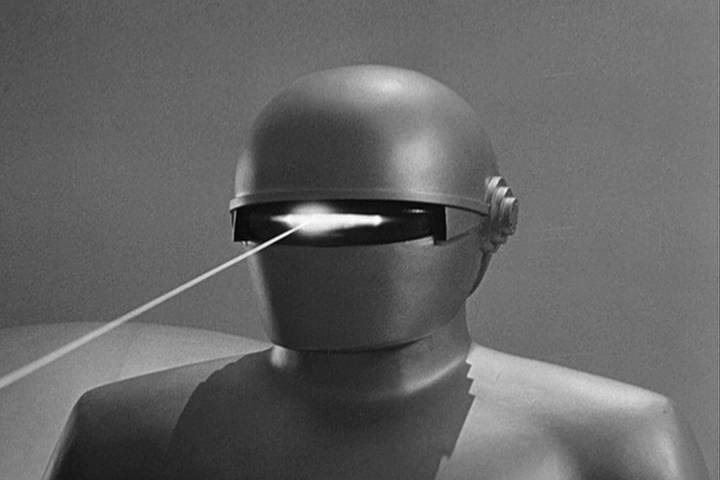
I’m sorry, but it seems to me that all politicians are out for themselves, and their positions are based on personal desires and the special interests of the people that support them.  I’d be far more impressed with the Democrats and Republicans if they each based their policies on giant economic models backed by an army of PhD researchers.  Politicians have no intellectual authority behind their opinions even though they hold them so strongly.  In fact, after recent events I’d be happy to replace all our political leaders in Congress with robots and referendums.

gort

Every major university and think tank in the United States should be developing an economic model.  All their economic and political PhD students, postdocs, and faculty should be researching and writing to support these models.  All the models should compete, like weather models and global warming models, to see which ones best reflect actual reality.  We need to get away from opinions, away from us versus them.  It’s obvious that many of our leaders don’t know shit about economics.

The makers of Sim City should create Sim Economy so we can all play and study how our economy works.

simcity4_ss1

We all need a better economic and political education.  Maybe we have saps for leaders because we’re not smart enough to elect anything better.  If we learn anything from this current political/economic crisis, it’s that we need to elect smarter politicians.  Or replace them with AI robots.

JWH – 10/15/13