How to Fight a Virus on Your Computer

By James W. Harris, Thursday, February 26, 2015

WARNING: This is free advice, take at your own risk. I’m trying to be helpful, but without commitment.

Twice in the past month I’ve had to help people clean up a computer virus remotely over the phone, and both times Kaspersky 2015 Antivirus did the trick. At $39 for a 3 user license, it’s not first tool people want to turn to. What you want to do is try all the free tools first, and if they don’t work, consider buying Kaspersky, or another top level antivirus program.

Before I retired, I had to support hundreds of computers and their users. The first tool we tried when someone got a virus was Malwarebytes. If it was a minor infection, Malwarebytes would clean it up. If it was a bad infection, that infection wouldn’t let us install Malwarebytes. That’s a major indicator. You know you have a bad computer virus when you can’t install software, can’t run Microsoft updates, can’t get to the command prompt, or pursue any other course of action that might clean up the virus. Viruses are getting very clever about protecting themselves. [Home users get the free version of Malwarebytes and make sure you uncheck the box that asks you if you want to try the professional version when you run the install. The professional version is great if you want to pay for it, and have it run in background all the time. The free version is great for running occasionally, which takes up fewer resources.]

If you think you have a virus, try running your regular antivirus program doing a full scan. Then, run Disk Cleanup, and go through your Programs and Features control panel  and uninstall anything you know you don’t need. Don’t uninstall what you don’t know. Google the program to find out what it does if you don’t know.  Restart the computer. Try and install Malwarebytes again. If you can’t get to the internet, put Malwarebytes on a flashdrive using another computer. If something keeps Malwarebytes or other scanners from installing, then you probably have a nasty virus that’s going to take more work.

You can try some of the better free antivirus programs, but I’d avoid AVG. It’s become really annoying. Here are two reviews for free anti-virus programs at Gizmo’s Freeware and Tom’s Guide. The trouble with free is these companies have to find alternate ways to make money, and sometimes their methods can be very annoying. That’s why I don’t love AVG anymore.  Avira seems to be kinder in this regard.

Helping someone over the phone clean up a virus infected computer isn’t easy. Getting them to try a bunch of different free programs in hopes of finding one that works can be tedious, and usually people who ask me for help aren’t real keen on messing with computers in the first place. That’s why I’ve asked them to consider paying for a top level program like Kaspersky. It’s work like a charm twice now this month. That’s all I can say. You could buy it, and get nowhere.

I’m offering this experience because it might be useful, but I don’t want to be responsible for anything that goes wrong. However, in both the cases I’m referring to, these people couldn’t use their computers, and they wanted to avoid hitting the panic keys to reinstall Windows.

Kaspersky requires you to register before using it – they want to track your licenses. We’ve always gotten the cheaper version, the plain 2015 antivirus program. They offer more expensive suites. If you visit a lot of dangerous places on the Internet, you might want the extra protection. In both cases I mentioned, Kaspersky was able to install and run when the infected machines were not letting other programs install.

If you have a killer virus that stops all programs from installing, try and find an antivirus program that can run from a boot disc.  This bypasses Windows. Here’s a list of free ones. Here’s another view of 26 such utilities. These usually boot to Linux and often have hard to use interfaces. You need some Geek skills to use them. Often if you take badly infected machines to a computer shop or Geek Squad, they will want to wipe your disc and start over. Sometimes it takes many hours to clean up an infect computer, and they know it’s quicker to wipe a disk and start over. Otherwise they’d have to charge you $400.

Getting an infection on your computer can be very trying and depressing. The best thing to do is always run good antivirus software, always keep your operating system and programs up-to-date, and even consider running extra preventive measures. It’s not good to have two antivirus scanners running in the background at the same time – it causes a performance hit, and sometimes conflicts. However, I’m considering adding Webroot to my home computer. I used it at work. It’s an Internet base scanner, so it approaches problems from another direction. But that means paying two yearly fees. However, $39.95 a year keeps me thinking about it, rather than buying. If you visit a lot of iffy web sites, consider buying Malwarebytes. It’s not a general purpose antivirus program, but it does clean up the crap you step in while walking the seedy streets of the web.

JWH

Why Fixing Climate Change is Conservatives Worst Nightmare

by James Wallace Harris, Thursday, February 26, 2015

Conservatives deny climate change because they are savvy enough to understand what it takes to stop climate change, either intuitively, or with calculated conscious awareness. The only way to stop climate change is end business as usual, kill off marketplace capitalism, create a super-big federal government, increase taxes like crazy, and probably introduce the beginnings of a world government. Fixing climate change is their worst nightmare.

To solve climate change will mean giving up oil, gas and coal as cheap forms of energy. To solve climate change will require designing a steady-state economy that isn’t based on a cancerous consumption of the Earth. Industries depending on building cheap products in poor countries and selling them halfway around the world to more prosperous countries will have to stop. Such a steady state economy would probably put half of the population out of work, requiring a massive socialized form of government. To stop coal, oil and gas usage, and curtail other forms of greenhouse gases from being created, heavy carbon taxes will have to be rolled out. Trillions and trillions of dollars worth of extractive ores, minerals and gases will need to be left in the ground. People will have to stop living in mansions, driving SUVs, and developing every last acre of nature.

eco-catastrophe

Is it any wonder conservatives deny climate change? It’s much easier to promote business as usual and pretend the bill for economic collapse will be delivered to a future generation. Maybe they imagine after we kill off all life on Earth except humans, rats and cockroaches, after we destroy the atmosphere and ocean, we can just live on this planet in space suits, like we would have to on Mars. Some even talk about blasting off to outer space when Earth is used up. Of course, they always imagine they will be among the few to get a berth in one of those rare lifeboat rocketships.

Are liberals any more realistic? Can we build a society where everyone has a little house powered by sun and wind, with lawns made up of indigenous climate friendly plants and trees. Can we switch from packaged food to growing our own fruits and veggies or buying from local farmers. Can we build and decorate houses with renewable building materials? And work at nearby creative jobs that don’t hurt the environment, and commute to those jobs in small electric cars or bicycles? Are our egalitarian ecological fantasy lives their nightmare too? Is it any wonder that Republicans embrace climate change denial. They fear the future just as much as liberals, but their nightmare is different. Their whole way of life will be destroyed, just like Comanches and Apaches in the 19th century. They don’t want to move to the liberal reservation.

JWH

How Much Can We Learn About the World Traveling by Books?

By James Wallace Harris, Saturday, February 21, 2015

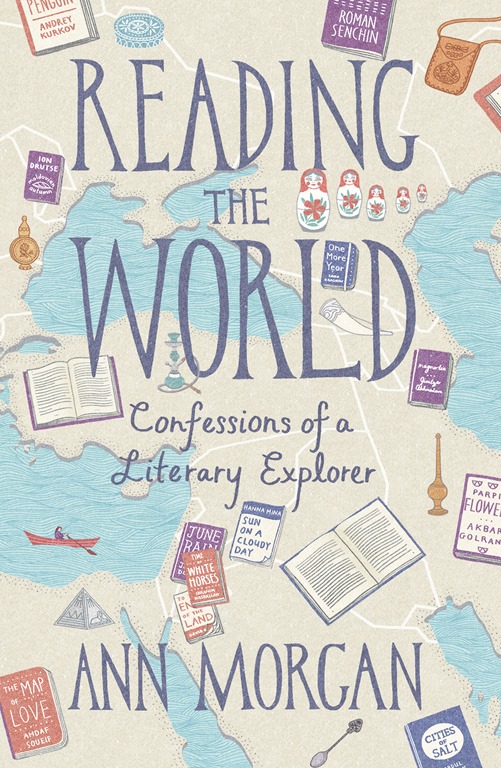
Ann Morgan has a new book out in England, Reading the World: Confessions of a Literary Explorer, due out in America May 4th, as The World Between Two Covers: Reading The Globe. Her book is based on her blog, A Year of Reading the World, where she created a reading challenge to read one book from each of the 196 countries. Here are the books she read. Now, don’t expect her book to be a retelling of the web posts, as she points out in her blog. It’s about the experience of the project.

worldbetweentwocoversreading-the-world

I’ve often thought of doing something like this. Like Ann Morgan, 99.9% of my reading comes from The United States, Canada, Australia or Great Britain. I’ve encountered this project before, over at A Striped Armchair, where super-bookworm Eva routinely reads books from around the world. It’s an inherently fascinating reading challenge, but as the review at the Telegraph points out, it’s full of flaws. How much would non-English speaking people learn about America from reading Jonathan Franzen or Philip Roth? Of course, Morgan wasn’t seeking a course in geography, but getting a sampling of the global literary landscape.

But what if we were trying to get a big picture of what life on planet Earth was like? What if you read 196 nonfiction books about all the countries of the world, wouldn’t that be a fascinating education? I just read Deep Down Dark by Héctor Tobar, about the Chilean mining disaster, but I really didn’t learn much about Chile. Some, but not much. I know lots of travelers who believe you have to visit a country to know it, but I’m not sure if that’s true either, not in the complete sense I’m talking about. Seeing the airport, a few tourist destinations, hotels and restaurants, doesn’t really tell you about the history, politics, social structures, economics, and on on. What about the news? I’ve been seeing a lot about Egypt in the news for the last couple of years, but hasn’t taught me much about the country either.

Ann Morgan set aside a year to learn about the world by reading novels. That’s very impressive, but more work than I want to commit to. I don’t even want to read 196 nonfiction books about the countries of the world. However, I wonder if I could tour the world in a year by watching documentaries? I’d have to watch four a week for a year, and that’s fairly reasonable. I wonder if Netflix has one on every country? Or would I even need to do that? What if I just read the Wikipedia entry for a country each night? Look at this one for Afghanistan. It’s incredibly informative. It’s so interesting, it makes me want to read a book about the country and watch documentaries, especially about its Paleolithic and Neolithic times. Of course, this makes me think I should just become a regular reader of National Geographic.

This concept of getting to know the world through books, either fiction or nonfiction, is a wonderful idea to think about. Here’s a list of countries at Wikipedia, it will give you the scope of the project. Even if you don’t start reading books, reading a Wikipedia article about a country now and then off your smartphone could be an excellent way to virtually travel the world.

JWH

Three Useful Internet Sites for a Dynamic Reading of Ulysses by James Joyce

By James Wallace Harris, Wednesday, February 18, 2015

Reading Ulysses by James Joyce can be very difficult, even daunting. Many well read readers consider Ulysses the number one novel of all time, because of it’s rich complexity and advanced writing techniques. Joyce intentionally made Ulysses a reading challenge, full of Easter eggs for readers to find and decipher, making it a novel worthy of multiple readings.

I have tried reading Ulysses before, but even after reading Portrait of an Artist as a Young Man three times, I wasn’t ready. One major barrier for me is my poor reading skills. I’ve been conditioned to read fast, always wanting to know what’s going to happen, by the plot driven novels of my youth. Ulysses is more like a great painting that you must study slowly and carefully, and for most of my life I never had the patience.

The range of what I could read took a quantum leap forward in 2002 when I started listening to audio books. Listening makes me read slow, and that changes everything. Also, professional readers showcase writing far better than my own inner voice. It’s like the difference between reading poetry and hearing it read aloud. Quality fiction should be heard. It should sound dramatic and dynamic, even poetical. Bad writing sticks out when read aloud. Once I started listening to Ulysses I could get into it. But still there was much I was missing.

Ulysses is famous for its stream of conscious writing techniques. If you just read it with your eyes, it’s easy to confuse the narrator with inner monologues. And even good audio book narrators don’t always distinguish between the two.

Ulysses is also full of allusions to real world and literary history, using colloquial and idiomatic words and phrases that are long out of fashion. Plus Joyce frequently cites lines of Latin, songs and poems that well educated people knew back then, but most people don’t know about today.

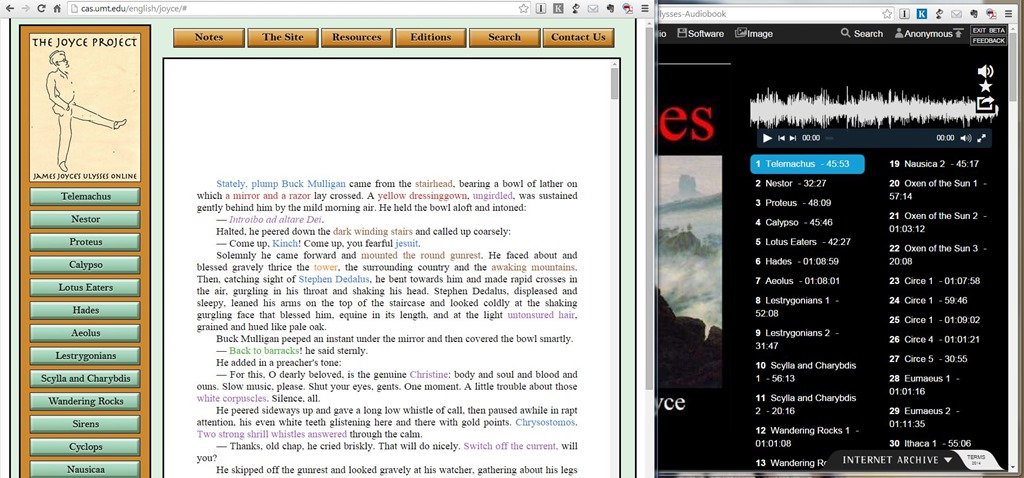
Luckily, I’ve stumbled upon two sites on the internet that are wonderful tools for helping me to read Ulysses in a very efficient manner. The first is  The Joyce Project that features an online version of Ulysses. Now most people hate reading online, but I have a major reason to get over that prejudice. The second site that I use is an audio performance of Ulysses at Archive.org. I read online as I listen to this online recording. This recording is very special because they use different actors for different characters, and they use a special effect for when Joyce is having his character speak in their internal voice. This is a tremendous advantage for understanding Ulysses. And I can’t emphasize enough how important it is to hear Joyce read by someone that can pronounce everything correctly, and even offer good accents.

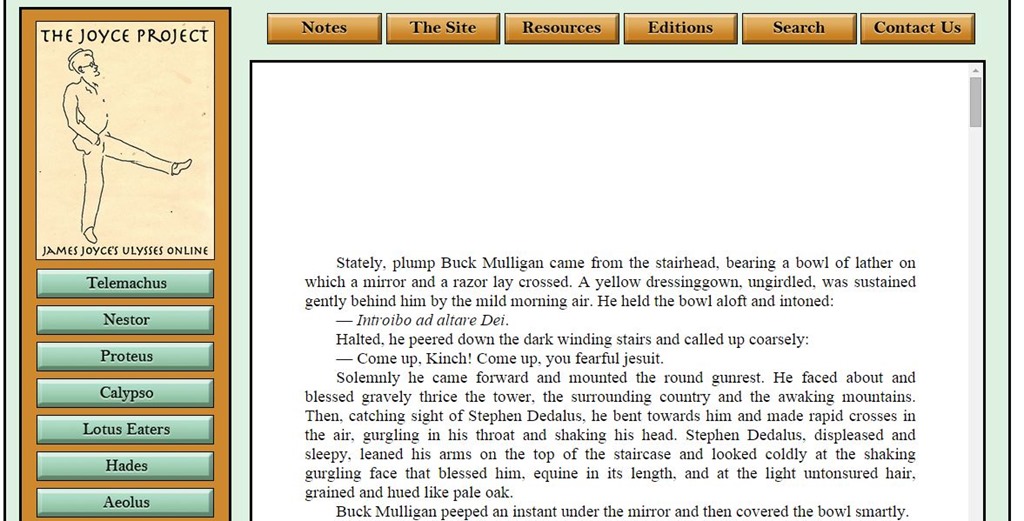
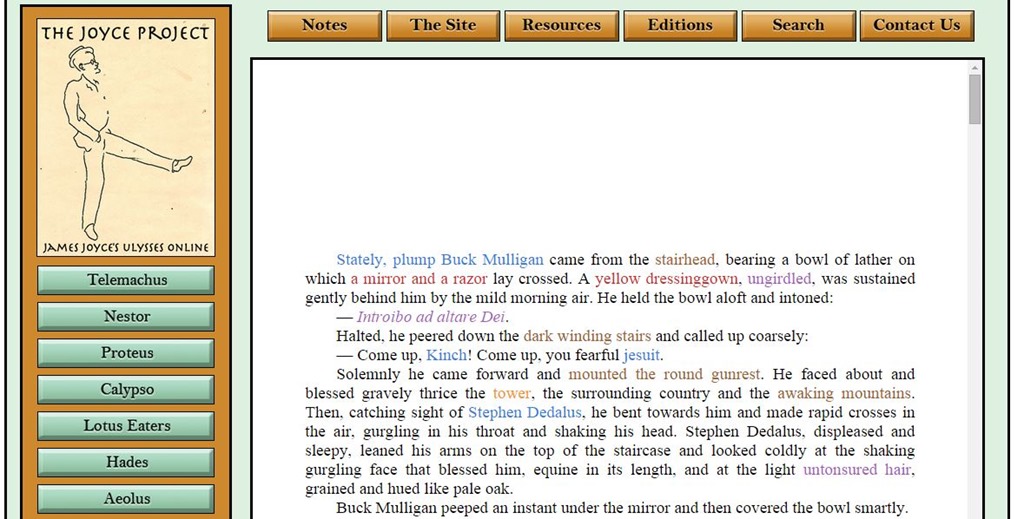
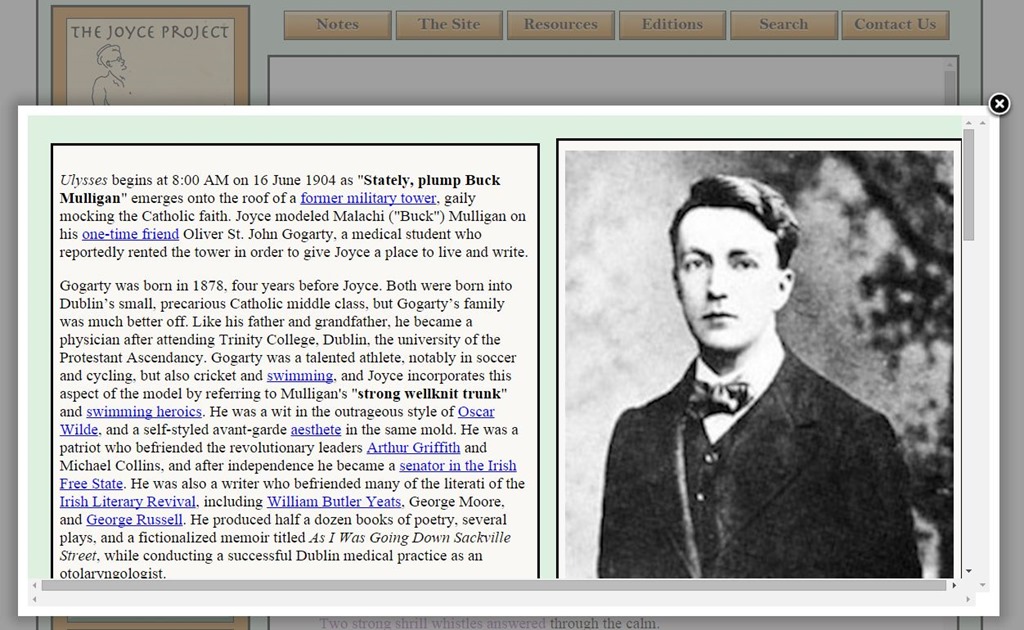
As an extra bonus, The Joyce Project has an annotation mode you can turn on, and certain words and phrases will appear in color that you can click on to read for elaboration. What I do is read and listen to each episode, and then go back and click on all the highlights. Here’s what the plain text looks like, then with the annotations highlighted, and then with the pop-up for the first annotation.  Clicking on the image will enlarge it.

The Joyce Project 1

The Joyce Project 2

The Joyce Project 3

But what works really well is to open the The Joyce Project and the Archive.org audio player windows so they overlap, like this:

Read and Listen

This allows me start and stop the audio easily as I read, in case I do want to stop my reading to study an annotation.

Finally, there’s a third dimension to using the web for reading and studying Joyce – there’s a goldmine of supplemental material. I’m not pursing the study guides on my first reading except in a very limited way. Ulysses is a black hole for scholarship.

One site that is frequently recommended to me is Frank Delaney’s podcast re:Joyce. Delaney does one podcast a week and is up to #245, but only to episode five in the novel. He estimates it will take him 25 years to finish the project. Delaney is a famous author and broadcaster, and knows Joyce’s Ireland, so his rich voice and literary experience makes him a great guide for traversing the land of Joyce. His enthusiasm enhances the enjoyment of reading Joyce.

I figure the first two tools, the annotated text and the performance narration, are the two best tools I’ve discovered for reading Ulysses for the first time. And the Frank Delaney podcast is a wonderful supplement for those people who want to take their first step into Joyce scholarship.

JWH

Has Telepathy Become an Extinct Idea in Science Fiction?

By James Wallace Harris, Tuesday, February 17, 2015

Science fiction is a genre that generates far out ideas. Science fiction writers often imagine new concepts to structure into their plots. Some invented concepts are embraced by the genre and become subgenres – like space marines and military SF. Concepts like time travel, galactic empires and hyperspace travel become memes that spread to the outside world at large. At other times, real world topics, like nuclear winter and warp drives, get incorporated back into science fiction.

The Demolished Man - Signet

This gets me to wondering. Are there science fictional concepts that become extinct? Do ideas come in and out of fashion? I ask this because I’m reading The Demolished Man (1952) by Alfred Bester, which is about telepathy in society. Does anyone believe in telepathy anymore? Back in the 1950s there was a boom in ESP/Psi stories. Belief in mind reading and psychic powers have been around for thousands of years, probably crossing over from religions and beliefs in magic of our earliest ancestors. In the 1940s and 1950s, I figure SF psi-power stories became popular with the development of the idea of next stage humans, mutants or advanced aliens. For some reason people assume evolutionary advancements will confer ESP, even if it isn’t logical. Since the 1950s whenever television or movie science fiction like The Twilight Zone, The Outer Limits, Star Trek and Star Wars wanted to present advanced humans or aliens, they’d give those characters the ability to read minds or telekinetic powers.

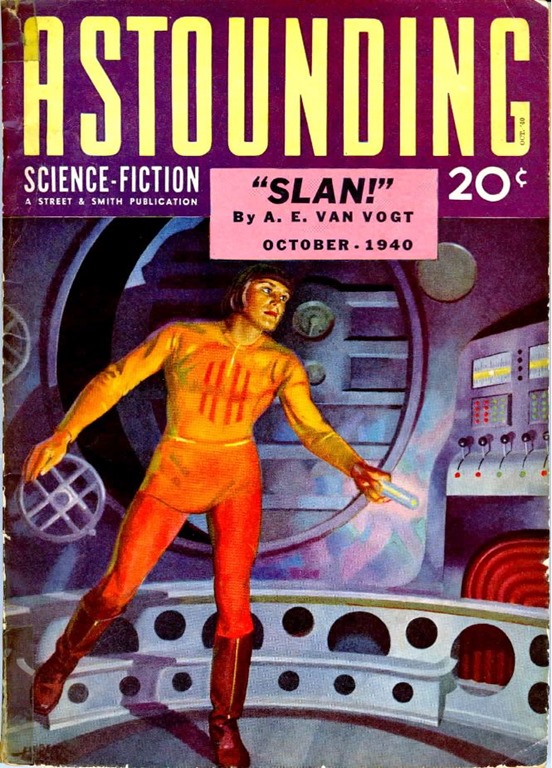
What’s strange is we hardly read about ESP and telepathy anymore – at least in science fiction. I’m sure the ideas are still popular with fans of the occult, but not science fiction. A nice chronicle of  the use of telepathy in science fiction can be found at The Science Fiction Encyclopedia. However, checking with GoodReads I find that telepathy is still very popular with fantasy novels and paranormal romances. If you look at their list of telepathy novels very few are science fiction, and most are the classics like Slan, More than Human, Odd John, Zenna Henderson’s The People stories, and the #1 book is The Demolished Man. However, I might be wrong about telepathy becoming extinct in fantasy fiction – just check out this list of 1650 books at SciFan. However, even the titles that are science fiction, most are fantasy based.

slan-astounding oct1940

At The Science Fiction Encyclopedia they suggest that telepathy as a theme in science fiction has fallen off because of the rise of cyberspace. We now picture ourselves using computers to connect to each other. That theory feels right. One day iPhones might be implanted into our heads, and that sounds more realistic than brain cells evolving radio frequency transmitters and receivers. Technological telepathy is well underway with machine-body interfaces to allow thoughts to control muscles.

childhoods_end

So why was psi-power science fiction so popular in the 1950s science fiction? Some people claim its because John W. Campbell, Jr., the editor of Astounding Science Fiction pushed the idea of psionics on his authors because it was his pet belief. Others claim Charles Fort influenced writers like Robert A. Heinlein and L. Ron Hubbard. Others claim it was the Rhine experiments in the 1930s that got the ball rolling. The 1950s was a weird time in America, with “true stories” of UFOs, ESP, Bridey Murphy, and Edgar Cayce inflaming the public with nutty ideas. After the atomic bomb became famous in 1945, I think people start believing anything was possible with the help of science. Science fiction got people thinking about intelligent life on other worlds, life that might be far superior in intellect to our own. We started imagining what humans could become with the help of mutation, genetics and machines.

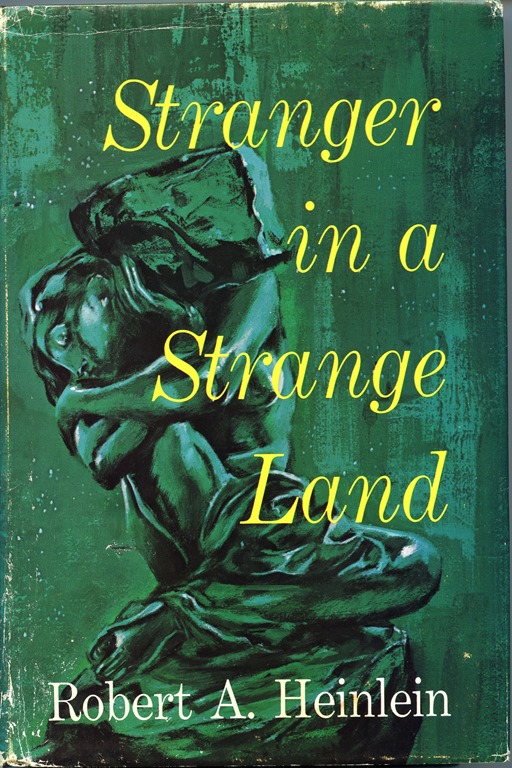
stranger in a strange land - 1961

I think the idea of psi-powered humans peaked in 1961 with Stranger in a Strange Land by Robert A. Heinlein, where Heinlein featured an ordinary man raised by advanced aliens capable of learning amazing feats of brain power. For me, the idea died with Dying Inside by Robert Silverberg in 1972, which showed a lonely, pathetic telepath surviving on the margins of society.

I don’t know what caused it, but for some reason I woke up in the 1970s and rejected all speculation about the paranormal. The idea of ESP just became silly. I think the reality distortion field of the 1960s wore off. Even in 1977, with Close Encounters of the Third Kind being a wonderful film, the idea of UFOs seemed just as silly too. UFOs and ESP became concepts embraced by cranks. After the Apollo Moon missions ended in 1972 and the Viking landers made it to Mars, space travel took on a realism that made 1950s science fiction seem quaint. Starting with Neuromancer in 1984, cyberpunk fiction just changed everything in the genre. We’ve been overwhelmed by the impact of computers and nanotechnology ever since. We find magic and power in machines, not minds.

Psi-powers and mutants have been replace by exploring posthumanism. And if you think about it, there are many concepts once popular in science fiction that are slowly becoming extinct. Beside Psi-powers, the idea of mutants seldom shows up. We don’t talk much about WWIII or nuclear wars. Even though the population of real robots is growing in the real world, we don’t see many robot stories anymore either. Interstellar had a nice robot. We seem to imagine AI machines being embedded into our technology rather than Asimovian robots.

I can’t say if psi-powers were just a story idea, or if people really believed back in the 1950s that humans would one day evolve to have such amazing abilities. Maybe the kids of that era hoped to grow up to be Superman and fly. If I had to guess, I would say many SF fans back then did believe in Slans, because many people today want to believe in life-extension, artificial intelligence, downloading brains and human-machine mind connections. Over time we’ll discover what’s really possible, and then many of the beliefs about those concepts will die off too, like belief in ESP powers today.

p.s.

In the late 1980s I had a BBS devoted to science fiction and I brought up the topic of telepathy and ESP then. I assumed everyone believed it a dead topic by that time, but I was proven wrong. Many of the members of my bulletin board became enraged by my attack of telepathy. They passionately wanted to believe in extrasensory perception. I wonder if that’s going to happen again with this essay?

Table of Contents