The Way We Were and The Way We Are

by James Wallace Harris, Wednesday, September 9, 2015

One of the few positive aspects of getting older is living long enough to see great changes in society. Although, a savvy young person should be able to observe the same changes by watching old movies. It’s not the same thing as living through those changes, but it’s good enough for intellectual chitchat. I’ve been watching a lot of old movies from the 1950s, especially ones from 1951, the year I was born, and struggling to understand why I like them so much now that I’m 63. It’s amazing how much different America is today than it was then. What’s far more important, is seeing how we’ve stayed the same. That takes a discerning heart, and it’s easy to overlook how we haven’t changed because all the new stuff overwhelms our senses.

To get the easy stuff out of the way quickly, in the 1950s there were no smartphones, internet, personal computers or social apps. White males dominated society, people of color were barely visible on screen. Women usually wore dresses, stayed at home defining themselves as wives and mothers. There was a double standard for sexuality back then, and women were considered tainted if they had sex outside of marriage. There wasn’t much of a youth culture. Watching these old films its easy enough to spot obvious differences between then and now, like how men wore hats and suits all the time, and cars looked like those we see in Cuba today.

There are less obvious differences that are more subtle to spot. Movies in the 1950s feel like they are made for adults, while many movies today seem to be made for adolescents or the adolescent in us. There were some science fiction and fantasy films back then, but they weren’t the norm. And even then, their science fiction and fantasy had a foundation of realism that modern genre films lacks. Partly that’s due back then because fewer movies were completely escapist, and they didn’t have CGI to make the unreal real—which tends to make the real unreal.

Like I said, it takes more work to study how we’re the same. The reason why we can still enjoy the plays of Shakespeare is not because we enjoy people talking funny and wearing weird clothes, but because how we see ourselves in those people who talk funny and wear weird clothes.
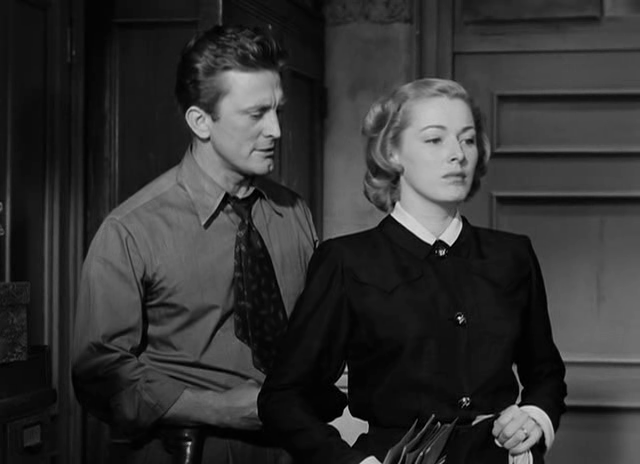
detective-story-1951

Last night I watched Detective Story (1951) about a morally rigid cop Jim McLeod (Kirk Douglas) learning his wife Mary (Eleanor Parker) had an abortion before they met. Detective McLeod was raised by a criminal father that McLeod despised. McLeod upbringing contra-conditioned him to demand that everyone fit an exacting black and white categorization. McLeod judged everyone that came into the precinct as righteous or evil, with no room for compassion, or understanding. I see that kind of rigid morality all the time on the nightly news, and sadly in some people I know. McLeod’s thinking was no different from members of ISIS, people living in Old Testament times or Donald Trump’s political persona.

Ace in the Hole - 1951

A more complicated example of sameness is Ace in the Hole (1951) which also starred Kirk Douglas, as Chuck Tatum, a cynical reporter capable of great compassion or cruelty depending on his personal needs. Chuck Tatum used his psychological skills to manipulate people and orchestrate sensational news stories. Tatum reminded me of Steve Jobs, because he believed it was good to push people into doing more.

The Big Heat

Many young people think terrorism is something new since 9/11. It’s always existed in human society. The Big Heat (1953) has Det. Sgt. Dave Bannion (Glenn Ford) fighting terrorists who control the police force and corrupts the government. Small minded men with big guns kill Bannion’s wife with a car bomb. They kill witnesses and anyone who tries to help Bannion. Makes me think of the news from Mexico, but corruption using violence to rule is common throughout the world.

And it’s not just seeing that the bad people then are just like the bad people today. The good people then are like the good people today. Det. Lou Brody (William Bendix) in Detective Story  tries very hard to get Jim McLeod to bend and see shades of gray in the folks they arrest. In fact, if you look at every character in this film, to see what motivates them, you can find parallel characters in today’s movies and real life.

This reminds me of something I learned from anthropology. Neanderthals were a species that lived unchanging lives for hundreds of thousands of years, making the same tools in the same old way all their long species’ lifetime. Our species, Homo sapiens, have changed a lot over the millennia, yet, there are other traits that don’t change, and like the Neanderthals and their stone tools, we keep constructing similar personality traits over and over again, with the same routineness that our cousins flaked out stone scrapers.

For most of my life, the 1950s was my least favorite movie decade, but in recent months, it’s become my favorite. That will change. It always does. I stay up late watching shows that I once thought dreary and depressing, and now I find fascinating and inspiring. I remember the 1950s, just barely, since I was born in 1951, and these movies little resemble the memories I do have of those times. The closest they overlap are of a trip to New York City in 1959.

Living in Kidland in the 1950s was much different from Hollywoodland. I didn’t know any cops, mobsters, B-girls, reporters, or small-time hustlers. My world looked like those old home movies that The Center For Home Movies work to preserve. And I’d bet lots of family home movies taken today have strange similarities with home movies taken back in the 1940s and 1950s. I live in a house and neighborhood that was built in the 1950s, and sometimes on my morning walks I pretend I’m seeing the neighborhood like it was long ago. Since most people park their cars behind their homes it helps with the illusion. I see women coming out in their robes to pick up the paper, and they look like the women I saw when I delivered papers in the 1960s. I’ve read a lot of books written in the 19th century, and on the surface people appear very different, but if you look closer they don’t. Just read The Way We Live Now by Anthony Trollope. It’s much harder, but I can even find overlap with tales as old as The Bible, Homer, Plato, or Lucretius.

Even with smartphones, Ecclesiastes was right.

JWH
When Does Nonfiction Go Stale?

By James Wallace Harris, Friday, June 19, 2015

When does a newspaper transform from news to wastepaper?  How old do the magazines at your dentist office have to be before you sneer at reading them? When does a science book become a history book? Why don’t we have classic nonfiction books like we have classic novels? What’s so important about new information as opposed to old information? If you found a two week old newspaper in your house you’d immediately throw it away, but if you found a 1832 newspaper in your attic you’d treasure it. How many bestselling novels from 1955 are still read today versus the nonfiction bestsellers from that year? When The Bible and The Iliad were written there was no distinction between fiction and nonfiction.

Sometimes it seems the books I enjoy reading the most are novels from the 19th century and the nonfiction books just published that are getting a lot of buzz. The only nonfiction book I can remember reading from the 19th century is Walden; or Life in the Woods  by Henry David Thoreau. I’ve always meant to read On the Origins of Species by Charles Darwin.

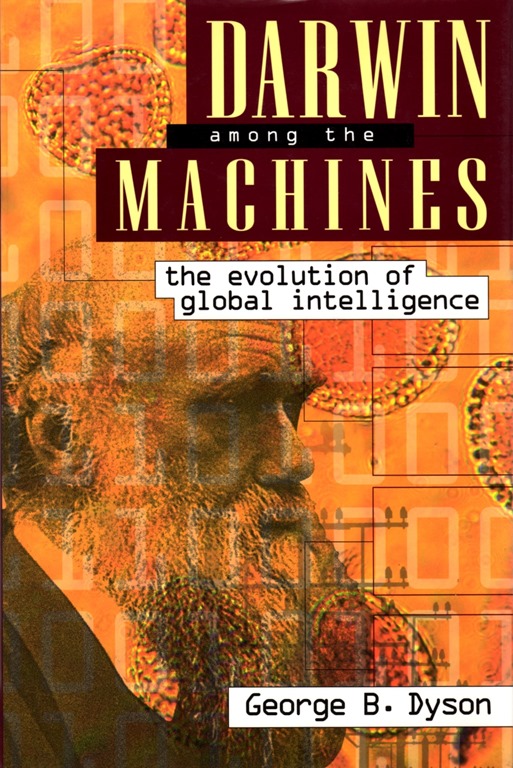
I started reading Darwin Among the Machines: The Evolution of Global Intelligence by George B. Dyson, a book I bought new back in 1997, but just now getting around to reading. Dyson is the son of Freeman Dyson, and the author of the more recent book Turing’s Cathedral (2012), which I bought and is also lying around here waiting to be read. I wonder if I’ve waited too long to read Darwin Among the Machines, because I’ve read The Information (2011) by James Gleick and The Innovators (2014) by Walter Isaacson, as well as many other books about artificial intelligence and information theory since 1997. However, Dyson has a unique approach to the history of thinking machines, starting his story with Thomas Hobbes and his book Leviathan. Dyson even ties in H. G. Wells and Olaf Stapledon. This is the kind of book I would write if I had the discipline to write books.

Darwin Among The Machines by George Dyson 1997 1st printing

Yet, I wonder about reading such an old book when there are so many newer books waiting to be read. Is there a Read By date for nonfiction books?

Dyson opens with,

“Nature (the Art whereby God hath made and governes the World) is by the Art of man, as in many other things, so in this also imitated, that it can make an Artificial Animal,” wrote Thomas Hobbes (1588–1679) on the first page of his Leviathan; or, The Matter, Forme, and Power of a Common-wealth Ecclesiasticall and Civill, published to great disturbance in 1651. “For seeing life is but a motion of Limbs, the beginning whereof is in the principall part within; why may we not say that all Automata (Engines that move themselves by springs and wheeles as doth a watch) have an artificiall life?”¹ Hobbes believed that the human commonwealth, given substance by the power of its institutions and the ingenuity of its machines, would coalesce to form that Leviathan described in the Old Testament, when the Lord, speaking to Job out of the whirlwind, had warned, “Upon earth there is not his like, who is made without fear.”

Three centuries after Hobbes, automata are multiplying with an agility that no vision formed in the seventeenth century could have foretold. Artificial intelligence flickers on the desktop and artificial life has become a respectable pursuit. But the artificial life and artificial intelligence that so animated Hobbes’s outlook on the world was not the discrete, autonomous mechanical intelligence conceived by the architects of digital processing in the twentieth century. Hobbes’s Leviathan was a diffuse, distributed, artificial organism more characteristic of the technologies and computational architectures approaching with the arrival of the twenty-first.

The trouble is Dyson wrote this sometime before 1997, and artificial intelligence has come a long way since then, beyond what Dyson could imagine eighteen years ago. Yet, what he’s really writing about are the centuries of thought before the 20th century on the subject – and that is mostly new to me. The common starting place seems to be with Babbage and Ada Lovelace, so it’s rather interesting that Dyson starts with Hobbes.

I guess it depends on what I’m enjoying learning. I seem to have two modes of interest. First is, what’s happening right now. The second is, how did we get here. Should I spend my time reading about the current state of global intelligence, or study the history of how someone imagined it would be hundreds of years ago?

I could be reading The Fourth Revolution: How the Infosphere is Reshaping Human Reality published 9/1/14 by Luciano Floridi. The Fourth Revolution is a book Hobbes would have found very interesting.

I wish I could read, digest and summarize a book in my blog in three or four hours. It takes me one or two weeks to read a book, and often longer to digest. If I really get caught up into a book I want to follow its leads and tangents. Just reading the first chapter of the Dyson book makes me want to go read about Thomas Hobbes. But do I need to spend so much time thinking about the 17th century when I live in the 21st? Tim Urban claims in “The AI Revolution” that the years 2000-2014 experienced as much progress as all the progress in the 20th century, and that the years 2015-2021 will speed even faster through that same amount of new information.

I am reminded of an old play title – Stop the World I Want To Get Off. Of course, I’m also reminded of that bestseller of the 1970s, Future Shock. Maybe it would easier on my mind to read Thomas Hobbes than Luciano Floridi. Yet, isn’t it sort of sad, that whatever nonfiction book I’ll read will be out-of-date in just a few years. If I had a good memory, I could tally up a very long list of nonfiction books that promoted some kind of far out idea as a possible understanding of how reality works yet has since been forgotten. How many people remember The Naked Ape by Desmond Morris or The Origins of Consciousness if the Breakdown of the Bicameral Mind by Julian Jaynes?

Not only do we surf the web, but we surf the current state of knowledge by reading the latest nonfiction books. New information flows into creation far faster than we can gain wisdom from processing that data. Is it practical for me to stop and read a book from 1997? Dyson was working to make sense of 1996.

Quite often new popular science books rephrase the same histories the older books covered. How many popular physics books have I read that summarized Einstein’s discovery of general relativity or  Kurt Gödel’s incompleteness theorems? Generally my knowledge of science lags far behind it’s discovery. At least I gave up on String Theory before The Big Bang  characters did.

I read for fun, so does it matter when a book is published if it’s fun to read? I’m not a scientist, so I don’t need to be up on the latest theories. I can never understand science at anything more than a popular science level, which is essentially at a philosophical level. And at a philosophical level, Darwin Among the Machines is still a fun read.

The problem that continues to nag me is whether or not I’m being the most efficient reader I can be. I only have a few more years left to live, and I want to cram in as much knowledge as possible. I know it leaks out my brain as fast as I consume it, but overall, a little residue remains and it feels like I’m progressing in my understanding of reality.

The decision to read an old nonfiction book versus a new nonfiction book must be made on how much knowledge will it add to my overall collection. That means I must choose between a writer who is carefully digesting a lot of historical information versus a writer who is reporting a lot of new information.

JWH

Finding The Top Albums By Year From 1948 to the Present

By James Wallace Harris, Wednesday, October 21, 2014

The 33 1/3 LP came out in 1948, and even by 1958 had only garnered 25% of the total record market. At first, 78s  continued to dominate, and then 45 rpm singles. It took a while for what we know as an album to become a major art form. Even the term album is a holdover from 78 rpm records, which could only contain up to five minutes to a side, and required many discs to make a collection of songs, which was called an album. LP discs can contain twenty or so minutes a side, and 10-12 songs per disc, and so they were an album of songs, not an album of discs. The modern concept of the album, first the LP, then the CD, seems to be fading. It’s apparent reign was about half a century.

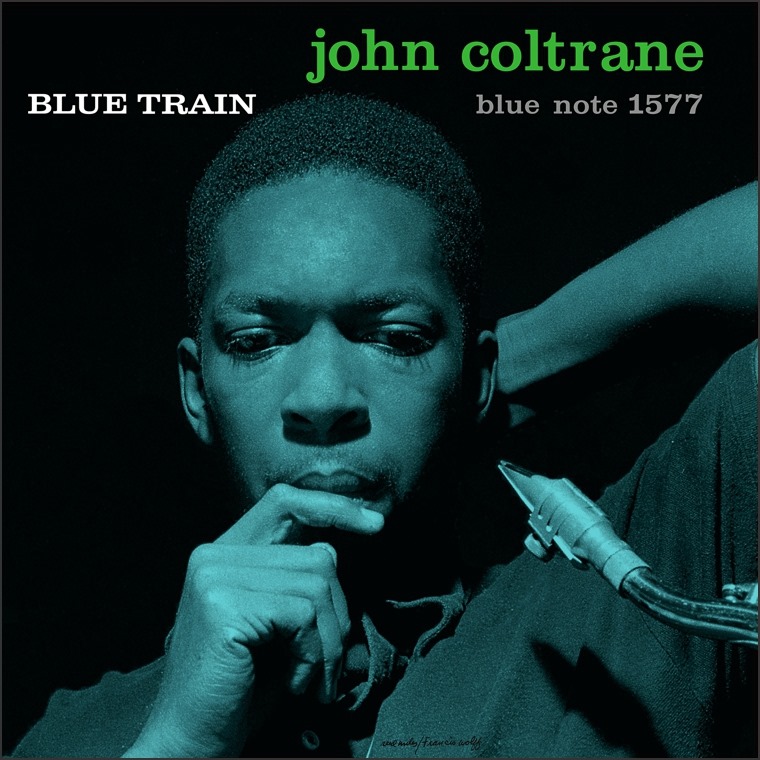
Using Wikipedia’s excellent Timeline of Musical Events, it’s possible to drill down to a decade, and then year, to follow popular album releases over time. For example, here’s 1951, the year of my birth. If you look at the 1951 album releases and then try to find them on Spotify, you won’t, most likely. Nearly all of the early LPs of the 1950s aren’t reprinted. It’s not until the later 1950s do some albums become famous enough to be remembered, reprinted, and even stay in print. For example, Blue Train by John Coltrane in 1957.

Blue Train - John Coltrain

Now this is the point of this essay. If you subscribe to a subscription music service like Spotify, Rhapsody, Rdio, you can musically stroll down memory lane, year by year, and listen to the albums of the time.

Another great site that helps is Best Ever Albums, and here’s how they present 1957. In 1957, they list 107 top albums. By 1967 that jumps to 312, then 453 by 1977, 704 in 1987, to a 1,000 in 1997. Best Ever Albums quits tracking after a thousand albums each year. There’s no telling how many albums come out each year today. People still make albums, but listeners don’t buy them. They’re on Spotify waiting to be played. Unless you find a method to search for albums other than popularity, you won’t go looking for them. My time tracking method is one such alternative method of discovering albums.

My point is you probably missed a tremendous number of great albums. The average music fan bonds with a relatively small number of albums they discover in their teens and twenties, and then pretty much stick with their favorites for the rest of their life. They might add a few new songs to their playlists each year, but not many. Subscription music services offer you access to millions of songs and albums. What mind blowing tunes have you missed?

Using Wikipedia, Best Albums Ever and Spotify, it’s possible to attain a magical music education. I wished Spotify would let us browse by year, or even better yet, but release date. I love tracking things by time. I wished Billboard put all its charts online, but it doesn’t. It is possible to go to Tropicalglen.com and play songs by year. You can then follow the links to Cash Box charts. For example, here’s the weekly charts for 1967.

I don’t know why I like to remember things by time. Maybe I’m trying to time travel.

JWH

“Who Knows Where The Times Goes” at 4am

The older I get, the more I think about time.   Maybe that’s because I’m running out of time, or maybe time is just how we link our memories.

Now that I’m retired my sleep patterns are changing.  I guess work made me a solid sleeper.  Now I sleep whenever I feel like it, and more and more I find myself waking up in the middle of the night.  I’ve discovered 4am is a great time to listen to music on the headphones.  This morning’s random play started with “Who Knows Where The Time Goes” sung by Judy Collins.

One reason 4am is a great time to listen to music is because my mind exists in a disassociated dream-state.  Music and lyrics trigger images and thoughts that don’t surface during the daylight hours.  Since I also have a bit of a cold, my mind was even more weird.  Colds make me nostalgic, and listening to a song about where did the time go really pushed that button.  I even played it twice.

I do not fear the time

Who knows how my love grows

Who knows where the time goes

Me and my friends are getting older and we often talk about where does the time go, and lament that time is running out.  If I live an average lifetime, I only have about as many years as I did from 2000 till now.  That’s both a lot of time, and not very much.  I already know many from my generation that have passed on, and the people I spend time with are becoming old friends in both age and the length of time I’ve known them.

Getting old sucks, but what can you do about it?  I have a philosophical bent that lets me enjoy my decay, but my friends think I’m morbid.

There’s a weird dichotomy between the people I knew before thirty, and those after forty.  Some of my “new” friends I’ve known for twenty years, yet sometimes when I’m hanging out with them I feel like I’m with strangers.  Maybe blood kinship only feel tighter because those are the people we’ve known since the beginning of our personal time, and everyone we met after we’ve adultified still feel like strangers.

Since my playlist was on random, it was rather serendipitous that the next song was “Old Friends” by Simon and Garfunkel.  It was a song written back in the 1960s imagining being old at seventy  I realized that Paul Simon and Art Garfunkel are now in their seventies.

Can you imagine us years from today

Sharing a park bench quietly

How terribly strange to be seventy

Old friends

There are damn few people I knew growing up that I’m still in contact with now.  What’s funny is I used to wonder back in the 1960s what all those rock stars I admired then would be like in their seventies.  Now I know.  It’s so fucking weird to see Bob Dylan, Neil Young, The Rolling Stones on TV.  I’m still playing albums those guys made back when, picturing them from their classic covers, but seeing wrinkled old coots on my TV screen.

In the darkness, half asleep, I think about how Susan and I are getting old, and so are all our friends, and how we’re all worrying about becoming feeble or demented.  I seem to worry about different things things than my lady friends.  They hate so much not being young, but they seem to have their health.  My friend Connell and I, worry more about our failing bodies.  We don’t mind the wrinkles, but know our bodies aren’t going to hold out like the ladies, who will probably all last until their nineties.  Connell and I think we’ll fade away before our eighties.  I’ve known Connell since 1966, so we’ll be old friends in our seventies.  Some of my lady friends might have as many years ahead as they’ve had since 1980.

While listening to “Old Friends” in a dreamy state, half in, and half out, of consciousness, I had many revelations about time, things that seemed so insightful in the four o’clock hour of the morning, but now lost in the light of day.  I wish I could recapture the brilliance of my visions, but I can’t.  I live a strange life now by not working, spending most of my time processing the past.  I still do things in the now with friends, but my nine-to-five time is mostly spent in the profession of studying the relics of time.  I am a temporal archeologist.

I graze on time.  I study science that chronicles billions of years. I read histories that span  thousands of years.  I read novels from the past three centuries.   I watch movies that span nine decades.  I listen to popular music that span the same nine decades.  I read biographies that take me up and down the past.  I study 3,000 year old religions and philosophy that are distilled from 300,000 years of ancient thoughts.  I graze on time while my own dwindling 4D space is being consumed.

The next song that came on was “Hello Stranger” by Barbara Lewis.

Hello stranger

It seems so good to see you back again

How long has it been

Seems like a mighty long time

How very strange, because it feels like I’m constantly reacquainting myself with old friends.

Wow, three songs in a row about time, what a coincidence.  Maybe fate is telling me something.  Or maybe time is very essential to song writing.  I wonder if I went through my playlist of All Time Favorites at Spotify, how many songs will I find about time?

Laying in the 4:14 am dark, with my eyes closed, in a serene state of floating consciousness, listening to my Spotify playlist through an old pair of Sony Walkman headphones attached to my iPod touch, I realized just how much time I spend consuming the past.  I study cosmology about things billions of years old, and evolution about things millions of years old, and history of things thousands of years old, and pop culture that spans hundreds of years, and my parent’s life since 1916, and old movies of the 1930s and 1940s, and my life since 1951, and rock music and science fiction since the 1960s,  and computers since the 1970s, and computer networks since the 1980s, and the internet since the 1990s, and all the great TV shows since the turn of the century.

I could restate that list over and over again with different examples.

I now like to think of my memory as a timeline, and my life in retirement is about moving up and down that timeline learning new stuff to fill in the ticks of time.  Laying in the dark I think of all the people I’ve known, many of which are dead, or I’ve lost contact with, who exist along my timeline since 1951.  Interspersed between the memory of people on the timeline are songs, and next to the songs are books I read while listening to music.  Or maybe television shows I watched with different people, or places I visited with other people.   It does seem like a mighty long time.

Time is the thread that ties everything together, and who knows where it goes.

JWH – 7/13/14

The Eternal Now and Time Travel

This morning while taking a shower I began thinking about now.  Here I was, a naked 62 year old male, in a 1950s pink tile room, wondering what was going on concurrently in the rest of reality as I soaped up.  My wife would be just getting to work in her office in Birmingham.   1.3 light seconds away, events are happening on the Moon, several light minutes away Mars and the Sun are doing their thing, stuff is also happening around Alpha Centauri, four and half light years away, then 2,538,000 light years away the Andromeda galaxy is speeding towards our galaxy, and who knows how many billions of light years is the edge or the universe, or what’s beyond and how far it extends. 

Everywhere there is something happening, as I take my shower.  We’re all in an eternal now.

I try to imagine Einstein’s space-time concept and how it might affect things.  But to me, it seems logical to think there is a universal now that happens everywhere, even into adjacent universes in the multiverse, or even adjacent multiverses.  Could there ever be two nows?  Or multiple nows?  Isn’t death just losing touch with the now?  And didn’t the eternal now exist even before I existed?  Isn’t consciousness tuning into the now?

As as science fiction fan I love the concept of time travel, but isn’t time travel the attempt to go to another now?  If there is only one eternal now, then that will be impossible.  We see artifacts of the past, and anticipate the future, so we assume both places exist – but do they?  When we see the Andromeda galaxy in the sky, we’re seeing what it looked like 2,538,000 years ago.  It’s actually much closer.

Recently scientists created a computer simulation of the universe.  I wonder if it’s how it looks in the eternal now, or how we see through timed artifacts?  Everything we perceive about reality is time delayed.  We aren’t looking out our eyes, but at reprocessed information, so there’s a slight delay.  If I talk to my friend Connell in Miami, a thousand miles away, there’s a slight delay in the phone signals.  The eternal now is everywhere, but we experience it inside our heads, and all that input about reality is delayed.  The visual field I see in front of me as I type is a tiny fraction of a second late from the eternal now.

The theory of an all powerful, all knowing God is quite interesting to think about regarding the eternal now.  If God is not limited by the speed of light, God would see everything at once in the eternal now.  But would this deity also see the past and future all at once too?  Or does God inhabit the moment like everyone and everything else?  It’s hard for me to believe in God knowing how big reality is, especially if the eternal now has always existed, and will always continue to exist.  Infinity is such a mind-bashing number.

We often ask when did time start, and when does it end.  And we often imagine the beginning of space and matter.  But do we ever wonder about the origin of the eternal now?  If there was only one Big Bang moment, then that was the beginning of time, space and now, but it’s starting to look like there wasn’t just one Big Bang.  No matter how many universes there might be, won’t there only be just one eternal now?  Isn’t it the same now here as it is fifty-five universes over from ours?

I think we’re hung up on birth and death, beginnings and endings, because we have one of each, but maybe reality and the eternal now doesn’t.  As a kid I wondered who made God like other kids, and why wasn’t there nothing.  How could existence start at all.  My conclusion?  That non-existence nothing can’t exist.  That it’s impossible.  If it could, it would have, but since it didn’t, it can’t.  It hurts our heads to comprehend why non-existence isn’t so.  Logic tells us there should have been an origin.  Our minds can’t get beyond cause and effect.  We know nothing lasts forever, but maybe one thing does, the eternal now.

We spend our lives pursuing religion, philosophy and science trying to understand the origins of existence, but in the end the answer is always beyond our small brains to comprehend.  And even if we built an AI Mind the size of Jupiter, would it be large enough to know?  Even if God existed, would God know?  Would not a being that could comprehend all of reality have to ask:  Where did I come from?  How did I get here?  Doesn’t any being asking the ultimate ontological question end up with “It’s turtles all the way down!”

pugs-00121

The Hindu tell us to “Be Here Now” – but where else could we go?

JWH – 5/9/14