
Orphans of the Sky by Robert A. Heinlein

Orphans of the Sky is one of Robert Heinlein lesser known novels, even though it’s one of his best.  It’s hard to talk about the novel without giving away its big idea, but it’s not likely I’ll convince you to read it without telling.  This short novel is made up from two novelettes first published in 1941 in Astounding Science Fiction, and it might be the first fictional account of a generation ship, that is a starship that travels so slowly, that it takes generations to reach its destination. 

In Orphans of the Sky, the characters do not know they are in a starship, but think of the ship as all of reality.  They can’t see outside.  They have forgotten most of what civilization gave them, so they are primitive, superstitious people.  Heinlein uses this as a beautiful setup to attack our own superstitions.  I don’t want to spoil the joys of the story by giving away the plot, but if you need to know more, read the first link to Wikipedia above.  The important thing to know is Orphans of the Sky makes major contributions to the genre science fiction.  It’s central speculation, made in 1941, is probably the most creative since H. G. Wells’ The Time Machine, 1895.

Stories about interstellar travel in science fiction have mostly taken the fantasy route of faster-than-light (FTL) travel.  Whereas, Orphans of the Sky dwells well within humanity’s technical ability to get people to the stars.  It will still be an amazing engineering challenge to build a starship miles long, that rotates to create artificial gravity, and is design to function for hundreds, if not thousands of years.  A trip might have to last as long as from now back to Shakespeare, or Christ, or Aristotle.  If worldly societies can change so much in those time periods, imagine what life in a starship might be like and how it could change.  This is a brilliant idea, and Heinlein imagines his characters in a post-apocalyptical world inside the ship.   It’s strange that Orphans of the Sky wasn’t printed in book form until 1964 since it is so innovative in a genre that loves far out ideas.

Although, the novel is only about 150 pages, Heinlein does an amazing amount of speculation.  Besides the big new science fictional ideas, Heinlein imagines how society would change if it evolved backwards, for example he has women treated like they were in the Old Testament.  There are scientists but no science.  One of the most enchanting aspects of the story is how concepts we take for grant in our world are turned into strange superstitions in the world of Heinlein’s forgotten starship crew.  Heinlein knew how thin the veneer of civilization is that covers our nations.  He also plays with what we know now could be completely wrong.

Orphans of the Sky is not a literary masterpiece, but heavy duty pulp fiction from the golden age of John W. Campbell’s Astounding Science Fiction.  It’s all action, with little characterization, but what characterization there is is very vivid and sharp, especially the mutants.  For my third reading of this story I listened to the Audible Frontiers audiobook edition that is beautifully read by Eric Michael Summerer.  Audible Frontiers goal is to put great SF and fantasy into audiobook editions.  If you love classic science fiction and hanker to experience it again through a dramatic reading, it’s worth joining Audible to get these audiobooks.  They are also available through iTunes.

Orphans of the Sky would make a wonderful sense of wonder film, and I’m surprised it’s cinematic potential has been ignored.  Movie producers often strike pay dirt with SF, but they seldom select innovate classics to explore new science fictional themes.  They beat the dead horse of alien invasion over and over again.  There’s so much more to science than strange invaders.

JWH – 12/13/9
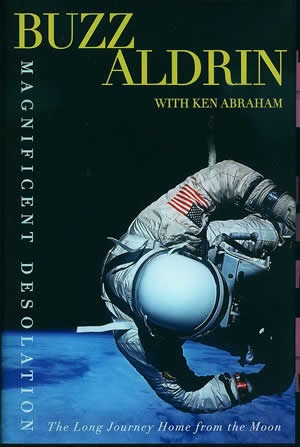
Magnificent Desolation by Buzz Aldrin

I’ve read other memoirs by the Apollo astronauts who went to the Moon, most of whom wrote about their tremendous efforts to become space jocks and their stories always peaked with their lunar adventures.  Buzz Aldrin second autobiographical book starts with the Apollo 11 landing and quickly wraps that adventure up, because his book is about the second half of his life, the forty years of life after being a famous man who landed on the Moon.  Aldrin had an exciting first half of life before becoming the “second” man to walk on another world.  He went to West Point, flew jet fighters in the Korean War, got a PhD at MIT, became a NASA astronaut and blasted into orbit on the Gemini 12 space mission, getting to do one of the early space walks.

MagnificentDesolation

So after coming home from the Moon and spending a year touring the world and being famous, Buzz Aldrin had a tough second act to follow his first.  His book chronicles his decline into depression and alcoholism, and it’s not a pretty story.  The real magic of his life appears to be recovering from his early success and starting over, especially his amazing luck of finding Lois Driggs Cannon, his third wife who helped him rediscover a purpose in life that has carried him forward these last twenty plus years.  It’s the Buzz Aldrin 2.0 that I find the most fascinating.

Of all the Apollo astronauts, Buzz Aldrin is the only one that has stayed in the limelight making a career campaigning for space exploration.  This is the tragic part of Magnificent Desolation, and maybe not one Buzz intended to portray.  Aldrin is completely gung-ho on space travel – the trouble is the rest of the world isn’t ready to follow his lead.  Why have we never left low-Earth orbit since 1972?  It took less than 10 years to get to the Moon starting from scratch, but with all the fantastic technology we have today, we can’t seem to get back to the Moon, much less go further.  Why?  Well, it’s not for Buzz’s heroic effort in trying.

I believe the portion of the population who are space travel true believers is so small that they don’t have the political critical mass to make Aldrin’s dream come true.  I’m not even sure 1/10th of 1 percent of the world’s population, or 7 million people are space advocates.  The Planetary Society doesn’t state how many members it has, but I’m guessing it’s in the low hundred thousands range.  The National Space Society, is even smaller.  In other words, the core group of humanity that seriously wants for humans to live in space is probably another magnitude smaller, 1/100th of 1 percent, or 700,000, and probably much less.

Buzz Aldrin has a tremendous uphill battle to convince the world to spend the money on manned missions to the Moon and Mars when only .01 percent of the population really cares.  Even if you add in all the the heavy duty science fiction fans, I doubt the number grows beyond .1 percent of the population.

Aldrin has hitched his star to the space tourism philosophy, which I have never bought.  Magnificent Desolation is current through late 2008 or early 2009, so Buzz reports on all his friends in the private space exploration business, the people who keep the dream alive, but it’s like what Aldrin states in the book, it only takes a rocket going 2,000 mph to achieve sub-orbital success, but it would take a spacecraft going 17,000 mph to make orbit. 

Can private space programs launch that kind of leap in technology?  We know the minimum required, an Atlas rocket like John Glenn road to fame.  The minimum to get to the Moon is a Saturn 5 – can anyone really imagine a private company funding that kind of expense?  If there’s a better way to space don’t you think someone would have found it in the last forty years?  Rocket technology seems to be the sole technology for heaving people off Earth.  Many space advocates campaign for the space elevator, but that technology is far more fantastic than real.

I grew up with the Mercury, Gemini and Apollo astronauts – they were my childhood heroes.  I thought NASA was blazing a trail to a future where science fiction would become real, but that hasn’t happened.  We have the technology to colonize the Moon and Mars now, and we have pioneers who are ready to go, we just don’t have the patrons to pay their way to the stars.  Buzz Aldrin still dreams the dream, and so do I, and a lot of other space enthusiasts, but I don’t think there’s enough of us to make a political or financial difference.

The only force that inspires the tax payers of America to send missions beyond low-Earth orbit is international politics.  We went to the Moon because of the Russians.  I believe President Bush announced the Vision for Space Exploration and the plans for Project Constellation in 2005 because China, Japan and India were making their own plans to send their citizens to the Moon.  However, President Bush’s vision didn’t impassion America like John F. Kennedy did in 1961. 

I think most Americans feel “been there, done that” and don’t see the point of returning to the Moon.  Even the majority of science fiction fans don’t pine for new missions to the final frontier.  For forty years we’ve been great at planning new manned space exploration, but no country or company is willing to spend the big bucks.  Space travel still excites and inspires legions of kids, but most somehow lose the dream as they get older because the political climate never seems to change.

Buzz Aldrin could have called his book Magnificent Ambitions, because space travel true believers feel that spawning a branch of humanity that lives off Earth and eventually colonizes other worlds in this system before moving on to other stellar systems is the ultimate purpose of our species.  I think many of us space travel true believers have been depressed, like Buzz, since the success of the Apollo Moon landings because the United States didn’t go on to greater missions. 

The phrase “to infinity and beyond” was the funny rallying cry of Buzz Lightyear, a cartoon character, but that’s how space travel believers feel.  The fascinating question about the 21st century is whether or not the rest of humanity will take up the challenge.  I don’t think the political leaders of China, India and Japan are space travel true believers.  Since 1945 there have been two spectacular ways for a nation to prove they are great – exploding an atomic bomb or developing a space program.  Nationalism isn’t a good force for long term space patronage because citizens eventually feel such wealth should be spent on programs closer to home.

JWH – 11/20/9  

Rethinking Interstellar Travel for Science Fiction

If you read science fiction we live in a small universe, but if you read science, the universe if horrendously huge.  There is no way with words to convey the immensity of space – even math fails to give us a feeling for the size of reality.  If we drove over to Proxima Centauri in a Camry it would take 50,000,000 years and if Voyager 1 was going that way, it would take 76,000 years.  Of course, if we could travel as fast as light it would take a mere 4.28 years.

So what does it say about our SciFi fundamentalist belief when we imagine Hans Solo or James T. Kirk making the trip in a matter of hours?  How close is this to believing a man in  a red suit can visit every house in the world in one night?  Now I know all the science fiction true believers will come back at me with testimony about a short-cut to the the stars can be discovered any day now.  Just for the sake of this argument, lets assume Albert Einstein is right (we have no real other reason to believe otherwise).  Hell, even if there were no FTL speed limits we’d find it it damn hard to build anything that could travel even at 1/10th the speed of light.

Let’s say we create the technology that gets that trip down to Proxima Centauri to 100 years, and thus need to rethink science fiction.  (My personal feeling is we’ll have tremendous trouble getting the trip down to 1,000 years, but none of us will ever know that final answer.)  To get an astronaut to another star when the trip takes 100 years means either using generational ships, extending the life of the astronaut or developing some kind of suspended animation technology, or so the SciFi gospel has preached so far.

I have some weird alternate ideas – I mean, there’s always more than one way to skin a flat cat.  We could send machines that have the ability to grow people from an in vitro culture.  Imagine being born on a spaceship in its last years approaching the target stellar system?  Of course, if the destination lacked a habitable planet, those poor souls would be doom to a limited existence – but it might  make for a fantastic philosophical SF novel.

Another idea is just give the job of interstellar travel to robots.  Then whenever they find a potential womb for biological life they could whip up a DNA soufflé from a recipe book inspired by life on Earth.  Our AI children could be the Johnny Appleseeds spreading carbon life forms across the galaxy, and given enough time, intelligent life would re-evolve.  We just wait for our star children to phone home.  OK, we’ll need to develop some real patience.

Using our SciFi minds I think we could all come up with many kinds of seed pods to shoot at the stars.  We could even engineer life to live where our kind of DNA couldn’t.  But that doesn’t sound like much fun for us, does it?  What if we built huge robotic telescopes to launch in all the directions of the celestial compass that we could tap into as a hive mind VR input and commune with the stars?  We could become cyborg space minds – I’m sure this will appeal to the Spocks among us more than it does to the action oriented Kirks types – those guys can invent STL travel and crawl to the stars.  

The more I study science and cosmology it feels like life on Earth is about as practical as one atom somewhere on Earth becoming conscious and wondering why none of his buddy atoms ever talk back.  If life is important, why is it such a tiny aspect of reality?  If life isn’t common, maybe it’s our duty to spread the complexity. 

Life is all around us, so living things dominates our awareness, but if we measure our world against the rest of the universe, life is freakishly well hidden.  If there is a God, why did she make us so small compared to the rest of existence?  We’re hardly the center of the universe.  From our perspective, if we played God, comparing the size of the Universe to the Earth, the children of Homo Sapiens would live on a world no larger than a charm quark in size.  Good luck getting our little beings to spot us.

My guess is we don’t have a creator other than reality churning through all the possibilities.  Intelligent, self-aware life, is a fluke that may exist elsewhere in reality, but maybe not, or maybe not close by.  We are doomed to be snuffed out with the same indifference by reality as all the other millions of species that have become extinct on this planet so far.  Interstellar travel could extend humankind’s lifetime a few billion years, until we needed to travel further afield.

Travel between galaxies is well beyond speculation but imagine if we could spread our species across the entire universe, so it was finally obvious that our strange self-aware kudzu filled the universe, would any being outside our reality take notice?  Maybe there is no one to impress or judge us, but isn’t it a better aspiration than letting ourselves go extinct while assuming we get to live in another reality after this one.  Like man, what are the odds of our personal self-awareness striking two existences in a row?

Star Trek’s Enterprise like space travel will probably soon be seen as a fun fantasy like It’s A Wonderful Life angels or Harry Potter wizards, so I think science fiction needs to rethink interstellar travel.  From Doc Smith to Stephen Baxter, we’ve had some fantastically fun science fiction, but just how realistically visionary has it been?  When science fiction fans die, and their last thoughts are on future possibilities, is Star Trek really any better than fantasies of Heaven’s streets of gold and immortal life with wings?  We can’t know the future, but it’s science fiction’s job to try harder than we’ve done so far.

JWH – 10/12/9

Has the Universe Gotten Too Big for Science Fiction?

District 9 is the much talked about new science fiction movie that was released just days ago.  But I have to ask:  Is District 9 science fiction? Since we get so few new science fiction movies every year why should I even suggest that one isn’t science fiction?  We’re always overwhelmed with comic book movies that are obviously too silly to be science fiction, and ignoring the franchise films, like Star Trek, we were gifted with what many fans would consider two uniquely classic-SF movies this summer:  Moon and District 9.  I enjoyed watching both, but unfortunately I don’t consider either to be science fiction, not by my picky old fart definition of science fiction.

But am I deluded, blowing smoke up my own ass, by worrying too much that science fiction has fallen asleep with alien pods in the room?  I know hordes of old SF fans in their 40s, 50s, and 60s that stopped reading SF after the 1980s, or even earlier, who are all wanking nostalgic for SF from the 1940s, 1950s and 1960s, living in a retro science fictional paradise.  This new fangled stuff might look like science fiction, it might walk like science fiction, but it doesn’t quack like science fiction.

District 9 uses outer space aliens as a metaphor for a story about immigration xenophobia and racism.  And even though District 9 opens with a magnificent flying saucer orbiting perfectly over Johannesburg, South Africa, with max-gnarly alien aliens, I still don’t consider it science fiction.  Why?  Real science fiction is about exploring the cutting edge of reality, and District 9 uses its aliens like other movies use angels or dragons to tell a fable.  More than that, District 9 models its action after video games rather than modern science fiction magazine stories – but does District 9 model the emerging post-modern SF magazine stories?

Now, I’m not saying that District 9 isn’t a very creative film, I’m just saying it’s not science fiction.  It uses science fiction as a metaphor for human xenophobia, rather than being speculative fiction about first contact with a non-human intelligence.  Sure it’s a fun, gripping movie, with a fascinating storyline and engaging characters, told with stomach churning hand-held camera anxiety.  District 9 is gritty and realistic about human nature, but is totally unscientific, choosing to stay well within the cliché tropes of SF, which are getting moldy-oldie even for me.  Even though the aliens look very different from us, they act just like us, especially at our worse, which I believe was the intention of the film’s storytellers.  District 9 is an allegory about apartheid, and all other political histories where one group of human beings treat another group of human beings with zero empathy.

Then again, am I wrong?  I want to define science fiction by the standards I use in my review of “The Time Machine by H. G. Wells.”  I don’t think I’m the only one sniffing out changes in SF.  Read Jason Sanford’s “The noticing of SciFi Strange,” and his story “The Ships Like Clouds, Risen by Their Rain.”

Then read the gorgeous “Exhalation” by Ted Chiang, which just won the 2009 Hugo Award for short story.  These are cutting edge stories marketed as science fiction, but are they really science fiction?  I’d call them fantasy, but they aren’t even fantasy like Tolkien, L. Frank Baum, J. K. Rowling or Lewis Carroll.

We’re living in a post-modern science fiction world where science fiction has little relationship to science, or reality.  In our age of tremendous science and technology, science fiction has decided to become fantasy.  Why is this?

An old friend Jim called me this weekend to tell me that he and his wife were watching The Universe, a TV series about astronomy and Stacy decided the universe was too big for her mind to handle, which Jim thought was hilarious.  Reality is big, and the old purpose of science fiction used to be producing sense of wonder about the vastness of space and time.  Has the universe gotten to big for science fiction?

And, has the universe gotten too big for our cozy little minds?  Has science fiction pulled back from the event horizon of reality, fearful of facing the black hole of science fact?  As much as I want science fiction to be about science, the story from The Year’s Top Ten Tales of Science Fiction edited by Allan Kaster, that had the greatest emotional impact on me was “26 Monkeys, Also the Abyss,” by Kij Johnson from Asimov’s Science Fiction. 

26 Monkeys is a purely fantasy tale that is a post-modern science fiction story where the universe is too big, and the only way to comprehend it is with allegory.  The story is scientifically fatalistic, in that the characters give up on trying to understand the sense of wonder in their lives. 

This is even more explicitly stated in “The Ray Gun: A Love Story,” by James Alan Gardner, another favorite from the above collection.  Read this story, but substitute the concept “science fiction” whenever you hear “ray-gun” while reading this story.  This story feels like meta-fiction about giving up science fiction, at least the old modern kind.

And what about Moon, the SF film about where humans refuse to go.  When did mankind decide the final frontier was not for them?

Science fiction has always been about the future, it always embraced modernism, showing absolute faith in science with the relentless belief that we will eventually comprehend reality.  Ivy League intellectuals have always considered the SF genre to be a literature for dreamy adolescents, so maybe it’s just taken science fiction a bit longer than the rest of the literary world to grow up and face the post-modern world of uncertainty.

JWH – 8/18/9

Making SETI Chit-Chat

Humans have been playing galactic wall-flower, afraid to make first contact with our alien neighbors, but what happens when a neighborly little green alien sends us an interstellar text message, what will we type back?  Linguists aren’t even sure if interstellar communication is even possible, but let’s say we overcome the language barrier rather quickly.  What will we say?  Yeah, I know, all those pesky scientists will want to send boring mathematical messages to see if our brains are bigger than theirs, or heaven’s forbid, it’s the other way around.

No, let’s say we can get down to some intelligent species to intelligent species chit-chat, what would you want to ask our new space alien buddies?  I think the first question I’d ask is, “Do you guys know many people from around here?”  I think the first thing I’d tell them would be, “Man, it’s been very lonely in this neck of the galaxy.  Geez, I was afraid we were the only sentient beings in the universe.”

Would we have enough in common to carry on a long distant relationship?  Another question I’d be anxious to ask, “Hey, you guys got television?”  Can you imagine the The Alien Channel?  I wonder if they have a better Monday comedy lineup than “How I Met Your Mother,” “Two and a Half Men” and “The Big Bang Theory.”  And what would they think of the human race if they could see “True Blood,” “Big Love,” “Dexter” and “Wipeout.”

SETI gurus assume we’ll have mathematics in common, and that might be true, but what might two intelligent cultures, separated by light years, share?  Music might be a possibility.  But imagine if giant redwood trees were big brain thinkers, with IQs of 300, but only they live in a world of little activity, with long slow lives.  What would they think of us hummingbirds?

Like the geek boys in Sixteen Candles, when asked what kind of proof they would accept, I’d also have to answer:  Video!  Even if we couldn’t understand our B.E.M. friends’ Monday night TV lineup, it would be great to watch anyway, like watching nature documentaries without sound.  Can you imagine the alien porn channel – “Whoa, did ya see that egg depositor on that giant beetle babe with the gold bikini last night!”  And would aliens feel like African Americans watching old movies with racial stereotypes when watching our science fiction films?

That brings up censorship.  Should we try to put on an act and project some kind of high minded normal view of human behavior, or just let it all hang out.  And would alien cultures be as diverse, bizarre and brilliant we we are?  What if we could load up some super laser canon with petabytes per second bandwidth, and blast all the daily human culture into the sky, what would they make of us?

What if they were brilliant mathematical lizards, but mainly lazed around laying eggs and thinking big thoughts about reality, would we blow their minds?  What if our alien neighbors made us feel like a race of Mother Teresas?  What if their pop culture is so vibrant that all we can do is form a cargo cult?

We have thousands of years of far out history that our children find boring.  We have magnificent sciences and mathematics to study, but our kids prefer listening to Lady Gaga or playing Call of Duty.  Most of our pop-culture is about mating, which I doubt has much interest to other intelligent species.  Will we have much to say to each other?  I don’t speak any other languages and seldom read web pages that aren’t based in the United States.  What does that say?

Science fiction always show alien diversity, with humans boogieing with all kinds of strange looking creatures, going on adventures, smuggling cargo, and being all PC BFF.  Einstein’s speed laws will make such joy riding very unlikely, but even if we could get close, would we want to?  Homo sapiens have all kinds of bacteria and viruses living in, on and around us.  Would we want to chance Wookie cooties?  And what’s the likelihood of becoming chums with another sentient race that enjoys the same mixture of air, temperature, gravity and atmospheric pressure as we do?

Science fiction has always assumed everything would be easy, and if we weren’t trying to exterminate each other, aliens would make great friends.  But I don’t know.  That might just be overly anthropomorphic, like imagining bears will be like Winnie the Pooh.

I want to know that aliens exist.  I want to share science and mathematics.  Passing tech tips back and forth will be great too.  But how much chit-chatting can we really expect?

Reality 

If we’re lucky, and I mean really lucky, like life on Earth lucky, we’ll one day detect an intelligent message coming from a not too distant star, hopefully within a few hundred light years.  At first only scientists will understand the signal, because it will probably take a great deal of abstract knowledge to understand the unnatural patterns in the signal from the rich existing energy patterns of our universe – and probably much of public will refuse to believe our eggheads. 

Slowly the science community will build their case that will convert the unbelieving.  It will take years, decades or even centuries to partly decipher the message, and when it’s revealed,  the communiqué probably won’t be all that exciting to the average woman and man, but just knowing we’re not alone will mean a lot philosophically.  Over vast periods, that span many lifetimes, we’ll slowly development interspecies communication.  And one day we might even get video, the real proof for the unbelievers.  Eventually, the excitement will die down, because it’s doubtful we’ll ever meet our new friends, and human life being what it is now, won’t make us that broad minded across light-years, because most of us are focused on the moment, the near and now.

We might be alone in the universe.  Then again, we might not.  But if we do discover other intelligent life, it won’t take away our existential loneliness.  Humans swarm over this planet by the billions, but most of them feel very lonely, because each of us is a singular soul, living as a solitary island castaway, tossing messages in bottles onto the sea, hoping for a little communication.  When the bottles must cross the distant shores trillions of miles away, it won’t feel any different.

Song of the Moment 

JWH – 7/28/9