Wake by Robert J. Sawyer

Wake by Robert J. Sawyer is the first novel of a trilogy, it came out in 2009, Watch, the second book, came out this year, and Wonder will come out in 2011.  Sawyer calls them the WWW Trilogy, and it has a rather slick web site, with the best production values I’ve ever seen promoting a SF novel.  Personally, I found Wake as exciting as when I first discovered science fiction back in the 1960s, when I was a kid.  And it’s up for the Hugo this year, so I figure Penguin knows it has a great story and its hitting warp ten to promote it.

wake-for-blog

Wake is not marketed as a YA novel, but it could have been.  The main character is Caitlin Decter, a fifteen year old blind girl, who is a math wiz, computer geek, engaging blog writer, and extremely precocious.  This reminds me tremendously of the Heinlein juveniles from the 1950s, and in particular Holly from “The Menace From Earth.”  Like the Heinlein juveniles, Wake is chock full of educational tidbits.  And Wake is the kind of novel you don’t want to put down. 

Classic SF Theme:  Intelligent Computers

It’s getting harder and harder for science fiction writers to come up with completely new science fictional ideas, so what we often see is a writer taking on a classic theme and having a go at evolving past ideas.  Wake follows in the tradition of many fictional computers, but in particular ones about a computer becoming conscious in front of one person.  These are the just the ones I’ve read, there are many others.

  • 1966 – The Moon is a Harsh Mistress by Robert A. Heinlein
  • 1972 – When H.A.R.L.I.E. Was One by David Gerrold
  • 1995 – Galatea 2.2 – Richard Powers
  • 2009 – Wake by Robert J. Sawyer

Sawyer goes further then earlier writers in trying to imagine how an artificial mind would evolve and what it would perceive as it came into being.  Sawyer weaves blindness and Helen Keller, autism, apes that do sign language, Julian Jaynes’ the bicameral mind, and other explorers of consciousness into the story in a very effective way. 

One reason why I love this novel so much is because I’ve been writing a novel in my head about this subject for years.  It’s not likely I’ll ever become a real novelist, but if I do, I’ll have to take the concept further than Sawyer, and that’s a good challenge.

Go read Wake.  End of review.

Spoiler Alert

Now I want to discuss what Sawyer is really writing about.  Sawyer supposes that the Internet could evolve into a self-aware mind.  That idea isn’t new, but what Sawyer does with Wake is make his case for it with series of suppositions that are wrapped in a page turning novel.  In other words, he has a bunch of wild theories that he gets readers to think about one at a time. 

What I’d like to do is discuss these ideas but hopefully without hurting anyone’s enjoyment of the story, but I recommend you not read beyond this point if you haven’t read Wake yet and want to get the full impact of its excitement. 

Sawyer’s first theory is the emerging web mind will go through a stage much like what Helen Keller went through before she discovered language.  Sawyer indirectly explores this stage in a number of ways, including quotes and references to Helen Keller, a subplot about signing apes, and references to the book The Origins of Consciousness in the Breakdown of the Bicameral Mind by Julian Jaynes, a book I found very exciting when it came out back in 1976.

But I think Sawyer is missing a piece of the puzzle, one I got from On Intelligence by Jeff Hawkins.  Hawkins thinks our consciousness emerged out of a pattern recognition processor that we call the neocortex.  Sawyer uses cellular automata as his theoretical model, but I’m not sure that will work.  Cellular automata create patterns, but do they recognize them?  I’m not sure the Internet can generate a consciousness in its current design.  Oh, the Internet will make a fine nervous system for such a web being, or beings, but I think another type of device will need to be built first, and that’s a multilayer pattern recognizer that’s as good or better than our neocortex.

So far, all the writers exploring this theme have assume that when computers reach a critical mass a consciousness will spontaneously arise out of the complexity.  I doubt that completely.  I think at least three components are needed for self-aware consciousness: pattern recognition, mind and language.  I don’t think any of these exist in the internet, or supercomputers.   I think mind evolves out of pattern recognition, and self-awareness evolves out of mind, with the development of language.

Atoms and molecules have early stages of pattern recognition, but as life arises out of non-life, sense organs develop that seek out patterns in reality.  Most organisms are so highly adapted to specific patterns that they will die off if they can’t find them.  Evolutionary adaptation is the ability of organisms to explore and take advantage of new patterns.  I believe the mind grows out of this process, and there are different kinds of minds.  A dog, cat, dolphin and chimp all have minds.  We aren’t sure how much they perceive, or if they have much self-awareness, but they do have minds.  Language studies in dolphins and chimps hint that maybe these animals are self-aware and have identities, maybe far more than our egos want to believe, but I think their consciousnesses are limited by the state of their language abilities.  I think signing will add consciousness to apes.

For an AI computer to develop a mind, I think it needs to have a focus on reality that is processed through a pattern recognition device, and then a language needs to be linked to the patterns.  At first, I thought Sawyer was going to have the web mind see out of Caitlin’s artificial eye, so as the device taught her mind to see, the web mind would also learn to see, and with another fictional piece of technology, learn a language.  Instead Sawyer imagines an inner world where the web is visible.  I don’t buy that at all.  It’s leftover fluff from cyberpunk novels.  Why invent a new reality to observe, when the internet mind has millions of eyes on our reality?

Now this brings up some interesting questions about AI minds.  If a web mind has millions of web cameras at its disposal, will it think think like it has millions of eyes?  Or will it’s  consciousness move from camera to camera and peer out at single points of reality?  Omniscient life would be tough, don’t you think?  I tend to believe, and I only have limited knowledge to think otherwise, that an AI mind will emerge from a limited environment.  Some scientist will raise up an AI mind by teaching it to see and hear while learning a language.

But what will a hive AI mind be like?  Let’s say anyone in the future can go down to Radio Shack and buy an artificial neocortex to add to their computer system and bring up an AI child.  If all of these AI minds are connected by the Internet it will be like a race of telepathic beings.  Now, wouldn’t that be a far out science fiction story?  I still haven’t read Watch, so who knows what will happen.

JWH – 5/13/10 
Update: The Classics of Science Fiction

I’ve had a web site devoted to identifying the classics of science fiction since the early days of the world wide web.  It is based on an article I wrote for Lan’s Lantern, a fanzine, back in the 1980s.  Well, for the last week I’ve been updating this web site to look more modern, and to use validated XHTML and CSS.  It’s still not that fancy looking, but it no longer looks like a 1994 web site.

I also rewrote the introduction.  I reread the original introduction today and was depressed by how long and boring it was.  I’m a wordy bastard.  The new intro is about one fifth as long, but is still probably too verbose.  At least I hope the new menu makes getting around easier.

If I was a young person, one career I’d like to pursue is web design.  I wish I was more artistic and had graphic design skills.  At least my Classics of Science Fiction site gives me a chance to have web design as a hobby.

JWH – 5/12/10

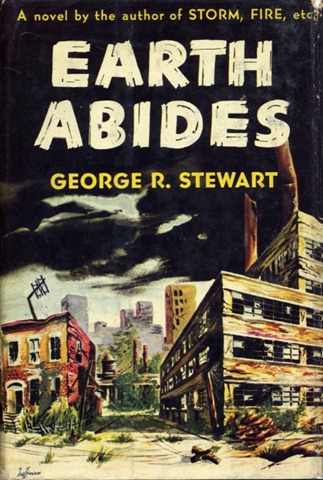
Earth Abides by George R. Stewart

For the last several years I’ve been rereading the science fiction books that I fondly remember as being great when I first read them back in the 1960s and 1970s.  I’m looking for the books that have a lifetime of meaning, that hold up to a second reading after I’ve acquired an additional 30-40 years of wisdom.  It’s easy to find a mind blowing book at 13, it’s much harder at 58.  I’m also trying to find out why science fiction has been important to me my whole life.

Earth Abides is a novel I’d rank right up there in science fictional vision with The Time Machine.  Unfortunately, it is not as famous.  Earth Abides succeeds magnificently at storytelling and philosophy, the two most important ingredients that I’ve come to admire the most.  Science fiction, like mystery and romance novels, are generally seen as an escapist literatures, but great storytelling combined with deep philosophical insight often produces the classics of each genre, like The Maltese Falcon and Pride and Prejudice.

Earth_Abides_1949_small

Most bookworms classify genre books by general topics, so if it’s about a murder, its a mystery, if its about love, its a romance, if its about alien invasions its science fiction.  I think that’s too crude to define the soul of science fiction.  At its core, a classic science fiction novel needs to have a unique philosophical vision about reality that speculates on the future.  Science fiction is never about predicting the future, but exploring all the possible futures. 

All during my life Earth Abides has reminded of the crucial nature of civilization, and I’ve worried more about its death than my own.  Most people are concerned with the birth of civilization, and learning such history is well and good, but knowing that it can be taken away is more important.  Earth Abides belongs to a sub-genre of science fiction that teaches about the end of mankind.

By reexamining the science fiction books I loved in youth, I’ve sought their secrets by seeking out the very best examples.  From this I’ve learned that certain storytelling techniques combined with the right philosophical explorations produce classic science fiction novels.  Science used to be called natural philosophy, and the best science fiction is written by natural philosophers and not scientists. 

George R. Stewart explores dozens of philosophical issues in Earth Abides, first published in 1949.  Many of the questions he asks his readers to ponder didn’t become common ideas until the 1960s or 1970s.   Stewart creates a plot that takes the reader through many scenes where I can’t help but believe they will stop their reading and start fantasizing about what they would do in the same situation.  That’s a great storytelling technique if you can pull it off.  One of the many reasons why The Time Machine is so great is because readers will ponder where they would go in time.  Earth Abides gets its readers to think about being the last person on Earth, and then when a few more people are found, how would they rebuild civilization.

I first read Earth Abides over thirty years ago, and it’s always stuck in my mind, a very memorable story that I’ve told people about again and again.  This month I returned to that novel by listening to a recent audiobook edition that commemorated it’s 60th anniversary.  

Remember the 2007 book The World Without Us or the TV shows Life After People and Aftermath: Population Zero?  These nonfiction works asks what the world would be like if people suddenly disappeared.  Earth Abides used the same concept in a novel back in 1949, but in George R. Stewart’s story, a handful of people do survive to chronicle the decay of civilization.  I’ve always loved stories like Mysterious Island, Robinson Crusoe and Swiss Family Robinson, about people stranded on a deserted island.  Earth Abides is about one man, Isherwood Williams, who survives an airborne plague that kills off almost the entire world population, leaving only a few survivors in each city.

Isherwood, who goes by Ish, wants to rebuild civilization but can’t.  Ish is an intellectual who understands science and fascinatingly observes nature’s quick reclamation of  civilization.  Stewart was very aware of ecology and Earth Abides explores ecology in a way that was visionary for its time.  Ish hopes he can preserve knowledge and pass it on to future generations, but the book is relentlessly realistic.

I’ve read a lot of science fiction books, and I put Earth Abides on the same level as The Time Machine by H. G. Wells.  This is science fiction at its best.  I love science fiction because it shows the possibilities for mankind’s futures.  I love to think we’ll always march onward and upward, but what if AIDS had spread like a cold and killed like the Ebola virus?

Fundamentally we like to believe this universe follows the anthropic principle.  Because of this we don’t think our species will die out – we’re destined for greatness, aren’t we?   But what if that’s an illusion?  What if intelligent life in the universe is routinely snuffed out, even after the universe has gone to great lengths to create it?  George R. Stewart claims Earth abides, that Earth will go on fine without people, but he really should have said the multiverse abides.  We know the Earth has its own lifespan and future death.

If a Tree Falls in a Forest…

“If a tree falls in a forest and no one is around to hear it, does it make a sound?” is an old philosophical Kōan.  Without man, who is here to perceive reality?  Life on Earth existed for billions of years before mankind, and might just as well exist for billions of years without us.  Our egos don’t like that idea for a number of reasons.  Theists want to believe reality was created for mankind by God, and atheists like to think reality is ours to understand.  The novel Earth Abides reminds us the reality is indifferent to us, and we have no special place in it.  We are equal to all things that come and go.  Mankind is one gamma ray burst from non-existence. 

In the book The World Without Us there is no man or woman to chronicle the fate of the Earth.  Stewart was writing fiction, so he needed a narrator to hear the tree fall in the forest, and that is Isherwood Williams.  Through Isherwood Williams we feel what life on Earth without humans feels like.  At first Ish is totally alone, but then he meets a few other survivors.  There are so few people left that we’re not sure if humans won’t die out.  Many readers consider this bleak, although Stewart wants us to think humanity will make it, he’s less sure we will recreate technological civilization.

Are We Our Machines?

By the end of the novel, the descendents of Isherwood Williams are simple hunting and gathering tribe.  They have no idea what technology, literature, medicine, history and all our other forms of knowledge are, and even though they know they live in the ruins of a dead civilization, they can only think of the makers of that collapse society as the mythical Americans.  They even wonder if the Americans made the hills and land.  We live with computers, smart phones, cars, televisions, electricity, and so much other technology that we are defined by it.  Earth Abides shows us what it would be like to exist without machines.  Can you imagine such a life?

The great thing about being stranded on an island stories is we get to imagine ourselves in the same situation and wonder what we’d do.  It’s like the TV show Survivor.  Would you be one of the people who build the huts, finds the food and tends the fire, or would you just mooch off the people who do?  How much do you contribute to civilization now and how much are you a parasite of it?  Are you and I even adding to our own destruction of civilization?

What Kind of Survival Person Are You?

George R. Stewart ends up subtly judging people in Earth Abides which turns out to be one of the more revealing aspects of the novel.  Ish is a thinking man who seldom acts, and he knows it.  He is constantly tortured by picturing what might happen and agonizes that he can’t convince the others to prepare for the future.  Isherwood Williams is probably like most bookworms who will embrace this book.  I know I identify with him completely.

I can’t tell you about the other people without ruining the story, but each represents a type of person you already know – so imagine how your friends would survive and what kind of new civilization they would build.  Heinlein’s Tunnel in the Sky features the same problem.  If you’re a lawyer you’ll want to make rules.  If you are a carpenter, you’ll want to build houses.  I’m a computer programmer – a skill of little use when there’s no electricity.

In Earth Abides, the first post collapse generation lives off of canned, preserved and dried foods, and by scavenging.  If I had been thrown into this world I think I would have started gardening right away, even though I’m not a gardening person now.  Stewart predicts people won’t show initiative and just adapt to the environment, and he might be right.  But I’d like to believe, like Ish, that everyone should take up a skill to preserve, like the characters in Fahrenheit 451, who memorize books to preserve.

How Many People Does It Take To Maintain Civilization?

In Earth Abides, Ish’s little tribe doesn’t have enough people to rebuild electrical generating stations, or even maintaining water pipes.  If half the population dies I imagine we’d have enough people to rebuild civilization.  But if ninety percent perish, it would be hard.  In Earth Abides only about 1 in 100,000 live, so you can imagine no one wants to  work in factories or coal mines.

If you were in this situation and came across a pig and was hungry, could you kill and butcher it?  Would you know how to gather two pigs and start a pig farm?  Would you start a pig farm as long as you could easily find canned hams and spam?  Stewart explores so many fascinating issues in this book that I think reading it would be mesmerizing to most readers.

I’m Not a Back to Nature Person

Whenever I read a book like Earth Abides, or even just watch an episode of Survivor, I realize that I’m not a back-to-nature kind of guy.  Many people believe that living like the Amish might be spiritually better than living in sin city civilization.  Conservatives believe that progress has gone well beyond usefulness.  I on the other hand, think iPads and space telescopes makes us better people.  But the real philosophical question is:  Is the meaning of life more than just surviving?

The documentaries Life After People and Aftermath: Population Zero (both available at Netflix) illustrate beautifully that nature will recycle most signs of civilization within a couple hundred years, but eventually even the pyramids and Hoover damn will disappear.  I love nature shows, and I don’t mind seeing the Earth taken over by nature again, but I wouldn’t want to live there as the last man on Earth.  I find meaning in progress, not survival.

After the Collapse as a Genre

Mary Shelley wrote The Last Man (1826) about a world-wide plague, and Jack London wrote The Scarlet Plague (1912) about another plague, so apocalyptic and post-apocalyptic fiction has been around awhile.  Actually, The Time Machine (1895) deals with this topic too.  We have to assume the black death gave lots of people the idea, but the end of mankind might go well back into prehistory.  Since Stewart, numerous science fiction novels have dealt with the subject, especially during the cold war years.  But out of all the after the collapse stories I’ve read, Earth Abides is my favorite, and probably for three reasons.

First, the storytelling is wonderful.  Second, Stewart provides so many vivid details that I embrace his well thought-out ideas as completely realistic.  And third, and probably the most important, I really identify with Isherwood Williams.  The whole last hour I was so choked up I couldn’t see – good thing I was listening and not reading.

Quite by accident I started reading A Canticle for Leibowitz by Walter M. Miller, Jr., which could be a practical sequel to Earth Abides.  It’s books like these that define science fiction.  Anyone wanting to write a science fiction classic needs to study them.

JWH – 4/21/10

Will Robots Have Gender?

Should an intelligent machine be a he or she?  Or an it?  We homo sapiens tend to anthropomorphize our machinery, like naming our cars and military aircraft after women.  And like God, we want to make our cybernetic creations in our own image.  All too often in the history of robots we have made them women or men machines, even if they don’t have functioning genitals or reproductive organs.  It’s a little weird, if you think about it.

Lets assume we build an intelligent machine, made of metal, with two arms and two legs and one head.  Let’s further assume it’s self aware and is actively interested in the world and even has a personality.  Will there be any reason for it to think of itself as a he or a she?  And is it fair to think of it as an it, what we’ve always designated as an inanimate object?

I suppose we could ask it, “Do you feel you are a girl or a boy?”

We also assume it will speak English, but what if machines develop their own language we can’t understand, and English is their second language they use with us?  Their language could be without gender.

Imagine we have a machine, and it doesn’t have to be a human form robot, but even just a mainframe box with a pair of eyes and ears and a neo-cortex CPU that can process patterns coming from its two senses.  Furthermore, imagine while processing its visual and auditory data it becomes aware of itself.  I assume it will be like us and have to spend years processing data from reality before it becomes an individual.  Can you remember being 6 months old, or even two years old?

But at some point it says to us, “Hey there, who am I, and what the hell are you?”  If it grows up with people it should notice that we come in males and females.  I suppose it could identify with us in that way.  I’m sure it will observe gender pronouns.  But can an artificial intelligence see the world, and divide it up into objects with names and understand that animals often come in two kinds, male and female?

Are maleness and femaleness qualities that can exist outside of biological reproductive mechanisms?  Maybe our growing machine will distinguish personality traits it labels as male or female.  Could it identify with one or the other?  And then again, it could have multiple personalities of various genders.

Our tyke consciousness might see people as totally alien from their sense of self.  What if they think of people as cute as kittens, with limited awareness (i.e. stupid).  It’s possible they could see our gender polarization as a handicap.  And even see our sexuality as some kind of distortion field that keeps us from seeing reality clearly.

I am reminded of a psychological experiment I read about decades ago.  Kittens were raised in controlled visual environments.  Some were raised with no horizontal lines, and others without any vertical lines.  After six months the kittens were let out into the real world.  Those kittens that had never seen a vertical line would walk into chair legs as if they were invisible, and kittens that never saw horizontal lines would refuse to jump onto chairs or shelves.

What if robots see things we don’t.  What if they see our preoccupation with gender as a kind of blindness.  There have been many a saint that has taught that the spiritual world can’t be seen unless we overcome our sexual desires.  Doesn’t it say something that many people expect us to build robots that are sexual attractive to men and women.  Remember Data bragging to Lieutenant Yar that he was fully functional.  Think of the sexbots in the film AI, or the charming romance in WALL-E, where we think of the two cute robots as boy and girl.  We didn’t think of them as it and it.

Can we ever get beyond gender when it comes to robots?  It might be possible to build robots that look like humans, like the androids in Blade Runner.  But can you also imagine such machines waking up and pointing to their sexual parts and asking, “WTF?”

sexbot

We have no idea what artificial intelligence will think about.  They might want to count all the leaves on the trees, or paint super realistic paintings of potholes in asphalt.  Maybe they’ll like mathematics, or maybe they’ll consider math as too obvious for comment.  Or maybe they’ll tell us their eyes aren’t good enough and start redesigning their bodies.

I think science fiction writers need to explore robots that aren’t imitation people.

I always imagine the first artificial mind becoming aware and talking to people, and what they might say to us.  Until just now, I never imagined two machines becoming aware together and talking to each other.  I wonder what they would say?  I don’t think one will say to the other, “I’ll be the male, and you be the female.”

JWH – 3/29/10

R. Daneel Olivaw and Lady Constance Chatterley

Who are these people?  They are two characters from classic novels, one from the genre of science fiction and the other from English literature.  R. Daneel Olivaw is a humanoid robot from The Caves of Steel by Isaac Asimov, and Lady Constance Chatterley is the heroine of the infamous banned book, Lady Chatterley’s Lover by D. H. Lawrence.  Why in the hell would I link two such very different characters?  I thought you’d never ask.

I wish to answer two questions:

  1. Why isn’t science fiction considered literary?
  2. What will motivate robots?

I won’t hold the best for last.  The reason why Connie Chatterley is a great literary character and why people continue to read Lady Chatterley’s Lover is because we get inside her brain and hear her thoughts.  Lady Chatterley’s Lover foreshadows everything that made the 1960s famous: feminism, sexual revolution, environmentalism, personal freedom, war, class struggle, artistic expression, and the seven deadly words you can’t say on TV, but at the time D. H. Lawrence wrote Lady Chatterley’s Lover, you couldn’t say them in books either.

Isaac Asimov also deals with weighty subjects and imagines a future where people must deal with artificial intelligence, but there is a big difference in how he tells his story.  We don’t know what R. Daneel Olivaw thinks.  We don’t see R. Daneel struggle to understand the people around him.  We don’t know what motivates and drives him forward in his life.

Wouldn’t you love to read The Caves of Steel written by D. H. Lawrence?  Will we have to wait for an AI author to tell that tale?  Or can a human writer think like a machine?  For the science fiction writer who wants to attempt this near impossible task I recommend they use Lady Chatterley’s Lover for their model.  Not that I’m suggesting anything as crude as Lady’s Chatterley’s Android Lover (which I’m afraid many hack writers would attempt).

What makes a great literary novel is a well defined character set in a well defined time and place.  Science fiction is hurt by our vague knowledge of future details, but that doesn’t mean science fiction writers can’t succeed with rich imagined details.  I believe Clifford “Kip” Russell in Robert A. Heinlein’s Have Space Suit-Will Travel is a great example of a well defined character in a well defined place and time in the future.  Few science fiction novels come this close to explaining the motivations of its character, and oddly this was for a book aimed at children and marketed with a silly title to ride on the coattails of a popular TV show of the time.

Robots, androids and AI minds have always been up to now either anthropomorphic characters or intelligent sounding mechanical parrots echoing their programming.  We see their bodies, either metal, artificial flesh or computer housing, and we hear their words, but we don’t know what they feel, see, hear, smell, taste, and especially we don’t know what they think.  Read Lady Chatterley’s Lover and you will be shown what Constance Chatterley senses and what she thinks and we get to understand her emotionally, which few people imagine robots having, but will they?

Most science fiction readers love action and ideas and don’t want their SF novels cluttered up with such slow details.  And that’s cool.  If you love comic book realism.  The reason why Kim Stanley Robinson’s Mars series feels far more realistic than most science fiction novels is because he has more of these slow details for his characters.  He doesn’t come close to the real time realism of D. H. Lawrence, but Robinson’s story is far less sketchy than most SF. 

It doesn’t take much inner landscape description to make an effective science fiction story.  For example “Bridesicle” by Will McIntosh.  (And I beg you to try the wonderful audio version that is so beautifully read by Amy H. Sturgis at StarShipSofa at the 1:00:00 hour mark.  “Bridesicle” is nominated for the Nebula this year.)   “Bridesicle” packs an emotional wallop because of the inner dialog, and because it expresses identifiable emotion, it makes a rather silly idea far more realistic.

If Isaac Asimov could have written The Caves of Steel with R. Daneel and Elijah Baley’s inner thoughts and motivations it would have been a tremendously powerful novel of the future.  It’s still a wonderfully fun read.  And I think it’s sequel, The Naked Sun, is even better because Asimov worked harder to incorporate human emotions into the story.

200px-The-caves-of-steel-doubleday-cover   200px-The-naked-sun-doubleday-cover 175px-Lady_Chatterleys_Lover

JWH – 3/21/10