
by James Wallace Harris, Tuesday, January 16, 2018
I was messaging a friend in South Africa this morning, Piet Nel, about reading old science fiction short stories in retrospective anthologies and best of the year annuals. Piet is reading through the Terry Carr’s Best Science Fiction of the Year series (1972-1987), but he doesn’t have them all. This morning’s message told me how he used ISFDB.com to find the stories in The Best Science Fiction of the Year #4 elsewhere. #4 was the first volume he didn’t own. For example, here are all the places “Born with the Dead” by Robert Silverberg has been reprinted. Piet already had four copies of that story in other anthologies. Piet was able to find all the stories #4, either in books he owned or online.
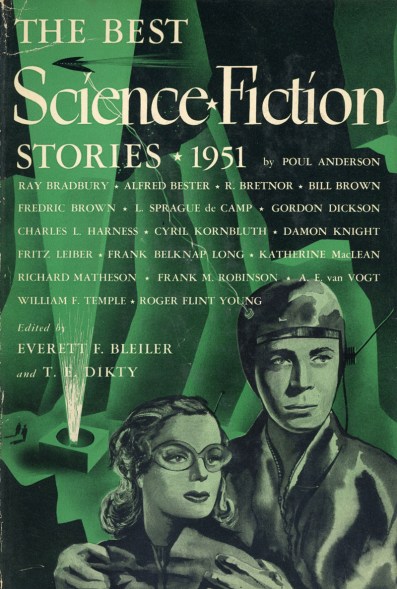
I thought I’d take the same approach to The Best Science Fiction Stories 1951 edited by Everett F. Bleiler and T. E. Dikty because I can’t afford to buy it. That annual came out the year I was born. By chance this month, I’ve already read two of them, “Born of Man and Woman” by Richard Matheson and “Coming Attraction” by Fritz Leiber when I listened to The Science Fiction Hall of Fame Volume One. [See the results of this game at the end of this essay.]
This morning I read an essay by James Jackson Toth, “Too Much Music: A Failed Experiment in Dedicated Listening” that resonated with me. Toth laments that streaming music is overwhelming him and he longs for the days when he had a limited collection of records he knew intimately. I feel the same way about science fiction. I’m not giving up on reading new science fiction, but my old mind can’t grasp much more new stuff. I’ve decided my specialty of knowledge will be science fiction published from 1946-1985. I need something to hang onto, and this will be it. Mostly, I chose this topic because I already know a bunch about it — why bother becoming a specialist in something other than what’s already crammed into your mind. But also, I’m attracted to this era because I enjoy talking with other folks that also love this era too.
This got me to thinking:
- How many people love to read old science fiction short stories from this era?
- What SF short stories from this era are anthologized the most?
- What are the essential anthologies to collect to get the top stories of this era?
- What stories would I put into an anthology if I was an editor of SF 1946-1985?
It’s not that I haven’t thought of these ideas before, and answered some of them in “The Best Science Fiction Short Stories.” That’s the most popular essay I wrote for the Classics of Science Fiction site. CSF is not a very popular, but that page has gotten 2,600 hits. Not many in the big scheme of things, but it suggests there’s a fair number of readers like Piet and I. Overall, I would guesstimate there are not that many fans of old science fiction short stories, probably much less than a thousand in the world, and we’re dying off all the time. I’m sure young folk would rather watch Black Mirror, Philip K. Dick’s Electric Dreams, Dust films, Short of the Week Sci-Fi, or The 7th Matrix for their short science fiction fix. I love these shows too, but I forget their details almost immediately.
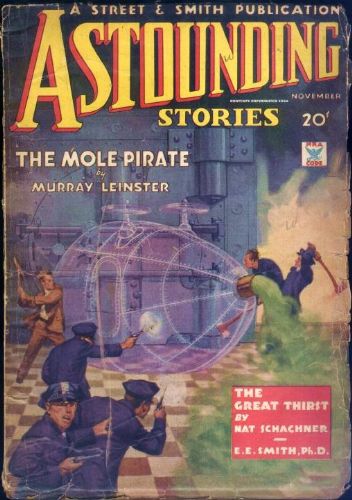
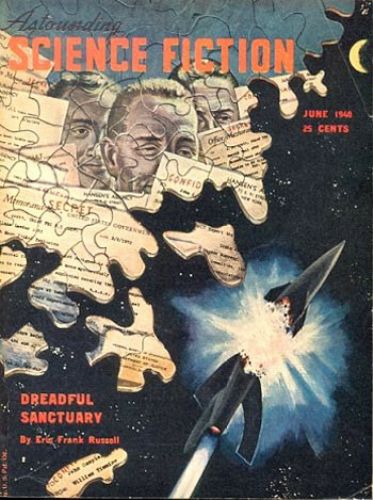
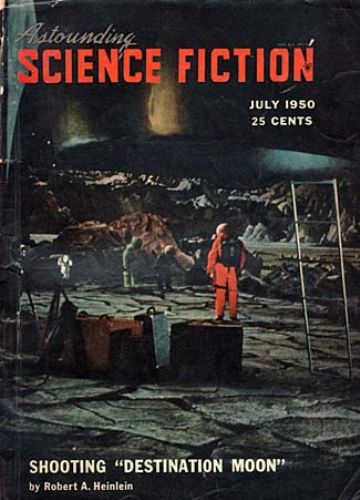
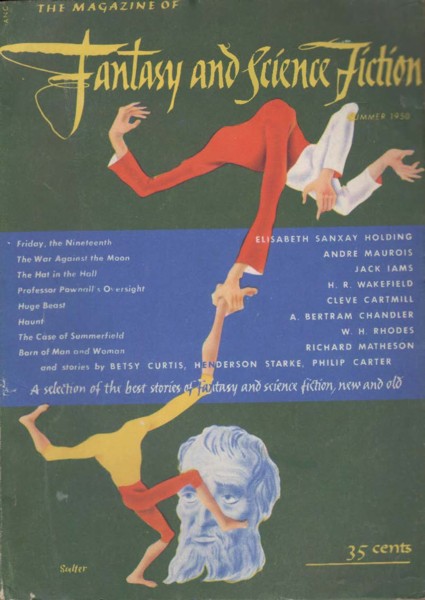
Baby boomers were born 1946-1964 but I would think their formative reading years lasted until 1985. Only a small percentage of boomers got into reading science fiction, and for most of them reading science fiction was only a casual interest. I do know there are around 11,000 members to Space Opera Pulp, a group on Facebook for people who love covers to old science fiction magazines. Probably for most of them, that’s a minor nostalgic diversion. I wonder how many still buy, collect, and read old SF stories?
There are a handful of blogs that reflect a love for old science fiction short stories. That suggests we are the keepers of a very weak flame. I see many of the same names posting comments at these sites. Are we the fans of a dying art form? I don’t think science fiction is dying out, but I do think new science fiction gets most of the attention. Pop culture is inherently linked to generations, and the Baby Boomers who loved reading science fiction short stories from 1946-1985 make up a dwindling cohort. There is a bit of generational overlap, with folks older and younger than Baby Boomers still loving science fiction from that age of science fiction digests.
There are more anthologies than ever collecting the best short science fiction of the year, including one from the prestigious Best American Series. And there’s plenty of places that publish new short science fiction. I believe the readership is smaller today than we I was growing up, but the science fiction short story is still going strong despite the overwhelming popularity of media science fiction. I’d love if I could read and retain knowledge of all this new stuff, but I can’t. I try, but it’s a struggle to remember. Reading new stories from the past will also be difficult to remember, but reading them feels like I’m finding missing pieces of a puzzle I’ve been working on my whole life. Filling in those blanks are reinforced by surrounding memories, so that might help to learn new stuff.
And, I do find more and more pleasure nostalgically returning to old science fiction, and I don’t think I’m alone. Maybe I can keep it in my head. I think it is a mentally good thing to have a specialty to care for when aging.
Here are some sites I read by fans of old science fiction stories. (There are more, but memory limits me at the moment. Be sure and send me your link if you focus on this era of science fiction.)
- SFFaudio
- Galactic Journey
- Black Gate: Magazines
- Black Gate: Rich Horton
- Strange at Ecbatan (Rich Horton’s blog)
- SF Magazines
- Science Fiction and Other Suspect Ruminations
- The Space Merchants
- SciFi at Dark Roasted Blend
- Tangent Online
- Escape Pod
- Best SF
- Locus Online: Short Fiction
- Free Speculative Fiction Online
- Sweet Freedom
Game Results
These are the stories I have for The Best Science Fiction Stories: 1951 edited Everett F. Bleiler and T. E. Dikty. Links are to ISFDB. This goes to show how well some stories from 1950 have lasted, although I should admit that the anthologies I own them in were assembled decades ago. I guess I should admit that they are mostly forgotten stories.
Stories I Have in Anthologies
- “The Mindworm” by C. M. Kornbluth in His Share of Glory (audio edition)
- “Process” by A. E. van Vogt in Isaac Asimov Presents the Golden Years of Science Fiction: Sixth Series
- “Oddy and Id” by Alfred Best in Isaac Asimov Presents the Golden Years of Science Fiction: Sixth Series
- “To Serve Man” by Damon Knight in multiple anthologies
- “Born of Man and Woman” by Richard Matheson in multiple anthologies
- “The Fox and the Forest” by Ray Bradbury in The Illustrated Man
- “The New Reality” by Charles L. Harness in Isaac Asimov Presents the Golden Years of Science Fiction: Sixth Series
- “Coming Attraction” by Fritz Leiber in multiple anthologies
Stories I Have in Magazines
- “The Gnurrs Come from the Voodvork Out” by R. Bretnor
- “The Star Ducks” by Bill Brown
- “Not to Be Opened” by Roger Flint Young
- “The Last Martian” by Fredric Brown
Stories I Don’t Have
- “The Santa Claus Planet” by Frank M. Robinson
- “Forget-Me-Not” by William F. Temple
- “Trespass!” by Poul Anderson and Gordon R. Dickson
- “Summer Wear” by L. Sprague de Camp
- “Two Face” Frank Belknap Long
JWH


 The Science Fiction Hall of Fame Volume One is probably the most loved science fiction anthology of all time and comes in #1 at Goodreads list of








 Fiction has been around for thousands of years and most plots are retreads. Quite often scholars of fiction try to consolidate plots into a
  Yet, I wonder, even worry, that science fiction has run out of good ideas. I don’t mean good ideas for plots, which are endless, but good ideas like space travel, time travel, dimensional travel, intelligent life besides us, creating intelligent life, creating artificial life, digital realities, etc. I’m currently reading
  Auxiliary Memory