
This is a book review of Revelations: Visions, Prophecy, and Politics in the Book of Revelation by Elaine Pagels, but I’m going to go about it in a very round about way.
How the Concept of Heaven Came to Be
Once up a time there was a man named Jesus. He was an ordinary human. He was not divine. He was not God. We know next to nothing about Jesus and can’t even prove he existed. We are fairly sure he did exist and that he said some interesting things about compassion and love, but even that is speculation. We know if he existed that he died. Everyone dies.
After he died his friends began to remember him through oral story telling. He must have made a great impression on them. At first they told stories about what he preached. Those stories were told to other people. The stories spread and grew. Story tellers began to embellish on those stories and Jesus became something new.
The storytellers developed a whole life around Jesus, telling more than than just messages. He was deified. He was giving magical powers. And the stories grew and grew. Decades after his death people began collecting those stories and writing them down. Some of those stories were attributed to men who had known Jesus personally, but it’s doubtful those men actual wrote the gospels. Then a man named Saul had a vision from Jesus, and he began preaching about Jesus and spread stories about Jesus far and wide, especially to people who were not Jews, to the pagans. Saul became Paul and invented Christianity. The myths of Jesus caught fire in the minds of men living around the Mediterranean in the first century.
We know dead people can’t talk to the living. We know the dead don’t return to Earth. We know the people in the first century were very ignorant, illiterate and superstitious. We know the followers of Jesus were marginalized people. We know the followers of Jesus were persecuted. We know the poor people of the first century lived extremely hard lives. They wanted escape from cruelty, poverty and death. They believed the stories of Jesus. They believed because they had nothing else.
As the stories about Jesus spread, what was promised to the believers of Jesus? Jesus could conquer disease and death. Jesus promised eternal life. Jesus was God, and he could give you anything you wanted if only you believed. Ideas about Jesus became very powerful ideas. Ideas about Jesus eventually overthrew the Roman Empire. Ideas about Jesus have survived for two thousand years and spread to billions of people.
We know life after death is not real. We know God does not exist. We know people aren’t born from virgin birth. We know magic does not exist. So how did these ideas survive and spread? How is belief in fantasies so much more powerful than reality?
Words and ideas do have power. Ideas and concepts do spread. Belief and fantasy is far more powerful than facts and reality.
The logic against God is overwhelming, but the power of belief is even more powerful than logic. Why?
Jesus no longer exists. Ideas about Jesus do exist and are so powerful as to almost be indestructible. Ideas about Jesus aren’t immortal, but as long as believers exist they will thrive and spread. How are ideas able to become this powerful and spread so thoroughly?
Heaven
There was a time when the concept of heaven didn’t exist. The idea of an afterlife is so old that it’s impossible to trace. We think Neanderthals believed in an afterlife. We know the Egyptians believed in an afterlife. The ancient Jewish people didn’t. One Jewish friend told me once that if modern Jews think of heaven or life after death it’s because they’ve been corrupted by Christianity. I’m not sure Jesus promised an afterlife, but sometime after he died, his followers started using the promise of eternal life as a selling point for Christianity.
Where did the idea of heaven come from? Well, one specific place is the Book of Revelation in the New Testament. It describes Heaven quite specifically that is completely different from most people’s concept of heaven today. How did the heaven in the Book of Revelation get to be the heaven we know today? And which heaven. It seems every person that’s heard of the concept imagines it differently.
The Tree of Ideas – Forking Branches
Here’s a chart I’ve borrowed from the Internet to show how ideas branch, and how new ideas even merge with other ideas. If I were to give a chart that tracked this history of the concept of heaven it would have billions of nodes.

In the computer world when programmers argue over a programming project, they’ll split into two groups and each take the source code and develop new versions separately, in the manner each want. That’s called forking. Judaism and Christianity are a fork. Judaism and Islam are a fork. Christianity and Mormonism are a fork. Every different Protestant sect is a fork. Every personal view of The Bible is a fork. Some people want to believe in the literal truth of The Bible and cut out all the middle forks of religion, but every personal interpretation is a fork.
But smaller ideas fork too. Religions are composed of many, many concepts, even thousands, so it’s very hard to pinpoint any whole subject exactly because it’s components are always forking and mutating.
If God exists and is all powerful he could just appear in the sky, on every TV, on every cell phone, on every computer screen, on every Game Boy, once a year and tell us all who is is and what he wants from us. The Book of Revelation is like many of the books of The Bible where the writer is extorting its readers to all act the same way and it uses the fear of God as the stick and the promise of heaven as the carrot.
Go read The Book of Revelation. Use this link which has a modern easy to understand translation. The Book of Revelation has the most descriptive accounts of heaven and hell in all of The Bible. Read it carefully. The Book of Revelation’s description of heaven sounds no different from hell to me. Here is the description of heaven:
10 And he carried me away in the Spirit to a mountain great and high, and showed me the Holy City, Jerusalem, coming down out of heaven from God.
11 It shone with the glory of God, and its brilliance was like that of a very precious jewel, like a jasper, clear as crystal.
12 It had a great, high wall with twelve gates, and with twelve angels at the gates. On the gates were written the names of the twelve tribes of Israel.
13 There were three gates on the east, three on the north, three on the south and three on the west.
14 The wall of the city had twelve foundations, and on them were the names of the twelve apostles of the Lamb.
15 The angel who talked with me had a measuring rod of gold to measure the city, its gates and its walls.
16 The city was laid out like a square, as long as it was wide. He measured the city with the rod and found it to be 12,000 stadia in length, and as wide and high as it is long.
17 He measured its wall and it was 144 cubits thick, by man’s measurement, which the angel was using.
18 The wall was made of jasper, and the city of pure gold, as pure as glass.
19 The foundations of the city walls were decorated with every kind of precious stone. The first foundation was jasper, the second sapphire, the third chalcedony, the fourth emerald,
20 the fifth sardonyx, the sixth carnelian, the seventh chrysolite, the eighth beryl, the ninth topaz, the tenth chrysoprase, the eleventh jacinth, and the twelfth amethyst.
21 The twelve gates were twelve pearls, each gate made of a single pearl. The great street of the city was of pure gold, like transparent glass.
22 I did not see a temple in the city, because the Lord God Almighty and the Lamb are its temple.
23 The city does not need the sun or the moon to shine on it, for the glory of God gives it light, and the Lamb is its lamp.
24 The nations will walk by its light, and the kings of the earth will bring their splendor into it.
25 On no day will its gates ever be shut, for there will be no night there.
26 The glory and honor of the nations will be brought into it.
27 Nothing impure will ever enter it, nor will anyone who does what is shameful or deceitful, but only those whose names are written in the Lamb’s book of life.
1 Then the angel showed me the river of the water of life, as clear as crystal, flowing from the throne of God and of the Lamb
2 down the middle of the great street of the city. On each side of the river stood the tree of life, bearing twelve crops of fruit, yielding its fruit every month. And the leaves of the tree are for the healing of the nations.
3 No longer will there be any curse. The throne of God and of the Lamb will be in the city, and his servants will serve him.
4 They will see his face, and his name will be on their foreheads.
5 There will be no more night. They will not need the light of a lamp or the light of the sun, for the Lord God will give them light. And they will reign for ever and ever.


From this description most concepts of heaven have forked. Heaven is a meme that entered the collective consciousness almost two thousand years ago and has infected our minds like a virus ever since. It has forked so many times that it’s impossible to reassemble all the mutant paths. Nonetheless, heaven is just an idea, that’s all. It’s an idea people want to be real, but it’s not.
Is this your image of heaven, a building that one translation of measurements of the time would make it slightly smaller than Australia, with no sun or moon or sky, lit only by the light of God. Some people rationalize The Book of Revelation by claiming it’s symbolic, but then why isn’t the rest of The Bible symbolic?
Does Christianity merely promise an afterlife of living in the biggest mall on Earth where you spend all your time admiring God? No, Christians loved the idea of immortality and life in heaven, but they’ve constantly reshaped each.
Heaven is an idea that has infected the world and constantly mutates. It’s an ancient meme. It’s a mental virus.
Generally, ideas, once introduced are hard to reclaim, like the contents of Pandora’s Box. But, in the early days of Christianity there was a war of ideas and many were erased from the minds of men. Or almost. See The Book of Revelation wasn’t the only book of revelation going around when they assembled the Bible. All the others were repressed and destroyed so the one we have today is the officially divine version. So why did early Christians insist on John of Patmos’ vision?
Book of Revelation
One of the most powerful pieces of writing that has ever existed is The Book of Revelation. The Book of Revelation has inspired religions, believers and artists for eighteen centuries. If we could trace all the ideas it contained, forked, mutated, inspired and generated, the list would be staggering. The Book of Revelation has generated more false beliefs than any book in history, except maybe The Book of Genesis. However, stories about Adam and Eve, the Garden of Eden, the Tree of Knowledge and Noah don’t really match up to the power of the second coming, the final judgment, and life in heaven and hell. Just look at the Left Behind movement, which came from The Book of Revelation, and deeply affects politics and society today.
Again, I recommend reading The Book of Revelation in the New International Version here. It’s a fairly quick read, and for all its legendary reputation for having confusing symbolism, it’s quite straight forward and explicit once you know few historical clues. 666 is a numerical coding for Emperor Nero probably, and the whore of Babylon is Rome. Basically The Book of Revelation is a declaration of war on the Roman Empire. The Jews are God’s chosen people, the Gentiles and Pagans are evil and unworthy. Like most of the other books of The Bible, it nags the good to follow God’s laws and warns the bad of his wrath. However, this time, John is given a preview of what’s to come. Basically God and Jesus will rescue the chosen, the elect, the 144,000 people’s whose names are in God’s book, and the followers of Christ, and then kill everyone else.
Elaine Pagels, a scholar specializing in the Gnostic Gospels and Apocrypha books of The Bible just came out with Revelations: Visions, Prophecy, and Politics in the Book of Revelation. Her book is a short overview of The Book of Revelation, what it’s about, why it was probably written, how it’s significance grew until it was included as the final book of The Bible, and finally how it beat out many other books of revelations to become the book of revelation in the Christian belief system.
My friends often wonder why I read books about religious history. They figure since I’m an atheist I would have no interest in religion. But I am fascinated by history, information theory, science, philosophy and how ideas are created and spread. How religious concepts go viral is just as fascinating as how computer viruses are created and spread. Since humans are not computers, many people dislike this analogy, but you might be surprised that ideas are like viruses, infecting their hosts and spreading through social contact. The theory isn’t new. It’s slowly spreading itself. The science of infectious ideas is called memetics, and the idea that memes are “Viruses of the Mind” was first proposed by Richard Dawkins in 1991. A newer book by Richard Brodie called Virus of the Mind: The New Science of the Meme takes this concept further.
While Dawkins and most atheists study how religious ideas are spread in our contemporary world, I find it worthwhile to go back to the beginning of Christianity and see how its most powerful memes got started in the first place. An excellent of example of this kind of study is Pagels’ book Revelations. Another book that covers the same territory Forged by Bart D. Ehrman, that also came out in 2012.
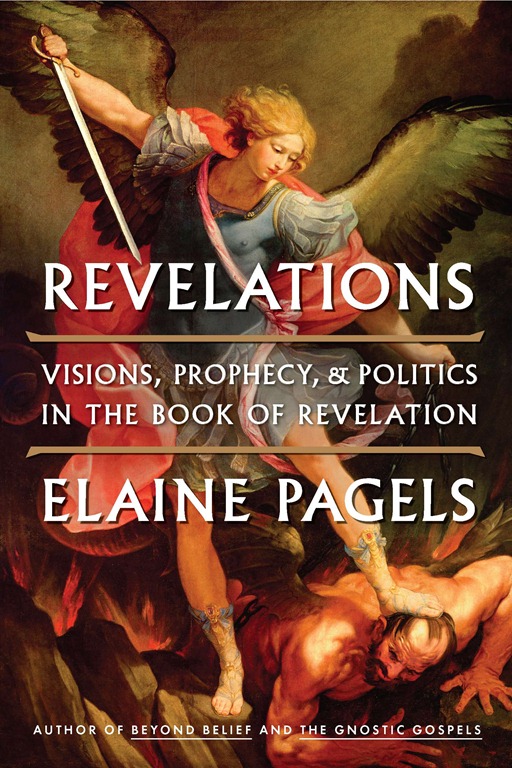
Let me be very clear in my position – anyone believing that The Book of Revelation is about anything other than 1st century politics is spinning out new memes. There is no such thing as divine revelations or prophecy. We know this is true for two reasons, science, and the fact that all people we’ve examined in modern times that proclaimed revelations or prophecy have proven to be insane. But for some reason modern people think that ancient people really did receive revelations from God and angels and were given the power to foretell the future. Those are just two of the memes that grew out of The Old Testament and even older religions. We have no way to track down the originals of those meme, revelation and prophecy. They are very ancient concepts that have spread all over the world to all religions. They probably originated separately in various parts of the world.
The Book of Revelation by John of Patmos does create many original memes we can track through the centuries. One of the most fascinating aspect of Elaine Pagels’ book, and of Forged by Bart Ehrman, is how early Christians used their religious beliefs for political purposes. Their rhetoric, tactics, motives and argumentative styles are almost identical to contemporary Christian fundamentalist thinkers and the political pundits we see today on Fox News.
The Book of Revelation has a lot of mysteries that I am not interested in. Many people want to believe that the John who wrote The Book of Revelation was also the John who wrote the Gospel of John, and many of those people want to believe that John was also the John the Apostle. Most scholars consider them three separate men. But authorship is an issue that I am interested in for a different reason.
When Jesus lived, and even that’s open for debate, he had a few followers. How did Christianity go from a few believers to billion of believers? How did the early Christians spread their ideas, especially after Rome started a program to exterminate them. How did they keep spreading their ideas until Christians were the rulers of the Roman world? How did Christians codify their beliefs into a book that spread their beliefs across the whole world? Strangely. the story is far more political than spiritual.
How did Christian ideas spread like a virus infecting untold billions of people through the centuries, even after better, and more rational ideas developed? I believe they used certain techniques that made their memes more powerful. They include:
- God told us (revelation)
- Jesus taught us
- Jesus died and was reborn (it’s funny how people just accept this idea of proof of Christianity)
- the disciples taught us (Gospels)
- Jesus reveal to us after he died (Paul, John of Patmos, etc.)
- we will live after we die (heaven didn’t exist as a reward until after Jesus died, but it was a huge selling point)
- the scriptures taught us
- allegories and coded works
- forgeries, fakes and forked ideas
One way to validate your idea is to not claim those ideas are yours, but God gave them to you. Very few people get away with being a Prophet with a message from God. The next best thing is to claim your idea was given to you by a Prophet personally, these are the disciples that knew Jesus. But if you weren’t part of the original twelve how do you validate your ideas? Paul claims to have met Christ on the road to Damascus in a vision. That’s pretty convenient, and he got away with it, even though he taught a message of Christianity that was distinctively different from Peter and James and the other apostles. In today’s world there are countless people who hear from God and Jesus but we don’t take them serious.
As Bart Ehrman points out in Forged, that back in the early days of Christianity there were a lot of people with ideas, mainly political, that wanted their ideas accepted, so they wrote using another name. Ehrman shows how many Christian scholars believe several of the books in the New Testament are forgeries of this kind. Mostly people after Paul’s time using Paul’s name to get some things done. What John of Patmos does is claim he got his revelations from a vision of Christ. He was attacking Rome in an allegoric and coded document. He had to hide his true meaning because the Romans would have killed him. For centuries other people have used The Book of Revelation as the basis of their authority to attack social and political conditions in their own day. The entire second coming, left behind meme comes from The Book of Revelation, even though it was intended the first century and not the current. Coding your ideas in allegoric visions usually doesn’t work, but thousands of writers have cribbed from this story.
This kind of claiming authority worked for the first few hundred years until it became very hard to believe anyone knew the original guys, or that any of their writings were still left undiscovered. Today we always doubt people who claim they got a message from God, except that it’s been pulled off rather well twice since Christianity began, by Islam and The Church of Later Day Saints.
Today we get people who claim they know what God thinks and they try to speak for him. Here’s a horrific example that came out after the Sandy Hook killings. Watch this video till the end, so see how their logic is refuted.
The logic used by the people to promote prayer in school is the same logic that was used for form Christianity and take over the Roman Empire. There were writers in those early centuries that attacked Christianity for its illogical premises, but those works have been mostly destroyed. For a religion claiming be based on the lamb, the early Christians were as aggressive as lions. Pagels told of a bishop who foiled the power of his enemy, a powerful intellectual monk, by writing the monk’s biography and having him believe everything the bishop did.
Reading about early Christianity is the study of political power of memes. Christianity spread spiritual memes like belief in heaven and hell, but it mainly spread political ideas that developed the Catholic Church. Pagels chronicles the early Christians who believed very differently from modern Christians. The Catholic Church, which became the orthodoxy, had many opponents which the orthodoxy labeled heretical. These opponents had different ideas as to what Jesus taught. We can never know what Jesus really taught because the orthodoxy wiped out the heretics and all their writings. Well, victors always get to write history, except in the 20th century we discovered a couple caches of documents hidden by the heretics 1800 years ago. Elaine Pagels has made a life-long career of studying these documents and they give us vague tantalizing clues to the early Christian years and how various memes were created.
If religion is a virus of the mind, what is the anti-virus? Obviously logic and science are not the answer. They do work against religion, but their effective rate of cure is very slow. Scientists are learning that humans are not logical and rational, but are powerful rationalizing creatures. Most people’s desire to believe in an afterlife is so powerful they will do anything to maintain that belief. This is particularly perplexing because the details of what immortality will be like are extremely vague. Other than not dying, the most common benefit of the afterlife is getting to meet dead family and friends. Most people expect a pleasant existence in the afterlife but have no specifics of what that will involve. The Book of Revelation does provide a lot of details, but I can’t believe people actual find them appealing.
We live in a reality obscured by ideas. John the Apostle and John of Patmos did know the power of “The Word.” Like Plato they believed their ideal concepts were reality. They thought their concepts were purer than reality. Their visions became memes that have infected the minds of men ever since. Will we ever be cured of these fantasies?
We live in a world were the majority of people live lives based on delusions. They fiercely campaign for political changes based on their delusions. They demand that all people follow their delusions. They demand that all morality be based on their delusions. And many of them are willing to kill to get what they want. All for a virus of the mind.
JWH – 1/13/13

 Auxiliary Memory