A Choice of Two Creation Stories: Cosmos v. The Book of Genesis

Although the new documentary series Cosmos is a science show, it can also be seen as a creation myth.  It tells how the universe was created and how people came about.  This puts it in direct competition with all other creation myths, such as The Book of GenesisCosmos represents the creation myth of 2014.  Trying to find a date for when the Book of Genesis was written is very hard.  We don’t know when or who wrote it, but there is great speculation, both by scholars and the faithful.  Unfortunately the faithful have come up with endless theories to when The Book of Genesis was written and by who.  Some of them are very creative, but they are all self-serving, in that they are meant to validate a particular view of religion.  Let’s just say The Book of Genesis was orally created thousands of years ago, before written language, before history, before science, before philosophy, before most every kind of systematic form of learning that we know today.
For-Cosmos

My point here, is we’re constantly creating stories to explain reality and our origins.  Three thousand years from now, the science of Cosmos will seem quaint – maybe as quaint as The Book of Genesis seems to most educated people today.  And maybe there will be a small segment of the population that clings to the ideas of Cosmos 2014 because it rationalizes some idea we treasure now but is rejected in the future.

Young Earth Creationism is the idea that reality has only existed for about 6,000 years and any suggestion that anything is older is a challenge to their theory.  Basically, these believers do everything possible to rationalize that The Book of Genesis is literally true, even though its full of internal inconsistencies.  They believe Moses wrote the first five books of The Bible around 1445 BC, even though Moses is a character that comes generations later.  They’ve even come up with an idea of how Moses could have done this, The Tablet Theory.

Cosmos is based on science, and science claims to be based on directly studying reality.  Because science is logical to most people, people with opposing creation myths like the young Earth creationists, now attempted to be scientific.  Sadly, their pseudo science is pathetic.  Both sides will reject the myth label, and insist their story is the actual explanation of how reality works.  That puts them into direct competition for the hearts and minds of citizens of the Earth.

Trying to understand how many Americans believe young Earth creationism is hard, but here is one study, “How many Americans actually believe the earth is only 6,000 years old?”  Tony Ortega estimates this is around 31 million.

The new Cosmos will be seen in 170 countries in 45 languages, but how many people will accept it as the best possible current creation story is hard to calculate.   Neil deGrasse Tyson is the new Moses of science, and he claims the universe is 13.8 billion years old, and instead of structuring his story around 6 days, uses an analogy of the 365 day calendar to picture how 13.8 billion years would unfold.  The image is our modern world since the Renaissance would fit into the very last second of that imaginary year is just bind blowing!  One year has  31,536,000 seconds, so this creation myth is quite complex. 

The Book of Genesis, a single chapter in one book, and is merely a few thousand words.  To understand those 13.8 billion years Cosmos covers you’ll need to read hundreds of books just to get the basic ideas how how things works, and thousands of books to get a fairly accurate picture.  I wouldn’t be surprised if there weren’t at least one scholarly book for each of those 31,536,000 representational seconds.  Maybe the faithful prefer The Bible for their explanation of reality because it’s requires reading only one book.

For most people, watching the whole series of Cosmos will only be educational in the vaguest sense.  Fundamentally, it will just be another creation story to accept or reject unless they study more science books to dig into the details.  I’ve often wondered just how many science books an average person had to read before they could claim they have a decent sense of scientific understanding.  To get some idea of the variety of science books available, read Gary’s Book Reviews at Audible.com.

Fans of the new Cosmos after finishing the series could read ten of the best popular science books on cosmology and still not understand much.  It’s a shame that K-12 schooling isn’t structured so children end up recreating the classic experiments of science.  Educating a scientific mind might be beyond reading books – it might require a series of AH HAH! moments of doing actual experiments.

Cosmos is a magnificent television show, but it’s only a beginning.  I’m sure the producers only expect it to inspire rather than teach.  It is Glenda telling Dorothy that the Yellow Brick Road exists, and viewers need to follow it to discover the real meaning of science.

The Great Books of Science

Encyclopedia Britannica has Great Books of the Western World – 60 volumes of the most influential writing in history.  This set was inspired by the 1909 idea of Harvard University and their Harvard Classics.  Which is also imagined in Harold Bloom’s Western Canon.  What we need now is The Great Books of Science series.  It doesn’t have to be an actual publication, but a constantly updated list of the best 100 books to read to understand science.  Science books get dated quickly, so the list needs to be constantly monitored and revised.  The editorial board needs to be scientists, or at least popular science writers of great experience.  Here are some attempts of coming up with such a list of science books.

As you can see, I didn’t find that many lists, so it’s a great project waiting to happen.  There’s many more lists of great science fiction books than science books, which is sad.  I love science fiction, but shouldn’t real science be more popular?

JWH – 3/13/14

Can 20th Century Dogs Ever Learn 21st Century Tricks?

We moldy holdovers from the 20th century must admit now that it’s 2014, that the 21st century is much different from how things used to be in our Leave it to Beaver days.  Young people born in the 1990s will have a hard time even understanding our old ways.  And why should they?  As a writer I should spend less time focusing on the past because more and more of my potential audience will have no understanding or connection to it.

On the other hand, I don’t think I can ever become a post post-modern, or whatever we should call a 21st century individual.  I just can’t move my head into the Twitterverse, and have a hard time even using Facebook, which evidently is becoming passé with the younger generations because they’ve already moved on to newer technologies that I don’t even know the names of.  Even more, I really can’t imagine myself wearing Google glasses, or modern fashions.

trans-human 

But I have changed a lot.  Is that even interesting to the 21st century citizen, that a 20th century person is adapting?  If I live to be 100, I’ll have spent roughly half a century in two different centuries.  How long will it take to become a completely 21st century person?  Is it even possible to catch up?  Will 20th century folk always be on the trailing edge of 21st century living?

In history and literature, the term modern means early 20th century, and by the time I was born I was growing up in a post-modern era.  That kind of talk is completely alien to a true 21st century mind.  What do they call their post post-modern lives?

In the world of science fiction, we talk about post-human cultures, and post-humans and trans-humans.  We expected genetics and other cyber technologies to transform humanity into something new.  However, we thought they’d be physically different, but what if that’s not true?  What if merely growing up in a high tech culture makes that generation significantly different?  Hell, us baby boomers growing up in the 1960s thought we were significantly different from our parents who grew up in the 1920s and 1930s.

Would it be possible for a 20th century person to catch up and even surpass a child of the 21st century?  I have 50 years of wisdom and knowledge they don’t – won’t that count for something?  I also have 50 years of reading science fiction and thinking about the future that should give me some kind of edge.  But is thinking about the future of equal value to growing up in the future?  I don’t know.

When I sat down to write this essay I intended to write a completely different essay.  It was originally called “How New Technology Changed My Old Lifestyle.”  But as I wrote the first few sentences I realized the more interesting question is:  Can my older mind catch up with newer thinking?  And if I’m having a hard time, how do the Gen X and Millennials feel?  If must be confusing for a Millennial (Generation Y) to think of themselves as the cutting edge generation and realized they’ve already been surpassed by the latest crop of youngsters, which some people are calling the New Silent Generation or Generation Z.  Hey, it’s a bitch getting old, get used to it.

And even though modern teens walk the tech walk, and talk the tech talk, do they even have a clue as to what the fuck is going on?  Is living in virtual worlds almost 24×7 of any real value other than hiding out from the real world?  Did rock music and dope confer anything special on us baby boomers that made us more savvy about reality?  Is being hip a real survival trait?  Can you transform the world into a better place with just smartphone smarts and social media savvy? 

I think the real trans-human mind will think with scientific clarity that requires seeing with statistics and math.  The real power minds of the 21st century won’t be Twitterers, but data miners.  Talking in 140 characters only leads to snippy gossiping skills, if you want to conquer the world you’ll need to be able to digest petabytes of data at a gulp, and convert it into  graphics that show visual insights that transcends text.  In other words, if you’re only nibbling at tech, you won’t get far.  It’s the super-geeks that will inherit the Earth.

To answer my title question, yes, it’s possible for baby boomers to excel in the 21st century but only if you ignore the glitter of tech glamour, and go deeper.  In every generation it’s the folk that can tell shit from Shinola that succeed.  Technology is transforming how we live, but I’m not sure it’s transforming us in how we think.  People still think the same stupid stuff, but just say it in 140 characters or less.

Probably the real 21st century citizens have yet to emerge.  And all the tech we’re seeing is a kind of churning of digital conversions, transforming culture more than people.  Does it really matter that you watch TV shows via broadcast TV, cable TV, or Netflix TV?  19th century people would feel superior to me because I’m not smart enough to hitch up a team of horses.  I’m thinking the difference between old humans and post humans are whether or not they can comprehend what David Deutsch writes about in The Beginning of Infinity, which is the ability to effectively evaluate knowledge.  Sadly, I’m just as far from understand that as I am at understanding the Twitterverse.

JWH – 1/8/14

Reality is Not About Us–Philosophy in a Photograph

Sometimes I get very philosophically excited by a picture, but I find it very hard to put my reaction to it into words.  The whole picture is equal to a thousand words kind of thing, but for me, some pictures could generate a hundred thousand words, or even millions. 

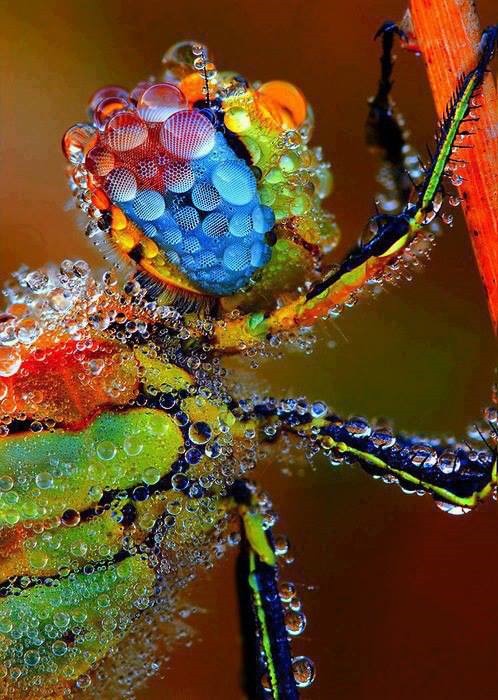
Here’s a photo I found and sent to several of my friends.  It’s a dragonfly covered in dew.  Philosophically, I’m fascinated by the idea this reality wasn’t meant just for humans, and reality is experienced by an infinity of minds perceiving it in infinite ways.  This is one of the many reasons why I don’t believe in God.  God is too small of a concept to encompass all of reality.  God is too anthropomorphic, to human self-centered, to be a meaningful hypothesis when you study all of reality.  The reason why I embrace science is because science is a better tool for understanding the truth about reality, even though I know that even science is too puny to do the job completely.  Science just handles big numbers far better than theology.

dragonfly-color-intense

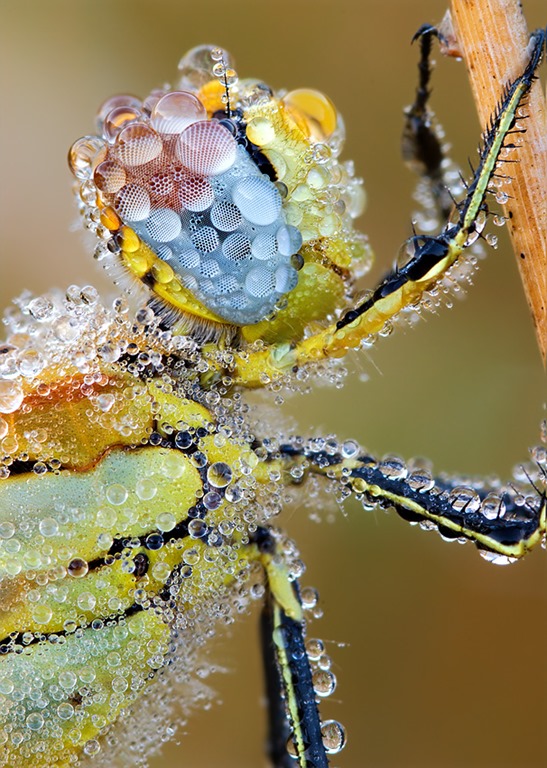
Our human senses are so limited when it comes to looking at reality.  For example, look at this second photograph of the same image, taken from the photographer’s web site.  This is from Martin Amm Photography, and is color corrected differently.  The first picture had been color saturated to make it more intense.

dragonfly-in-dew-original

Now don’t get the idea that the second photograph is the way the dragonfly really looked at the moment the camera snapped the picture.  First off everyone sees things differently, and everyone’s monitor color calibrates differently.  But even back in the reality from which the photo was taken the photographer saw the dragonfly differently from what he photographed, and the birds nearby waiting to eat the dragonfly saw it differently too.  And the insects on the same branch saw the dragonfly completely different too.  There is one huge reality, but all the beings in it see it differently, in an infinite number of ways.

To begin to understand how complex seeing is, and I mean beyond just the tiny window of visual light that humans use, we have to study the electromagnet spectrum.  On a recent PBS NOVA, “Earth From Space” they had a scientist report that if the electromagnet spectrum was measured from New York to Los Angeles, then the part the human eye sees with would be the size of a dime.

Size matters.  Our view of reality is distorted by our size and the size of our senses.  When humans invented the concept of God, our awareness of reality was much smaller, and we pictured God as being the biggest thing we could imagine.  All our cherished concepts, God, heaven, hell, love, hate, justice, good, evil are measured by human scale senses.  As human minds progressed beyond theology into philosophy and then into science, we saw the reality around us expand further and further.  At one time God was the biggest thing we could imagine, and then science gave us the universe, an object whose size is beyond our best imaginations to fathom, but it can be measured.

I use the word “reality” to label everything rather than the word “universe” because scientists are now speculating that our universe might only be one of an infinite number of universes.  When I say “reality” I mean the whole she-bang, and not just the big bang.  When I say the word “God” isn’t a big enough concept to convey reality I’m  not just being an atheist, but I’m making a philosophical statement about numbers, size and reality.

Humans generate ideas constantly, but most of our concepts don’t hold up against reality.  Take the concept of heaven.  Many people believe when they die they will go somewhere else, somewhere beyond reality.  Where is heaven?  How big is it?  How far do we have to go to get there?  How many people are there?  How many animals?  What about plants and insects?  What about intelligent beings from other worlds?  Does the dragonfly above deserve everlasting life too?  Reality is huge, but how big must heaven be?  If everything in this reality gets to live again, how big must heaven be?

By one estimate, over 107 billion people have lived on Earth, and that doesn’t count Neanderthals and earlier forms of hominids.   Is heaven and hell crowded now with all those people?  What about their favorite pets? What about all the billions to come?  Just how big is heaven?  Heaven is described in The Book of Revelation and even given with measurements.  Depending on we interpret the ancient measure, heaven could a large shopping mall about the size of Australia.  Did you know the Bible describes heaven as a building, and living in heaven would be indoors?

See what I mean when I say our concepts about reality are too puny to be realistic.  People who study Zen Buddhism are taught to look at reality without using all their bullshit concepts.  If they say something stupid they are caned about the head and shoulders.  If we had a Zen master walking behind us all day, we’d get whacked in the head constantly.  We’re always bullshitting ourselves.

It’s very hard to use words precisely.  We have so many bogus words.  We have too many words that distort our view of reality because of their anthropomorphism.   I find it helpful to stare at photographs and try to forget the words.  Or just stare at reality and try not to explain what I’m seeing.  But that’s a failure too.  You see, we do have a sixth sense, one that the dragonfly doesn’t have, and that’s language.  We see with words.  Learning to use the correct words, without distorted concepts, is a way to focus our inner sight on reality.  We can see reality, in our limited fashion, but we must wash the bullshit off our eyes first.

Does this begin to show you why I got excited by seeing the photograph of the dragonfly?  I’ve written about a thousand words now.  Tomorrow I could write a different thousand words on meditating on the same photograph.

JWH – 6/27/13

Is Dieting a Test of Free Will?

Ever since I read The Blank Slate by Steven Pinker I’ve been obsessed with the concept of free will.  I’ve read enough books on brain studies in recent years to doubt the existence of free will.  Now I’m not saying we’re all robots, but I question whether or not we’re making decisions on our own, as if we were independent souls sitting in our heads driving our bodies around, and making impartial decisions based on weighing all the evidence and facts.

red-pill-blue-pill-matrix

I remember a freshman philosophy course I took in 1969 and my professor challenging us to come up with an example of free will.  That class inspired many arguments between me and my friends.  Free will is a philosophical concept that few people think about in normal life – mostly because it feels like we do make our own decisions so why even ask about free will.

When Neo makes his choice between the red and blue pill in the film The Matrix, is that an act of free will?  If he’s the One, wouldn’t that make him born to take the red pill?

Everyone assumes they have free will and they are acting on their own volition, but the older I get the more I assume that’s just an illusion.  So I’ve been wondering if I can come up with a test for free will.  I think I’ve found one with dieting.  Our bodies and hunger represent the power of nature and the hardwired programming of genes.  The need to diet comes from our environment, where we constantly learn that fat is sexual unattractive, unhealthy, and like Pavlov’s dog, we’re constantly conditioned that being fat is bad.  Without that nurturing my nature would run wild.

If we have free will we should be able to evaluate all the outside data and decide to diet and lose weight because of its own philosophical merits.  Then why do so many people have trouble dieting?  Is it because our bodies, genes and physiological wiring program us to eat and free will can’t overcome that?

I started a diet today and at this very moment my body is already nagging at me to eat something fun.   “What a puss,” my mind tells my body.  I say no, it says yes.  If I can keep saying no, is that proof of free will?

Now there are two factors here:  free will and will power.   Scientists are throwing water on the concept of will power too.  And what’s the difference between free will and will power?  Deciding to diet might be an act of free will, but failing to diet might be a lack of will power.  And if I succeed in losing weight is it really because I have free will, or has outside stimuli overcame my genetic programming and reprogrammed my eating habits?  Where is the me in all of this activity?

Or is it a case of “I diet, therefore I am.”  (I wish I knew the Latin equivalent to cogito ergo sum that includes the word diet.)  Is thought good enough to prove the existence of free will?  Without thought I’d just eat anything I wanted and never think to lose weight.  However, all those thoughts about losing weight come from the outside world.  If I really had free will, wouldn’t it have been my idea to lose weight? 

But who comes up with original ideas???!!!  Einstein and the theory of relativity comes immediately to mind.   Imagining the concept of space-time had to be an act of free will.  Do we discount the billions of years of cosmological and biological evolution that produced Einstein as not part of the equation, or is Einstein’s discovery of space-time really the universe’s act of free will?  Einstein couldn’t have made his discovery without a long history of other scientists and thinkers.

When I choose to diet, is it my decision, or society’s?  Like Neil Armstrong’s “That’s one small step for man, one giant leap for mankind.”  Can we ever separate our will from the world’s?  The urge to eat is genetic.  How much I want to eat is probably genetic too.  Choosing to eat between steak and veggie burgers would seem like a free will choice, but is it?  If I had never read about vegetarianism would I ever considered the choice?

That’s the weird thing about asking ourselves if we have free will.  Genetics might be our hardwiring, but the environment seems to be doing all the software programming, so where is there room for free will?  Would that be self programming?  Even if I could write my own personality programming, wouldn’t the “free will” writing the programming been created by outside programming or genetics?

If I really had free wouldn’t even the urge to eat be my choice?  Is thwarting the urge to eat free will, even thought he idea didn’t originate with me?  Is free will the ability to choose among the various outside impulses we get from society?  Society tells me not to eat, but advertising on TV is doing a major brainwashing job to get me to eat.  Every time I see a Sonic commercial I want one of their shakes.

Dieting is a test of will power and maybe even an example of free will.  It’s a shame I always flunk it.

JWH – 12/15/12

The New Normal (NBC)–Now and Then

The New Normal – I love the title of this NBC show that premiered back in September, it says so much.  Makes you ask, “What was the old normal?”  Is there such a thing as normalness?  Having grown up back in the 1950s during the Leave it to Beaver and  Father Knows Best normalcy, I can remember a long parade of new television seasons where Hollywood tried to capture the new normalness of the American family every Fall for a half century.

(Some of the more famous shows about the American family from the last 50 years were My Three Sons, Andy Griffith Show, The Dick Van Dyke Show, The Brady Bunch, All in the Family, The Waltons, An American Family, Good Times, Little House on the Prairie, The Jeffersons, Eight is Enough, Family Ties, The Cosby Show, Our House, Married with Children, Full House, My Two Dads, thirtysomething, The Wonder Years, Roseanne,  Life Goes On, Family Matters, The Simpsons, Home Improvement, My So Called Life, South Park, That 70’s Show, The Sopranos, Family Guy, Freaks and Geeks, Malcolm in the Middle, Grounded for Life, Two and a Half Men, Weeds, Big Love, Jon & Kate Plus 8, Breaking Bad, The Secret Life of the American Teenager, Modern Family, Parenthood)

new-normal-2

But were Ward, June, Wally and the Beav ever a normal family?  ABC, CBS and NBC painted America as if everyone were WASPs (white Anglo-Saxon protestants)  in the 1950s, and even though my family was just as waspy, George, Virginia, Becky and Jimmy looked and acted like nothing we watched on TV.  America wasn’t lacking in people of color or various sexual orientations back in that black-and-white TV era, television just didn’t report on their normal day-to-day lives.  Some of those old gay couples getting married today were together back during the old normal.

TBDLEIT EC040

My parents were on the ass end of middle class, drank enough to be called alcoholics, fought and smashed things like Richard Burton and Elizabeth Taylor in Who’s Afraid of Virginia Woolf, and my and I sister ran wilder than any switch or belt could control.  Although television didn’t chronicle my family or anyone I knew, I think it did influence American society, and may have even shaped us.  TV showed us there was no such thing as normal.  Have you ever seen your family on TV?

Conservatives might swear to God that television news is biased to the left, and shows like The New Normal and Glee are propaganda for the liberal lifestyle, but television news reporting and fictional shows have always trailed the changes in society – they have never led the way.  Television has always been the fantasy of how we want to live.  I think America has always wanted television to chronicle the countless types of people that we are, and the accidental byproduct of all this voyeurism was that we have adapted to diversity.  Real life strangers would flair up your xenophobia, but put that same subculture or ethnic group on TV and they became endearing.

Real life and television life seems to have some kind of reverb going, with television echoing changes in society and stimulating society with its feedback.  The New Normal is about two gay men, Bryan (Andrew Rannells) and David (Justin Bartha) hiring Goldie (Georgia King) to be the surrogate mother of their baby.  This arrangement is far from new in the real world, or even on TV, but it’s taken for granted normalcy is a way to convince all those Americans who haven’t gotten the memo, that this is the new normal.

I find The New Normal just as comforting and pleasant as Leave it to Beaver, Father Knows Best or The Adventures of Ozzie and Harriet back in 1958.  These happy families, both then and now, make me feel good and wish all families were just as happy.  Like Modern Family, to which The New Normal is often compared, these and other feel-good liberal shows are designed to make us feel better about life in America in 2012, they are our Sunday School classes about how to be good people.  Our economic lives might suck, but at least we’re evolving as accepting and empathetic beings.

Sadly, this doesn’t work with everyone in our polarized society.  We’re still fighting the war between extreme religious belief and the Enlightenment.  I wonder what Descartes, Bacon,  Locke, Voltaire and Rousseau would make of our modern times, and what philosophical issues would they make out of our television shows?

father-knows-best

That’s the thing, I don’t think television initiates social change, but soothes us to accept it.  Many Americans don’t like gays or gay marriage, but as a whole, those attitudes are changing.  Last October, GLAAD released a report showing the 2012 television had the highest percentage of gay LGBT characters ever.  Not only are there more gay characters on TV, gay characters are finding more fans, and even the hateful grumpy people who protest their outrage are becoming fewer.

Television makes us comfortable with new ideas.  Television is an agent of integration, and I don’t mean that in just the racial integration sense, but in the integration of all change that’s going on in society.  Television is the spoon that stirs the American melting pot.

Television has been programming my social awareness since the 1950s, and it’s fascinating to contemplate all the changes the TV has made to America in the last fifty years.  If we had a time machine and could go back to 1962 and convince NBC to show The New Normal to America back then, how would it have been received?  Of course the show would be seen as a kind of science fictional view of the future.  There’s more new to The New Normal than two gay guys living together, and besides they did have gay people in 1962 so it wouldn’t have been a totally new concept, but they didn’t have surrogate mothers, or iPhones, video games, an African-American president, global warming, etc.  Change is relentless.

Remember, 1962 was before the sexual revolution of the 1960s.  The pill had just been released a few years earlier and it still hadn’t made it’s social impact.  If you watch The New Normal it has an whole spectrum of liberal ideals integrated into the show that would have been overwhelming to the “normal” people of 1962 to digest.  On the other hand civil rights and feminism had already begun by 1962, so maybe the viewers of 1962 would connect the dots between then and now.  And even though America was a technological giant in 1962, I just don’t think those 1962 TV viewers had any clue as what computers would do to our society.

Today we have hindsight to see how far we’ve come.  All too often we judge the citizens of the past by the morality and political correctness of today, but let’s reverse the tables.  How will people fifty years from now look back on us in 2012 and will they judge us harshly?  I’m sure in 2062 there will be a sitcom that’s the equivalent of The New Normal, and if we could see that show today, how would we react?

Liberal education marches on.  Will we ever reach an end and be perfectly enlightened?  I’m sure the seeds of future liberal standards of political correctness exist in our day-to-day life now.  Our treatment of the environment and animals will horrify our descendants.  Our polarized politics and fundamental religions will make the people of 2062 scratch their heads in amazement wondering how we could have been so irrational.  Our wasting of natural resources will be judged criminal.  But those are the easy issues.  What are the harder ethical issues we can’t discern with our quaint old-fashioned minds?

What will be the next new normal?

JWH – 12/10/12