Self-Psychoanalysis By Studying My Reading Habits

By James Wallace Harris, Tuesday, January 20, 2015

People in the 19th century had the bumps on their heads examined to reveal their personalities. I find examining the books on my bookshelves to be more enlightening.  Going through my library, culling books I won’t read, and reorganizing the rest, is revealing  my preoccupations with various subjects I’ve had for a lifetime. I’m surprised by the diversity of topics, and their stark limitations. Look at your books to see how your personality is revealed, or when you visit a friend, glance across their volumes.
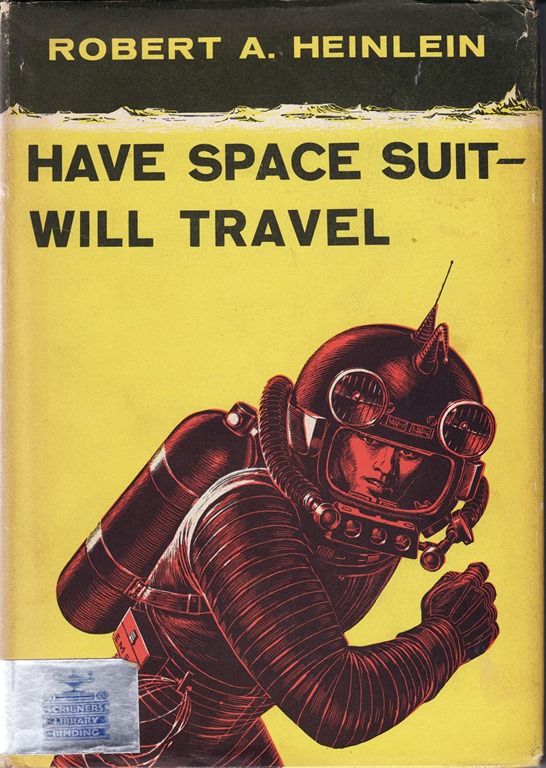
have-space-suit---will-travel 

The majority of my books are science or science fiction. But with each, I can see if I have definite sub-interests. I have many books on physics and astronomy, and very few on biology and geology, and none on chemistry. I have quite a number of books on science history. I have maybe two dozen books just on brain research, and just as many on evolution. I used to have shelves of books on observational astronomy, but I’ve gotten rid of them because I gave away my telescope. I never could see well with my scope, and it was always very inconvenient to drive out to the club’s observation site. So my astronomy interests shifted to books on cosmology and space science. I love books on discovering and researching the cosmic background radiation. I have a few books on early man and anthropology and wished I knew more.

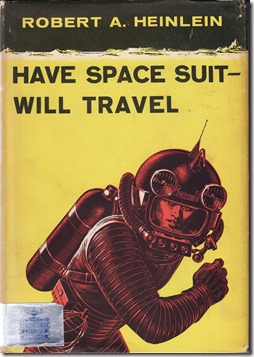
My science fiction reveals a partiality to Robert Heinlein, Samuel R. Delany and Philip K. Dick for nostalgic reasons, a smattering of SF novels from the last 25 years, and quite a number of anthologies and yearly best of collections of short stories ranging from the 1940s to the present. I have about two dozen books on the history of science fiction. I have many volumes on science fiction art. I should admit, that my interest in Heinlein, Delany and Dick is dwindling because my interest in newer writers is growing.

I feel bad about abandoning old friends, but sometimes you just have to move on. And that’s an important revelation too. I can only pursue a very limited number of subjects and authors.

I have fair amount of contemporary literature, as well as classic American and English novels. I have damn few novels written by people other than British and American writers. That’s rather narrow minded, but I do have lots of books by women, and a fair number by African-American authors. Because I know only English, the few French and Russian novels are translations.  No Spanish, Italian and German books at the moment, but I have read some in the past. I have also read a few books by people from Africa, but mostly South Africa. And I’ve read a few books from Asia. My literary awareness of South America and Central America is very close to zero.

I have a couple shelves of biographies. I’ve seem to specialized on Charles Darwin, Mark Twain, Jack Kerouac, Bob Dylan and The Beatles, but I have at least on volume on H. G. Wells, Jules Verne, Rudyard Kipling, Anthony Trollope, Charles Dickens, Margaret Fuller, Louisa May Alcott, L. Frank Baum, D. H. Lawrence, Edith Wharton, Wyatt Earp, Alan Turing, Neil Young, Steve Jobs, and books about the music groups Buffalo Springfield and The Byrds. Plus many bios and histories of people I can’t recall at the moment.

I’m also into certain historical subjects. I have lots of books on the 19th century for some reason, especially literary and scientific history, but many books on Boston, the Transcendentalists, and the wild west. I have several books on computer history, including one just on the ENIAC machine.

I probably have two or three dozen books on books. Book history, the histories of magazines, the history of the printing press, collecting books, classic books, western canon books, and many books on the best books to read in a lifetime.

I do have a number of books on feminism, a few on black history, and a number of ecology. Since the 1960s I’ve followed these subjects in a peripheral way. I also have some books on world cultural and economic problems. And a number of anthropology and sociology type books. All of these reflect a general interest in social issues and a desire to learn about my fellow humans on lifeboat Earth.

Even though I’m an atheist, I have many books on Christian history and The Bible – but I’m giving them away. I have several of the history of religion, and I’d like to know more about how religion developed in Neolithic times. I’d like to know more in general about how early man got from living in the forest to living in cities, and what they may have thought or believed. And I have many books on philosophy. However, my interest in Christian history is fading at the moment. In comes and goes over the years. But I think I’ve read enough to understand how Jesus was made into a deity to satisfy me for now. I’m still fascinated by the early intellectual development of the Christian church, and the impact Greek philosophy had on it.

I have many books on art history and photography. I’m not sure about keeping these. It’s not that I’m losing interest, but art books are big and heavy, and I seldom get them out to look at. Instead, I like finding copies of famous paintings and photographs and putting them on my desktop background, which rotates a new image every minute. Sometimes I just sit and watch my 27” screen show famous paintings or historical photographs. Often when I get into a particular painter, I’ll search out many of their paintings to collect digitally.

I had about twenty mathematic textbooks because I’ve always dreamed of returning to study math where I left off in college. But I realized that’s not going to happen, so they are in the pile to go. I did keep a handful of math history books, and a couple books on statistics, but I doubt I’ll even get to them either. I think my math days are over.

I have no books from these popular genres: mysteries, thrillers, espionage, romance, porn, historical novels, and contemporary best-sellers. I do have a smattering of young adult novels like the Harry Potter series, The Hunger Games trilogy, His Dark Materials trilogy. I have no books on sports, opera, poetry, politics, guns, automobiles, airplanes, gardening, boating, decoration, architecture, flowers, pets, fishing, hunting, travel, jewelry, collecting, clothing, and the list goes on and on. It would be fascinating, but time consuming, to make a list of all subjects I’ve tuned out.

I used to have a great number of books on old movies and film makers, but they’ve mostly been given away over the years. There are probably many subjects I’ve pursued at one time but no longer chase.

This bookish psychoanalysis makes me want to broaden my interests, and specialize more deeply. I think I should read more books about all the countries of the world. I’m currently listening to Age of Ambition about China by Evan Osnos and its riveting. Another thing my self-analysis reveals is how I follow certain ruts, but I’m not systematically learning anything. I feel like I know a lot about the history of science fiction, and I can blather on about a dozen more subjects, but not convincingly. I could teach courses in science fiction, but not anything else. 

Last night I watched a writer from Entertainment Weekly talk to Charlie Rose about the Oscars. I was amazed at the precision of his diction and the mastery of his knowledge. He made me envious to be able to talk about more subjects. I think science fiction is the only subject I could talk about with such erudition, but not with the same comfort of public speaking. I’ve read many books about Mark Twain, but I could only discuss his work and life in a stumbling way. Ditto for cosmology and computers, two other subjects I’ve spent years studying. This makes me feel jealous of people who can regale people at parties on numerous subjects so easily.

Since I’ve known a lot of teachers and professors, I’m used to talking to people who show great confidence in their knowledge. Most people just gab about what they know, and what they know is usually sparse and jagged. I always love meeting a person who’s in love with their topic, even if it’s a topic I have no interest in like baseball or fashion, because they inhabit their subject with such a comfort and confidence that their enthusiasm is infectious. Sadly, most people just natter about what they heard on the news late night, or relate a story about a co-worker.

Part of my failure at expressing the interests of my personality is poor memory. I’m not very good at verbalizing my thoughts, often stumbling over the language, but it’s my erratic memory that keeps me from being more coherent.

As I reorganize my bookshelves, putting books together by topic, I realize exactly what my interests are. I’ve often wondered if I could program a robot to have my personality. When I thought about what personality is, I concluded it’s the subjects my soul are attracted to at any given moment. Back in the sixties they had a saying, “You are what you eat.” I believe our personality is “You are what you think.”

What’s weird is my interests really haven’t changed much my whole life. My reading interests have stayed close to the same subjects since I became a bookworm in grade school. They’ve gotten far more sophisticated, but like I said, I follow certain ruts. Which makes me wonder if I started reading and studying new subjects if it would change my personality.

The most painful revelation of this study is how much I’ve forgotten. I’ve read thousands of books, but forget 99.999% of what I read. That’s demoralizing.

This is a superficial flyover of analyzing my personality. If I really wanted to understand myself, I’ll need to meditate on why I chose all these topics as my own. Why did I become a science fiction guy instead of a sports guy? That will take much deeper thought than I have time for now.

JWH

Why The Selfie Is Significant

I was in the middle of my physical therapy exercises this morning when I realized the significance of the selfie.  Most people think the selfie is silly, and so did I, until I realized how important a form of communication they were.  The selfie has reach the stage of pop-culture success that it’s now the subject of parodies.  It’s quite easy to dismiss the selfie as a narcissistic fad, but a flash of insight tells me that the selfie represents a breakthrough in language.

If you typed a text to a friend that said “I am at the beach” it conveys a certain amount of information.  But if you sent them a selfie of yourself with a beach and ocean in the background you’re sending them many magnitudes more information.  That old saying that a picture is worth a thousand words in quite true, and maybe even an understatement.  But the selfie goes beyond beating a few words with massive amounts of data.

pug at beach

Language is a code.  It’s symbolic.  Pictures are also symbolic.  They give the illusion of reality, but they aren’t.  But they are far closer to modeling reality than words.  And the most important aspect of the selfie is modeling the self – the I.  We all struggle throughout life to express ourselves, and we always fail.  We neither know ourselves, nor can we describe ourselves.  A photo does a pretty good stand-in, much better than words, especially if it also expresses action and place. 

If a photo captures an image of our self doing something in the moment it’s very close to expressing where we’re at.  Sure it’s not as deep as Proust, but it’s far better than the words the average person can express.  Not only does a selfie capture us in the moment, it becomes a much better memory than we can store by chemicals etching our neural pathways.

A selfie of yourself at the beach is proof that you were indeed at the beach, now, to your friends, and to yourself, in the future.

And I think the selfie portends more than that.  The history of the human race is really a history of language and information.  We didn’t become the crown of creation until we acquired language, but no matter how significant that accomplishment was, language has huge limitations as a form of communication.  Think of this way.  Let’s say you were at the beach and wanted to tell your grandmother about the experience.  You could send her a text, write a long email, call her on the phone, send her pictures or send her a videos of several events of your time at the beach.  Which mode of communication gives your granny the best sense of your time at the beach?

What smartphones are doing is allowing us to communicate in two new languages – images and videos.

Sadly, I’m not a smartphone person, or a selfie taker.  I live in the old world of words, and I realize I’m being passed by young people who speak in new languages that I have few skills at using.  Of course there are limits to every language.  Selfies show the outside of things, and even if they can infer a lot about our inner states, they can’t compete with words at expressing our thoughts.  I can’t help but wonder for those people who talk in selfies aren’t outer-world oriented.  One criticism I’ve read of the selfie is young people feel if they don’t have a picture of an experience it didn’t happen, that a selfie is a kind of proof they really did do something.

This is really a weird concept to explore.  It suggests that television and movies have influenced our sense of reality, so that if we aren’t in the picture or the video we’re not there.  It suggests our sense of self is shifting from inside our heads to the pages of Facebook, and that’s quite fascinating.

Some people have already begun to think of the selfie as an art form, but I’m thinking the selfie is a kind of language, one that communicates a sense of self, and says a lot about self image.  I don’t like my physical image, so I use an ugly dog as a stand in.  I see myself in words instead.

JWH – 8/17/14

Are Our Brains Being Fucked Over by Fantastic Tales?

While watching the previews of the new Spiderman movie I wondered how could Spiderman do all that swinging from building to building?  I don’t read comics, but is there some kind of theory as to why he can leap from location to location?  What propels him?  How does he have the strength to survive the G-forces pulling on his arms, or impacting on his legs?  What generates his webbing?  I know all of this is just for fun, but thinking about how it could ever be real hurts my brain.  It’s just so fucking unbelievable that I have to wonder about its psychological allure.

Why are we so entertained by fantastic tales?  Aren’t superhero movies just fairytales for adults?  And aren’t they getting out of hand?  Action movies are moving further and further from reality.  Is this good for our brains?  There’s a saying by old programmers, “Garbage in, garbage out.”  It meant if you input bad data into the computer, the machine will spit out bad data.  Couldn’t that also be true for our bio-computers?

Why do we so badly want to believe in magic?  From the earliest days as toddlers, we are told fantastic tales.  We watch TV that’s full of bullshit concepts.  We read comic books and real books based on fantastic concepts.  We teach our kids about the tooth fairy, Santa Claus, angels, witches, vampires, gods and God.  As children grow their fantasy inputs becomes more sophisticated, switching to Harry Potter, Star Wars and Spiderman.  They will tell you its not real, but what do they feel in their heart of hearts?

We let them watch old TV shows like I Dream of Jeannie and Bewitched where a crossing of the arms or a twitch of the nose can alter space and time.  Does anyone ever wonder what is the science behind the God of Genesis ability to create?  Is it a magic staff like Moses, or does he twitch his nose like Samantha?  We subtly embed the meme that magic exists, while saying it doesn’t.  Is it any wonder that some kids have a frail grasp on reality?

I’ve spent a lifetime reading science fiction, and bought into all kinds of crap that’s not supported by real science, or I did.  I’ve now become an atheist to my own religion – science fiction.  Once you question one bullshit theory, you question them all.

I know it’s supposed to be in fun, but how many people secretly wish for the fantastic?  Deep down, how many people wish their lives were like the movies?

And haven’t action movies gotten a little embarrassing?  Aren’t they really power porn?  Sex porn is the dream of unlimited sex.  Isn’t action movies and superhero movies just a desire to gorge on unlimited power?  To be able to kill you enemies with enormous force and ability?  Most people would never watch sex porn in public, but why aren’t people embarrassed to watch huge quantities of power porn in large groups?  And isn’t it hilarious that both sex porn and power porn are about carrying different kinds of big sticks?  Talk about your AK-47 envy.  Isn’t this all just power fantasy?

What is the underlying need for binge TV watching?  Is it any different from binge video gaming?

Isn’t it all about escaping reality – becoming one with fantasy?

What’s the exposure limit to fantasy before it becomes harmful?

JWH – 5/2/14

How Many Topics Do You Love To Talk About?

When you’re at a party and you hear other people talking, what topics draw you into their conversations?  If you use Flipboard, Zite or News360, what subjects do you follow?  If you use Google Alerts, what news do you want to keep up with?  If you want to be a know-it-all, what areas of knowledge do you want to master?  If you were a contestant on Jeopardy! what categories would you hope would show up?  If you want to get a Ph.D. what would you want to write your thesis on?

zen1

I think we all have pet topics we like to think, talk and even write about, but how many can we realistically keep up with?  Yesterday I was reading this fantastic article about  clean coal at Wired and realized that its topic is one that will impact all of us for the rest of our lives.  Carbon sequestration, or carbon capture and storage (CCS) is not the sexy topic that will impress your friends or cause people to gather around you at a party.  [Idea:  Should we all take on a few important topics to collective worry about?]

That makes me think not only do we have a number of topics that always attract our attention, but we have different kinds.  Some are fun, some are serious, some are just obsessive.  We’ve all have friends we avoid certain subjects because once they start talking they won’t shut up.  Just mention Obama to a Fox News junky to know what I mean.  Yet, isn’t that fanatical focusing the thing that defines us?  Isn’t one way we define ourselves, or our friends, is by the topics they love?  If we use the label jock, geek, hipster, Republican, liberal, artist, don’t we paint a topical picture of how those folks think?

Are the aspects of reality we dwell on the genes of our personality?

When we promote ourselves on dating sites, don’t we paint ourselves by our interests?

This got me to thinking about my own interests.  How many do I have?  How much time do I spend keeping up with each subject?  How much do I enjoy it when I meet other people interested in the same subject?  Is the closeness of friendship related to how many topics we share in common?  How many of my favorite topics are serious subjects, and how many are just for fun?  How consumed am I by each?  Could I rate them 1 – 10 on how important they are to me?  If I had a Billboard Top 100 of Jim Harris topics, could I rank them, plus code them with symbols that showed a growing interest, or waning?

Right now, I couldn’t be that specific with a list of my interests, but it might be rewarding to try make such a list.  Programming an app that track interests, their intensity and their waxing and waning might be a fun project.  I wonder if other people find this idea interesting?  I might start with a spreadsheet and see what happens.  The new “in” topic I often see on the web is decluttering.  People want to get organized, simplify their lives and their possessions.  I wonder if they’d like to organize their interests?

Recently I decided to get rid of LPs again.  For a while I was caught up in the vinyl retro movement, but I discovered there’s a reason why I gave up vinyl when CDs came out.  Now that I’m retired and have all the time in the world to do all the things I dreamed of doing I realized that a whole bunch of things just ain’t going to happen.  In other words I think I have a whole list of topics I’ve lost interest in.  And there’s some new topics that are popping up that I need to pursue.  For instance, I need to sod my yard, but I thought, what would be the best carbon footprint yard to help fight global warming?   So if I had an app that tracked my interests, I’d delete LPs/vinyl and add environmental friendly landscaping.  I wonder how many friends I have that might want to talk to me about carbon friend weeds?

It would have been interesting to have this interest tracking app starting when I was a little kid, if it had some kind of historical record of my interests over my lifetime.  I believe some topics would be life long, and others fleeting, and others would come and go.  Books, music, television and movies would stay constant, but vary in their details.  Science and history topics would wax and wane.  I got interested in computers in the 1960s, and started tech school in 1971, and became obsessed in 1978 when I decided to buy my own microcomputer.  My last three computers I built myself.  Of course, it seems our whole society has a passion for technology now.

I have a growing interest in the 19th century, especially for literature, science and history, but also music, math and philosophy.  I wonder how many of my friends think about the Victorian era?  If I was at a party and heard people talk about Anthony Trollope or Charles Babbage I’d be overjoyed and overcome my shyness to talk to them.  The last party I attended I found a friend for the night by striking up on conversation on popular science books about physics.  And I’d really like to meet some people who are interested in 24 bit FLAC music files.

“One of Us Must Know (Sooner or Later)” just came on the Rdio playlist.  One entry to add:

  • Bob Dylan (1965 – present)

http://rd.io/x/QJhDK3aErw/

JWH – 4/20/14