Sharing Music

Yesterday WordPress informed their bloggers we could add links to Spotify and Rdio to our blog posts and they would be converted into music players.  Great!  I’ve always wanted to review music and let people play it while they read the review.  It’s very hard to describe music in words.  Last night I posted a couple test posts and discovered there’s some real limitations to the endeavor.

I’ve also started a new blog site, Streaming Music, where I will branch off my writing about music. To give you some idea what I can do there I’ve created some tests of embedded music players.

Rdio only played 30 second clips to the people I got to try it, none of which were subscribers to Rdio.  I’m going to try again here and see if I can find some subscribers and see if they hear more than 30 second clips.

You can join Rdio for free and get limited access to their music. You can also join Spotify for free and get quite a bit of free music, but you’ll need to install their software client. Rdio works with a web client.

Spotify won’t play at all unless you have the Spotify client installed.  This is free, but requires people to go off and install the client.  However, Spotify has millions of subscribers, and millions more free users.  And they have users in Europe.

The next downside to the project is people outside of U.S. and Europe can’t use either service.  All the legalities of online borders is a pain to deal with on the Internet where we’re really just one big world.

People have been sharing music on the Internet right from the beginning, but illegally.  For $5 a month you can have legal access to gigantic libraries of music, so subscription music is a new kind of sharing that’s spreading fast.  By WordPress offering linked music players should push this movement further, and hopefully one day I can put a song up to play on my blog and anyone in the world can hear it while they read my post.

If you don’t mind, leave a message and tell me if you can play music from Rdio or Spotify.  Tell me if you only hear 30 second clips or the whole songs.  Tell me if you are a subscriber of either service.  And let me know what country are browsing from.

Spotify

Rdio

http://rd.io/x/QJhDPldi7w

The Last Bruce Springsteen Song I Ever Loved

This is not a review of Wrecking Ball, the new Bruce Springsteen album, but I’m listening to it as I write this.  Nothing in this essay is a about Mr. Springsteen, this story is about me.  At one time I was passionately in love with Bruce Springsteen songs but I haven’t felt that passion since Darkness on the Edge of Town in 1978.  All of Springsteen’s most successful albums were after that, so it’s me and not him.  What I want to know is why did his music and my life intersect in 1975-1978 so well, but hasn’t since?

Romantics love to believe that love is eternal – but is that ever the case?  Many will question my comparison of love for songs to being in love with people, but I wonder if love is love, and any passion we feel is based on the same laws of attractions.  Buddhism shows us that desire is the cause of all suffering.  But isn’t that just another description of lost love?

When we meet people with the right characteristics that set fire to our passions, we are driven to keep those passions burning as long as possible.  Love is a drug with a painful withdrawal.  Whether we fall in love with the girl next door or a new song on the radio all we can think about is how to keep pushing those buttons.

In 1975 I don’t know how many times I played Born to Run.  I first heard the album while living in Dallas, but I moved back to Memphis to catch Springsteen in concert in a small auditorium, and it was like being in a hurricane of rock and roll.  Of course I bought his two earlier albums, and in the years after that, before seeing him again for the Darkness on the Edge of Town tour, I got into buying all the Springsteen bootlegs I could find.  I couldn’t get enough of his music.  It was around this time I gave up getting high with drugs, and music was a positive addiction I used to fight the craving of a negative addiction.  In 1977 I met my wife and we got married in 1978, so this was a very intense time for me, and Springsteen’s music provided the soundtrack.

I also loved Darkness on the Edge of Town with the same passion I did for Born to Run but something happen after that.  When The River came out in 1980 my romance with Springsteen’s music was over.  I kept buying Springsteen albums but the magic was gone.  Except for a couple live albums that returned to the 75-78 years, I don’t think I ever played them more than once.  The passion was over.  Why?

That’s what I want to know, why doesn’t love last?  I’ve been married for 34 years and love my wife Susan dearly, but we’ve changed, and things now aren’t like when we had to spend every day with each other.  I think long-term love is a different kind of love.  It’s almost as if the long-term love isn’t about pushing buttons but learning to live with the life between the button presses.

And that explains our modern world.  We spend our lives always looking for new highs or trying to find our way back to old ones.  And there are exceptions.  Some thrills do last.  Some songs keep firing those synapses and take us back in time.  That’s the difference between human lovers and artistic loves.  Art is static, people change.  With art we’re constantly time traveling to the past to recapture an old feeling.  We want to do that with the people we love, but we grow and change and it just doesn’t work.  We can’t ever become young again.

I wished I kept a diary so I could chronicle all the things that turned me on during those years 1975-1978.  Those were hard, lonely years for me.  I had left the friends I had made during the 1971-1974 behind, to break away from drugs.  I dated a series of girls that didn’t work out.  I was making friends with a New Age crowd and trying to become religious without any success.  I worked a bunch of different jobs, none of which I stuck with for more than a few months.  I was still getting high but struggled to quit, and I read tons of books looking for answers.  Music made me feel great.  Springsteen’s songs weren’t the only ones pushing my buttons, I bought hundreds of albums during those years, but I think his music was the music I loved best then.

I’ve had two peak music times in my life, 1965-1968 and 1975-1978.  I don’t understand the symmetry.   Each peak involved a passion for dozens of groups and artists, but each peak had a central figure.  In the 60s it was Bob Dylan, and in the 70s it was Springsteen.  And yes, both of those peaks were during very stressed out years.  I needed music during those years to survive.  Maybe I’ve never been as passionate about music since because I gave up drugs, got a job, got married, finished college and settled down to a happy life.

Because I loved Bob Dylan and Bruce Springsteen songs so strongly during those troubled years you’d think the words meant something to me, but they don’t.  I admired the words, but it was the music that ignited my passions.  It was the music that made me play the songs over and over again.  It was the music that made me feel alive.

I’ve often wondered if being fanatic over a song is like being a vampire, an emotional vampire.  That the high we get listening to music comes from the emotion the artist felt achieving success and fame, and those powerful emotions come through the music, with fans living off their transmitted feelings.  I’ve always felt the songs with the most emotional power are those when the artists are rocketing up with success.  Born to Run is an ecstatic album.  It’s the album that took Springsteen into orbit.  Springsteen matured for Darkness on the Edge of Town, but he was still aiming at the Moon.  To me, The River was like a master at work but the excitement of success was over.

The same is true with Dylan.   Dylan feels like he had the world by the tail on Highway 61 Revisited and Blonde on Blonde, and then on John Wesley Harding, he’s painting his masterpiece with a new kind of maturity.  I can like and admire the mature artist, but it’s the clawing to the top artist whose songs I want to feed off like a musical vampire.

The last Bruce Springsteen song I ever loved was “The Fever” which was recorded before Born to Run, but I didn’t hear until after Darkness on the Edge of Town, on a bootleg.  It was officially released in 1998 on 18 Tracks.  “The Fever” is the only Springsteen song I still play often.  I never tire of it.  It’s the Springsteen song I live with.  Thematically, I wished it had been the last song on the Darkness on the Edge of Town album.

JWH – 3/12/12

My Music DNA: The FM Years

Until I wrote My Music DNA:  The AM Era I never thought about how my life has been one long experiment with technology.  We like to think personal technology started with personal computers, or for some people, the iPod, iPhone or iPad, but now that I contemplate the topic, I realize The Gadget Age started in the 19th century with photography, then the phonograph, movie camera and radio.  Before gadgets if you wanted to hear music you had to go where the musicians were performing.  If you wanted to see Paris you had to go to France.

Gadgets bring the world to us, whether it’s voice, music, images or movies.  To a degree, books and paintings are proto-gadgets, they bring distant words and images to us created by people, but gadgets bring snapshots of reality, whether it’s images (photography), voice and music  (phonograph, radio) or movies (film and television).  A personal computer or iPad are dazzling devices because not only can they bring us voice, music, images and movies, they can process these media like a word processer processes words.

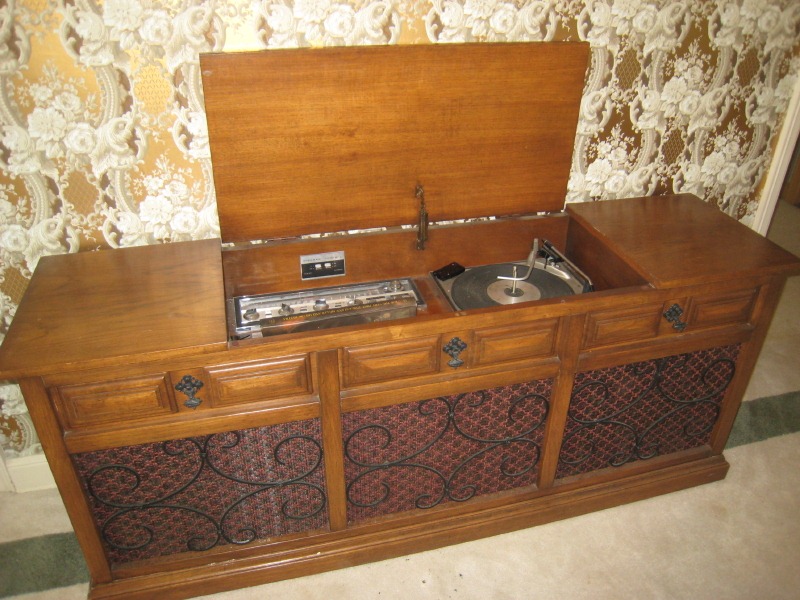
Although FM radio was patented in 1933, first broadcasts weren’t made until 1939, and stereo not added until the late 1950s, I didn’t get my first FM radio until 1968.  FM radio took a long time to catch on.  If you look at the Fidelity Potential Index Table you will see how sound recordings have evolved since the invention of the wax cylinder.  FM music has more fidelity than the 78 and 45, but not as much as the LP.  I had already started buying 45s and LPs before I got my first FM radio.  My first FM radio came in a small console stereo I bought in 1968 from the Columbia Record Club, when I was 16.  It was my first installment plan purchase.  I don’t have a photo of my first console stereo, but it looked something like this.
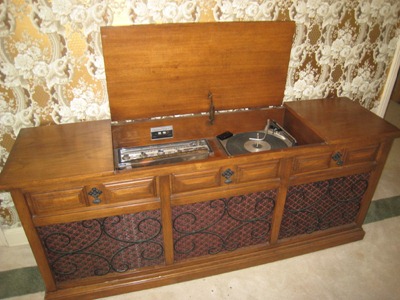
console-stereo2

Working as paperboy, cutting lawns, babysitting, and eventually as a bagboy didn’t not pay enough to buy all the music I wanted to hear, so my FM radio was a magical piece of technology.  AM radio was all about hit singles, whereas FM was about albums.  FM radio took me out of the teeny-bopper tunes and introduced me to a more mature level of album oriented music.

Among the albums I discovered back in 1968 on my FM radio was Truth by Jeff Beck, which I immediately bought.  I was transitioning from AM radio to FM and I discovered new groups like Cream,  Quicksilver Messenger Service, Moby Grape, Steve Miller, Grateful Dead, etc.  I also got into the albums of artists I had discovered on the AM airwaves like The Byrds, Bob Dylan, Jefferson Airplane, Buffalo Springfield, The Beatles, The Rolling Stones, The Doors, Jimi Hendrix, The Mamas and The Pappas.

I remember friends coming over in 1968 to hear the FM radio for the first time and being blown away – it was that different from AM.

My FM years didn’t last long, from 1968-1972.  It was transitional technology.  FM brought me a wide range of music from around the world, but it was a broadcast technology.  I started buying LPs in the AM era, and by 1970 I had about 300 albums, but they were never enough.  FM radio was my music news and how I discovered new music until I couldn’t handle the disc jockeys.  At first, back in the 1960s, FM was considered underground music, but FM took over the hit parade as more people got FM receivers.  At a certain point disc jockeys became so annoying I gave up FM and AM radio.

In 1969 I started getting my music news from The Rolling Stone magazine.  For a brief while in the late 70s and early 80s I returned to FM to listen to WEVL, a volunteer radio station where music fans hosted music shows rather than professional disc jockeys.  But for the most part I gave up radio listening in the 1970s.  I became a album buying addict, buying over a thousand LPs before I switched to buying CDs in the 1980s, and I went on to buy 1,500 CDs before I phased into streaming music in recent years.

AM radio showcased top hits that were played frequently.  AM hits of the 1960s provide the core music that Baby Boomers share.  On any given day you could hear about 40-60 different songs.

FM radio offered a far larger range of music and styles until it was hijacked by the Top 40 format and became zany entertainment for automobile drivers.  In the early days of FM if you tried hard enough you could hear 100-200 different songs in a day.

Buying LPs offered the choice of thousands of albums at better stores.  And LPs allowed fans to own music, another kind of enabling technology.

With Internet shopping, collectors could buy a million CDs if they could afford it – then the MP3 revolution hit, and collectors could steal those million albums if they had the time, bandwidth and lack of ethics.  Now with steaming music anyone can have easy access to over a million albums, or about 15-20 million songs for $9.99 a month.

iTunes and iPod reinvented the hit singles and almost killed the album.  Streaming music is like combining FM and owning LPs with renting music, and it promotes the album.

FM radio still exists, as does AM radio and even LPs, but they are waning technologies that have been supplanted by the Internet.  FM radio was a stepping stone technology that expanded the world of music over AM.  FM radio is now a trailing technology – it fits a niche market, and has many competitors like Sirius Radio, a paid service, or Pandora Radio, free and paid, that offers music from a very wide selection of albums, and is a far superior to broadcast technology.  Broadcast radio itself is a waning technology, even with HD Radio.

Streaming music offers the greatest selection and control – with instant access to most of the albums in print.

Strangely enough, it’s very hard for me to remember FM songs that I loved because of listening to the radio, versus songs from the same time period that I bought on LPs.  The way I’ve discovered how to tell the difference is to listen to Play Cofi Jukebox at tropicalglen.com by the years below.  The songs I loved but never bought are songs I can give thanks to FM radio technology.  What’s surprising is just how many of those songs there were.  Just click on a link and listen.  How many of the songs did you buy, and how many are part of your memories because you listened to FM radio?

19681969197019711972

It’s strange to think that young people today may never have listened to an AM or FM radio, or bought a LP or CD.  But I wonder, just what kind of technologies will supplant streaming music?  Combining streaming music with a smartphone is about as close to thinking of a song and hearing it instantly telepathically as one can get.  Will they ever invent brain transceivers that stimulate the neurons directly, and just bypass the ears?  It’s just amazing to think of all the technological change in one lifetime.

But you know what?  There’s one constant that doesn’t change.  That’s listening to music.

JWH – 2/21/12
My Music DNA: The AM Radio Era

In an age of gadget addiction I look back and realize my first AM radio was my first personal gadget that changed my life.  TV will always be the gadget that raised us baby boomers to see the world, but it was a family gadget.  For me, it was a white clock radio I got for Christmas in 1962 that was my first in a long line of personal gadgets.  Sadly, I don’t have a photo of my much loved radio, but this one will do to inspire these words.

clock-radio

How do we become the people we grow up to be?  The other night I watched Transcendent Man, a documentary on Ray Kurzweil on Netflix streaming.   Kurzweil is an inventor and visionary who hopes to live long enough for medical science to discover immortality, but he also loved his deceased father dearly, and wants to recreate his dad’s personality in a computer.  Kurzweil’s assumption is if he could program a computer with everything his father was interested in, he could create an artificial being that has his father’s personality.  I think a lot about artificial intelligence and I’ve long wondered what programs our personality.  Are we the sum of our likes, loves and dislikes and hates?

The other day I told a friend at work that the music of the 1960s defined me.  She objected to the term “defined” but I couldn’t think of a better one.  If I tried to program a robot to act like me it would require figuring out how to program a love for the same music I love.  I don’t think that’s possible, but then how did it happen in the first place, with me?  How was I programmed to love the music that I do?  What are my music genes?

Some people are very sentimental about music.  Think about weddings and funerals and how we select songs that define us.  There’s that word again.  But we don’t play our favorite TV shows at our funerals, but songs we love.  Some couples mark falling in love with songs.  And what would movies be without songs to enhance our emotions?  Baby Boomers are very different except that most of us feel tied together by the music we shared growing up in the 1960s.

One reason I’m writing this is to remember.  Figuring out the answers to these questions helps me remember.  Writing about the past involves spelunking into the deepest caverns of my mind.  My first memories of music was from the 1950s, listening to songs on my dad’s 1955 Pontiac car radio.  Right from the start my Dad hated the pop music I was unconsciously drawn to.  But it wasn’t until I got that clock radio for Christmas, when I was 11, that the songs started burning into my memory.  My AM radio, with a tiny 3” speaker, was one of the most transformative gadgets of my life.  I wished I had a photo of it sitting in all the rooms I lived in during the years I owned it.  What a shame.  That’s another article to write:  what I wished I had photographed when growing up.

From the end of 1962 until through 1967 that AM radio programmed the musical foundation of my life.  I got the radio when I was living on Maine Avenue at Homestead Air Force Base.  I was in the 6th grade at Air Base Elementary.  I started 7th grade a Redlands Jr. High in September 1963,   We then moved back to our house in Hollywood, Florida probably late October, where I attended Broward Jr. High until just after JFK was killed, when we moved to New Ellington, South Carolina, for the rest of the 7th grade and part of the 8th at John F. Kennedy Jr. High.  Then back to Leisure City near Homestead, where I spent the 8th grade going to Homestead Junior High, and then we moved to Cutler Ridge, where I went to the 9th grade at Cutler Ridge Jr. High.  I graduated Jr. High in 1966, the summer they started advertising Star Trek.  By the time the show premiered we had moved to Charleston, Mississippi for the first half of the 10th grade at East Tallahatchie High School, and then in March of 1967 we moved to Coconut Grove, Florida where I finished the 10th grade at Coral Gables High School and started the 11th.  This is was 1967 and 1968.  It was around the end of 1967 that my white AM radio died.  In 1968 I bought a small console stereo with AM/FM radio, and that began my FM years I’ll write about in the future.

Through the magic of Rdio I’ve been assembling playlists for the songs that are etched in my synapses, making groovy grooves in my gray matter.  I played my radio whenever I wasn’t in school, and I even slept with the radio playing.  Is it any wonder that I imprinted on those songs.  I can even remember the radio stations I listened to when we lived in South Florida, WQAM and WFUN.

If you wish to listen to these songs, sign up for the free membership to Rdio and play these playlists.  You can view the lists without joining, but it doesn’t take much effort to set up a free account.

196219631964196519661967

Would I have been a different person if I had played different music for those five years?  What if I had gotten into jazz or classical music?  Would different music made a different Jim Harris?  Wouldn’t it be a fascinating experiment if we could raise ourselves over and over again, traveling back in time to our birthday to be born in a different country and culture.  Then compare how much of our personality stays the same and how much is differs?  If I had been born in China and immigrated to the US in the 1990s, would I eventually discover that I loved these songs on these 6 playlists?

I don’t think I’d love the music same way if I did.  There’s something about absorbing the pop culture around you when you go through puberty – that stuff sticks to you for the rest of your life.  1962-1967 seems very clear in my memories, while the rest of my life is a blur.

To illustrate how precise my memories are from this time, is how attuned I am to the sound of the original recordings.  When building my playlists I could tell almost immediately when a song was the original, or if it was a recreation, or even if it had been re-mastered tune.  I don’t mind some sonic improvements but I hate major changes.  Remember, I first heard this music in mono.  I usually don’t mind the stereo versions, but the re-mastering that messes with the sound levels, even when it makes the instruments stand out clearer, bothers me.  And I just hate when artists re-record their hits.  I know it’s because they lost the rights to the originals, but I want to hear what I heard over my white AM radio from late 1962 to late 1967.

The soundtrack for the film Pirate Radio re-mastered many classics, compressing the sound to modernize the feel of the songs because modern songs are much louder than oldies.  I can handle this to a degree, but it makes me want a 60s AM filter to change the sound back.  It’s not quite the same, but it’s somewhat like colorizing old black and white movies.

A lot of songs are missing from these playlists – songs I’ve forgotten, songs that everyone has forgotten and gone out of print, songs out of copyright, songs from The Beatles and other butthead artists that refuse to let their music play from streaming music services.  And there’s another group of missing songs, those I learned later to love, like folk music and jazz from that era that I didn’t learn about until after I switched to FM and LPs.

Also, there’s the problem that Rdio just doesn’t have all the songs it could.  For example, “Half Heaven, Half Heartache” by Gene Pitney is available from Rhapsody but not Rdio.  This is why I pay $9.99 a month to two streaming music services.

Finally, there’s the problem of my memory.  Even with national playlists I can’t remember all the songs I used to love because many songs were local or regional hits.  For example, in Miami back in 1963, my sister and I loved a song called “The Lone Teen Ranger” that I never heard again for decades.  I later I learned on the Internet this was Paul Simon singing as Jerry Landis.  But there are so many songs like this that I haven’t heard for decades that are still lost in the darks corners of my mind.

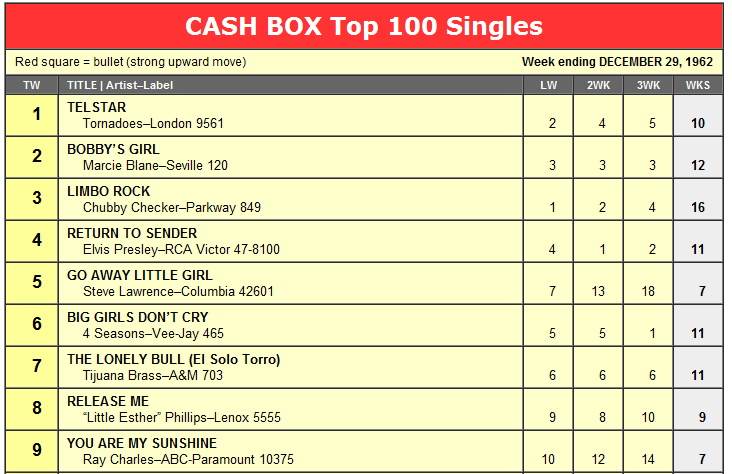
There’s a wonderful internet radio called Playa Cofi Jukebox that lets you play songs by years 1950-1989.  Nothing is required to play the music, and if you pick a year, you’ll get a link to the weekly record charts – for example here’s December 22, 1962, around the time I got my radio.  By the way, this goes to show you a flaw in my playlists.  Songs on 1963 have songs that first appeared in 1962.  If I was anal I’d remake the lists by absolute release dates.

cashbox-chart

The other night on the Grammys Maroon 5 and Foster the People sang two Beach Boys songs as a 50 Year Tribute.  Are songs from my youth still turning on young people after all these years?  I have no idea what these songs sound like without the nostalgia speakers I always hear them through.  Do they sound funny and quaint, or could they actually appeal to an eleven year old in 2012?

JWH – 2/20/12 (50th Anniversary of John Glenn’s flight into space)

24-bit FLAC Crash and Burn

After listening to a video interview with Neil Young tell us music lovers who listen to MP3 files we’re settling for 5% of music data from a studio master I wrote The Quest for the Highest Fidelity.  Since then I’ve been experimenting with 24-bit FLAC files to see if I could hear the stuff I’m missing.  I downloaded a copy of Fubar2000 to play FLAC files and then downloaded a selection of sample FLAC files from 2l.no.  I did not notice a dramatic 20 times better sound quality from having 100% of the music data.  I couldn’t even tell if it was 5% better.

The big question is why not?  Some possible answers are:

  • My ears aren’t good enough (60 years old)
  • My PC speakers aren’t good enough (Kliptsch THX 2.1)
  • My PC audio isn’t good enough (RealTek HD Audio)
  • I don’t have things set up right
  • I don’t have auditory skills to notice a big difference
  • I don’t have all the various components working together properly

If I had $10-20,000 in audio gear I might notice a significant difference but I’m not going to spend the money to find out.  But even if had the money and was willing to spend it, I think I’d need a degree in audio engineering to set up the system.  There are damn few books about setting up high definition digital audio, and not that much on the Internet either.  My Realtek HD audio supports playing 24-bit 96kHz and 192kHz files, and I download FLAC files of each type, and damn if I can tell any difference.  I could tell a slight difference between the 24-bit FLAC and the streaming MP3 music.

And even if the sound was dramatically better, would I really switch to buying $25 albums?  A terabyte hard drive would hold about 100 albums, which would be $2500.  I get a million albums for $10 a month from Rdio, and they sound great.  But then I’m happy eating beans and rice.

I suppose if I was a rich dude living in a big house and had lots of money to burn, I’d build a room for high definition audio, and a RAID NAS with many terabytes of free space, assemble a high end stereo system and collect 24-bit FLAC files, but I doubt I’ll ever be a rich dude.

But you know what?  I recently created a playlist of 1963 songs on Rdio and played them through Roku box connected to my $400 Pioneer amp, with a pair of Infinity floor standing speakers and cranked up the volume, and that was the best I ever heard those songs since 1963.  Neil, I might be missing 95% of the music data, but the 5% I had sounded great.

Even on my PC, if I crank up the volume, the songs sound way better than when I first heard them on a clock AM radio with a single 3” inch speaker.

Streaming MP3 music is just too damn convenient.  This experiment is over.

JWH – 2/15/12