Does Anyone Actually Read the Paper Version of Wired Magazine?

By James Wallace Harris, Monday, July 6, 2015

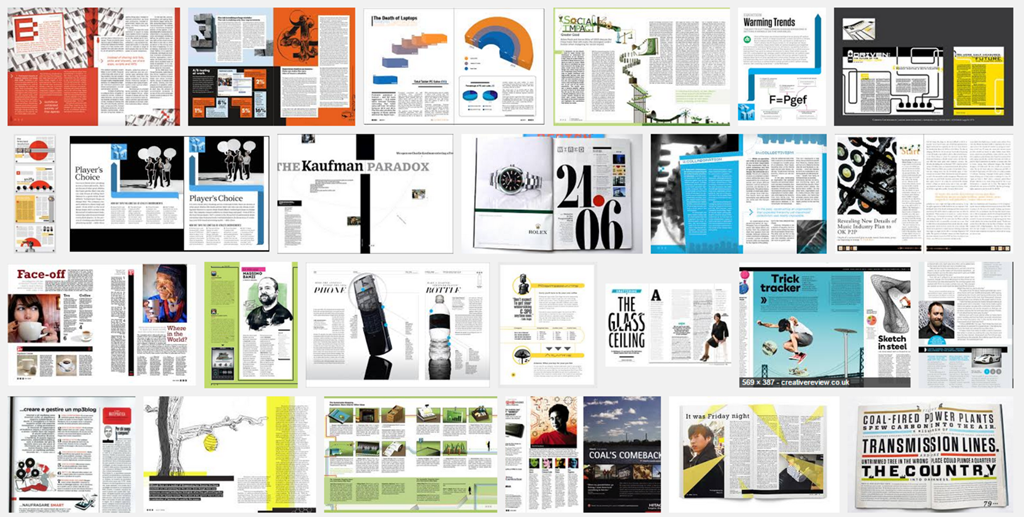
I find it almost impossible to read the print edition of Wired magazine. Ditto for Vanity Fair. The emerging trends in magazine graphic design keeps me from reading my favorite magazines printed on paper. Why? Is it because I’m too old to appreciate modern layouts? Are my eyes too ancient to see their tiny typefaces? Is my brain too slow to comprehend their fire hose content? Have I been corrupted by reading on the web or tablet computers? I’m sure all of those things are true, but, could their graphic design be flawed? Have we pushed beyond the limits of Gutenberg?

Wired layouts

The Atlantic and Harper’s offer the most comfortable reading for me. The New York Review of Books and The New Yorker are in the middle of my comfort zone. If you study the design of the six magazines I’ve mentioned so far, there’s an obvious pattern. The harder to read magazines have more areas on the page vying for my attention. If a two-page layout has ten things shouting at my eyeballs I just turn the page. The two NY titles are pretty good at displaying reading content, but their ads are very distracting. The New York Review of Books is printed in large format making it hard to hold. And I hate to say it, but The New Yorker cartoons distract me.

In many ways, all these magazines are easier to read from the web or tablets. It seems print magazines are trying to compete with digital layouts and they’re ruining  print aesthetics. The web and tablets offer flexible font sizing that help readers, but print magazines keep making their text smaller. New layout techniques on tablets offer even better reading experiences by providing modes to separate words from images. I now prefer to read Wired or Vanity Fair on my iPad.

Reading on the web has several advantages over print and tablet. I can clip articles to Evernote, or save them to Instapaper. I can email articles to friends. I can highlight and copy content to my blog. I can follow their hyperlinks. Plus, I don’t end up with piles of paper to recycle. And of course, web editions are free.

The print edition of Wired is beautiful—but busy. I’m sure the editors find their large layout boards easy to study, and feel their content outstanding and obvious. However, when it’s all squeezed down to the size of the printed page, the content looks like information overload puked onto paper.

I’m quite honest when I ask, “Does anyone read the print edition of Wired magazine?” Yes, it has a stunning layout. And it has an amazing array of trendy new ideas presented in innovative visual ways. I enjoy flipping through the pages, and gazing at bits of things, but I can’t read it.

Are the days of printed periodicals over?

JWH

The End of Zite–The Beginning of News360

Here’s the problem.  Every day on the internet millions of articles are published and some of them are ones I really want to read.  Finding those articles that are perfect for my peculiar interests is like finding Malaysia Flight 370’s black boxes in the middle of the Indian ocean.  Over the years various genius programmers have come up with systems for customized news reading.  The big breakthrough was RSS feeds, and then Google Reader.  But even then, you’d get hundreds or thousands of articles to sift through each day.  What’s really needed is some kind of AI smarts to find less than 50 daily news stories that can be quickly perused.  You want your news feed to only have stories that matter most to you.  After the iPad came out I discovered Zite, and thought I had found news nirvana.  Well, Zite is going, and I’m trying News360.

news360

What the Internet gives, the internet also taketh away.  Time and again I fall in love with technology only to have it taken away.  Remember Lala?  Now I’ll be losing Zite.  To me, Zite is the one app that made tablets great.  Zite was the best Internet newsreader I ever used.  I liked it far better than Google Reader, another technology that was prematurely wrenched from my hands. 

Zite has been bought out by Flipboard.  Now I have nothing against Flipboard, except that I don’t enjoy using it.  Flipboard uses a different metaphor for presenting the news, built around do-it-yourself magazines.  Zite was more like a customized newswire feed.  Zite learned what I was interested in reading, and queued up a bunch of great stories for me to check out.  The more I used it, the smarter Zite got, finding just the right stuff to read.  This is very efficient for reading from the fire hose of news stories available every day on the net.

robotreadingmagazine

Curated News

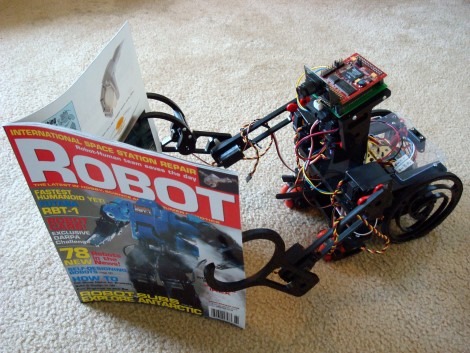
Like the curated music site Pandora, what voracious news readers want is a reader robot to pre-read the news and decide what we’d like to read.  Zite was my reading robot, but now it’s being killed off.  One of the most popular reading robots is Flipboard, and it has bought Zite in hopes of using its technology to be a better reading robot.

I’ve used Flipboard from time to time but have never been comfortable with it.  If they integrate Zite’s intelligence into Flipboard I might start to like it, but even then I don’t like the visual layout of Flipboard.  For now I’m experimenting with News360 – which Paul N. Shapiro turned me on to – so I don’t need to worry about the Flipboard Zite merger.  Check your app store and try it out – News360.

News360 does one thing that Zite didn’t and I always wanted, it has a website front end so I can use from my desktop.  The controls are nicer on the iOS and Android versions, but the website version is quicker to use, and links me directly to the news story as it appears on the web.  The tablet versions of News360 take a bit more clicking to get to the actual reading.  Zite was the tops for reformatting web pages for easy reading.  News360 is fancier in some ways, with more options, but it takes more clicks to get to the full reading copy.  I haven’t decided if I like News360’s rolling cubes or not.  On the iOS version, it appears the full text can be scrolled on a cube site.

Thumbs Up or Down

There are millions of blogs, magazines, newspaper, journals, websites that publish something new every day.  Even if you find all your favorite publishers and check their site daily, you’d spend way too much time going through stuff you don’t want to read.  And even with a good news reader that zeroes in on your interests, it will find stories you’ll want to look at but still waste your time.  For example, News360 sent me “Einstein’s ‘spooky’ theory may lead to ultra-secure internet.”  The topic interests me, but the piece was short, fluffy and lacking in any real content.  So far, no news collector system I’ve found is perfect, or even close to perfect. 

Reading Robots take training.  And for that, you need ones you can thumbs up and thumbs down on what they give you to read.  However, I can’t thumbs down the article above because it was skimpy, otherwise News360 might stop sending me other articles on quantum mechanics.  You have to apply your intelligence to training your robot.

I’ve just started using News360 and I’m trying to train it not to send me stories I see on the nightly news.  I already waste 30 minutes a day watching the TV news so I don’t want to see those stories again.  I also subscribe to The New York Times – so I don’t want that kind of general news in my news feed.  However, I still want special interest news from The New York Times because I don’t catch everything.  By unchecking Top Stories I got rid of most of the general news.

News360 also found me this morning “The future is coming. 6 ways it will change everything.”  This is still speculation, but it’s the kind I like.  I’d like more substance, but News360 has quickly zeroed in on my interests.

Training a system to be perfect is hard.  I told News360 I’m interested in steampunk, so it found “This $80K Steampunk Inspired Baron Safe-Box…” – that’s interesting, and has visually appealing photos, but ultimately fluff I don’t want to waste my time on.  I’m going to thumbs down the article and hope News360 finds me something more substantial about steampunk – but ultimately I might have to kill that topic.  I’ve already killed the topic Leonardo Da Vinci because News360 kept giving me stuff about a TV show.  Like I said, no system is perfect.

Sometimes New360 makes a mistake that turns out to be wonderful.  I told News360 I wasn’t interested in science fiction movies, but was interested in science fiction books.  This morning it found me  “The Glorious Incoherence of Divergent” at The Atlantic.  Now most everything at The Atlantic is über-readable, but what made this piece a treasure trove is it tied in Philip K. Dick’s books to current movies and YA books.  I’m very into Philip K. Dick, so I forgive News360 giving me a movie review.  It was smart enough to know the article wasn’t just about the movie.

News360 does allow me to block sources when I use the tablet app after I’ve thumbs down something.  This can be dangerous.  Often a news story will come from many sites – it’s been syndicated – so be sure and don’t nix something you like.  But if it’s a single site that you’re sure you don’t want to read from, this is a great feature.  Last night I blocked MTV.com.  I’m just not that young anymore.

I wished News360 had some way of asking about the quality of the content.  A way to mark something that’s too fluffy, or even too verbose.  I also wish it allowed me to diss certain kinds of formatting.  I hate slideshow news – like seeing a headline for the twelve types of dogs that don’t like cats, and then having to click through twelve pages just to see the names of twelve breeds of cat hating dogs.  I think these slideshow stories are a ways to generate ad clicks, which I find fucking annoying as hell.  Just use a goddamn list, please.

Discovering Cool Publishers

One of the most brilliant side-effects of using a reader robot is discovering new publishers.  If you go to a big bookstore and browse the magazine section you might see a couple thousand magazines.  But on the web there are millions.  Discovering new publishers is pretty much serendipity.  If you pay attention to the sources of the articles you like, you’ll discover new sites to read in general.

Theoretically if your reading habits were very specific, you could just bookmark several sites that pertain to your topic and view them daily.  But I’ve yet to find any site that every article they publish is always of interest to me.  So even having my Reader Robot read my favorite magazines is a big help.  I wished sites like News360 had a configuration page that allowed me to list my favorite publications.   Some Reader Robots allow for adding RSS feeds, but News360 doesn’t seem to do that.

News360.com

The best thing about News360 is it’s web site.  Most other magazine styled news aggregators are designed as apps for tablets and smart phones only.  I’m an old fashion sit in the desk chair kind of guy, so I appreciate being able to look at the news on a 27” monitor.  Even though my Nexus 7 has more pixels than my 1080p monitor, I can scan content faster on the big screen.

I’m not used to News360 on my tablets yet, not like I am to Zite, but I’m adapting quickly.  And now that I have a magazine style newsreader for my Chrome browser, I’ll probably be even more addicted to reading the news.

JWH – 3/25/14
Aren’t Television Shows Just Short Stories for People Who Don’t Want to Read?

Many of my bookworm friends tell me they dislike reading short stories.  They claim short stories are too slight, not enough plot and character, to waste their reading time on.  Okay, I can buy that.  But isn’t a 22 minute episode of The Big Bang Theory just a short story?  Isn’t a 47 minute episode of Nashville, merely a novelette?  I’m currently listening to The Portrait of a Lady by Henry James that runs 24 hours.  Most current TV shows have a season of 24 episodes.  So if they were collected as an audiobook, the entire season of 30 and 60 minute shows would still be shorter than one literary novel.  Doesn’t that sound like an anthology of stories?

In other words, don’t people still really love the short story?  Some people like to read, others to listen, but most love to watch!  Don’t most of us crave two or three stories a day?

playhouse-90-2

At one time the short story was very popular in America.  There were hundreds of short story only magazines for sale at newsstands, and some writers like F. Scott Fitzgerald were paid big bucks for a single story.  Even when I was growing up in the 1950s and 1960s, most women’s and men’s magazines would contain at least couple short stories. 

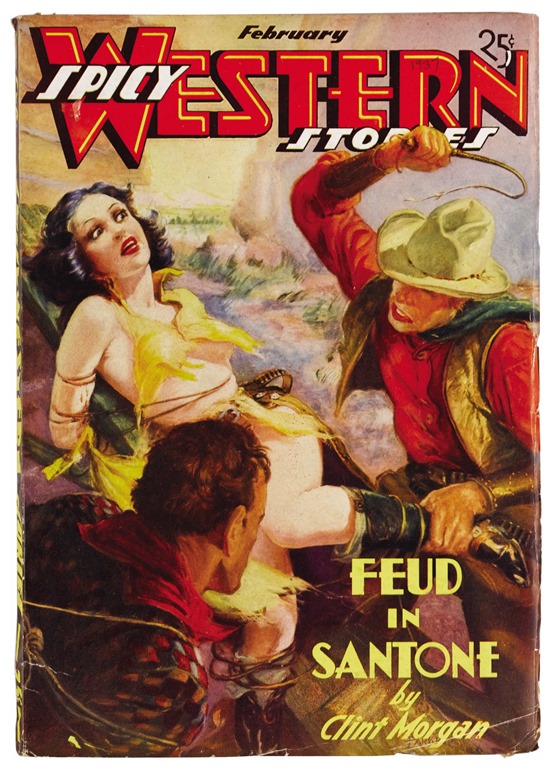
Why did people stop reading short stories?  Why did they fall out of favor?  The obvious answer is they haven’t.  Pulp magazines just mutated into television shows.

How long have humans needed a daily diet of fiction?  Aren’t short stories just oral story telling in mass production?

It seems pretty logical to think folks just switched from reading a thirty minute story to watching one.  It’s also easy to assume that the half hour show is the short story, the hour show the novelette, and the movie is the novella.  But if we look deeper, I think there are some other concepts to consider, most notably the continuing character, the series, and the genre subject focus.

spicy-western-stories

At the beginning of the 20th century most magazines, even pulp magazines, were general purpose magazines for readers of all ages of both sexes.  But as the century progressed publishers created specialty subject magazines, some devoted to single characters, that catered to particularly reading tastes, and demographics.

If you read the latest volume of Best American Short Stories 2013, the annual anthology that collects the best of literary short fiction, you don’t see stories involving a continuing character, a series, or can easily be pigeon-holed into a micro-genre.  Now there are plenty of genre magazines devoted to the short story that do regularly publish this type of story, but their content seldom gets picked for the annual Best American Short Story collection.  For the last 50-75 years, publishers seem to be zeroing in on the continuing character novel, so that most mystery novels, and many science fiction and fantasy books, are now about popular characters involved in a series of adventures.  Doesn’t that sound like television?

doc savage

Television supplanted the pulp magazine, and is now inspiring how many writers write their books.  What happened to the slice of life short story, and the great American novel?  Writers prefer to develop a character and setting they stick to, like those in television shows.  It’s easier to sell, and sells better.

The best literary short stories are tiny slices of life, unique views of humanity.  Most novels from the early history of book publishing were always stand-alone tales, just longer slices of life, with highly detailed unique views.  In the early days of television there were many drama shows that featured a different story and cast of characters each week, the most famous at the time was Playhouse 90, but probably the most famous still somewhat seen via streaming, is The Twilight Zone.

The unique slice of life story was quickly supplanted by the continuing character show.  But that had already started in pulp magazines before the age of television.  I’m curious who the first continuing character was?  Sir John Falstaff appeared in three plays by Shakespeare.  And how many stories did Sherlock Holmes appear in?  Huck Finn and Tom Sawyer appeared in several books, and readers wouldn’t let Louisa May Alcott stop writing about Jo March.  If Louisa was alive and writing today, the March sisters would be a television series.

It seems most people love short stories, about favorite characters, in a setting and subject of particular interest to them.  Other people like stories stretched into novels.  While I love continuing character stories on TV, I avoid them in novels.  But I still love short, unique, slice-of-life stories, either written or dramatized.  I wonder why most people don’t.  I’ve been re-watching old episodes of The Twilight Zone, and some of them are very powerful.

Burgess-Meredith-Time-Enough-at-Last 

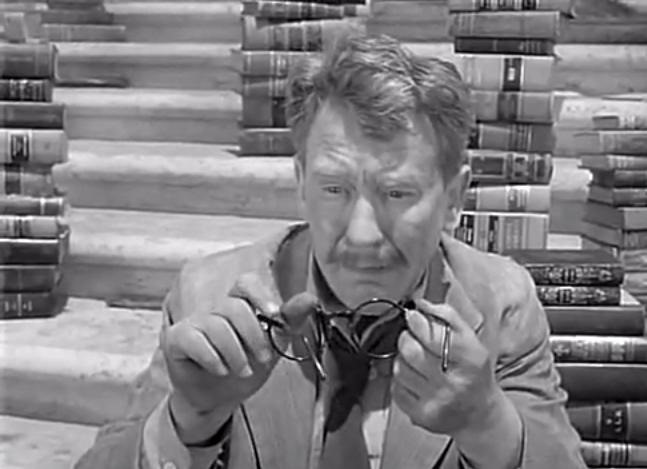
However, my brain quickly forgets them, or most of them.  In over fifty years I’ve never forgotten Henry Bemis, or the pig nose people.  If I had only seen one episode of The Big Bang Theory in my life, would I still remember it?  Maybe it’s memorable because I’ve stuck with it for seven years.  Apparently we crave long term relationships with our fictional friends.

Memorable novels are like short intense love affairs we never forget.  By that standard, it seems most people would rather have long term friendships.

JWH – 1/17/14

Next Issue: Can Magazines on Tablet Computers Replace Printed Magazines?

Years ago I gave up subscribing and buying paper magazines in hopes of going paperless.  Oh, I’d break the rules and buy a magazine now and then.  Then recently a guy a work started giving me his magazines after he read them with recommendations of articles to read.  I started discovering that some articles found in magazines are vastly superior to most of the free articles I was finding on the web.  I guess it’s a case of getting what you pay for.  I also discovered for some subjects its much more fun to browse a magazine than the web.

So I started back on a couple of paper magazine and quickly discovered I really don’t like them piling up.  Once you go paperless, it’s hard to go back to paper.  Then I discovered Next Issue.  For $15 a month I got digital access to a library of magazines.  (There’s also a $9.99 version with fewer magazine.)  I quickly rediscovered just how much I love magazines.  The only trouble is they don’t look very good on my iPad 2.

next-issue-sample

That’s not completely true.  Some look much better than others.  For the most part the magazines look like their paper versions – I see all the editorial content and the ads.  Some even have extras, like animations, film clips, and multiple view of photos, so in a sense they are super-magazines.  And some magazines actually reformat their content slightly to take advantage of tablets.  So when you get to an article you page down to read it, rather than page right, for a few pages, and then skipping to page 79 to finish the thing.  The magazines that use this feature tend to format their content in a larger font that’s easy to read without magnification – and that looks best on older tablets like the iPad 2.  Other magazines just give you two views of a static page, one that fits the screen on the tablet, and another brought up by double tapping that is greatly magnified that you slide around with your finger to read.

I’ve been reading for weeks with my old iPad 2, and getting into this new method of magazine reading, all the while thinking about how it could be better.  Mostly I thought about having to buy an iPad Air.

I then borrowed my wife’s Kindle Fire HD with a 7” screen and spent an evening reading my favorite magazines.  The Kindle HD has much better resolution than the iPad 2, a pre-retina display model.  Switching between the two  devices, taught me something about reading magazines on  a tablet, and made me realize that Apple no longer has a lock on tablet computers.  Here’s what I learned:

  1. Resolution matters – the more the better.  Sometimes it’s nicer to read small fonts than to tap and magnify
  2. 7” tablets are much easier to hold and read for longer periods of time
  3. 10” tablets make the photos pop out more, so it’s more fun to look at pictures with a larger screen
  4. If the magazine formats for the tablet, it’s much easier to read on a 7” screen
  5. If the magazine doesn’t format for the tablet, it’s much easier to read on a 10” screen
  6. An aspect ratio of 4:3 is probably better for magazines than 16:10, but not always
  7. I have to use a reading stand with the larger tablet for long periods of reading
  8. A 7” screen is more conducive of carrying around
  9. I’d love to be able to print a whole article, or clip it to Evernote.  The iOS version of Next Issue will let me AirPrint a page at a time.
  10. If I could clip an article to Evernote (or .pdf) I could print it from Evernote
  11. Tablets offer a way for magazines to offer more creative layouts, and even multimedia

Next Issue is far from perfect, but I still feel like I’m getting my money’s worth.  I would be happier if I could find just the right tablet, if I could save articles, and if I could get a few more magazines.  Of course this is dealing with two different issues.  One, can I enjoy reading a magazine exclusively on a tablet and give up print copies?  And two, does Next Issue offer everything I want to read?

Next Issue is a disruptive technology in the same way Netflix was a game changer.  I essentially stopped buying videos after I adapted to Netflix.  Will I give up buying magazines too?  Next Issue has a nice selection of over 125 magazines, but it doesn’t have The Atlantic, Scientific American, Discover, Sky and Telescope, Asimov’s Science Fiction, The Magazine of Fantasy & Science Fiction, The New York Review of Books, Linux Journal, and others that I like.

next-issue-sample2

But like I said, that’s two issues when regarding whether can I give up paper magazines for reading magazines on a tablet.  If I had a Kindle Fire HDX, either 7” or 8.9” screen, or an Apple iPad Air or Mini with Retina Display, or a Nexus 7 or 10, or Samsung Note 10.1 2014, I might be able to conclusively answer the first part of the question.  They have the dots per inch resolution that will make tablets sharp enough to read small print.  And they might even make photography stand out more.  However, paper still wins on some factors.

If I can’t clip to Evernote or .pdf, printed magazines win on the “tearing an article out to save” factor.  Also, for “making a photocopy” factor.  They also win on “lending/giving to a friend” factor.  But tablets win on “these magazines are driving me crazy piling up around the house” factor.  Tablets also win on the “where the hell did I put that magazine” factor.  They also win on the “I wish I had that magazine with me” factor because Next issue works from the smartphone and iPod touch.

It’s not hard to see the writing on the wall.  Paper and printing will eventually go away.  Whether magazine library subscriptions like Next Issue will become standard is still to be decided.  Netflix hasn’t killed the DVD buying business, but it’s changed it.  Netflix did kill off the local video store, and I wonder if tablets will do that to newsstands?

JWH – 1/5/14

Rethinking My Kindle Magazine Subscriptions–And Electronic Magazines in General

Years ago I cancelled all my magazine subscriptions to go paperless.  I was finding plenty to read on the Internet for free, and I was experimenting with services like Zinio, which offers electronic magazines.  Then I got a Kindle and iPad and subscribed to Kindle magazines at Amazon.  I liked I could subscribe by the month, and quit any time.  But like paper editions of magazines, I often didn’t keep up, and unread back issues piled up.  So I cancelled my Kindle subscription to The Rolling Stone.  I thought I’d have all my back issues to read when I got some free time, but once you cancel, you can’t download the issues, even for the ones I’ve “bought.”  If you had previously downloaded an issue it stayed on my iPad.  Unfortunately, I discovered there were many I never downloaded, even though their cover image was in my library listing.

See, I was thinking all those back issues were mine to read whenever I wanted, even if I wanted to wait years.  But that wasn’t the case.  I’m not bitching about Amazon’s licensing restrictions, I’m just reporting how things work.  It turns out that when I re-subscribed I could go back and download those previously subscribed issues.  In other words, you can get past back issues if your currently subscribing and paid for them previously, but they aren’t accessible when you aren’t paying the current monthly fee.

Reading on the iPad wasn’t bad, but I had an iPad 2, the one before the Retina Display, and reading small print was a bitch.  Using a tablet for both bookshelf and reader has it’s drawbacks.  When I upgraded to iOS 7 and v. 4 of the Kindle Reader, it zapped my collection of old magazines, telling me I needed to download them again.  I had just cancelled my Kindle subscription of The Rolling Stone, because I had started getting the paper copy again, and thus I couldn’t re-download my old issues.

Okay, I thought, the reason I subscribed to the paper copy of The Rolling Stone was to get access to the complete archive online.  Well, that didn’t work out either.  The online viewer for The Rolling Stone has one of the worst screen readers I’ve ever used.  It magnifies better than the iPad, but moving around the page and between pages is just flat out horrible.  I can’t believe many people would take the time to read old copies of RS online.

[Update 10-18-13 – the RS online reader looks great on my 24″ iMac at work.  For some reason the reader controls and the bottom of the page are removed from my Windows 7/Chrome browsing.  I also tested it on Ubuntu 13.10, with Firefox on a 1280×1024 screen.  It worked better than Windows 7/Chrome but not as nearly as good as Mac/Safari.  Unfortunately, I don’t have a Mac at home.  I need to test Windows 7/IE and iPad 2 when I get home.  Maybe there’s hope.]

What’s funny is the reader that comes with the complete archive on DVD is much better, but still clunky.  They’ve had that reader for years.  The current online reader won’t even show the bottom of the page on my 23” 1920×1080 screen.  It’s a huge step backward.

You know what? It turns out the old fashion paper magazine is the real winner here.  Damn, technology goes down in flames.

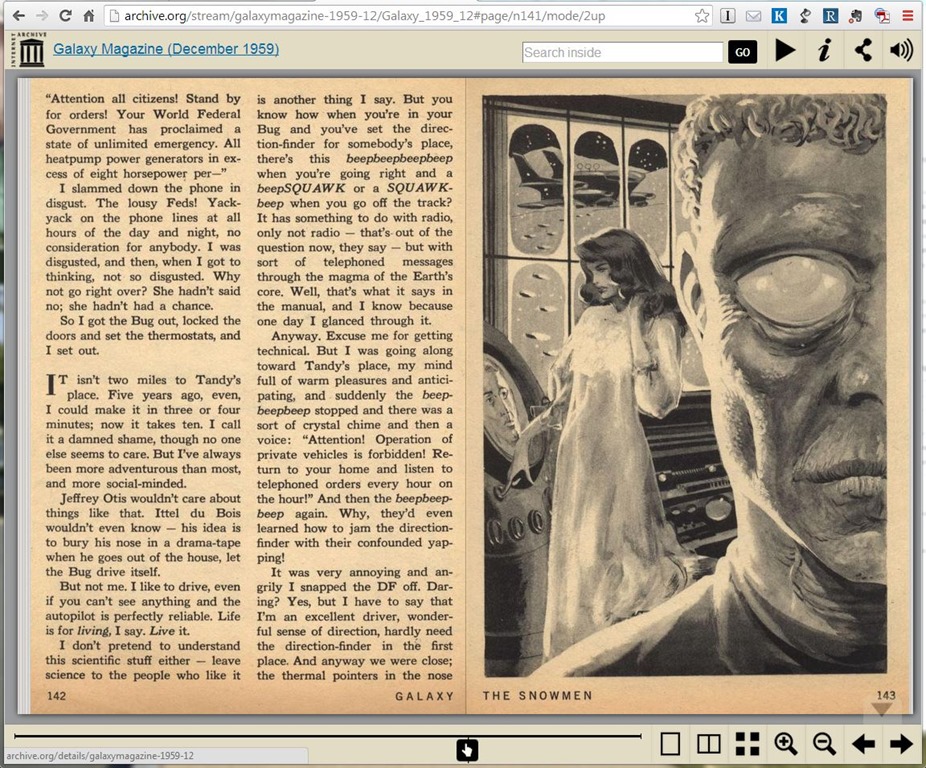
Now it is possible to create an elegant screen reader that shows old magazines, just look this December, 1959 issue of Galaxy Magazine at Archive.org.  If the folks at The Rolling Stone used this program to show it’s back issues I’d be in periodical heaven.

galaxy-mag

[Click to enlarge]

Now I’d love to have a complete back run of Galaxy Magazine in this format.  It would be better than owning all those shelves of moldy pulp paper copies.  And it would be great to have them on a modern tablet with 2560 x 1600 pixels screen.  The Archive.org reader works very well on my iPad, making it the most comfortable way to read this classic SF mag.

The ideal way to read magazines would be to have a large, very high resolution tablet, with the complete archive of a magazine online, and an excellent viewer app.  That way the environment benefits, and we wouldn’t be bothered by shelves and shelves of old magazines to maintain.

Right now I’m very disappointed with the electronic versions of The Rolling Stone, either tablet version or online version.  Reading the paper version is the easiest technology.  That’s a shame.  I was so looking forward to doing some serious reading of past years of The Rolling Stone.  Now that I start my retirement years next Wednesday I’ve got some real reading time.

JWH – 10/17/13