Love’s Labour’s Lost

    Libraries used to be repositories of knowledge. Writers wanted their books bought by libraries so they could be preserved for all time. Times have changed and their labors of love are being lost. Quite often when I buy a used book on Amazon.com I get an ex-library edition back in the mail. I recently bought Stories of Your Life and Othersby Ted Chiang, an exceedingly fine collection of science fiction/fantasy writing. Its previous owner was the Palm Springs Library in California. It’s easy to spot how many ex-library books I own because their call number labels stand out along the rows of books in my bookshelves. To me this is a literary tragedy.

    Libraries have made a paradigm shift from storehouses of culture to panderers of popular taste. Librarians use computers to track usage and if a book hasn’t been checked out for a certain period of time, neglected volumes are pulled from the collection and made to walk the plank, thus falling into the sea of oblivion. Libraries were meant to preserve books and copyright laws were meant to protect authors, but I’m not sure if that’s not more love’s labour’s lost.

    While libraries dash to digitize crumbling ancient books modern books are disappearing too. With strict copyright laws books are “protected” for the lifetime of the author plus seventy years. There are millions of books published and most are never reprinted or even make back the advance paid to their authors. The last time I saw anything on this subject; it took on average, selling 2,500 copies of a hardback novel to break even for a publisher. That’s not a huge print run. Like giant sea turtles laying piles of eggs, few ever hatch and live to find homes in the sea.

    I collect books by Lady Dorothy Mills, a writer of travel and fantasy adventure books from the 1920s and early 1930s. Her fifteen books have almost disappeared from the Earth, with just a handful for sale at any given time. Her books are still within copyright, so they can’t be reprinted on the web. Lady Dorothy Mills is a forgotten writer. It’s doubtful she gets many new readers – I feel I’m one of her last fans. If her labors of love where still on library shelves or reprinted as e-books on the web, Lady Mills might have a few more fans.

    Copyright laws exist to help writers make money, but most writers labor for love. It’s like Las Vegas, a few gamblers make a killing, some win a little, and most leave the glittering casinos with empty pockets. Copyright laws should be changed to help the writers who don’t make money. I’d suggest that any book that hasn’t been reprinted for ten years be allowed to be republished free on the web. However, if the book is ever used for profit the same lengthy copyright laws should still apply. There’s always a chance that if enough people in the digital world rediscover a book it will help resurrect interest in a novel for the people in the analog world.

    Books are owned by the writers, but they belong to their readers. Fans are what keep books alive. Once a book comes into existence it deserves every chance to live. Sure the writers deserve every dime they can get, but a book deserves every reader it can find. I’m reminded of Bob Dylan and bootleg albums. Dylan and his publishers may want to protect his catalog and reputation, but as a Dylan fan I feel it’s my right to be able to listen to any song he recorded during 1964-1966. I love Blonde on Blonde, and have bought it many times in many forms, but I love those songs so much I feel it’s my right to hear any version of them that still exists. Once an artist creates a work of art, fans have the right to explore and experience that work to the nth dimension. Artists have the right to sell access, but if they don’t offer such access for sale, it should be wide open to free access. The reality of the web reflects that and I think copyright laws should too.

    It’s my hunch that if writers can’t have money they might like readers for their love’s labour’s lost.
    

Guaranteed Classics – Music Just For You (To Buy)

If you searched the net you can find plenty of writers riled up over The Rock and Roll Hall of Fame’s The Definitive 200 list of CDs they want you to own. Since I’m a list maker myself, see The Classics of Science Fiction, I like to think about preparing a good list. The Rock and Roll Hall of Fame has essentially prepared a list of CDs that is based on sales from recent decades, rather than compiling a list based on artistic merit that I think most readers expected it to be. Of course, we could assume that hordes of buying fans represent good taste and the list does represent the best 200 albums any music lover should own. Maybe it’s like school where they make you read books that are good for you. The trouble is they recommend music from several musical genres that doesn’t necessarily match any single music lover’s taste.

Any list of all time great albums that leaves out Blonde on Blonde by Bob Dylan can’t be much of a list. (Supply your own missing album to make this paragraph more meaningful.) That’s my all-time favorite album, so I’d expect it to be on the list – it wasn’t. Do I have no taste in music? When I assembled the Classics of Science Fiction list I realized I couldn’t just tell people what I thought were the best science fiction books. I had to come up with a system that represented authority of opinion.

The Rolling Stone Greatest 500 Albums of All Time list is more to my taste, but then Blonde on Blonde was #9. Increasing the number of bests also helps to hit everyone’s favorite. However, the Rolling Stone list just feels more genuine to me. There is a lot of overlap with the R&R Hall of Fame list, especially near the top. You can spot the impact of sales on both lists by looking at the RIAA of Gold & Platinum Top 100 albums or Wikipedia’s List of Best-Selling Albums Worldwide. Studying these two lists shows how the Rock and Roll Hall of Fame made up their list. Every album I went “Huh!” over with great puzzlement and head scratching sold enough CDs to wallpaper Florida.

If I was going to make a list, I’d do something like what Time did for their All-Time 100 Albums. First, I would not rank albums. That should stop a lot of fights. Second, I would arrange the list going back in time, year by year, and list alphabetically what I determined through careful research were the best albums for each year. I would do what the Rock and Roll Hall of Fame did and put in muliple genres – but I’d add even more genres including World, Folk, Classical, and others they left out. This would be a massive job and one I’ll probably never work on, but I wish someone else would. Like the R&R HoF listers, I’d use sales figures but I’d also use critical reviews, awards, fan polls, books on music history and the test of time to figure out what albums really were the best for each year. I’m sure there are books that have done this, and maybe even web sites.

Metacritic has done something like this for the years back to 2000, but the list I want needs to go back through the 1920s, and maybe earlier to cover the entire history of pop music and the history of albums.

Now that I have Rhapsody Music, and can listen to almost any album I desire at the touch of a mouse for $9.95 a month, I’ll take these lists and explore what all the fuss is about. Hopefully, I’ll find some albums that I’ve never listened that’ll blow me away. Just because I lived through all those years since the 1950s doesn’t mean I got to hear all the best albums. And it really is exciting to discover great artists you totally missed.

Beautiful Bassett Hound and Really Big Lobster

In my dream I was outside, in a public place. There were no buildings. I saw a few trees in planters. A man stood talking to a group of people. I was one of them. We sat on rock benches and I felt I was in a class. The man talking was a teacher, a Socrates like character. I see the last page of a book. The teacher asks us about the last scene of a book. I’m only vaguely aware of the title of the book, but throughout the dream I struggle to grasp the title. Eventually my confused mind labels it The Great Gatsby. I turn to the back of the book and read the last scene.

“Hey, I don’t remember this scene, and I’ve read this book three times!” I exclaim without hearing my voice. There are only a handful of students around the teacher and we’re all quiet. The teacher pushes us for an answer again. I make a suggestion that I know is wrong and stupid as soon as I say it and the teacher gives some wise reply that shoots me down. In the dream it almost feels like I’m saying real words, or even reading real words, but really it’s only vague concepts and squiggles that look like words. Communicating in dreams is like telepathy.

I can tell there are two characters in the scene. I reread the scene again. For some reason an image of a giant lobster interrupts the dream and I flash on this idea. “One of the characters in the scene is God.” The teacher agrees and the other students start talking excitedly. I study and study the scene but can’t figure out what’s happening. Has a character died and gone to heaven and is talking to God? Or has God come down into the world to tell him something?

Then I have an image of a beautiful bassett hound running, with its huge floppy ears flying around its head. I don’t connect any meaning and all I feel is the desire to buy a bassett hound – could this be a form of subliminal advertising? Then I return to the outdoor classroom and struggle to make something out of the last scene again. We all make suggestions but the teacher isn’t happy but I feel somewhat pleased that I discovered that the mysterious character was God. The dream fades away and I awake.

It’s fascinating to play amateur scientist and try to discover how dreams work. I think there is a mind that experiences dreams that is different from the mind of the waking me. I call it the narrator. This narrator may be a mechanism that the waking me also uses, but I see “the me” of dreams separate from “the me” who is writing this. When you are in a semi-wakeful state you can observe this narrator in action. Random images will appear and bits of meaning will pop into your mind. Dreams appear to be built on a series of still images or crude moving images that the narrator comments on. The narrator makes up meaning for the images. The dream me acts on those suggested meanings.

Take for instance the dream above. I saw a man standing and with a handful of people sitting around him. The narrator informs me without words, “a teacher and his students.” That image could have been anything. The narrator sees the last page of a book and supplies, “the teacher wants to know the meaning of the last scene in the book.” The sleeping me, that is the mechanism of self-awareness, is very dormant but I relate to one of the students. The “me” in the dream isn’t aware of the narrator – it experiences the series of images and thoughts the narrator provides as a whole story.

On rare ocassions I’ve had vivid dreams where the waking “me” is the dream “me.” However, it’s an illusion. If the waking “me” tries to guide the dream it will destroy the dream. The sleeping “me” is passive and must watch the dream like a movie. If the “waking me” tries to think and override the narrator, the dream will fall apart and I’ll awake.

I think the narrator mechanism works in waking life too. If you are at a restaurant and see a young couple sit down nearby, the narrator might tell you, “See that couple, they are on their first date. See how they act nervous…” The narrator can be very convincing, even to the point where you believe it and think what you are seeing is real. This is why cops say they saw a gun when they didn’t. The narrator can see something and tell the cop it’s a gun. The narrator can be very powerful. The narrator thinks much faster than normal self-aware thinking.

Usually dreams relate to the previous days events, but the above dream doesn’t remind me of anything that happened yesterday. I was an English major in college, so the dream does make sense to me. I’m used to trying to figure out what books mean. I’m used to the anxiety of having a professor put pressure on a class to supply an answer. The Great Gatsby is a book that is taught a lot, and last week I read an article suggesting it was the great American novel. I have no idea why the lobster and bassett hound popped into the dream, but the narrator quickly used the one image and made it fit into the story. Maybe if the bassett hound would have stayed long enough the narrator would have made up a new story for the dreamer, a new dream.

Fiction and story telling seem to be at the heart of our minds. We look out at the world and see trees and mountains. It doesn’t take long before we’re making up stories about fairies living the in the trees and gods living on the mountains. Zen masters try to break their students of this habit – to see the world as it is without the stories, but that’s a very hard habit to break. Think of the war in Iraq. Imagine all the stories created by all sides of the conflict. Just think, the Sunnis and the Shiites are killing each other over stories made up thirteen centuries ago. It’s no wonder that some people believe that even our waking real world is a dream, a nightmare.

And finally, at a meta-level, notice how I can take tiny events in my life and turn them into a narrative structure. Observe the narrator.

Heaven, Hell, and the Other Places

I died in my dreams last night. No biggie, I’ve died in my dreams several times over the years. Dying in dreamland is intense. Yesterday I was having some minor heart trouble and last night I dreamed my heart stopped. I felt myself falling. My last thought was, “Here I go” with a sense of complete acceptance, and I let go. All details around me fell away, and the final thing I was aware of was a dull gray light. Everything stopped. That’s when I woke up. It was quite a relief to wake up and be alive. I love being alive.

Dreamland is such a strange place. I’ve died before, and once came to, floating up towards heaven before waking up. My cousins and I had been riding in the back of a station wagon and we were hit by another car with a tremendous bang. Then blackness. Going to heaven was the scariest dream I ever had. I think it was my first time to die in a dream. I’ve since died a few times from endlessly falling into hell. It’s easier to die the atheist’s death where I collapse into black nothingness. It’s always a trauma to survive death and come to in again, and still be in dreamland. Sometimes the shift is to a pleasant new life but the transition is scary. Other times its overhelming and I wake up in a sweat and panic. Then there are times when I come to and I’m living again on another world or in another life. I don’t believe any of these events have real relationship with reality, but I can see how lots of wild ideas got started in the real world over the centuries.

On these other worlds I’ve been flying creatures, swimming creatures and tree swinging creatures. I’ve always assume my brain created these roles for me because I read a lot of science fiction and fantasy. I remember one time dying and ending up in bed with an attractive matronly woman in her sixties, whom I eventually realized was God. Now that was unnerving. What would Freud have made of that? I was over fifty at the time, but I still wonder if God had any age of consent laws to deal with. She had been jolly, warm and caring and when I woke up, I was reminded of when I was a kid and how I felt about big soft grandmotherly women with ample bosoms.

I wonder how many concepts have come into the world from dreams. Reincarnation feels like an idea generated by dreamland. Did people think of talking animals before they dreamed of them? I remember a beautiful dream of being a part of a troop of monkeys, and being in love with a girl monkey. I never knew if we were Earthly monkeys, or monkey-like creatures living on another world. Did we imagine aliens living on other worlds or did our dreams paint those sense of wonder creatures in our mind. I tend to believe that all mysticism comes from dreams or hallicinations, which to me are dreams that leak out into the waking world. Primative people talk much of dreamtime.

I am reminded of a title of a book about Philip K. Dick – “What If Our World Is Their Heaven.” I’ve been to many heavens and hells, to many alien worlds, in my dreams, and I’ve never visited a world that could top our world no matter how wild my imagination got. If there is a heaven, it is this world.

Super Men and Mighty Mice

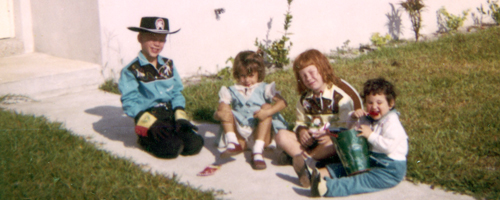
During the Ozzie and Harriet years, when I was seven and people called me Jimmy, my sister Becky and our best friends Mikey and Patty, would beg old tattered terrycloth towels from our moms and pretend to be George Reeves. We’d tie those old faded pastel rags around our necks, stretch out our arms, hands flat, fingers pointing forward, tilt our heads down and run like Hanna-Barbera cartoon characters, occasionally jumping with all our might, with the hopes of getting airborne like Superman, or at least Mighty Mouse. And when we were burnt out and our little bodies too tired to try any more, we’d go to sleep at night and have flying dreams.

My sister and I moved around a lot while growing up in the 1950s and 1960s, but wherever we lived it was Kidland, either as part of a mob of kids running up and down the middle of our suburban streets, or in packs roaming the woods, or scattered in hordes over the vast plains of school playgrounds. Kidland was great. It was great because there were no adults. It was beyond fantastic because we were all fueled by our imaginations. Television rocket-fueled our little minds, jazzing our kiddie dramas and kicking those dreams into orbit.

A few years down the timeline, during the black-and-white Beverly Hillbillies era, we could be seen in backyards playing astronauts pretending we were Alan Shepard or John Glenn with cheap white plastic helmets on our heads. After that most of my efforts to fly were in my head and inspired by the philosophy of science fiction, especially the grand master, Robert A. Heinlein. Then the I Dream of Jeannie and Bewitched magic charmed us. We all desperately wanted the skills of being able to twitch our noses and make wishes come true with the flourish of a TV sound effect. Can anyone doubt why in the epic times of The Monkees, Star Trek and The Time Tunnel we turned in our terry cloth capes for grooving with micrograms? Later on into the 1970s, after growing up with Archie Bunker, we became disciples of Carlos Castaneda, studying the ancient wisdom of the New Age, or wishing for rides with little green guys of the third kind. And don’t forget our cousins the Jesus Freaks, Hari Krishnas and Moonies who chanted about the transformation of Earth into Heaven.

Is it too much to say that the Baby Boomers wanted transcendence? Why weren’t boomer guys satisfied with putting on our Brooks Brothers and dancing the nine-to-five? Why weren’t our sisters, the boomer gals, so unsatisfied with wearing stockings and bras and staying at home to be queens for a day every day with Donna Reid?

There is always reality. Meridith Grey cannot fly or make McDreamy disappear with a twitch of her nose, even though she has a nose that reminds me of Samatha. And are the post-boomer generations any different from the boomers? Hiro is our kind of guy. During Christmas I listened to my nephew, an Iraqi vet, talk fondly of the golden age of television cartoons, waxing nostalgic with his brothers over favorite episodes of The Transformers. I kept my mouth shut and just listened, but I was thinking, no way man, The Flintstones and Jetsons were the golden age of cartoons. Yet, it didn’t go unnoticed that the next generation wanted to fly too.

Mighty Mouse