Sailing Around the World Alone

How young is too young to sail around the world? The other night I watched Maidentrip about Laura Dekker, a Dutch girl who wanted to sail around the world by herself at age 14.  The Dutch courts intervene for ten months before Dekker finally got to sail when she was fifteen, completing her circumnavigation when she was sixteen.  It’s hard to say when a person is too young to do something.  We want to protect our children from harm, and we think of teenagers as being inexperienced and incapable of knowing what we know, but does that mean they shouldn’t do something if they have the ambition and the means to get what they want?  Wikipedia even has a list of teenagers who have sailed around the world.

The first person on this list on the list is Robin Lee Graham who was made famous by a serious of articles in National Geographic Magazine back in the 1960s when he set off to sail around the world at age 16.  They even made a movie about his trip named after his boat, The Dove.  Even today he is still remembered, and was recently asked what he thought about kids sailing around the world on their own.  As a teen in the 1960s I followed Graham’s story in National Geographic magazines with great interest.  I thought it would be a great adventure, and envied his freedom.  However, I wasn’t very enterprising, and had trouble keeping my old $150 Ford going when I was 16. 

The man who started it all was Joshua Slocum who was the first person to sail solo around the world starting in 1895.  There have been many solo souls to circumnavigate the world since.  I guess it was Slocum who started the whole mania for solo sailing around the world.  It takes a special kind of person to spend hundreds of days alone in a small boat by themselves away from human society, and to live so completely in the harsh elements of nature.  The ocean can be a very cruel place to be alone, both physically and psychologically.  It reminds me of the early days of spaceflight when men orbited the Earth in solitary capsules.

There’s two ways to sail around the world – port-to-port and nonstop.  Graham took five years to sail around the world, stopping for long periods in various ports, and eventually using two boats.  The nonstop sailors stay on the ocean the entire trip, never making port.  Those are the real loners of the sea.  And there’s something about the psychology of these solo sailors that make them want to stay at sea and not come back.  Laura Dekker, a port-to-port voyager, finished her round the world trip and then kept going, disappointed she hadn’t stopped at New Zealand on the first time around.  Bernard Moitessier, who was about to win the Sunday Times Golden Globe Race for fastest solo circumnavigation, turned around on his approach to the finish line and started another lap of the globe.

The dramatic Sunday Times Golden Globe Race was recently portrayed in the documentary Deep Water.  I beg you to watch this film, but also beg you not to read about the film or the race ahead of time if you don’t know the story.  It’s riveting as it unfolds, especially the human interest angle.  I’m not even going to link the trailer that spoils the story.  There were nine sailors that entered the race, and one, Donald Crowhurst, had no real experience.  It was the old salts versus the daydreamer.  Crowhurst’s story is so compelling that a fictional film account with Colin Firth and Kate Winslet is in the planning stages.

Since the Sunday Times race, there have been many round the world races and even more solo sailors.  Over the years I’ve read about various men and women sailing solo around the world and have been quite fascinated by two aspects of this sport.  First, why and how people can survive so long in self-imposed solitude.  Second, I’m fascinated by the details of outfitting a sailboat and the equipment it takes to navigate precisely around the world.  Most of the recent documentaries have focused on a quick overview of the trip, and spent little time on the details.  These films make me hunger for books with lots of how-to facts.

From watching Maidentrip it was pretty obvious that Laura Dekker was only marginally experienced at sailing, and her boat gave her little trouble, and her GPS did all the navigation work.  She said she knew how to use a sextant, and had the charts but we didn’t get to see her use them.  Her voyage was from port-to-port, and my worry for her as a teenager,  was more for when she was on land than at sea.  I thought a 15-year old girl would be an easy victim for crime and sexual assault.  But she made the trip and has kept going.  She evidently has a savvy and toughness that most teens lack.  Dekker is obviously a school dropout, and doesn’t seem to be interested in any subject other than sailing.  I tend to believe most parents would keep their kids away from round the world sailing because of school, and not because it’s a dangerous activity.

How dangerous is sailing around the world?  I haven’t heard of any kids being killed, but some have sailed into container ships.  Modern boats must be pretty well made compared to the old days, because old sailing stories are often endless tales of equipment failure.  And sailing from yacht club to yacht club has its own level of safety.  I don’t know how young a kid could sail around the world by themselves, but it’s probably dependent on them acquiring a good boat, and a decent amount of training.  Yet, how many kids would want to spend weeks and months totally by themselves?  Crewed sailing is far more popular.  Like I said, it takes a special kind of person to sail solo around the world.  I’m not sure if they want to get away from other people and society, or they love the feel of being completely in control of their own fate.

Sailing around the world has changed because of technology.  Jessica Watson is the youngest girl to sail around the world solo non-stop, although she didn’t meet the requirements to qualify for official records.   It’s not quite the solo experience it was in Slocum’s time.  With radio, cell phones, YouTube, and the Internet, fans can follow sailors almost in real time.  Jessica Watson’s voyage was well covered by YouTube reports and television.

Deep Water and Maidentrip are available on Netflix streaming.  The Dove is available on Netflix DVD and Amazon Prime Streaming.

JWH – 8/16/14
Consuming Inspiration 2

The internet is about sharing, and I find much on the internet that is inspirational.  We’re seven billion souls sharing the planet and the internet lets easily communicate what inspires us in a kind of mass journalism—making us all reporters.  We don’t create the content, but pass it on.  I guess that makes us all a kind of a wire service.  I’m retired, and I spend a lot of time alone, and most days are routine, one is like the next, but what makes my day distinctive, are these inspirational news stories, the documentaries I watch, and the books I read.  A documentary a day keeps the psychiatrist away.

I need air, water and food to stay alive, but I think it’s inspirational stories that really make me feel alive.  Now, one man’s inspirational story can be another person’s depressing tale.  I find inspiration in people overcoming adversity, or someone inventing something very clever, or even an economist coming up with a fascinating statistical chart.  Here are some more examples.

Tattoos That Go Beyond Art

I’ve never really liked tattoos, especially on women.  I guess that’s showing my age.  But I came across this story at The New York Times about a tattoo artist Vinnie Myers who has given up his artistic work to create 3D nipple tattoos on women who’ve undergone mastectomies and breast reconstruction.   Caitlin Kiernan wrote and filmed her transformation in  “A Tattoo That Completes a New Breast.”

At one point in the film Myers said he wanted to give up doing nipples all the time so he could return to inking art again, but then his sister got breast cancer, and he stopped worrying about going back to art to become a healer full-time.  Now his daughter wants to learn this new trade that is part artist and part healthcare provider.  Be sure and read the comments, they are very inspiring too.

Inequality in America

Most people when they talk about inequality in America think about helping poor people, but strangely it’s really about helping the middle class, and even expand the economy to make more rich people.  A thriving middle class is what drives our economy.  That helps both poor and rich alike.  But for decades the American middle class has shrunk as all the wealth has moved to a very few people.  We all share one giant pie, however that pie can grow, but it only grows if the middle class thrives.  Look at this video:

Robert Reich, Clinton’s former Secretary of Labor came out with a film last year about this problem, Inequality for All.  It’s available from many sources, including Netflix streaming.  Here’s the trailer.

The film describes the problem, but does not really go into the details of solving it.  Reich appears with Bill Moyers and they discus some solutions.  Watch this video below if you have the time, but definitely rent or buy the documentary Inequality for All because not only is it educational, informative, inspirational, it’s also very entertaining.  Robert Reich is a very charming guy.

Most people are turned off by economics, but that’s a shame.  The numbers are so mind blowing.  For instance, during the economic recover of 2009-2012 the top 1% of the wealthiest Americans took home 95% of the economic gains made during those years.  What that means is most Americans got poorer, while a damn few got much richer.  Do you ever wonder why the rich are against taxes, social security, Medicare, Obamacare, K-12 education, etc.?  Those are big pools of money that they haven’t gotten yet.

You might not be concerned about inequality of wealth in America because you believe it’s about poor people.  Well, except for the very rich, everyone is much poorer than they used to be, and getting poorer, including you.  It’s like the frog in the pot of boiling water.  We just don’t know how warm it is.  Reich points out we’ve hidden from this problem by two family incomes, working longer hours and having more jobs, and by going into debt.  For many people, options to adjust to declining income have run out.  If you play that Wealth Inequality in American animation above you’ll understand why.

Black and White, And Dead All Over

The newspaper was the answer to the old riddle, “What’s black and white and red all over?”  Well, newspapers are no longer read all over.  I didn’t worry too much about this change in society until I watched Black & White and Dead All Over.  What these writers reminded me of that I didn’t know, was corruption in society has always been checked by investigative newspaper reporting.  The trouble is investigative reporting is very expensive, and as newspaper began to loose money publishers often cut those reporters first.  Every town needs a paper that watches over local politics and business, but that’s disappearing.  Hundreds of papers have gone under in the last decade.  One of the big differences between the United States and the rest of the world is we have much less corruption.  I’d hate to see that change.  We still have lots of investigative reporting at the national level and a handful of big cities from the few remaining big papers, and from television news programs, and even documentary makers, but ever shrinking coverage everywhere else.

I caught this on PBS but it appears you’ll have to buy a copy for now to see it.  It is free with Amazon Prime, and just $3.99 on YouTube.

This film made me feel bad for not subscribing to my local paper, but I feel it’s a waste of natural resources to print newspapers, especially when I read so little of each one.  The film did profile ProPublica – an non-profit service that claims it is “Journalism in the Public Interest.”  They syndicate their stories to papers to defray the cost of investigative reporting.  What we all need to do is find out who does the investigative reporting where we live and support them.

If you subscribe to Netflix streaming, keep an eye on their documentaries.  They have zillions.  After Breaking Bad finished I’ve hungered for another intense TV show to watch every night, but I haven’t found one.  However, documentaries are filling the void, and some of them are as intensely good as watching the adventures of Walter White.

JWH – 6/19/14

Consuming Inspiration

We eat food to fuel our bodies, but I read nonfiction essays and watch documentaries to feed my soul.  Every day I consume inspiration like a vampire consumes blood.  Inspiration keeps me alive.

A Powerful Punch in the Gut

The older I get the more aware I am of my inevitable fate of a long lingering death.  Few people like to dwell on this future.  Most hope they will go quickly, or quietly in their sleep, but it’s doubtful that modern medicine will allow that.  Last night I saw Life and Death in Assisted Living on PBS Frontline via my PBS Roku channel.  They reported that as much as 67% of assisted living residents have some kind of dementia, and although these facilities weren’t meant to be nursing homes, they’ve become essentially unregulated care for the dying.  The show attacks the big business practices of making fortunes off of end-of-lifers, but that’s not what inspired me about the show.  I watched its videos seeing the elders as explorers of territory I must one day travel myself.  To live with any kind of dignity while dying requires enough health to keep saying fuck you to fate.  Once you are condemned to a wheelchair to be cared for like an infant it’s very hard to find meaning in life.  Although I’m an atheist I’m praying like crazy for the acceptance of euthanasia by the time I get feeble.  At some point before I forget too much I’ll need to get a tattoo over my heart that says in big letters:  DNR.  But as long as we do live, we have to keep finding inspiration and ways to make ordinary daily living meaningful.


John Green, An Impressive Young Man Who Speaks to Millions

I’m very grateful to The New Yorker for publishing “The Teen Whisperer” about John Green, the author of The Fault in Our Stars, and for putting the full article on the web so I can link it to my friends.  I read The New Yorker via Next Issue on my tablets, and it’s always depressing to read an inspirational essay and not be able to share it with friends.  Next Issue is the Netflix of digital magazines offering 135 titles for $15 a month.  I wished Next Issue had a desktop web app, or Windows application like Spotify, that made sharing fantastic reads easier with fellow members.

But back to John Green.  Read the Margaret Talbot article linked above to see just how cool John Green is as young writer and internet entrepreneur.  Green’s web presence allowed The Fault in Our Stars to be a bestseller long before it was published and gave him the opportunity to autograph the entire first printing of 150,000 copies of his book before they went on sale, which cost Green ten weeks of time and a lot of physical therapy.  Green and his brother Hank also produce the Crash Course series on YouTube.  Between those educational courses and his Nerdfighter followers, Green has a fandom to make anything he writes an instant hit.

If you haven’t read The Fault in Our Stars then you’ve been staring at your iPhone way too much.  The book is magnitudes more powerful than it’s hype, so go get a copy if you haven’t.  By the way, be prepared to cry your guts out, and that even applies to macho moronic dickheads.  In Norway the book was titled Fuck Fate, so don’t think of it as just another YA teenager read.  I don’t know if Green has lasting literary talent, but he certain Babe Ruthed one out of the park with The Fault in Our Stars.


Worry Less About The Future

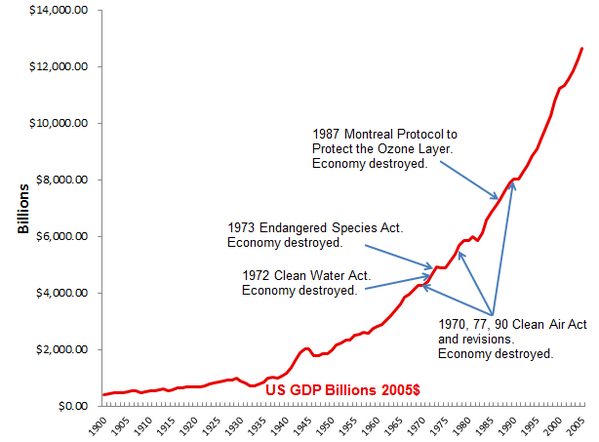
Right-wing conservative global warming deniers all cry in Chicken Little unison that doing the right thing about climate change will destroy our economy.  Well, Ramez Naam points out  in his essay “Reducing Carbon Emissions Will Be Cheaper Than Expected – It Always Is” that in the past after everyone ran around crying the economy would collapse, it didn’t. 

economy and environmental costs

We need to do something about CO2 pollution, and we need to do it fast.  Probably if we spent as much time and money on converting energy sources as trying to build the F-35 fighter we’d be mostly done by now.  We could fix the carbon pollution problem in a decade if we applied ourselves.  Much could be done with just conservation, and a tremendous lot could be accomplished by switching energy sources.  Anyone should be able to see that altering the environment is dangerous, and burning coal is stupid.  The goal should be something like converting carbon to coal and burying it, not burning it.  Coal was nature’s way of getting rid of CO2 in the first place.

Policy makers talk about making changes by 2050.  That’s bogus shirking the responsibility.  We should clean up our mess before we die, by 2025.  Besides converting to a new clean economy will stimulate the economy, not kill it.  Anyone who thinks otherwise lacks inspiration.


Makers and Robots

I find people who make things inspirational.  And the Maker movement is a nice antithesis to digital life.  Forbes covers “Maker Movement Fuels Apps, Robots, and Internet of Things.”  This is a movement that is growing so rapidly that I even hear non-Geeks are talking about it.  If I was a kid today I’d be totally into the FIRST Robotics Competition.

Building robots is becoming a mania.  Make Magazine even recommends “10 Ways to Make Your Robot More Humanlike.”  Building a robot teaches us about how bodies work.  Building an AI will teach us how the mind works.  If you aren’t paying attention, you might someday be shocked when humans are no longer the smartest beings on the planet.  Creating an AI mind should be possible but it’s going to be really hard.  O’Reilly.com says, ‘“It works like the brain.” So?’  Computers can already out-do us at many intelligent tasks now.

I expect someone to invent a cyber-cortex any day now that allows machines to learn and eventually become self-aware.  Maybe it will be a maker or one of those kids building robots.  Maybe they will be inspired by ODROID Magazine.


JWH – 6/4/14