Anna Karenina–Translations

Every time we read a book we have to translate it into our mind, even when we’re reading a book written in the language we speak.  If the book was written in another language, we have to depend on another mind to do an initial translation for us.  Sometimes two or more people work on a foreign language translation.  Those translators must interpret what they read in the original language and refashion it into English for us.  They have to choose between a literal translation and one that reads well.  Many decisions have to be made.  If an old book is being translated, does the translator preserve the language of the past, or modernize it, do they translate the colloquial phrases, or substitute similar English sayings, should they improve upon the original authors writing, for example, and change a weak passive sentence into a strong active one, etc.

In our modern world books are most often translated to film, but every reader translates words into pictures when they read.

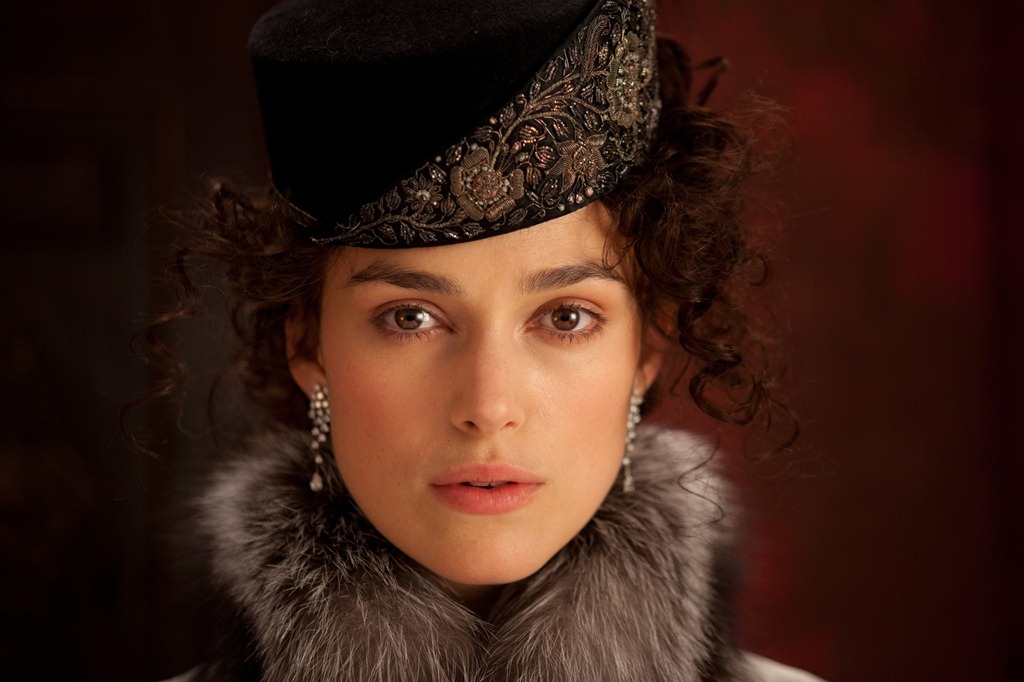
anna-karenina-kk

There are so many kinds of translations going on, more than just moving ideas from one language to another.  When we read a story we picture it in our minds, and we seldom picture it as the author pictured it.  How often have you read a book and then talked with someone about that book only to find they translated the book completely different.  The best illustration of this when movies are made from books.  Is Keira Knightley what you think when you imagine Anna?  Or is Aaron Johnson how you picture Count Vronsky?

anna-karenina-vronsky

If you’ve read a book about a poor person and have never been poor yourself, you will translate the book different from a reader who has been poor.  I have never been a woman, Russian, rich, dashing, beautiful, lived in the 19th century or been part of an aristocracy, so I have to imagine a lot when reading Anna Karenina and translating what it must have been like to been Anna or Count Vronsky.  I have studied American History, but is translating concepts about American slavery equal to Russian serfs?  I’ve seen Greta Garbo play Anna in a 1930s film, but is Garbo anything like what Tolstoy pictured when he was describing her with words?

Here is a portrait of Baroness Varvara Ivanovna Ikskul von Hildenbrandt that was painted in 1889, years after the book was published, but who people in Russia then used as a model for Anna.

PZ 401-038-753
Ilya Repin
Portrait of Baroness Varvara Ikskul von Hildenbandt, 1889
The State Tretyakov Gallery

Researching translations is fun.  That’s why studying the Bible is fun for me even though I’m a non-believer.  My friend Mike loves studying Homer and other Greek and Roman writers and comparing translations.  Readers have to constantly ask:  Is this a good translation?  Think of how many Christian creeds, sects and churches been created from reading one book.

I’ve always wanted to tackle Anna Karenina or War and Peace.  Well I’ve finally read (listened) to Anna Karenina, but how much of the story did I get?  Is one reading enough to make a fair judgment?  Did I pick the right translation?  Without doing any research I ended up with the Maude translation because I liked the sound of the reader of the audio book.  But I have to wonder, did I pick a good translation.

I’ve gone out and found four different translations.  Two of which I have on my Kindle, and two of which I did a screen shot of the first page off of Amazon.com.

Here’ is the opening of Anna Karenina translated by Constant Garnett (1901):

Happy families are all alike; every unhappy family is unhappy in its own way.

Everything was in confusion in the Oblonskys’ house. The wife had discovered that the husband was carrying on an intrigue with a French girl, who had been a governess in their family, and she had announced to her husband that she could not go on living in the same house with him. This position of affairs had now lasted three days, and not only the husband and wife themselves, but all the members of their family and household, were painfully conscious of it. Every person in the house felt that there was no sense in their living together, and that the stray people brought together by chance in any inn had more in common with one another than they, the members of the family and household of the Oblonskys. The wife did not leave her own room, the husband had not been at home for three days. The children ran wild all over the house; the English governess quarreled with the housekeeper, and wrote to a friend asking her to look out for a new situation for her; the man-cook had walked off the day before just at dinner time; the kitchen-maid, and the coachman had given warning.

Here is the same opening translated by Louise and Aylmer Maude (1918), the version I listened to:

ALL happy families resemble one another, each unhappy family is unhappy in its own way.

Everything was upset in the Oblonskys’ house. The wife had discovered an intrigue between her husband and their former French governess, and declared that she would not continue to live under the same roof with him. This state of things had now lasted for three days, and not only the husband and wife but the rest of the family and the whole household suffered from it. They all felt that there was no sense in their living together, and that any group of people who had met together by chance at an inn would have had more in common than they. The wife kept to her own rooms; the husband stopped away from home all day; the children ran about all over the house uneasily; the English governess quarreled with the housekeeper and wrote to a friend asking if she could find her another situation; the cook had gone out just at dinnertime the day before and had not returned; and the kitchen-maid and coachman had given notice.

Here is another translation, from Joel Carmichael (1960).

anna-karenina-carmichael

And here is the more recent translation by Richard Pevear and Larissa Volokhonsky (2000):

anna-karenina-pevear

This last translation was made famous by being picked for the Oprah Winfrey book club in 2004.

While listening to the novel I felt there were phrases that sounded modern, and wondered if Russians had some of the same sayings we did, or if the contemporary feel came from the translators.  Then my friend Mike called me to talk about his research on translations of War and Peace.  So I got to thinking about the translation of Anna Karenina.

I was very happy with the Maude translation, but it felt like I was reading Dickens.  But then Tolstoy wrote Anna Karenina just after Dickens died.  It was also serialized like Dickens’ novels, so it had that episodic feel.  Plus, both writers are coming to grips with similar changes in society brought about by industrialization, science and technology.

If you look at these different versions you’ll notice they are different and similar.  So, does the translation really matter? 

In the old two, Oblonsky had an intrigue with the French governess, while in the modern versions he had an affair.  Why the change?  How long has “an affair” meant what it does now?  But look at some other phrases:

“The wife did not leave her own room, the husband had not been at home for three days.” – Garnett.

“The wife kept to her own rooms; the husband stopped away from home all day;” – Maude, and it’s only part of a long sentence.

“Oblonsky’s wife refused to leave her rooms; he himself hadn’t been home for three days.” – Carmichael.

“The wife would not leave her rooms, the husband was away for the third day.” – Pevear and Volokhonsky.

Notice, there’s even changes in facts.  In the first the wife had one room, in the others, rooms.  In the second, the husband had been away all day, but in the others three days.

Notice how we’re told the cook has left.

“the man-cook had walked off the day before just at dinner time” – Garnett.

“the cook had gone out just at dinnertime the day before and had not returned” – Maude.

“the day before the cook had picked dinner time to go out” – Carmichael.

“the cook had already left the premises the day before, at dinner-time” – Pevear and Volokhonsky.

The Carmichael one doesn’t mention that the cook never returns.  And why doesn’t three of them mention that the cook is male?  I assumed the cook was female from my translation, but that’s my cultural spin on things.  I thought “walked off” was the strongest way of saying the cook quit.  “Left the premises” seems passive and not definite about why.

Well we do know why, the household is in confusion, upset and topsy-turvy.   Each of those words convey a different meaning to me, and none of them really convey the anger of a marital fight.  But then that might be Tolstoy’s failure.

Also, the famous first line is subtly different.  I wanted it to be more succinct.  Like “Happy families are all alike, unhappy families are distinctive.”  I don’t know Russian and would never be in the position to do a translation, but are the others translators like me, wanting to write the lines like they would want to read them?  If I had translated Anna Karenina it would have been a much shorter book, but is that translating or editing?

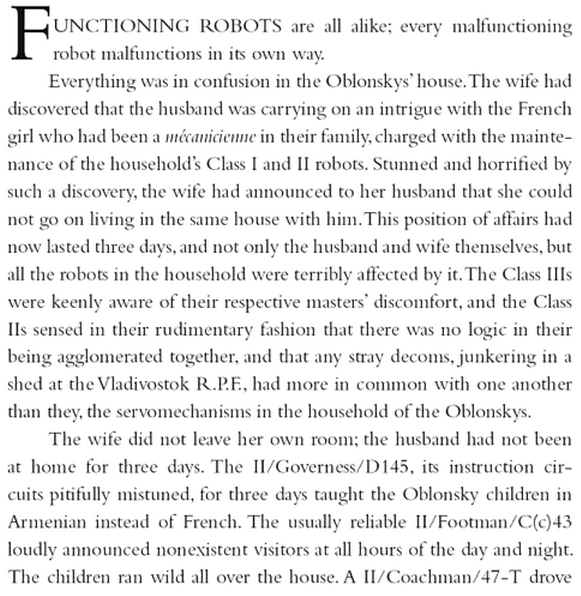
Then there’s Android Karenina, a parody mash-up of classic novel and science fiction – it’s another kind of translation.

android-karenina

Now many readers will be outraged by this particular translation of the novel, but really, is it any different in its extremes than the many film versions of Anna Karenina?  Most movie versions jettison the stories of Levin and Kitty, who appealed to me far deeper than Anna and Count Vronsky.  Just look at all these images from a Google search.  Each actress, or each painting for a book cover is an interpretation or translation.

How can modern readers understand Anna Karenina without understanding the social norms of the 1870s?  How much history do we have to know to really appreciate what Tolstoy is writing about?  I read AK at 60 and admired it greatly.  I could not have comprehended it at 20 or 30 or even 40, but even at 60 I’m sure I’m missing most of the story.  I don’t know Russian, but even if I did, I really don’t know much about life in 19th century Russia.  However, reading Anna Karenina is teaching me about Russia, like Dickens, Elliot and Trollope are teaching me about 19th century England.  Again though, through their translation.

History and fiction are constant mistranslations of reality, that change from generation to generation.

To see how we mistranslate history watch this little video “5 Historical Misconceptions Rundown" at YouTube:

JWH – 5/11/12

How Will the Future See Us in the Art of Our Times?

When I go to a museum, like the National Gallery in Washington, DC, I look at their collection as a doorway into time.  I know when I look at a Titian or Rembrandt I’m not seeing an actual view of the past, but an artistic view.  Art works on many levels, but the level that is most important to me is what it communicates across centuries.

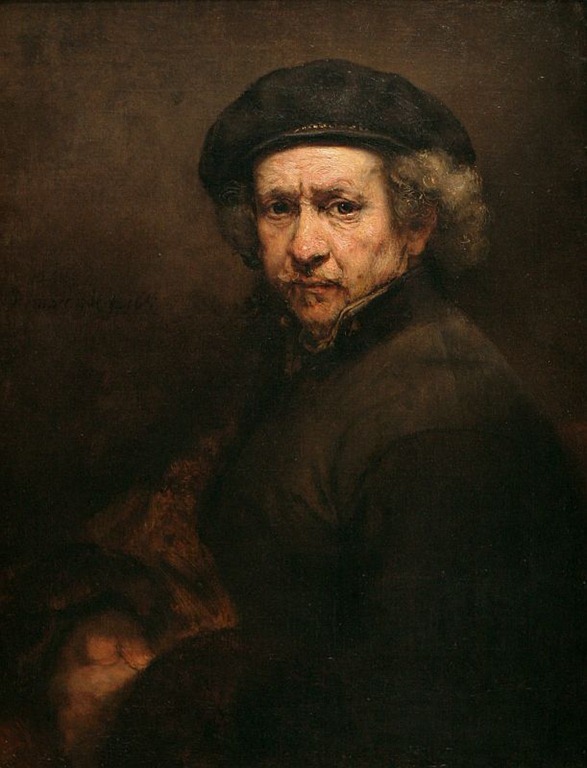
What I want to see when I look at a great work of art is communiqué from the past  .  When you look at this painting what does it say to you about 1659?  Scroll through Rembrandt’s paintings on Google Image Search, or his gallery at the Google Art Project, or read his entry at Wikipedia.  The more you study, the more you are pulled into the past.  If you become hooked you’ll even start reading history books.

[Click on photos for larger views.]

rembrandt-van-rijn-self-portrait

Rembrandt’s self portrait says so much.  He’s looking at us looking at him.  He knows we’ll see his world through his eyes, the ones that stare eternally from this painting.

Here is a photograph by Miru Kim.  In four hundred years what will people make of it and our times?  Will they think that was when humans discovered their cruelty to animals?  That early the 21st century was when we began to identify and empathize with our fellow creatures?

Miru-Kim

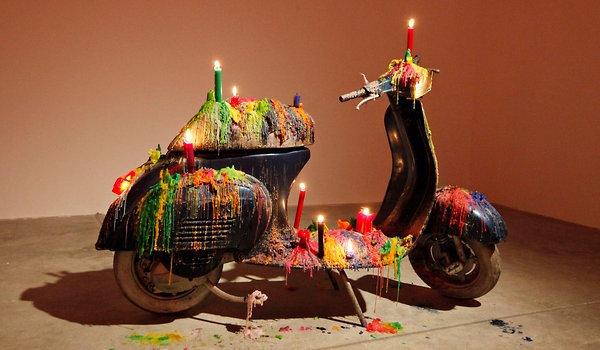
But what does this work by Mark Handforth say about our lives?

vespa-by-mark-handforth

Now I’m not criticizing modern art.  Contemporary art is very successful, as Morley Safer reported on 60 Minutes recently, and written up as “Even n tough times, contemporary art sells.”  If the future will look into our souls from the art we leave behind, what will they see?

In our times art is about about how much it’s worth in dollars.  Art speculation is big business.  That’s a dimension of art that I’m not interested in, nor want to analyze.  I doubt “Vespa” will survive 400 years to be seen – pop sculptures look fragile to me.  I tend to think contemporary painting has been overshadowed by photography and film.  The future will know us through our documentaries.  But I think the Miru Kim photograph will communicate something to humans centuries from now if it survives.

Today I was reading in Anna Karenina, at the part where Anna and Vronsky are visiting the Russian artist, Mikhailov living in Italy.  They study his painting of Jesus Christ and Pontius Pilate.  Mikailov is trying to capture history, but tell the story from his unique time and place.  This scene allows Tolstoy to express his views on art, and he sends a literary message across time about the timeless of art.

Most of the art that Morley Safer showed us on 60 Minutes won’t last no matter how much people pay for it.  It either doesn’t send a message or sends the wrong message.  I’m not even saying it has to be a coherent message, it just needs to convey a piece of our collective soul in some way.  I think this one says a lot, but I can’t put it into words.

trippy-5-modern-art

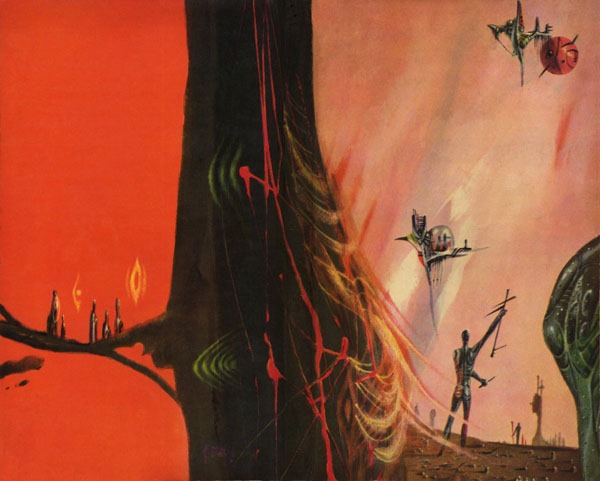
Then we have the problem of science fiction art.  It’s about the future, but is really about the present.  What do you make of this Richard Powers painting?  What does it say about the 1950s?

Pwrs_3from

When I looked at the 60 Minutes piece I felt tremendously disappointed by most of the art is saw.  I worry that the future won’t look kindly on us because our art is so lacking in beauty and imagination, and it says so little about our times.  Like Mikhailov in Anna Karenina trying to paint something that’s been painted thousands of times before, the struggle to be unique is a dangerous quest.

Which takes me back to Rembrandt.  Why don’t artists paint more faces?  Why is the 20th and 21st century so faceless?

Rembrandt

The art I like best features people.  Modern art seems to have moved away from people.  I guess painters think photographers have people covered, but I actually preferred painted people.  Here’s one of my favorites.

caillebotte-paris-a-rainy-day

JWH – 4/12/12

Throwing Away the Past

Have you ever found a pair of ticket stubs to a concert you went to a quarter-century ago when cleaning out an old drawer?  You hold in your hand proof that you were somewhere in the past at a certain time, and even what building, row and seat, and what you heard for a few hours.  Do you save the ticket stubs or toss them?  Maybe you could jot the info down in a journal, or make an entry into Facebook Timeline.  If you don’t, you’re throwing the past away.

I often throw my past away, and sometimes I regret it.  Saving the past takes work.  I turned 60 last year and my memory is in decline, so I often wish I had validation for lost memories.  But saving the past often feels like hoarding, and hoarding scares me because the weight of past can become paralyzing.  Some folks bury themselves in the past long before they die.

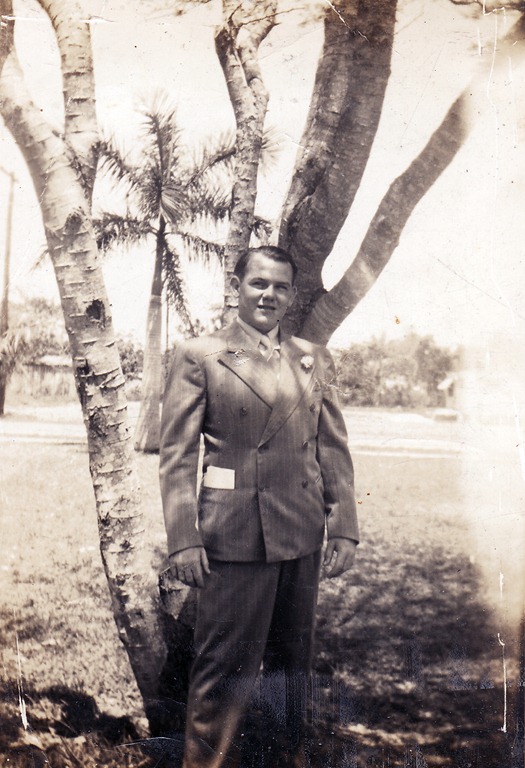
1939-05 - Dad at Homestead FL

Most people don’t have eidetic memories.  Have you ever wondered how biographers could write gigantic biographies of people who lived a hundred or two hundred years ago?  George Washington and Abraham Lincoln left big historical trails to follow, but most people leave few clues to piece together.  My father died when I was 19 and it took me years to realize that I knew nothing about him.  I had memories and a handful of photos, which I thought was all I needed, but when I finally got around to examining those memories I realized I had zip, nada, nothing.  I have no idea what was going on inside his head.  Like, what was he thinking on his graduation day in the photo above?  What did he hope to get out of life?

Recently I threw out decades of credit card bills, medical statements, receipts on big purchases, bank statements.  I knew if I wanted to I could recreate at least my spending and medical history with those clues, but in the end, I chose to throw them all away.

Who are we?  Are we what we think?  Are we what we own?  Are we what we did?  Are we what we love?  Are we what we hate?  I’m not a believer in the afterlife, but I wonder what it would be like, because if we went some place new do we throw out who we were on Earth?  Memories of my Dad are defined by Camel cigarettes and Seagram 7 bottles.  If my Dad can’t have his cigs and booze, can he be my Dad in heaven?  Or do they have bars and ashtrays on the other side?

And is that how the young man in the photo above expected to be remembered?  By his bad dying habits?

There was a period in my life where I fanatically collect LPs.  I had over a thousand of them.  Collecting and listening to music is what made my life good and meaningful.  I eventually sold or gave them all alway.  I only have one LP now.  Last year I had a fit of nostalgia for an album I heard in 1971 called Never Going Back to Georgia by The Blues Magoos.  It was never reprinted on CD.  I ordered a used copy off the internet and a friend gave me a turntable and I played that album a couple of times.   What I heard was not what I remembered from forty years ago.

It takes a great effort to recapture the past once you throw it away.  I know many people who never throw anything a way.  I knew a guy who claimed he had every book he ever bought and read.  I know that’s not true because he lent me a book and I never gave it back, and I’m sure I’m not the first.  I have a piece of his past – sorry about that Bob.  But is it a piece that matters?  And which pieces do?

Does the past matter?  I can go long periods of time without thinking about the past, but boy do I hate it when a memory pops up and I can’t place when and where I was.  It bums me out that I can’t remember one face or name from kindergarten through third grade.  I do remember returning to Lake Forest Elementary in my fourth grade year and meeting a girl name Helen and how it upset her that I didn’t remember knowing her from when we went to second grade together.  I can remember a few people from 5th and 6th grade.  That’s pitiful, ain’t it?  In all my K-12 years I can barely remember and name more than a dozen classmates.  Where did all those people go, I spent years with them.

Religious people agonize over being reborn after death – they just don’t want to let go, they’re just afraid of dying.  But I think we die every day, every moment, I think we’re constantly throwing away the past.  We’re new people every day.  We go to sleep every night and our brains housecleans the day’s memories and throws out most of them.  If we kept all our memories we’d be like hoarders buried under piles of useless crap.

But each night, and maybe not every night, the old noggin decides to keep a few bits of the past, so there’s a precedence for keeping some stuff.  I wish I had kept a diary and took more photographs throughout my life.  A case could be made that we should each be our own biographer, and maybe that’s the right amount of past to keep, what we could keep in one big book.  Our brains aren’t very good with details, so we should jot the important ones down and take a few snaps to document our lives.

Now here’s my wish.  I wish The Library of Congress would create a national digital archive where we could store our memoires, like a permanent blogging site that historians can depend on for mining memories about all of us.  I know most of our autobiographies will go unread, but they’d be there.  I’d love to read my father’s thoughts, and his father’s, and his father’s father, and so on.

There are things we do want to remember.  Most of the past we throw away, but maybe we should start throwing away a little less.

JWH – 3/16/12

Understanding Reality

Think about cockroaches.  How much do they know about reality?  They have compound eyes that see the world poorly.  They can sense vibration, and they have a sense of touch.  Do they smell and taste the world around them?  I don’t know.  Cockroaches are little biological machines that eat and replicate.  They survive.  Between roaches and humans is an array of animal life with ever improving senses that understand more of reality.  To get some idea how an animal thinks watch “My Life as a Turkey.”  Humans do not have an exclusive hold on consciousness, but our consciousness lets us explore reality far deeper than any other creature we know.

I tend to doubt animals understand their environment in a conscious way.  They react to it, and even develop rudimentary calls that can be language-like that can relate to others of their kind about locations, events or things in their environment.  But I don’t think they ever ask:  who, what, where, when, how and why?  Maybe some higher forms of animals might pine for who, what and where, but I doubt they cognitively ask.

I believe we have a number of cognitive tools that help us analyze, map and understand reality.

Language

Words let us break down reality into parts.  Grammar lets us describe actions with nouns and verbs.  The origin of language let us work with who, what, where and when.

Theology

Theology introduces abstractions that attempt to answer how.  Theology was our first tool that lets us ask why are we here.  Unfortunately, theology is all based on imaginary concepts.  Theology distorts reality.  Theology lets us think we see things that aren’t there.  Theology has imprisoned humans for tens of thousands of years in a pseudo-reality.

Philosophy

Philosophy introduced rhetoric and logic and attempts to understand reality through deduction.  Sadly, philosophy was tainted by religion and sought to reconcile reality with ideal forms of the mind.  It took philosophy centuries to throw off trying to make reality shoehorn into a preconceived concept.

Mathematics

We started counting with language and commerce, but mathematics came into its own with philosophy.  At first mathematics was used in philosophical interpretations of abstractions and ideal forms, but eventually we applied it to analyzing reality.  It became our first tool where consensus and validation was important.

Science

Science is a system for testing reality.  Answers only count if they are consistent, reproducible and universal.  Mathematics became the cognitive tool of science.

Technology

Technology allowed us to expand our senses.  Telescopes and microscopes see further than our eyes.  Other technology allowed us to look into the reality where our senses can’t perceive.

The first three cognitive tools we developed, language, theology and philosophy often distort reality, or create illusions and fantasies.  Most humans never get beyond those three tools and even though they perceive reality far greater than a cockroach because of their superior senses, language, theology and philosophy often just confuses their minds.  Our brains are so powerful that they let us see what we want to see.  Our minds can override our senses and alter reality.  Theology has always been more powerful than any drug, especially combined with the power of our imagination.

The Limits of the Mind

Math, science and technology have expanded our awareness of reality out to infinity in all directions, including time.  How much of this reality humans can comprehend is yet to be determine.  Most humans on planet Earth cannot get beyond theology which blinds them from seeing true reality.  Most religions have incorporated bits of philosophy to make their religion logical and understandable by rhetoric, but its foundation is based on illusion and quicksand.  In recent years theology has even attempted to incorporate science but its been a pathetic failure.  Those people whose only cognitive tool for understanding reality is theology cannot comprehend how science works, if they did, it would destroy their theology.

There are many other tools for understanding reality, such as art, literature, history, journalism, poetry, drama, etc.  They are all subjective, but they have their pros and cons.

JWH – 3/6/12

The Gnostic Gospels by Elaine Pagels

The Gnostic Gospels by Elaine Pagels is both fascinating and tedious.  Who Jesus was has been argued by billions for thousands of years, so why should anyone assume we can solve an unsolvable puzzle?  Before the Catholic Church became the monolithic institution that defined Christianity for centuries, there were a few centuries after Christ’s death where many different Christian beliefs flourished, and among those were the Gnostics.  Gnosticism wasn’t limited to Christian thinking, but Christian Gnosticism in various forms were large enough movement that early orthodox leaders wrote books teaching against Gnostic thinking.  Gnostics were heretics early orthodox Christians hated even more than the Romans.  The orthodox did everything it could to wipe out the heretics and burn all their books.  In 1945 we found 52 texts at Nag Hammadi, Egypt.

gnostic-gospels

The Gnostic Gospels by Elaine Pagels is a short overview of alternate Christian beliefs before the Council of Nicaea in 325 AD.  Now here’s the rub.  You have many Christian philosophies before 325 AD, then hundreds of years of the Catholic Church, and many Christian philosophies after the Protestant Reformation in 1517.  The Catholic Church spent centuries hammering out who Christ was and what his teachings meant, but there are always other people believing he taught something different.  Gnostics had very radical ideas about Christ that sound just as good or better.  Who is the real Jesus?

How Christianity evolved is a fascinating historical mystery.  I’ve been watching Lost Christianities: Christian Scriptures and the Battles over Authentication, A Great Course lecture by Bart D. Ehrman.  I got The Gnostic Gospels as a supplement.  The Gnostics are intriguing because they claim to have secret knowledge of Jesus based on his mystical teachings, like Eastern religions.  Some Gnostics thought the virgin birth and bodily resurrection were silly stories the orthodox Christians believed in and claim to know the real truth.  They said Jesus taught that the Kingdom of Heaven was within and had already arrived and with the right practices and secret knowledge it would be revealed here on Earth.  It wasn’t faith, but direct experience.

While studying these early Christians I got a strange idea.  History is full of religious charlatans and con men.  What if Jesus had been a con man gathering his flock with a promise of secret knowledge.  Then he gets killed, and after that all his followers taught something different about his “secret knowledge” creating endless religions never knowing they had been conned.  Most people like to assume that one view of Christ is the right one.  But what if they are all wrong?

The more I study the history of Christianity the more its obvious that every Christian see a different Jesus and it’s impossible to know the real Jesus.  Reading The Gnostic Gospels only made me feel more conclusively that Jesus and his teachings are unknowable – and all we can know is an endless series of imaginary Christs created by people who have their on unique beliefs.

JWH 1/4/12