Could A Robot Read Jules Verne?

by James Wallace Harris, Friday, January 12, 2018

I’m listening to the AmazonClassics audiobook edition of Journey to the Center of the Earth by Jules Verne, a novel originally published in France in 1864, and first translated into English in 1871. The translation I read was by F. A. Malleson, from 1877, and is considered a pretty good translation. Verne suffered from many bad translations, often ruining his reputation in the English speaking world.  The story is impressively narrated by Derek Perkins. His voice perfectly matches this 19th adventure tale. This audiobook sounds more thrilling and real than most of the silly movie and television productions I’ve seen.

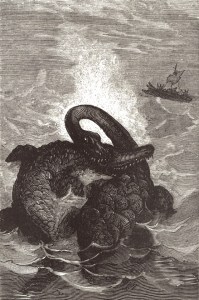
Journey to the Center of the Earth 26Journey to the Center of the Earth 36

However, I have one problem with Verne’s story. It’s not very believable. Of course, it’s well over a century-and-a-half since Verne imagined it, and science has progressed a great deal, but was it even believable in his day? I wish I had an AI robot that could read and understand fiction and nonfiction. I want to talk to it like Alexa but it would be much smarter. I want my AI mind to crawl across the web and answer questions for me. Google is so goddamn stupid that it drives me crazy. I searched for [19th-century reviews of “journey to the center of the earth”] but it only brought up modern reviews of recent book editions and movie versions. I thought my query was quite explicit. If Google is such a leader in AI, why can’t it understand my query? Don’t you get tired of all the crap Google searches return?

I want to build an AI mind that I could input texts of all the science fiction stories and novels from the 19th and 20th centuries and have it analyze those works by correlating that content with information found on the internet. Journey to the Center of the Earth was originally published in a magazine for boys. I’ve love to find diaries, journals, essays, and books by 19th-century readers who read Journey to the Center of the Earth when it came out and to know their reactions. Verne adds a good deal of science from his day into his story to make it sound plausible, but was it?

Hollow Earth theories and stories go back much further than Verne. Were its proponents and speculating on real possibilities and taken seriously? Or, were they the UFO nutters of their day? I get the feeling that the concept of dinosaurs had inflamed 19th-century imaginations and Verne used his story to speculate how dinosaurs could still exist. He was doing the same thing that Doyle’s The Lost World and Crichton’s Jurassic Park did, creating a theory to present live dinosaurs. I have many theories about the evolution of science fiction, and having an AI collaborator could really help.

I’d love to build an AI robot that I could chat with me about science fiction. I picture talking my digital companion like Mannie did with Mike in The Moon is a Harsh Mistress (1965) by Robert A. Heinlein. I imagine creating my AI friend like the AI machines in When HARLIE Was One (1972) by David Gerrold or Galatea 2.2 (1995) by Richard Powers, where Harlie and Helen came into consciousness by interacting with a human mentor. I fantasize talking with this AI and collaborating on articles about the history of science fiction. And what if it woke up and became conscious?

Computer scientists are building AI machines using machine learning to do all kinds of things today. If they can master games like Chess, Jeopardy, Go, and old Atari 2600 games, or analyze MRIs and X-rays for cancer, why couldn’t they learn everything to know about science fiction.

Lately, I’ve been thinking about learning ML (machine language) using Python. I’ve been daydreaming about building a machine after reading (“Deep Confusion: Misadventures in Building a Deep Learning Machine,” “The $1700 great Deep Learning box: Assembly, setup and benchmarks,” and “Build a super fast deep learning machine for under $1,000“) or just paying for a hosting service like Paperspace. There’s a new edition of Python Machine Learning: Machine Learning and Deep Learning with Python, scikit-learn, and TensorFlow by Raschka and Mirjalili that could get me started, or Hands-On Machine Learning with Scikit-Learn and TensorFlow: Concepts, Tools, and Techniques to Build Intelligent Systems by Aurélien Géron.

Of course, I doubt if I could ever program such a fantastic AI machine or even learn the basics of ML at my age. I’ve been watching a series of videos from Google Developers on Machine Learning Recipes. I’ve also been reading about Natural Language Processing with Python, a book I bought years ago when this idea first came to me. The concepts aren’t hard, but it would be just the first steps on a journey of ten thousand miles. I’m not sure I have the concentration power or memory space anymore. I’m probably too old and too feeble minded to do it, but that doesn’t mean some youngster couldn’t.

I’m quite envious and jealous that young people today can choose this kind of work for their career. I programmed databases during my work years, and that was fun enough, but imagine getting to develop robots, AI minds, and machine learning? What an exciting time to be a programmer.

JWH

Science Fiction Hall of Fame Volume One

by James Wallace Harris, Tuesday, December 19, 2017

Christmas came early this year for me. I’ve been wishing since 2002 for an audiobook edition of The Science Fiction Hall of Fame Volume One and my wish was finally granted sometime after midnight this morning. (For non-Audible.com members there’s a CD version but it’s $45.)

Science Fiction Hall of Fame v. 1The Science Fiction Hall of Fame Volume One is probably the most loved science fiction anthology of all time and comes in #1 at Goodreads list of Best Science Fiction Anthologies. The Science Fiction Writers of America (SFWA) voted for its contents when they formed in 1965 to recognize the best science fiction stories published before the Nebula Awards were created. The anthology was edited by Robert Silverberg and first published in 1970.

Just after five in the morning, I began the download. Sitting in the dark with my headphones I sampled the stories. There are 26, narrated by an array of professional readers that bring these tales vividly alive to my ears. I’ve long recognized that my reading skills are poor compared to the hired guns of the audiobook world. Since I joined Audible.com in 2002 I’ve been searching out all the science fiction I loved in my youth to reread by listening. When I hear these old favorite stories it’s like when Dorothy opened that door in The Wizard of Oz and the black and white movie switched to Technicolor. I get so much more from hearing than when I read with my eyes.

The pulp fiction punch came through right from the first with “The Martian Odyssey” by Stanley G. Weinbaum. Science fiction is often attacked as poorly written, yet while I jumped from story to story sampling how each sounded, I felt the writing was lovely and vivid. Each story began with distinctive details that envisioned a uniquely imagined concept. Sure, this is pulp fiction, but it’s pulp fiction at its classic best. These old stories showcase how science fiction writers back then felt compelled to invent a novel idea to fictionalize. I often read stories today that improvise off these original themes.

These stories all get their own entries in Wikipedia, which attests to their longevity. I’m borrowing this table from Wikipedia in case you want to read about them and their authors.

Author Story Title Year of first publication
Stanley G. Weinbaum A Martian Odyssey 1934
John W. Campbell Twilight 1934
Lester del Rey Helen O’Loy 1938
Robert A. Heinlein The Roads Must Roll 1940
Theodore Sturgeon Microcosmic God 1941
Isaac Asimov Nightfall 1941
A. E. van Vogt The Weapon Shop 1942
Lewis Padgett Mimsy Were the Borogoves 1943
Clifford D. Simak Huddling Place 1944
Fredric Brown Arena 1944
Murray Leinster First Contact 1945
Judith Merril That Only a Mother 1948
Cordwainer Smith Scanners Live in Vain 1948
Ray Bradbury Mars is Heaven! 1948
Cyril M. Kornbluth The Little Black Bag 1950
Richard Matheson Born of Man and Woman 1950
Fritz Leiber Coming Attraction 1950
Anthony Boucher The Quest for Saint Aquin 1951
James Blish Surface Tension 1952
Arthur C. Clarke The Nine Billion Names of God 1953
Jerome Bixby It’s a Good Life 1953
Tom Godwin The Cold Equations 1954
Alfred Bester Fondly Fahrenheit 1954
Damon Knight The Country of the Kind 1955
Daniel Keyes Flowers for Algernon 1959
Roger Zelazny A Rose for Ecclesiastes 1963

I consider”A Rose for Ecclesiastes” by Roger Zelazny the epitome of pulp science fiction style, and the story I was most anxious to hear. It came out in 1963 just before the Mariner IV mission to Mars forever ruined the planet for pulp fiction adventure. After NASA science fiction had to grow up and accept a new reality. Mars and Venus could no longer be home to ancient races, and “A Rose for Ecclesiastes” is a wistful elegy of an era.

It’s quite elegant that The Science Fiction Hall of Fame Volume One begins with “A Martian Odyssey” and ends with “A Rose for Ecclesiastes” using the two best short stories about Mars as bookends for the anthology. These stories are the sense of wonder of my childhood. I can’t recommend this anthology highly enough. It captures the essence of the science fiction that baby boomer SF fans discovered in the 1960s and defined the genre for us.

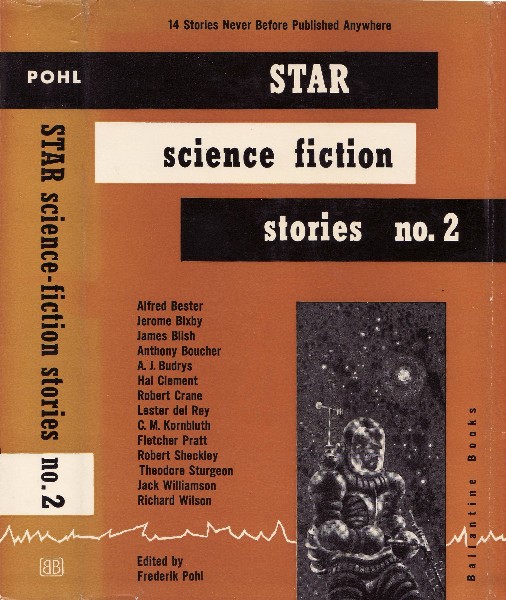
I thought I’d close out this essay with cover images that first featured these stories. What’s funny is many of them didn’t make the cover art — which is a pity. Makes me wonder if the editors didn’t recognize their greatness at that time, or if they thought other stories were superior. I’m also going to include the link to the story’s Internet Science Fiction Database (ISFDb) entry so you can see how often it’s been anthologized over the years.

My many thanks to the gods of the audiobook world. You have given me many hours of happiness.

A Martian Odyssey – by Stanley G. Weinbaum

1 - A Martian Odyssey

Twilight – by John W. Campbell

2 - Twilight

Helen O’Loy by Lester del Rey

3 - Helen O'Loy

The Roads Must Roll by Robert A. Heinlein

4 - The Roads Must Roll

Microcosmic God by Theodore Sturgeon

5 - Microscopic God

Nightfall by Isaac Asimov

6 - Nightfall

The Weapon Shop by A. E. van Vogt

7 - The Weapons Shop

Mimsy Were the Borogoves by Lewis Padgett (Henry Kuttner and C. L. Moore)

8 - Mimsy Were the Borogoves

Huddling Place by Clifford D. Simak

9 - Huddling Place

Arena by Fredric Brown

10 - Arena

First Contact by Murray Leinster

11 - First Contact

That Only a Mother by Judith Merril

12 - That Only a Mother

Scanners Live in Vain by Cordwainer Smith

13 - Scanners Live in Vain

Mars Is Heaven! by Ray Bradbury

14 - Mars is Heaven

The Little Black Bag by C. M. Kornbluth

15 - Little Black Bag

Born of Man and Woman by Richard Matheson

16 - Born of Man and Woman

Coming Attraction by Fritz Leiber

17 - Coming Attraction

The Quest for Saint Aquin by Anthony Boucher

18 - The Quest for Saint Aquin

Surface Tension by James Blish

19 - Surface Tension

The Nine Billion Names of God by Arthur C. Clarke

20 - The Nine Billion Names of God

It’s a Good Life by Jerome Bixby

21 - It's a Good Life

The Cold Equations by Tom Godwin

22 - The Cold Equations

Fondly Fahrenheit  by Alfred Bester

23 - Fondly Fahrenheit

The Country of the Kind by Damon Knight

24 - The Country of the Kind

Flowers for Algernon by Daniel Keyes

25 - Flowers for Algernon

A Rose for Ecclesiastes by Roger Zelazny

26 - A Rose for Ecclesiastes

JWH

Cozy Science Fiction: Chocky by John Wyndham

by James Wallace Harris, Friday, October 27, 2017

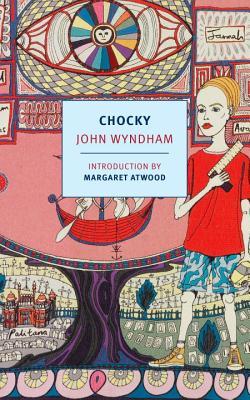
What makes for good storytelling? How is a science fiction story different from other kinds of stories? Chocky, John Wyndham’s last novel published in 1968 is a story about a David and Mary Gore and their two children Matthew and Polly, living in England in what appears to be the quainter side of the 1960s. I imagine its time and setting looking somewhat like the Father Brown mysteries on PBS. The story is told by David. It’s rather prosaic, with a light literary touch. David relates how he met Mary. How she came from a big family and the pressure they felt to have a big family too. When they apparently can’t they adopted Matthew. Then, Polly, a girl is born. The story jumps ahead a few years to give the history Polly’s imaginary friend when she was four, and how that problem was resolved. Then the story jumps again to the present when Matthew is twelve, much too old for imaginary friends, and how he acquires one anyway. Most of the novel is about the family difficulties caused by Chocky, Matthew’s mysterious invisible companion.

Chocky by John Wyndham

Wyndham’s novel Chocky could be considered a mainstream literary novel, a nice quiet little story about family life in mid-century England. What makes it science fiction is who we think Chocky might be. The mystery genre has a sub-genre called cozy mysteries. Chocky could be a cozy science fiction novel. But what does that mean? There’s already a sub-genre in science fiction called cozy catastrophes. Many of them are by English writers by the way, and I believe many cozy mysteries are set in England too, but an Anglophile appeal is not a defining attribute of a cozy novel.

I’m sure there is no international standard for cozy novels but for me, the size of the setting, number of characters, and scope of the plot are important factors. So a story about a single alien invader impacting one family makes it a cozy tale. I guess that also makes E. T. the Extra-Terrestrial a cozy, but Chocky is much smaller and quieter than that story. The story loudness knob for science fiction movies is usually cranked to 11. Gattaca and Her being level 3 exceptions. Chocky is about a 1 or 2, and I found that exceedingly pleasant.

I’m not sure if science fiction fans even crave cozy science fiction novels. Science fiction plots are inherently big, thundering, and exciting. Mostly mystery fans who love cozy mysteries love them because they are quiet, with simple murders usually solved by ordinary folks, with tame storytelling for sex, violence, and crude language. Chocky fits that bill nicely. Chocky is currently in print from NYRB Classics, the prestigious paperback line from New York Review of Books. As of today, NYRB Classics only publishes 13 science fiction novels, most of which are on the quiet side, and many from England. Maybe the NYRB editors admire cozy science fiction too.

I doubt Wyndham intended Chocky to have an ambiguous ending, but if you were skeptical and tried hard, the science fiction could be removed the story. I imagine if there were a sub-genre cozy science fiction, that would be one of the defining characteristics, the science fictional element would be painted lightly onto a story of ordinary life. Examples might be The Age of Miracles by Karen Thompson Walker or Station Eleven by Emily St. John Mandel, both gentle post-apocalyptic tales that are a far cry from Mad Max rip-roaring tales of civilization’s collapse where it’s kosher to blast away anyone you want with your modified AK-15.

When I was younger I loved loud science fiction. Now I’m drawn to the cozier side of its storytelling. I think loud storytelling, both in books and movies became popular in the 1960s. I love westerns and constantly seek out old ones, and I’ve discovered the kind I like best were made in the late forties into the middle fifties. Westerns are a genre that depends on violence, but starting in the late 1950s they began cranking up the violence too until they became a kind of gun-porn by the 1960s. Special effects, relentless action, and comic book violence have ruined movie science fiction for me. I guess that’s why I enjoyed discovering Chocky so much.

Be sure and read Margaret Atwood’s introduction to the new edition of Chocky, “Chocky, the Kindly Body Snatcher.”

JWH


Is Facebook Replacing Older Ways?

by James Wallace Harris, Tuesday, July 19, 2017

A few years ago an older version of our web site devoted to the Classics of Science Fiction would get hundreds of hits a day, some days going over a thousand. Now it’s lucky to get two dozen. Searching Google for “classics of science fiction” usually places the site on the first page of returns, which would suggest it’s still valid.

Why the decline in hits? It’s doubtful that science fiction has fallen out of favor. I’ve been wondering if how people use the internet has changed. I know our site is boring and statistical but it did have some fans. Now it doesn’t. I’m wondering if folks have stopped using the web in the same way they used it before. Are most people going to big sites and ignoring the small sites?

Or is everyone hanging out on Facebook instead?

Facebook

Pages and groups devoted to science fiction on Facebook often have thousands of followers. Are people spending more time socializing on Facebook than surfing the web? Facebook has over 2 billion members. Many of my friends and family use Facebook daily. Has Facebook reached a critical mass of users meaning it can’t be ignored?

I know many people who loathe Facebook. As online forums and Yahoo! Groups die from inactivity will those holdouts be forced to become a Facebook pod person?

The internet existed for years before the World Wide Web. It wasn’t until the invention of the web browser that people began surfing the internet purely for entertainment. Users jumped from link to link, going wherever inspiration led them to click.

Then came search engines. Instead of surfing, you keyword searched. Of course, search results could take you to unknown and surprising places.

The way we use the internet has changed again with smartphone apps. Whereas before I’d start with Google, I now tap Wikipedia, IMDB or other icons instead. There are times when I have to fall back to Google, but it’s usually when I’m doing writing research.

For years my online socializing happened on blogs, Yahoo! Groups, or forums at web sites. All those virtual meeting places are becoming depopulated. After the internet became universal I assumed it would always be the same. Now I’m thinking the underlying technology will always be there, but how we use it will constantly mutate.

Has Facebook become an alternative to web surfing, blogging, home pages, personal web sites, etc? Even more, is Facebook replacing family get-togethers, scrapbooks, printed photos, letters, postcards, greeting cards, telephone calls, and email? Many people now prefer texting to a phone call because it is less time-consuming. Has Facebook become the quick replacement for visiting online friends, or even some real life friends?

JWH


Science Fiction Books That Start Snowballing Themes

by James Wallace Harris, Saturday, December 3, 2016

2017 Sci-Fi ExperienceOver at Stainless Steel Droppings, Carl Anderson has started his 2017 Sci-Fi Experience early. It’s based on Andrea’s Vintage Science Fiction Month. Usually, Carl reads old science fiction in January and February, but decided this year to switch to December and January. Since I’m already reading old science fiction I decided to join in. But I want to put a focus on my efforts. I recently read “17 Science Fiction Books That Forever Changed The Genre” and although I agree with some of their selections, I disagreed with others. However I really liked their idea of identifying the books that either changed the rules/direction of science fiction, or inspired other writers to explore their ideas. I like to think of certain science fiction books as snowballs rolling down a slope getting bigger and bigger – or even causing an avalanche.

James Gleick’s new book, Time Travel: A History does just that for The Time Machine by H. G. Wells. Wells’ little book has started a huge snowball rolling down the decades. It might be the best example of what I’m talking about. And Gleick describes many classic time travel novels that came afterwards, but he doesn’t come close to covering all the major time travel stories, just look at this list of books, television shows and films at Wikipedia. Hasn’t every possible speculative variation on time travel been imagined by now?
I want to make my reading of vintage science fiction about studying science fiction themes. I keep wondering if there’s a limited number of science fictional concepts. But then I read something like Spin by Robert Charles Wilson or Quarantine by Greg Egan, and think speculative fiction is unlimited. I do believe we can identify snowballing books, and that will help us count up the themes.

Another good example would be Starship Troopers, a book that inspired such novels as The Forever War by Joe Haldeman, Ender’s Game by Orson Scott Card, and Old Man’s War by John Scalzi, plus seems to have launched the Military SF sub-genre. When I watch movies like Aliens, I think Starship Troopers. When I watch Star Wars I think of Asimov’s Foundation books.

Under-the-Ocean-to-the-South-Pole-2What other books, or series of books inspired a sub-genre in science fiction? Did Heinlein start the YA science fiction market with Rocket Ship Galileo in 1947? But then, does anyone remember The Great Marvel Series by Roy Rockwood (1906-1935)? Carl’s reading challenge generally focuses on books from 1950-1979, but what about books from 1850-1950? Have we already forgotten the books that inspired the Golden Age writers to write those 1950-1979 classics? Older fans today can remember juvenile series by Heinlein, Norton, Asimov and Wollheim, but science fiction for young people goes way back.

Did The Last Man by Mary Shelley, The Scarlet Plague by Jack London and Earth Abides by George R. Stewart start the sub-genre of post-apocalyptic science fiction last man on Earth stories? Remember Wells hinted at that in The Time Machine. And didn’t The Time Machine set things up for Olaf Stapledon? All that stuff about future species of humans.

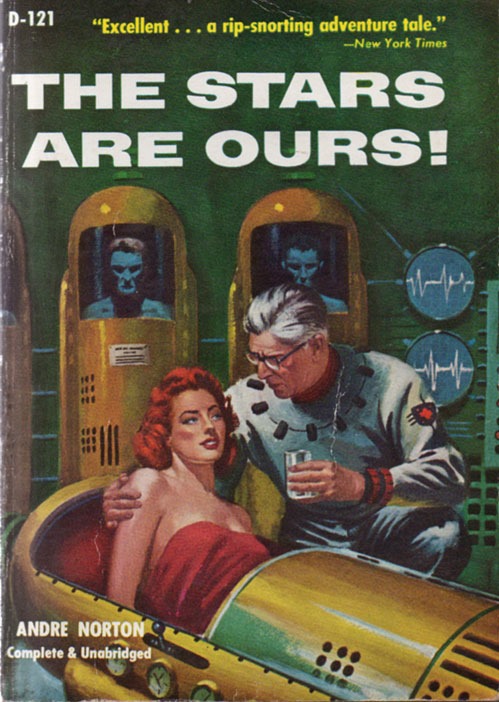
The Stars Are Ours - NortonI’ve been been wondering two things. One, is there a limited number of science fictional ideas, themes, subgenres? And two, how far back do they go? For my science fiction book club, we’re reading The Stars Are Ours! by Andre Norton from 1954. It presents two interesting themes. One, conservative/religious groups repress/destroy science and scientists, and two, people need to escape Earth to start over again on another planet. Both themes are relevant today.  Can we find books from the 19th century or even 18th century that first got those snowballs rolling? Do those themes ever stop being relevant? Will science fiction written in the  22nd century add to the existing snowballs? Will science fiction fans in the 2050s read many SF books from the 1950s? Or even known about them? Or will they think the science fiction they discover in adolescence as having original ideas?

At what point does vintage science fiction become forgotten science fiction, and newer, but older science fiction, become vintage? SF of the 2010s will be vintage by the 2050s. The appeal of vintage science fiction might be due to fans getting older and realizing what they once thought of as original ideas might be as old as the hills. As I’ve said before, Noah’s Ark might have been the first generation ship story. I find parts of The Book of Genesis to be very science fictional. If you squint at it in the right way, doesn’t the whole tree of knowledge of good and evil story seem like speculation about the evolution of human awareness? I can easily imagine a writer, male or female, living under Babylonian occupation, trying to imagine how everything got started, and wrote about a powerful alien being creating us. What’s really science fictional, is people think that story is the literal truth 2700 years later.

Generally, we read for story. We want to be entertained. But I think as we read and reread these vintage science fiction tales, we should examine the ideas they present. Then speculate about what inspired those ideas, and finally, evaluate how well they were implemented. As a liberal, I was rather shocked by the 2016 election results. The lesson I learned is don’t trust my assumptions. I’m applying that lesson to reading vintage science fiction. For example, should we assume that humans can leave Earth and start over on another planet if we totally screw things up here? I hated that Interstellar depended on that idea.

Some snowballs rolling down a hill just fall apart. Can we also count them as we read?

I believe science fiction represents a collection of speculative ideas that have been around a very long time. Eventually, they become real – like heavier than air flight, traveling to the Moon, cloning, constructing robots to do our work – or, we can eventually give up on the idea. I think time travel stories are now considered fantasy by most people. I hear they are remaking filmed versions of Starship Troopers and A Handmaid’s Tale. That’s a recognition that those themes are still valid to a mass audience. But are they considered fantasies or science fiction? Do we believe space marines and horrible theocracies are possible? I think we do.

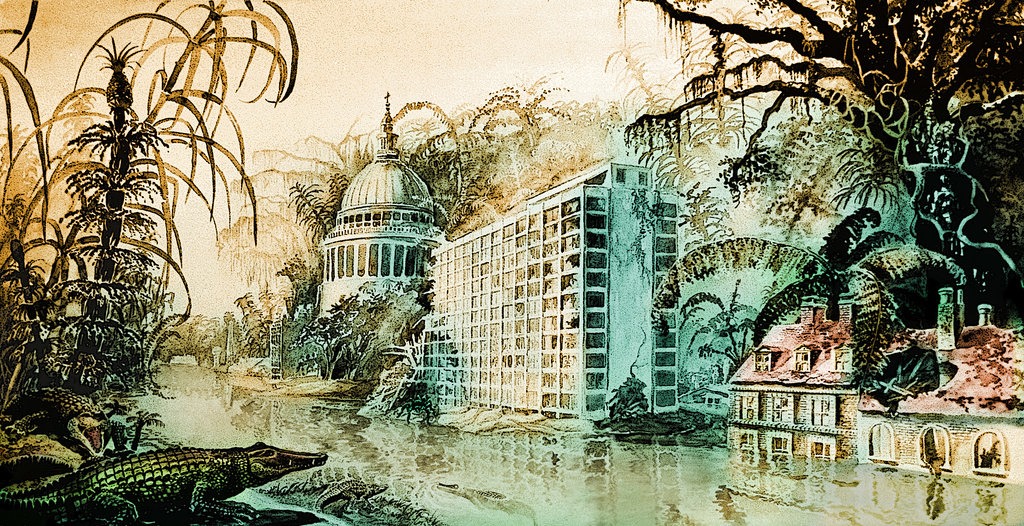
I’m currently listening to The Drowned World by J. G. Ballard, a short novel that was first published in 1962. Ballard wrote several eco-apocalyptic novels back in the 1960s. They are part of a speculative snowball that now includes The Windup Girl by Paolo Bacigalupi and Green Earth by Kim Stanley Robinson. In biblical times God caused such catastrophes. After Darwin, it was nature that could destroy us. Now we imagine species suicide. But the theme is the same. Either all, or nearly everyone, gets wiped out. That theme isn’t new – it might have existed in pre-history.

I want to contemplate vintage themes while reading my vintage science fiction.

drowned-world

JWH