A Dance to the Music of Time: Autumn by Anthony Powell

by James Wallace Harris

The Valley of Bones, The Soldier’s Art, and The Military Philosophers are books seven, eight, nine in a twelve-volume series called A Dance to the Music of Time by Anthony Powell. The twelve books are about Nick Jenkins, written between 1951 and 1975, covering Jenkin’s fictional life from 1921 through 1971. The twelve volumes are sometimes published in four volumes named after the seasons. Books 7-9 are called Autumn, or the Third Movement. The series takes its name and theme from a 1640 painting by Nicolas Poussin.

The three books of the third movement cover the war years 1940-1945 and give a rather unique view of England during WWII. Nick Jenkins’ life somewhat resembles Anthony Powell’s life (1905-2000) and some of the characters are based on people he knew. Here is a description of Powell’s military career during WWII from Wikipedia. It is very much like what we read in the three novels. Although we aren’t told Nick won any awards or medals, but then he is a modest character that doesn’t like attention.

Upon the outbreak of the Second World War, Powell, at age 34, joined the British Army as a second lieutenant, making him more than 10 years older than most of his fellow subalterns, not at all well prepared for military life, and lacking in experience. Powell joined the Welch Regiment and was stationed in Northern Ireland at the time of air raids in Belfast. His superiors found uses for his talents, resulting in a series of transfers that brought him to special training courses designed to produce a nucleus of officers to deal with the problems of military government after the Allies had defeated the Axis powers. He eventually secured an assignment with the Intelligence Corps and additional training. His military career continued with a posting to the War Office in Whitehall, where he was attached to the section known as Military Intelligence (Liaison) overseeing relations with, and the basic material needs of, foreign troops in exile, specifically the Czechs, later with the Belgians and Luxembourgers, and later still the French. Later, for a short time, he was posted to the Cabinet Office, to serve on the Secretariat of the Joint Intelligence Committee, securing promotions along the way.

For his service in the Army, he received two General Service medals as well as the 1944 France and Germany Star for escorting a group of Allied military attaches from Normandy to Montgomery's 21st Army Group Tactical HQ in November 1944 three miles from Roermond, Holland then held by the Germans. For representing the interests of foreign armies in exile as a liaison officer he received the following decorations: the Order of the White Lion (Czechoslovakia), Oaken Crown (Luxembourg), Order of Leopold II (Belgium), and Luxembourg War Cross (Croix de Guerre -Luxembourg).[19]

After his demobilization at the end of the war, writing became his sole career.

I find Nick’s story of military training and life on the London home front quite fascinating since the last book I read was about a British bomber squadron and all the books work like a jigsaw puzzle to create one vast image. The most action Nick sees are air raids. In one sequence he describes how several of his friends were killed in a bombing raid, and in another he gives a description of living with V-1 attacks. I was particularly moved by Nick’s observations and contemplations when he attended the VE Day Thanksgiving Service at St. Paul’s Cathedral.

But you don’t read these books for military history. Powell was an observer of people, and so was Nick. Powell’s A Dance to the Music of Time is often compared to Marcel Proust’s seven-novel sequence In Search of Lost Time. However, Proust was very inward looking, and Powell was not. We learn little about Nick Jenkins in these novels because he likes to look outward. He is an observer of people, places, and society.

I love Powell’s books because there are so many characters that come and go. I am delighted whenever one returns. Powell’s characters are like real life people, reminding me of people I know who have come into my life and left, but sometimes I run into them again, or hear stories about them years later. That essentially describes the books in this series. It’s sad that in the third sequence, many of the characters I loved reading about die in the war. I was especially saddened by Charles Stringham story. Peter Templer tale ends too, in The Military Philosophers, but it is offstage and mysterious. and there’s plenty of Kenneth Widmerpool anecdotes. He’s everyone’s favorite, getting his own entry in Wikipedia.

The notable new character that enters in these three books is Pamela Flitton, a femme fatale of the first order. She’s a real piece of work and was based on Barbara Skelton, wife of Cyril Connolly. Skelton also wrote novels and memoirs, so now I must read her. Powell’s vicious portrayal of her makes me wonder if he got sued. Her character continues into the final three novels.

Powell’s reputation is on the decline, which is disappointing. He was friends with Evelyn Waugh, Henry Green, and other British writers of the 20th century, which means my TBR pile is growing. I’ve also discovered several articles about Powell and his friends on Google, but I can’t read those articles until I resubscribe to The New York Review of Books and The New Yorker. That could become a black hole that could capture me forever.

20th century British literature is gently pulling me away from science fiction. Part of that tugging comes from reading A Dance to the Music of Time. Science fiction is known for its world building and the vast fictional landscape created by English writers is becoming far richer and real than the sci-fi alien worlds I’ve lived with for six decades.

For the first six novels, I only rated them four stars in Goodreads, but these last three are five-star novels. I expect if I go back and reread the first six, I will bump up their ratings to five-stars too. And this is a series that I will need to reread. It has over three hundred named characters, and the web of interconnections they make is rich and baroque. It will draw me back in again.

JWH

Rebecca (1940)

by James Wallace Harris, 9/11/23

This is not a review, but my reactions to watching Rebecca, the 1940 Alfred Hitchcock movie with my friend Olivia. I’ve decided I don’t want to review books and movies because that would involve withholding spoilers. I want to talk about how I react to fiction — how fiction works on me.

I don’t think I’ve seen Rebecca before. I’ve started it a few times recently, but in recent years I have had trouble watching movies by myself, so I didn’t watch it all the way through until Olivia wanted to see it too. I’m thankful she came over to join me. Over the past year I’ve encountered several women friends who have told me they’ve read the 1938 novel Rebecca by Daphne du Maurier. They all loved the book, and I bought a copy. I started the book a couple of times but didn’t stick with it. I loved the writing. I adore the open paragraphs. du Maurier description of nature taking over the old estate is exactly how I picture nature taking back cities when civilization falls.

Last night I dreamed I went to Manderley again. It seemed to me I stood by the iron gate leading to the drive, and for a while I could not enter, for the way was barred to me. There was a padlock and a chain upon the gate. I called in my dream to the lodge keeper, and had no answer, and peering closer through the rusted spokes of the gate I saw that the lodge was uninhabited. 

No smoke came from the chimney, and the little lattice windows gaped forlorn. Then, like all dreamers, I was possessed of a sudden with supernatural powers and passed like a spirit through the barrier before me. The drive wound away in front of me, twisting and turning as it had always done, but as I advanced I was aware that a change had come upon it; it was narrow and unkept, not the drive that we had known. At first I was puzzled and did not understand, and it was only when I bent my head to avoid the low swinging branch of a tree that I realized what had happened. Nature had come into her own again and, little by little, in her stealthy, insidious way had encroached upon the drive with long, tenacious fingers. The woods, always a menace even in the past, had triumphed in the end. They crowded, dark and uncontrolled, to the borders of the drive. The beeches with white, naked limbs leaned close to one another, their branches intermingled in a strange embrace, making a vault above my head like the archway of a church. And there were other trees as well, trees that I did not recognize, squat oaks and tortured elms that straggled cheek by jowl with the beeches, and had thrust themselves out of the quiet earth, along with monster shrubs and plants, none of which I remembered. 

The drive was a ribbon now, a thread of its former self, with gravel surface gone, and choked with grass and moss. The trees had thrown out low branches, making an impediment to progress; the gnarled roots looked like skeleton claws. Scattered here and again among this jungle growth I would recognize shrubs that had been landmarks in our time, things of culture and grace, hydrangeas whose blue heads had been famous. No hand had checked their progress, and they had gone native now, rearing to monster height without a bloom, black and ugly as the nameless parasites that grew beside them. 

On and on, now east now west, wound the poor thread that once had been our drive. Sometimes I thought it lost, but it appeared again, beneath a fallen tree perhaps, or struggling on the other side of a muddied ditch created by the winter rains. I had not thought the way so long. Surely the miles had multiplied, even as the trees had done, and this path led but to a labyrinth, some choked wilderness, and not to the house at all. I came upon it suddenly; the approach masked by the unnatural growth of a vast shrub that spread in all directions, and I stood, my heart thumping in my breast, the strange prick of tears behind my eyes. 

There was Manderley, our Manderley, secretive and silent as it had always been, the gray stone shining in the moonlight of my dream, the mullioned windows reflecting the green lawns and the terrace. Time could not wreck the perfect symmetry of those walls, nor the site itself, a jewel in the hollow of a hand. 

The terrace sloped to the lawns, and the lawns stretched to the sea, and turning I could see the sheet of silver placid under the moon, like a lake undisturbed by wind or storm. No waves would come to ruffle this dream water, and no bulk of cloud, wind-driven from the west, obscure the clarity of this pale sky. I turned again to the house, and though it stood inviolate, untouched, as though we ourselves had left but yesterday, I saw that the garden had obeyed the jungle law, even as the woods had done. The rhododendrons stood fifty feet high, twisted and entwined with bracken, and they had entered into alien marriage with a host of nameless shrubs, poor, bastard things that clung about their roots as though conscious of their spurious origin. A lilac had mated with a copper beech, and to bind them yet more closely to one another the malevolent ivy, always an enemy to grace, had thrown her tendrils about the pair and made them prisoners. Ivy held prior place in this lost garden, the long strands crept across the lawns, and soon would encroach upon the house itself. There was another plant too, some half-breed from the woods, whose seed had been scattered long ago beneath the trees and then forgotten, and now, marching in unison with the ivy, thrust its ugly form like a giant rhubarb towards the soft grass where the daffodils had blown. 

Nettles were everywhere, the vanguard of the army. They choked the terrace, they sprawled about the paths, they leaned, vulgar and lanky, against the very windows of the house. They made indifferent sentinels, for in many places their ranks had been broken by the rhubarb plant, and they lay with crumpled heads and listless stems, making a pathway for the rabbits. I left the drive and went onto the terrace, for the nettles were no barrier to me, a dreamer. I walked enchanted, and nothing held me back.

du Maurier, Daphne. Rebecca (pp. 1-3). Little, Brown and Company. Kindle Edition. 

This is why I wanted to see the movie and finish the book. I wanted to see it even more when I discovered there was a 2020 remake with Lily James, and a 1997 Masterpiece Theater version. What makes this story so compelling that it gets filmed many times? It’s immensely popular, and Hitchcock’s film won an Oscar for best picture. I find such enduring tales intriguing to study. Watching Rebecca with Olivia was just my beginning of studying du Maurier’s novel.

I didn’t know that when I watched Rebecca last Thursday, but reading about the film reveals that Rebecca was the movie David O. Selznick produced right after Gone with the Wind. Two movies about strong-will women. Gone with the Wind could have been titled Scarlett. Rebecca is never shown in Rebecca, but I now picture her as Vivian Leigh.

I was somewhat disappointed with Rebecca. It’s slow to get into. My wife Susan bailed on it after the first hour and left Olivia and I to finish it on our own. But more importantly, it’s the kind of story that withholds information to create suspense, and I dislike that plot trick. Overall, I did enjoy the film.

Don’t read any further if you haven’t seen the film or read the book, because I’m going to give away big spoilers.

The film begins by recreating the dream sequence I’ve quoted above from the book, but it’s shortened and somewhat changed. There are clues to what happens in this dream sequence, but the real mystery is why the dreamer can’t return to Manderley.

The story then cuts to Monte Carlo where a young naive woman (Joan Fontaine), a paid companion to a Mrs. Van Hopper, meets the mysterious Maxim de Winter (Laurence Olivier), aged forty-two. At this point in the movie, the scenes are light and somewhat humorous. Joan Fontaine plays the unnamed young woman as drab, skittish, fearful, clumsy, and innocent. We don’t know why the older, rich, sophisticated man takes an interest in her, but he does, and they quickly marry. This opening is a kind of Cinderella story, and I assume why women like the picture so much.

I didn’t buy it. Maxim came across as a tortured soul, both wise and educated, but mentally imbalanced. If age of consent was based on a relative scale of maturity, then the young girl should have been out-of-bounds. But a discerning Sherlock Holmes might have guessed something here. If Maxim was honest with Mrs. de Winter 2 the whole rest of the picture which turns into a gothic torture tale could have been avoided and we could have continued with a light romantic comedy.

Now we arrive at Manderley and slowly learn about Mrs. de Winter 1, who was named Rebecca. This whole middle 80% of the film is about misdirection. Both the audience and Mrs. de Winter 2 slowly learns about Rebecca and gets an entirely false picture of her. This is exactly the kind of plotting that Alfred Hitchcock loves. He tells this part of the story with many tense sequences, building us up, and then backing off a bit. Hitchcock has hooked an enormous fish and reals us in slowly.

A good part of this action involves Mrs. Danvers (Judith Anderson), who is the creepy housekeeper of Manderley. She loved Rebecca. Obviously, du Maurier was a huge fan of Charlotte and Emily Brontë. It’s worth reading the Wikipedia entry on Rebecca, especially the sections on “Derivation and inspiration” and “Plagiarism allegations.” Du Maurier was jealous of her husband’s former lover and claimed it gave her the idea for the novel. Other people thought differently.

Finally, the movie takes a weird twist. We were told Rebecca had drowned and her body recovered. Eventually, her sunken boat is found by divers, and her body is found inside with clues to suggest she was murdered. Jack Favell (George Sanders) shows up and we learned that Rebecca had been fooling around with him. Favell starts accusing Maxim of murdering Rebecca and the plot really thickens. Poor Mrs. de Winter 2 starts going crazy trying to figure out what was going on. It’s then that Maxim confesses what happened.

Up till then Mrs. de Winter 2 thought Rebecca was an angel and perfect wife she could never measure up to. Maxim tells her that Rebecca was a cheating sack of shit who began destroying his life just days into their honeymoon. Mrs. de Winter 2 is immensely relieved because she finally realized Maxim loves her for herself. Of course, there’s the matter of Maxim might be a murderer. But she still loves him. In fact, these revelations empower her to fight for her man.

The film goes through a few more twists and turns to wrap things up with a happy conclusion after the crazy housekeeper burns down Manderley with herself inside. That’s why people can’t go back.

If du Maurier and Hitchcock had not withheld information at the beginning of the story, we wouldn’t have had such a tortured-tension plot. If Maxim, back in Monte Carlo, had told the innocent lady’s companion that he liked her because his dead wife was everything he hated, we would have needed a different plot. That would have been the natural thing to do for most men.

And it’s illogical that Maxim kept Mrs. Danvers on, who worshipped Rebecca and kept half of Manderley as a shrine to her. Most guys would have fired her and gotten rid of everything that reminded them of Rebecca. In fact, the premise that Rebecca could do what she wanted because Maxim wouldn’t want her indiscretions to ruin his reputation is also ridiculous. Maybe it’s better explained in the book, but I find that to be an extremely weak point of the story. Divorce was common enough in England in the 1930s.

Why didn’t Maxim pull Rhett Butler and tell Rebecca he didn’t give a damn about her threats? Both Maxim and his new bride are weak and retreating. Is there another story here? What if Rebecca wasn’t bad? What if Rebecca had to live with a mentally ill husband, the reverse of Mr. Rochester in Jane Eyre?

Rebecca is essentially a thriller with a major plot twist. That’s the trouble with thrillers and mysteries, they often depend on unbelievable plot points. They contrive and contort their stories. I understand why Hitchcock does this because he loves to manipulate his audience. But I’ve got to ask: Why does the audience accept being manipulated? In one interview I saw with Hitchcock he compared what he did to scary amusement rides at carnivals. Riders know they are safe but love to pretend to be scared. This suggests that most moviegoers loved to be manipulated. I’ve gotten tired of it.

I’m anxious to read the book to see if du Maurier makes the same kind of contrivances in her story. Did Hitchcock bend it to his needs, or did du Maurier have better explanations? Her opening describing how plants take over is very realistic. I’m hoping to find more of that realism in her novel.

Plus, I’ve thought of some things after watching the movie. Why does the crazy housekeeper trick Mrs. de Winter 2 into dressing up as Rebecca for the costume party? She probably knew that Maxim hated Rebecca. On my first viewing of the film, I assumed that Maxim loved Rebecca and blew up at Mrs. de Winter 2 for recreating a painful good memory. But as we know now, it’s a painful bad memory. We knew Mrs. Danvers wanted to kill Rebecca’s replacement, so I should have guessed a different motive for her getting Mrs. de Winter 2 to dress as Rebecca.

This is why rereading books and rewatching movies are important. Since I know the information that du Maurier and Hitchcock withheld, will the story still work? Or will it fall apart? Or will it even work better as I see deeper into a multidimension structure?

JWH

Replacing Classic Novels

by James Wallace Harris, 8/12/13

Most bookworms just want to be entertained. They know their tastes are so individualistic that no friend or authority can predict what they will like. However, teachers and literary scholars like to think that certain books should be read, and a tiny fraction of readers are willing to read books because they have a great reputation. We feel reading the classics makes us a better person.

There is no FDA like agency that officially rates books as choice or prime. So, what makes a classic novel? The common assumption is novels that survive the test of time are the real classics. However, you can go on Amazon and order a lot of books from the 19th century that no one considers classics. Some people consider books that are taught in school or college to be the classics. And there is some merit to that, but literary works that get taught are also subject to the whims of pop culture, and English departments.

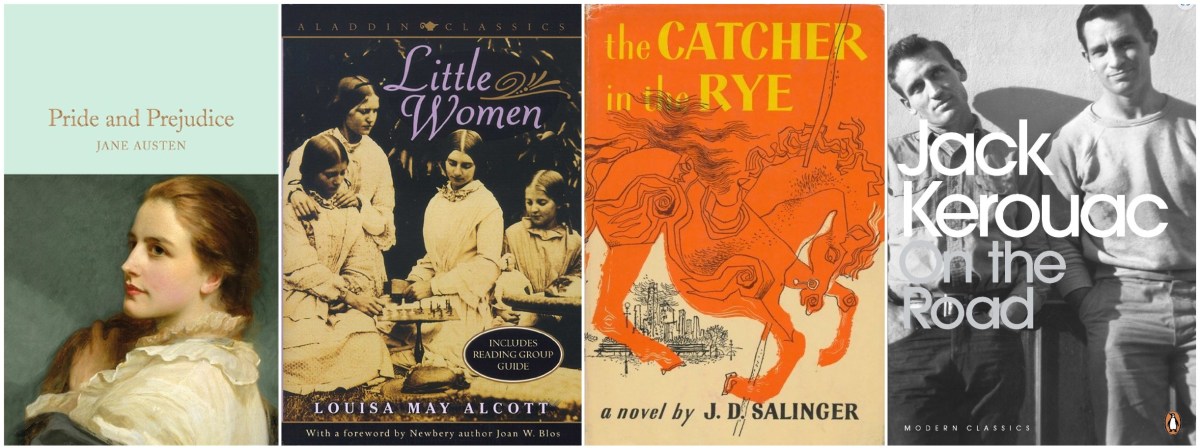
I mention all this, because I read “8 Overrated Literary Classics and 8 Books to Read Instead” by Jeffrey Davies, especially since it throws four of my favorites under the bus: On the Road by Jack Kerouac, Pride and Prejudice by Jane Austen, The Catcher in the Rye by J. D. Salinger, and Little Women by Louisa May Alcott.

Of course, this is clickbait, but I’ve seen this kind of essay before. A couple other examples are “13 Overrated Literary Classics, and What to Read Instead” by J. W. McCormack and “9 Overrated Classics — And What to Read Instead” by Zoraida Córdova.

I understand why young people rebel and want to overthrow the reading lists of the past, especially a past dominated by white male writers. And sure, sometimes these articles are just giving suggestions as to something different to read. But other times, I do feel the writers just hate the classics they are demoting. I often see On the Road and The Catcher in the Rye listed in these literary rebellions. (A hilarious generational attack on The Catcher in the Rye is the novel King Dork by Frank Portman)

What I would like to propose are rules for this game. If you want to oust a literary classic, you need to provide a proper substitute. All too often, these writers offer alternatives that are just their personal favorites, and usually something from recent decades. Classics have specific qualities that any substitute should have too. They include:

  • A snapshot of history – time, place, and subculture
  • Innovation in writing style and techniques
  • A philosophical or psychological insight

In other words, classic novels offer a view of everyday life in the past, even if it’s inaccurate, slanted, or distorted. That’s why I’m against publishers cleaning up aspects of older novels to make them politically correct for modern woke minds. We need to know both the good and bad about how we were. No censoring or whitewashing the past by substituting novels that agree with your moral and ethical sensibilities.

Classic novels supplement history books to build mental models of the past in our heads. Removing any one of them takes pieces of the puzzle away from the collective images we’re building of our cultural heritage and history.

If you’re serious about offering replacements because you feel an existing classic work doesn’t do the job well enough, then suggest a novel that offers a better view of the same time and setting. One that is more insightful.

The trouble is, doing just this is extremely hard. Readers have spent decades and centuries winnowing out the best novels. You might dislike novels for the views they show, but finding good replacements takes a lot of work and reading.

I would suggest, instead of trying to replace specific classic novels, you offer supplements instead that expand or enhance the classics. For example, The Catcher in the Rye (1951) and On the Road (1957) are about alienated youth in America before the youth rebellion of the 1960s. We need more novels about kids growing up in America in the 1940s and 1950s to expand on the views those two famous classics give. I would suggest Horseman, Pass By and The Last Picture Show by Larry McMurtry and The Bell Jar by Sylvia Plath, among others.

The challenge would be to find novels written near the time and setting covered, ones that have been forgotten but are worth resurrecting and remembering. There is something more authentic about novels written by people who lived in the time of the novels as opposed to later novels that are historical fiction.

Few novels are truly contemporary. On the Road was set in the 1940s, but was written in the early 1950s, and published in 1957. It takes a certain number of years to get the perspective and write things down. Breakfast at Tiffany’s was published in 1958, but about 1943. And it’s not the early sixties we see in the film, and neither is the plot or characters. Holly Golightly is a lot closer to Neal Cassidy than most people realize. She is another alienated youth from the 1940s, and another supplement for The Catcher in the Rye.

I understand why young readers dislike older novels. I can understand why they want to promote their favorite stories as classics. But I don’t think it’s an ethical idea to suggest they should replace the older classics, especially with newer novels.

They need to decide which novels from the eras in which they lived paint a worthwhile picture of those times and places, and then promote them as the classics that represent those settings and characters.

If these essay writers need a hook to promote the books they love, please don’t throw the books under the bus that other people love. I’d suggest being straight forward and creating titles like: “The Best Books about Miami in the 1980s.” Or “Novels About People Who Lived Down the Street from Jane Austen.” Or “Characters Who Lived While Jack and Neal Were On the Road.” Or “Novels That Louise May Alcott Read That We Should Read Too.”

JWH

Memories Imagine the Darndest Things

by James Wallace Harris, 7/10/23

This essay is about remembering something that never happened and the theories I’ve developed to explain my memory hallucination.

While reading The Kindly Ones by Anthony Powell, the sixth novel in a twelve-novel series called A Dance to the Music of Time, I had the constant feeling I had read it before. Several scenes throughout the novel seemed so familiar that I felt like I had studied them over several readings. I always assumed it was because I had twice watched the four-part miniseries based on the books. I’m sure that accounts for the general sense I’ve read The Kindly Ones before, but not the intense sense of remembering specific scenes. Yesterday I replayed the portion of the miniseries that deals with the most remembered scene and it merely skims over a very long detailed scene in the book.

A Dance to the Music of Time is about Nick Jenkins and his life from the 1920s through the 1960s. It’s not a Roman à clef but Anthony Powell based Nick on his own life. It’s a fictional exploration of memory, so it’s rather ironic that I’m having memory problems reading it.

There were many scenes that felt I had read before, but I just assumed they were in the miniseries. However, one scene was intensely vivid and familiar. It was the long scene where Nick Jenkins met Bob Duport years after Nick had had an affair with Duport’s wife Jean That affair was chronicled in an early novel in the series. So those pages recall events that happened in earlier novels, but it also has much new information that wasn’t in the earlier novels. The most vivid scene involved Nick wanting to avoid the subject of Jean, but Bob slowly getting around to talking about her. Bob starts describing the men he knew Jean had affairs with and what they were like. Bob kept making a case that Jean was attracted to men who were assholes and even admits to being one himself. Nick doesn’t know if Bob is intentionally insulting him or accidentally torturing him.

In recent years I have become distrusting of my memory for many reasons. The first is, memories often feel faulty. But that sense of faultiness is the kind we associate with dementia. I’m now exploring memory delusions.

I’ve read a number of books about the limitations of memory, and I’ve come to assume memories are unreliable. The best book I’ve read on this is Jesus Before the Gospels by Bart D. Ehrman. You wouldn’t think a book about Jesus would be the best place to learn about the limitations of memory, but it’s the best I’ve found.

If the television miniseries wasn’t where I acquired my pre-knowledge of that scene in The Kindly Ones, where did it come from? My first thought was to wonder if I had read the book before? I checked my reading log, a listing of books I’ve read since 1983, and it wasn’t there. Now, there have been times when I forgot to record a book read, but I don’t think that happened in this case. Why would I read the sixth book of a series out of order?

Another possibility is I listened to it in my sleep. Books 4-6 are in a combined edition on my Audible edition, a total of 21 hours. Theoretically, I could have fallen asleep and my unconscious mind heard it. This happens all the time. But I wake up, usually, in minutes, but no more than an hour, and shut off the book. I always scroll back to a scene I’m positive I listened to the day before. I’m almost positive I didn’t let this whole book play while I was sleeping with The Kindly Ones. Because of an overactive bladder, the longest stretch I can sleep at night is two hours.

I do have a wild and crazy theory. What if certain human experiences become part of what Jung called our collective unconscious? I know this is New Age woo-woo, but it’s a thought. It might explain why some people think they are reincarnated, or some instances of Deja vu.

I have two less wild theories, ones I think might be closer to the truth. One involves prediction, and the other involves resonating with tiny universal fragments.

The novels in A Dance to the Music of Time feel like an autobiography. The novel series is not a Roman clef, but they were inspired by Powell’s own life and the people he knew. I’m thinking they create such a detailed sense of Nick Jenkins, especially after six novels, that when I got to the scene with Bob, I felt like I was Nick, and the encounter felt so real that I had experienced it as if I was remembering it.

The second theory is somewhat like the basis of holograms. If you cut one up, it will still show the whole picture, just fuzzier. Even a tiny fragment of a hologram will still show the entire image, but just very fuzzy. This second theory suggests that any scene involving a man meeting the husband of the woman he had an affair with will trigger a resonating memory response. I can’t recall any specific similar scene in fiction or real life that matches this, but that doesn’t mean I haven’t and just don’t remember it.

This hologram fragment theory might explain all Deja vu experiences. Our mind remembers things in generalized tokens, and sometimes we confuse the token from one event with another. If you think about this, you’ll probably recall this happening to you. The other day I asked Susan if I had gotten the mail, and she said, yes, you got a book. I said, no, that was yesterday. I was quite positive. I even convinced Susan that it was true. A few hours later I remembered that yesterday was the 4th of July and there was no mail. I have a “got the mail” token in my brain and it makes me feel like I’ve always gotten the mail. But it’s not really specific to any single event of getting the mail.

A recent episode of 60 Minutes on Google’s AI called Bard offers another theory. Bard was asked to explain inflation, which it did, and offered five books on the subject with descriptions of the books. When CBS fact-checked that list days later they discovered the books didn’t exist. CBS asked Google about this. They were told this was an AI phenomenon called hallucination. Evidently, AIs will just make up shit whenever they feel like it. Maybe what I experienced was a memory hallucination.

Google’s Bard performed another scary feat. It taught itself to read and write in a language it wasn’t trained on, and without being asked. Maybe my brain just tricked me into thinking I had read this book before?

And there’s one last idea. Last night I dreamed of a variation of an episode of a TV show Susan and I watched last evening. The dream didn’t involve characters from the TV show, but people I know. But the dream put me, and people I know in the same exact situation. Have you ever wondered how our brain can generate so much endless dream content? What if the same mental mechanism that generates dreams also creates our memories and beliefs? What if that mechanism works like Bard?

I’ve always liked Roman à clef fiction, or fiction that is highly biographical. I’ve always been obsessed with memory. I’m ready to finally read Proust, who is the authorial authority on fictionalizing memory. Some people compare Anthony Powell to Proust, others hate that comparison. Proust fans don’t think Powell was heavy-duty enough. I think they each had their own approach to remembering their life. Powell may have been an extrovert and Proust an introvert, and the differences in their prose were caused by that and not the quality of writing. But I also think the differences involve the different ways of how memory works.

JWH

Come Back in September by Darryl Pinckney

by James Wallace Harris, 3/31/23

I nominated Come Back in September by Darryl Pinckney for my nonfiction book club because it was on some best-books-of-the-year lists at the end of 2022, and because it was about creative writing and literary people from the 1970s and 1980s. The book club members voted it in and Come Back in September was our March 2023 read.

However, I don’t think I can say, “Rush out and buy it.” It won’t be a bestseller, but I’d highly recommend it for a specific audience. If you have any of these qualities, you should read more of what I’ve got to say about the book below:

  • Your twenties and thirties took place in the 1970s and 1980s
  • You enjoy reading memoirs and autobiographies
  • You majored in English
  • You’ve taken or taught creative writing courses
  • You enjoy reading and writing poetry
  • You’re fascinated by the New York literary scene of the 1970 and 1980s
  • You love The New York Review of Books
  • You know about Robert B. Silvers and Barbara Epstein
  • You’re interested in Mary McCarthy, Norman Mailer, and Susan Sontag
  • You get a kick out of books with lots of name-dropping and gossip
  • You’re interested in punk rock from the 1970s and 1980s
  • You’re interested in black literature and writers
  • You’re interested in feminist writers of the 1970s and 1980s
  • You want to know about AIDs in New York in the 1980s
  • You can handle terse prose that is detailed and highly episodic

Come Back in September is mostly about Darryl Pinckney and Elizabeth Hardwick, two people who were completely unknown to me. Both have achieved a certain level of success in the literary world, especially in New York City, but are far from famous.

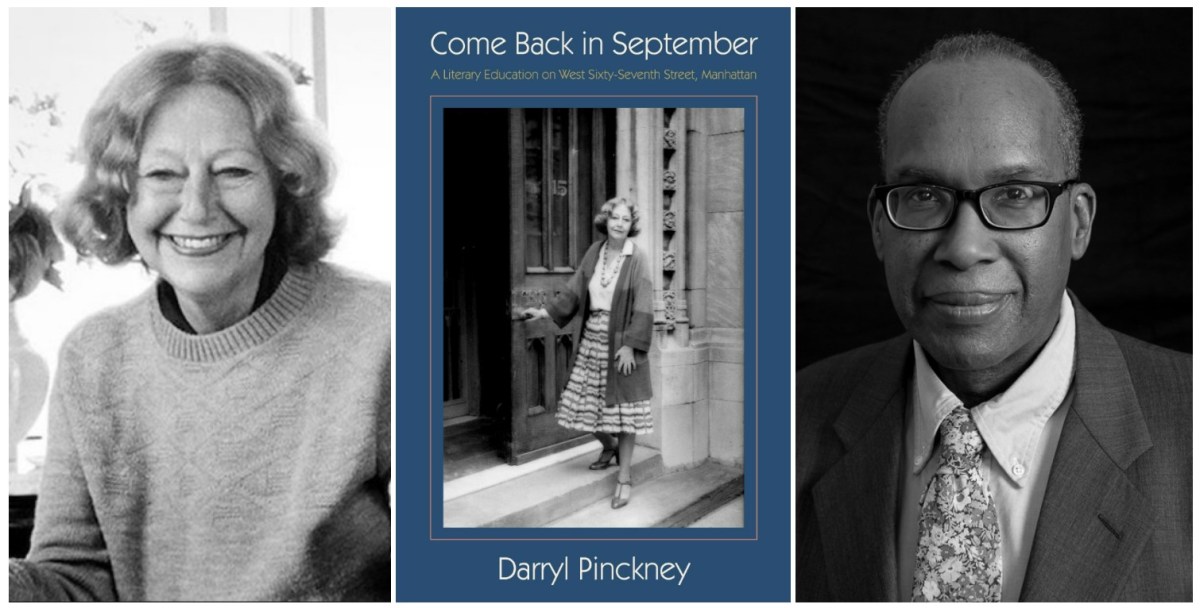
Even though Pinckney dedicated Come Back in September to the memory of Barbara Epstein, I feel the book is mainly about Elizabeth Hardwick – she is pictured on the cover. Epstein and her husband Robert B. Silvers, along with Hardwick were the founders of The New York Review of Books. Epstein and Silvers coedited the magazine from 1963 to 2006 when Epstein died, and Silvers was the sole editor until 2017 when he died.

Elizabeth Hardwick was Pinckney’s writing teacher and mentor. She also hired him as an assistant and helper. They became personal friends. Evidently, through that connection, Pinckney got a job working in the mailroom at The New York Review of Books and getting to know Epstein and Silvers. Much of this memoir is about his life at the magazine in the 1970s and 1980s. If you are a fan of The New York Review of Books, then I recommend Come Back in September. Pinckney went from mailroom clerk to typist to substitute assistant to reviewer, writer, and I believe even doing some editing.

Pinckney was born in 1953, making him two years younger than I am, but still very relatable in age. He accomplished goals I only fantasized about achieving. Elizabeth Hardwick (1916-2007) was born the same year as my mother and died the same year as my mother too. So, I pictured Pinckney throughout his memoir as interacting with a woman my mother’s age. I tried picturing my mother, a white woman born in rural Mississippi, befriending a gay black man. She wouldn’t have been prejudiced against him, and I’m positive she would have loved the attention that Pinckney gave Hardwick. She would have considered him a much better son than me.

Most of the memories in the book are divided between Pinckney’s life with friends and family, and his life with the literary crowd, and most of those seem to deal with Hardwick. So, why does he dedicate the book to Barbara Epstein? Maybe she helped his career more because of her position.

While reading Come Back in September I kept thinking about all the things I was doing the same years while Pinckney was writing about them.

Pinckney first met Elizabeth Hardwick in 1973 and he opens his memoir with:

I made Elizabeth Hardwick laugh when I applied late to get into her creative writing class at Barnard College in the autumn of 1973. Not only could I, a black guy from Columbia across the street, rattle off a couple of middle-period Sylvia Plath poems when she asked me what I was reading—Blacklakeblackboattwoblackcutpaperpeople—I told her that my roommate said we would kidnap her daughter, Harriet, if she didn’t let me into the class. His sister was her daughter’s best friend. I’d met her at a party of his Dalton School friends. I was in.
 
   Where do the black trees go that drink here? 
   Their shadows must cover Canada. 

I walked her to the subway at 116th Street and Broadway. Plath had come around once for her husband’s class when they lived in Boston. Professor Hardwick remembered her as almost docile, nothing like the poems that would make her famous.

Professor Hardwick was fresh and put together. Her soft appearance made the tough things she said even funnier. In her walk, she rocked gently, from side to side. She was on the job, in a short black leather coat and green print scarf, carrying a stiff leather satchel with short handles just wide enough for a certain number of student manuscripts. I hadn’t yet seen her bound up from a chair and break free, flinging over her silk shoulder a silver evening bag on its chain, saying to an astonished table of graduate students and free spirits who’d just agreed among themselves that poetry was everywhere,

   —I’m sure you’re very nice, but I can’t bear that kind of talk. 

And then dancing away from their party because she’d rather be at home looking forward to Saturday night delivery of the Sunday New York Times. 

At our first official teacher-student conference in dingy Barnard Hall, I made Professor Hardwick laugh again, because I recited the last paragraph of Lillian Hellman’s memoir An Unfinished Woman:

    Although I do have a passing sadness for the self-made foolishness that
    was, is, and will be … 

—That fraud, Professor Hardwick said. She tried to do everything but have me killed. 

Six years earlier there had been a Mike Nichols revival of Hellman’s play The Little Foxes at Lincoln Center, and she, Hardwick, had reviewed it for The New York Review of Books, calling it awkward, didactic, and full of cliché. She didn’t believe in the South as an idea, she said.

 —Her use of black people, she said. You would die. 

Agrarianism was a bore. Had I read Allen Tate? A poet I’d never heard of. 

—You don’t need him. Faulkner?

  The Bear. 

—You do need him. But don’t ever do that again.

—Excuse me?

—Read Lillian. People were cutting me on the street. She got people to write letters. She told them, I’m not used to being attacked by someone who has been a guest in my house. I made up my mind that I didn’t care if I never went to another dinner party at Lillian’s. Dashiell Hammett was always trying to get away from her, for Patricia Neal.

I was discovering so much: Rimbaud, Frank O’Hara, Baldwin’s essays, Gertrude Stein’s autobiography. Every day, from hour to hour, there was something new, a name to put on my list of names to reckon with. One afternoon I walked by an open door and a guy with long blond hair was at his upright, preparing to play. The music had poignance and a couple of other people also paused. My mother loved the piano, but I had never heard of Erik Satie. Friends and professors had a lot to tell me.

Pinckney, Darryl. Come Back in September (pp. 3-5). Farrar, Straus and Giroux. Kindle Edition. 

I quote so much of the opening pages to give you an idea of reading Pinckney’s prose. I had to pay close attention, and often reread lines to pick up on what he was saying. Pinckney’s prose reminds me of poetry, which involves short lines, that are tense, terse, vivid, detailed, and hard to read. On a superficial level, Pinckney’s prose reminds me of Hardwick’s novel Sleepless Nights, which I’ve just started. Both books are told in a long series of snippets of memories.

Our nonfiction book club rates books, 1 to 10, at the end of the month. I gave it a 10 even though I had problems with it. I think those problems were mine and not Pinckney’s. I admire Come Back in September quite a bit, but it’s just not something I always cared about, but I never stopped valuing its quality. My hunch is that Come Back in September is far more brilliant than I’m capable of perceiving.

This memoir is an amazing bit of memory excavation. I write about dredged-up memories all the time, so I know how hard it is, and I admire it when I see it done so much better than what I do.

I had problems with Pinckney’s writing style at first, but once I tuned into his way of expressing memories, I could see what he was doing. I don’t know if it was intentional, or if that’s how he thinks. His prose is very granular. He depends on the accumulation of memory flashes rather than one long consistent narrative.

I am reminded of Kurt Vonnegut’s technique. Vonnegut claimed to write his novels in 500-word chunks. Pinckney does something similar, but often his chunks are very short – just long enough to capture a significant moment of the past. Come Back in September covers the years 1973 to 1989 and is based on journals and letters, but I also expect deeply buried memories.

By our reading group’s rating scale, a 10 should be for books that we consider highly recommendable. I can’t say that’s true for this book. It’s highly recommendable if you are the right reader for this book, but I guess most readers won’t be. Still, I rated it a 10 for a group. I wasn’t the only one.

Now for the philosophical reading question. Should we always read books that are exactly like what we’ve trained ourselves to read? Even though my undergraduate degree is in English, and I’m a dropout from an MFA creative writing degree, Pinckney’s prose and subject matter were far outside of my normal stomping grounds. For the first half of the book, I had to push myself to read it. Eventually, I adapted and the second half became a page-turner.

I’m not sure if I will ever reread Come Back in September, but I think if I do, I will find a great deal more to get out of it. I’ve tried to find out more about Pinckney and Hardwick online. There’s a lot for Pinckney, he’s become somewhat successful over the years, but I believe Hardwick has become more obscure. I can’t find any videos of her at all, but within Come Back in September she expressed a distaste for that kind of attention.

A couple of years after the events in Come Back in September Pinckney published his first novel, High Cotton. It’s dedicated to his parents and sisters. Elizabeth Hardwick mentored and encouraged his writing during this time, so I was surprised she wasn’t mentioned in the dedication.

Another problem I had with the book, is all the big-name authors that Pinckney got to hang with back in the 1970s and 1980s are not ones I care about. How many people still read Mary McCarthy, Norman Mailer, Susan Sontag, Robert Lowell, etc.? Still, I imagine for people who do, this book will delicious inside gossip.

Pinckney leaves me mostly interested in Elizabeth Hardwick. I’ve started Sleepless Nights, but so far I don’t like it. It’s too poetic. She shunned plots. I can read books without plots, but I need engaging characters and marvelous settings to make up for them. So far I haven’t found them.

Hardwick’s novel and Pinckney’s memoir are both about collecting memories and depending on the totality of those collected flashes of memories telling a story. That worked for Pinckney but it took a while, that may also be true for Hardwick.

Jim