Reviewing Science Fiction Books With Statistics

Before the Internet if you wanted to find a rip-roaring science fiction novel to read you’d flip through the books at your favorite bookstore and hope to stumble upon the next mind-blowing sci-fi novel to change your life.  Or you’d ask your best buds about which books knocked them into orbit.  True fans subscribed to science fiction magazines and fanzines, reading all the reviews so as to maintain their status as the Sci-Fi guru at their local Slan shack.

Back in the 1980s I wondered if there was a better way, and developed a statistical system that I wrote about for a fanzine Lan’s Lantern.  I describe the process at my Classics of Science Fiction website.  When the world wide web came along I put my lists online, and eventually revised them three times.  The latest list, Classics of Science Fiction by Rank, is now several years old.

Today I discovered SFFMeta.com, a site created by Eric Bouchard, that also applies statistics to the task of finding a great science fictional read.  Think of it as Rotten Tomatoes for science fiction, fantasy and horror books.  SFFMeta is the newest in a succession of websites that use statistics for identifying the best science fiction books.  An early endeavor was Tristrom Cooke’s The Internet Top 100 SF/Fantasy List, which is now maintained by a new list maker.  Years later came Sci-Fi Lists Top Science Fiction, an excellent polling type site from the land down under.  I wish their creators would take credit and write about developing their systems.

Each statistician of reading has come up with a different method for identifying good reads. All of us look for ways to cash in on the wisdom of crowds theory.  Bouchard’s site is built on the idea that collectively, a group of current book reviewers, will spot the best reads.  I love his simple and elegant web design.  And it will be one that will evolve with wisdom over time. 

Bouchard assembles lists of reviewed books from online reviewing sites.  This produces worthy information now, but not deep enough to show wisdom just yet.  In other words, his samples are too small.  Rotten Tomatoes gets over a hundred reviewers for each film, but SFFMeta is limited by surveying a much smaller industry, and many books on his list have just 1 review. 

SFFMeta’s 90 day lists are a helpful indicator now, but their all-time best books are iffy.  It might take SFFMeta 5-15 years to gather the data using their methods to show inherent wisdom in identifying all-time classics because they have to wait for old books to be reviewed in new editions.  And be reviewed in numbers more significant than new books.

Their best lists now are the 2008 and 2007 summary lists.  Statistically, it would be wonderful if we could compare them to sales figures, and other annual best lists, because it would further reinforce the wisdom of crowds concept. I’m looking forward to the 2009 list.

I made my lists before the Internet was well known, and I had to combine the wisdom of fan polls with the wisdom of cross-tabbing critic’s recommended reading lists, along with award lists, and other criteria.   We came up with 28 lists, and to get on the final list, a book had to be on at least 7 of those 28 lists. 

If SFFMeta could find more reviewers and up their green cutoff to 5 reviewers their accuracy would improve dramatically I think.  It would also help if they could factor in other indicators besides reviewers – such as sales numbers, awards and nominations, Google citation numbers, and critical articles, foreign editions, audio book editions, for instance.  

SFFMeta also faces the problem that most of their cited reviewers are either overly kind, generous, or just plain hate to trash a book.  One positive review can get a book on the list, but it takes three reviews to get a highlighted green score.  Because their site is new, their 90 day list has only two green highlighted titles.  Their all-time list covers 100 books, with all getting the green rating, and one book having 14 reviews.  Statistically that’s better than the 90 day list, but not good enough for identifying true classics.

As their database of reviewed books grow, I’d like to see SFFMeta allow the viewer to manipulate the lists – for example, to see a 90 day list made of books getting more than 3 reviews, or more than 5, etc.  You can eyeball this now, but their programmer is obviously talented enough to do this for us.  I hope SFFMeta can find many more review sites too.  Here is their current list.  Print reviewers, I encourage you to reprint your reviews on the web if possible.

Bookmarks Magazine collects statistics on books via reviewers too, but uses print reviewers.  In their annual best of the year grid.  Their standout books will have 7 or more reviews, and the best of the best will have 12 or more, from the reviewers they use.  This illustrates why writers lust after reviews – any kind of attention helps.  There are so many books published that it’s hard for most books to get noticed at all, and for some to get noticed by several reviewers is a triumph. 

SFFMeta is a dream come true for genre writers because its results further emphasizes the best reviewed books.  SFFMeta is also a positive force for book reviewers.  Be sure and click the titles to drill down to where you can read the reviews.  There’s a major amount of work that’s gone into this site and I hope it becomes a huge success.  Hopefully, SFFMeta will bring more readers to the reviewers too, and that should help educate the audience for SF/F/H.  It should promote the value of reviewers and maybe bring more into the field. 

I’ve always dreamed of doing something more with my lists, but it’s so much damn work.  The latest books on my site are three from 1992.  I’d love to find enough lists to make it practical to identify books through 2000, but that will be hard.  I have 28 lists now.  If I could find 5-7 newer lists it would catch a lot of new books, but if I left the cutoff at 7 the final list would be far too long.  I’d need to make the cutoff 8-10 lists, and that makes it even harder for new titles to get listed.  My system has it’s limits.  It tends to recognize the very best of the very best of older books in the bell of the curve, dropping older titles that are being forgotten, and making it very hard for newer titles to be recognized.

If I used a 10 list cutoff, my current list would be 116 books.  If I use 11 lists, I’d get 94 books.  By using 7 lists, I get 193 books, far too many to be a real Top 100 SF Books, but look what gets left off (scroll down to #94 and see).  The Top 100 Sci-Fi Books site have a great overlap with my list and they do have a few newer titles.  When SFFMeta collects enough reviews and start matching those two lists it will be a powerful system with a lot of built in wisdom.

SFFMeta, if it becomes popular, should help sell books.  I watch way more little movies after the advent of Rotten Tomatoes.  I was overwhelmingly surprised by how many unknown authors (to me) I saw listed on SFFMeta.  For old SF farts, stuck in the 1950s science fiction world of Heinlein-Clarke-Asimov triumvirate, it’s quite a revelation.  Using the wisdom of crowds should push book reviewing into a new paradigm, but it will make it even harder for a new writer to break in.  One book review will sell books, but now buyers will expect books to be positively reviewed from a database of reviewers.  This could become a dangerous trend.

Books have always competed in a survival of the fittest competition, but now the internet will push that competition to newer heights.  My Classics of Science Fiction web site gets on average 92 hits a day – not that many, but it builds up over time for people looking for a list of SF books to read.  I’ve gotten lots of emails over the years from people telling me they use my list to find new books to try out.  This helps maintain fans for these older books.  SFFMeta will also create a momentum for popular new titles, and hopefully it will help find new readers for the genre by helping them to discover exciting books.

Will the wisdom of crowds increase the number of overall readers though?  Harry Potter books certainly got more kids to read for pleasure, but I’ve often heard kids say they couldn’t find anything exciting after HP, and gave up reading.  It’s hard to find books to love, so systems that identify top reads should create new bookworms.  Let’s hope so.  Be sure and add SFFMeta to your Blogroll.

JWH – 12/20/9
Orphans of the Sky by Robert A. Heinlein

Orphans of the Sky is one of Robert Heinlein lesser known novels, even though it’s one of his best.  It’s hard to talk about the novel without giving away its big idea, but it’s not likely I’ll convince you to read it without telling.  This short novel is made up from two novelettes first published in 1941 in Astounding Science Fiction, and it might be the first fictional account of a generation ship, that is a starship that travels so slowly, that it takes generations to reach its destination. 

In Orphans of the Sky, the characters do not know they are in a starship, but think of the ship as all of reality.  They can’t see outside.  They have forgotten most of what civilization gave them, so they are primitive, superstitious people.  Heinlein uses this as a beautiful setup to attack our own superstitions.  I don’t want to spoil the joys of the story by giving away the plot, but if you need to know more, read the first link to Wikipedia above.  The important thing to know is Orphans of the Sky makes major contributions to the genre science fiction.  It’s central speculation, made in 1941, is probably the most creative since H. G. Wells’ The Time Machine, 1895.

Stories about interstellar travel in science fiction have mostly taken the fantasy route of faster-than-light (FTL) travel.  Whereas, Orphans of the Sky dwells well within humanity’s technical ability to get people to the stars.  It will still be an amazing engineering challenge to build a starship miles long, that rotates to create artificial gravity, and is design to function for hundreds, if not thousands of years.  A trip might have to last as long as from now back to Shakespeare, or Christ, or Aristotle.  If worldly societies can change so much in those time periods, imagine what life in a starship might be like and how it could change.  This is a brilliant idea, and Heinlein imagines his characters in a post-apocalyptical world inside the ship.   It’s strange that Orphans of the Sky wasn’t printed in book form until 1964 since it is so innovative in a genre that loves far out ideas.

Although, the novel is only about 150 pages, Heinlein does an amazing amount of speculation.  Besides the big new science fictional ideas, Heinlein imagines how society would change if it evolved backwards, for example he has women treated like they were in the Old Testament.  There are scientists but no science.  One of the most enchanting aspects of the story is how concepts we take for grant in our world are turned into strange superstitions in the world of Heinlein’s forgotten starship crew.  Heinlein knew how thin the veneer of civilization is that covers our nations.  He also plays with what we know now could be completely wrong.

Orphans of the Sky is not a literary masterpiece, but heavy duty pulp fiction from the golden age of John W. Campbell’s Astounding Science Fiction.  It’s all action, with little characterization, but what characterization there is is very vivid and sharp, especially the mutants.  For my third reading of this story I listened to the Audible Frontiers audiobook edition that is beautifully read by Eric Michael Summerer.  Audible Frontiers goal is to put great SF and fantasy into audiobook editions.  If you love classic science fiction and hanker to experience it again through a dramatic reading, it’s worth joining Audible to get these audiobooks.  They are also available through iTunes.

Orphans of the Sky would make a wonderful sense of wonder film, and I’m surprised it’s cinematic potential has been ignored.  Movie producers often strike pay dirt with SF, but they seldom select innovate classics to explore new science fictional themes.  They beat the dead horse of alien invasion over and over again.  There’s so much more to science than strange invaders.

JWH – 12/13/9

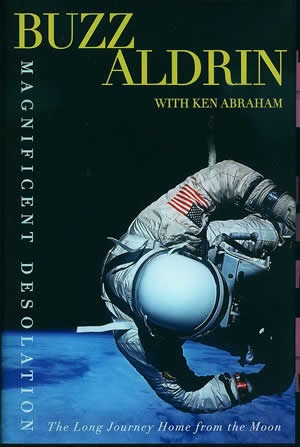
Magnificent Desolation by Buzz Aldrin

I’ve read other memoirs by the Apollo astronauts who went to the Moon, most of whom wrote about their tremendous efforts to become space jocks and their stories always peaked with their lunar adventures.  Buzz Aldrin second autobiographical book starts with the Apollo 11 landing and quickly wraps that adventure up, because his book is about the second half of his life, the forty years of life after being a famous man who landed on the Moon.  Aldrin had an exciting first half of life before becoming the “second” man to walk on another world.  He went to West Point, flew jet fighters in the Korean War, got a PhD at MIT, became a NASA astronaut and blasted into orbit on the Gemini 12 space mission, getting to do one of the early space walks.

MagnificentDesolation

So after coming home from the Moon and spending a year touring the world and being famous, Buzz Aldrin had a tough second act to follow his first.  His book chronicles his decline into depression and alcoholism, and it’s not a pretty story.  The real magic of his life appears to be recovering from his early success and starting over, especially his amazing luck of finding Lois Driggs Cannon, his third wife who helped him rediscover a purpose in life that has carried him forward these last twenty plus years.  It’s the Buzz Aldrin 2.0 that I find the most fascinating.

Of all the Apollo astronauts, Buzz Aldrin is the only one that has stayed in the limelight making a career campaigning for space exploration.  This is the tragic part of Magnificent Desolation, and maybe not one Buzz intended to portray.  Aldrin is completely gung-ho on space travel – the trouble is the rest of the world isn’t ready to follow his lead.  Why have we never left low-Earth orbit since 1972?  It took less than 10 years to get to the Moon starting from scratch, but with all the fantastic technology we have today, we can’t seem to get back to the Moon, much less go further.  Why?  Well, it’s not for Buzz’s heroic effort in trying.

I believe the portion of the population who are space travel true believers is so small that they don’t have the political critical mass to make Aldrin’s dream come true.  I’m not even sure 1/10th of 1 percent of the world’s population, or 7 million people are space advocates.  The Planetary Society doesn’t state how many members it has, but I’m guessing it’s in the low hundred thousands range.  The National Space Society, is even smaller.  In other words, the core group of humanity that seriously wants for humans to live in space is probably another magnitude smaller, 1/100th of 1 percent, or 700,000, and probably much less.

Buzz Aldrin has a tremendous uphill battle to convince the world to spend the money on manned missions to the Moon and Mars when only .01 percent of the population really cares.  Even if you add in all the the heavy duty science fiction fans, I doubt the number grows beyond .1 percent of the population.

Aldrin has hitched his star to the space tourism philosophy, which I have never bought.  Magnificent Desolation is current through late 2008 or early 2009, so Buzz reports on all his friends in the private space exploration business, the people who keep the dream alive, but it’s like what Aldrin states in the book, it only takes a rocket going 2,000 mph to achieve sub-orbital success, but it would take a spacecraft going 17,000 mph to make orbit. 

Can private space programs launch that kind of leap in technology?  We know the minimum required, an Atlas rocket like John Glenn road to fame.  The minimum to get to the Moon is a Saturn 5 – can anyone really imagine a private company funding that kind of expense?  If there’s a better way to space don’t you think someone would have found it in the last forty years?  Rocket technology seems to be the sole technology for heaving people off Earth.  Many space advocates campaign for the space elevator, but that technology is far more fantastic than real.

I grew up with the Mercury, Gemini and Apollo astronauts – they were my childhood heroes.  I thought NASA was blazing a trail to a future where science fiction would become real, but that hasn’t happened.  We have the technology to colonize the Moon and Mars now, and we have pioneers who are ready to go, we just don’t have the patrons to pay their way to the stars.  Buzz Aldrin still dreams the dream, and so do I, and a lot of other space enthusiasts, but I don’t think there’s enough of us to make a political or financial difference.

The only force that inspires the tax payers of America to send missions beyond low-Earth orbit is international politics.  We went to the Moon because of the Russians.  I believe President Bush announced the Vision for Space Exploration and the plans for Project Constellation in 2005 because China, Japan and India were making their own plans to send their citizens to the Moon.  However, President Bush’s vision didn’t impassion America like John F. Kennedy did in 1961. 

I think most Americans feel “been there, done that” and don’t see the point of returning to the Moon.  Even the majority of science fiction fans don’t pine for new missions to the final frontier.  For forty years we’ve been great at planning new manned space exploration, but no country or company is willing to spend the big bucks.  Space travel still excites and inspires legions of kids, but most somehow lose the dream as they get older because the political climate never seems to change.

Buzz Aldrin could have called his book Magnificent Ambitions, because space travel true believers feel that spawning a branch of humanity that lives off Earth and eventually colonizes other worlds in this system before moving on to other stellar systems is the ultimate purpose of our species.  I think many of us space travel true believers have been depressed, like Buzz, since the success of the Apollo Moon landings because the United States didn’t go on to greater missions. 

The phrase “to infinity and beyond” was the funny rallying cry of Buzz Lightyear, a cartoon character, but that’s how space travel believers feel.  The fascinating question about the 21st century is whether or not the rest of humanity will take up the challenge.  I don’t think the political leaders of China, India and Japan are space travel true believers.  Since 1945 there have been two spectacular ways for a nation to prove they are great – exploding an atomic bomb or developing a space program.  Nationalism isn’t a good force for long term space patronage because citizens eventually feel such wealth should be spent on programs closer to home.

JWH – 11/20/9  

The Gods of Vampires

Every vampire has a god, and since the advent of the novel, those gods have been writers.  Before the printing press, storytellers were the creators of vampires, and word of mouth published endless variations of vampires that spawned unique species of monsters in each culture and country.  Superstition and the love of the story kept the vampire immortal throughout the centuries.  It’s very easy to know each god of today’s vampire, because the names of their creators are famous, boldly printed across the books from which give them creation.

When did Sex in the City urban women deem vampires fuckworthy?  And most of all, when did American heartland save-myself-for-marriage tweens and teens decide that creatures of the night make great Mr. Rights?  The new gods of vampires, women writers, have changed the romantic ratability of the undead.  Geez, it’s hard enough to deal with the fact my omega male body is so unworthy compared to human alpha males, but now women seek to mate with guys who have immortality, inhuman strength, and supernatural wealth as hot sexual attributes.  Man, now I’m really out of the sexual rat race.

What have these new gods wrought on the fictional landscape of our world?  I wonder if accepting the undead into the American melting pot is also happening in other multicultural societies around the world?  Storytellers have always been mythmakers and creators of imaginary pop-cultural stars.  Homer had a huge hit with his creation, Ulysses.  The whole mystery genre seems to have converted to writing character book series hoping to hit one out of the park by creating the next Sherlock Holmes or Miss Marple.  Now both the mystery market and horror genre are churning endless variations on the vampire theme, each hoping to create an iconic vampire or vampire slayer. 

In my review of Dracula by Bram Stoker I took a backasswards approach to understanding vampires.  I falsely assumed writers were describing their vampires rather than creating them, by observing what they thought was the current pop-culture concept of a vampire.  And to a degree writers do steal their ideas from their peers and mentors.  This morning I had the revelation that every vampire is created in the image of their god. 

If I was to write a series of vampire stories, I’d invent a science fictional vampire because I like science fiction more than I do horror.  I’m not all that keen on bloodsucking, so I’d find some other way for my vampires to acquire the life essence of their victim, maybe a device that transfuses specific hormones or proteins that could be used to enhance health and thinking for a cyborg vampire.  If I wrote a series of books about my new high-tech-vamp that became successful, it would make me a god of a fictional creation, but I would have also changed the archetype of the vampire.

When I read Dracula I thought Bram Stoker had studied folk culture and had assembled his vampire, Count Dracula, from a selection of vampire models already in existence.  Now that I’m using the god metaphor for creators of fiction, I’m not so sure.  Count Dracula, and every successful vamp ever created by a wordsmith could each be a unique creation, fashioned in the image of their creator, so to say.

This explains why the current crop of vampires are less violent and very romantic – all the wildly successful new vampires are created by women authors.  Men writers want monsters to slay, while women want romantic retelling of the beauty and the beast myth.

Now I know my feminist friends are going to howl at my sexist generalization, but lets look at the evidence.   Here’s an easy one.  Women love Pride and Prejudice by Jane Austen.  To make it suitable for the average guy, Seth Grahame-Smith created Pride and Prejudice and Zombies.  I could rest my case there, but I’ll go for overkill instead.

I think I can safely say that the Twilight series is mostly popular with women, and girls.  It’s much less obvious, but I’d say the Anne Rice and Charlaine Harris vampire books are also more popular with women readers then men.  True Blood, the HBO version of the Sookie Stackhouse Southern Vampire Mysteries, has been transformed by its producers to have a unisex appeal (mixing love, romance, sex and violence), so I’m only talking about the Charlaine Harris books for now.  If you compare these women vampire stories to Blade and Van Helsing movies, which are obviously targeted to male audiences, you can see the difference between the vampires and their creators.

Red blooded American males love violent movies.  They want the moral issues to be black and white so there is no ethical squeamishness to full-throttle slaying by the good guys.  Literary movies that want to question violence will introduce many shades of gray and ambiguity, but for the most part, us guys like our action films, monster movies, cop shows, sci-fi, thrillers, war flicks, and westerns to be non-stop kill, kill, kill.  We accepted feminism to the point that in recent years the good guys can include hot action babes on their teams, who can also kill, kill, kill with the best of the guys.  We’ll even accept women as squad leaders, as in Buffy, the Vampire Slayer.

Now, I’m not saying there aren’t plenty of women who love a dab of violence in their books and movies, but they seem to want the volume of violence turned down.  Women writers accept that vampires are dangerous cold blooded killers, but they keep most of their hunting off stage, ignore that vampires are evil, and tame them by having their creatures of the night only hunt animals, drink artificial blood or prey on the scum of the earth, humans they figure humanity can do without.

The famous dictate of writing teachers is to write what you know, but I observe instead, that writers write about what they love to read.  Women love romance stories, and the influx of women writers has changed the nature of vampires in pop culture in the last few decades.  If you study romance novels, a category of fiction dominated by women writers and readers, you’ll find two general types of stories in the genre:  the purely romantic and the hot-and-spicy romantic.  To be clear, I’m calling some romance novels hot-and-spicy, to be nice, but the heat on that spice goes all the way to XXX. 

Stephanie Meyer’s Twilight series is very close to the Pride and Prejudice end of the spectrum of romance, while Charlaine Harris writes stories well into the soft core porn range of romance books.  And if you are converting Mr. Darcy into the undead, women writers know their readers won’t feel the emotional attraction for a protagonist if he’s too evil or looks like he belongs in a Mad Max flick.  Thus the What Not to Wear overhaul of vampires.

A young woman at my office asked another young women, “Which of the undead do you think are the sexiest?”  That’s not a question you would have overheard two Victorian women discussing.  I’d say the vampire has gotten the role of most eligible supernatural bachelor more often than all the other types of undead combined, with hunky werewolves a distant second in popularity.  Zombies and mummies just don’t clean up well.  Although J. K. Rowling, strangely enough seems to prefer werewolves over vamps, so maybe kids like furry love romance.

If you think about it, the lady gods of fiction have transformed all the popular genre fiction in the last fifty years.  Look how wildly successful Lois McMaster Bujold, Catherine Asaro and Anne McCaffrey have been with science fiction readers.  Genre fiction has been liberated by females.  I don’t know why it took me so long to realize why modern vampires are so different.  To be honest, I didn’t expect women to shake things up so much.

But I’m still puzzled as to why women find vampires sexy.  If I was a vampire and had to drink blood, I’d want to dine on women, and it would be a sexual attraction, but it would still feel like rape.  But as a male human, vampires seem as sexual appealing as sharks and bears, but then I’ve always identified with the beast, and not the beauty.

JWH – 7/23/9

Dracula by Bram Stoker

Dracula by Bram Stoker amazed me by how thoroughly Christian it portrays it’s 19th century worldview.  Published in 1897, this late Victorian novel doesn’t proselytize, but accepts Christianity like the rising of the Son.  Dracula is about a creature of the darkness invading the world of the light.  More than that, Dracula is about a royal citizen from the land of superstition making a beachhead on the Mecca of Modernity, London.   Dracula is about evil attacking the divine, which is very strange when when you compare this most famous of all vampires to contemporary vamps of the big and little screen. 

Dracula presents a scared world, whereas True Blood and Twilight represent secular vampirism.  How did our pop culture go from women pleading for their hearts to be staked,  their heads to be cut off, and their mouths crammed with garlic, if they were kissed by the vampire, to our modern times where virginal tweens willing dream of letting blood sucking monsters pop their cherry, but only if he’s really really really cute, dresses fabulously, and loves to cuddle.  Talk about living in Bizarro World.

Now, let me set up my definition of evil and divine.  Evil has become a debased word in our language.  For example, we might hear a kid whine, “That’s just evil,” when told he must turn off the TV and do his homework.  Most grownups would use Hitler as their prime example of real evil, but even for that example I will disagree.  I see the word evil coming with a more precise definition.  To be upfront, I’m an atheist, so any discussion of religion by me is from an outside observer.

My definition of evil, is any action that’s under the influence of Satan, whereas the divine, is any action inspired by God.  Modern grammarians will knock my prescriptive definition over more mundane descriptive grammar.  Bram Stoker’s Dracula is a novel with easy metaphors.  Light shines from God, dark is Satan blocking the light.  Vampires are agents of evil, stealing souls from the forces of goodness.

I plead with my readers to read the history of vampires at Wikipedia.  I was totally shocked by examples of vampirism showing up in all the cultures of history.  Superstition has dominated thinking for most of homo sapiens time roaming this Earth.  Vampires and similar scary ghoulish characters are deeply rooted in all our folklore, and its very shocking how crazed our ancestors became over common fears. 

Count Dracula is just the most famous vampire in Western pop culture, where Bram Stoker hit a vein of subconscious literary gold.  Dracula is not the first novel about vampires, but Bram Stoker has invented such a successful fictional character, Count Dracula, whose fame is on the order of Sherlock Holmes (1887) and Tarzan (1912), the true eminent Victorians.  Stoker may have used Vlad the Impaler as inspiration for his character Count Dracula, but he is mostly a fantastic fictional invention.

I’ve always avoided reading Dracula because I expected it to be as hokey as the Béla Lugosi films, so I was greatly surprised by how literate and well-written this epistolary novel is compared to all the cheesy films it has inspired.  By using letters, telegrams, diaries, phonograph cylinders, newspaper clippings, etc., Stoker gives an immediacy to his story that the standard third person narrative would have lacked, and was still too confining to express in the standard first person tale.  The novel is full of rich details, especially about living and travel in Europe in the late 1800s.  The story progresses slowly, relying on a slow buildup of horror, with little direct stage time for Count Dracula himself.  This works very effectively to showcase life in 1897, when news traveled very slowly, and generally came by word of mouth or newspapers.

I claim Dracula is a Christian novel because its worldly philosophy is based on the British viewpoint at the peak of its empire, with it’s stout, stiff-upper lip embrace of Jesus, scientific progress and world conquest.  Abraham Van Helsing, a Dutchman, is the real hero of this novel, but he’s not the action hero of the Hugh Jackman film Van Helsing.  He’s an older doctor and lawyer, wise man of science, and early X-Files philosopher, who is deeply religious and accepting of the Christian faith.  Makes no bones about it, Count Dracula is an invader of England and the divinely backed civilization of Christ.

Dracula is an intimate novel, with Van Helsing, the prototype for Rupert Giles I’m sure, as Watcher, leading his merry band of vampire slayers, who must keep their war secret because they know few people can accept the truth about the undead, and nothing they can ever say will be believed, and all their actions will be considered law breaking and criminal.

Out on the border between darkness and light, Count Dracula lives in remote Transylvania, where the medieval mind still dominates the peasant population.  The story begins with Jonathan Harker’s long trip to Dracula’s castle, that chronicles moving backwards in time as he leaves the civilization of the west, heading east, via devolving forms of transportation.  The descriptions of his travels are rich with details, making me think Stoker had made the trip himself.

The story involves two women, Mina and Lucy, and five men, Harker, Seward, Morris, Holmwood and Van Helsing, and takes a leisurely time to unfold.  Each get to tell their story in first person through the trick of the epistolary novel.  This could be confusing with so many characters, but I listened to a version of the novel narrated by John Lee, which was fantastic in its presentation, making quite clear the identity of each narrator.  This novel is well worth the trouble of listening to slowly, in a good audio book edition. 

I especially loved the character of Quincey Morris, a laconic Texan that greatly reminded me of another American cowboy, Lee Scoresby, also inhabiting a British fantasy novel, set in the 19th century, The Golden Compass, and played by Sam Elliot in the film, who has lassoed and hogtied many a laconic Texan role, even to the point of satire, as in The Big Lebowski.  Quincey Morris is a young Lee Scoresby in Dracula, and one of Lucy’s three suitors.

Psychiatry even plays a roll in Dracula, with John Seward, a head of an insane asylum that contains yet another fascinating character in the novel, R. M. Reinfield, whose mind swings between vivid sanity and raving madness.  It’s a shame his story couldn’t have been in on the round-robin of first person narratives.  Reinfield’s madness and Mina’s hypnosis induced telepathy, is used by Stoker in a creative way to drive the plot forward, beyond the standard letter and diary knowledge.  For its time, Dracula is a very creative novel, that remains fresh and powerful in its narrative techniques.

Dracula represents an entire spectrum of communication, from God’s divine will, to the woo-woo world of ESP and the scientific telegraph, to shadowy unconscious minds sending up clues to the conscious minds of our heroes to decipher, while Satan commands his legions of undead with his will of evil whispering out of the darkness.  And here is where we define evil, where dark and light fight for the soul of humans, by claiming evil is the force that chaos uses to conquer order, and the divine is that force that civilizes.  This definition should work for my spiritual friends, as well as me and my secular unbelieving pals.

Dracula is an agent of the devil, so, why do our modern vampire scribes like Charlaine Harris and Stephenie Meyer secularize the vampire, exorcising its true evil nature?  Women often lust for the bad boys of society, and these women writers are making alpha vamps the sexiest of the stereotype.  Why is that?  Maybe women no longer want cavemen, Conan the Barbarian types, but prefer the better dressed, well-mannered vampire, with his suave sophisticated ways.  Or, is the enticing appeal of vampires, their power to give everlasting youth, something all women would sell their souls to get?  But something weird is happening.  Women have switched from wanting Van Helsing and Quincey Morris as males to swoon over, to wanting their fictional dream dates to be Edward Cullen and Bill Compton.

Sookie Stackhouse and her lady friends of Bon Temps, Louisiana, would be considered vamp tramps in Bram Stoker’s time.  If you want to know the philosophical difference from 1897 and 2009, read Dracula and then watch True Blood on HBO.  If we could send Victorian readers a television set and DVR loaded HBO’s True Blood and Deadwood and ShowTime’s Dexter, they would all believe that Van Helsing lost the battle in Dracula, and Count Dracula succeeded in his invasion of the British Isles and eventually conquered the Western world.

And don’t you find it rather ironic that an atheist is pointing out that popular modern entertainment represents the success of 19th century evil over the providence of the divine?  In the Sookie Stackhouse Southern Vampire Mysteries, the Christians are seen as the bad guys, and portrayed as buffoons impassioned by gun love, but ignored sexually and made cuckolds by lusty wives tempted by bad boys.

I love watching True Blood and Dexter, but then I’m an unbeliever.  It’s what my conservative friends expect of a yellow-dog, scum sucking, NY Times reading, liberal.   What I’m wondering is why all those hordes of Twilight fans, those young girls and their clean-cut moms, women who wouldn’t unzip their jeans for nice boys, and bitch at any bad boy they met, have fallen madly in love with the pretty vampire.  When I grew up, the only good vampire was a staked vampire.  I was taught it was perfectly ethical, even heroic, to kill vamps and Nazis, neither of which had souls.  Now Spike, the Vampire, will go to the ends of the Earth to find a soul and gain the love of Buffy, The Vampire Slayer.  We certainly live in topsy-turvy times.

But let’s get serious here.  What is really happening?  Are secular vampires really a product of liberal thought, where every frail human action must be forgiven and understood?  Charlaine Harris presents her vampires seeking civil rights, and compares them to gays coming out of the closet.  But is this going too far, isn’t civilizing vampires wrong?  Isn’t it unjust to compare civil rights and gays to savage killers?   Why does popular culture now romance the evil?  Dexter wins sympathetic feelings for serial killers, so should we expect a lovable but loopy child molester in some future premium channel drama that will warm our hearts?  If we could see ourselves from some outside pop culture viewpoint, would we look like skinheads embracing a warm and fuzzy Hitler?

Or is it just good clean fun, like when we let our tykes play with Grand Theft Auto.  Personally, I wonder if it is wrong, either ethically, or morally, to have the entertainment appetite of a Roman at the Coliseum.  Or can I justify my entertainment tastes by rationalizing that it explores the edges of social reality?  Dracula is good clean fiction, but what has Bram Stoker planted in Victorian times, that has flowered in our modern world, causing us to love the vampire?  Actually, I don’t love the vampire, and still want to see them dusted, so maybe I just jealous of Bill, Edward and Eric. 

This leads to the next level of psychology of vampire stories, the one below good and evil.  Something is happening here, and I don’t know what it is, but I’m thinking it has to do with the changing roles of women in society.  Bram Stoker started it by giving Mina and Lucy, equal time with men, and equal bravery, showing that Count Dracula only converts women to his way of life.  Why are the leading writers of modern vampire stories, Anne Rice, Charlaine Harris and Stephenie Meyer, all women?  What would Sigmund Freud make of all of this?

Does the acceptance of vampires merely model the acceptance of male psychology by women?  Vampires are violent killers, but so are men.  Vampires enslave the souls of women, but so do men.  And if biting throats are equated with sexual intercourse, vampires and men both seek to penetrate the female body.  Maybe Harris and Meyers just want tame the savage beast, dress him in romantic garb, polish his behavior and put his lustful appetite on a diet.  If this is true, then the trend of accepting modern vampires is merely women recognizing how far they have to go to get guys to dress GQ and stop our killing ways.

Up till now vampire stories have always been Christian stories because the standard issued weapons to fight vampires were the cross, host and holy water.  Vampire fiction in recent centuries are metaphors for the Catholic Church supplanting the ancient religions and superstitions.  Charlaine Harris’ vampire world has regressed to a pre-Christian pagan worldview in direct conflict with Christians.  Does that mean she’s a witch?  But then her vamps only fight Protestants. 

Contemporary revamp vamps represent a loss of Vatican power.  Is it any wonder Anne Rice and Charlaine Harris stories are set in Louisana, a former Catholic stronghold?  But as the power of God grows fainter, so does the power of Satan.  Vampire Edward is downright prissy compared to Count Dracula.  If this trend continues, the bottle blood drinking vamps of today will be supplanted by even wimpier vamps in the future.  Without God there is no Evil, leaving a reality of random dangers fought by the force of evolution to produce order.  Vampires are supernatural creatures, and if our secular world erases all belief in the supernatural, what happens to vampires?

In other words, atheism kills vampires just like Holy Water.

JWH – 7/20/9