LibraryThing, Goodreads, Shelfari, Google Books, Anobii, WeRead

I’ve been a bookworm my whole life, and for as long as I can remember I’ve wished I had a list of all the books I own.  I’d also love to have a list of all the books I’ve read.  I think it would be impossible to create the second list, but the first list would only be a matter of typing.  And now with the Internet and the ISBN book number, it’s even less typing than before.  I could even buy a barcode reader that looks up information automatically online without typing at all.  My first consideration was to buy a standalone computer program like Book Collector from Collectorz.com, or even design my own database or spreadsheet with Access and Excel, but I decided the fun solution is to use a Web 2.0 online book cataloging site. 

The Internet has added an extra twist to this list making activity, called  social cataloging.   By entering your books into an online database it allows social network programs to compare your list to lists created by millions of other bookworms.  The synergy of doing this offers endless social networking possibilities.  The obvious one is to find other readers who have similar reading tastes to yours that will help you find great books to read that you’ve missed.  For people trying to build big personal libraries, it’s fascinating to know the size of other collector’s collections.  The largest on LibraryThing is 43,061 books.  Also on LibraryThing, the most reviewed book is Twilight (1,386 reviews), the most owned book, Harry Potter and the Philosopher’s Stone (47,598 people out of 1,035,403 members), or that my favorite science fiction writer, Robert A. Heinlein has 72,427 books in those collections, as compared to my second favorite science fiction writer Philip K. Dick who has 46,991 books in LibraryThing user’s homes.  That’s out of 48,365,418 total books catalogued.

The trouble is there are many wonderful book cataloging sites to choose from, each with their own plus and minuses.  Luckily, all are free except LibraryThing, and it’s free for your first 200 books, so you can try them all.  The sites I’ve found so far are (there may be more):

Each of the sites try to make it easy to enter books, but they all do it differently.  They each have millions of books already catalogued, so the quickest way to add a book to your list is to find it first on their list by searching on the ISBN and then hitting the add button.  This can be made even faster with a barcode reader, but I don’t have one.  I’d say it’s taken me a couple hours to enter in 58 books at LibraryThing.  This is slow because I like selecting the right cover photo to match the cover of the book I own, and I started with a shelf of old books without ISBN numbers.  That means searching by author or title, or even entering in all the book info myself.  I could probably do 60 books in 20 minutes if they were all recent and I only needed to use ISBN.  Usually when you get a book with ISBN, the cover and all the other information is already there.
LibraryThing

I’ve taken to LibraryThing, but when I finished building my list I could export my library to another site to see if I like their social networking features better.  Or I’ve thought about using one site for listing books I own, and another for books I can remember reading.  Or use another site for just my non-fiction science and history books to see if I can find readers with my exact interests.  The different cataloging sites have discussion groups for books, or linking systems to Facebook and blogging sites, so if you like to discuss and review books, these systems connect you to other people who are looking to read reviews or talk about books too.

On one blog I read a post by a woman who said her family paid for three separate $25 lifetime subscriptions to LibraryThing, for herself, her husband and her kid, so I’m assuming there’s long term rewards for doing the work of entering a book collection into the system.  I won’t know for awhile.  I’ve got 18 more shelves of books to enter, and then I’ve got to try all the different features, but I’ll get back to you with more info.

I’ve added books with all of these systems and I find it easiest to add books to LibraryThing, especially when dealing with manual adds.  LibraryThing was the only site to have any books by Lady Dorothy Mills, an author I collect.  Her books are very rare, and they only had 3 of 15 I own.  These systems are far from perfect, and the quality of the data is imperfect.  It would be great if everyone catalog the precise edition they owned, but that doesn’t happen.

Anobii, Shelfari and WeRead are probably best for people with newer books and people looking for more social interaction since they have the largest number of members.  They are slicker sites with more glitz than LibraryThing.  GoodReads is in the middle.  Google Books merely lets you tag books without any reporting features or social networking.  It is good for links to the web, and if you’re a complete Google user in general.

One of the fun things about adding books to LibraryThing is it tells me how many other members own the book when I add it to my collection.  For books by Lady Dorothy Mills, out of over a million users, I’m the only one that has any of her books.  I really like it when I find just a few people who also own the same book, like the 2 other people that own In Search of Paradise a biography of Charles Nordhoff and James Norman Hall, the guys who co-wrote Mutiny on the Bounty.  Are those two people much like me?

JWH – 2/7/10

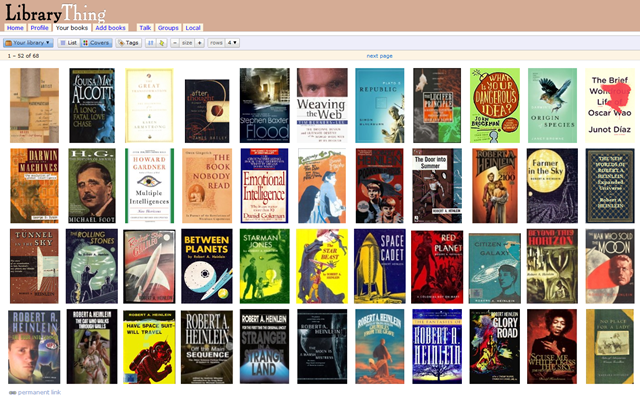
I finished my data entry and my library can be seen here.   To me, the fun way to view is by cover art.  Open your browser to fill the screen and then click the Covers button.  I have 706 books.  I learned a lot by creating this catalog.  For one thing, I have too many books, and I plan to thin my collection when I get a chance.  The largest portion of this collection is unread by me.  My bookstore roaming eyes are far bigger than my reading stomach.  I really wish I had more time to read.

JWH 2/16/10
Seven Views of Olduvai Gorge by Mike Resnick

“Seven Views of Olduvai Gorge” is the Hugo and Nebula Award winning novella from 1994, that was produced as an audiobook two years ago by Audible Frontiers.  I read the story when it came out and remembered being impressed, but I just couldn’t remember the details, so I listened to audiobook version, beautifully  narrated  by Jonathan Davis, and now it’s etched into my brain again.  I wonder how much I’ll remember about the story in 16 years?  I hate that my mind is a sieve.  And maybe, since I’m writing a review here, that will further reinforce my memory.

“Seven Views of Olduvai Gorge” is available to read online at Subterranean Press, and reprinted in these anthologies.  “Seven Views of Olduvai Gorge” is a fantasy allegory in science fiction drag about alien anthropologists finding seven artifacts at Olduvai Gorge that tell the story of extinct mankind.  Mankind had conquered the galaxy and the aliens both admired and hated us.  They wanted to know what drove humans to destroy everything we touched.  You can think of the recent film Avatar as an eighth story about homo sapiens’s impact on the galaxy.

I really hated the way Avatar painted humanity so thoroughly brutal and selfishly uncaring.  When I tell friends about this, they tell me that’s how they see humans too.  It’s certainly the way Mike Resnick paints us in “Seven Views of Olduvai Gorge,” but he does it with more finesse than James Cameron.

The audio production of “Seven Views of Olduvai Gorge” runs two hours and twenty minutes and is seven short stories encased in a fictional frame.  Resnick infuses his firsthand knowledge of Africa into this tale, and uses Olduvai Gorge as the touchstone setting for the seven visions and the frame.  It works fantastically well on audio, and reminds me of a shorter version of Ray Bradbury’s The Illustrated Man.  I’ve always considered Bradbury the anti-science fiction science fiction writer because he fears the future, and sees so much horror in the nature of man.  “Seven Views of Olduvai Gorge” could be a homage to Bradbury.  I always like Mike Resnick’s prose because he’s better than most science fiction writers at blending emotion into his stories.  One of my all-time favorite short stories is his “Travels with My Cats.” [Also on audio at Escape Pod.]

I review a lot of science fiction, but the story review that gets the most hits is “The Veldt” by Ray Bradbury.  My guess is the story is often taught in school, and if it wasn’t so long, I’d suggest teachers should replace “The Veldt” with “Seven Views of Olduvai Gorge.”  Both are cautionary tales about the evil side of humanity, a perfect Rorschach test for young minds to contemplate our reality.  How do you judge humanity after reading “Seven Views of Olduvai Gorge?”  Are we inherently flawed?  Are we evil?  Not only do we threaten all other life forms, we lean towards the self-destructive.  And if we’re not evil, are we just stupid, aggressive and unrelentingly unaware?

Robert A. Heinlein used to brag that mankind is the most dangerous animal around and any intelligent life on other planets should get out of our way.  There’s a lot of extinct species on this planet that would agree with him.  “Seven Views of Olduvai Gorge” agrees with this sentiment, but who is Mike Resnick warning?  I don’t think his message is to aliens from outer space.  Are we merely meant to accept this story at face value?  Or does Resnick expect us to smarten up?

JWH – 2/2/10

The Bible: A Biography by Karen Armstrong

Karen Armstrong presents a precise history of how The Bible was written and assembled and then she concisely chronicles how Jews and Christians have used The Bible for the last 2,000 years in her short volume, The Bible: A Biography, from Atlantic Monthly Press.  Armstrong’s narrative runs just 229 pages – it’s intense, scholarly, and very readable.  If there’s a better short one volume overview of The Bible let me know, but for now, this is the book I’ll recommend to anyone who wants to study The Bible in a historical context.

The Bible is not a single book, but an anthology of narratives written over hundreds of years, by many writers, with some text blended together by unknown editors from multiple earlier sources.  The books of The Bible are not always in chronological order, and most of the main characters are presented differently by various writers.  How do you sum up the most read, most written about, book in history?

To understand the scope of Karen Armstrong’s task, I thought I’d list pertinent Wikipedia articles.  Reading these articles will enhance your understanding and enjoyment of The Bible: A Biography.  Whether you are among the fundamental, faithful or unbelieving, The Bible is completely woven into the fabric of Western society and history.  The Bible is actually the Rosetta Stone between prehistory and history, between oral tradition and the dawn of writing.  Studying religious texts written down in the Iron Age reveals concepts first formulated in the Bronze age, giving clues to the childhood psychology of homo sapiens.

Take the time to read these articles even if you don’t buy Karen Armstrong’s book, but I really recommend her elegant digestion of this vast intellectual feast.  I was especially impressed with her whirlwind survey of how The Bible has been used to back so many different belief systems, and inspired so many philosophers and philosophies.

I read Armstrong’s book first, and now I’m going back researching all this stuff on Wikipedia.  I wish I had found a review like this one, telling me to read the Wikipedia articles before I read Armstrong’s book because I think I would have been even more impressed with her writing.  I just finished listening to the unabridged version of this book and I’ve already started back at the beginning and I’m now reading a hardback copy with my eyes.

Edward R. Hamilton Booksellers has the hardback edition remaindered for $5.95.

The Bible: A Biography is part of a series from Atlantic Monthly Press called Books That Changed the World.  Other books in the series are:

  • The Republic by Plato
  • The Prince by Machiavelli
  • Origin of the Species by Charles Darwin
  • Rights of Man by Thomas Paine
  • The Qur’an
  • The Iliad and The Odyssey by Homer
  • The Wealth of Nations by Adam Smith
  • On War by Clausewitz
  • Das Kapital by Marx

JWH – 1/27/10

The Age of Wonder and Joseph Banks

I started reading The Age of Wonder: How the Romantic Generation Discovered the Beauty and Terror of Science by Richard Holmes, but because each chapter features a different historical person, I decided to review the book chapter by chapter, as I read it, and discuss the biographies separately.  The Age of Wonder came out last year, getting glowing reviews.  I immediately bought it, but didn’t start reading it until after I saw it on several best books lists of 2009.  Chapter one starts off like gangbusters with a thrilling tale of Joseph Banks, an unknown historical figure to me, but after finishing the chapter, I wondered why he isn’t one of the more famous dudes in history.

Joseph_Banks_1773_Reynolds

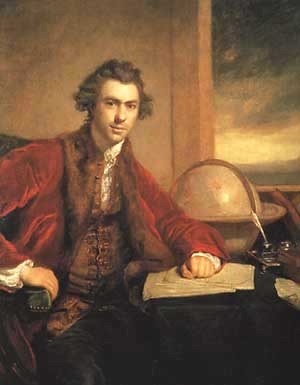
Sir Joseph Banks (1743-1820) was a handsome Englishman that would have put Jane Austen’s Mr. Darcy’s riches to shame.  Banks was wealthy enough to finance himself, and his assistants, as the botanist on James Cook’s first voyage around the world in 1768-1771, and he could be one of the many models for James Cameron’s Avatar, because Banks went totally native in Tahiti decades before Fletcher Christian, falling in love with sexual free island women, the Eden-like Tahitian culture, learning their language and ways, shocking his fellow crewmen on the Endeavor, and bringing back concepts of free love and earthly paradise to European society on his return.  By exploring new ideas about morals and behavior, Banks became a proto-anthropologist.  Joseph Banks became famous in a time when it was hard to become famous, when the only mass media were the newspaper and the recently invented general circulation magazine – literacy was far from universal.

Richard Holmes could have written a whole book on Joseph Banks the size of The Age of Wonder and it would have been riveting,  leaving his readers begging for more.  I know I wanted more, but when I went looking, the pickings were slim.  Patrick O’Brian, author of the popular Jack Aubrey-Stephen Maturin  sea novels, wrote Joseph Banks: A Life which I plan to buy, even though the reviews on Amazon have been less than enthusiastic.  Amazon also offers Journal of the Right Hon. Sir Joseph Banks: During Captain Cook’s First Voyage in H.M.S. Endeavour in 1768-71 to Terra del Fuego, Otahite, New Zealand, Australia, the Dutch East Indies, etc, but I don’t know if I’m hard core enough to read that book yet.   I really wish for a David McCullough biography of Banks, because I love reading the big predigested cerebral view of history, rather than reading contemporary journals and diaries myself.  Amazon also has Sex, Botany, and Empire: The Story of Carl Linnaeus and Joseph Banks by Patricia Fara, which tempts me with the big picture, but not enough to buy yet because of limited reviews.

Banks claim to fame now, and in his own time, was more than just titillating adventure stories about getting his penis polished by South Sea babes.  Banks was the Internet Entrepreneur of his day, not for being rich, but for being part of a 18th century gang of geeks ushering in the new paradigm shift of science.  We think we live in exciting times because of the Internet Age, but is that really true?  What blows our minds today are but spring storms compared to the mental hurricanes of the Age of Enlightenment.  We debate freedom of information, they fought for personal freedoms, and dared to step away from God to discover science.  We’re excited about ebooks, but they were excited about real books becoming popular with the common man and woman.  We’re excited by Twitter and Facebook, but they were discovering scientific journals and the magazine.  We have Google, but Joseph Banks was promoting Carl Linnaeus and the classification of plant and animal life and building a natural history database.  Banks crawled the real world indexing its features.

We take too much for granted in the 21st century.  And we’ve all forgotten far too much about how we got here.  Few of us even have a glimmer of the real story.  Reading The Age of Wonder is a voyage of discovery into the 18th century where the foundation of modern mind was created.  Slowly, as I’ve gotten older, I’ve been working my way backwards in time.  Growing up meant getting comfortable with the 20th century, but I’ve spent a lot of time exploring the 19th century in books, and only now at 58 am I starting to really push back into the 18th century.  I routinely flit up and down the timeline of history, and even prehistory, but I seldom get comfortable in any era for anything length of time.  Reading The Age of Wonder convinces me I need to make a major expedition into the 1700s.

Some websites to browse:

JWH – 1/23/10

2010 Pub Challenge

publarge2010-300x244

The 2010 Pub Challenge is about reading 10 books published in 2010.  Follow the link to the official home page of the challenge to read the rules and how to sign up.  Even before I discovered this reading challenge, I had made a new years resolution to read 10-12 books in 2010 that had been published in 2010.  I have discovered that my reading feels more exciting when I mix in a good many new books.  But this challenge presents another challenge:  How to find the best books of 2010 before the end of the year when everyone publishes their Best of 2010 reviews?

The only solution I can think of is to read as many book reviews as possible and see if I can spot titles with several consistent rave reviews.  Bookmarks Magazine does just this, but unfortunately, I’ve sworn off buying paper magazines, but they do have a links page to many current book reviews.

What I’ve decided to do is collect links on this page to the best online book reviews I can find.  Hopefully this will help me spot the emerging best books of 2010.  I also create another list, one for books I want to keep an eye on.  Working on this 2010 goal is actually helping me achieve a long term goal I’ve been thinking about for years.  I’ve always wanted to find a way to systematically read book reviews.  Even if I don’t have time to read all the books I want, I’d like to at least be aware of what’s out there.  Assembling this list below has been very rewarding already.

Best Book Review Sites

2010 Books to Keep an Eye On


JWH – 1/2/10