
Jesus, Interrupted by Bart D. Ehrman

I believe The Bible can be a very dangerous book.  For most people The Bible is a book they read occasionally, and use it for inspiration to be a good person.  There are better books to teach ethics but we can overlook that like we can overlook casual drinking, a minor indulgence.  I use the drug metaphor very intentionally, because I believe The Bible alters people’s mind and how they see reality.  Because some people take The Bible too far, into cocaine, heroin and LSD levels of use, and they become addicted, deluded and cut themselves off from reality.

The Bible can be like a computer virus that infects the minds of those who read it.  This is true of any religious literature.  The Bible does not describe reality. The Bible can not predict the future.  And most important, The Bible does not describe God (if there is a creator), at best The Bible presents very ancient theories about God.  In terms of philosophical theology, it is very important to separate the concept of God from any description about God.  Holy books captures how people thought thousands of years ago and that’s a huge danger because people minds become paralyzed by seeking closure on mysteries that will never be solved.  It’s mental quicksand.

The reason why I call myself an atheist is because I’ve never heard a definition of God that I could accept.  If there is a God he is unknowable in the same way that a bacteria in our blood can never know who we are.  People want a personal God, and that’s understandable, because life is scary and we’d love to have a spiritual parent to protect us.  But that’s a dangerous desire because it causes people to avoid real sources of strength, other people and ourselves.

There are many reasons why people seek religion and embrace holy books:

  • They want answers about reality (knowledge)
  • They want to know how life began (ontology)
  • They want a history and genealogy
  • They want instructions on how to be a good person (ethics)
  • They want to worship and be thankful (appreciation of life)
  • They want rules for equal justice for all people (law and order)
  • They want to know the future (prophecy)
  • They want a promise of protection (security)
  • They want an afterlife 

The reason why holy books like The Bible are so dangerous and powerful is our minds are extremely powerful.  Holy books transmit powerful memes.  All books do, but holy books come with extra-strength memes.  The concept of God is a meme.  Once an idea is let lose in culture it’s very hard, if not impossible to erase.  What happens instead is people alter memes.  Think of a virus mutating.  If you study just The Bible you’ll actually come up with dozens, if not hundreds of meme variations for the original meme for God, which was created thousands of years before the Jews existed.  There is no one God in The Bible.  There is no one Jesus, which brings us to the book Jesus, Interrupted by Bart D. Ehrman.
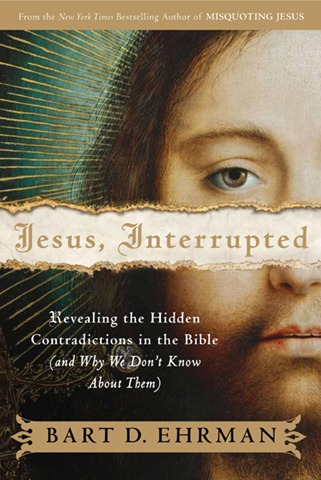
Jesus-Interrupted

Many people divide the world into the secular and the divine.  Believers in divine knowledge think its more important than down to Earth knowledge.  That’s an illusion.  The divine is a meme too.  Beliefs are more powerful than reality.  In fact, all we have is beliefs.  What we want is to keep beliefs that validate reality and jettison fantasies, but religious beliefs can’t be validated, but how you got them can.  That’s what Bart D. Ehrman is doing in his writing.

For example, do you believe that Jesus is a divine being?  Who gave you that idea?  How old were you?  Why did you believe them?  Where did they get the idea?  What Ehrman is doing in Jesus, Interrupted is working on a cold case that goes back 1900 years.  Where did the origin of the meme that Jesus was divine come from?  He calls this research a historical approach to Bible study. 

Jesus, Interrupted is a significant book on many levels, but proving that will be difficult because what he says challenges people’s beliefs.  Bart D. Ehrman is most famous for his book Misquoting Jesus, but this newer book is even more exciting to read, that is, if you find history and academic research exciting.  Ehrman claims he is not trying to be sensational with his books on The Bible, and claims he is only relating what any mainstream seminary teaches.  Ehrman is the James A. Gray Distinguished Professor at the University of North Carolina at Chapel Hill.  He started out as an evangelical Christian but after many years of studying The Bible became an agnostic.  Since I’m an atheist, reviewing a book about The New Testament written by an agnostic will be hard to convince Christians the value of reading Jesus, Interrupted.

I don’t ever expect Christians to give up their faith.  I figure most will ignore this book, but I expect others will combine the knowledge that Ehrman provides with their faith and create a new synthesis.  Whether this leads to a new reformation is another issue, but in cruising around the net trying to find reactions to Ehrman I was surprise by some reactions of the faithful.  Some reviewers say Ehrman goes too far, others just dismiss him, but others have jumped in and started their own analysis using his historical approach to test and validate Ehrman’s ideas.

Ehrman says many times in his book that he has no wish to destroy anyone’s faith, but anyone with a deep faith in The Bible being the absolute word of God will be tested by Ehrman’s books.  Ehrman started out as a person believing God inspired The Bible and it had no errors, but his desire to study it deeply and thoroughly led him to believe that it is the work of men, chock full of errors, forgeries, and contradictions.  I think anyone examining the historical evidence will also conclude that men wrote The Bible without guidence from God.

The next logical step in theology is to ask how God might inspire men to write about the metaphysical.  I don’t believe in the divine, but most people do.  I expect them to keep looking for the doorway between the physical world and the spiritual world.  And that’s okay.  Religion is deeper than memes, and I expect humans to always invent new and better religions.  Some atheists want to throw off religion and God, but that’s like being a vegetarian wanting the rest of the world to give up eating meat.  Evolution is a nasty word to the righteous, but everything evolves.

So why should agnostics and atheists even concern themselves with this book?  Ehrman still believes The Bible is the greatest book ever written and still provides inspiration.  For me, I want to understand Christians and how they evolved in history.  Jesus, Interrupted is a quick survey of the first four hundred years of Christianity and how The New Testament was written.  I think it explains why we have hundreds of different Christian faiths, and it also explains part of the psychology of conservatives and liberals, something Ehrman wasn’t intending.

Ehrman says most people study The Bible devotionally, but for the last two hundred years scholars have applied a historical approach to understanding it.  Ehrman also says most people only read The Bible randomly, just studying a few lines here and there.  Even if you read it vertically, from top to bottom, Ehrman believes you will miss much of what’s in The Bible.  He recommends studying it horizontally, comparing one gospel against another, or how one incident is depicted by multiple writers.  Jesus, Interrupted focuses almost exclusively on The New Testament except where gospel writers claim events were foretold in The Old Testament.

When you study the gospels this way you quickly see they conflict.  And not in minor narrative details, but in great theological differences.  In fact, much of what Christians believe today does not come from The New Testament at all, but from later theologians.  What many Christians might be shocked at is the gospels were not written by the disciples that knew Jesus, but educated people writing decades later, living in another country, speaking a different language than what Jesus and his apostles spoke.

The reason why there are so many conflicting stories in The Bible is because it was written by many different people, each with their own agenda.  I cannot do justice to the vast research the Ehrman puts into his book, so don’t trust me, and read Jesus, Interrupted for yourself.  Then read reviews by people who oppose Ehrman, and there are plenty.  Interpreting The Bible is a academic black hole that I want to avoid, but I do think it’s possible to study The Bible without falling into its gravity well.

I think there will be many different audience reactions for this book.

  • Atheists will get a good overview of Christianity, but also find intellectual support that The Bible is not a divine communication to the human race.  If they have any residual guilt about religion from early Sunday School programming, this book will help deprogram those feelings.  I found the book a fascinating history, explaining much of Western culture in a surprising way.  It was a real page turner for me.
  • Liberal Christians will expand their theological foundation and maybe invent a new synthesis.  Ehrman explains how new theological concepts developed in the first few centuries of the common era shaped The New Testament, but Christian evolution did not stop there.  Christianity is always evolving and diverging, and modern Christianity has little resemblance to Jesus and his times.  I think Ehrman’s book should have been called The Evolution of Christ.  I think books like this, using historical studies to examine spiritual doctrine, will inspire some folks to invent new theological memes.
  • Conservative Christians can choose to ignore the book, or counter it.  I think Christians constantly redefine and reinvent God.  God is a mutating meme.  Creationism and Intelligent Design are fundamentalist adaptations to their philosophy from reacting to science.  I expect similar ideas generated from reacting to historical studies of The Bible.  Theological evolution does not have to be logical, for example, look at the doctrine of the Trinity.  Essentially, a monotheistic religion accidently reinventing polytheism while trying to rationalize how a human could be the one and only God.  And don’t get me wrong, I’m not making fun of this theology – it’s a deadly serious pursuit by some folk to grapple with reality, but my point is religion doesn’t stand still, it’s constantly being reinvented to jive with current knowledge.
  • Believers from other religions will find a concise overview of The New Testament that might quickly explain the diversity of Christian faiths and sects.

Everyone feels like they are an expert on The Bible, even if they’ve only read a few passages.  I think the historical studies of The Bible will up the ante for anyone getting into the game.  Ehrman claims that most mainline ministers know what’s in this book already, but they seldom preach this knowledge to their parishioners.  I don’t know if that matters. 

Most people only want simple answers.  They are happy with a very few concepts to embrace.  There is a God.  There is a heaven.  Believing in Jesus is the way to heaven.  Period.  No more study.  This covers all the bases for this life and the next.  As long as these believers stay out of politics I don’t want to challenge their beliefs.  Don’t read this book. 

No use confusing the simple faithful by trying to explain that heaven is a theological invention that came well after Jesus.  Nor should we cloud the water by proving the God of Moses is not the God of Paul, even though some modern apocalyptical Christians want to bring back an Old Testament genocidal God.

Ehrman proves The Bible can be a black hole of academic study, but it’s also an endless engine that justifies hatred and intolerance.  Ehrman illustrates this with a quick lesson in how Christianity created anti-Semitism.  And I certainly wanted to read more about the development of the Orthodox Church at the expense of heretical sects.

Jesus, Interrupted is an important book beyond Bible studies because it explains so much modern psychology.  Rush Limbaugh is not just a conservative Republican, but an apostle of orthodoxy attacking the heretical liberals.  What Ehrman shows is Swift Boating a technique well illustrated in The New TestamentJesus, Interrupted unintentionally shows a relationship between the Bible belt and conservative thinking and behavior.  If someone like Lee Atwater had lived in the first century he might have written a gospel to get his point across.

Liberals who want to understand why conservatives are the way they are should study Jesus, Interrupted carefully.  I always assumed Republicans got their rhetorical skills from the Greeks, but that is only half-right, and they might have studied classical Greeks, but they also learned rhetoric from the Greek speaking writers of  the New Testament.            

JWH – 6/8/10
Nebula Awards Showcase 2010

WTF?  You’d think an anthology with Nebula Awards in the title would be filled with all the award winners and as many of the nominees as they had room to cram in.  Not this one.  It has the winners for each category, and even an excerpt from the winning novel, but all the runner-ups get the hook.  See this Locus page for the entire list of nominees.  Winning must be everything to the editor Bill Fawcett, but I like reading all the nominees for the awards because more often than not, I don’t agree with the voting.

Everything else in these 420 pages is padding, and there’s lots of it.  And to be honest, I also bought the volume for several essays that promised to be a history of science fiction in the 20th century decade-by-decade, but even on that count I was burned badly.  But for a book subtitle, “The Year’s Best SF and Fantasy” I’d have to say I’m extremely disappointed.

To give the publisher and editor the benefit of the doubt, most of the 2009 nominees were available on the net for free reading during the voting period – but so was lots of the padding, like a listing of all the Nebula Awards back to the beginning.  The non-fiction portion of this volume was so slight in actual information, with some essays showing no more work than blog level nattering, that I’d rather trade them all for fiction from the non-winning nominees.

On the cover and title page is “Nebula Awards Showcase 2010 – The Year’s Best SF and Fantasy – Selected by the Science Fiction and Fantasy Writers of America.”  From that I expected all fiction, no non-fiction filler.  I would also expect fiction that the SFWA endorses as their absolute best writing for the year.  Of course even this is confusing.  The title says 2010, because that’s when the volume is published, but it’s for the 2009 award year, for fiction first published in 2007 and 2008.  This volume contains two excerpts from novels that I wouldn’t have include either, to make more room for complete stories.  I would have called it Nebula Awards 44.

When I found Nebula Awards Showcase 2010 at my bookstore I thought cool, a good collection of stories to keep.  When I flipped through the table of contents and saw this listing of additional essays below, I bought the volume thinking it had two reasons to add it to be collection.

  • Early SF in the Pulp Magazines by Robert Weinberg
  • The Golden Age by David Drake
  • Science Fiction in the Fifties: The Real Golden Age by Robert Silverberg
  • Writing SF in the ‘60s by Frederik Pohl and Elizabeth Anne Hull
  • Science Fiction in the 1970s: The Tale of the Nerdy Duckling by Kevin J. Anderson
  • Into the Eighties by Lynn Abbey
  • Science Fiction in the 1990s: Waiting for Godot … or Maybe Nosferatu by Mike Resnick

These essays are really disappointing.  I’m sure part of their fault lies with my expectations.  I assumed in an anthology about great fiction, the essays would be surveys of the best fiction from each of the decades covered.  It appears the business of SF/F is more interesting to the SFWA writers. 

I was wanting to be reminded what were the best novels, novellas, novelettes and short stories from each decade.  How can you write an essay about SF in the 1960s and not mention the New Wave?  And, not mention work by Samuel R. Delany and Roger Zelazny, the two authors I think of as the decade’s brightest stars?  Delany won 4 Nebula awards in the five years they were given in the 1960s.

What I would have loved from these essays, is for their authors to list, with brief comments, the novels and stories that they felt were Nebula Award worthy before 1965, and for the years after that, comment on how the winners have been remembered and what stories have emerged as more memorable since the awards.

If the Nebula Awards Showcase 2010 had just included all the winners and nominees from the non-novel categories I would have been very happy with the collection.  It would have been a keeper, instead I’m going to leave it on the free table at work.

JWH – 5/31/10 

Does Jesus Matter?

When I became an atheist at 13 I figured I wouldn’t have to worry about who Jesus was anymore, and I could stop reading The Bible.  Around age 55, I returned to reading The Bible, to understand its place in history and to find out why so many people claimed it was so significant.  I’m still not religious, or even spiritual, but The Bible is like the world’s hardest jigsaw puzzle, you start to put a few pieces together and you get hooked.

In this week’s issue of The New Yorker, Adam Gopnik describes the latest crop of books about Jesus in, “What Did Jesus Do?”  I highly recommend you taking the time to read this essay.

Gopnik claims ten books came out about Jesus in just one month.  I always figured Jesus was a real historical person, that we have very little actual evidence about him, and that there is a difference between Jesus the philosopher and Christ, the deity with infinite aspects.  I might be right or wrong about all points.  In fact, there are so many interpretations of who Jesus the real person was that I have to wonder if I shouldn’t write him off as unknowable.

The trouble is about 2 billion people want to define reality by their interpretation of Jesus.  Would reading all of these books that Adam Gopnik surveys put enough puzzle pieces together to produce a consistent view?  No, you won’t get a conclusive answer to who was the historical Jesus, but your sense of history and reality would be greatly expanded.  Here are links to some of the books he reviewed, and some others I ran across.

And there is no end in sight.  I put “Jesus” in the search box at Amazon, and then set the order to date, and there were over twenty pages of books scheduled to be published.  So I have to ask, should I even study a subject that produces so many opinions?

I know the faithful will say Jesus is someone I should study forever, but I don’t think that’s true.  He either had a definite message or he didn’t.  I also know the faithful will claim the definitive message is found by reading The Bible, but that’s also not true, because of the zillions of books trying to interpret The Bible.

And why try to understand Jesus and not all the other religious figures who have thousands of books written about them?  I do know from the many books I’ve already read, that the more one studies Jesus, the more one tries to understand him in a historical and political context and not as a metaphysical being.

In other words, if we can get a clear picture of the time in which he lived, it reveals much about what he supposedly said.  Studying history is fascinating, but why spend so much time on one person in one tiny portion of the globe for one very short period of time?  Wouldn’t it be more important, and even more spiritual, to study now?  Let’s assume Jesus was an astute observer of life, and his message was different from the teachers of his time, because he was revolutionary, choosing not to look backwards. 

All religions eventually come up with the golden rule.  The basic direction of religion is to inspire people to be better people.  Do we really need to know about people and their problems 2,000 years ago, when we have plenty of people and problems now?  My guess is people would be more Christian if they forget the past and just worked and studied in the present to improve their own lives and help other people around them.

The only real reason to study Jesus is to study biblical history and that eventually leads to studying ancient politics and sociology.  I think the reason why there is so much scholarship on the historical Jesus is because his life is such a delicious mystery.  And if you study biblical times you’ll eventually migrate into classical studies and the study of prehistory.  It’s a deep well to fall into.  Obsessive scholars even take up ancient Greek and Latin.  Eventually these studies turn into the psychoanalysis of the western mind.  Look what happened to Bart D. Ehrman.  He started off as a Evangelical Christian and now he’s almost a  pure historian.

I’m not the kind of atheist that wants to convert the faithful to the scientific worldview.  I don’t want to argue The Bible with others.  I can live with an indifferent reality, but most people need the comfort of answers, even if they are fantasies.   I wish the religious wouldn’t kill each other, or go on jihads and crusades, but I can’t do much about that.  Attacking their beliefs doesn’t do much good.  I do think I contemplate many of the same concepts Jesus is said to have meditated on, and seek many of his same goals, but I just don’t believe any of the stories written about him after he died. 

I’m willing to accept Jesus as a philosopher, say like Plato.  But does he matter?  Not to me.  But then neither does Plato.  In terms of leading a good life one only needs to endlessly explore the golden rule.  The study of history is like the study of science, it is meant to explore the nature of reality.  In this content Jesus is the most famous person in history, and understanding why does matter.

JWH – 5/25/10

The Windup Girl by Paolo Bacigalupi

The Windup Girl by Paolo Bacigalupi just won the Nebula Award, and is one of the finalists for the Hugo Award to be announced at the end of summer.  Time, in their Top 10 Everything in 2009, called The Windup Girl the #9 novel of 2009.  Jason Sanford gave The Windup Girl five stars at SF Signal in his insightful review.  In fact, The Windup Girl gets so much great press I don’t think I should try to review it.  When I read Wake by Robert J. Sawyer, also up for this year’s Hugo award, it was so good I couldn’t imagine another novel beating it.  Well, The Windup Girl is such a tour de force that now I can’t imagine anything beating it.  I’ve got four more novels to read before September, including Julian Comstock: A Story of 22nd Century America by Robert Charles Wilson, that like The Windup Girl is another view of our world gone mad next century.

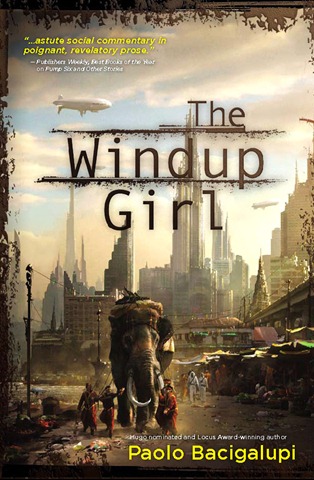
Look at the cover of The Windup Girl to see the future:

the-windup-girl-by-paolo-bacigalupi

Paolo Bacigalupi pictures the future without oil,  powered by weird clockwork “kink-spring” devices that stores kinetic energy, plagued by relentless blights on genetically engineered food crops, a future that struggles against the rising oceans and global warming, while enduring complex political intrigues.  But the most interesting aspect of this future is the new people, called windups, designed by gene splicing, who are outlawed and despised.  The title of the novel refers to an abandoned Japanese new person struggling to survive in Thailand as a sex slave.

As one of my reading friends told me, “The Windup Girl is dark.”  One reviewer even called it a dystopian novel, but I don’t think that’s correct.  Let’s just say it’s a very gritty future.  I suppose every century is full of hardships, so this future might not be any more bleak than the next.  If 19th century people could have read about a fictionalized but true version of the 20th century, they would think we lived through hell.  But the overall quality of life now is better than any time in the past, even though we might have millions complaining about how our present time sucks.

I really admire Bacigalupi’s creative vision of the future, but I don’t expect the 22nd century to be like The Windup Girl.  Our current problems, can be seen as evolving into the world of The Windup Girl, but on the other hand, I think by then we will have solved those problems and the 22nd century will have new problems we can’t imagine today.

No one can predict the future, but I’d like to believe in a future where we get smarter and solve our present problems.  But our world is diverse beyond any measure.  How would the past judge 2010 if they saw two films:  It’s Complicated and The Girl with the Dragon Tattoo?  One film shows the world as light-hearted and cheery, and the other as brutal and perverse.

If we read dozens of science fiction novels about the 22nd century, will they all be bleak?  I want life to be like Wake, where the problems are mathematical and scientific, which is why I liked that book so much.  I loved Wake, but I have to admire the creative writing of The Windup Girl.

JWH – 5/20/10

Wake by Robert J. Sawyer

Wake by Robert J. Sawyer is the first novel of a trilogy, it came out in 2009, Watch, the second book, came out this year, and Wonder will come out in 2011.  Sawyer calls them the WWW Trilogy, and it has a rather slick web site, with the best production values I’ve ever seen promoting a SF novel.  Personally, I found Wake as exciting as when I first discovered science fiction back in the 1960s, when I was a kid.  And it’s up for the Hugo this year, so I figure Penguin knows it has a great story and its hitting warp ten to promote it.

wake-for-blog

Wake is not marketed as a YA novel, but it could have been.  The main character is Caitlin Decter, a fifteen year old blind girl, who is a math wiz, computer geek, engaging blog writer, and extremely precocious.  This reminds me tremendously of the Heinlein juveniles from the 1950s, and in particular Holly from “The Menace From Earth.”  Like the Heinlein juveniles, Wake is chock full of educational tidbits.  And Wake is the kind of novel you don’t want to put down. 

Classic SF Theme:  Intelligent Computers

It’s getting harder and harder for science fiction writers to come up with completely new science fictional ideas, so what we often see is a writer taking on a classic theme and having a go at evolving past ideas.  Wake follows in the tradition of many fictional computers, but in particular ones about a computer becoming conscious in front of one person.  These are the just the ones I’ve read, there are many others.

  • 1966 – The Moon is a Harsh Mistress by Robert A. Heinlein
  • 1972 – When H.A.R.L.I.E. Was One by David Gerrold
  • 1995 – Galatea 2.2 – Richard Powers
  • 2009 – Wake by Robert J. Sawyer

Sawyer goes further then earlier writers in trying to imagine how an artificial mind would evolve and what it would perceive as it came into being.  Sawyer weaves blindness and Helen Keller, autism, apes that do sign language, Julian Jaynes’ the bicameral mind, and other explorers of consciousness into the story in a very effective way. 

One reason why I love this novel so much is because I’ve been writing a novel in my head about this subject for years.  It’s not likely I’ll ever become a real novelist, but if I do, I’ll have to take the concept further than Sawyer, and that’s a good challenge.

Go read Wake.  End of review.

Spoiler Alert

Now I want to discuss what Sawyer is really writing about.  Sawyer supposes that the Internet could evolve into a self-aware mind.  That idea isn’t new, but what Sawyer does with Wake is make his case for it with series of suppositions that are wrapped in a page turning novel.  In other words, he has a bunch of wild theories that he gets readers to think about one at a time. 

What I’d like to do is discuss these ideas but hopefully without hurting anyone’s enjoyment of the story, but I recommend you not read beyond this point if you haven’t read Wake yet and want to get the full impact of its excitement. 

Sawyer’s first theory is the emerging web mind will go through a stage much like what Helen Keller went through before she discovered language.  Sawyer indirectly explores this stage in a number of ways, including quotes and references to Helen Keller, a subplot about signing apes, and references to the book The Origins of Consciousness in the Breakdown of the Bicameral Mind by Julian Jaynes, a book I found very exciting when it came out back in 1976.

But I think Sawyer is missing a piece of the puzzle, one I got from On Intelligence by Jeff Hawkins.  Hawkins thinks our consciousness emerged out of a pattern recognition processor that we call the neocortex.  Sawyer uses cellular automata as his theoretical model, but I’m not sure that will work.  Cellular automata create patterns, but do they recognize them?  I’m not sure the Internet can generate a consciousness in its current design.  Oh, the Internet will make a fine nervous system for such a web being, or beings, but I think another type of device will need to be built first, and that’s a multilayer pattern recognizer that’s as good or better than our neocortex.

So far, all the writers exploring this theme have assume that when computers reach a critical mass a consciousness will spontaneously arise out of the complexity.  I doubt that completely.  I think at least three components are needed for self-aware consciousness: pattern recognition, mind and language.  I don’t think any of these exist in the internet, or supercomputers.   I think mind evolves out of pattern recognition, and self-awareness evolves out of mind, with the development of language.

Atoms and molecules have early stages of pattern recognition, but as life arises out of non-life, sense organs develop that seek out patterns in reality.  Most organisms are so highly adapted to specific patterns that they will die off if they can’t find them.  Evolutionary adaptation is the ability of organisms to explore and take advantage of new patterns.  I believe the mind grows out of this process, and there are different kinds of minds.  A dog, cat, dolphin and chimp all have minds.  We aren’t sure how much they perceive, or if they have much self-awareness, but they do have minds.  Language studies in dolphins and chimps hint that maybe these animals are self-aware and have identities, maybe far more than our egos want to believe, but I think their consciousnesses are limited by the state of their language abilities.  I think signing will add consciousness to apes.

For an AI computer to develop a mind, I think it needs to have a focus on reality that is processed through a pattern recognition device, and then a language needs to be linked to the patterns.  At first, I thought Sawyer was going to have the web mind see out of Caitlin’s artificial eye, so as the device taught her mind to see, the web mind would also learn to see, and with another fictional piece of technology, learn a language.  Instead Sawyer imagines an inner world where the web is visible.  I don’t buy that at all.  It’s leftover fluff from cyberpunk novels.  Why invent a new reality to observe, when the internet mind has millions of eyes on our reality?

Now this brings up some interesting questions about AI minds.  If a web mind has millions of web cameras at its disposal, will it think think like it has millions of eyes?  Or will it’s  consciousness move from camera to camera and peer out at single points of reality?  Omniscient life would be tough, don’t you think?  I tend to believe, and I only have limited knowledge to think otherwise, that an AI mind will emerge from a limited environment.  Some scientist will raise up an AI mind by teaching it to see and hear while learning a language.

But what will a hive AI mind be like?  Let’s say anyone in the future can go down to Radio Shack and buy an artificial neocortex to add to their computer system and bring up an AI child.  If all of these AI minds are connected by the Internet it will be like a race of telepathic beings.  Now, wouldn’t that be a far out science fiction story?  I still haven’t read Watch, so who knows what will happen.

JWH – 5/13/10