52 Essential Astronomy Lessons

A couple weeks ago at a meeting of my local astronomy club I heard a talk about the upcoming International Year of Astronomy 2009.  This reminds me of the famous International Geophysical Year when the U.S. and Russia first launched satellites into orbit back in 1957-1958 and brought about the Space Age and the amazing explosion of knowledge about our universe. 

If the IGY was about new discoveries, it seems the purpose of IYA2009 is to celebrate the 400 years since Galileo started using his telescope and to enlighten the worlds billions to the great discoveries of the science of astronomy.  We are currently living through a renaissance of astronomical exploration and I think most of the world’s citizens are missing out on the excitement.  This is a great time to throw a year long party for astronomers.

At my astronomy club meeting and at the IYA2009 web site there is a great push to find ways to get people to an eyepiece of a telescope so they can experience observation first hand.  I think this is a grand goal, but we should push people further than just showing them the rings of Saturn.  There’s a lot more to astronomy than pretty stellar tourist sites – astronomy is a long succession of conceptual breakthroughs that have changed the course of history and philosophy many times and is the foundation for the scientific age.

I think one project for the IYA2009 is to define the essential lessons needed to understand the science of astronomy.  Since we have eight months before IYA2009 begins this would be a good time for amateur astronomers around the world to tally what those lessons should be and campaign with the IYA2009 to find scientists and educators to develop those lessons to distribute all next year. 

Wouldn’t it be great if we could find 52 essential lessons of astronomy that could be taught across the web each week.  Using web pages, podcasts, videos, computer programs and any other instructional tool to let as many people as possible try than hand at teaching these 52 concepts.  Use astronomy as the subject to show off the potential of the web to teach millions.

Lessons is astronomy are all around us.  PBS, Discovery and History channels have astronomy related shows almost every week.  Bookstores have shelves of new astronomy books and sell several great astronomy magazines.  The Internet is loaded with diverse astronomy sites.  The question is how many people know about the essentials of the science?  It’s the 21st century but I think most of the worlds billions think of the heavens only in terms of the speculations taught by ancient religions or from misinformation brought about from science fiction movies.

How many of the nearly seven billion inhabitants of Earth really understand that our planet orbits the sun?  And how many of those know how to theoretically prove it?  And even still, how many from the last group could actually prove it?  Astronomy is the history of those people who could figure out ways to test and prove observations about our universe.  What I’d like to see the IYA2009 do is teach people the most important 52 scientific techniques used in understanding what we know about the Universe today.

Week 1 – The Stick

I’ll start off with an example of what I’m talking about.  Recently, while reading Neil deGrasse Tyson’s book Death by Black Hole, I was enchanted by his chapter about how much astronomy can be taught with a stick.  Most people have heard of stories about ancient cultures building monuments like Stonehenge or the Pyramids that scientists have reported were used in observational astronomy, but do you know how they worked?

Astronomy began long ago by people watching the sky.  I’m not sure modern kids understand that thousands of years ago they didn’t have television or even electricity, so the night sky was a lot more captivating then now.  You also have to understand these ancient dudes didn’t have clocks or even concepts like years, months, hours, minutes, and seconds.   They did have seasons and days, which I hope you can understand why.

It doesn’t take much observations skill to notice that day and night repeat, but it takes a little more brain power to notice the seasons coming and going and how to reliably predict them.  If you plant a stick in the ground and make notes about its shadow you’ll eventually start learning some cool stuff.  The National Science Teachers Association even offers lesson plans for elementary school kids and you might even like to take a look at what they do.  Sadly, these simple astronomy lesson plans seems to be singular, with most other web sites referring back to them.  A search of “Teaching astronomy with a stick” should bring up hundreds of unique individual pages, but it doesn’t.

Modern classroom teaching is mostly cramming kids full of words and numbers with the expectation they can puke them out later in the same order they were shoved in.  Instead we should be teaching kids how to learn on their own.  The tests should ask – 1. Prove how you know the seasons change, 2. Prove how you know the Earth is round, 3. Prove how you know the Earth orbits the Sun, and so on.  Then expect the kids to explain how they learned these truths from their own various experiments, including planting a stick in the ground and watching it, taking notes and making observations for years.  Make them work at learning, force them to develop discipline, expect more from them than memorization.

Great Expectations

Of course I know I’m asking a lot of IYA2009 – but hey, they brought up the idea.  Is IYA2009 going to be some PR fluff for telescope sales, or should it do something profound?  Maybe 52 lessons in science are too many – we could lower our sights to 12 monthly lessons.  I’m fond of the The Teaching Company that offer college level lectures for fun learning.  They build their courses around collections of 30 minute talks that come on audio and video and can include supplemental books.  52 thirty minute lectures would be 26 hours of teaching for the whole year.  About one college course taught in a semester spread out over a whole year.  I don’t think that’s too much.

It would be great if IYA2009 or its supporters could offer podcast subscriptions so people would automatically receive a 30 minute lesson each week of next year.  The audio lessons could point to a web page with supporting material, and if we’re lucky, maybe even downloadable videos that expand on the teaching.  And to make things perfect, I think each lecture should have lesson plans for teachers in K-12 classrooms.  Finally, a complete DVD course from the year, like those sold at The Teaching Company, could be given away as .iso downloads.

For this idea to work I think it would take something like the open source software paradigm to get people started.  Build it from the ground up with contributions.  There are countless astronomy clubs around the world that want to participate in IYA2009 and each could promote and campaign for particular weekly lesson and how to support them.  There are also countless academic professionals that teach astronomy and physics that could join in.  And there are countless instructional design professionals that could aid in the development of the lessons for the web.  Teaching astronomy would be a very good way to marry the potential of computer based instruction with a specific learning goal.  The emerging RIA (Rich Internet Applications) programming tools could be used to demonstrate their power.

I like this idea of an international year to learn something new.  It’s like when a city starts a community wide book club.  I think 2008 is unofficially the year of climate studies, or maybe 2010 should be the official year.  The idea of the world getting together to studying something globally sounds like lots of fun and I hope they pick a new topic every year.

Jim

Virtual Astronomy

There are few things in this world that has more sense-of-wonder impact than standing out in the dark nighttime and seeing the Milky Way.  Now, the key word here is dark.  You can’t do this from the city, so that means most people have never experienced this wonderful view of the night sky.  One of my most vivid memories is sleeping on the beach in the Florida Keys when I was a boy and waking up to see the Milky Way overhead.  The sky was gray with stars.  Amateur astronomers lament the growing light pollution we live with.  If you want to see the stars you need to visit the country.  Pretty soon people living in urban areas will be as bad off as the citizens of the planet in Isaac Asimov’s classic short story, “Nightfall.”

Last weekend I was out at the local star gazing site of the Memphis Astronomical Association.  I had taken two of my friends, Linda and Carolyn, to see through my telescope, but in the end it was more exciting to just stand and look up at all the stars.  The Milky Way isn’t up this time of year but we had plenty of constellations to see like Orion, Leo, Ursa Major, a setting Cassiopeia, Virgo and Gemini.  The challenge of astronomy is learning the night sky and developing a sense of where we are in the universe.

When you are outside at night it feels like the universe is slowly spinning around us, and if we could turn off the sun, in each 24-hour period we’d see the parade of constellations march overhead.  Of course it’s us who are spinning, and we can’t turn off the sun, so each evening of star gazing only shows us a portion of 360 degrees of one plane of the stellar map we live in.  To really learn the sky you have to go out regularly all year round, and even then you won’t know the stars of the southern hemisphere if you live on the northern half of Earth and vice versa for those living down under.  There’s a lot of sky to learn and it’s very hard to grasp, being three dimensional.  Most people fail at two-dimension geography, so it’s easy to understand how hard it is to learn your way around the celestial sphere of the universe.

One solution is virtual astronomy.  In this day of computers and Internet there are plenty of programs to help you visualize the sky.  Most people know about Google, and a large subset also know about Google Earth, but do you know the latest versions of Google Earth has a menu option to turn your sights away from Earth to look out at the universe?  Just run Google Earth, go to the View menu and select Switch to Sky.  [For those who do not want to download and install Google Earth, there is a web version of Google Sky – but all my instructions below are for the full Google Earth version you download.  Google Sky is lots of fun but is less dynamic – just type what you want to see in the search box.]

Google Earth will spin out to look at the constellations for a moment and then spin around and zoom in on a galaxy shot they use as a menu with an artificial constellation of icons now strewn across the screen.  By clicking on these icons you’ll be instructed through a series of pop-ups about the program and astronomy.  Clicking on the small >> next page buttons in the pop-ups will cause the view to spin dizzyingly to new vistas and more lessons.  You can by-pass these instructional features by using the navigation controller up in the upper-right hand side of the screen.  Just hold the – button down to zoom out until you see just the constellations again.

Once you are in the constellation view you can move around the sphere by clicking on any portion of the sky and holding down the left mouse button and just sliding the sky around.   If you have no knowledge of the constellations this will be confusing because your view is one of being inside of a sphere.  Go up to the View menu again and select Show Grid.  You can then push the sky around and find the poles.  If you watch the navigator icon at the top right you can find your way to the north pole.  Find the constellations Ursa Major and Minor, the old Big Dipper and Little Dipper.  This is the beginning of learning your way around the sky.  It’s like navigating on Earth, find North first.

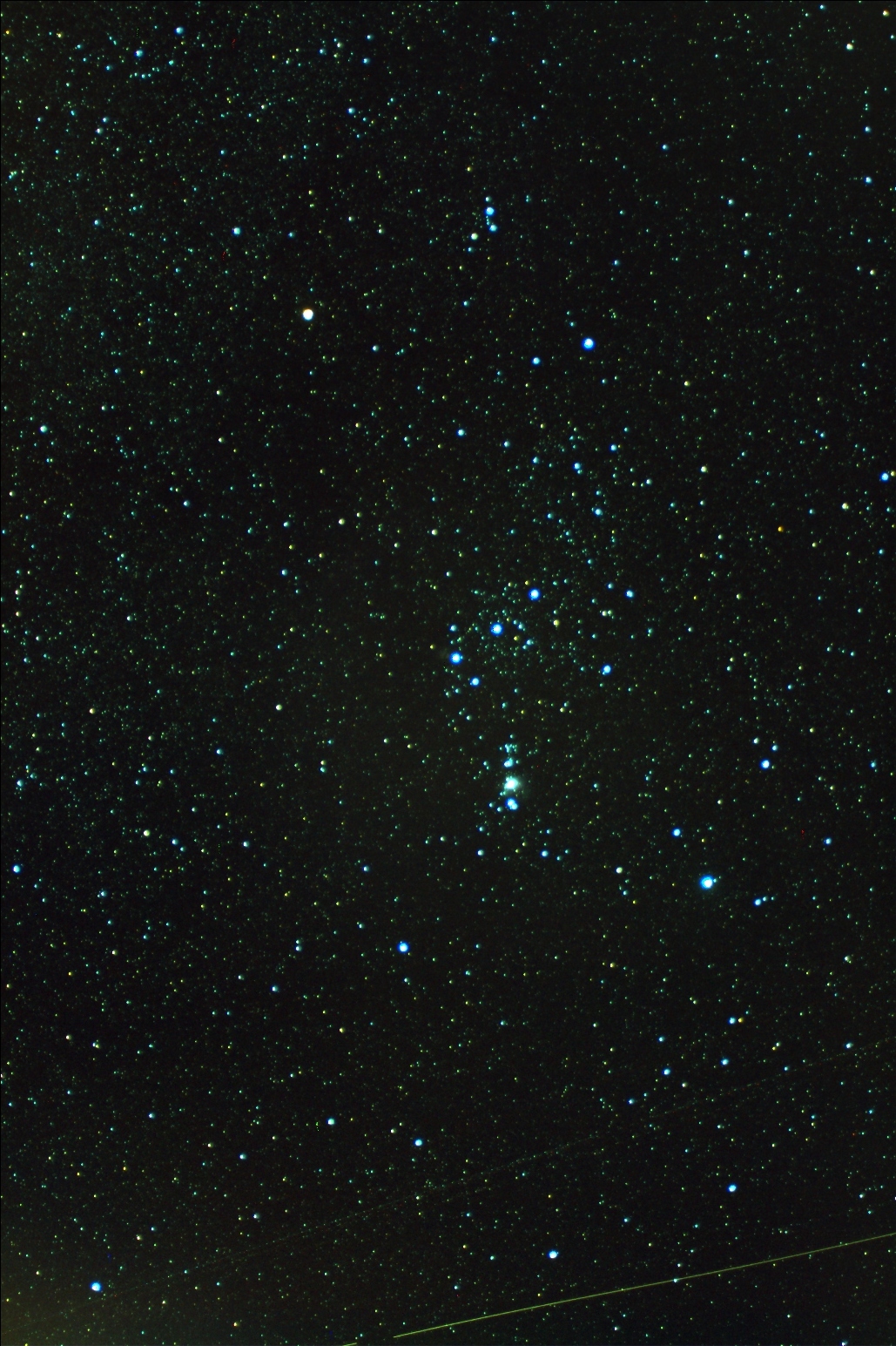
If you can see any stars at night where you live you might want to try and match your outside view with your virtual view.  If you have a good view of the north the Big Dipper shows well in urban skies this time of year.  The easiest constellation to learn in the overhead sky is Orion – even in a heavily light polluted city skies Orion will stand out.  Look for three stars close together in a line, that’s the belt of Orion.  Orion is up now but sets early.  A good free program to simulate the sky in relation to time and day is Stellarium.  Once you configure it for your location and time the program will start by showing you the sky in real time.  So if it’s daytime, you see simulated daylight and if it’s night you see the dark sky with minimum stars, like you would see in the city.  Stellarium has just a few iconic controls.  At the bottom right are video player buttons that you fast forward and reverse through time letting you jump ahead to plan your night-time viewing.

The Internet provides a wealth of free virtual planetarium programs that you can try out.  Some of these programs are very serious tools with catalogs of millions of stars that allow you to print very detailed maps of the sky for telescope observation.  Programs like the open source Stellarium and the commercial Starry Night programs offer great introductions to learning the sky with software.  Both the free Google Earth and the most expensive edition of Starry Night marry astronomical photography with celestial maps that allow you to zoom in and see photographs of famous cosmological tourist sites.  Most people love looking at the beautiful Hubble images but they don’t know where in the sky these photographic subjects are – these programs can show you.

The hardest part about learning astronomy is knowing where you are in the universe and which way you are looking.  An Atlas of the Universe is a site like the famous Powers of Ten video I used in explaining What Shape is the Universe?  Essentially all directions look the same when you observe the universe at large, it’s like being a grain of sand and trying to tell someone how to find another grain of sand.  For local viewing we use the Earth’s poles, the plane of the ecliptic, and the center of the Milky Way for orientation.  Advance students of the cosmos learn the various astronomical coordinate systems.

Most people think of astronomy as looking through a telescope.  Telescope viewing can be fun and exciting – especially the first time -but I personally find it frustrating and disappointing.  Except for a handful of objects all I see are countless little points of lights and occasionally some fuzzy smudges.  My advice to people thinking about buying a telescope is to learn the sky first.  Join a club and drive out to the dark sites.  Just learn the sky by looking up, and then get free views from members with telescopes.  If you want a telescope, wait to buy one until you find out if you like learning the sky.  The real fun of using a telescope is finding hard to find objects and that won’t be appealing unless you also like learning your way around the sky.

My advice is study virtual astronomy, books, magazines and learn the sky with your eyes first.  Then get binoculars with the widest field of view and study the added detail they bring.  There are plenty of people with telescopes that will give you free views.  Learn from them before buying your scope.  If you live in the city and seldom get to dark observing sites considering getting a scope that works well with urban views.  The  Moon and planets do well with small scopes.  You can get special filters and scopes for observing the Sun.  Start with a scope that’s easy to grab and carry outside for a few minutes observing – such as to check on Saturn or Jupiter, or gaze at the Moon for awhile.

The International Year of Astronomy is coming up in 2009.  This will be a great time to take up astronomy as a hobby because it will be getting lots of attention.  Starting off with these virtual astronomy programs will help you develop a foundation for learning the sky.  Astronomy is a vast field of study.  Our ancestors always lived with dark skies which they read like clocks.  The history of mankind has been the study of the sky.  Us modern folk have tuned out the night sky by constantly living with artificial light.  Learning astronomy is a way to tune back in.

Jim


What is the Shape of the Universe?

The other night while waiting to visit Slumberland, I lay in my bed thinking about Einstein. Long ago before people knew the Earth was round, people imagined our world to be a vast plane. Some people imagined the plane to be infinite in all directions and others speculated finding the edge and falling off. Then along came some smart Greek dudes, no, not Geeks, but Greeks, but maybe Geek Greeks, who suggested that maybe Earth was round. If this was true they theorized one test of their theory’s validity would be to start walking in one direction and eventually you’ll end up back where you started. Imagine how mind-blowing that bizarre concept was to fathom back then. We know it’s true, but then we know the ending of the story.

Now I’m reading Einstein and I’m trying to imagine the shape of the universe. Like our ancestors who felt that Earth was one vast plane, we feel the universe is one infinite three-dimensional space and Einstein, like the smart Greeks of long ago, is suggesting something different. And guess what, the same test would apply. You head out in one direction and eventually you’ll get back to where you started. Boy is that hard to imagine.

I’ve always loved astronomy and all my life astronomers have talked about how big or how old the universe is and they argue whether it’s 12 billion light years or 14 billion light years. And it’s never 7 billion in that direction, and 14 billion in that direction and 2 billion in that direction. No, they always talk about the size of the universe as if we’re smack in the middle of it. My mental picture of the universe is a giant cube of black Lucite embedded with grains of galaxies that occasionally make swirls of clusters. But that begs to ask what’s outside of the universe.

According to Einstein and others there is nothing outside of the universe. No space-time, no empty space, not even non-existence – the only thing that exists is our universe. How can that be? It hurts to think of such a universe. To grasp that we have to ask: what is the shape of the universe? This has gotten me to read The Poincare Conjecture by Donal O’Shea which is the history of developing a geometry that answers that question. I’m slowly working my way through the book and O’Shea is carefully building the background that I hope will give me a slight cognitive glimpse. It is beyond any fantasy I might have to think I’ll actually understand it.

While thinking and reading about all of this I got the idea if the universe is finite in one direction, what about the other direction, the world of small. This reminded me of that classic film The Powers of Ten and wondered how many magnitudes of distance up is compared to down. It turns out its roughly 1026 expanding out and 10-18 shrinking down until we reach the current barrier of perception. So in this case we’re not in the middle of things unless we haven’t gone all the way down as small as possible. Wouldn’t it be weird if we were always in the middle of everything? If on the cosmological scale the universe can’t be infinite, then it would also seem on the microscopic scale we’d reach a finite end to the world of tiny.

This doesn’t make mental sense does it? It’s like the Greek who argued that the universe was infinite because no matter where the edge was if he stood there and stuck his arm out wouldn’t there be more of something? Or if we found the smallest particle our minds just beg to break it in two. It’s like the old story of kids asking about what made God, and then asking who made whatever made God. It’s damn strange, but we just can’t comprehend a finite world.

Doesn’t the universe feel smaller already when you think its size is just twenty-five magnitudes greater than our own little space in the world? There have been a number of people who have made Powers of Ten films, books and websites. There’s an excellent IMAX film you can rent from Netflix called Cosmic Voyage that gives a fancier version of Powers of Ten with a lot of fantastic computer animation. The link takes you to a web version, but it’s worthwhile to get the DVD – it’s quite beautiful.

Also visit Quarks to Quasars for another conceptual approach to this subject and be sure and look at the index page, which is a quick one page summation. This Powers of Ten has a great little ruler menu. Click on 108 and 10-8 shows the Earth from space and DNA. I wonder if that means we’re the size of DNA if seen from a high orbit.

The fun thing about playing with the powers of ten is to try and conceptualize our place in the universe. Essentially these films, web sites and books try to create a very simplified map of reality. It’s wonderful to meditate on each power of the scale. A big chunk of the scale from 10-12 to 1012 is from the realm of the atom to the Sun, both objects we have intimate relationships with, so we should try to comprehend them. While we send rockets up to explore the higher positive powers ten we work with nanotechnology to capitalize on the negative powers of ten.

At 100 we’re at the one meter vantage. That’s roughly the world of personal contact with other people. I like to think the starting point is the point of consciousness that reside behind my eyes. Within that one meter world is the distance to my monitor. People and pets we love the most are the beings we let into this range of magnitude.

At 101 we’ve expanded our world out to ten meters, or roughly the size of a large room. This takes our conscious minds into the sphere of homes and offices and cars interiors. This is the magnitude of our social world. At 102 or 100 meters we reach the limits of very large social events like football stadiums, shopping malls, downtown areas, and where we lose our ability to distinguish other individuals.

It’s hard for our minds to grasp the area of 103, or 1000 meters, which is 5/8th of a mile. This is a whole neighborhood, a large farm, an area of woods, even a small town. It’s difficult to know all the people in an area this size but most people can maintain a fairly intimate social relation within this magnitude. It’s like living in a small town. For people who can’t comprehend maps or geography this is probably the limit of their conscious world.

Expanding out to 104 brings us 10,000 meters or six miles, about the size of a large downtown city. There have been whole populations that never ventured out of a world this size. I’d guess in some populated cities they could squeeze in a million people at this scale. And the next jump to 105 brings us to 100,000 meters or about sixty miles. This is a large city and its surrounding towns, but it isn’t so big that many people can’t commute to work such distances. At 106 or a million meters we’re getting into the size of states and small countries.

The next two jumps 107 and 108 take us to 10 million and 100 million meters and we’re seeing a large segment of the Earth like an astronaut to zooming out to see the Earth as a marble in the sky as if seen by travelers heading to the moon. At 109 we could see the orbit of the moon because we’re looking across 1 million kilometers of space. We’ve now reach the limits of manned exploration and we’re into the magnitudes of space age awareness.

All of world politics happen on the scale between 7 and 8 magnitudes and few people try to keep up with events at that level. Most people’s conscious world of events remains below magnitude 5. It is between magnitude 7 and 8 that we see that our world is a sphere and the end of human territory. Few people in the course of a day think about things outside of magnitude 7.

People at the Jet Propulsion Laboratory (JPL) think and work in magnitudes 1010 through 1013, which take us out to the edge of the solar system. Anyone willing to study astronomy can grasp a basic idea of this territory. It’s the territory of popular science, and even though objects within this scope are immense, like the Sun or Jupiter, they are within our ability to imagine.

At step 1016 we reach one light year and expanding out to 1017 we pass by our nearest neighbor star before we hit the 10 light year sphere. Astronomers and science fiction writers explore this territory often, but most of humanity never thinks this big. We have to expand out four magnitudes to 1021 to see our home galaxy. Very few science fiction stories have ever been written about traveling beyond our galaxy. We can still imagine that space is a huge three dimension void speckled with a bit of matter.

Few people can make mental maps of expanding out further than our galaxy. Imagine the three dimensional positions of galaxy clusters at 1025 or a billion light years of volume is mind numbing even to think about. Making that last jump or two in magnitudes to see the whole universe as it really is, is a feat of imagination beyond all but a few humans. The idea that someone can imagine it, even mathematically, is beyond my abilities. How many magnitudes of mental power must Einstein have needed over us normal people to see what he saw?

It’s out in this territory where we’ll find the shape of the universe, where it continues to expand. It’s so hard not to think of the universe as an explosion of matter shooting out in all directions in infinite empty space. If I knew what I know now as a little kid starting school I sure would have studied harder, especially math.

Maybe they should start kids out by teaching them all the far out puzzling facts about the universe and then tell them if they want to understand the answers they better study math. They never really gave me an incentive to study math – hell I didn’t buy into that whole grade thing back then. What motivation is having the letter A marked in a box over the value of having the letter C? Damnation, why didn’t they warn me that one day I’d want to read The Poincare Conjecture and understanding mathematics was the key.

Jim

The Lights in the Sky is Space-Time

When I wrote “The Lights in the Sky are Stars” I was trying to remind people we live in this far out universe but most people fail to look up and notice.  Sadly, light pollution has destroyed the impact of the night sky thus diminishing our sense of wonder.  Now I’m reading Einstein by Walter Isaacson and its like a lesson in astronomy on LSD.

Over the years I’ve seen many documentaries and read many books on the theory of relativity and other ideas discovered by Einstein but I never really got them.  I still don’t get them, but this book by following Einstein step by step as he grows up and then works on each problem helps me visualize the immensity of his discoveries better than anything so far.  Coming to grips that space and time are not absolute and that they are really one thing called space-time is hard.

Einstein often uses vivid thought experiments to teach his concepts and one of my favorites is trying to imagine people living in a two dimensional world like the classic book Flatland.  This is a great metaphor because for most people on Earth we only see the universe in a very limited way, and the genius of Einstein was he looked intensely at reality and said to everyone, “Hey guys, we’re not in Kansas anymore.”

I took many physics and astronomy courses in college but I never achieved orbit with them.  I am like Charlie Gordon in Flowers for Algernon in that I once had a bit of smarts and got a tiny glimpse of reality but now it’s all forgotten.  I’m like a woman of 56 trying to recapture her beauty of 22, so I don’t know if its physically possible to facelift my brain, but I keep trying.  Hell, there’s got to be more to life than watching Lost on my HDTV (not that I don’t love that show).

Plastic surgery only succeeds so far with the body, so I don’t know how much I can push my brain at 56 to rejuvenate.  Awhile back I bought The History of Science: 1700-1900 on DVD from The Teaching Company.  I’m going to start watching those lessons again and study physics again.  Einstein wrote his own popular science book about special and general relativity and I’m also going to buy that and try to “see” into his world using his own words.

Science is weird because a few really smart people study reality and make discoveries, and then they tell everybody and the rest of us go, “Oh yeah, I get that,” and then go on with out lives.  We’re all taught in school that the Earth orbits the Sun even though when you look outside it sure does look like the Sun moves around terra firma.   Most people live their lives like ants unaware that our little hive and its activities is part of something much bigger.  The Earth is like an atom in an Apple.

Cosmology is the science of describing the whole enchilada.  When Einstein first theorized the nature of space-time Hubble hadn’t even made his breakthroughs to explain galaxies.  By trying to understand the nature of light and gravity he became the father of cosmology.  Einstein’s brain and mathematics brought forth our whole spooky universe of quantum physics as if we were born out of his thoughts.

It didn’t take long for other scientists to see what Einstein saw.  He quickly became movie star famous.  A hundred years later we take all of his discoveries for granted, but not really.  How many people really think about their place in the cosmos?

Now, at 56 I wonder how much I can see if I try?  My memory is already a sieve.  One reason I write these essays is to exercise the mechanism in my brain that processes words.  Since working on this blog my brain is just a bit better at finding words, so maybe thinking about physics will be gym for my mind.

Jim

The Lights in the Sky are Stars

    “Because something is happening here, but you don’t know what it is, do you, Mr. Jones?” – Bob Dylan

    I think people forget we live in a fantastically large universe. We’re bacteria living in a drop of water and imagine the few molecules we swim in are the crown of creation, the darling of God’s eye. Light polution has stolen the Milky Way from our lives and shrunk our universe. Most people never look up any more and speculate beyond the event horizon of their lives. Sense of wonder and philosophy has been replaced by gossip about Anna Nicole Smith. Is it no wonder that the uneducated of the world crave their old time gods? DVDs and iPods can’t give the young transcendence. We live in the most exciting time of all history but the only philosophers we have are ones that tell us how to cope with stress, lose weight, invest money, or quibble over left and right politics. Where are our transcendental explorers? Our population seems divided between people who want to ignore reality by partying till they die or those who ignore reality by feverishly studying ancient religious texts and praying for a rebirth in another reality – one that is simple and easy to understand.

    If you wake up to The Today Show, come home from work to the ABC World News Tonight, and go to sleep with Eyewitness News and Jay Leno, then your view of our monsterously large multiverse is rather tacky and small. Watch the Discovery Channel in High Definition – it is the Henry David Thoreau of our times. A telescope will help you learn how small you are and a microscope will teach you how big you are. Ask yourself this question: What should I be doing in this immense creation that has no guidebook or instruction manual. For most of history our philosophers have asked: “Why are we here?” Up till now people have answered that question by believing in the silly idea that we’re being judged on our behavior and assume the judgement determines our immortal life in the reality after this one. Imagine if ants thought one human judged their every action.

Get over it. There is no reason why. We’re not being judged and there is no reality after this one. This reality is our final destination – our only vacation from oblivion. We’ve all gone to Hawaii and all we do is sit in our hotel room and watch reruns of That 70’s Show. How lame is that. We need to remember every moment of our lives that the lights in the sky are stars.