A Universe From Nothing Lawrence M. Krauss

As far back as I can remember I’ve often contemplated why there is something rather than nothing.  And by nothing, I don’t mean empty space, because even that would be something.  I finally decided that nothing can’t exist.  That it’s impossible for “nothing” to exist, because if it could, we wouldn’t be here, and there would be nothing.  I concluded that reality is all the possible some-things coming into being. 

When I first saw a copy A Universe From Nothing by Lawrence M. Krauss I wondered if he had a scientific theory to explain why nothing cannot exist to support my own philosophical theory.  Sad to say, he doesn’t actual work with the same concept of nothing as I imagined it, but I think he’s getting close.  Theology has always been burdened with the question that intellectual pesky kids eventual ask, “Who created God?”  Smart kids will also ask scientists, “What created the Big Bang?”  Sooner or later the ontological question has to be:  “How did something come from nothing?”

Cosmology has always invaded the territory of theology and Krauss does not shy away from this conflict.  In fact, Christopher Hitchens had promised to write the introduction to A Universe From Nothing, but he died too soon, so Krauss got Richard Dawkins to write the afterward, which uses the science in this book to attack theology rather sharply.

It seems like every popular cosmology book I read has to reiterate all the cosmological discoveries since Edwin Hubble figured out that nebulae are galaxies existing outside of the Milky Way, and they are speeding away from us.  For a short 224 page book, Krauss gets the background covered quickly and moves on to the title topic, but it requires the reader to grasp quite a bit of recent research.  To understand nothing requires understanding a lot of some-things.

Now here is where I wish I had the writing skills of Brian Greene, my current favorite science writer.  Of course, if I had such writing skills I’d end up writing a book much like what Lawrence M. Krauss wrote – however, I’d still like to summarize what I learned from reading A Universe from Nothing.  I’ve lost count of how many books I’ve read on cosmology, or documentaries I’ve seen, but I feel the need to summarize just to get things straight in my head by listing them on paper.

And if Krauss and Dawkins are right, and cosmology deposes theology, then the average person needs to learn a lot to catch up with science.  Cosmology is science’s Book of Genesis.   But unlike the Bible myths, cosmology explains how the universe came about by studying the evidence, a lot of evidence, a whole lot of evidence.  And for some concepts, like the Big Bang, there are multiple paths that prove the theory that makes the scientific research more and more definite.  This is a lot of learn and its no wonder that most people prefer the Bible to answer their origin questions.

Here’s quick and dirty study guide to modern cosmology.  The more you know will make understanding A Universe From Nothing easier to understand and comprehend.  Also, it’s impossible to understand cosmology without understanding particle physics.

Now this is a lot to learn, and even after reading many books I only have a vague layman’s idea of what’s going on, but what’s fascinating is how everything interconnects.  Reading A Universe From Nothing just inspires me to read more, to keep putting more puzzle pieces together to get the big picture. 

Just take what we’ve learned about the cosmic microwave background radiation in my lifetime.  Reading The First Three Minutes by Steven Weinberg and The Very First Light by John C. Mather tells the long story of how the CMB was theorized, discovered, and measured to finer and finer accuracy.  The Very First Light is about building the COBE spacecraft to measure the CMB.  Then I read about the Wilkinson Microwave Anisotropy Probe that studied the CMB with even more accuracy.  Then there was Planck spacecraft that explores even deeper.  If you aren’t familiar with the cosmic microwave background radiation then I beg you to study it.  It’s a near perfect example of how science works.   Just look at the list of the major experiments studying the CMB.  This history shows how experiments are constantly refined and evolved to find more evidence, or how to look for evidence from other sources, or from other approaches.  Science is a beautiful Chinese puzzle where the pieces interlock in elegant ways.

Don’t worry about not knowing mathematics to enjoy reading about cosmology.  Most of the popular science books are about the men who invented the mathematics, and their stories are told by the experimental evidence.  Their numbers are validated by real world experiments and applied engineering.  Did you know that GPS systems in your smartphones depend on mathematics that involve relativity?  Without Einstein’s equations they wouldn’t work.

Back to the book – does Krauss explain how something comes from nothing?  No.  But he does explain the current theories on dark energy, which suggests that powerful forces come from apparently empty space.  Of course, once we understand how dark energy, and dark matter work, they won’t seem like nothing anymore – they will be some-things.

The nothing Krauss is talking about are just some-things that science can’t see right now.  The nothing I say can’t exist is pushed further back into the unknown, into the multiverse.  Like the kid who asked who created God, I’m asking what created the multiverse, but if science could tell me, there would still be another layer of unknown to explore.  It’s still turtles all the way down.

Other Reviews:

JWH – 2/24/12

Accepting Reality

For most of the history of mankind, gods or God, explained reality.  God made us, the plants and animals.  Any event in nature, whether good or bad, was caused by gods or God.  Then science came along and explained rain, thunderstorms, earthquakes, eclipses, droughts, stars, planets, and so on.  When science explained the origin of animals and people, some religious people rebelled.

We now have people that reject science because they want to keep God.  They feel science is explaining away God.  I’m afraid they are right.  But instead of accepting reality and letting God fade away, like the gods before monotheism, they are rejecting reality.  When I was very young I rejected God and accepted science mainly because of the size of reality.  Reality seemed too immense to have been created by one being, especially one in our image.  Take a look at this video to see what I mean.

God was a great concept when our awareness of reality was small but once you realize the size of reality, age and scope, even at the limits of what we know now, that knowledge changes everything philosophically.  Humans can’t be the crown of creation.  We can’t be the center of the universe and the focus of God’s attention.  We can’t be special if we’re so small and insignificant.

So what is our place in the reality?  Years ago I would have asked, what is our place in the universe, but it appears our universe might be one of an infinity of universes, and this round of 13.7 billion years since the Big Bang, only a single bubble in a foam of universes.  Science now talk of the multiverse, but I prefer the term reality to encompass it all.

Humans are here in this vast reality by an accident of randomness.  We won’t always be here.  Reality existed before us, and it will exist after us.  Being here is the biggest miracle we’ve yet discovered.  It’s a miracle that outshines any miracle ever recorded in all of the religions of the world.

I think its time we reject the theory of God and start accepting reality for what it is.  Start asking questions about what existing in this vast reality means.  Becoming self-aware in this immense reality is a great opportunity.  Instead of destroying the Earth and committing species suicide we need to think about what we could become.  Don’t ask what is our purpose.  Under religion our purpose was to obey God.  Reality doesn’t work that way.  We each have to find our own purpose if we want one, but reality expects nothing of us.  We can’t have a personal relationship with reality.  Each of us is an awareness of reality, but most of us pretend we’re not here.

Erase all the past thoughts of religion and philosophy.  You just woke up in an unknown place.  Take stock in your surroundings.  You know that old saying, think global but act local – do the same for reality.  Our philosophy should be based on our best picture of reality.  Start with cosmology and work your way down.  Most people define reality by their very small personal delusions.  I say, any philosophy that doesn’t account for the size of reality dooms itself to a cockroach mentality.  A cockroach scurries about satisfying its personal urges unaware of its environment.  A cockroach does not know it’s in your kitchen because it doesn’t see the big picture.

There is only one human endeavor that tells us about reality, and that’s science.  I suggest starting at the top, and work down.  NOVA presented a wonderful four part series called The Fabric of the Cosmos hosted by Brian Greene based on his book of the same name.

Fabric of the Cosmos 1: What is Space?

Fabric of the Cosmos 2: The Illusion of Time

Fabric of the Cosmos 3: Quantum Leap

Fabric of the Cosmos 4:  University or Multiverse

Maybe there’s still room for religion in reality, I don’t know.  But any religion that ignores what we know about reality is delusional.

JWH – 2/11/12

Gave Away My Telescope

I haven’t used my telescope for about 3 years, so when a lady at work started talking about saving up for a telescope I gave her mine.  Now, it’s not that I’m losing my interest in astronomy, but it’s a recognition I’m not much of an observational kind of amateur astronomer.  The night before I bought Archives of the Universe:  A Treasure of Astronomy’s Historic Works of Discovery by Marcia Bartusiak.  What does it say about me that I find it far more exciting to read about the history of astronomy than look through a telescope?

I’m learning a lot about myself in my fifties.  Or maybe I’m learning the same things a second time.  My fifties, and I’m 58 now, have turned out to be a decade of returning to the interests and desires I loved in my teens.  I had a telescope in my teens and I gave it away too.  I even took astronomy and physics courses in my first two years of college, and dreamed of being a real astronomer, but I didn’t stick with it.

I’m a bookworm at heart and not a doer.  I’ve always dreamed of being a doer, but I just don’t have the personality for action.  I had a hard time adapting to the world of 9 to 5 work in my twenties, and for decades now my job has used up all my active energy.  I think about retirement all the time now.  Like in my teen years when I fantasized about what I would do when I grew up, I now fantasize about all the things I’d like to do when I retire, but I’m starting to think I won’t do that much.

It’s sad to say, but I’d rather spend time looking at a big picture book about astronomy than looking through a telescope.  Or I’d rather read biographies about astronomers than trying to recreate what they did.  My telescope was better anything Galileo, Copernicus or even Kepler had, and I did so little with it.

There are several pitfalls to owning a telescope.  The primary problem of small scopes is they never give views like the photographs you see in Sky and Telescope.  However, photographs are never as exciting as seeing Jupiter, Saturn or the Moon in real time with your own telescope.  After those three objects, how well a person will enjoy using a small telescope is determined by their temperament.  Most new scope owners will go hunting for the faint fuzzies, the term amateur astronomers use for all those gorgeous galaxies and nebula you see in Sky and Telescope, but when you find them they are more like tiny gray smudges than swirls of stars.  And they are damn hard to find.  

And it’s the skill in finding faint fuzzies that determines whether you’re going to really love owning a telescope.  I was never patient enough to develop a knack for star hopping, a technique of finding a naked eye star and looking at fainter stars through a low power lens to hop from one pattern to another until you find your target.  Through a telescope, you can aim it in the sky where you see one star, and through the eyepiece see twenty stars.  Learning those patterns within patterns is essential, and I never developed that skill.  Comet hunters learn the sky so well they can spot a new dot of light among old familiar patterns by memory. 

Amateur astronomers are a noble group, and some of them actually perform useful scientific research.   Another trait that separates me from real amateur astronomers is I don’t like  being outside or staying up late.  Oh, I love being out in the country, under dark skies looking up at the whole sky full of stars, but after about an hour, I’m satisfied.  Real amateur astronomers can stay out all night.  I’ve even discovered I prefer to stargaze without a scope under remote skies because I like the magnificent wide-field vistas to close-ups of tiny points of light .  Through a telescope you see way more stars, but a eyepiece full of tiny lights gets boring to me quickly.

The one skill I hoped to develop with my telescope was getting some kind of 3D sense of awareness of where I am in the universe.  Living on a big ball that’s spinning between day and night skies makes that difficult.  If the Earth wasn’t spinning on its axis or orbiting the Sun, most objects in the sky would remain fixed, and it would be easy to learn and remember their positions. 

I always wanted to master the constellations, so when a star or galaxy was mentioned, I could mentally picture in which direction of the sky to look.  Except for a handful of constellations, I never did this.  In urban skies, it’s very hard to make out constellations.  Ancient people saw far more stars than we do, and they spent way more time under the night sky, so memorizing the constellations was second nature to them.  Now, the night sky is a theoretical concept to most people.  That’s a shame.

I hope the lady at work can do more with my telescope than I did.  She has good vision and likes spending time outside, so I’m expecting to hear some great observing reports from her.

JWH – 6/20/10

The Edge of Physics by Anil Ananthaswamy

If you are the kind of person who believes that science explores reality and would love to catch up on  the latest explorations in cosmology and subatomic particles, then The Edge of Physics (2010) by Anil Anathaswamy is the book for you.  For years I’ve wanted to know where the big experiments are taking place, and even daydreamed of being a science journalist whose nine-to-five job would be to visit them, well Anil Ananthaswamy has my dream job.

The Edge of Physics is mostly a travel book, and Ananthaswamy even has photos for each of the sites he visited at his web site, collected chapter by chapter.  What Anil has done, and I hope he pardons my familiarity, because typing his last name is work, is weave science history in with his travelogue and then explain what each experimental site he visits hopes to achieve. 

To enjoy this book does not require a deep understanding of experimental physics or math, just a sense of wonder.  I’m praying to Einstein that  PBS’s NOVA makes a multipart series based on this book.  The average person is afraid of science, and Anil really goes a long way to making it accessible.  Anyone who hates that we’re spending billions on theoretical science needs to read this book too, because it makes you wish they’d spend billions more, because in the end, Anil helps us understand the mysteries that are remaining to be discovered.  And I hope I live long enough to hear those results reported too.

On the day I started this book I experienced a bit of serendipity.  The first chapter is about Mount Wilson and why the work it did back in the 1910s and 1920s is so important to the work being done today.  While listening to the book on audio I wished I could see pictures of what Anil was writing about.  Well, my wished was grant that very day, because that night NOVA started a two part Hunting the Edge of Space that featured photos and films from the early days of the Mount Wilson Observatory.  This documentary overlapped wonderfully with The Edge of Physics

Now, if NOVA would only film the other chapters.  Most people are familiar with visual telescopes but how many have heard of a neutrino telescope?  One of the more adventuresome trips Anil makes is to Lake Baikal, to where scientists brave the Siberian winter to build an underwater telescope beneath the ice of a large freshwater lake.  Anil also visits two sites in Antarctica, Chile, Hawaii, South Africa, deep underground in Northern Minnesota, India, and of course Switzerland where the LHC is located.

I read Sky and Telescope every month but I never knew there was so many big telescopes around the world.  I wish someone would build a web site for telescopes like they have for the Top 500 Supercomputer Sites.  And I also wish someone would build the Top 500 largest science research sites.  And reading The Edge of Physics I could imagine a new tourist industry based on visiting scientific research.  I don’t have the money to take up that hobby right now, but I’m inspired to see if I can find web sites for all the places Anil visited in his book:

All this travel is glamorous but the real value of The Edge of Physics is what Anil reports about the status of all these experiments.  He really is trying to show his readers where the edge of physics lies, and what that means.  I can’t summarize that, you need to read the book, but if you haven’t read any science books in a few years, you’ll be surprised by how far science has gotten to explaining all of reality.  We are far from finished, but wow, scientists are hot on the trail of explaining almost everything.  Research in particle physics, dark matter, dark energy, cosmic background radiation, string theory, multiverses, radio astronomy, neutrino astronomy, are converging towards filling in missing puzzle pieces. 

It’s like doing a Sudoku puzzle.  Finding any one number can solve problems in all nine quadrants.  Breakthroughs at any one of these sites Anil visits means more evidence for the other sites.  Everything is interrelated.  I’d love to be able to list all the areas of research covered in this book with hyperlinks and explanations, but I’d have to write a book and Anil Ananthaswamy has already done that for us.  Be sure an visit Anil’s blog for newer reports.

JWH – 4/24/10

Pale Blue Dot

I discovered over at Mike Brotherton’s blog that today, 11/7/9, is Carl Sagan Day, and Mike makes some interesting observations about Sagan and Richard Dawkins and the public’s attitude towards their atheism.  For awhile, Carl Sagan was the face of science to the general public, sort of like Stephen Hawking is today.  Any second rate pop/rock/movie/sports star is more famous than these scientists, but they have great influence on millions of Earthlings.  I think Sagan’s Cosmos book and TV documentary series introduced cosmology and science to a generation of people and it’s impossible to judge his impact.

Mike Brotherton’s blog is a favorite of mine because he and I share a similar fascination with science and constantly wonder why science isn’t more widely accepted by the public.  Read his recent essay “Smarts, Spontaneity, Science, and Science Fiction.”  It explores just how hard it is to teach science, or even just express scientific ideas.  That’s why Carl Sagan was so admired, he could communicate scientific ideas.  And I agree with Mike, Sagan wasn’t as successful as his popularity, too often Carl Sagan was ridiculed on SNL other LCD comedy shows as being a geeky guy, too overly enthusiastic about billions of stars.

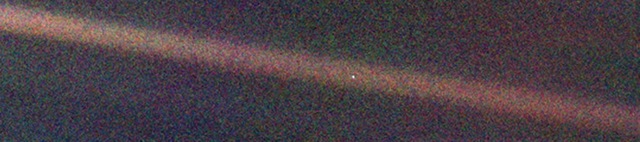
The people of our planet focus too narrowly on their own personal immediate reality, and all too often they believe silly theories about ontology.  Carl Sagan tried to show people we live in a vast Cosmos and reality can’t be explained by just what we see in front of our noses.  Look at this photo:

Pale-blue-dot

If you look close you’ll see a little pale blue dot in the center, a bit bigger than all the other dots in this grainy photograph.  That’s Earth as seen from Voyager 1 on the way out of the solar system.  By astronomy standards, this is an extreme close-up.  We’re use to seeing high-powered electron-microscope photos of our planet in comparison. If a photograph could be taken of the universe as a whole, our galaxy wouldn’t even be visible.  It’s hard to take our silly ideas about the meaning of life seriously when we see the relative perspective of our existence in relationship to all of space and time. 

That’s why I call existence the foam of reality.  From most perspectives, whether 10 to the +25 or 10 to the -25 magnitude vantage points, reality looks like a homogenous foam or fuzzy collection of points of reflected light.  We only see details at magnitude 0

The universe is so vast in scope and dimensions, that it’s hard to imagine a deity even noticing us.  One of the major lessons that Carl Sagan taught us, is we are insignificant in relation to the rest of the universe.  That little dot is home to seven billion people, and from their perspective their lives are the center of the universe, but we must remember that’s an illusion. 

Carl Sagan is most famous for his book Cosmos, but he wrote a sequel that is less famous, based on this photograph, and also called, The Pale Blue Dot.  Any philosophy or theology that tries to explain the meaning of reality must incorporate our true position in the universe, anything less will be delusional.  Science is hard to teach because you have to get little minds to think big, and Carl Sagan could do that.

JWH – 11/7/9