Does Perry Mason Follow the Rules for Detective Fiction?

by James Wallace Harris, Thursday, November 29, 2018

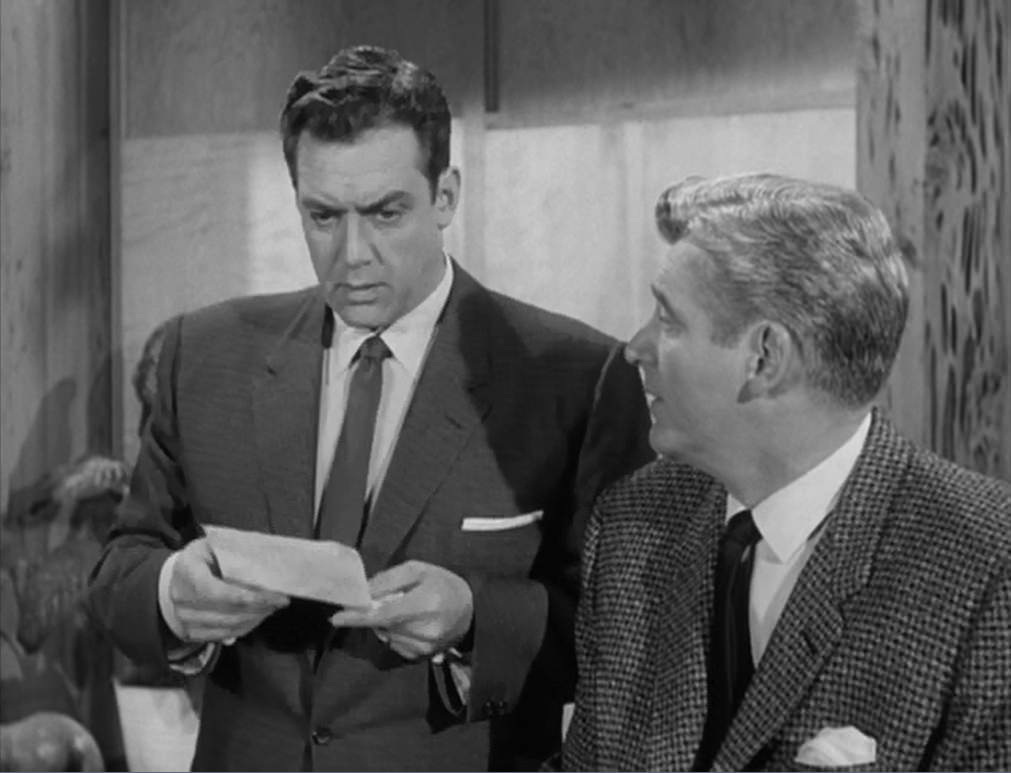
In my last post, I wrote about becoming addicted to Perry Mason. The trouble is I’m not a murder mystery fan, so I’m clueless when it comes to analyzing the clues. I’ve never guessed whodunit while watching Perry Mason. In fact, I often feel cheated when the murderer confesses because it seems like the writers kept them mostly offstage, and Perry doesn’t give us the important clues until the end of the show when he’s explaining his logic to Della and Paul. We seldom see the murderer conviving.

Because Perry Mason won nearly all the 271 cases presented in the nine seasons of the show, I know not to suspect his clients. The show certainly would be a great deal more fun if Hamilton Burger won at least a quarter of the cases or even a third. By some accounts, Mason only lost three cases, but even those are iffy. Watching a formulaic story is comfortable sometimes, but annoying at other times.

The creative appeal of Perry Mason is the highly contrived murders. The other night I watch “The Case of the Fan Dancer’s Horse” which involved two women with the same name and looks. It featured a young actress Judy Tyler who had just made Jailhouse Rock with Elvis Presley that tragically died in a car accident not long after making the PM episode. The story was colorful and sexy, but highly contrived, while the murder and whodunit seemed more like an afterthought. In most episodes, the cleverness of how the victim was murdered seems to take a backseat to actually allowing the viewer a chance to solve the murder. To me, that’s breaking the rules.

Like I’ve said, I’ve had little experience with murder mysteries. I’ve read damn few of them, mainly a handful of novels by Raymond Chandler and Dashiell Hammett. I’ve seen many more murder mysteries on television or at the movies, but I don’t seek them out. Now that I’ve got hooked on Perry Mason, I want to understand the art form.

I did find “Twenty Rules for Writing Detective Stories” by S. S. Van Dine, author of the Philo Vance mysteries. I tend to think the Perry Mason episodes often violates his rule number 10:

The culprit must turn out to be a person who has played a more or less prominent part in the story–that is, a person with whom the reader is familiar and in whom he takes an interest. For a writer to fasten the crime, in the final chapter, on a stranger or person who has played a wholly unimportant part in the tale, is to confess to his inability to match wits with the reader.

I have not read the Erle Stanley Gardner books, so I can’t claim it’s his fault or the television writers when the rules are broken. And part of the problem is Perry Mason isn’t a detective but a lawyer, but he seldom lets Paul Drake his hired detective do any detecting. Reading, “I Rest My Case: Perry Mason Still Rules in the Courtroom” by J. Kingston Pierce, I get the feeling that book Perry is very different from TV Perry.

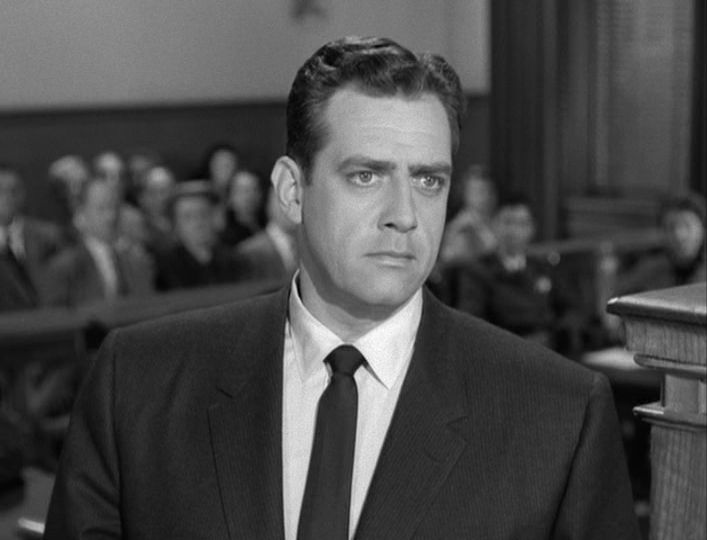
Raymond Burr is the star of the show and he gets to do all the crime solving. Because half the show is usually in the courtroom, we get a mix of a detective story with a courtroom drama. Everything moves fast, and it often feels like the writers are pulling a sleight-of-hand trick at the end. This doesn’t keep me from watching, though. Maybe the appeal of the show is to recreate the logic in the post-show analysis.

I know Perry Mason is an extremely well-loved television show, but I think it could have been much better. I feel it often breaks the rules for writing detective fiction. It makes Perry invincible which makes Paul and Della feel like subservient pawns in Perry’s game. I think the stories would have been superior if Paul Drake had done most of the detective work and Della had been given more of her own skills to contribute. And the stories would have had far more depth if Perry lost one-fourth of his cases to a more cunning Hamilton Berger. Plus, I think Lt. Tragg should have outsmarted Perry some of the time too. In fact, I think it would have been thrilling if the viewer sometimes got to solve cases that Perry flubbed. Or even have murderers outwit Perry. It gets tiresome waiting for Perry do all his same old tricks in each episode. I haven’t seen many episodes after season three, so maybe things change. Or maybe someone will create a new Perry Mason series.

It’s tedious to have infallible heroes. I wished Perry Mason had broken its formula writing rules and followed more closely the rules for writing whodunits. Like I said, I’m just getting into murder mysteries. I’ll start taking notes and analyzing some of the more interesting Perry Mason cases. Maybe the clues are all there and the writers are on the up-and-up, and I’m just a terrible murder mystery solver. I need to prove my case that Perry Mason breaks the rules with more specific facts, which will require deconstructing some episodes in the future.

JWH

Why Am I Binge Watching Perry Mason?

by James Wallace Harris, Wednesday, November 28, 2018

Until the success of the VCR in the second half of the 1970s fans of television shows couldn’t just watch their favorite episodes whenever they wanted. I’m not sure people born after the DVR will understand that. In the early decades of television, a show premiered in its allotted time slot, and then a subset of that season got repeated in the summer reruns. You might fall in love with a particular episode and not get to see it again for decades.

Eventually, popular shows like I Love Lucy, Perry Mason, and Star Trek made it into syndication. If a fan was patient they could eventually see every episode of a series. Early adopters of VCRs took pride in collecting a complete run of their favorite shows, especially if it took years.

Nowadays fans can watch almost any show on demand. Some TV aficionados only watch a show when it has been completed or canceled so they can see the complete story on DVD or streaming. Meaning, they can watch an entire multi-year series by binge-watching for several days or weeks. After randomly watching about 50 episodes of Perry Mason on MeTV during the last year, I decided to start with season 1, episode 1 on CBS All Access and watch the entire 271 shows in order. They only have seasons 1-5, but I hope they’ll add the rest, otherwise I’ll have to buy the DVDs. (Maybe that’s their intention.)

I have to ask myself: Why Perry Mason? Even though Perry Mason is one of the most popular TV shows ever, it’s artistic quality pales compared to modern television series like Breaking Bad, Downton AbbeyThe Game of Thrones, The Crown and The Marvelous Mrs. Maisel.

Often when I watch an episode of Perry Mason my mind boggles by how the plot struggles to make any kind of logical sense. And Perry, Della, and Paul are completely lacking in the kind of vivid personal details we expect in 21st-century TV shows. I’ve never liked murder mysteries, never cared whodunit, and I never guess the guilty person while watching Perry Mason. Yet at this time in my life, I find the show very addictive.

I’ve binge-watched nearly of all the most popular television series since The Sopranos so I know Perry Mason is primitive in comparison. According to Wikipedia, “Perry Mason is Hollywood’s first weekly one-hour series filmed for television and remains one of the longest-running and most successful legal-themed television series.”  It premiered on September 21, 1957. The contrast between TV storytelling in 1957 and 2018 is startling. The evolution of creating TV shows during those years is worthy of countless Ph.D. dissertations.

The difference between television then and now is so stark, that I can’t imagine younger fans even being able to even watch Perry Mason. Except for one episode, it was filmed in gorgeous black and white. To the current generation, it would be like Baby Boomers having embraced early silent movies in their teens. So, why am I watching Perry Mason now when I could be watching countless superior shows? I think there’s something psychological I need to unearth. And it’s taking the length of a long Atlantic Monthly essay to scope out the problem. I doubt seriously if even my closest friends will want to read all of this, but I feel compelled to write out why. I need to explain it to myself.

Socrates warned us the unexamined life if not worth living. I’ve never argued with that. In the last third of life, such self-reflection seems truer than ever even for the smallest aspects of day-to-day living. Have you ever dissected your soul to find out why you love what you love? Stop a moment and think about that. Why is your gray goo wanting to substitute its current sensory input with data from a video screen? Watching television is a rejection of reality for a substitute, and maybe that isn’t bad, but it is revealing. When we tune in, turn on and drop out, what are we really doing?

Maybe you’ve been asked this deep question of why you love TV before, and maybe not. But let’s take it a little further, just a bit deeper. Have you ever asked yourself why you love to watch television with other people? Or do you? What we watch by ourselves tells us so much about ourselves, but what we watch together says so much more about our relationships. I bet you haven’t thought of that one before.

For almost a decade I’ve watched television with my friend Janis. Until this August, my wife had been working out of town all that time and Janis and I would watch shows together three or four nights a week. Janis moved to Mexico this August, something she’s been hoping to do as long as I’ve known her, and Susan finally got transferred back to Memphis. Susan and I discovered we no longer watch the same kind of shows, not like we did before 2008. Now, every evening we watch the NBC Nightly News and Jeopardy together in the living room, and then I go to the den to watch my shows.

What’s enlightening to me is the shows I choose to watch by myself. I assumed I’d continue to watch all the popular binge-worthy shows I had been watching with Janis. But I’m not. For weeks I tried countless shows but my restless mind could not settle on any of them. I ended up watching old westerns from the 1940s and 1950s every evening.

For the last few years, whenever I’m alone watching TV, I binge on Hollywood classics, westerns, film noir, 1960s comedies, or Pre-Code Hollywood from the early 1930s. These have all been life-long favorites. They’ve also been the kinds of films my friends don’t like watching. Then I got hooked on the 1950s and 1960s television shows I hadn’t seen much of when I was young, like Alfred Hitchcock Presents, Route 66, and The Fugitive. After Janis moved away I mostly watched westerns for weeks, mixed it with some Perry Mason. Strangely, all these television shows and movies are in black and white. I wonder what that means?

I’ve gone through a number of psychological changes since I retired five years ago, including how I watch television. I’ve been a TV addict since 1956, but the level of addiction and types of shows I craved have changed many times over the years. The hole in my TV watching schedule is making me think about my lifetime relationship with TV and who I watched it with.

Watching TV by myself is so different from social TV watching. Looking back, I realized I’ve mostly been a social television watcher. There have always been shows I watched by myself, but there have been more shows I watched because of other people. When I was young, I watched shows with my family. Once I got past the sixth grade, I loved watching shows with friends, either at my house or theirs. I got a job in high school in 1968 and quit watching television for many years. That ended some friendships. I seldom watched TV in my college years. As I got back into television around 1975, I began social TV watching with a new generation of friends. Then when I got married to Susan in 1978, and we found prime-time bliss. I would watch her shows and she would watch mine. When Susan move to Birmingham to keep her job, my television life fell apart. Then Janis became my TV buddy during the time that coincided with the era of binge-watching on streaming TV. We picked shows that made us want to watch two or three episodes at a time.

For the last few months, I’ve tried many new series, but my mind can’t stick with them. I keep hopping from one show to the next for about ten or fifteen minutes. Every once I a while I could find a series that would hook me like Sisters season 1 or Man in the High Castle season 3, but for the most part, I’d fall back on westerns. Then I got hooked on Perry Mason.

Remembering my television watching habits when I was 5-15 is a hazy affair. I’d love if my memories were perfect. I do have clues. I have memories of my parents always asking me what was on television even from an early age. There were only three channels back then, so I imagine it wasn’t a great feat for a kid to memorize the schedule. One of the first magazines I remember reading is the TV Guide, but I’m not sure how often we bought it, or when my mother started bringing it home from the grocery store.

What I realized now is I watched all kinds of shows back then because sometimes my parents picked them, and sometimes Becky, my sister, and I got to choose. It wasn’t until I, Spy (1965) and Star Trek (1966) that I tried to never miss an episode of a favorite show. That got interrupted in 1968 as I mentioned before when I got my first punch-the-clock job after school in the eleventh grade.

Wanting to see every episode of a television show became a real habit after Susan and I got married. We loved NBC’s Must See TV Thursday nights. Then in this century with whole season DVD sets of television shows and Netflix. Binge-watching a series from the first episode to last become a thing.

I believe part of the attraction to Perry Mason is because it’s a complete work, and available on DVD. It also appeals to me that I can buy The Perry Mason Book by Jim Davidson for my Kindle, a handy-dandy comprehensive episode-by-episode reference guide to supplement my Perry Mason watching. Even though I don’t care about whodunit in a murder mystery, I do care about what model car Paul Drake drove or where a picturesque scene is filmed. One aspect of Perry Mason I love is the location shooting from 1957-1966. The show is full of little details I find compelling.

Of course, these are piddling details. The urge to go deeper into my unconscious pushes me to find greater insight. I’ve known for years that living in the last third of light resonates with the first third. When I was young I was often disappointed with older people when they told me they were clueless about the current pop culture I valued so much. Now that I’m older I know what it means to not be able to keep up. Perry Mason is familiar territory. The beautiful black-and-white photography is comforting. All the then new cars are the ones I coveted growing up and wished I owned now as classic old cars now. Plus the women in their conical bras and tight sweaters are the prototypes of feminine beauty from my earliest memories of horniness.
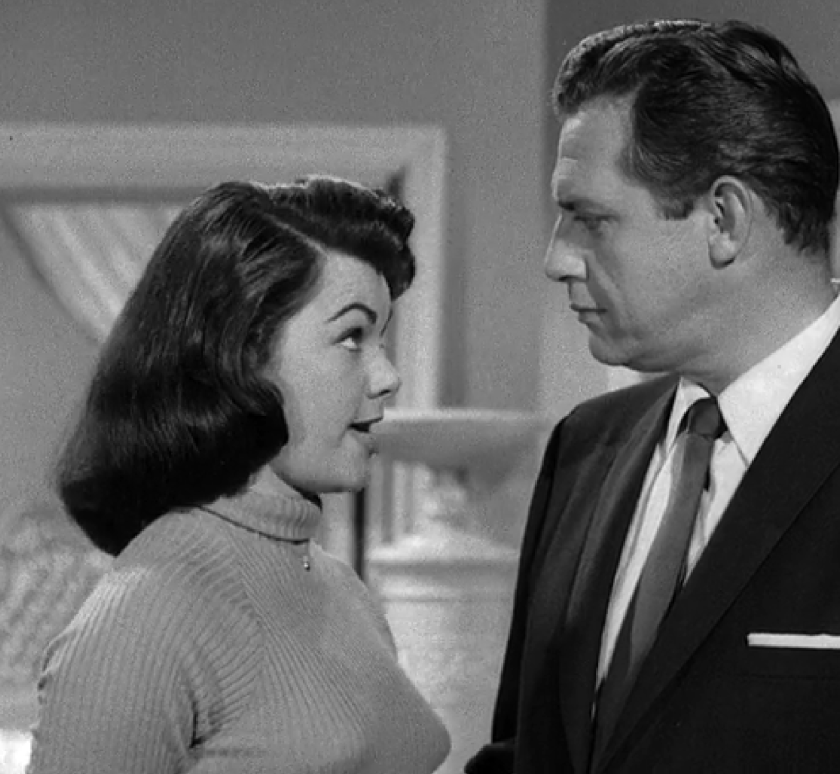
Perry Mason 2Back in the 1990s I flew down to Miami and got my old buddy Connell to drive me to a house where I lived in 1955 when I was four. I stood on the sidewalk in front of my old home, the site of some of my earliest memories of playing outside. I felt like I was standing on the Big Bang beginning of my universe. Watching 1957 Perry Mason takes me very close to that origin. It’s the inflationary period when my mind began to be expanded by television.

So, what does this say about my psychology? Why do I pick a 62-year-old TV show to watch by myself at 67? If I watch TV with friends we’d watch a 2018 show. Susan too watches old TV shows by herself, but they are usually from the last decade, except for Friends. Are the shows we pick reflective of the escapism we need? Is the political incorrectness 1957 much easier to handle than political insanity of 2018?

I wonder what my friends watch by themselves and why? Is everyone sitting alone turning back the hand of time? Some people I know have the TV on all day long to keep them company. They tell me it helps with loneliness. I hate hearing a TV in the daytime. I love TV when it’s dark and late, and I’m too tired to do anything else. I realize now that I categorize my friends by which pop culture references we share. I go flicks with some friends and other films with other friends. I share old science fiction with a couple of friends, but not with the rest. My love of westerns requires hanging out with strangers on Facebook to find anyone to share that enthusiasm.

I have one friend that loves Perry Mason but we seldom see each other anymore since she was a work friend and I’m retired. She watches Perry every night at 10:30. I wish I could watch it with her. But she is younger than I, so I’m not sure we resonate with the same aspects of the show? None of my close friends will watch Perry with me. None of them like the old movies and westerns either. This got me to thinking about how our personalities are divided by what we do alone and what we do together.

I went to see Green Book with a friend after getting positive reviews from several other friends. And I know a few other folks who want to go see it. That means we’re all bonded by this one current movie. I like that. Back in my K-12 days, I’d go to school and seek out other kids who had seen the same TV shows the night before. The same thing happened during my work years.

Some people I know get their feelings hurt if you tell them you don’t like their favorite TV show. I don’t. I am disappointed sometimes when someone I like a lot won’t try a current show I love. I feel like I’m making an offer of connection, and they refuse. I don’t care if they end up hating the show. It’s the willingness to try to communicate that counts.

When I go to a party I ask people what they are watching on TV or going out to see at the movies. When I find someone who has seen what I have, and we both are crazy about the story, I actually like the person more. And if I hear a person put down a show I love, I feel like there’s a side to the person I can’t comprehend. It’s like the old generation gap – a pop culture divide.

Comparing tastes in television shows makes me realize just how different people are in my life. What we share is a kind of Venn diagram of commonality, what we don’t, defines our borders. But I wonder. Is it the shows we watch alone that define us the most, or the ones we share with each other?

JWH


Counting the Components of My Consciousness

by James Wallace Harris, Tuesday, November 20, 2018

When the scientific discipline of artificial intelligence emerged in the 1950’s academics began to seriously believe that someday a computer will become sentient like us, and have consciousness and self-awareness. Science has no idea how humans are conscious of reality, but scientists assume if nature can accidentally give us self-awareness then science should be able to intentionally build it into machines. In the over sixty years since scientists have given computers more and more awareness and abilities. The sixty-four thousand dollar question is: What are the components of consciousness needed for sentience? I’ve been trying to answer that by studying my own mind.

Thinking Machine illustration

Of course, science still doesn’t know why we humans are self-aware, but I believe if we meditate on the problem we can visualize the components of awareness. Most people think of themselves as a whole mind, often feeling they are a little person inside their heads driving their body around. If you spend time observing yourself you’ll see you are actually many subcomponents.

Twice in my life, I’ve experienced what it’s like to not have language. It’s a very revealing sensation. The first time was back in the 1960s when I took too large a dose of LSD. The second time was years ago when I experienced a mini-stroke. If you practice meditation you can learn to observe the moments when you’re observing reality without language. It’s then you realize that your thoughts are not you. Thoughts are language and memories, including memories from sensory experiences. If you watch yourself closely, you’ll sense you are an observer separate from your thoughts. A single point that experiences reality. That observer only goes away when you sleep or are knocked by drugs or trauma. Sometimes the observer is aware to a tiny degree during sleep. And if you pay close enough attention, your observer can experience all kinds of states of awareness – each I consider a component of consciousness.

The important thing to learn is the observer is not your thoughts. My two experiences of losing my language component were truly enlightening. Back in the 1960’s gurus of LSD claimed it brought about a state of higher consciousness. I think it does just the opposite, it lets us become more animal-like. I believe in both my acid and mini-stroke experiences I got to see the world more like a dog. Have you ever wondered how an animal sees the reality without language and thoughts?

When I had my mini-stroke it was in the middle of the night. I woke up feeling like lightning had gone off in my dream. I looked at my wife but didn’t know how to talk to her or even knew her name. I wasn’t afraid. I got up and went into the bathroom. I had no trouble walking. I automatically switched on the light. So conditioned reflexes were working. I sat on the commode and just stared around at things. I “knew” something was missing, but I didn’t have words for it, or how to explain it, even mentally to myself. I just saw what my eyes looked at. I felt things without giving them labels. I just existed. I have no idea how long the experience lasted. Finally, the alphabet started coming back to me and I mentally began to recite A, B, C, D, E, F … in my head. Then words started floating into my mind: tile, towel, door, mirror, and so on. I remembered my wife’s name, Susan. I got up and went back to bed.

Lately, as my ability to instantly recall words has begun to fail, and I worry about a possible future with Alzheimer’s, I’ve been thinking about that state of consciousness without language. People with dementia react in all kinds of ways. From various kinds of serenity, calmness to agitation, anger, and violence. I hope I can remain calm like I did in the bathroom at that time. Having Alzheimer’s is like regressing backward towards babyhood. We lose our ability for language, memories, skills, and even conditioned behaviors. But the observer remains.

The interesting question is: How much does the observer know? If you’ve ever been very sick, delirious, or drunk to incapacity, you might remember how the observer hangs in there. The observer can be diminished or damaged. I remember being very drunk, having tunnel vision, and seeing everything in black and white. My cognitive and language abilities were almost nil. But the observer was the last thing to go. I imagine it’s the same with dementia and death.

Creating the observer will be the first stage of true artificial intelligence. Science is already well along on developing an artificial vision, hearing, language recognition, and other components of higher awareness. It’s never discovered how to add the observer. It’s funny how I love to contemplate artificial intelligence while worrying about losing my mental abilities.

I just finished a book, American Wolf by Nate Blakeslee about wolves being reintroduced into Yellowstone. Wolves are highly intelligent and social, and very much like humans. Blakeslee chronicles wolves doing things that amazed me. At one point a hunter shoots a wolf and hikes through the snow to collect his trophy. But as he approaches the body, the dead wolf’s mate shows up. The mate doesn’t threaten the hunter, but just sits next to the body and begins to howl. Then the pack shows up and takes seats around the body, and they howl too. The wolves just ignore the hunter who stands a stone’s throw away and mourns for their leader. Eventually, the hunter backs away to leave them at their vigil. He decides to collect his trophy later, which he does.

I’ve been trying to imagine the mind of the wolf who saw its mate killed by a human. It has an observing mind too, but without language. However, it had vast levels of conditioning living in nature, socializing with other wolves, and experiences with other animals, including humans. Wolves rarely kill humans. Wolves kill all kinds of other animals. They routinely kill each other. Blakeslee’s book shows that wolves love, feel compassion, and even empathy. But other than their own animalistic language they don’t have our levels of language to abstractly explain reality. That wolf saw it’s mate dead in the snow. For some reason, wolves ignore people, even ones with guns. Wolves in Yellowstone are used to being watched by humans. The pack that showed up to mourn their leader were doing what they do from instinct. It’s revealing to try and imagine what their individual observers experienced.

If you meditate, you’ll learn to distinguish all the components of your consciousness. There are many. We are taught we have five senses. Observing them shows how each plays a role in our conscious awareness. However, if you keep observing carefully, you’ll eventually notice we have more than five senses. Which sense organ feels hunger, thirst, lust, pain, and so on. And some senses are really multiple senses, like our ability to taste. Aren’t awareness of sweet and sour two different senses?

Yet, it always comes back to the observer. We can suffer disease or trauma and the observer remains with the last shred of consciousness. We can lose body parts and senses and the observer remains. We can lose words and memories and the observer remains.

This knowledge leaves me contemplating two things. One is how to build an artificial observer. And two, how to prepare my observer for the dissolution of my own mind and body.

JWH

Bookworms Should Worship Scribd

by James Wallace Harris, Monday, November 19, 2018

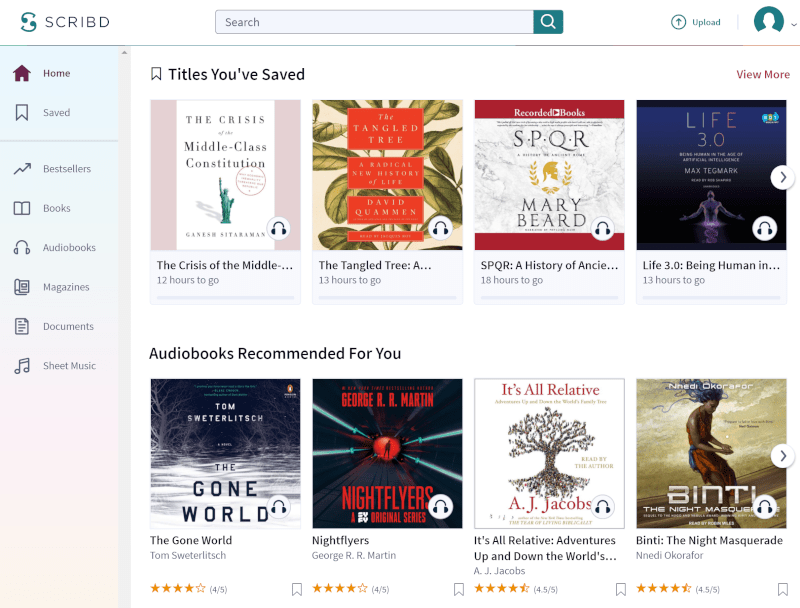
Scribd is to books and audiobooks as Netflix is to movies and television shows, and Spotify is to songs and albums. For $8.99 you get all the books and audiobooks you can read or listen to in a month. The complete variety of its offerings is somewhere between Netflix and Spotify. I consider Spotify at $9.99/month the best bargain on the planet because it provides nearly every song or album I ask from it. Scribd has about 80% of the books I read for book clubs or hear about word of mouth. It has around 25-30% of the older titles I want, but that’s better than Netflix. Plus Scribd offers magazines, sheet music, and single documents. Here’s my home screen.

Scribd 800

Every month I realize the value of my $8.99 subscription more and more. Yesterday I got a sale announcement from Audible.com for about 500 books. I love these $4.95-6.95 sales, and usually, load up. I told myself I could buy ten of them. I selected 17 to whittle down, but before I did I checked Scribd. All but one was there. This left me in a quandary. Did I spend $60 and hoped I eventually get around to listening to those books or did I take a chance they’d still be at Scribd when I wanted them?

I usually end up listening to one or two books a month from Scribd, and two or three from Audible. This might change. At $8.99 versus $20-30 (I buy the annual 24-pack of credits so my Audible books are $9.56 each, but single purchased credits are $15, which would be $30-45).

I’m in two nonfiction book clubs. Saturday night my face-to-face book club picked Sharp by Michelle Dean. The ebook version was at Scribd. White Trash, Bad Blood, and Educated, the last few selections I remembered were there too. I’m also in an online nonfiction club too. I’m listening to our current selection, American Wolf as an audiobook from Scribd. Next month’s read, The Crisis of the Middle-Class Constitution is also at Scribd, as was last month’s selection, Fascism by Madeleine Allbright. We’re now nominating books for the next three months. Here are the books at Scribd that’s among the nominations:

  • The Tangled Tree by David Quammen (audio)
  • Bad Blood by John Carreyrou (audio)
  • A Brief History of Everyone Who Ever Lived by Adam Rutherford (audio, ebook)
  • Leonardo Da Vinci by Walter Isaacson (audio, ebook)
  • The Library Book by Susan Orlean (audio)
  • My Beloved World by Sonia Sotomayor (audio)
  • Disinformation by Ronald J. Rychlak (ebook)

The nominated books that weren’t at Scribd are:

  • On Paper: The Everything of its 2000 Year History by Nicholas Basbanes
  • The Book: A Cover to Cover Exploration of the Most Powerful Object of Our Time by Keith Houston
  • Process: The Writing Lives of Great Authors by Sarah Stodola
  • Essential Essays Adrienna Rich

For months now, the books we actually select with our voting end up being on Scribd. However, this is only for nonfiction. I’m not in a general fiction book club. But for my science fiction book club, Scribd does well on new science fiction titles, but less well for older titles. The book we just picked for January, Noumenon by Marina Lostetter is available in both ebook and audiobook at Scribd.

I’ve always been a book hoarder, squirreling away books for the future. Now I need to rethink my book buying habits. I’ve practically stopped buying CDs because of Spotify. The only DVDs I buy anymore are rare titles for my western collection, everything else I stream. Is it time to rent my books too?

Every day I look at ebook sales from Amazon, BookBub, Early Bird Books, and LitFlash. At $1.99 I can’t resist a great book I think I want to read. But subscribing to Scribd is like having my own gigantic library with instant access to books and audiobooks, far more convenient that my local public library.

But owning books is so fulfilling! At $8.99 a month, even if I just used Scribd to preview the books I want to buy it’s a fantastic bargain. And if you’re a Kindle Unlimited subscriber, don’t think it compares to Scribd. Amazon doesn’t provide access to the books I want at Kindle Unlimited. Amazon seems to use up-and-coming writers and self-published books for its subscription service. And that’s a good thing for new writers, but it’s not what Scribd is doing. If you belong to a book club you really need to check out Scribd.

The reason I’m writing this essay is selfish. Scribd is just hanging on. It’s been reorganized several times. Several other book rental companies have come and gone. All are being squashed by the Amazon juggernaut. I want Scribd to survive and thrive so I will always have access to it. Give it a try if you love books.

I’m still crazy about Audible.com. I’m not going to abandon it. I’m a big fat bookworm, so I think paying for both is worth it. But for people who think Audible.com is too expensive at $15 a month, they should consider spending $8.99 a month at Scribd. It’s a much better bargain.

JWH


The Future Belongs to the Young and Diverse

by James Wallace Harris, Thursday, November 15, 2018

We can easily see a difference between conservatives and liberals in these pictures. This photo spread has become a popular meme on Facebook. The new conservatives in Congress are all white males except for one white woman. The liberals are still mostly white, but there are more women, and if you look closer, there’s more diversity. If you study the photos a bit more, it appears the liberals are younger on average.

Personally, I think this is good. I feel there are too many old white guys running this country, and I’m an old white guy. I don’t want to get into politics here, but talk about the future. It’s time to rethink everything. We have more problems than any single ideology can solve. If ever there was a time to think out of the box, it’s now.

We’re at a crossroads where one dominant group is fighting with everything they’ve got to retain their dominance. But we live in a country of 325.7 million very diverse people. You can’t judge by appearance. You can’t go by age or gender. But the odds are if all our leaders look the same then everyone is not getting proper representation.

I don’t want leaders who are driven by special interests or limited philosophies. I want leaders who feel compelled to make the 100% happy with the government, not just their own 50%. I want leaders who can see the giant multi-dimensional picture of global everything. Think global act local is still a valid mantra. Our current government is run by a fraction for their own self-interests — that can’t succeed. We are doomed if our votes are only guided by self-interest.

I love the photos above because the diversity of faces looks like the diversity of faces I see everywhere in America. I love the faces above because they are young and the future belongs to them. I don’t want to be governed by a desperate minority hanging onto yesterday, I want to be governed by the majority who will build tomorrow.

JWH