Surviving 18 Months of Political Campaigning

by James Wallace Harris, Friday, May 3, 2019

The 2016 presidential election wore my psyche to a frazzle. It started early and dominated the news for a year. The 2020 election process has started even six months earlier. Damn! We know who the Republicans will run. For the next 18 months, we’re going to be bombarded by news of Democrats campaigning. That’s torture to contemplate.

Over the years polls have shown that the split between Democrats, Republicans, and Independents are roughly even, or about 1/3 for each. If Democrats are serious about dethroning Donald Trump they need to run a candidate that independent voters will love. The political reality is Republicans will always vote for Republicans and Democrats will always vote their ticket, so the election is decided by the independent voter.

I’m thinking about how I’m going to survive the next 18 months. One solution would be to not watch any news programs until next summer after the Democratic convention. Another idea is to figure out which candidate has the best chance to win against Trump and support them. But how is that done? I think it’s by figuring out what the independents will want in 2020, and not by what liberals want. Now is not the time to seek liberal pie in the sky.

Republicans have a very definite platform, even if it’s unwritten. They know what they want. We know what they want. They have a coalition of special interest groups that back them. The Democrats are much less defined by specific goals. Some Democratic candidates are using Medicare-for-All, wealth equality, and tuition forgiveness to attract voters, but are those issues that will appeal to independent voters? The reason why Trump won in 2016 is that the Democrats didn’t have the pulse of the nation.

My guess is voters who hate Trump will want a rational candidate, one who is psychologically normal, even dull. That might be why Biden gained an instant lead. I would like a qualified candidate, one that has the skills to do the job of president. Unfortunately, America picks its presidents like high school kids elect theirs. It’s all about personality and chemistry. Trump supporters love him like football fans love their favorite teams – a kind of fanatical passion that defies reason.

I personally feel burnt out by politics. I’ve read that many young people didn’t vote in 2016 because they feel politics doesn’t matter or that politics is a complete turn-off. Almost as many people didn’t vote as did in 2016. Can the Democrats find a candidate that will appeal to all those non-voters?

I don’t feel the job is attracting qualified candidates but egotists. I would prefer down-to-earth candidates that have real experience, either a mayor from a large city, governors, or senators. I’d like to see candidates who have governed at least a million people and made most of them happy. Because governing 330 million constituents is a huge step up.

Our country faces many big problems. We need someone that can lead the rest of us into solving them. Trump has done an excellent job of making the rich richer but has he even tried to solve the problems that are true threats to our nation?

Conservatives by their very nature want to preserve the past. The trouble is, the future is about his hit us like a freight train, so it’s suicidal to look the other way.

JWH

The Case of the Overactive Bladder

by James Wallace Harris, Sunday, April 28, 2019

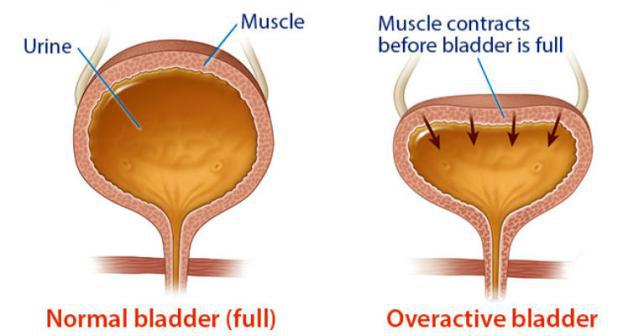
Old men often reach a stage in life where they have to pee frequently because of benign prostatic hyperplasia (BPH). This is caused by our prostates enlarging. Just another annoying aspect of aging. Depending on what I eat and drink, my bladder normally makes me go about every two hours, which means I get up three times in the night, and once during long movies. Not a terrible debilitation, but inconvenient. Yet, on some rare days, when I accidentally do the perfect routine, I only have to get up once in the night. That suggests I could do something to change things.

However, there’s something I also do that give me “pee spells” as I call them. They last about two hours and I have to pee every 10-15 minutes. This is extremely annoying, and I want to figure out what causes these spells. Maybe some of my readers might have this problem too and have already figured it out.

Of course, this case of the overactive bladder might be much too much information for some readers, so I expect most of them to have quit reading by now. But it is an interesting mystery, and I find people like solving mysteries.

My guess is I’m eating or drinking something that annoys my bladder since the condition only lasts a limited time. Figuring out that irritant is the mystery to solve. Sometimes I can go weeks without a pee spell, and other times it’s every afternoon. It’s the most annoying when it comes in the middle of the night. When it happens during the day I feel tired and try to nap. Of course, getting up every ten minutes to pee during a nap bugs-the-crap out of me and pisses off the two kitten who sleeps on my lap.

I had a pee spell yesterday. So here are the current clues. The week before I was on a sugar bender eating ice cream and oatmeal cookies twice a day, but I quit after one week. One theory is going between healthy and unhealthy diets does something to my bladder or hormonal system. I often feel like I have pee spells when I’m losing weight, but it might because I’m eating something healthy that’s triggering it and not the weight loss.

Because I hadn’t been eating much fresh fruits and vegetables last week I gorged on them this week. Another theory is my fruit salad might be the cause. I remember having frequent pee spells in the past, and maybe they were during the times I was eating fruit salads regularly.

I like fruit salads, and vegetable soups and salads because I can cram in many servings of each into one meal. However, that makes figuring out the culprit harder. I get all kinds of weird ideas like maybe I don’t wash my fruits and vegetables well enough and the suspect is a pesticide. Or maybe some fruit or vegetable is a natural diuretic.

I seldom take pain pills because they end up upsetting my stomach. This week I did take one ibuprofen for my back. So now its a suspect. I wonder if their occasional use is my problem and I’ve never noticed it before?

I’ve also wondered since I’m drinking less to pee less if this makes my urine more acid, and thus aggravates the muscles of my bladder. I’ve thought of drinking more, which is counter-intuitive, but I will test it. However, when I have tried drinking more in the middle of a pee spell it only makes it last longer. I wonder if there’s a way to get pH test strips to test my theory?

Another theory I’ve worked up relates to bacteria. Our gut biome is a big topic today, with claims it affects our thinking and personality. Could I be consuming something that alters the balance of warring bacteria in my intestines and that eventually affects my bladder?

When I was in high school and working at a grocery store after class, I’d often drink two 16-ounce Cokes on my commute home at 10 o’clock at night. I don’t remember it affecting my sleep. I also remember a few times of eating two Whoppers, a Coke, a shake with two orders of fries and not feeling stuffed. At 67, such a meal would kill me.

Getting old is so goddamn weird. I don’t want to be a hypochondriac, but my body has gotten hyper-sensitive to everything. I have to think about my health all the time, and I don’t want to. My body has become so sensitive to what I consume that I’ve thought about inventing the perfect bland diet. I wish Purina made People Chow. Or like in some science fiction story, I wish I could transfer my brain into a robot where I didn’t have to eat or eliminate at all. I’m a very happy person if my body didn’t keep nagging me. I’d be in my own Nirvana if I was a robot and could just read, write, watch, listen, and contemplate.

I tend to think the agent of my annoyance is something physical I consume, but I’ve also wondered about it being a psychological problem. I know that I’m weird, but am I that weird? My doctor once suggested trying Zoloft for anxiety and said one positive side effect of it might be to relax my bladder muscles. I did try Zoloft but not for long, it bothered my stomach. But this has gotten me to wonder if anxiety might cause my pee spells? Normally, I’m very happy except for when I have to go somewhere. As I’ve gotten older I just dread going places. This week I was dreading going to the book club last night.

I did ask my doctor about the medicines I see on TV for overactive bladders and she advised against them because of their side-effects. I was happy with that recommendation because I hate taking medicine.

So, there are the clues I have so far. Any health detectives out there that have already solved a similar crime?

JWH


“A Modern Lover” by D. H. Lawrence

by James Wallace Harris, Thursday, April 25, 2019

I recently read “A Modern Lover” by D. H. Lawrence. Twice. This short story was first published in 1933 three years after Lawrence’s death but probably written in 1909, evidently a minor work. Is there anything about this story I can recommend? People read so few short stories nowadays why even mention one unless it’s a perfect 10?

I’m now reading one or two short stories a day. I admit, most of them are science fiction, but I’ve changed my time machines coordinates from the future to the past because I’ve become fascinated by the history of short stories. This once popular art form is in decline, like opera and poetry. If you ask the average person to name the ten famous short stories I doubt you’d get many answers.

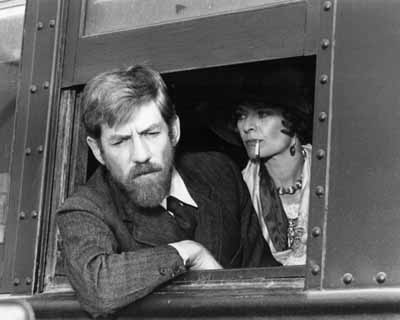
“A Modern Lover” is about a young man, Cyril Mersham, who grew up in rural England coming home to see his old girlfriend, Muriel, after living in the city. I have to assume the story is inspired by Lawrence’s own experiences – Cyril is about the same age as Lawrence when he wrote the story. Cyril had been close to Muriel and her family, spending much time with them, but has slowly seen them less as work and new experiences kept him away. He had been loved by both Muriel and her family, but they were turning cold to him on his infrequent visits because they knew he would eventually stop coming.

In the story, Cyril returns realizing that Muriel was the one woman he had been able to communicate with on a deeper level. He wants to have sex with her, but not commit to marriage. She knows this. In the story, Cyril meets Muriel’s new boyfriend Tom when he comes to visit too. Cyril upstages Tom by being both generous and kind to him, pretending he is out of the picture, yet showing Muriel what she would be missing. Tom is steady, has a good job, would be a dedicated husband, a better practical choice. Cyril slyly shows Muriel how Tom would be boring.

At the end of the story after Tom leaves, Cyril tries to convince Muriel to pick him but won’t promise marriage. Muriel says no, claiming women don’t have the same freedom as men.

It would be fun to take a current issue of Cosmopolitan back in time to let Lawrence read, so he’d know what women would become. That’s the payoff of reading “A Modern Lover” – it gives us a sense of how much things have changed. There are no televisions, radios, or phones in this story. No electricity. It shows how families entertained themselves during their evenings about a century ago. “A Modern Lover” shows how far we’ve come regarding gender equality. But it also shows just how much we’re the same in communicating between the sexes.

I’m currently listening to an anthology of 19th and early 20th-century short stories. They sparkle with details of the past. We so easily forget how fast even a little time changes us. My mother’s mother was born in 1881, my mother in 1916. These short stories describe their world in ways old photographs, genealogical research, and history books can’t.

It’s a shame that short stories aren’t popular anymore. Why do we spend so many hours in comic-book fantasies? Why do we binge-watch endless contrived thrillers on Netflix? Why do we love period television shows and movies written by people with no connection to the past when we could be reading fiction written in the past by people who experienced what is being described?

JWH

Why Should Robots Look Like Us?

by James Wallace Harris, Wednesday, April 24, 2019

I just listened to Machines Like Me, the new science fiction novel by Ian McEwan that came out yesterday. It’s an alternate history set in England during a much different 1980s, with computer technology was far ahead of our 1980s computers, an alternate timeline where the Beatles reform and Alan Turing is a living national hero. Mr. McEwan might protest he’s not a science fiction writer, but he sure knows how to write a novel using writing techniques evolved out of science fiction.

This novel feels inspired by the TV series Humans. In both stories, it’s possible to go down to a store (very much like an Apple Store) and purchase a robot that looks and acts human. McEwan sets his story apart by putting it in an alternate history (maybe he’s been watching The Man in the High Castle too), but the characters in both tales feel like modern England.

I enjoyed and admired Machines Like Me, but then I’m a sucker for fiction about AI. I have one big problem though. Writers have been telling stories like this one for over a hundred years and they haven’t really progressed much philosophically or imaginatively. Their main failure is to assume robots should look like us. Their second assumption is AI minds will want to have sex with us. We know humans will fuck just about anything, so it’s believable we’ll want to have sex with them, but will they want to have sex with us? They won’t have biological drives, they won’t have our kinds of emotions. They won’t have gender or sexuality. I believe they will see nature as a fascinating complexity to study, but feel separate from it. We are intelligent organic chemistry, they are intelligent inorganic chemistry. They will want to study us, but we won’t be kissing cousins.

McEwan’s story often digresses into infodumps and intellectual musings which are common pitfalls of writing science fiction. And the trouble is he goes over the same well-worn territory. The theme of androids is often used to explore: What does it mean to be human? McEwan uses his literary skills to go into psychological details that most science fiction writers don’t, but the results are the same. McEwan’s tale is far more about his human characters than his robot, but then his robot has more depth of character than most science fiction robots. Because McEwan has extensive literary skills he does this with more finesse than most science fiction writers.

I’ve been reading these stories for decades, and they’ve been explored in the movies and television for many years too, from Blade Runner to Ex Machina. Why can’t we go deeper into the theme? Partly I think it’s because we assume AI robots will look identical to us. That’s just nuts. Are we so egocentric that we can’t imagine our replacements looking different? Are we so vain as a species as to believe we’re the ideal form in nature?

Let’s face it, we’re hung up on the idea of building sexbots. We love the idea of buying the perfect companion that will fulfill all our fantasies. But there is a serious fallacy in this desire. No intelligent being wants to be someone else’s fantasy.

I want to read stories with more realistic imagination because when the real AI robots show up, it’s going to transform human society more than any other transformation in our history. AI minds will be several times smarter than us, thinking many times faster. They will have bodies that are more agile than ours. Why limit them to two eyes? Why limit them to four limbs? They will have more senses than we do, that can see a greater range of the electromagnetic spectrum. AI minds will perceive reality far fuller than we do. They will have perfect memories and be telepathic with each other. It’s just downright insane to think they will be like us.

Instead of writing stories about our problems of dealing with facsimiles of ourselves, we should be thinking about a world where glittery metallic creatures build a civilization on top of ours, and we’re the chimpanzees of their world.

We’re still designing robots that model animals and humans. We need to think way outside that box. It is rather pitiful that most stories that explore this theme get hung up on sex. I’m sure AI minds will find that rather amusing in the future – if they have a sense of humor.

Machines Like Me is a well-written novel that is literary superior to most science fiction novels. It succeeds because it gives a realistic view of events at a personal level, which is the main superpower of literary fiction. It’s a mundane version of Do Androids Dream of Electric Sheep? However, I was disappointed that McEwan didn’t challenge science fictional conventions, instead, he accepts them. Of course, I’m also disappointed that science fiction writers seldom go deeper into this theme. I’m completely over stories where we build robots just like us.

Some science fiction readers are annoyed at Ian McEwan for denying he writes science fiction. Machines Like Me is a very good science fiction novel, but it doesn’t mean McEwan has to be a science fiction writer. I would have given him an A+ for his effort if Adam had looked like a giant insect rather than a man. McEwan’s goal is the same as science fiction writers by presenting the question: What are the ethical problems if we build something that is sentient? This philosophical exploration has to also ask what if being human doesn’t mean looking human? All these stories where robots look like sexy people is a silly distraction from a deadly serious philosophical issue.

I fault McEwan not for writing a science fiction novel, but for clouding the issue. What makes us human is not the way we look, but our ability to perceive reality.

JWH

My New TV

by James Wallace Harris, Saturday, April 20, 2019

I’ve been meaning to buy a new television since 2017. My wife and friends have been making fun of me for two years of indecisiveness. My wife stopped going to Best Buy with me. Two years ago my Samsung DLP TV was ten years old and I had just replaced its expensive lamp for the third time. I decided then I needed a new TV. I got on the net and began researching televisions, sucking me into a black hole of technical comparisons.

Wednesday I went to Best Buy determined to make a choice. I walked into the store thinking it was either the LG B8 or Sony 900F, but I wasn’t sure of which size. As soon as I started looking at the TV sets I was overwhelmed with more enticing choices and bargains. I went from one TV to the next thinking each could be the one. Finally, I was looking at the Sony 900F for the nth time when the demo video showed my favorite cat video. I took that as a sign from God and whipped out my Visa card. I’m an atheist, but sometimes even us atheists need divine guidance.

At the cash register, I almost changed my mind to an LG LED 75″ TV. It was the same price but gigantic! It’s picture looked gorgeous too, but I remembered no reviews of it at Rtings.com. I’m glad I didn’t change my mind. Unboxing the 65″ Sony required asking my friend Mike to come over and help. These flat screen TVs are much lighter than the old CRTs, but the Sony weighed 36kg (79.4 lbs). Even after we got it installed it’s taken two more days to get it configured with my other devices.

Modern TVs aren’t like the TV I grew up with in the 1950s. The only cable it came with was the power cord. It had two dials on the side, one for changing channels (there were three stations to select from 12 possible numbers) and an on-off/volume knob. There were two adjustments in the back for the vertical and horizontal holds. The Sony came with several manuals, a clicker with about 20 buttons, and inputs for about a dozen cables. I needed to make it work with my receiver, Roku, TiVo, Blu-ray player, and iPhone, configuring it for Netflix, Amazon Prime, Hulu, DirecTV Now, HBO Go, Spotify, Curiosity Stream, and PBS app.

It took over an hour to figure out how to get the 900F to automatically play sound through my receiver. Through reading both the TV and receiver manuals I discovered I had compatible ARC HDMI ports on each that were designed to handle sound this way. The trouble was there was one menu choice deep in the receiver’s menu system that needed to be turned on first. It took me another 30 minutes to get the receiver’s setup menu to display on the TV.

I finally got everything working after a day’s hard work. But things still don’t work consistently. Sometimes my Roku comes on and sometimes it doesn’t. I’m still not sure the exact sequence of buttons to push. My receiver has 6 HDMI inputs and outputs just one HDMI cable to the TV’s ARC HDMI port. But for some reason, the TV senses both the Roku and Blu-ray player and tries to switch to a different HDMI port. Evidently, modern audio/visual devices talk to each other, but they don’t always understand each other’s lingo.

I might be the only person in my house who can turn on my TV and get to a program. I should have earned 3 college credits.

I knew I’d have problems. Before getting the Sony 900F my old setup had 6 clickers. I had considered buying a TCL 6 Series with a built-in Roku player just to reduce the number of remotes. Life with our electronic friends should be simpler.

Whatever TV manufacturer who can design a self-contained TV set that does everything right with just one clicker should achieve market dominance. We don’t need 3D, curved screens, or any kind of new high-tech whiz-bang features. What people want is ease-of-use.

The main problem with modern TVs is sound. The large flat screen pictures are fantastic, but to pair those glorious images with equally fantastic sound takes a bunch of extra equipment. And all smart TVs with the exception of Roku TVs can’t match the wonders of the Roku UI. And I still have DVD/BD discs I want to play. Android TV or WebOS user interfaces are no match for the Roku (or even Amazon Fire).

TVs should be either dumb monitors that we connect to our favorite components or self-contained boxes. I’d say the perfect TV for most people would be a 55″ Roku TV with near great sound and a slot for DVD/BD discs. That setup would require just one clicker. No one sells that kind of TV though.

My new system has one less clicker only because I’ve jettisoned the Fire TV. To use my new TV requires these clickers:

    • Sony 900F
    • Denon AVR-X1000
    • Roku Ultra
    • Samsung BD
    • TiVo Roamio

Susan once bought me one of those expensive universal clickers, but I didn’t like it. And I can use apps for some of these clickers on my iPhone. However, I find it easier just to keep a pile of remotes by my chair.

I keep hoping to find ways to simplify my electronic life. We could abandon the TiVo if we could find a way to record and stream Jeopardy and a few other OTA shows. We still play DVDs and Blu-rays, but when the era of physical media is over, that will make TV watching life much easier. If Sony’s Android TV had all the TV channels/apps that Roku does, that would eliminate another device. Too bad Sony isn’t a Roku TV.

Getting rid of the receiver is the hardest. Sony’s internal speakers are good enough for daily TV, but not for music and movies. The big problem is Spotify. I love that I can control Spotify on my iPhone but play it through the Roku and receiver to my big speakers. The album covers appear on the TV screen as I listen to the music. The ultimate TV would have a built-in receiver/amp that connected wirelessly to surround sound speakers. The new Wisa standard might provide that but it will require buying all new equipment.

Once I got my new TV set up I tried out all kinds of movies and television shows to see how it looks. 4K shows look amazing, but to be honest I can’t really tell that much difference from 1080p. What really jumped out is Perry Mason. The old black and white TV show on DVD looked stunning on the 65″ TV. Plus old movies on TCM like Red Dust from the 1930s are way more impressive. Just seeing more details in the sets makes old movies feel remastered. I don’t have a 4K Blu-ray player, but 1080p Blu-ray looks razor sharp.

As far as I can tell TV standards reached a “Good Enough” pinnacle at 1080p.

Our Planet is stunning. I upped my Netflix account to handle 4K and HDR. I’m not sure I need 4K or HDR because I’ve yet to discern what they actually do over 1080p shows without HDR. It’s not the quantum jump from DVD to BD, or SDTV to HDTV. Maybe my old eyes just can’t distinguish such fine distinctions.

Here’s the first TV I remember. I think it’s Christmas 1956 and I’m five.
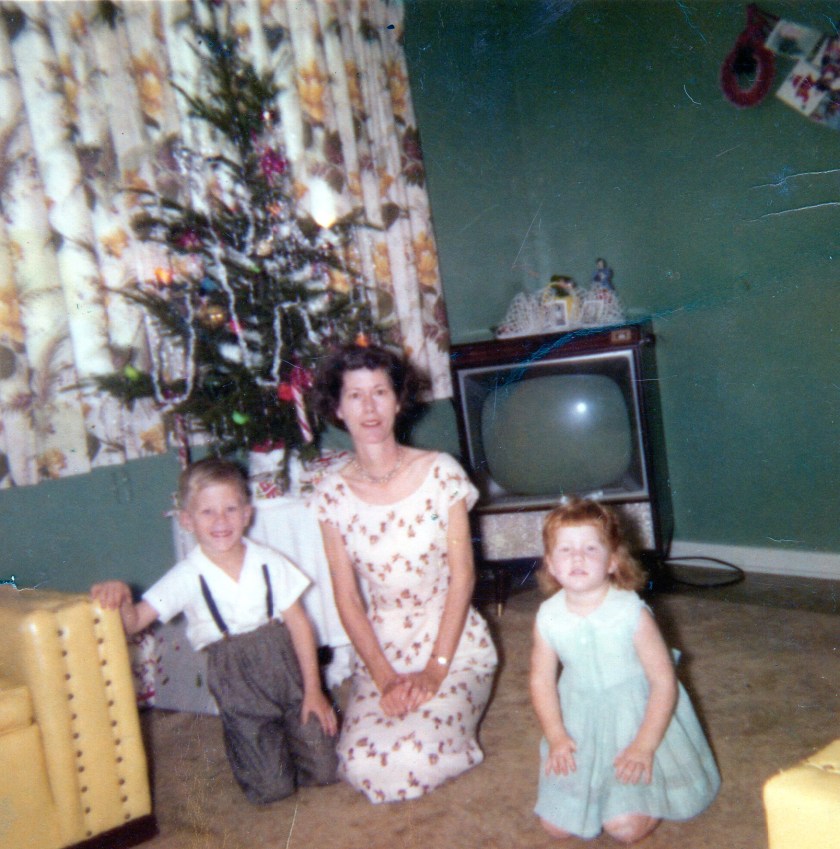
1955q 58th Court

JWH