Red Planet by Robert A. Heinlein

Red Planet was the first Robert A. Heinlein novel I discovered back in 1964, and with the first reading of that book I turned into a life-long fan of Heinlein’s work.  From 1964 through 1966 I read Heinlein’s backlog of books, some several times, so after a four year dry spell of no new books I was mentally demolished when in 1970 I read I Will Fear No Evil and hated it.  Somehow my literary hero wrote a clinker, at least in my eyes.  After The Moon is a Harsh Mistress Heinlein (1966), Heinlein never wrote another book I liked.

I still love rereading Heinlein, and usually reread a few of his novels every year.  In the last decade I’ve been listening to audio book editions of his books.  Red Planet just came out on unabridged audio from Full Cast Audio, a company that publishes audio books for young people.  Full cast audio means each character gets their own actor performing the lines.  This works extremely well for young adult novels, and Red Planet comes off wonderful in this format, making each character dramatically stand out.  I’m not sure what authors think about this technique, because the actors get to emotively interpret their character.  In this edition I think they all stay well within the cues Heinlein gave his readers.

This edition of Red Planet from Full Cast Audio uses the restored unedited edition from Del Rey published after Heinlein’s death.  For more information on that, read “Red Planet – Blue Pencil.”

Red-planet-cover

Over the years I’ve struggled with why I don’t like the Heinlein books that came out after 1969.  Why was that such a turning point?  As I got older, I also discovered that his novels after 1959 were different, and they had many elements I didn’t like too.  Before 1969, most of the novels I read were science fiction, but after that my reading tastes broaden.  I was constantly changing from 1969 through 2008, so it’s understandable that my reaction to the books would change too.

Listening to Red Planet gave me an interesting new insight.  Up till now I thought Heinlein became a different person sometime in the 1960s, but in his 1949 story, Red Planet, I found all the elements of later Heinlein hidden away.  The reality is, no matter how much we all feel like we’ve changed and matured, we’re still the same person all our lives.  I’ve long figured that editors influenced what Heinlein wrote, especially before his move to Putnam in 1959 with Starship Troopers.

redplanet2

There’s a strong dichotomy of opinion about Heinlein.  Most of his fans are extremely loyal, if not rabid. There are many people who try to read Heinlein and can’t stand him.  I’m in this middle zone, both loving his work, and despising it, and it’s a very weird position to hold.  I often piss-off other Heinlein fans when I express my doubts, but I seldom meet people who read, reread and study his work like I do.  If I had the time, I’d love to write an analysis of his writing, which I think might end up being a psychological study of myself.

But back to Red Planet.  I’m quite confident that this time was at least my fourth time through the book, and I was amazed by parts I didn’t remember.  It wasn’t until after I finished the story that I discovered I had listened to the revised edition.  Memory is such a fascinating subject.  At one level, I only remembered the book vaguely.  If I had tried to write down what the book was about before I listened to it, I would have given a skimpy plot outline, and then a general impression of several cherished scenes.  When I started listening to the book much of it came back to me, so I could predict just before it happened what would happen.  I call that movie déjà vu because I often feel that when seeing a movie I had watched decades earlier and forgotten.   It’s the weird feeling of knowing what will happen just before the event unfolds.

The revealing part on listening to Red Planet this time, was all the stuff I had completely forgotten since my last reading in 1989.  You’d think after four reading there would be very little I wouldn’t remember at some level.  That wasn’t true.  What’s even more revealing, and I imagine astute readers of this essay will guess, the unfamiliar parts were more like the Heinlein I disliked.  But I hadn’t forgotten.  I was tricked by the new restored edition.

Heinlein had even written Alice Dalgleish, his 1949 Scribner’s editor, “I have made great effort to remove my viewpoint from the book and to incorporate yours, convincingly – but in so doing I have been writing from reasons of economic necessity something that I do not believe.”  I have long theorized that Heinlein’s personal opinions ruined his later stories, and that the reason why I liked the earlier books better were due to editorial censorship.

Story elements that Heinlein would later fixate on are now here in Red Planet, but in shorter, and still restrained form.  Listening to Red Planet showed me I could probably build a list of Heinlein themes that probably exist to some degree in all of his books, either subtly hidden away by editors, revealed by restored editions, or just blaring in later books.

Heinlein explored a wide range of science fictional frontiers, but in the end he often repeated himself thematically.  There is a quality in art that I call the “Beatles Effect.”  I believe a large part of the Beatles success in the 1960s was due to the Fab Four working hard to make every song different.  Mediocre artists tend to create work that has a sameness to it.  Heinlein’s most distinctive individualistic work was all done before 1969, and in particular, before 1959.  During the 1950s, Robert A. Heinlein was The Beatles of science fiction.  Those books are still in print half a century later.  Red Planet has its 60th anniversary next year.

1949 was the year that Red Planet and “Gulf” came out, two stories that anticipated Stranger in a Strange Land, Heinlein’s breakout novel from 1961, that first revealed the true Heinlein, even though Putnam forced him to cut out 60,000 words of that novel.   (Those words were later restored in an uncut edition decades later.)  Listening to the uncut version of Red Planet made it very clear that Heinlein hadn’t changed at different points in his career, but merely, more of his personality had been revealed.

There are two Heinlein aspects that we’re dealing with here.  The first, is a fascinating man that was very opinionated.  The second is a story teller.  As a kid, I imprinted on the storytelling aspect.  As an adult I rebelled against the author’s personality poking through the illusion of the storytelling.

Even in the restored edition, Red Planet is a very slight novel.  It’s overwhelming charm is due to the mysterious Martians and Willis, an engaging talking Martian animal.  What captured me as a 12-year-old was the sense of wonder of humans colonizing Mars, something that would fuel my personal fantasies for decades.  I was also charmed and amused by the antics of Willis.  Heinlein’s juvenile novels often had wondrous alien creatures in them.  And the book was fast paced, and full of adventure for boys.

Red Planet is a good book, but it doesn’t compare well with the dazzling creativity of Heinlein’s later juveniles, Have Space Suit-Will Travel and Tunnel in the Sky.  The ancient culture of the Martians, used in both Red Planet and Stranger in a Strange Land, is an impressive creative achievement on first encounter, but doesn’t hold up to long term scrutiny.  The old Martians are like Australian aborigines.  Their culture is exotic, mysterious and mystic, but after the initial wow, few people would want to follow their lifestyle.   We’re a high-tech species, a species that likes to build and expand.

The super-wise Martians that Heinlein created do not wear clothes or even appear to use tools and they do wonders with thoughts alone.  This appears to conflict with Heinlein’s blaster-toting, rocket-riding humans out to colonize every piece of rock in the universe.  And this is further complicated by Heinlein’s constant promotion of revolution, where bold exploring characters sneer at the corruption of law and order stay-put stick-in-the-mud characters.

Now that the revised version of Red Planet is fresh in my mind, I can easily see how its author will come to write Stranger in a Strange Land in the following decade, and eventually evolve into the man who writes The Cat Who Walks Through Walls.  The disturbing thing is to contemplate which themes will come to dominate.  From 1949 to 1985 Heinlein seems mostly concerned with who deserves to die, and nudity.  This is grossly unfair to the stories, but I think it’s true.

In the restored edition of Red Planet, 1949 Heinlein portrays his colonists of Mars as wearing little clothes when not needing their pressure suits for outside excursions.  In 1961, one focus of Stranger in Strange Land is shedding of clothes.  And in 1985, Heinlein has all his former favorite characters getting naked together.

Even more disturbing is the theme of who deserves to die.  Heinlein’s characters are often preoccupied with who to kill.  Sometimes, it’s individuals, sometimes it’s groups of people, and sometimes it’s whole planets.  As a kid, this motive for story action was no different from the westerns I loved to watch on TV, but now as a person in late middle age, I find very disturbing.

The hated headmaster Howe is “disappeared” by the Martians, but his only real offense was being a strict school administrator and taking a strange pet away from a student.  Heinlein revered his time at the Navy academy, an institution known for strict rules and administrators, so why make such a straw man of boy’s school principal?  Beecher, a colonial administrator is also a man executed by the Martians whose crime was trying to force the colonists to winter in a harsh climate to save the company money.  Not exactly a capital crime in our capitalistic society.  For being known as a conservative, Heinlein seems to love mob rule when it appears to be revolutionary and led by a pseudo-Patrick Henry.  But not every rebellious horde of unhappy armed men equal the American revolution.

The restored political parts of Red Planet make the story more offensive to me, at least as an adult.  As a kid, I would have just skimmed over the boring bits, and all the exotic Mars life and adventure of skating down Martian canals would made me forget them.  So which is the better edition?  I think Heinlein’s original unedited story is better because of the way he handles what happens to Willis.  Ditto for Podkayne of Mars.  Heinlein’s harsher more realistic endings are better, even for kids.  And I have to accept Heinlein as a whole person, even though I don’t like parts of that whole.

It would be interesting if I could read Red Planet at 56 and not be influenced by over forty years of nostalgia.  If I could, I would savage it.  And not just because we know there’s no life on Mars now, but because so much of the story isn’t logical at all.  Jim and Frank wear plastic pressure suits with only jockey shorts underneath and then skate all day on the canals.  Logic tells me the legs of their suits would have pooled up with sweat, and their skin would have been rubbed raw.  And there was no mention of oxygen bottles, or any kind of consumables to power their suits.

Furthermore, there is no, and I mean none, discussion of adapting to living on Mars.  It’s really like living on Earth, but with less oxygen and air pressure.  They have to kill the Mars equivalent of rattle snakes with blasters instead of six-guns.   The boys attend a boarding school, and the only difference is they wear minimal clothes while inside the pressurized areas.  That isn’t about Mars so much as it’s about Heinlein picturing a future where people don’t wear clothes.

What we need is a boys book as exciting as Heinlein’s juvenile novels about what realistic life would be like for future colonists on Mars.  Heinlein was enchanted with the concept but didn’t want to explore the details.  I can’t blame him for wanting to create exotic intelligent life on Mars back in 1949.  That’s what I admired when I first read the story just about the time the first Mariner space missions flew past Mars and showed that Mars was a dead world like the Moon.  Red Planet remains a simple story about a boy and his pet Martian, and it is charming and entertaining.  Time has hurt the speculation, but not the story.

I tend to think twelve year-olds today discovering this story might still be well entertained, but I hope they would be savvy enough about our knowledge of Mars to know that it’s all a fantasy.  I’d bet that they would ignore the silly trumped-up revolutionary politics, and not even think about whether the rest of the story is realistic.  Only the kids who love to read about real space exploration would have an inkling about how complex a pressure suit would have to be, and silly it would be to live on cold Mars and only wear shorts while inside.  Or how silly it would be to have a revolution with Earth that supplies and pays for all the necessities of life.

Like I said, reading Heinlein for me, is more about studying myself.  As a kid I wanted to run away and live on Mars.  It was my Never-Never Land.  What us fans of classic science fiction must ask ourselves is:  Was science fiction just the fairy tales for 20th century children, or was science fiction meant to be more than that?  Heinlein always said he wrote to pay the mortgage.  Were his Scribner’s books just entertaining stories for mid-century boys that helped him pay his liquor bill?

I took his stories as inspiration about exploring space.  So did a lot of other people.  The red planet is still up there, waiting for us.  There are ancient alien life forms waiting for us to discover them.  To me, the real critical question is:  Will humans ever live on Mars.  Heinlein returned to Mars in story after story.  I study what NASA finds with its robots on Mars, but I keep rereading Heinlein.  Why?

JWH – 11/1/8

Ad Pollution

In these bad economic times, it might be heresy to attack marketing, but advertising is starting to crush my innate cheery disposition.  The web is being choked with ads, reducing the signal-to-noise ratio so low that many sites and searches are worthless.  Google, the darling of weberati, whose motto is “don’t be evil,” has become corrupted by advertising revenue.  Slashdot.org should stop making Borg allusions about Microsoft, and start making them about Google.  Too often a search on Google leads to page after page of links to sites wanting to sell me something directly, or links that take me to honey-pot pages, with tiny bits of info nestled in large screen acreage of ads.  For the most part, I’ve replaced the World Wide Web with Wikipedia when I’m searching for knowledge.

I stopped listening to the radio decades ago because of advertising and annoying disc jockeys.  I can only watch TV because of PBS, HBO and DVRs.  I know people who have stopped watching television altogether because of the advertisements.  I’m quickly approaching the decision to stop going to movies because of advertisements.  The only place I don’t mind advertising is the Sunday newspaper, but I feel guilty about all that wasted paper.  Shouldn’t there be a better way?

There are sites on the web that will reward or pay you for looking at ads.  What we need are systems to bring ads to us when we need and want them.  There are times when I’m shopping that I would be open to sales pitches, and I wouldn’t even mind an AI shopping companion.  Marketing really should be on the basis of don’t call me, I’ll call you.

Are ads really effective?  Sure, sometimes.  Those “I’m a Mac, I’m a PC” TV mini-dramas from Apple are effective at making me hate them for selling misinformation and promoting style. I’ve never bought a Mac.  Microsoft is miserable at creating ads, and I always buy their products?  Neither decision has anything to do with advertising.  When I want to buy something, I research it, and then look for the most convenient place to shop with the lowest prices.  And how often do you see ads on TV selling on the basis of price?  I suppose if Apple ran ads that said, “Buy the latest Mac Book with the hi-tech aluminum cases for $899,” I might rush out and buy one.  Instead they sell comedy on TV, without mentioning the details of their products, or the price of the one I want.  Me to Apple, if you want “me” to be a Mac, then sell that $1299 Mac Book for $899, and I’ll come visit your store.

My point is I’ll buy something I’ve studied if the price is right.  The rest of the time I’m just avoiding ads like I avoid mosquitoes, ticks, fleas, germs and viruses.  Of course, the real test of reality is whether or not the various forms of mass communication could exist without advertising.

If there were no advertising, how many television channels would we have?  How many TV shows would exist?  How many college sports programs would exist?  How many professional sports teams would exist?  Can you imagine racing cars without their advertising paint jobs?  HBO and PBS exist without advertising and have outstanding programs.

I’m not alone in my aversion to advertising.  It’s obvious some big economic bubbles have burst this year, and I’m wondering if the advertising bubble will not burst soon too?  As we move into a world-wide recession we’re going to see a lot of companies cut their advertising budgets.  Unless there is real proof that ads bring in dollars, companies will start seeing how naked their marketing programs really are, and close them down.  Recession has a way of cutting out the fat, and mean vicious recessions, like I’m guessing we’re moving into, trims away every gram of grease.

I would like to see more marketing along the HBO model.  I’d rather pay $5 or $10 a month per channel for a handful of quality channels, and abandon all the rest.  I’d rather pay a subscription fee to an online digital magazine if they could provide me the content without the advertising.  Theater owners and movie distributors need to cut the ads before people give up on going to the movies.  And that’s for three reasons.  One I hate seeing the ads.  Two I hate people trying to find seats at the last moment trying to avoid the ads.  And three, I hate that they waste my Saturday afternoon time.

Now, don’t get me wrong.  There are occasions when I want ads.  I’ve been meaning to buy some new shirts, and have wished I could get some stylish ones that fit better.  My wife complains about the constant boring shirts I wear now.  I wouldn’t mind going to a web site and telling it I’m in the mood to buy shirts and then see some healthy competition to market me new styles, especially if I had more choice in sizing and material.

I don’t know what to do about the web.  I can’t believe that all those web pages with Google ads really make enough money to pay their bills.  I was just researching on optical astronomical interferometers and I couldn’t believe the “Ads by Google” signs I was seeing on pages with links to scientific papers.  The reality is we have too many web sites trying to direct us to too few places with real content by paying for their useless help with web ads.  Go away.  Please, turn of your servers, and go away.  If you try to make money on the web by solely linking to other sites, you are worthless.  Google and other top level search engines can do all that work.

Comment to Microsoft, if you want to beat Google, offer a search engine that is based on subscription income and only provides links to 100% content.  I can’t guarantee it will work, but if you offered such a service for $19.95 a year, and you filtered out all commercial web pages, you might have an alternative to Google.  If I’m sick enough of Google’s commercial results and willing to pay, there might be others like me.

This recession is going to shake up how we earn money and how we spend money.  Inflationary bubbles will be bursting everywhere.  I think the advertising world will be one big bubble that’s going to pop big time.  In all the various mass market venues, we’re going to see disappearing players, fewer networks on TV, fewer magazines and newspapers, and fewer web sites.  I’m an ordinary guy, so if I’m reaching the tipping point of running away from advertising, I imagine there are lots of other ordinary folk feeling the same way.

JWH – 10-25-08

Free Stuff Table

At work, years ago we set up a “Free Stuff” table, up on the third floor near the student copier.  I work at a university, in the College of Education.  The free stuff table started with old text books, from a school book repository.  We had a library of K-12 schoolbooks, and when new editions came out, we’d put the old ones on the free stuff table.  After that, when a professor would move their office, or leave the college, they’d dump academic books and journals on the free table they didn’t want to take with them.  Eventually, faculty and staff, began bringing books, magazines, music CDs and LPs, software, VHS tapes, DVDS from home and drop their stuff off on the table.

Sometimes the donations were good stuff, and the table would clear in less than an hour, sometimes even within minutes.  Other times, the table would fill with boring stuff, 20 year old educational journals that would lay there for weeks, but would eventually thin out and disappear.  I used to take old books to the library, but bringing them to work is much easier.

Because of its location, the table needs to stay neat, so mostly people leave small stuff.  Sometimes we’ll see a DVD drive for a computer, or little radio, or various office supply gadgets, but for the most part the giveaways have been books and magazines.  We have a couple hundred faculty and staff, and a few thousand students, and the table is by the computer labs, so it sees a lot of traffic.  The free stuff table has become a form of recycling.

I’m also fascinated by what kinds of books show up there.  Lots of fiction, lots of educational books, but also religious books, statistics, psychology, sociology, kids books, cook books, etc.  After my mom died, I took a bunch of her old books up there, various bibles, religious books, and Edna Ferber novels.  They went quickly.  The other day my wife set out a box of Christmas ornaments to give to Goodwill.  I took them and put them on the free stuff table and they were gone within 5 minutes.  What’s worthless to one person is valuable to another.

I’m writing about this free stuff table as a way to recommend the idea to others.  It could be a common concept at most offices, but I don’t know.  All we did was tape down a sign on a 30″x42″ table that said, “Free Stuff.”  After that, the table took a life of its own.

JWH 10-21-08

Spin by Robert Charles Wilson

Spin by Robert Charles Wilson is an old fashion novel of super-science that won the Hugo award in 2006.  It reminds me of War of the Worlds, but not because the stories are alike, but because of their sense of wonder impact.  I really do not want to say anything about what happens in the story, hoping you’ll just try it sight unseen.  I’d even advice you not to read the blurbs on the book.  If you want the story spoiled, follow the title link to Wikipedia, it explains everything.  I’ve read two other books by Wilson, Memory Wire, and Darwinia, and enjoyed them both.

Of course, this puts me in a quandary, because how do I recommend a novel without giving some juicy tidbits to get you hooked?  If you can imagine how readers in 1898 felt after reading War of the Worlds, then think about what an alien invasion of 2005 would be like, except that it’s a totally new take on alien invasions, and with luck you might feel awe like H.G.’s readers at the end of the 19th century.  The scope of Spin also reminds me of the epoch spanning ideas of Olaf Stapledon.  If you’ve happen to have read Greg Egan’s Quarantine, you might think that Spin is less original, but I found it unique enough to admire it’s vast gee-whiz sense of wondrousness.  However, these two novels do need a name for their new sub-genre of alien invasion types.

Science fiction has a reputation for poor characterization, and science fiction writers are often accused by literary types of producing pawns for their plots, and that’s essentially what Wilson has done here, but I have to give him great credit because Tyler Dupree, the first person narrator, is very engaging, even though he is still a plot pawn.  The trouble is science fiction writers think up ideas first, and then figure out what characters would best show off the ideas dramatically.  It’s probably very difficult to create characters in a SF story that don’t feel like straight men setting up gags for the science fictional funny man.  [That would make a great blog entry – a discussion of SF characters that stand on their own.]

In Spin, Wilson has created a story around three children and then follows their very long lives.  Jason and Diane Lawton are twins, but identical they are not.  Jason represents science and Diane religion, while Tyler plays the reporter of their stories, even though he eventually becomes a doctor.  Jason and Diane are rich, and Tyler is poor, and like the plot of Brideshead Revisited, Tyler loves their big house, admires Jason and falls in love with Diane.   If you subtracted the science fiction, you’d have mediocre love story that would make an entertaining potboiler, but since we’re reading a fantastic tale that John W. Campbell would have loved, that doesn’t matter too much, because when it comes down to it, it’s the super science that dazzles.  The characterization is far better than most pulp fiction, and Wilson does a pretty good job developing the family dynamics of the three children and their three parents.

What Robert Charles Wilson has done is imagine science fiction on a big scale, an evolutionary scale of astronomical time, and then invented a gimmick to make it all work in the short life-time of his very human characters.  That’s one pretty fancy writing trick.  Spin is a very satisfying modern SF novel, that well deserves it’s Hugo award.  I recommend it to all science fiction fans.

JWH 10-20-08

Hubble Telescope at 10x or 100x or 1000x

The other night I caught a new documentary, “Hubble’s Amazing Universe” on the National Geographic Channel that in high definition wonder showed how the Hubble Space Telescope revolutionized astronomy since 1993.  Sadly, I can’t find a link to an online version.  I hope they repeat this HD documentary often because seeing the spectacular Hubble images on a 52″ inch screen was beyond beautiful.  Using technology that I can’t name, they made the images look three dimensional, and the stories that went with them explained why Hubble was well worth it’s price tag of billions.

Now, I’ve got to wonder, what will a telescope that is 10 times more powerful than the Hubble will see and discover?  What about one 100 times more powerful, or even a 1,000 times more powerful?  We really won’t know what such futuristic telescopes will discover, because like the Hubble’s discoveries, they will be unexpected.  In my mind, the most exciting thing these future space telescopes could discover are Earth-like planets orbiting around nearby stars that show indications of life or technology.

image

Pillars of Creation

Ever since our cave dwelling days, humans have been asking how we got here in this unbelievable reality.  Well, the Hubble telescope has shown us how big here really is, both in dimension and composition.  Hubble has revealed stellar nurseries and black hole graves.  It has helped scientists make discoveries about dark matter and energy, and revealed the largest structures in the universe discovered to date.

Most people never ponder the size of reality.  They never grasp that we live in space-time.  Hell, few people even look at up at the lights in the sky at night.  If Genesis had to encompass the scope of Hubble’s vision, imagine how different God and the Bible would have been.  Is there any analogy that I can give that can convey the scope of how far Hubble can see?  If you were the smallest sub-atomic particle in an carbon atom that’s part of a molecule in a one cell of your heart, would any scientific instrument you build show you how big your body would be?  Imagine being one grain of sand and trying to count all the others on a beach?  In the photo above, our solar system is so small it wouldn’t be seen in those dust pillars that are light years high.  But look at the picture below.  The above scene is smaller than you in relation to the solar system compared to the objects in the photo below.

image

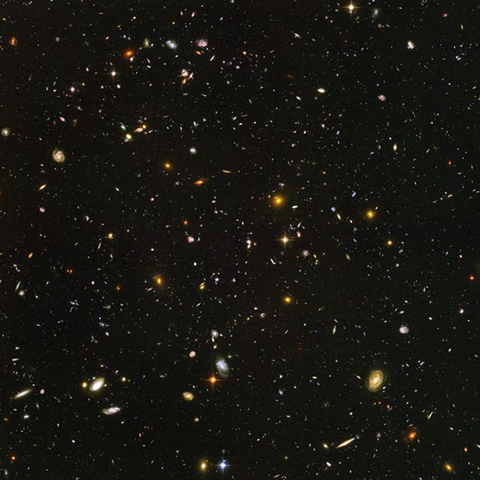
This is the famous Hubble ultra deep field photo, where scientists tried to photograph an empty patch of sky.  Each speck of light is a galaxy containing billions of stars.  Now imagine a more powerful space telescope picking a black patch in this photo and zooming in on it.  What would it see?

We know the universe is big.  Back to that analogy of being a sub-atomic particle in your heart, now imagine trying to figure out that you are part of a body of organs, each with its purpose, could you ever imagine what the brain does from just looking at its parts from your tiny vantage point?  It’s no wonder that so many want to embrace the Biblical view of creation, because the scientific view is too much work to grasp by us little fellas.  Individually we are tiny, but scientists stand on each other’s shoulders to get the bigger view.  Now imagine future space telescopes spying on nearby stellar systems and seeing other Earth-like worlds, worlds where we analyze the chemicals in their atmospheres.  What if we discovered what we call man-made chemicals?

Now imagine, if we could get our giant artificial brains to communicate with the distant giant AIs of their world.  How far can two species see standing on each other’s shoulders?

Think of it another way.  If we consider every human as a cell in the body of a single being called humanity, a space telescope could be its eyes, and all our computers and knowledge, its brain.  The mirror lens of the Hubble telescope was slightly wider than a very tall man.  Now imagine building a pair of eyes in space where the pupils were the size of a football stadium?  How far could our new body see?  Then hook them up to immense armies of computers and swarms of natural philosophers and you might begin to imagine what I’m asking.  And, I’m only wondering, “what might we see?”  We won’t know until we build these new eyes.

The primary question we’ve always asked is, “Where do we come from?”  The next important question is, “Are we alone?”  We hoped that SETI would answer that question, but it might be astronomy and space telescopes that will actually answer it.  The manned Apollo missions to the Moon answered a lot of scientific questions, but the Hubble Space Telescope has answered an immense amount more in comparison.  Some people are now asking, what if we went back to the Moon and built truly giant telescopes on its far side, how far could we see?

The James Webb Space Telescope is schedule to fly to L2 orbit in several years, and it’s eye is 6.5 meters in diameter, compared to Hubble’s 2.4.  The JWST is designed to see in the infrared, and not the visible spectrum like Hubble, but then the visible spectrum is such a tiny fragment of the total spectrum to be explored.

What if Congress had said no to the financial bailout, and given the $700 billion to astronomers, how much more would we have gotten for our money?  Just try and speculate what life on Earth would be like if we found out we weren’t alone in the Universe, and had nearby neighbors.  The Hubble Space Telescope gave us a quantum leap in knowledge about the universe, so think about a Hubble telescope at 10x, or 100x or 1000x.

JWH 11-18-08