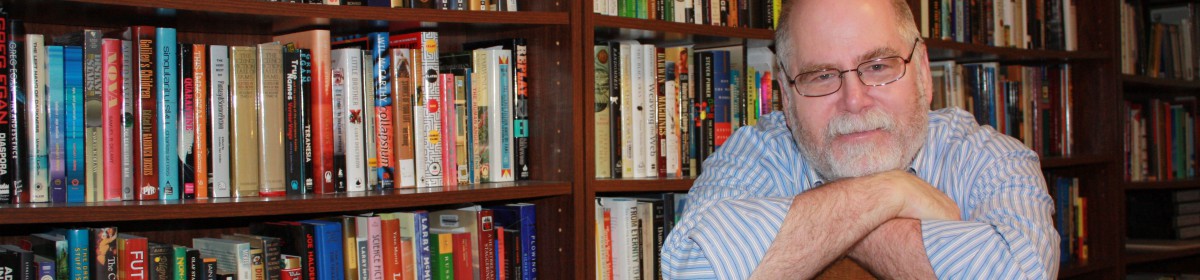
I am a child of science fiction and the 1960s. On rare occasions while growing up I’d run into others of my kind, but it didn’t happen often. It’s not like today where most kids love science fiction, even the popular pretty girls. I was a member of many pop culture groups, including the first generation raised on the boob tube that became the hordes that worshipped long hair, rock music and the counter culture. It seems a few us also read Heinlein, Asimov and Clarke.
As I type this Jefferson Airplane’s “The Ballad of You and Me and Pooneil” is blasting through the speakers. The long version. If I had a Venn diagram that collected people born from 1950-1955 and grew up interested in science fiction, astronomy and San Francisco acid rock music of the 1960s, how many of those people would have overlapping interest in all three subjects? How many people out there grew up influence by L. Frank Baum, Robert A. Heinlein, Mark Twain and Jack Kerouac?
I know who my blood relatives are, but now I’m wondering, who are my literary relatives? With the advent of the Internet I’m running across my kind more and more. This first started happening back in the 1980s with online bulletin board systems. Just recently I stumbled on a couple of online watering holes, where my SF siblings hang out talking about the classic books of science fiction. These are two Yahoogroup discussion lists:
There are about two hundred science fiction fans signed up between the two groups, with each group reading a classic SF title a month and discussing it, and a subset of those participating are a number of fans my age that started reading SF the same time I did in the early 1960s. We all discuss those old SF books with various levels of passion for the genre, but it seems like science fiction did a number on us that made us different from the normal kids growing up around us, giving us our own unique subculture.
I feel the kids who grew up with Star Wars are much different from my generation that grew up with Heinlein, Asimov and Clarke. Sure we might have evolved some when we started reading Delany, Zelazny and Dick, and the New Wave writers, but we’re strangely tied to that generation of Ace Doubles and Ballantine Books and finding our reading thrills on twirling wired racks. And I wonder if the kids who grow up now with the many forms of science fiction today have any sense of kinship at all. I know about First Fandom, and later generations of SF fans from the 1940s and 1950s that preceded my generation, because dozens of them became the science fiction writers my generation loved.
From my science fiction cousins, born 1950-1955, many also went on to write science fiction too, like Catherine Asaro, Kage Baker, Iain M. Banks, Steven Barnes, Greg Bear, David Brin, Pat Cadigan, Orson Scott Card, Brenda Clough, Julie Czerneda, Karen Joy Fowler, Lisa Goldstein, Kathleen Ann Goonan, K. W. Jeter, Gwyneth Jones, James Patrick Kelly, John Kessel, Michael P. Kube-McDowell, Geoffrey Landis, Paul J. McAuley, Pat Murphy, Kim Stanley Robinson, Richard Paul Russo, Mary Doria Russell, Geoff Ryman, Lewis Shiner, John Shirley, Melinda Snodgrass, Bruce Sterling, S. M. Stirling, Michael Swanwick, Lawrence Watt-Evans, Walter Jon Williams, Robert Charles Wilson, Timothy Zahn, and many others.
Will their fans be as faithful as my generation for going back now after forty and fifty years and rereading their favorite adolescent books? The 1960s was one strange trip. The times, with rock and roll, Vietnam, the counter culture, civil rights, psychedelic drugs, and all the other pop cultures of the 1960s, seared deeply into our brains. Distinctive smells trigger memories, and science fiction is like newly mown spring onions, dredging up long forgotten past experiences – but artificial ones, one of adventures on far off worlds, induced by a self mesmerizing technique of staring at black marks on cheap paperback pulp pages. I can’t play an oldie rock song without an old science fiction story haunting me. I can’t read an old science fiction story without 60s rock music coming out of that old memory radio.
No matter how hard I try, I can’t exorcise science fiction from my soul, and I have tried. Fifty of my nearly two hundred blog posts have been about science fiction. Science fiction is a toy I’ve never outgrew. No matter how much I try to convince myself into believing that science fiction is merely entertaining stories I can’t deprogram myself. I once wrote, “The Religion that Failed to Achieve Orbit” to be funny, but it’s not. I rejected religion as a tyke, but caught the science fiction bug instead. No matter how much my Zen master beats me with his bamboo cane, I still see the Maya of science fiction.
Is it just me? Or are there other aging science fiction junkies out there still looking for sense-of-wonder fixes? When I turned fifty and decided to go to the Clarion West Writer’s Workshop, I intended to write Science Fiction 2.0 stories. I wanted to purify my mind of all the old science fiction tropes and invent new ones for the twenty-first century. Heinlein, for all of his success never achieved escape velocity. The science fiction I grew up with was merely wish-fulfilling fantasies about escaping this problem filled world and running off to enchanting new worlds.
Rereading the classics of science fiction is like retracing the original trail looking for new clues. Joining these Yahoogroups have introduced me to other people doing the same thing. Is it merely nostalgia? Is circling back just a common trait of getting older? Are my efforts just a silly desire to recapture my youth? Is it just a search for lost meaning, or a narcissistic impulse to find importance in my life? Or could it simply be that I want to be a amateur scholar of genre history?
I don’t know if this is true or not, but somehow I feel my generation was more influenced by growing up with science fiction than earlier or later generations of science fiction fans. For most readers of science fiction, the genre is just a category of entertainment. For people growing up with the 1960s, the baby boomers, who felt the whole world was watching, science fiction added an extra dimension of drama about the future. We listened to our rock and roll brothers and sisters sing about the revolution, and thought, “sure thing man!” But we believed the revolution was going to lead mankind into outer space, not some groovy hippie commune.
Now that I’m getting old, and reconnecting with other science fiction fans who are rereading those old classic SF novels from our youth, I think we’re reevaluating the meaning of science fiction. Were we just kids reading repackaged pulp fiction because it was exciting, or was it visionary and educational?
I’m currently listening to METAtropolis, a shared world-building theme anthology edited by John Scalzi and published by Audible.com. The five writers, all newer science fiction writers born 1962-1979, write about cities of the near future with the same kind of 1960s revolutionary excitement. They grew up with science fiction and the Internet, another social revolutionary vector, and they see exciting possibilities. Does that help us?
Unfortunately, the world of science fiction philosophers is tiny, and not as influential as the more famous digital-world philosophers. There is overlap, but I have to wonder if the unfolding of the future has already outpaced the writers of the future. How will John Brunner’s epic experimental Sci-Fi masterpiece, Stand on Zanzibar from 1968 and set in 2010, match up with the real 2010 when it arrives, or even the science fiction writers of 2008 trying to predict the near future?
Using hindsight, and rereading old science fiction, how many of those childhood reads really prepared me for the present? I recently discovered this quote while rereading The Space Merchants by C. M. Kornbluth and Frederik Pohl:
The Conservationists were fair game, those wild-eyed zealots who pretended modern civilization was in some way “plundering” our planet. Preposterous stuff. Science is always a step ahead of the failure of natural resources. After all, when real meat got scarce, we had soyaburgers ready. When oil ran low, technology developed the pedicab.
That’s a pretty fascinating quote written originally in 1952. Especially when you realize that this is satire and the conservationists are right even back then. Science fiction is just amateur philosophers thinking about the future. Sometimes, it’s just an action story. Sometimes, it’s a “what if this goes on…” story. Science fiction writers and readers think about all the possibilities. Now the children of science fiction are growing up in the real future. Have their literary parents, the science fiction books they were raised on, prepared them properly?
I’m always surprised to find seeds like the quote above when rereading old science fiction. It makes me wonder if reading science fiction helped program my personality. I’ve been concerned with over population, the limits of growth, pollution, global terrorism, economic collapse, and more, all my life. A certain percentage of the population take global warming very seriously. Another percentage don’t. Is it because they weren’t prepared by reading lots of science fiction scenarios?
I fondly remember hundreds of wonderful science fiction novels, but when I reread them, many aren’t so wonderful today. Foundation by Isaac Asimov has some cool ideas, but the storytelling in that fix-up novel is clunky. City by Clifford Simak is another fix-up novel that still provoked a sense of wonder in me, but failed to work with some of my friends. Strangely, I discover that I admire Philip K. Dick’s old work because he wrote about quirky realistic people who were motivated by their own self interests that often superseded the direction of the plot.
Too often old science fiction novels contained characters that are just mouthpieces for the author to rattle off his pet ideas. That makes for bad storytelling, but is maybe a clue about my personality and why I’m haunted by science fiction. Science fiction wanted to explain reality. It lacked the discipline of science. It was much further out than religion, which was always quite far out, but science fiction sold itself as being scientific, which has never been true. The 1960s was a kooky time, with UFO freaks, drug trippers, Edgar Cayce disciplines, ESP dreamers, so is it not all that strange that a bunch of kids wanted to follow Danny Dunn and Tom Swift Jr. into outer space.
Of course, you know what that means? I reread science fiction in my fifties because I’m wanting to return to the dreams I had in my teens. 2008 is the far future from my kid self of 1968. It’s just not the future I expected or wanted. Is being nostalgic merely wanting to start over again, and maybe this time get it right?
I finish this as Jefferson Airplane starts singing, “Have You Seen the Saucers.” I kid you not.
JWH 11/19/8
 Auxiliary Memory