
Science Fiction’s False Assumption?

Since the earliest days of Buck Rogers and Flash Gordon the public has assumed the future of mankind included space travel.  The inherent assumption was humans would extend the range of civilization into space, across planets and moons, and then out to the stars.  I’m starting to wonder if that’s a false assumption.  From commitment to landing, the United States went to the Moon within a decade.  We spent the next four decades going nowhere.  Why?

Answering that question could take volumes.  Most people’s quick response is money, but our society waste billions upon billions with little effort.  It’s obviously not technology, we have that in spades.  Nor are we lacking in visionary scientists and dreamers.  Have we reached the limits of our frontier exploring impulses?  Could the dreams of space civilizations be built on false premises?  Science fiction presents thrilling fantasies that are endlessly entertaining, but does anyone really want to live them?

When I was a kid I wanted to be an astronaut because I loved science fiction.  Since then I’ve read dozens of books by and about astronauts and it’s quite obvious I don’t have the right stuff.  I couldn’t even be a mission specialist.  I would love to live that life, but in all honesty I never had the intelligence and drive.  Could that be a clue to science fiction’s false assumption?  Space travel is for the very elite, the very best, the most driven, the most focused, and that leaves the rest of us ordinary folk off the crew list.  Would NASA get more money if it reserved seats on their spaceships for normal people?

When it comes down to it, there is only one reason to build a space civilization, to protect the human species from extinction.  And since most of humanity wants to go to heaven rather than Mars they don’t buy that reason.  Leading normal lives of marriage and family is far more important to people than living in space.  All the astronauts had emotional conflicts between missions and marriages.  Few people would leave their families if offered the chance to colonize the Moon or Mars.

I now wonder if the premise that the future always includes men and women living in a space is just a false assumption.  That somewhere back in time we developed that premise, a false one, and we’ve all been working off that bad hunch ever since.  The reality is living in space is extremely difficult, if not impossible.  We won’t know if it’s impossible until we try. We blithely assumed it was possible, but that might another false assumption.

The other day I wrote “Is Colonizing the Moon Possible?” and I have received some interesting email comments.  Some people don’t believe we’ll ever build industries on the Moon to make a colony self-sustaining.  Others have suggested that the reason why science fiction never portrays the pioneering days of building a lunar civilization is because people don’t care about such boring details.  If you asked a 1,000 high school kids if they wanted to work  at manufacturing steel would any raise their hands?  I was hoping in my essay that if we rephrased the question by asking how many would like to design a robot to produce steel panels on the Moon a few might raise their hands.  But that might be another false assumption on my part.

Most science fiction fans love the dream and tell me it’s just a matter of waiting for the right time, that conditions will be different in the future.  Is that another false assumption?  I’ve been waiting forty years for something new to happen.  In all those forty years there have been endless books and documentaries predicting the glories of space travel that are just around the corner.

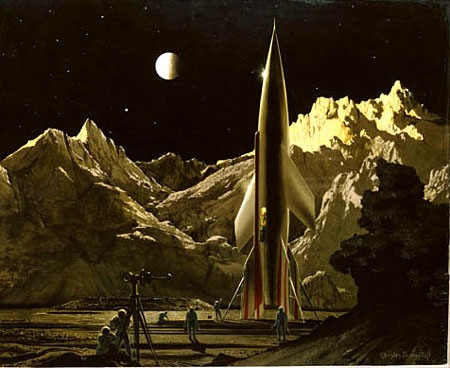
I’m constantly watching HDTV documentaries with beautiful animations of astronauts building habitats on the Moon and Mars.  They are quite awe inspiring!  I’ve been watching such futurist documentaries since the 1960s and grew up admiring paintings of the future like those of Chesley Bonestell.
bonestell_450

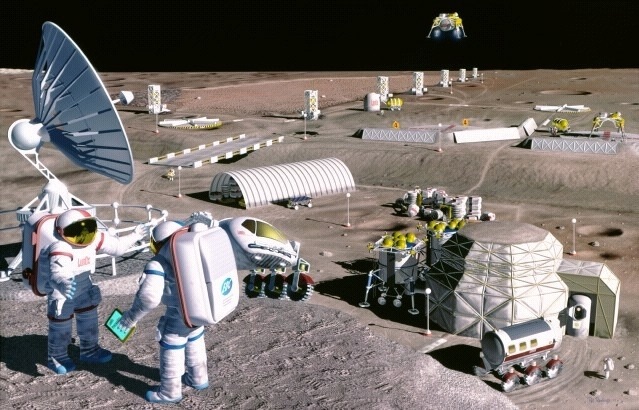
Are those animated plans any different than science fiction?  We know what kind of payloads the Saturn V and the planned Ares V can deliver to the Moon, and those wonderful animations show lunar outposts with equipment that would take dozens and dozens of rockets to ship to the Moon or Mars.  The United State flew thirteen monster Saturn 5s over a period of six years (1967-1973).  Budget cuts kept a two more from flying.  The public lost interest with Apollo 12.  The big space race was over, so why watch a rerun?
mooncolony

To build scientific stations on the Moon or Mars, and I’m not even talking about self-sustained colonies, but Antarctica like research habitats, like those in space documentary animations or pictured in space book illustrations, would take years of launchings, with each year blasting off the entire historical fleet of Saturn V rockets.  Will this ever really happen?  It could, and without much of a budget increase to NASA, but only if the public demands it.

President elect Obama is planning on spending several hundred billion dollars to create millions of jobs, but so far he isn’t looking to NASA as a jobs agency.  But even in flush economic times, no President has wanted to expand NASA’s budget by much.  This shows there is little public demand for space exploration.  Congressmen are often quoted as saying they see zero support for space projects.

I guess two things can happen.  One day we’ll collectively wake up and say to ourselves, “Hey, whatever happened to that vision of space travel,”  and get busy.  Or, next century people will look back on the era of manned space flight like we look back on 19th century whalers.

I’m too tied to my science fiction heritage to imagine what the average person on Earth thinks about space exploration.  Sales of hard science fiction books are quite small.  And even though science fiction movies are among the top money makers in Hollywood, few movies are made about space travel.  The public accepts the idea that space travel, but they assume it’s in the far future.

There is a vast difference between science fiction and the reality of space travel – just read the biographies of the twelve men who walked on the Moon.  Space is an extremely harsh environment.  If you think this winter is cold, imagine 250 degrees below zero in a vacuum.  Or more radiation than any nuclear plant worker sees in a lifetime.  And you know how you seldom see space suits in Star Trek and Star Wars, it’s because they are brutal to wear.  Living in the worst slums of Earth is paradise compared to the limited life in a controlled space environment.

Now all of this may sound like I’m a naysayer about space exploration, but that’s completely wrong.  I’m just saying it will be viciously hard and almost impossible but we need to do it.  Can you imagine a future where we never go to Mars or create a civilization in space?  Imagine humanity never leaving Earth but solving the problems of war, environment, hunger, disease, and we build a steady state economy where life is comfortable and secure.  Do we wait around until the race is snuffed out by an exploding Yellowstone, visiting comet or mutated virus?  Is that all there is?

Anyone who studies science knows that mass extinctions periodically visit Earth.  This weekend there were many scary stories going around the Internet about the Yellowstone super-volcano exploding and I wondered what would happen if it was true.  Do we accept the death of our species in the same way as we accept our own death?  We were born out of nothingness and we shall return to nothingness.  Do we just accept that?

Most of humanity answers yes.  There are a few extreme thinkers who say no.  To those thinkers, we are born out of nothingness and we will do whatever it takes to cling to existence.  If this world goes, we’ll find another, if our universe goes dark, we’ll wormhole our way into another.  The universe may lack meaning, but our purpose is to survive.  That’s the drive behind science fiction’s main assumption.  The question you must ask yourself:  Is that a false assumption?

It is the true dichotomy of humanity – life on Earth and life off Earth.  To most men and women, the ultimate question is:  Do you believe in God and eternal life?  To atheists, the question is:  Do you want to survive?  To future intelligent robots the question will be:  Is there a reason to keep the switch in the on position?  Developing a space civilization is asking the human species:  Do you want to avoid extinction.

JWH 1/3/9
004.jpg

Books Read 2008

2008 was a year of reading about the world and looking back at classic science fiction.  18 of the 45 books I read this year were SF.  11 were non-fiction.  12 books were ones I had read before – for some reason I listened to many SF classics that I first read back in the 1960s.  Although I enjoyed many science fiction and fantasy novels this year, the stories that moved me the most were two by Edith Wharton.  Two other novels stood out, The Road was intense and Oscar Wao was dazzling.

Science fiction books from the 1950s and 1960s are starting to show their age.  I think Childhood’s End by Arthur C. Clarke holds up the best.  I liked City and The Case of Conscience, but structurally they had problems.  City and Way Station presented wonderful sense of wonder ideas, but the writing is so dated that I worry that kids today will find them hard to read.  I still have nostalgic love for the Heinlein juveniles Red Planet, Starman Jones and Podkayne of Mars, and they hold up enough to get reprinted as audio books, but I also worry that young people will have problems reading them.  Their science is very dated, with canals on Mars, Venus being habitable, and people doing calculations for interstellar space jumps with pencil and paper.

Favorite Fiction:

  1. The Age of Innocence by Edith Wharton
  2. The House of Mirth by Edith Wharton
  3. The Road by Cormac McCarthy
  4. The Brief Wondrous Life of Oscar Wao by Junot Diaz

Favorite Non-Fiction:

  1. Hot, Flat and Crowded by Thomas L. Friedman
  2. The Outliers by Malcolm Gladwell
  3. The Post American World by Fareed Zakara
  4. Einstein by Walter Isaacson

The Whole List:

  1. Old Man’s War – John Scalzi
  2. Candy Girl – Diablo Cody
  3. The Road – Cormac McCarthy
  4. Running with Scissors – Augustine Burroughs
  5. Northanger Abbey – Jane Austen
  6. Einstein – Walter Isaacson
  7. Marsbound – Joe Haldeman
  8. The Cult of the Amateur – Andrew Keen
  9. The Book Thief – Markus Zusak
  10. The Coming Economic Collapse – Stephen Leeb
  11. Do Androids Dream of Electric Sheep? – Philip K. Dick (3rd time)
  12. The Cat Who Walks Through Walls – Robert A. Heinlein (2nd time)
  13. Ethan Frome – Edith Wharton
  14. The Maltese Falcon – Dashiell Hammett (2nd time)
  15. Death by Black Hole – Neil deGrasse Tyson
  16. Territory – Emma Bull
  17. Drop City – T. C. Boyle
  18. The Brief Wondrous Life of Oscar Wao – Junot Diaz
  19. Podkayne of Mars – Robert A. Heinlein (4th time)
  20. The Age of Innocence – Edith Wharton
  21. The Post American World – Fareed Zakara
  22. After Dark – Haruki Murakami
  23. Twilight – Stephenie Meyer
  24. City – Clifford Simak (2nd time)
  25. Proust was a Neuroscientist – Jonah Lehrer
  26. Lord of Light – Roger Zelazny (2nd time)
  27. Starman Jones – Robert A. Heinlein (4th time)
  28. The Little Book – Selden Edwards
  29. The House of Mirth – Edith Wharton
  30. Hot, Flat and Crowded – Thomas L. Friedman
  31. Way Station – Clifford Simak (2nd time)
  32. Spin – Robert Charles Wilson
  33. The Three Stigmata of Palmer Eldritch – Philip K. Dick (2nd time)
  34. The Little Guide to Your Well-Read Life – Steve Leveen
  35. Red Planet – Robert A. Heinlein (4th time)
  36. Swords and Deviltry – Fritz Leiber
  37. METAtropolis – ed. John Scalzi
  38. The Space Merchants – Pohl & Kornbluth (2nd time)
  39. Living Dead in Dallas – Charlaine Harris
  40. When You are Engulfed in Flames – David Sedaris
  41. A Case of Conscience – James Blish
  42. The Outliers – Malcolm Gladwell
  43. Childhood’s End – Arthur C. Clarke (3rd time)
  44. Like a Rolling Stone – Greil Marcus
  45. The Last Man on the Moon – Eugene Cernan & Don Davis

JWH 1/2/9

Is Colonizing the Moon Possible?

Despite the huge success of science fiction movies at the box office, despite the fact that most people think humanity is destined for space travel, despite the fact that manned missions into space are considered the high points of human achievement, few people support the space program when it comes to spending money in Congress.  The current recession is about to abort what many people consider our best chance to return to space as explorers since budget cuts killed off the Apollo program in 1972.  Tuesday the NY Times ran “The Fight Over NASA’s Future” that summed up the current situation nicely.

Now, I would like to give my view of the problem.  I just finished reading The Last Man on the Moon by Eugene Cernan and Don Davis, so Apollo 17 details are fresh in my mind.  Cernan was the last astronaut to step off the Moon’s surface and his book also chronicles how the public quickly lost interest in the Moon missions right after Apollo 11.  When going to the Moon was a space race with the Russians the public and Congress cheered.  When it turned to science and geology they snoozed.

If Project Orion is going to duplicate Project Apollo then it is doomed to fail.  And if you do not know what Orion and Ares are, that’s a bad sign in itself – read the NY Times link.  Already NASA’s meager budget is coveted for other uses in these bleak economic times.  If returning to the Moon is seen as a science mission it will lose to bean counters looking for other projects voters want more.  Accountants were dissembling Project Apollo at the peak of it’s success.  The only way to guarantee funding for manned missions to the Moon is to offer evidence that Al Qaeda has a stronghold there.

People who love the idea of humans conquering space are a tiny minority.  Those few believe that mankind is destined to live in space and pursue a future mapped by science fictional dreams.  The public will never pay for that dream if it’s only sold as science.  It needs to be a great challenge, even a patriotic challenge, and in these high unemployment times maybe even a giant WPA program solution. For decades now space enthusiasts have tried sell space as a profitable enterprise, but that’s silly and I think the public can smell that.  Creating a human civilization in space will create a giant off-Earth economy, but there will never be any real profits for Earthlings, not if we do complete cost accounting.

I have thought about this problem for decades, and the only way to start space civilization is by colonizing the Moon.  That one fantastic accomplishment will be the critical mass to set off a space civilization explosion.  The Catch-22 conundrum is the people of the Earth must pay the bill, and it will be enormous.  Now, is there any incentive that will convince citizens of the United States and other countries to convince their leaders to spend that kind of money, year in and year out for decades?

The public and Congress has never wanted to give up on NASA and space exploration completely, so NASA has always had a small budget that it carefully managed to get the most bang for its bucks.  The trouble with big manned exploratory projects is they require huge amounts of money committed across many future budgeting years.  Some space enthusiasts considered the Shuttle a congressional boondoggle that kept us flying in low Earth orbits for far too long, and they cheered when President Bush broke the cycle by suggesting we take the Shuttle money and go back to the Moon.  The idea was helped by the fact that China, India and Japan had turned their national gaze to Luna.

What Does Colonizing Mean?

Explorers are brave women and men who go places no one has gone before – but they go back home when they’re done exploring.  Scientific missions are like our bases in Antarctica.  Scientists go to live and work in distant lands for long periods but they eventually return home.  Colonization is like the people on the Mayflower, they left with no intention of ever going home.

The trouble with colonizing the Moon is it will be very hard.  Harder than anyone can imagine.  Maybe even impossible.  People need air, food, water and shelter just to minimally survive.  A self-sufficient colony means that at some point the colonists can survive on their own without resupply from Earth.  The Moon is essentially airless, but it’s rocks are full of oxygen.  There’s a chance of ice being on the Moon.  That’s more oxygen, and hydrogen.  Something to drink and the basis of creating energy and rocket fuel.  Then we need to look for carbon, nitrogen and all the other elements, and rebuild what we have here on Earth.  No small task, and we have to face the fact that it might be impossible.  It’s a fantastic challenge.

But look around you at everything you see that’s manufactured.  Think of the mining, industry and manufacturing that went into those products.  All those enterprises will have to be built on the Moon for colonization to work.  Some people will point out that all nations trade with other nations and no nation lives completely self-sufficient.  That’s true on Earth, but what if the Earth was hit by a giant comet and was destroyed?  Wouldn’t you, and the future Lunar colonists, want the Moon colony to be able to carry on without Earth?

The most important value of a self-sufficient colony on the Moon and Mars is life insurance for our species.  There might be huge number of intelligent beings in the universe, or we might be the only one.  Either way, it would be a shame for us to go extinct.

How To Start A Colony?

Strangely enough, I wouldn’t start with manned missions returning to the Moon.  I’d cover the Moon with robotic prospectors that would do a complete survey and tell us what minerals are available for use.  Then I’d build mining and manufacturing robots.  The first goal would be to build tunnels and construct safe underground habitats for men and women, plants and animals.

The robots would have to start processing the lunar regolith for oxygen.  But where to store it?  Could manufactured air be stored in underground tanks carved out of the rock by robots?  Do they need to be lined?  What ceramic material would make the best seal.  Do the robots need to mine and build metal tanks?  See what a fascinating challenge this becomes?

How do you make a light-bulb on the Moon?  We can bring seeds from Earth, but they will need light to grow.  Natural light on the Moon is weird, with days and nights lasting for weeks.  Plants won’t like that, nor will they like the radiation.  Colonists will have to build underground greenhouses.  If we can do that we’ll have food and air purifiers.  However, we have no idea if plants can live on the Moon.  The lunar dust is not practical to use for plants as it is, so it must be processed into fertile organic soil.  Everything is a challenge, and any one challenge might be a show-stopper.

This kind of work can be carried out by robots or people, but human labor will cost so much more.  We could combine the two like scientific stations in Antarctica, but working on the Moon is devilishly hard.  The dust is dangerous, and working in a spacesuit is painful.  I think until the robots build safe shirt-sleeve environments for humans, robots should get all the work contracts.

This will serve many purposes.  I think intelligent robots will be our co-colonists.  Designing robots to construct a lunar colony will help evolve the science of robotics and that might lead to intelligent machines and AI.  Now the spin-off affect of developing this technology will create an economic boom on Earth.  It won’t directly pay for colonization, but it will be a nice gift.

The Basics of Lunar Life

Home sweet home on the Moon will be an underground city.  An apartment could have several rooms cut out of rock with artificial lighting, heating and air conditioning, and a few creature comforts.  In the early years it will be logical to have communal kitchens, toilets and washing arrangements for people and clothes.  Everything will be recycled.  Human waste will go into soil and food production.  I expect flowers, plants, shrubs, vines and trees to be planted in the home apartments, along walkways and roadways, in offices and factories and walls everywhere should be covered in vines.  Living on the Moon will be like living in a greenhouse jungle.

It might even be practical to have bees, worms and other insects living with us.  Meat eaters will want rabbits and fish.  Will it be practical to have cows, pigs, sheep and goats on the Moon?  I don’t know.  More research.  What about pets, like dogs and cats?  Can you imagine a rambunctious dog in 1/6th gravity?  Or picture how high a cat could leap?  Also, in such closed environments would be want dog poop and cat boxes?

Every ceiling will have to have artificial light that is maximized for human and plant comfort, and it will probably cycle in intensity to match night and day on Earth.  Can you imagine shipping all these light bulbs from Earth?  And we’d want to use a lighting source that produced the best frequency of light, that was the easiest to make, and that would last for decades.  Even if you filled the Orion capsule plum full of LED lights, how many missions would it take to light even a small community?  See how the problem grows?

If everything must come from Earth, and at a tremendous cost per pound, will scientific style missions ever be practical?  Antarctic stations are practical because we can ship in supplies by the boatload or planeload.  It will be much different re-supplying a lunar outpost by the capsule load.

We can spend billions on shipping light bulbs to the moon that will last so many years, or we can spend billions on how to build light bulbs on the Moon so colonists will always have them.  It’s like the difference between giving someone a fish and teaching them how to fish.

Beyond the Basics

Once people have a place to stay, air, water and food, they might want more.  Like clothes they didn’t come from Earth.  Computers and televisions.  Washing machines, dishes, brooms, vacuums, and so on.  Or will they?  General purpose robots might be better than many single purpose machines?  But will that be practical?  On the Moon it will be cheaper for a person to do something than a robot.

And what do people do once they move into their new Moon home?  Robots and efficiency and the lack of resources for squandering will limit the need for some kinds of human work.  Do we really want to recreate capitalism with McDonalds and Starbucks?  Jobs and the space economy will be much different from Earth.  The Moon will not want tourists unless they came bearing hundred of pounds of manufactured gifts to pay for their stay.  Colonists will want talented people with great DNA that come to stay, rare elements and machines, and will resent freeloaders who come to gawk, but will accept them if they bring more than they take.

It’s one thing for Virgin Galactic to get people to pay $200,000 for what is essentially a Redstone Mercury flight, or for the Russians to get a handful of rich folk to fork over $20,000,000 for a Soyuz flight, but it’s a whole other thing to expect billionaires to shell out a significant part of their fortunes for what would be equivalent to a Saturn 5 flight.  Tourism won’t be a big business on the Moon.

Robots will be common but limited to working on the most vital of jobs until manufacturing is up to speed to produce lots of robots.  Probably for decades or longer, all robots will come from Earth and be dedicated to the dangerous surface jobs and mining.  People will tend the plants and animals, make the food, clean the toilets, weave cloth, and pretty much do the work of homesteaders everywhere.

There will be industries that will be unique to the Moon that provide jobs for the colonists.  Giant telescopes for all frequencies of the electromagnetic spectrum can be built on the Moon.  The Moon will be an astronomer’s paradise until large space habitats are built.  We’ll build such large telescopes in space that we’ll be able to see other planets for light-years around and we might even discover signs of alien civilizations.

Once manufacturing develops on the Moon the next big industry will be to build space ships and develop new rocket propulsion system, including nuclear rockets.  Inhabitants of the Moon will colonize Mars and build space habitats, and launch missions into deep space.  Complex electronics and computer systems will probably still come from Earth.  Rockets built on the Moon might be very simple system.  Living on the Moon will teach simplicity and recycling.  Everything will need to be bullet proof, long lasting and constructed with the least amount of resources.

What’s the Best Way to Start Now?

There are no talks of colonizing the Moon now.  President Bush in 2004 created the idea of returning to the Moon by sacrificing the budget for the Shuttles.  The idea is to send more people and stay longer, but it’s moving from exploring to building a scientific base station.  I don’t know if the public will find that any more exciting than Gene Cernan tooling around the Moon gather rocks with Jack Schmidt.  The fact that China, Japan and India want to do that too might convince voters to allow their Congressmen to throw NASA a bone, but I doubt it.

President elect Obama is trying to keep NASA in the business of flying people in space but so far hasn’t decided what’s the best way to do that.  The Shuttles are destined to be decommissioned in 2010 and the next flight system, Orion won’t be ready until 2015.  To pay for Orion and it’s launcher Ares, NASA had to scrap the Shuttle program.  Obama is considered using other rockets rather than building the new Ares system, or keeping the Shuttles flying longer, meaning we stay in LEO and travel in circles for a few more years.

Personally, I think the money should go into manned and unmanned missions to the Moon and building simple cheap one-use rockets that are the best transportation system for getting us there.  Ultimately, because of costs, only a limited number of rockets will fly to the Moon.  We need to decide whether manned or robotic missions will do the most good towards colonizing the Moon.  We might need some Maytag repairmen to take care of the robots, but I’m thinking we’ll get more done with our metal friends for decades.

Where to go next is space is as fractional as religion.  You have the Reds, those wanting to go to Mars.  The Whites, think the Moon is the next step.  Then you have the Robots, people who believe space is only fit for machines.  And after that you have all kinds of creative splinter groups.  The NASA piece of the American budget pie is small, and travel beyond LEO is expensive, so only one space philosophy will ever get a shot at what they want.  Of course, one splinter group, the Capitalists, want to commercialize space travel and get their own funding.  I don’t think space tourism will fund Moon colonization or even space exploration.

My conclusions from this life-long study is colonizing the Moon is the foundation for mutating the human species into one that can live in space.  If we can adapt to living on the Moon, we can make our science fictional dreams come true.  Yes, I know the Reds claim Mars is the place to start because it has far more resources, but it’s location makes that a silly assertion.  Obvious, I’m one of the Whites.  I believe when we finally go to Mars, the crew will be launched from facilities and rockets that were built and controlled on the Moon.

If we only wanted to go to Mars once, a Zubrin style mission would be cheaper, but it’s really a very impractical long shot.  We just don’t know if people can live three years away from Earth.  The Moon is a far closer, safer and cheaper testing ground for setting up Antarctica style bases to see if humans can become spacemen.  Zubrin had the right idea about living on the land, but we need to start that idea on the Moon and see what we can put together with lunar resources.  I’m pretty sure the public doesn’t want to pay for plant the flag missions, at least not in this country.

We’re back to trying to find a reason the public will fund space exploration.  Would the idea of colonizing the Moon be exciting enough?  And would people want to leave Earth permanently and go live on the Moon?  I’m too influenced by a lifetime of reading science fiction to be able to answer those questions.  A sizeable portion of the public has loved the robotic missions on Mars.  And Americans love the pioneering spirit.  Homesteading the Moon might appeal to them enough to tell their representatives in Congress to vote for such plans.

In my “Science Fiction in My Lifetime” I gave colonizing the Moon by 2050 a 1 in 10 chance.  And by that, I mainly meant committing to trying to colonize the Moon before 2050.  If several nations on Earth started now, forty years would get us a long way towards building a self-sufficient colony on the Moon, but it might be a hundred year project, or longer.  My uneducated hunch would be that we’d have to commit to spending between $10-20 billion a year for all those years.  That’s not a large annual figure, but is it an amount the public will accept?  Is it a goal they will stick with and stay interested in for all those years?

Colonizing the Moon is so much more than picking up rocks on the lunar surface.  It could excite a million kids to create science fair projects and a million PhD dissertations.  Maybe it could generate a million jobs.  It will never pay for itself, but it’s like those Mastercard ads, creating a human civilization in space, priceless.

JWH 1/1/9

Childhood’s End by Arthur C. Clarke

Childhood’s End holds up extremely well in the 55 years since the book first appeared in 1953.  I just finished listening to the new Audible Frontiers audio book edition from Audible.com, and I was surprised in several ways.  First, I was surprised that a science fiction book from 1950s worked so well as a whole.  I’ve been re-reading a number of classic SF novels from the 1950s this year and many of them are fix-up novels, made by gluing short stories together, stories that were first published in the pulp magazines, and the results feel episodic.  The original idea of Childhood’s End started out as a short story, “Guardian Angel” from a 1950 issue of Famous Fantastic Mysteries, but it works well as a novel even though it’s a series of encounters with different characters over time that could be also criticized as episodic.  It cohered for me perfectly.

childhood's end 2

Second, I was surprised how so much of the story had stuck with me since my last reading in 1985, showing how memorable the story is.  Third, I was surprised by how many classic SF ideas Clarke included in his novel.  Fourth, I was surprised by how many social issues Clarke dealt with that would explode later in the 1960s.  Finally, I was very surprised by Clarke’s belief in the limits of mankind.  Unlike Heinlein, Clarke suggests that man isn’t the toughest alien around, and is unfit to be the alpha creature of the galaxy.

Childhood’s End has to be somewhat inspired by the 1951 film The Day the Earth Stood Still.  In the film, Klaatu, a traveler in a flying saucer from a distant alien civilization comes to help the Earth.  In the book, Karellen, the leader and his crew from an advance alien civilization come to help Earth in flying saucers.  Of course, Arthur C. Clarke takes the idea much further than the “Farewell to the Master” story by Harry Bates which inspired the film.  And strangely enough both stories have deep religious undertones, with Klaatu acting out the Christ role, and Karellen and his crew acting out the role of angels, messengers of God, even if they look like Lucifer.

Klaatu came to Earth, preached about our evil ways and told the people of our planet to get their act together or face retribution from a higher power.  Karellen came to Earth and stayed, gently guiding the transformation of human society with miracle powers.  Both the film and book preached that human society is severely flawed, that the human race is a danger to itself, that our governments can’t help and that individuals are full of weak behaviors (the seven deadly sins).  Clarke is very philosophical about the future of mankind, and if you haven’t read the book yet, stop reading here because I’m going to give everything away.

To carry the religious metaphor further, both stories suggest that aliens from the stars will bring salvation to mankind.  Arthur C. Clarke goes even further, and suggests that mankind must be reborn before we can travel to the heavens because our current minds and bodies are too limited to see the wonders of transcendental society of higher beings.

Clarke explores what will happen to people when the aliens solve all of our big problems.  We fall back onto finding meaning in art, music, sports, sex and self education, but that isn’t enough.  Karellen won’t allow people to travel beyond the Moon, and Clarke says without the final frontier our lives will become meaningless.  In other words, life on Earth isn’t the real show, and it’s only until we evolve into a higher being that finally we will really understand our true purpose.  Isn’t that same exact message religion gives to us poor mortals.  Is this message built into our DNA?  Is it some kind of ancestral memory?

When I was young, back in the 1950s when I first saw the film The Day the Earth Stood Still, and the 1960s when I first read Childhood’s End, I believed in what Clarke was saying.  Science fiction was my substitute for religion.  I’ve been a religious skeptic since I was 12, but it’s taken me much longer to become skeptical of the preaching of science fiction.  Childhood’s End is a wonderful story, but so is the Bible.  I don’t believe either.  Whoever we are as a species, and as individuals of that species, is all we’ll ever be.  Nobody will save us but ourselves, and if we are condemned to oblivion, then we only have ourselves to blame.

We might not be alone in this universe, but for now, we stand alone.  Clarke really must have believed in higher psychic powers and that mankind would evolve into a super-being because the same message was replayed in his 1960s story, 2001:  A Space Odyssey.  ESP was a major theme in 1950s science fiction.  Science fiction writers obviously believed, or wanted to believe, than humans would one day evolve their own miracle powers and become god-like ourselves.  This is one hell of a wish fulfilling fantasy!  Of course this same fantasy appears in both religion and regular fantasy novels.  The same year 2001 came out, shows like I Dream of Jeannie and Bewitched were hits, and those power fantasies are still just as popular in various forms of entertainment today.

In the year 2008 I think we need to psychoanalyze Childhood’s End, Arthur C. Clarke and his fans, rather than evaluate the novel as science fiction.  It is a metaphysical fantasy that needs to be interpreted.  Do people really believe that we can’t solve our own problems and need God or alien overlords to save us?  Will life on Earth always be meaningless without a purpose delivered from a higher being?  Is frail mortal life so worthless?  Do people really believe that homo superior will be telepathic?  Or that any adaptation of nature to our evolution will include ESP powers?

Arthur C. Clarke was a scientist, so could he have been savvy enough to have written Childhood’s End for the masses, well knowing Marx’s dictate that religion is the opium of the masses and fashioned his SF novel to addict science fiction readers in the same way and sell more books?

This is why back then, I was a disciple of Robert A. Heinlein.  He was “a better to reign in hell than serve in heaven” kind of guy, believing mankind would build it’s own spaceships and the Klaatus and Karellens of the sky better get the fuck out of our way, for we are a jealous people.

JWH 12/30/8

Science Fiction in My Lifetime

When I wrote this title I intended it be about science fictional predictions coming true in my lifetime, and especially what might still happen before I die.  Then I realized it could also imply I was writing about the great science fictional books that came out in my lifetime, leaving me room to speculate on what far-out ideas could appear in the near future.  Over at Visions of Paradise, Bob Sabella chronicles seven waves of science fiction since H. G. Wells, and wonders when a new wave will hit.  I’ve lived through three of waves Bob describes, the 1950s transition from pulp mags to book SF, the 1960s New Wave and the most recent Cyberpunk movement, but I think we all live in a reality partly shaped by Herbert and Jules and their literary descendants.

Right now the science fiction scene is dormant.  Most of the new books in the science fiction section at your favorite bookstore are fantasy books, or adventures set in classical science fictional worlds, like Baroque art encouraged by the Catholic Church.  No radically new science fiction concepts have been created since the 1990s with the concepts of mind uploading and the singularity.  What I’d like to do is recap the big SF ideas of the 20th century and then try to predict where science fiction might go in the 21st century.

How many grand ideas imagined in science fiction stories will become real in our lifetimes?  Humans landing on the Moon is the shining example for science fiction stories going back hundreds of years.  Before that, submarines and airplanes were predicted long before they became a reality.  Some concepts are harder to judge.  Many science fiction stories were written about overpopulation, terrorism and running out of natural resources after the year 2000, and some of those dreary predictions are coming true, just read John Brunner’s Stand on Zanzibar.

How likely will the exciting, positive concepts of science fiction, bear fruit in our lifetimes?  Some people are anxiously awaiting flying cars and rocket backpacks.  Other fans are expecting alien visitors, while some folk can’t wait to go where no man has gone before themselves.  How many science fiction readers hope life-extension will keep them reading science fiction until the 22nd or 23rd centuries?  I know, I’d love my own Jeeves the robot.

I keep writing about the science of science fiction over and over again, but what really are the odds of these fantastic things happening before I die?  I had a revelation in the shower this morning.  Science fiction’s popularity has skyrocketed in the last 35 years not because of the validity of it’s ideas, but because the story telling has gotten dramatically better and thus appeals to a wider audience.

I thought my wife and lady friends were getting more and more into the ideas of science fiction when it became obvious they loved SF movies because of the hot actors and thrilling story telling.  Most people have zero expectation from science fiction, it’s just good fun.  They don’t want to homestead Mars, or expect the galactic overloads to come save Earth from ourselves.

I’ve been reading a number of classic science fiction novels from the 1950s this year and I’ve been amazed at the ideas, but disappointed with story telling aspects – it’s no wonder that science fiction had limited appeal back then.  I keep reading for the ideas and predictions, judging the science of science fiction, but the real success of science fiction in the last few decades has been in telling better stories.

I’m happy for that, but I want to focus on the science fiction ideas.  What are the likely odds for many of science fiction’s most popular visions coming true?  Let’s use the year 2050 as a cutoff.  If I could live to be 100, it would be 2051, so that’s close enough to call 2050 the end of my lifetime.  The odds I list are just my best-guess hunches because there is no way for anyone to really calculate them.  As far as I know, there are no bookies taking bets on these future endeavors.

Colonizing the Moon – 1 in 10

It’s been over 40 years since man has walked on the Moon, so this almost seemed a dead dream until China, India and Japan took a interest in the Moon and started up their own space programs.  This is very positive, except that the world-wide recession might slow things down.  Still the Moon is the logical base to start a beachhead on conquering space.  Colonizing the Moon is the cornerstone of all our science fictional dreams about space travel.

I think Robert A. Heinlein owned the Moon fictionally, with classics like The Moon is a Harsh Mistress, Have Space Suit-Will Travel, The Rolling Stones, The Menace From Earth, The Green Hills of Earth, Rocket Ship Galileo and The Cat Who Walks Through Walls.  John Varley and Rudy Rucker are modern writers who have been homesteading the Moon in recent years, giving it a twist with mind uploading, cloning and mad robots.

Some of these books are among my all-time favorite books, but I’ve got to admit, none of them have approach colonizing the Moon in any serious way.  For such an old subject this leaves lots of room for future science fiction writers to work.

Colonizing Mars – 1 in 100

Growing up in the 1960s I really expected to see manned missions to Mars in my lifetime.  It just seemed such an obvious step after the Apollo program  Men like Werner von Braun and Robert Zubrin made it sound so doable.  Well, it’s not.  If you do the research you’ll find just how tough a job going to Mars truly is, not impossible, but well on the edge of the limits of what humans can do now and the near future.

And I think it’s silly to think about Mars until we can conquer to Moon.  If we can send men and women to the Moon for three years, and prove we have the skills to keep them alive, then it will be time to talk about Mars.  However, colonizing Mars is the next step after the Moon, and for many, it’s the main goal.  On the other hand, I believe the road to the stars is paved with airless chunks of rock and we have a convenient one at hand to practice our space survival skills.

Many scientists have said it was amazing luck that some of the twelve men who made it to the Moon weren’t killed.  Most of their luck came from making short journeys lasting less than 2 weeks.  Moon dust would have ruined their suits, landers and machinery if they would have tried to stay much longer.  Is it possible to build self-contained habitats that will last three years, the length of a Mars mission?

Science fiction has always made the near impossible sound easy.  Kim Stanley Robinson’s Red Mars, Green Mars and Blue Mars have set the standard for Mars colony science fiction.  His work is far more realistic than most SF writers, but still way too full of fantasy.  Science fiction writers might be visionaries, but they have trouble seeing the details.  Speculation on how to build a self-sustaining colony on Mars is wide-open.  Terraforming is a great idea, but explaining how to build a computer on Mars without help from Earth would be magical.

Manned Missions Beyond Mars – 1 in 100,000

Theoretically, it’s well within our means technologically to colonize the Moon and Mars within the next 25-40 years.  We could make some amazing breakthroughs in technology that would allow us to go further, but we need to get busy, and I think public opinion will be against it.  To go beyond Mars will require developing nuclear rocket technology on the Moon or out in space.  Mars is about the maximum range for manned missions using chemical rockets, and that mission would be far easier if we could perfect nuclear rocketry before we try.  The people of the Earth will not let scientists develop nuclear rockets anywhere near our home world.  The Moon is a fine place to work with radioactive elements.  The real future of manned space travel will depend on the industrialization of the Moon.

Asteroid miners have been a staple of SF since the days of John W. Campbell took over Astounding, ignoring the fact that it’s much cheaper to find the same resources locally on Earth, the Moon or Mars.  Unless space ships can be built on the Moon, mining asteroids is silly.  Any colony on the Moon will want organic elements, and especially hydrogen, nitrogen and carbon.  Moonies will probably want to mine comets.

Manned Interstellar Flight – 1 in 1,000,000,000,000

I guess it’s possible we could discover some magical space drive system that will let us zoom off to the stars before 2050, but it’s highly unlikely.  Personally, I think the only way for humans will travel to the stars will be to build giant generational spaceships that can operate for thousands of years, but even that idea is mostly fantasy.  We might have the will and tech to build interstellar spaceships in a few centuries, but for now the idea is almost pure fantasy.  Star Wars like galactic civilizations are absolute pure fantasy.  Even our very best hard science fiction novels are really just thrilling stories, and are rather pointless for our needs of predicting the near future.  Hard core space opera gives us grand hopes, but the chances of colonizing worlds around other stars is about equal to finding biological immortality.

Intelligent Humanoid Robots – 1 in 5

Asimov, Simak and Williamson ruled the robot stories, but robot stories aren’t as popular today.  Robots and robotics seem to be moving full-steam ahead though, with scientists like Ray Kurzweil predicting an artificial intelligence singularity in the near future.  Hobby robotics is probably much more popular than hobby rocketry ever was.  Anybody with some programming ambition can get into robotics.  And after Spirit and Opportunity’s success on Mars, I can even picture an ever evolving series of robots going where no man can afford to go.  That’s a goddamn shame, but that’s the way it is.  I hope NASA at least starts building in real-time high definition video feeds from it’s metal Martian explorers so us biological creatures back on Earth can feel like we’re walking on Mars vicariously.

Many people believe artificial intelligence is impossible.  I figure if nature can accidentally stumble upon the recipe, than scientists should be able to figure it out sooner or later.  The question is how long.  Robots are cheap enough compared to manned space exploration, so we should see a continual increase in robotic intelligence on space missions, and that might evolve into intelligent robots.  The military is also pushing robots to do more.  The more we ask of robots the more intelligence they acquire.

What’s surprising is I don’t think science fiction has ever done any really good realistic robot stories, either they are people-like and cute, or they are like Gort, all-powerful and scary.  Commander Data was among the best, but not very realistic.  Before 2050 I think we’ll see some pretty amazing robots, and just maybe science fiction will predict what they really will be like.

Visitors From Space – 1 in 1,000,000,000,000

I’d really love to be proven wrong here.  We could use an alien like Klaatu or Karellen to knock some sense into us, but I don’t think that will happen.  What are the odds of intelligent life developing anywhere in the universe?  What are the odds of intelligent life developing twice and near enough to each other to visit?  It must be tremendous.  I’m not saying it’s impossible.  Let’s say it will be nice surprise.

For story purposes, the concept of visitors from space is pretty tired, although it will remain popular.  The idea has endless possibilities and offers so much fun and thrills.  Essentially, it’s a fantasy concept equal to stories about angels and vampires.

SETI Contact – 1 in 1,000,000,000

Detecting an intelligent signal from space is probably far more likely than having aliens over for coffee.  Detecting intelligent alien life in the universe would have profound philosophical implications to our society, so it’s strange that this topic is so seldom tackled by science fiction.  Often it’s a setup for physical contact or acquiring super-science, like Contact by Carl Sagan.  We need more books like His Master’s Voice by Stanislaw Lem, The Hercules Text by Jack McDevitt and The Listeners by James Gunn.

I figured if we were real lucky, and I mean astronomically numbered lucky, SETI would detect a signal from space before I passed on.  That’s the most exciting thing I can practically hope for, but I doubt it will happen.  I think if we build some really gigantic space telescopes we might visually detect artificial elements in the atmospheres of extra-solar planets.

Cloning Humans – 1 in 100

I’ve always considered cloning boring.  It’s making a human without sex, but you end up with another human, big whoop. Most science fiction is about 20 year-old cloned bodies grown in a month, which is silly.  Also, the idea of copying the brain patterns of a natural human onto a clone’s brain is also silly.

Uploading Minds – 1 in 1,000,000,000,000

Mind uploading is a growing topic.  It’s all part of the Human 2.0 theorizing, and has been slowly emerging in science fiction for decades.

[You can see the complete documentary here, or go to YouTube and watch all the parts.]

Whether you copy my brain to a computer simulation, clone, or android mind, I’m still going to die in the process.  What’s the point?  This is no route to immortality.  I’d much rather design an AI mind than copy my own.  Being alive is about experiencing the now, and that’s not copying memories.  However, seeking to reach Human 2.0 status is where much of the science fictional action will be during the 21st century.

The Cutting Edge

If you really want to explore the frontier of what’s happening scientifically, right on the border of where science meets science fiction, be sure and read the Edge.org.  Top thinkers from around the world examine the most far out ideas on the planet.  Most of the articles are very down to Earth, but some could be used to springboard into science fiction stories.

The Future of Science Fiction

From what I can detect, I’m thinking the appeal of science fiction is even waning, at least for the moment.  I examined many months of book reviews at SFSite.com and only a handful could be considered new breakthrough science fiction.  If the editors there removed all the obvious fantasy titles their site would shrink dramatically.  Many of the titles that most SF fans would classify as science fiction, are really adventure stories set in old comfortable science fiction worlds with few writers trying to imagine anything new conceptually.  Like I said above, science fiction writers have gotten much better at telling stories.

Right now I think of all the predictions dreamed up by science fiction writers, I think robots, AI and Human 2.0 explorations are the ones most likely to come somewhat truer in my lifetime.  SETI contact with alien signals from space is going to be like finding one snowflake in all the snow storms of Earth each winter.  It could happen, it might take a thousand years, or a million years, or it could be next year.

I don’t think we’ll ever seen visitors from the stars, and I doubt mankind will ever be an alien invader.  Science fiction has always been deceptive about interstellar rocketships, implying they’d be something like a new model airliner from Boeing.  That thinking is on the order of asking how fast does Santa have to travel to visit every house on Earth.

Until men and women colonize the Moon and Mars and we learn how to build with materials found in outer space and create a new economy that has no dependency on Earth, we won’t be able to think about traveling further than Mars.

I think the dramatic new ideas that come out of science fiction will be about living on Earth.  The potential of combining the Internet, artificial intelligence, robots, advanced learning techniques, simulated computer worlds, and so on will generate new possibilities for humans.  Science fiction writers need to think very hard about what’s going on in this world.  Sooner or later a new H. G. Wells, Jules Verne or Robert A. Heinlein will show up and surprise us.

JWH 12/28/8