
Freedom of Religion versus Freedom of Women

I want to be totally upfront and declare that I absolutely support the American ideal of freedom of religion.  I agree that mosques should be built wherever they want.  On the other hand, I wonder why I’m in the minority on this issue when so much of the country is consesvative and should be supporting this American ideal too.  Why aren’t they? 

In New York City people are fighting over building a mosque.  In Afghanistan Islamic people are stoning young people for being in love.  Is there a connection?  By the ideals of America,  citizens of the U.S. are free to pursue whatever religion they desire, so why not let mosques be built anywhere?  Or are the majority of Americans who are against mosque building really just anti-Islamic?  Who really wants to support a religion that treats its people as barbaric as the Taliban?  The Taliban is Old Testament thinking, and that’s troublesome at so many levels.

On the other hand, we’re trying to liberate Afghanistan from Taliban rule.  Now if we lived in the Star Trek universe, and Afghanistan was another planet, we’d be forbidden by Federation laws of interfering with a primitive society.  Is it even possible to modernize an Old Testament society like Afghanistan?  And if anyone wonders what Biblical times were like they only need to watch news reports about life under the Taliban.  We have had pretty good success in Iraq, but that society had already been modernized to a great degree.  Is it even possible to bring 7th century Afghanistan into the 21st century?

The Taliban recently killed humanitarian aid workers with the claim they were spreading Christianity.  We of course said, no, no, no, they were just giving medical treatment to the people.  But I don’t think Americans understand, our modern laws and government are shaped by two thousands years of Christianity, so just liberating Afghans politically is Christianizing them.  Now I know Christians will hate this, but to the Old Testament mind of the primitive culture of the Taliban, liberal philosophy and Christianity are one and the same.

I’m an atheist, so I don’t have a dog in this religious fight.  However, I’m a strong believer in American ideals, so I completely support freedom of religion.  I believe freedom of religion also means freedom from religion.  The ethical question here is:  Do we Americans have the right to force our freedoms on Afghanistan?  That’s too complicated an ethical question for me to grasp.

The Taliban is one aspect of the Islamic world, although it’s larger than it appears to be.  The leaders of Iran, and many other Muslim countries have the same mindset.  From my perspective, radical Islamic terrorists should be policed by Muslims who claim to know the true meaning of Islam, but that’s not happening at all.   The trouble is the Islamic world is openly or secretly supporting the radical Muslims.  Thus, I must assume the anti-mosque people of America are really responding to this kind of thinking and not necessarily a religion.  We don’t like Taliban Islam because it’s also an oppressive political system, and the Islamic people of the world has done a terrible job of selling the virtues of true Islam.

By the ideals of the American way of life, President Obama is right, any religion should be able to build houses of worship essentially anywhere.  We shouldn’t paint all Islamic people by comparing them to the Taliban.  What’s ironic is atheists and liberals are defending the rights of Islamic people in America, and it certainly would help mainstream Americans to be more liberal and American idealistic if mainstream Muslims were aggressively weeding our their radical elements.

The Islamic world needs to convince us the Taliban doesn’t equal Islam.  They need to do it damn fast.  And they need to prune their radicals, otherwise we will always think Taliban equals Islam, because that’s all we see of Islam.  And if the Taliban really equals Islam, even liberals like me will want to put a dog into the fight because they are making us choose between freedom of religion over freedom of individuals, especially women, and I’ll always choose freedom of individuals first.

What do we do?  What are the options?

  • Continue on the current path and hope to bring a western style government to Afghanistan
  • Leave Afghanistan and let the Muslim world do as it wants as long as it doesn’t attack the western world.  (Divided but equal cultures.)
  • Declare a modern crusade of liberalism and convince Muslims to modernize their religion

I was thinking we could succeed in Afghanistan like we did in Iraq.  Set up a police force and army – get a semblance of stability going and then leave.  But after reading “In Bold Display, Taliban Order Stoning Deaths” in the New York Times this morning, I’m changing my mind.  It’s either pull out and let those people alone, or declare a new crusade.  This is a hard issue to deal with, just read “Afghan Women and the Return of the Taliban” in Time.  Do we keep fighting to liberate the women?  Its freedom of religion versus freedom of individuals.

We are horrified by the primitive justice of the Taliban, even though they live exactly like people lived in the Old Testament, which is deemed holy by most Christians.  But remember Jesus and how he stopped the stoning of the woman?  We can’t ask the Taliban which of them is without sin.  That’s a pivotal moment in the origins of liberal thinking.  Conservatives might hate liberals, but we’re all flaming liberals compared to the Taliban.

Which is more important, personal freedom, or freedom of religion?  What would this woman say?
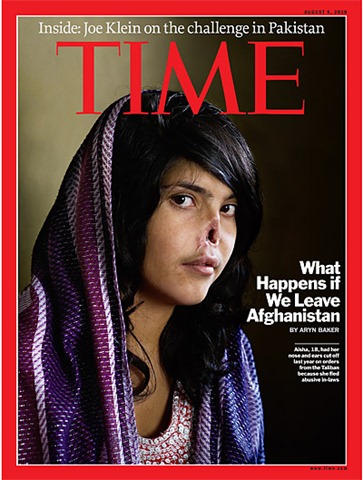
time_cover_0809

If we could poll all the women in Afghanistan and ask them if we should crush out the Taliban how would they vote?  And are we ready to spend the money on such a war?  I tend to believe Americans don’t care enough to spend the money, and if there wasn’t a terrorism threat, they’d be happy to ignore the Muslim world.  If there was no terrorism threat, they’d probably wouldn’t care how many mosques were built in our country.  But as long as Islam the religion looks exactly like the Islam of terrorism most Americans won’t be mosque friendly, and may even be willing to spend their tax dollars on a long term war.

We’re in a vicious cycle right now.  For every terrorist we kill, and especially for every innocent bystanders we kill, terrorist armies grow.  The larger their armies grow, the more we fill the skies of the Islamic world with drones and cruise missiles.  One side needs to break the cycle.  If we call off our crusade, will they call of their jihad?  I don’t know.  I don’t think we can convince them to pull back, but I wonder if mainstream Islam can?  Maybe the people wanting to build the mosque in New York City should consider building mosques in Afghanistan, northern Pakistan, Yemen or Iran and preach a better Islam.  If we allowed a mosque in New York City, would they try?  Or should we hold up the lease until we see change in the Islamic world?

I understand why the majority of Americans don’t want the mosques in New York City and elsewhere, they equate Islam to our enemy, and the mainstream Islamic world has done nothing to disprove that.  Why?  And are the Muslims coming to the western world fleeing Islamic oppression, like the Puritans on the Mayflower, seeking a new way of life, or are they bringing Old Testament thinking to the New World?

Like I said, I’m an atheist and firmly believe in America’s ideal of freedom of religion.  In America anyone can believe what they want, and it’s unethical and un-American to attack that ideal.  Christian theocracy is evil, but so is Islamic theocracy.  Unfortunately, the Islamic world has no sense of freedom of religion, and theocracy seems to be the only politics Islamic people want.

Building mosques in America is a very complicated philosophical issue.  I see both sides of the issue, but I’m no longer sure which one I’m on.  Obama is right, but I sympathize with the people who protest against him.  I think the liberals of all religions need to weed out their intolerant and xenophobic beliefs.    

JWH 8/17/10

Are We Living Through an Economic Paradigm Shift?


Because of the economic crisis of the last two years, people and businesses are cutting back on their spending.  Our economy is based on consumer spending and I’m now talking to a lot of people who have sworn off spending like the used to when they lived heavily in debt.  On the news there are reports of companies sitting on large cash reserves.  Some economists had hoped the economy would have already turned around but consumer spending and jobs don’t reflect that.  In Detroit, the Big Three automakers are out of the red ink and into the black  by being leaner and meaner.  They are making more money selling fewer cars.

The economic booms of the past twenty-five years all coincided with an overheated economy of people spending beyond their means and investors going crazy over unwise investments.  Could we be moving into an era of caution?  In previous busts we turned the economy around fast by going back to spending freely, but we don’t seem to be doing that this time.

I notice a lot of things that might point to different trends.  Something like 80 million baby boomers are approaching retirement and they are finally realizing it’s time to save and not spend.  I know that’s how I feel.  But also, after a big economic crisis people fear insecurity and want to hang onto their dollars.  Remember how the Depression era people lived for the rest of their lives?  That generation was shocked by the easy spending of the Baby Boom generation.

The younger generations out there now live a lot more frugally than the Baby Boomers.  They often live with their parents longer, and they learn to adapt to lower paying jobs.  And they are heavily into credit card and school loan debt, so they don’t have the resources to spend freely.

The rising cost of living have made the retired generations living on fixed incomes already cautious about spending, and now that they lost a lot of their retirement capital they have to make every dollar go twice as far.

But there are other clues lying around too.  When the economic crisis hit, television, newspapers and magazines were flooded with advice on how to live with less and I think a lot of people took up this advice and now like living with less.  The most popular story at the New York Times at the moment is “But Will It Make You Happy?” about people who have downsized their life to find more happiness.  Psychologists are telling people owning things won’t make you happy, it’s what you do that does.  If this modern Thoreau like philosophy catches on it will put a huge dent into the economy.

Logic tells us if everyone lived by the best popular advice, saving money, spending wisely, eating well, this would be a tremendous shock to the economy.  To have 5% unemployment our economy has to run hot with overspending.

And look what the Internet has done to the economy.  Before the Internet there were many music stores in every city selling CDs, now they are practically gone.  People use to spend hundreds of dollars each month on their cable bills and now people are happy with Netflix.  People use to spend big bucks on software and now they want free open source programs.  Amazon is putting local bookstores out of business by underselling them, and now with Kindle, they are putting an even bigger hurt on them.  I pay Rhapsody $9.99 a month to listen to all the music I want, where I used to spend $100-200 a month on CDs.

My wife and I have always bought new cars, but we’re thinking about buying used next time because the cost of an average new car has gotten so high.

We try to spend when we can because we know it helps the economy, but we want to spend wisely, like house renovations, and we also try to buy new products that are energy saving.  The whole ecological movement is also making people spend less.

In the news pundits talk about a “New Normal” for the economy because things are not turning around quickly like economists expected.  It’s pretty obvious if we want the “Old Normal” we need to act like we did then and we’re not.  Maybe young people will, but I’m getting too close to retirement to spend without caution.  My new normal is to hang onto every buck I can, and when I spend a buck make it count.

The only solution for the government to counter this new normal is to spend like crazy to put people to work.  The New York Times is also running a story, “Defying Others, Germany Finds Economic Success.”  Germany took a different route out of the economic crisis and it appears to have paid off.  Beside spending wisely, they think they found a solution for unemployment.

Government officials here are confident they found the right approach, including a better solution to unemployment. They extended the “Kurzarbeit” or “short work” program to encourage companies to furlough workers or give them fewer hours instead of firing them, making up lost wages out of a fund filled in good times through payroll deductions and company contributions.

In my naive way, I’ve always wondered in bad economic times that instead of laying off ten percent of the population, why not just cut everyone’s pay by ten percent.  Then in boom times, pay people more.  It sounds like Germany is trying something like that and its working.

I’m not an economist, nor do I like watching all the talking heads on TV talk about the economy.  But like Bob Dylan said, you don’t need a weatherman to know which way the wind blows.  If we’re living in a new economic paradigm, then we might need to be patient.  Blaming the Democrats or the Republicans is pointless.  We need to break the old political and economic cycles.  The federal government should spend money on improving America.  That will create value worthy jobs. 

The improvements should be ones that the majority want.  What kind of infrastructure do we want?  We should reevaluate war spending.  Is there a cheaper way to fight terrorism?  Does illegal immigration help or hurt the economy?  I have no idea.  Does universal health care help or hurt the economy?  If we did away with Social Security and Medicare, millions would be put out of work, and most families would have to spend their savings taking care of their aging parents.  I think it’s pretty obvious that killing off these entitlement programs would devastate the economy and make everyone poorer.

We need to rethink common assumptions.  Is big government bad?   Would paying less taxes stimulate the economy?  I’m not so sure.  The federal government produces a lot of jobs, and those people who hold them spend a lot of money that create more jobs.  We know it’s impractical for everyone to work for the government.  We just need to know which jobs are best created from tax dollars and which jobs are best created from business dollars.

K-12 teachers, police, fire fighters and soldiers have traditionally come from tax dollars.  And it’s pretty obvious we have a lot more health care workers if they come from the tax dollar too.  Although it might be interesting to take a state, maybe Texas or Alaska, since they are so conservative, and do away with all civil servants and see what happens.  Would life be better if every road you drove was a toll road, and if you wanted teachers for your kids, you hired them yourself, and if you wanted protection from criminals you carried your own gun?

I’m just thinking out loud.  I’m predicting the economic recovery will take much longer than expected because new kinds of jobs need to be created.  I don’t think Republicans will bring about instant change in the new elections.  I’m guessing the economy will stay painful for a long time and that pain will shape a new economy.  Global warming started decades ago and it’s already shaping a new economy.  Over population started long ago too and the current illegal immigration patterns almost follow the laws of physics.  The same physical laws will explain the never ending melting pot of ethnic diversity.

The world’s population has doubled in my lifetime.  That’s bound to make a paradigm shift.  Too many conservatives want things the way they were when the population was half of what it is now.  That’s not possible.   We need to prepare for an economy with several billion more people, in an era of growing scarcity, and whacked out weather.  There’s no going backwards.  If we returned to the overheated economics of before we’ll never solve the global warming problem.  As it is, we’re like a bottle full of ants and mother nature is starting to shake that bottle vigorously.  It’s time to do everything we can to slow down and live cautiously.

JWH – 8/15/10

Ebook Economics

Big name authors are making ebook marketing deals like Open Road Integrated Media and Odyssey Editions, while Amazon claims they are selling more ebook titles than hardbacks.  Is there an ebook gold rush?  Is 2010 finally the year of the ebook?  I’m meeting more and more bookworms with Kindles and Nooks.  I ordered the new third generation Kindle the day it came out, and lucky for me, because it sold out in a matter of days.

If everyone reads on an ebook reader does that mean printed books will go extinct?

On several of my online book club groups we have been grumbling because of rising ebook prices.  Ebooks used to be like paperbacks – far less glamorous than hardback or trade editions.  After the Kindle came out, ebook editions started coming out concurrent with the hardback editions, but priced at $9.99.  Can you imagine in the old days if new books were published in hardback and mass market paperback on the same day?  Which would you have bought?

Are cheaper ebook editions published the same day as hardbacks too good to be true?

Publishers now want more money for ebooks because ebooks are replacing hardbacks, as well as trade and mass market editions.  It used to be you bought the expensive hardback because you wanted to be among the first to read a book.  Sure there are book collectors, but most people just give away their hardbacks when they finished them.  Publishers want the most money for a book when its new, even if its in a digital edition which has no collector value at all.

It’s now possible on Amazon to find Kindle editions more expensive than hardback editions?  WTF?  That doesn’t make sense, does it?  What will be the new cheap mass market paperback edition then?  If everyone reads ebooks will they slowly drop in price as their sales dwindle?  Instead of waiting for the paperback edition, people will wait for the $4.99 digital edition.

What does that mean for new book sales, used books and remaindered books?  It used to be if you waited a few months you could buy a new hardback marked down for a fraction of the original price.  $35 books would go for $7.99.  Or you could go to a used bookstore or a library book sale and get a copy even cheaper.

If a bestseller sells a millions digital copies, how many used and remaindered books will show up for sale?  Will physical books from before the ebook era become more valuable as less books are published on paper?  Or will people just prefer a Kindle edition?

I’m in four online book clubs and I try to read one or two each month.  Some books I can get at the library, but often I can’t.  My choice is to buy either new or used.  I can generally get used hardbacks cheaper than new mass market paperbacks.  But if I had a choice between a $5 used hardback and a $5 download I’m going to pick the download for the convenience.  However, if the choice is a $5 hardback or a $9.99 download my decision gets harder.  The idea of having a 3,500 book library on my Kindle is cool, but not when I think it will be $35,000.

I’ll never need 3,500 books on my Kindle.  I read about 50 books a year, and even if I live to be 90, that’s only about 1,600 books, but still $16,000 at $10 each.  I could save a lot of retirement money by going to the library or shopping for used editions.  But what if used editions disappear?

Here’s where the pricing of ebooks will effect me.  I want the latest yearly edition of The Year’s Best Science Fiction, edited by Gardner Dozois.  At Amazon, it’s $26.40 for the hardback, $14.95 for the trade paper, and $9.99 for the Kindle.  If I wait it should show up at Edward R. Hamilton for $2.95-4.95.  Amazon has for years stopped me from buying it from my local bookseller because of the huge discount.  The trade paper is $21.99 locally.  If I want this year’s edition now, the ebook is $9.99, which is $12 cheaper (not counting tax) locally, or $5 cheaper from Amazon. That’s a pretty good deal.

But book publishers are balking at selling new books for $9.99.  If the Kindle edition was the same as the trade edition, wouldn’t it be logical to get the paper edition?  I could give it to a friend when I’m through, or donate it to the library.  But would I pay the same just for the convenience of having it on my Kindle?

Authors are flocking to agents to get special deals for their back list of books.  Royalty rates are 25-70% for ebooks compared to 8-12% for printed editions.  I wonder if writers would prefer to sell a million digital editions or a million hardbacks if they ended up making more on the digital edition.  I’m sure hardbacks will always be the most prestigious format.  Or will it matter?  I’ve bought hundreds of hardbacks I no longer own, maybe even over a thousand.

I’m starting to meet people that didn’t buy books before that are buying ebooks because they can read them on their iPhone.  That might be a novelty thing, or it might be a trend.  You have to carry your phone everywhere, but carrying a book everywhere can be a pain.  And if you are in the mood for a book and don’t want to wait for Amazon to mail you one, or find it at a local bookstore, will you just take the easy way out and buy a digital copy?

But look what happened to audiobooks.  Years ago about the only kind of audiobook that were for sale were miserable 2 and 4 cassette abridged editions that went for $25-35.  If you wanted unabridged editions you had to pay $50-$150 from a specialty seller.  Or rent them for $20-30.  Now I get digital audiobooks, unabridged for $9.56 apiece.  That’s how digital audiobooks have changed the economics.  But I buy my audiobooks from Audible.com (owned by Amazon.com) in 24 credit packs.  If I got them one a month they would be $16.  Audible is forced to sell a few titles for 2 credits per book, but I won’t buy those books.

You have to be crazy to buy CD audiobooks nowadays.

I’m thinking ebooks will shake out the regular book business too.  Non-fiction might hang in there because beautiful picture books look horrible on ebook readers, even the iPad.  Bookstores might focus on non-fiction.  And non-fiction books are the kind I like to see before I buy too.  I’m more likely to buy non-fiction locally, rather than order from Amazon.  Unless it’s $50 locally, and $22 from Amazon.

There are several economic revolutions going on at once with books.  When they come out with a digital ebook reader that makes non-fiction books look better than paper, that will cause another revolution, especially with textbooks.

Amazon is making deals with writers to sell classic old books for $9.99 for the Kindle.  Here’s a list of some titles to consider.  These are famous literary titles like Midnight’s Children by Salman Rushdie or The Naked and the Dead by Norman Mailer.  $9.99 seems too high for these old titles.  But the cheapest paperback of the Mailer book is $12.24.  Amazon also sells used paper editions starting at $4.86, but most sellers want $3.99 shipping. 

Thus $9.99 becomes a very interesting price point.  It’s cheaper than new paper, but slightly more expensive than used paper, but it conveniently goes on the Kindle.   If I searched around at used bookstores I might find a copy for $2-3.  But if I buy the $9.99 copy, Mailer’s estate gets a royalty, and Amazon and the publisher make money.  It stimulates the economy.  Plus it will sit patiently in my Kindle library not taking up any shelf space, not requiring any effort to move if I move, so it’s sort of appealing at $9.99.

Will low price and convenience kill off printed fiction?  But then, with ebooks, fiction should never go out of print.  In the end I predict ebooks will kill off the mass market paperback, seriously hurt sales of the trade edition, and hardback sales will be geared towards book collectors and libraries.  Slowly, the used book trade will retool for selling to collectors.  I think new books will sell for more than $9.99, that books that were sold as trade editions will sell for $9.99, and that as sales fall off ebooks will migrated down in price to be lower than the average cost of today’s mass market book.  We’ll eventually see $.99 – $2.99 specials.

JWH – 8/10/10

Thalia Novels of Larry McMurtry

Thalia, Texas is a fictional town, the setting for five novels by Larry McMurtry:

  • The Last Picture Show (1966)
  • Texasville (1987)
  • Duane’s Depressed (1999)
  • When the Light Goes (2007)
  • Rhino Ranch (2009)

I read all five of these books in the last six weeks, and the threads that weave them together are Thalia and Duane Moore, so it’s essentially the story of one man and his small town over fifty years since he graduated high school.  (My guess in 1952.)

I first read The Last Picture Show after seeing the movie when it came out in 1971 and this led me to be a life-long Larry McMurtry fan, but not a consistent one.  I read a handful of his early books during 1971-1975, then after seeing the Lonesome Dove mini-series on TV read most of McMurtry western novels in the late 80s and early 90s, then in the early double-ought’s, I read the Berrybender books, and final this summer I came back and caught up with the Thalia novels.

The Thalia novels are my favorites because I find so much that resonates with my own life.

The original story in this unintentional series, The Last Picture Show, was “lovingly dedicated to my home town,” by McMurtry, who was born in Archer City, Texas. I assume that’s the model for Thalia.  Thalia, from Greek mythology, was the Muse of comedy, and one of the three Graces.  Some people do see these stories as essentially comic, but any comedy is vastly overshadowed by loneliness, sexual frustration, sadness, restless boredom, depression and death.

I’d like to think The Last Picture Show is autobiographical, the kind of a novel that a young writer would write to describe how they grew up.  It’s about two high school best friends, Sonny Crawford and Duane Moore set in the early 1950s, during the Korean War.  It was made into a beautiful film by Peter Bogdanovich in 1971, starring Timothy Bottoms, Jeff Bridges, Cybil Shepherd.  The Last Picture Show is Sonny Crawford’s story, but Duane and Sonny share a tragic love for the fickle Jacy Farrow.  The odd thing about this novel is how the women are much stronger then the Texas men.

For some reason, starting with Texasville, the story shifted to Duane, and Sonny was marginalized as a character.  Because Texasville was also made into a film in 1990, again by Bogdanovich, I wonder if McMurtry wrote it for the Duane because Jeff Bridges was then a much bigger star.  All the books after The Last Picture Show focus on Duane Moore, and it’s Jeff Bridges who I picture in my mind as Duane for all five books.

Over the five books, two of which were made into films, I got to love many characters, and in the course of the series they all die.  Most of the deaths, like death in life, were surprises, and some were gut wrenching to me as the reader.

The peak of the whole series is Duane’s Depressed, when Duane is 62.  Like The Last Picture Show, I hope Duane’s Depressed has more of McMurtry in it because its emotions are more real.

The last two novels, When the Light Goes and Rhino Ranch, are slight, and follow many drifting years for Duane.  They are more intentionally comic, if not farcical.  The chapters become shorter and shorter until they are tiny scenes in Duane’s life, but they cover Duane’s late sixties and early seventies, a time of little activity in a man’s life, although those books should have been longer and more philosophical.

One thing I found amazing is how much America changes in these books.  We start out in Thalia, around 1951, the year I was born.  There are no cell phones, no computers, no Internet, no computer games, etc.  They do have television, but most people seem to ignore it.  Sonny and Duane play football for a school that seldom sees any wins, and they both dream of scoring with Jacy, their high school beauty queen.  Both have jobs, and Sonny has a mentor, Sam the Lion, plus Sonny has an affair with the high school coach’s wife.  But nothing I can say about the story conveys the full cast of vivid characters and all of their lonely lives.  You have to immerse yourself in the novel for that.  I’ve talk to many people who found it depressing, but I found the story uplifting.

Texasville jumps ahead in Duane’s life to his forties, after he’s married Karla, has four kids and a couple grandchildren.  He’s twelve million dollars in debt during a bust cycle of oil prices.  Jacy Farrow comes home at the same time Duane and Karla are having marriage problems, but Jacy steals Karla, his kids, his grandchildren, and even his dog from Duane.  Duane fails to communicate with his family even though he loves them.  Texasville is a riot of crazy characters, and Duane’s four children are every parent’s complete set of parenthood nightmares.

Texasville is about Duane’s failure to communicate with women.  His wife and several girlfriends read him like a book, knowing his every move, emotion and desire, but he is clueless, indecisive and the only words he can find for each women are the exact words that piss them off.

Evidently Duane never catches up with the women because in Duane’s Depressed, when he’s 62, walks away from his family.  Literally.  He parks his pickup, hides the keys, and walks away from a house with a wife, a cook, four children and nine grandchildren.  Duane is not educated enough to know who Thoreau was, or to know about Walden’s Pond, but he goes off to live in a small cabin.  Some people do point out he’s choosing to live a Thoreau like existence and he eventually finds a copy of the book, but he only reads a few lines about living deliberately.  Which he does.

Duane’s Depressed is about finding peace living alone, and Duane goes to a psychologist.  This is my favorite of the five books.  I’ll turn 59 in a few months, and that feels very close to 62.  McMurtry was just a little bit older than that when he wrote the novel, so I consider it my tour guide for my sixties.  Even though I write about almost anything I want in my blog there are topics I’m afraid to talk about.  Some of those topics are ones that Honor Carmichael gets Duane to discover.

I wished Larry McMurtry had written other books for this series.  I’d like at least one more book, if not two, from Sonny Crawford’s point of view.  Jacy deserves a book too, and I think Karla deserves three.  Ruth Popper definitely deserves a book.  And Jenny Marlow too.  And Lois Farrow.

JWH – 8/9/10

Mathematica versus Sage

Quick version:  If you want to learn math get Mathematica.  If you have access to Mathematica use it.  If you have the money, buy it.  If you want to study mathematics, pray that your school provides it for free.  It’s wonderful.  If you don’t believe me watch these videos or look at the Wolfram Demonstrations Project.  I believe if every K-12 kid or college student was taught math with Mathematica far more of them would becomes scientists and engineers.  Unfortunately, Mathematica costs a lot of money.  If you don’t have the dough, consider Sage, the open source alternative.  But if there’s any way to get Mathematica, go that route.  If you can’t, let me tell you about Sage in a roundabout way.

When I was a kid I wanted to be an astronomer.  I even took astronomy and physics courses when I started college, but I hit a math wall – I finished Calculus I, but then stayed out several semesters.  When I returned to Calculus II, my math knowledge was gone.  This was partly due the distraction of girls and getting high, but I mostly blame myself for being lazy.  I didn’t have whatever it took to focus and work hard.  I’ve always wondered how my life would have been different if I had taken school more seriously when I was young, and applied myself.

Now forty years later I fantasize about testing my aging brain by studying math again.  Could I go back and relearn math, catch up to what I had learned, and go further?  It’s the old question:  Can an old dog learn new tricks?  My regrets about life involve two kinds.  First, all the real jobs I wanted, astronomer, computer scientist, robot engineer, etc. involved mastering math.  Second, my fantasy ambitions were about writing science fiction or popular science, and those involved intense verbal skills.  I think I failed at both because I’m lazy or I can’t focus deeply enough.  Now that I’m older, with fewer distractions in my life, I wonder if I could break through those barriers.

Kids today should have a better time of it because of technology.  If young grade school kids could start out learning with Mathematica it could give them a tremendous edge.  It might make the abstract and boring subject of mathematics real and alive.

One test of my old brain would be to study math again.  I eventually finished college and went into computer programming, but with office applications and databases, not with computer science concepts.  I’ve wondered if I could take my computer programming skills and apply them to learning math.  Could programming a math problem teach me to understand how math works?

Searching the web, I looked for people who had already tried this, but what I thought of as an obvious match made in heaven doesn’t bring up many hits.  Then I found “Mathematical Software and Me: A Very Personal Recollection” by William Stein.  Sage is system for using dozens of mathematical programs that have evolved on Unix/Linux OS over the years and tying them together with a Web 2.0 front end and using the programming language Python as the underlying user input language.  It’s a free, open source alternative to Mathematica and similar expensive commercial programs.  From reading many blogs I had already decided that Python was probably the best programming language to use with learning math, so Sage intrigued me.

When I started out on this project I imagined myself finding a beginning math book, maybe just a 7th grade algebra book and seeing if I could write Python programs to do the problems.  But there’s another kind of problem – math has its own language and character set of symbols.   Programs like Sage and Mathematica have to create a way to enter formulas without using the traditional symbols of math.  Imagine putting this formula into code:

MathematicaTypesetExpression

If I just used plain Python I’d have to develop my own subroutines of conversion and I didn’t want to do that.  Also, there is the problem of binary to decimal accuracy.  Often computer programs will produce 3.99999999 when I need 4.000.  Programs like Sage and Mathematic have already solved those problems with custom formula editors and built in subroutines that are time tested.  They created programming conventions for entering mathematical formula and subprograms to show that code with standard mathematical symbols.  Think of word processing for mathematicians.

What’s the difference between Mathematica and Sage?  For some people it’s thousands of dollars.  Sage has the goal of providing a free and open source alternative to the commercial Mathematica.  Since I work at a university I have access to Mathematica, and thus I’m offered a choice.  It’s an odd choice too!  Mathematica is gorgeous, elegant, refined and advanced.  Mathematica is like being at NASA with state of the art tools.  Sage is like a poor garage inventor who has to buy their own.

If I would retire from the university I would no longer have access to Mathematica.  Also, if I develop something cool and wanted to share it, with Sage I could, but if I used Mathematica, I could only share notebooks with other Mathematica users.  Mathematica is a black box, users don’t know how the results are calculated.  With Sage you can look at the source code.

Sage seems like an obvious choice, doesn’t it.  Well, there’s one huge stumbling block, you need Unix/Linux to run it – there’s no native Windows application.

Now anybody can go to the free online version of Sage called The Sage Notebook, create an account and start using it for free.  A lot of people do, and that’s the problem, sometimes processing is iffy because of demand.  Next in ease of use, is to get a Live boot CD with Sage installed on it.  Just put it in a PC, reboot and make sure the CD is the first drive to boot – this bypasses Windows on your hard drive and boots Linux instead, leaving Windows untouched.  This is a great solution so long as you don’t really get into Sage heavily.

If you happen to already use Linux or Mac OS X, you can get binaries to install on your machine, but that still leaves out all those Windows users.  The way to actually run Sage in Windows is to install a virtual machine on your Windows PC.  Currently the Sage docs recommend VirtualBox, but that solution seems to be on the way out, and you need to use the free VMWare Player because at the Sage mirrors all they offer is the sage-vmware distributions.

Sage constructed a VMware distribution that you can load directly and run – no installing Ubuntu and Sage in steps.  The VMware distro has been pre-customized with all the Sage utilities.  This works very slick.  You can run Sage from within the virtual machine, or get it running as a server app, minimize the VMware window and call Sage from your Windows browser (the Sage notebook is just a Web 2.0 app.).

I’ve used all four different methods, online, LiveCD, Linux box, and Windows with VMWare.  All work.  Depending on how heavy duty your math processing needs are, will determine which version you want.  However, you have to get used to using a program that’s running other programs under Linux, and that can be tricky.  If you are a math teacher and want to use Sage with your students you’ll want to set up a Linux box that has some horsepower and then run Sage as a server app to Windows and Mac machines in your lab.

If Mathematica was free like Sage, I’d just recommend everyone use it.  It’s much easier to set up and far more consistent in its use.  It’s a shame that Mathematica isn’t given to every K-12 and college kid in the world. Mathematica would be a fantastic teaching platform, but it’s just so damn expensive.  But if little kids were taught to use Mathematica (or Sage) when they got their first math lessons a far greater percentage of the population would think mathematically.

What William Stein offers is a free alternative to Mathematica.  It requires a bit more work and knowledge to set up and use.  In fact, its Unix/Linux origins will turn off most users, so I’d recommend to math teachers to set up a Sage server and just get the kids used to Sage Notebook online.

Sage doesn’t teach math.  Mathematica and Sage are like the ultimate graphing math calculator, but with the notebook feature, it can record and animate math and statistics.  To see the potential of Sage see “Exploring Mathematics with Sage” by P. Lutus, especially the pages that start with “Trapezoidal Storage Tanks.”  This is fairly advanced math, but it illustrates what math teachers could require of their students.  Set up a problem, illustrate how to break it down mathematically, and then show the formula working with Sage.

You can visit the Sage Notebook site where users have saved and posted their notebooks online for all to see.  Studying these notebooks show the diverse way mathematics is applied to many problems.  This is the language of math, science and engineering.  I’d like to think if I had access to Sage when I was in grade school my life would have been significantly different.

Like I said, it would be best if Mathematica was given to all kids.  If that isn’t practical, I would recommend trying Sage.

JWH – 8/1/10