Reliving the Sixties: Freedom Riders (May 1961)

Last night I caught the riveting documentary Freedom Riders on the PBS American Experience series.  May 4th, was the fiftieth anniversary of the first freedom riders who rode down south to challenge the Jim Crow laws.  Check your PBS stations because they often repeat shows and this show is a standout that’s worth tracking down.  You can also watch the show online.

Last night I wasn’t in the mood to watch TV at all, but I caught the beginning of this show and just couldn’t stop watching, and the film was two hours long.  I love history, I read a lot of history books, and watch a lot of documentaries on TV about history, and I’ve read and seen references to freedom riders my whole life, but until I saw this film I never understood their real importance and how these people affected our everyday lives.  This film, in a day-by-day diary, made history riveting, but more than that, it was a revelation because it was history I had lived though, even though I was only nine at the time, and I realized just how little I had been paying attention.

Even if we’re news addicts, reading newspapers, magazines, blogs and spend all our time watching TV news, we still miss so much.  It takes time to put history together into a story that’s understandable.  Sometimes it takes a long time before we really want to put the facts together to make a story.  That’s why great books are often written years and decades later.

I realized as I was watching this film – we’re going to be reliving the 1960s day-by-day, week-by-week, month-by-month as 50th anniversary news stories and documentaries appear to remind us of how things happened as we were growing up.  I don’t know why I didn’t realize this sooner.  They’ve already had 50th anniversary stories about John F. Kennedy’s inauguration (January 20), the Beatles perform at the Cavern Club (February 9),  the Peace Corp creation (March 1), Yuri Gagarin’s first space flight (April 12),  Bay of Pigs (April 17), Alan Shepard goes into space (May 5), and so on.  I’m waiting for anniversary of  Kennedy announcing our plan to go to the Moon (May 25).

Fifty years is a long time.  I grew up in the 60s, so I love stories about that decade.  I turn 60 this year, and will be hearing all the anniversaries about the 1960s all through my sixties.  I felt like I came of age in the 1960s, so watching documentaries about those times is like filling in gaps to my memory.  Seeing that show last night was like SNAP! – and suddenly so much became clear.  My actual knowledge of the 1960s is rather sketchy, like having a 1,000 word puzzle with just a few clumps of pieces put together and no box cover to know what the image looks like.  The Freedom Riders show connected several pieces were I can actually see part of an image.

I was 9 years old in May of 1961 when the freedom riders started their trips south.  I was finishing up the third grade and I knew very little about the world around me.  I was very excited by the space program, and I remember being at school and they played Alan Shepard’s flight over the PA system.  I remember a lot of excitement about John F. Kennedy – my mom loved him.  I remember doing duck and cover drills, and I had fantasies about B-52 bombers dropping atomic bombs on our playground as part of the drills, and being disappointed when they didn’t. 

But if I heard about the freedom riders it made no impression on me.  I was living in Hollywood, Florida at the time, but just before that, when my mom and dad were separated for awhile, my Mom, sister and I lived in Marks, Mississippi.  My first memory of Jim Crow in action was at Marks, when I was getting a drink at the Piggly-Wiggly.  A big white guy came running out of the back and started screaming at me, calling me all kinds of names for being stupid.  I was drinking out of the fountain for black people.  I didn’t like that guy.  I didn’t like any of the racists I met there, but it wasn’t because I was enlightened and understood civil rights.  I just never liked violent people.

I don’t know when I became aware of civil rights as a cause.  Growing up the the 1960s I saw a lot of social upheaval, and civil rights was just one of many causes I grew up hearing about.  Because my family moved around so much, I was always the new kid, the outsider, and it was easy for me to identify with other outsiders.  I grew up embracing liberal ideas and thinking radical thoughts.  I have no idea why.  And often what I knew was fragmentary at best, third and fourth hand knowledge, passed around by kids who didn’t know shit.  I don’t think it was until 1965 that I started watching the nightly news regularly.  I got a few fun bits of news from Life Magazine and The Today Show, but how much?

My awareness of living through the early sixties was extremely limited at best, so seeing something like Freedom Riders brings a clarity to me, putting youthful memories into perspective.  I knew what civil rights were by 1965, but mainly because of Bob Dylan, so I’m sketchy on how things developed in the early 60s.  The Freedom Riders were the beginning of the end of Jim Crow, but I never knew that until last night.  And I had just finished The Warmth of Other Suns, that had chronicled the effects of Jim Crow in the 30s, 40s, and 50s.  History is amazing when the puzzle pieces start coming together.

The trouble is we all know so little about history.  How can we make sense of our times?  Look at this report, “STILL AT RISK:  What Students Don’t Know, Even Now.”   Only 43% of students can place the Civil War in the 1850-1900 time period?  April 11th was the 150th anniversary of attack on Fort Sumter.  Is the Civil War just too old to matter?  Well, most students don’t know much about WWI or WWII or Korea or Vietnam.  Maybe we’ve been in too many wars for our students to remember.  But should high school kids be expected to understand the wars in which they lived through?  Will it take kids who were 9 when 9/11 happened fifty years to finally put the puzzle pieces together abut their times?

History is something we learn our whole life.  As a kid I lived in the now, which was the 1950s and early 1960s, then as I started reading, watching the news, seeing documentaries, I started living backwards in time, studying the past.  While still young I explored the 1930s through MGM movies, or 1950s with jazz music, or the 1940s by reading Jack Kerouac.  I’m currently exploring 1870s England by reading Anthony Trollope.  But I think for the next ten years I’ll be concentrating on the 1960s again because of all the 50th anniversary remembrances.

Wikipedia has a nice year by year summary, and you can check 1961 to see what’s coming up.  June 25 is the anniversary of Iraq trying to annex Kuwait.  I didn’t know that, and that only proves Santayana’s famous quote "the one who does not remember history is bound to live through it again."

1961 was the year that Catch-22 and Stranger in a Strange Land were first published.  In 1961 Bob Dylan moved to New York City, and Ben E. King sang “Stand By Me” on the radio, and The Dick Van Dyke Show premiered on TV, but I didn’t know all that because I was 9 and was watching shows like The FlintstonesMr. Ed and Car 54, Where Are You?  What’s weird is I can go back to 1961 now by watching the first season of The Dick Van Dyke Show on Netflix.

I remember even more about 1962, 1963 and 1964.  As I got older I paid more attention to the things around me, and I can look at the Wikipedia listings of events during those years and remember that I heard about more of them when they happened, but most of those events I don’t remember at all, or learned about later.  But even by the year 1969, the year I graduated high school, I was still unaware of most of the events listed by Wikipedia.  How many of them will be remembered on the nightly news in the upcoming decade? 

How many of these historical events will get a 2 hour documentary made about them, like the Freedom Riders show?  I expect the Selma to Montgomery marches in 1965 to get the full treatment.  But what about the New York World’s Fair from the same year?  Most events might get 30 seconds on the nightly news, but the special ones will get  1-2 hour documentaries on PBS.

Remember Vietnam?  Reliving the 1960s will be reliving the Vietnam War.  Plus we have the Mercury, Gemini and Apollo space programs.  Remember the generation gap, the sexual revolution, hippies, rock and roll, communism, feminism, gay rights, and on and on.  There should be a wealth of 50th Anniversary documentaries in our future.  Why did we suddenly start changing so violently fifties years ago?  History is always about change, so was there really more change in the 1960s, or did it just seem so?

Why didn’t the 1950s get showcased in the last decade?  There was plenty of looking back to the 1950s, but I don’t remember the level of remembrances like we’re probably going to see for the 1960s.  The 1960s were when the baby boomers came of age, and we loved the spotlight, so I think my generation is going to do a lot more looking backwards.  Maybe the 1960s is more memorable because that was the decade that television and satellite communications took off.  Camera crews went everywhere.  But what does that mean for now, when historians start making documentaries about the twenty-tens?  There are way more cameras watching.  We’ll have to wait and see, but I doubt I’ll be around.

JWH – 5/21/11
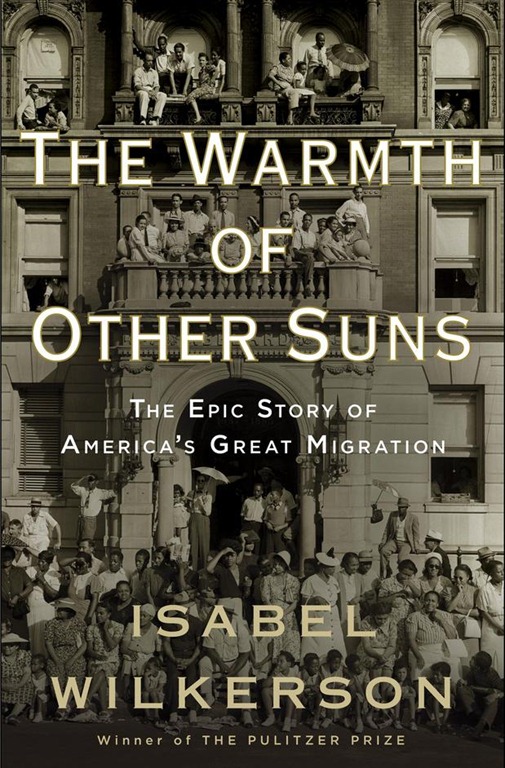
The Warmth of Other Suns by Isabel Wilkerson

With a title like The Warmth of Other Suns you’d think this book would be about interstellar travel, but it’s not, this book is about how we’re all so alien to one another.  From 1915 until the 1970s six million African Americans left the old south to find freedom living up north and out west hoping to escape the cruel Jim Crow laws that continued to enslave them long after the Civil War had ended.  These immigrants fled a homeland filled with oppression and cruelty hoping to find freedom in a new land that was ironically part of the same country they were leaving.

warmth-of-other-sun_571052c

The Warmth of Other Sun reads like a novel, but it’s a history book, one if you’re old enough you might remember living.  This is a great book, a wonderful book, and a very painful book to read because it paints scenes from an inglorious America that we must never forget even though most people have.   This is a tremendous book to contrast the past with the present and show us how far we’ve come with changing our society for the better.  Race relations is a tired subject for most people, so I worry this book won’t get the audience it deserves.  People need to read The Warmth of Other Suns because it’s a great story, amazingly told, and yes, it will be good for you, even if it hurts.

Watching TV after reading The Warmth of Other Suns is startling, because this book chronicles the horrors of the Jim Crow era so vividly that seeing so much diversity on the television screen makes it hard to believe this book is true.  One of the great sad aspects of this book is none of the principal characters lived to read it, or to see Barack Obama become President.  We haven’t reach the promised land, but I think we can see it in our telescopes, if we look hard.

Growing up the phrase “silent majority” was often used to mean the common people that didn’t get heard in the press.  The Warmth of Other Suns tells us there are more than one silent majority, and we each bask in the warmth of different suns.  There is no one group of blacks or whites that represent their races.  I hate the term race because it’s an optical illusion.  To talk about specifics we use generalities.  In this book we have the black people who immigrated to the north and west, and we have the black folk who stayed home in the south, and we have the whites of the south and the whites of the north and west.  But in end, every last person is different.  I think Wilkerson reflects this reality.

Wilkerson writes about three principal characters to tell her story, after interviewing over 1,200.  She could have written about three different people fleeing the dying Dixie and told a completely different story.  She could have written about three people that stayed in the south and their story could have reflected an equal amount of bravery as those who left.

I’d like to coin a different term, “silent heroes.”  This is what The Warmth of Other Suns is about, about three people brave enough to build a new life.  Isabel Wilkerson’s three silent heroes are:

  • Ida Mae Brandon Gladney  – Mississippi sharecropper
  • George Swanson Starling – Florida fruit picker
  • Robert Joseph Pershing Foster – Louisiana doctor

The history of humanity has been the story of men and women seeking personal freedom, but Americans have for so long lived with security, success and smugness that I’m not sure they even know what freedom means anymore.  Reading The Warmth of Other Suns will remind them with intense details and powerful emotions.  Americans love to think of themselves as living in the land of the free, but stories like The Warmth of Other Suns reminds us we have a long way to go until everyone is free in this country.  And freedom doesn’t mean just being free of metal shackles – because the southern racists who mistreated, tortured and murdered the blacks are imprisoned by psychological chains stronger than any metal.

We all have physical and mental chains that bind us from being truly free – read this book and see what I mean.  In reality The Warmth of Other Suns is another chronicle of the Greatest Generation.  I could never have been as brave as Ida Mae, George and Robert.  I never worked as hard in my life at anything as they did just to survive most of their routine days.

In the United States we all love the heroic soldiers fighting for freedom in distant lands, but somehow we feel threatened by freedom fighters in our own country.  I’ve always loved movies about brave soldiers in war movies, or brave cowboys in westerns, or tough cops that fight crime, but there are all kinds of brave people we don’t celebrate in movies, and the people in The Warmth of Other Suns are very brave people indeed, ones that need to be saluted and remembered.

Isabel Wilkerson also needs to be amply rewarded and recognized for the many years she spent researching this story.  The Warmth of Other Suns is an amazing accomplishment.

If I had the time and energy I could write thousands of words about this book, but I don’t know if any more would convince you to read it.  Most people read fiction.  Most bookworms stick close to their favorite genre, whether it’s murder mysteries, science fiction or romance.  I suggest skipping your next novel and reading this this non-fiction book because you might just find it far more exciting, emotional and wonderful.

Other Reviews:

JWH – 5/16/11

Google Music Beta v. Amazon Cloud Drive

Problem #1 – Should I Spend $659 for a Proper Storage Rack for My CDs

Currently, my wife Susan and I have 1,500 music CDs we store on a built-in shelf behind the door of our spare room.  This isn’t a good place for them because it’s not easy to get to, and it only has 9 shelves, and I need 15, so we have to go double high on some shelves, and even double deep on others, so finding and shelving a CD is very annoying.  This whole system is so annoying that I don’t like playing my CDs.  The solution would be to buy a nice CD rack from Boltz.com and put the CDs near where we play them.

CDs-behind-door

Convert that to this

Camera:   DCS560C
Serial #: K560C-00566
Width:    2008
Height:   3040
Date:  2/17/2001
Time:   20:40:28
DCS5XX Image
FW Ver:   3.2.3
TIFF Image
Look:   Product
Sharpening Requested:No (Preferences)
Counter:    [1776]
ISO Speed:  100
Aperture:  f18
Shutter:  1/250
Max Aperture:  f2.8
Min Aperture:  f22
Exposure Mode:  Manual (M)
Compensation:  +0.0
Flash Compensation:  +0.0
Meter Mode:  Spot
Flash Mode:  No flash
Drive Mode:  Single
Focus Mode:  One Shot
Focus Point:  --o--
Focal Length (mm):  35
White balance: Preset (Flash)
Time: 20:40:28.592

Problem #2 – We Hardly Ever Play CDs Anymore

Susan plays her music on her iPhone, and I play my music through my work computer, my home computer and my HTPC in the den that’s connected to the big stereo system.  The only time I like playing the CDs is when I want to sit in the den and play them loud so I can enjoy the music’s full fidelity.  That’s happening less and less often.  And for 97% of the time I play music from my Rhapsody subscription.  So why spend hundreds of dollars and hours of efforts to organize my CDs?  Could we get rid of the CDs altogether?  They are our proof that our digital copies are legal, so I suppose we could box them up and put them in the attic.  But when I retire I’d like to move around and dragging 20 storage boxes of CDs will be like carrying a boat anchor everywhere I go.

Problem #3 – Making and Maintaining a Perfect Digital Copy of Our CD Collection

A couple years ago I spent weeks ripping our collection, but since then we’ve discovered the results had been imperfect.  Here and there a cut will be missing, and on rare occasions a cut will be bad.  And since then we’ve bought many CDs that we haven’t ripped, but we’re not sure which ones.  And we have the worry of maintaining a backup.  I have the whole library copied on external drives, some of which we keep off-site, but each copy has gotten out of sync and we’re not sure which one is the master anymore, and all of them are now incomplete.  What a pain.  I love Rhapsody, but I’m being forced to maintain my own digital collection of music because Rhapsody doesn’t have everything.  For example, no Beatles.  Or if the CD goes out of print, it’s removed from their collection.  Basically Rhapsody provides most of what music is being sold at any given moment, with the exception of a few butthead bands that won’t sign with them.

Problem #4 – I Don’t Like Most of the Music in My Collection

Of our 1,500 CDs, or 18,000+ songs, I’d guess I really only like less than 6,000 songs.  And that’s only a guess, it might be much less.  Most albums have only 1-2 songs I really like, some CDs I never liked any of the songs, or have since turned against them.  And Susan and I like different songs.  What we’d really love is two digital collections:  His and Hers.  And we want each collection slimmed down to just the songs we love.  But going through 18,000+ songs to find those gems would be months, if not years of work.

Solution #1 – Forget CDs Completely

I could probably live without my CDs because I have Rhapsody.  Susan has most of everything she already wants in her iTunes library, and whenever she wants something new she buys a CD and rips it to iTunes.  If we weren’t worried about proving our digital songs were legal, we could just get rid of the CDs completely.  We could start buying MP3 songs instead of CDs.  This is a very appealing solution because it would be the most hassle free.  The downside is we’ve paid a lot of money for our CDs, and I don’t want to buy those songs again.  Many of those albums we bought as LPs, and then bought again as CDs, and some of them I bought a third time as SACDs, and many CDs we bought a second time as a CD when the remastered version came out.  I hate the idea of buying MP3 songs that we’ve already bought one more more times, and then getting a lower fidelity copy.  Will MP3 be the last format?  Is this the last time we have to buy our favorite songs?

Solution #2 – Move Our Collections to the Cloud

Google Music Beta is promising some lucky people storage for up to 20,000 songs for free.  Right now if we moved our collection to Amazon Cloud Drive it would cost us $125 a year to maintain.  And since Susan and I would like to have our own separate collections, if we both uploaded our collection to our Amazon accounts, it would be $250 a year.  Of course, we’d both like to thin out our collections, so eventually that cost would be smaller, but it would take us months to get to that ideal music library.  Google is promising free for awhile, and that might be enough time to reduce our collection to just the songs we love, but we don’t know what Google’s final cost will be.  More than likely, we’d want our collections in both clouds as backups, or case one service is down, or one goes out of business.  Is it possible that Google Music or Amazon Cloud Drive will survive for the rest of our lives?

The down side of this is I’d still be managing four collections:  CDs, Rhapsody, Amazon and Google.

Solution #3 – Give Up Music Ownership

I could go with Rhapsody, Pandora and other streaming music sites and just forget about owning songs at all.  This has a tremendous appeal to me, but it also has a scary downside.  If I get in the mood to hear a certain song and it’s not on Rhapsody I’m shit out of luck.  For $120 a year I get access to 11,000,000+ songs through Rhapsody.  That’s almost perfect, except that once in awhile I want to hear a song that Rhapsody doesn’t have.  Can I live with that?  It’s not like I don’t have more music than would ever have time to hear.

Solution #4 – The Compromise Solution

The compromise solution for now is to put our all-time favorite music into our personal cloud storage sites, save out my all-time favorite CDs to play loud, continue to listen to Rhapsody, and put the rest of the CDs in the attic.  This is still a big mess though.

Hope for the Future

If Rhapsody and other streaming music services could serve every song ever recorded then I’d give away my CDs and forget about owning music forever.  I wouldn’t even mess with cloud drives.

Amazon Cloud Drive is very appealing because I can buy music from Amazon which they promise to store for free and hopefully they could manage my music collection for the rest of my life.  If my music collection could be slimmed down, and their prices came down some, Amazon Cloud Drive might be a great long term solution for owning music.  I buy all my books, CDs, and DVDs from them now anyway.  The downside for Amazon is their lack of an app for iOS for Susan to use, and their player is rather primitive, but I’m sure that will improve.  They should offer some kind of incentive like for every $10 spent on music they will add 1gb of lifetime storage to your cloud drive.

Google Music Beta is even more appealing because it’s free right now.  I could put my whole collection online at no cost.  Another big plus that Google Music has over Amazon Cloud Drive is its player, which I’ve only seen in demo videos.  It looks far more sophisticated than Amazon’s player.  The downside is Google doesn’t sell music.  It would be weird to have to buy songs from Amazon and then copy them to Google.

Apple still hasn’t come out with their cloud drive yet.  Susan is very tied to iTunes because of her iPhone, and depending on what Apple charges, it could be a great solution for her.  I have an iPod touch, but portable music isn’t that important to me.  I’ll probably get an Android pay-as-you-go phone, so it will work with Amazon or Google.  If Apple came out with free unlimited for life music storage and offered a streaming service, I might be tempted to go with them, and then start buying my songs from iTunes.  Their downside is iTunes isn’t very good for managing large music collections, but that could be improved too.

I have yet to see any rumors that Rhapsody will offer a cloud music drive for its users, but it could be the best of both worlds.  Especially if Rhapsody could develop an app that looked at my collection and then upload only the albums they didn’t provide that were out of print.  And they could warn users when an album was going out of print and offer their users a chance to buy songs before they disappeared from the streaming collection.  In other words, Rhapsody could manage both of my collections.

Who knows what will happen, but these new cloud music services could be solutions to some of my problems.

And I can imagine another solution.  Why have millions of copies of “Hey Jude” stored on drives all over the world?  Why not have an international music registry, and when people buy a song they get a license to play it for life, and then music services would only have to cache one copy of a song wherever they stream music.  There would be no need to have massive server farms storing everyone’s songs.  That would save a lot of energy.  You could buy and play songs from any service you like and they would register the license for you.  All music services would be given rights to check the license registry.

Why make Amazon keep a million copies of “Hey Jude” on their servers for a million users when they could link to just one copy?

JWH – 5/15/11

Gullible and Malicious Gossip–Thou Shalt Not Bear False Witness

Politics is depressing – in our times it brings out the worst in men and women.  We are not a nation that pulls together, but one that everyone wants to pull apart.

I don’t know why there’s such a passionate hatred for Barack Obama, but there is.  To me he’s a decent man, a good family man, a man who works hard to do his job the best that he knows how.  I’m sure he has plenty of flaws, but he’s a far better man than I could ever be. 

There is a growing mob of people that want to tear him down.  Conservatives have always complained that national news is biased, but Fox New’s in-your-face bias is little more than rabble rousing, yet it is nothing compared the rumor mill of blogging. 

Blogging isn’t journalism although many bloggers want to be taken as serious as national papers, yet they have no self-control, respect for journalism, or decent sense of human fairness.  Writers on the internet can say anything without any checks and balances, and the lies, misconceptions and slander they create is almost unstoppable.  There’s a reason why Thou Shalt Not Bear False Witness was in the top ten sins that the old Testament God wanted to stomp out.

Although, I’m not really worried about Barack Obama, he can take care of himself.  Any conspiracy theory about him that percolates to the national news will be properly investigated.  No, who I worry about is my friends and relatives who believe the lies they send to my email box.  The beliefs you hold reveal more about your personality than any lack of clothes reveals about the nakedness of your body.  Hatred is ugly.  Passing on gossip, especially a hateful kind of gossip, undresses people’s ugly side.

In the old days people were careful to keep up a positive persona.  People dressed themselves in positive attitudes and acted with a aura of self-control.  If people expressed their negative side, their hatreds, it was usually only to very close friends and family members.  Only uncivilized people were nasty.  But two exceptions come quickly to mind:  racism and xenophobia.  Growing up, whenever I visited the South I was always shocked by mild-mannered church loving people, letting it all hang out when it came to expressing their feelings about black people.  It was frightening to me. 

Poor Obama seems to bring out people’s racism and xenophobia.

I believe that most of the hate mongering over Barack Obama is because he’s black, and maybe because people think he’s Muslim from another country.  I know conservatives hate liberals like Clinton and Gore, but they go beyond the pale in their attacks on Obama and try to find endless ways to discredit him.  Evidently the Presidency is one Jim Crow barrier they never wanted to take down.

Here is an example of one of the emails I’ve gotten:  Wadda Guy!!!!.

Here is the Snopes.com site that answers most of the issues:  Obama’s 50 Lies.

The trouble is conspiracies are very hard to pull off, and most of these stories are just gossip that people want to pass on because they oppose Obama’s politics by smearing him with lies.  And most often these emails come from Christians.  Don’t they know they are breaking the 9th commandment?  And remember what Jesus said about the golden rule….

I have to assume that most people who pass on these types of emails are just gullible and not truly malicious, but I might be wrong.  First off you shouldn’t gossip, but if you’re going to pass on these emails verify them first.  Would you want lies spread about you?  It’s easy enough to do, just get on the internet and research the issue.  Snopes.com is a great place that focuses just on this problem – verifying urban legends.

Malicious people know the stories are lies but pass them on anyway because they feel righteous about their cause.  However, if they are Christians it doesn’t justify breaking the 9th commandment.  Whether gullible or malicious, bearing false witness is very immoral and unethical.

I’m not religious, and I have two ethical rules which I apply to this kind of problem.  First is the Golden Rule, a concept that has appeared in all religions, by all philosophers and is part of all ethical systems.  If you don’t want people spreading lies about you, don’t spread them about other people.  The second rule is much simpler – don’t lie.  It should be obvious that lying is wrong.

Now if I would ask these people why are they spreading lies they will innocently claim they are revealing the truth, and they will feel quite righteously about what they are doing.  Does spreading lies when you honestly believe they are the truth a sin?  I have to say yes, because being ignorant should be a sin too.  We live in a world of ready information, so it should be everyone responsibility to fact check anything you say bad about someone else.  In the old days it was a virtue never to say anything bad about other people, but that practice is no longer common sense.

A long time ago I read a little essay called “Rules of Thumb” about how to judge facts without having to actually look them up.  Rules of Thumb is the idea that you find facts you know and compare them against what you are trying to verify.  For example, how many gallons of water does a bathtub hold?  Most people have no idea.  But people are quite familiar with a gallon jug of milk.  It’s easier to imagine how many gallon jugs of milk can fit into a bathtub, so that can be a rule of thumb.

When getting internet gossip apply rules of thumb to it.  Any story you read in an email that conveys something not publically known about a public figure should be suspect.  Here’s one rule of thumb to use.  We live in a society of pit bull journalists that would sell their mother’s souls for a story.  If you haven’t heard in the national news the story you find in an email figure it’s a lie.  Of course it might not be, but the odd are 999 to 1 it is.  We just don’t keep secrets in this society.  If Obama had not been born in the U.S. he never would have gotten elected.  Hundreds of reporters would have snooped out that story immediately.  To believe otherwise is to be very gullible.

But if you still think a story is valid, research it on Snopes.com.  If they have investigated it and say it’s true, or could be true, feel free to pass the story on.  You might include the link to Snopes with your email.

The email I got made a big deal proclaiming both Barack and Michelle Obama had had their lawyer licenses taken away from them for dishonest actions.  The email made 11 attacks on the Obama.  It had been forwarded at least 7 times because of the quote indicators, so one person can spread gossip at a speed never known before the internet.

How do I know these are lies.  Why should I trust Snopes.com?  The wise thing is to check many sites.  There is one problem though, there are a huge number of websites with conspiracy theories about the Obamas.  If you read enough you’ll find a reasonable answer, but if you’re not looking for a reasonable answer, you’ll find plenty of fuel to ignite the gossip.  Why aren’t these web stories front and center on all the national news programs?  Again, rule of thumb?  Would any national reporter pass up such stories if they could be proven?  No, they wouldn’t.  Look at the success Woodward and Bernstein created for themselves with their stories about Nixon.

So, why all the gossip about Obama?  Edge.org has a new theory that might apply here, “The Argumentative Theory.”  Now this is probably way to subtle and abstract for thinkers who believe Obama is a Muslim born in another country.  Basically it says we aren’t reasonably people because reason isn’t part of our nature, but to argue is.  In other words, most people can’t tell shit from Shinola but they will fight to the death thinking they know the absolute truth when in fact they are quite clueless.

I’ve thought about this.  Everyone acts like they know something, but for the most part we all know very little.  Most people like to think they are smart, at least about a few pet subjects.  But here’s my last rule of thumb.  Even the most specialized subjects around have hundreds of books written on them.  Some Ph.D. specialists may have read thousands of books and journals on their expertise.  Clueless people think they know it all after reading one page on the internet.  If you don’t want to be seen as something other than a crank, don’t profess facts unless you’ve read ten comprehensive books on the subject, and that will only be the beginning point where you can say you have a minor interest in the topic.  And even then, if you read the article at Edge.org, you’ll probably have found 10 books that support your personal bias.  We really don’t have the brains for exact reasoning – just remember that you want to pass off a fact.

JWH – 5/5/11

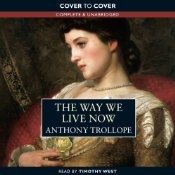
The Way We Live Now by Anthony Trollope

I have never read an Anthony Trollope book before reading The Way We Live Now.  In fact, I knew so little about Trollope that I thought he was a French novelist, but of course I was wrong.  He was born and died in London, and was roughly a contemporary of Charles Dickens.  The only reason I listened to The Way We Live Now is because Audible.com had a sale on audio books priced at $4.95 each and I loaded up on them.  Whenever Audible has one of these $4.95 sales I buy just about anything that sounds good, taking chances on books that I normally wouldn’t buy at regular price.  This chance taking often pays off, and with The Way We Live Now was a huge success.

TheWayWeLiveNow 

I didn’t even mean to start listening to The Way We Live Now this month, I have several books needing to be read for book clubs, and it was extremely long.  But I was curious and once I started listening I couldn’t stop.  The BBC WW edition I listened to was wonderfully narrated by Timothy West who seems to have made a career out of performing Trollope.  The 32 hour and 25 minute audio book was broken down in four 8 hour plus digital sections, and as I finished each part I watched one episode of the 4-part BBC One production of The Way We Live Now (2001). 

TheWayWeLiveNow2

That means 8 hours of book is turned into one hour of film.  Listening and watching was very educational about how movie makers distill a novel into a teleplay.  Sadly, four hours was way too short.  I think they needed a minimum of 8 hours to do the job well, and would have been a superior production if they had given it 12 hours like many HBO shows.  If a tiny 9.5 hour audio book like Dead Until Dark by Charlaine Harris can be made into a 12 part True Blood, imagine what the BBC could have down with The Way We Live Now at three times the length.

TheWayWeLiveNow2001

The film version uses the phrase “the way we live now” more than once, but I don’t remember it used in the book, but that’s essentially what the book is about, a time when things are changing.  People are having to change, and all the characters illustrate “the way we live now.”  The book is set in London during 1873 when everyone is caught up in an economic bubble.  The story has a very modern feel to it.

Augustus Melmotte is a very rich man who has come to London buying real estate and promoting a stock investing craze.  He has a Donald Trump quality to him.  His background is very mysterious, but he wants to be the wealthiest man in London and even has political aspirations.  He has a daughter Marie that he’s dangling in front of the English aristocracy hoping to wed her to another large fortune and get a title for the family to legitimatize his ambitions.  Unfortunately for Melmotte, many of the swells have titles but no money and see Marie as a solution to their own economic problems.

The story is about class and social climbing, and satirizes much about London life that Trollope didn’t like.  To stir things up even more he gives us two American characters Hamilton K. Fisker and Mrs. Hurtle.  Fisker is a wheeler-dealer promoting a railroad from Salt Lake City to Veracruz, Mexico and convinces Melmotte to lead the charge with  British investors.  Fisker wants Melmotte in on the deal because of all the lay about aristocrats he can get for the board of directors and use their names to sell stock to the gullible English.   And the English want to cash in on American empire building.

The story is long and leisurely, but never slow.  It has a horde of characters, many struggling to find appropriate mates, sometimes for love, sometimes for money.  Like most Victorian novels there’s no actual sex in the story, but Trollope seems to go further than his contemporary novelists at indirect suggestions.  He knows that people are having sex, he just doesn’t give us any sex scenes, or even directly implies his couples are having sex.  What’s interesting is the film version does bring the Victorian novel into the realm of PG-13.  I don’t think this hurt Trollope’s story except when Mrs. Hurtle tells another woman she was sleeping with Paul Montague, and that just doesn’t happen in the novel.  But we the reader knows that Hetta is thinking it.

The film versions leaves a lot out, and actually changes the story in key places, and totally screws up the ending.  If I hadn’t been reading the book I would have given the film a B- for a Masterpiece Theater type show, fun, but not great, like the A+ Downton Abby.  Knowing the book I’ll have to give the film a D+ at best, but well worth watching if you are hard up for Masterpiece Theater kind of shows, which I often am.

The novel is full of great characters that illustrates different layers of London life.

Sir Felix Carbury, a young penniless baronet, lives by his looks and title, mooching off his mother Lady Matilda Carbury while gambling at cards all night, and half-heartedly chasing Marie Melmotte.  Felix is as modern as any slacker son today, and gives his mother endless grief.  Lady Carbury, his doting mother, tries to get by on writing, but she writes terrible books such as, Criminal Queens: Powerful Women as the Playthings of Love that are full of inaccuracies and quickly cribbed from other sensational books of the time.  Trollope uses her literary ambitions to make fun of writers and publishers of the day.  Again, its very modern.

Roger Carbury is the novel’s decent man and suffers for it.  He’s always been in love with Felix’s sister Hetta, but she’s not in love with him.  Lady Carbury pushes her daughter to marry her cousin so the family would be  rich again and Hetta would inherit the Carbury estate.  Hetta is in love with Paul Montague, English partner and civil engineer to Hamilton Fisker’s great railway project.   Paul is Roger’s protégé and best friend.  It’s quite a nasty love triangle.

Paul is tangled up with Mrs. Hurtle, an American adventuress that might have killed more than one husband for being scorned or cheated on, and has taken to the English gentleman thinking he is honorable.  In the novel Trollope portrays Americans as bold, calculating, brash, uncouth, immoral and uncultured.  Mrs. Hurtle dominates Paul and he wants to run, so she chases after him like a big game hunter, refusing to let him escape her clutches.

Marie Melmotte, played by Shirley Henderson (Moaning Myrtle in the Harry Potter films) steals the show in the film version, and for the most part fulfills the character of the novel.  In the novel, Marie is boy crazy for Felix, but her domineering dad, Augustus sees right away that Felix has no money and is worthless for his plans.  At the beginning of the story Marie is weak and mousy, but by the end she’s in command of her fate.  The Way We Live Now is very much a feminist novel, or as much as it could be for the time.  One young social climbing girl is even willing to marry a Jewish man to get what she wants.  Trollope deals a lot with anti-Semitism in the novel, again showing the way we live now involves accepting Jewish people into society and politics, and I think he’s sympathetic to this issue, but I’m not sure.

I doubt few people will run out and read The Way We Live Now because of my recommendation.  Giant Victorian novels just aren’t that popular anymore.  But I do give it an A+ for entertainment value.   It has become one of my favorite 19th century English novels – and the very best include Pride and Prejudice, Great Expectations and Middlemarch.

JWH – 4/24/11