24-bit FLAC Crash and Burn

After listening to a video interview with Neil Young tell us music lovers who listen to MP3 files we’re settling for 5% of music data from a studio master I wrote The Quest for the Highest Fidelity.  Since then I’ve been experimenting with 24-bit FLAC files to see if I could hear the stuff I’m missing.  I downloaded a copy of Fubar2000 to play FLAC files and then downloaded a selection of sample FLAC files from 2l.no.  I did not notice a dramatic 20 times better sound quality from having 100% of the music data.  I couldn’t even tell if it was 5% better.

The big question is why not?  Some possible answers are:

  • My ears aren’t good enough (60 years old)
  • My PC speakers aren’t good enough (Kliptsch THX 2.1)
  • My PC audio isn’t good enough (RealTek HD Audio)
  • I don’t have things set up right
  • I don’t have auditory skills to notice a big difference
  • I don’t have all the various components working together properly

If I had $10-20,000 in audio gear I might notice a significant difference but I’m not going to spend the money to find out.  But even if had the money and was willing to spend it, I think I’d need a degree in audio engineering to set up the system.  There are damn few books about setting up high definition digital audio, and not that much on the Internet either.  My Realtek HD audio supports playing 24-bit 96kHz and 192kHz files, and I download FLAC files of each type, and damn if I can tell any difference.  I could tell a slight difference between the 24-bit FLAC and the streaming MP3 music.

And even if the sound was dramatically better, would I really switch to buying $25 albums?  A terabyte hard drive would hold about 100 albums, which would be $2500.  I get a million albums for $10 a month from Rdio, and they sound great.  But then I’m happy eating beans and rice.

I suppose if I was a rich dude living in a big house and had lots of money to burn, I’d build a room for high definition audio, and a RAID NAS with many terabytes of free space, assemble a high end stereo system and collect 24-bit FLAC files, but I doubt I’ll ever be a rich dude.

But you know what?  I recently created a playlist of 1963 songs on Rdio and played them through Roku box connected to my $400 Pioneer amp, with a pair of Infinity floor standing speakers and cranked up the volume, and that was the best I ever heard those songs since 1963.  Neil, I might be missing 95% of the music data, but the 5% I had sounded great.

Even on my PC, if I crank up the volume, the songs sound way better than when I first heard them on a clock AM radio with a single 3” inch speaker.

Streaming MP3 music is just too damn convenient.  This experiment is over.

JWH – 2/15/12

Dear Amazon, Please Create These Features for My Kindles

Now that I’m slowly becoming Kindlelized I realize I might be reading on a Kindle for the rest of my life, at least if Amazon keeps marketing their ereaders by that name.  Evolutionary steps in the Kindle technology have made reading much easier than book reading, especially now that I’m older with bad eyesight.  However, the Kindle is far from perfect, and I’d like to make a few suggestions Mr. Bezos for future features I’d like to use.

If I’m switching to ebooks then I want a library for my ebooks.  So far Kindles are more like a box for books, not even a bookshelf, and what I need for a lifetime of ebook collecting is a personal electronic library system.

Kindle Cloud Library and Librarian

Once I got a couple dozen books and magazines on my Kindle the interface became annoying and clumsy.  I now read my Kindle books on my Kindle 3, iPad 2, iPod touch, PC and Mac.  My wife owns a Kindle Touch and I’m going to buy one too, and I plan to get a Fire when version 2 comes out.  I also have Calibre on my PC, and Send to Kindle extension for Chrome on all my computers.  And even though the Kindle environment keeps up where I left off in any book despite what device I read on, not all content is available on every device or reader program.

My first request is for a Kindle Library in the Amazon Cloud.  I want one location to keep all books, magazines and documents that will be permanent.  By permanent, I mean the rest of my life.  I want to leave my library in my will.

I want one location to keep clean and organized.  I want one location where I can file and organize my library.  I want to be able to list by author, title, subject and collection.  I’d also like to list by year published, date acquired, books read, books unread, books I want to read, etc.

Once I start getting thousands of documents this will become very important.

I want all my devices to check out books from a single Kindle Cloud Library.  Then when I’m finish reading, I want to clear the book from the device, or even from all devices automatically.  I want to manage one library in the cloud rather than libraries on every device and reader program.

I want to upload my personal documents to the Kindle Cloud Library in addition to sending them to my Kindle email address.

I want a cataloging system too, something simple like the Dewey Decimal system.  Library of Congress is too complicated.

I also want tools for managing my library like a database.  It would be a huge plus if it integrated with LibraryThing or GoodReads, and I could export data to a spreadsheet or database for making printed reports.

It would also be great Mr. Bezos if my Kindle Cloud Library integrated with Evernote.

Kindle Special Collections File Folders

I don’t care how Amazon stores my ebooks and audiobooks, but I want a section of my cloud library for documents I create that works like Dropbox.  I want to be able to organize my documents into folders and subfolders.  It would also be useful to have a tool that converts documents that I want to keep permanently in my library to Kindle’s ebook format, but I want to store Word and Acrobat files too, as well as jpeg photos.  And hey, get rid of DRM and work out a world-wide universal ebook format that will last forever.

Kindle Library Card

I hate the fact that my wife can’t read my Kindle books.  I suppose we could swap Kindles, but that’s messy.  I suppose we could share one account, but that’s messy too.  I want my own library, and I want her to have her own library, but I want to be able to borrow each other’s books.

We need to have a library checkout system for family members.  Spouses and children should have unlimited access to family libraries.  We should also have limited check-out privileges for friends and extended family.

Kindle Interlibrary Loan and Bookstore

When I search for a book in my library I want to know if I own it first.  Then, I want to know if there are public domain editions I can add to my library.  Then I want to know if there are library copies available, either from my public library or from Amazon Prime.  Finally, I want to be told what copies are available for sale.

Kindle Multimedia Library

Because Amazon also owns Audible.com where I buy my audio books, and I have my music stored in the Amazon Cloud, I’d like to be able to integrate these media into my Kindle Library Cloud.  The Fire is moving towards this now, but I want all my Kindle devices and readers to read all the various kinds of content in my library.  I want my librarian management software to work with all media.

I’d also like to be able to add audiobooks I’ve ripped from CDs to my Kindle Cloud Library.  Ditto for tape audiobooks I’ve converted to MP3s.

Remove from Collection

I also want a way to remove content from my collection.  Whether this is a permanent deletion or shelving in hidden stacks I don’t care.

Kindle Book Match

Now I don’t know if this last request is even possible, but I’m going to ask.  I know some people will never cotton to ebooks, and many people will always want to collect physical books.  I’d like some kind of system like iTunes Music Match where I turn in my physical books and get ebooks added to my library.  I just don’t want to buy books twice like I did with albums when I bought many CDs that I already owned on LPs.  Since Amazon is in the used book business maybe it would take physical books in trade for ebook editions.

JWH – 2/14/12

Living in the Cloud: Google Music, Amazon Cloud and iTunes Match

I have over 18,000 songs ripped from CDs I’ve been buying since 1983 or 1984.  It was a big project to rip them, and I bought a couple external hard drives to back up my work.  One of those drives stopped working recently, and it’s a pain to keep master library and backups in sync, especially since I keep one drive off site.  In fact, I gave up on keeping my collection and backups in sync.  So when cloud music storage came out I thought wow, this is a great idea.

The first service I tried was Google Music since it was free.  It has an upload app that runs as a background service and I spent a couple weeks getting my collection online.  I mainly listen to music at my home office computer, my work office computer, and in the den with a HTPC hooked up to my stereo system.  I have an iPad and iPod touch, but I don’t like listening to music on those devices.   I just don’t like hearing music through earbuds.

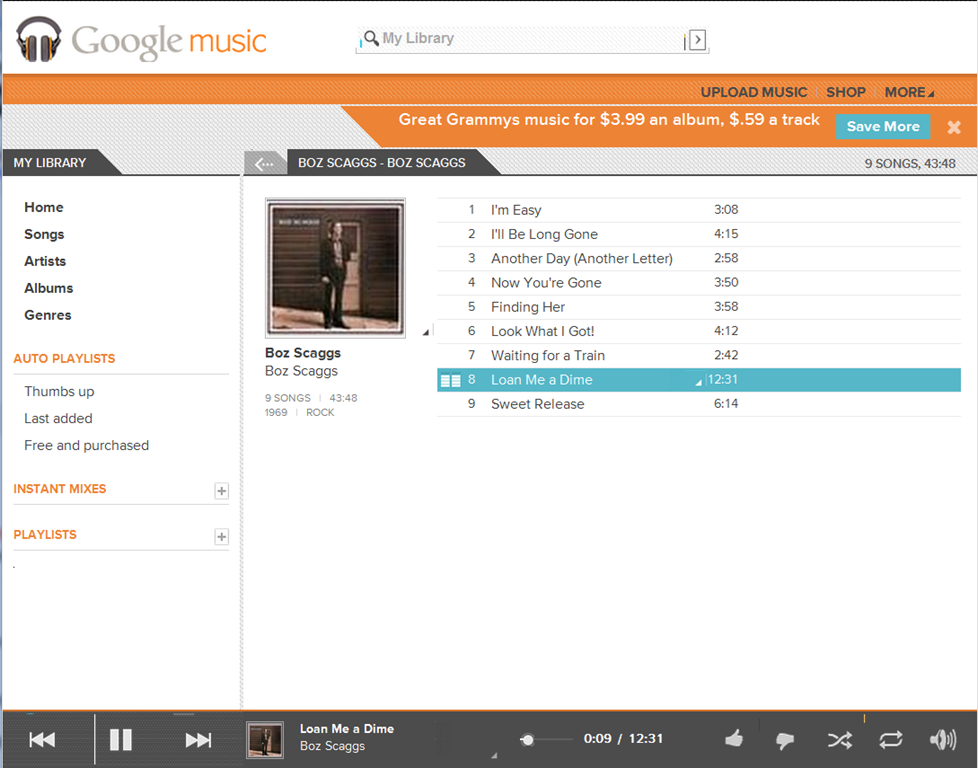
I did test Google music out on my iPad and strangely enough the album listings look best on the iPad.  Google Music looks bad on large screen desktop monitors because I think the album thumbnail images are optimized for phones and tablets.  Their web player has basic controls for play/pause, next, previous, repeat and shuffle – nothing fancy but gets the job done.

Here is the album view.  You can blow up all images by clicking on them.

google-music

Here is what it looks like to play an album – the controls are along the bottom.

google-music-player

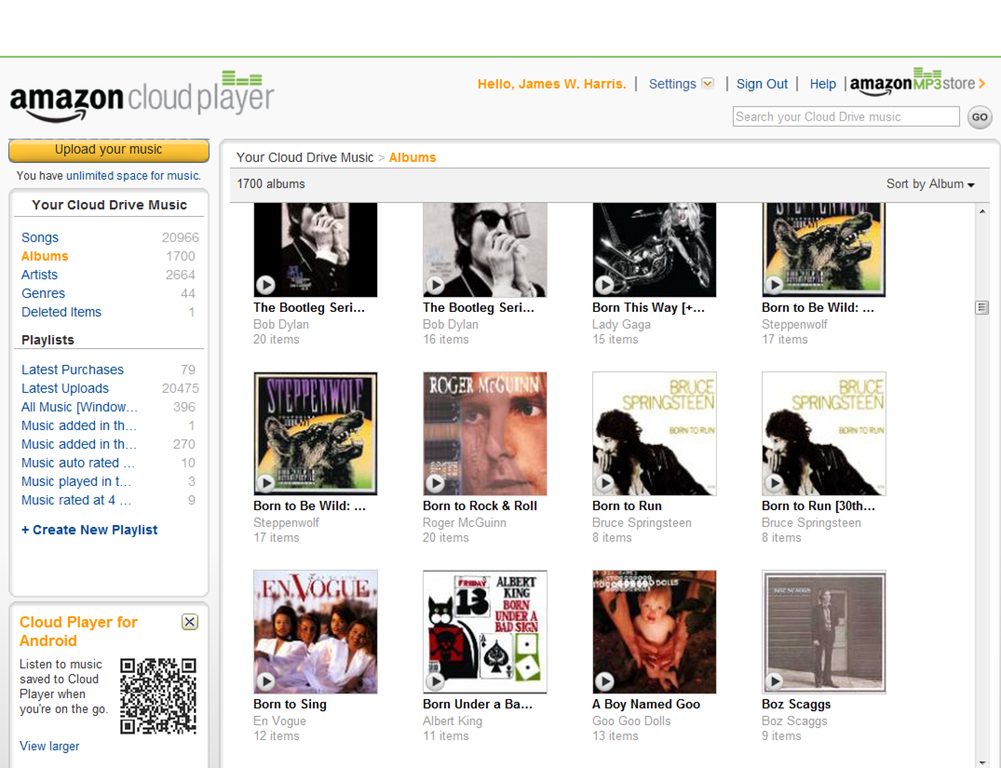
Then I uploaded my music to Amazon Cloud.  It also took a couple weeks, but it was a web app that kept crashing.  Also, Amazon’s upload app found all my audio books and uploaded them.  I really didn’t want it to do that, but it did.  I already had 20gb of storage at Amazon’s cloud because I had bought an album on promotion, and Amazon recently gave unlimited music upload space to anyone with 20gb of space or more.  When the renewal comes up, storing my music on Amazon Cloud will be $20 a year.  Here’s the album view for the Amazon Cloud player.

amazon.cloug

Notice the album covers are nicer looking.  Here’s what the album player looks like.  The same basic controls as Google Music.

amazon-cloud-player

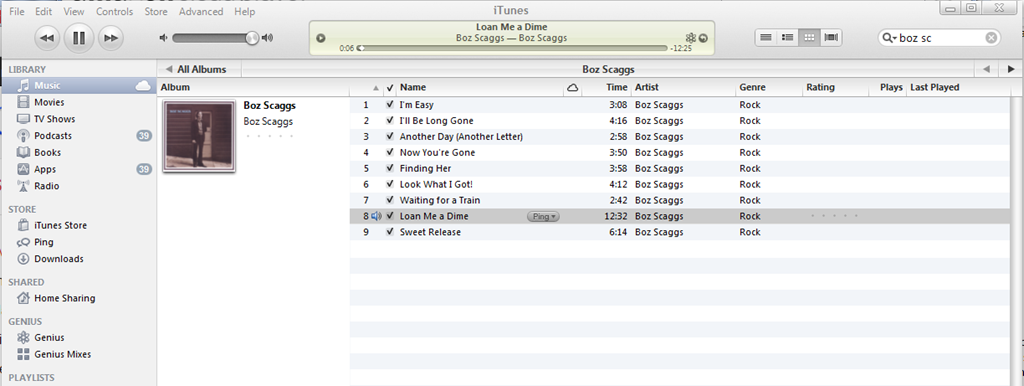
iTunes Music Match works different.  It works through iTunes – which I hate.  I was hoping it would have a web client too, but it doesn’t.  So I can’t play music on my Linux machines.  Nor do I want to install iTunes on all my machines.  And for some strange reason iTunes in album view iTunes sorts by artist, so I couldn’t recreate the album images like I did with Google Music and Amazon Cloud.

itunes

Here’s the player view.

itunes-player

Because iTunes Music Match costs $25 a year, and it’s from Apple, which has a reputation for style and slickness, I thought I would like it best.  I didn’t.  I like it least because it’s tied to iTunes.  The music match feature worked beautifully, and within minutes 15,000 of my albums were online.  It took two days to upload 3,350 unmatched albums.  This is a more sophisticated way to get albums into the cloud, but playing them is limited to machines with iTunes.

Another strange thing about iTunes is it did the poorest job of finding album covers.  Apple is so visual that I found this disappointing.  I have spent a lot of extra time trying to find the covers and put them into iTunes so I can enjoy album flow viewing, but I gave up somewhere in the D’s.  Now there’s a company that fixes this problem with a program called Tune-Up.  However, it’s expensive.  $39.95 per year, or $49.95 for a lifetime license.  It annoys me so much not having the artwork that I am tempted to spend the money, but I’ve decided that I just don’t like iTunes Music Match if I have to use iTunes.

Finally, iTunes plays music differently.  Google and Amazon streams from the cloud.  No internet, no music.  iTunes lets you download songs from the cloud.  The others do too, but iTunes seems to emphasize download.  You can have up to 10 devices sharing your Music Match cloud library, but what appears to happen is the music gets downloaded to each new device.  You can tell your satellite devices to intentionally download the music so you can play it offline, and this will be a great feature for most people who use iPhones and iPads.  However, it will fill up your device with music.  I prefer streaming.

As far as I was concerned iTunes Music Match was $25 down the drain.  However, Mac users who own Mac, iPhone and iPad will always have iTunes and so Music Match will be worth it to them.  iTunes Music Match seems geared to iPhone, iPod touch and iPad users, to help on-the-go users get music down from the cloud.

Now I have to decide between Google and Amazon.  Because I’m a dedicated Chrome user I’m partial to Google.  Because I’m a dedicated Amazon customer, I’m equally partial to Amazon.  I’m leaning towards the Amazon cloud because the player looks better.  However, it will cost me $20 a year.  I’m going to maintain both for now, or until I see what Google charges.  I’m an Amazon Prime user, so I wish they’d made unlimited music storage free for Prime members.

My next project is to thin out my collection.  I’m not sure how well Google and Amazon update their clouds.  I want to make one perfect copy of my library in Windows Media Player and hopefully Amazon and Google will keep this master library in sync.  Another test will be to download my collection to my work machine to see how well these clouds can be used as backup to restore my collection.  But these are for future reports because it will take months to do all this.

JWH – 2/12/12

Accepting Reality

For most of the history of mankind, gods or God, explained reality.  God made us, the plants and animals.  Any event in nature, whether good or bad, was caused by gods or God.  Then science came along and explained rain, thunderstorms, earthquakes, eclipses, droughts, stars, planets, and so on.  When science explained the origin of animals and people, some religious people rebelled.

We now have people that reject science because they want to keep God.  They feel science is explaining away God.  I’m afraid they are right.  But instead of accepting reality and letting God fade away, like the gods before monotheism, they are rejecting reality.  When I was very young I rejected God and accepted science mainly because of the size of reality.  Reality seemed too immense to have been created by one being, especially one in our image.  Take a look at this video to see what I mean.

God was a great concept when our awareness of reality was small but once you realize the size of reality, age and scope, even at the limits of what we know now, that knowledge changes everything philosophically.  Humans can’t be the crown of creation.  We can’t be the center of the universe and the focus of God’s attention.  We can’t be special if we’re so small and insignificant.

So what is our place in the reality?  Years ago I would have asked, what is our place in the universe, but it appears our universe might be one of an infinity of universes, and this round of 13.7 billion years since the Big Bang, only a single bubble in a foam of universes.  Science now talk of the multiverse, but I prefer the term reality to encompass it all.

Humans are here in this vast reality by an accident of randomness.  We won’t always be here.  Reality existed before us, and it will exist after us.  Being here is the biggest miracle we’ve yet discovered.  It’s a miracle that outshines any miracle ever recorded in all of the religions of the world.

I think its time we reject the theory of God and start accepting reality for what it is.  Start asking questions about what existing in this vast reality means.  Becoming self-aware in this immense reality is a great opportunity.  Instead of destroying the Earth and committing species suicide we need to think about what we could become.  Don’t ask what is our purpose.  Under religion our purpose was to obey God.  Reality doesn’t work that way.  We each have to find our own purpose if we want one, but reality expects nothing of us.  We can’t have a personal relationship with reality.  Each of us is an awareness of reality, but most of us pretend we’re not here.

Erase all the past thoughts of religion and philosophy.  You just woke up in an unknown place.  Take stock in your surroundings.  You know that old saying, think global but act local – do the same for reality.  Our philosophy should be based on our best picture of reality.  Start with cosmology and work your way down.  Most people define reality by their very small personal delusions.  I say, any philosophy that doesn’t account for the size of reality dooms itself to a cockroach mentality.  A cockroach scurries about satisfying its personal urges unaware of its environment.  A cockroach does not know it’s in your kitchen because it doesn’t see the big picture.

There is only one human endeavor that tells us about reality, and that’s science.  I suggest starting at the top, and work down.  NOVA presented a wonderful four part series called The Fabric of the Cosmos hosted by Brian Greene based on his book of the same name.

Fabric of the Cosmos 1: What is Space?

Fabric of the Cosmos 2: The Illusion of Time

Fabric of the Cosmos 3: Quantum Leap

Fabric of the Cosmos 4:  University or Multiverse

Maybe there’s still room for religion in reality, I don’t know.  But any religion that ignores what we know about reality is delusional.

JWH – 2/11/12

The Quest for the Highest Fidelity

Neil Young wants us to go beyond MP3.  In this video interview he tells us that MP3 only has 5% of the music data of a master tape, and that CD’s only have 15%.  Which makes me wonder what percentage of the master tape is presented in vinyl.  I also wondered how Neil came up with those numbers.  Well, I found Fidelity Potential Index (see the graph).  By this chart, the vinyl records processes 415,000-625,000 bits per second, whereas a CD is 705,600, and a SACD does 3,500,000 and 24 bit Dolby True HD reaches 4,608,000, but I’m not sure how to compare this to a MP3 file, which have different rates of compression.  But I found “16 Bit vs. 24 Bit Audio” with a number of interesting tables.

That article says a 24 bit master recording at 96kHz sample rates produces a 99 megabyte file for a 3 minute song, and 128kbps MP3 takes up 2.82 megabytes of space.  So if Neil was using a better sample rate that creates a 5 megabytes file, it would be about 5% of the master.  And that’s for a 24/96kHz master, what about a 24/192kHz master recording – the MP3 becomes 2.5%.  But a CD would still have 30-33%, not 15%, unless he was comparing CDs to 24/192 masters, which would be about 15%.  And I still don’t know what vinyl would have.

I’m listening to streaming music right now, “Rudy” by Supertramp, which might be 256 kbps MP3, so I’m getting that 5% of the original musical data, at least according to Neil.  If I spent a bunch of money on audiophile equipment and found a 24 bit master file of this song, if it’s available, would I experience 20 times as much music?

I tried SACD years ago, buying a reasonable amount of equipment just to see what it’s like.  If I sat in my recliner, closed my eyes, and concentrated, I could tell the difference.  Sometimes it was dramatic.  But if I started doing stuff while the music was playing it no longer mattered if I was listening to a CD or SACD.

Listening to music on Rdio while I write my blogs, streaming is good enough.  If I go sit in the den and crank up my stereo, and kick back in my recliner and concentrate on the music like I concentrate on a movie, breaking out the CDs is worth the trouble.  But not if my thoughts drift.  I like to use music to pump up my thinking.  For that, streaming is good enough.

Every once in awhile I’ll listen to music on my iPod touch – like when I have insomnia – but I find music through earphones tiny and thin.  It’s okay for emergencies, but I can’t believe that’s most people’s first choice in listening conditions.

I could go over to HDtracks and buy Fleetwood Mac by Fleetwood Mac in 192kHz/24bit FLAC for $25.98 and find out if Neil is right.  But can my HTPC actually play the file in 192kHz resolution?  Is it even worth it?   Read this thread, “24-bit/192kHz is pointless?”  Or read “Coding High Quality Digital Audio” by J. Robert Stuart.  These people have explored the territory Neil Young pines for us all to live in and they aren’t so sure it’s the promised land.

Let’s think of it another way.  Neil can’t even get people to listen to CDs which have three times the music data, so how can he expect people to demand a technology that delivers 20 times as much data?  I got into SACD years ago just as SACD was failing in the marketplace.  I think Neil is hoping that Apple will come out with iPhones/iPods that have 24/192 technology, and iTunes and Amazon will start selling is 100mb songs that download and store just as easily as 5mb songs.  This could happen.  But music fans aren’t asking for it, so will it happen?  How many people rushed out to buy HD Radio receivers?

I loved listening to SACDs where I felt the musical instruments had so much more texture, and singers sounded like they were live in the room, but I only noticed those details when I paid attention.  How many people really pay attention to music?

And I still can’t find out why people cling to vinyl – the scientific numbers just don’t justify it.  Is there a chance that people love vinyl for its warmth because it has less music data?  If that’s the case, one day when Neil gets his way and Apple presents HD digital music, the young people will all cling to MP3 files for their warmth – all that extra music data will sound too harsh.

JWH 2/9/12