Reading in the Second Half of Life

I started reading Anna Karenina this week.  I’ve never read Tolstoy before, I guess I wasn’t old enough.  Last year my favorite novels were The Way We Live Now by Anthony Trollope and Middlemarch by George Elliot.  Those stories are a far cry from the science fiction I grew up reading.  My story tastes have changed as I’ve gotten older.  I still read science fiction, I just finished Pushing Ice by Alastair Reynolds, but characters seldom seem real in science fiction, not like those in the classic and literary novels.  The same is true of movies and television, where I once thought The Matrix brilliant, now I find the sublime in Downton Abbey.

AnnaKarenina

At sixty I can look back and see my reading life changed around fifty.  Starting at twelve until my college years my reading life had been shaped by the science fiction of Robert A. Heinlein, but even before that, I can remember hazy days of grade school, and the earliest novels I remember reading on my own were the Oz books by L. Frank Baum and the Danny Dunn and Tom Swift, Jr. series.  My early life of reading was inspired by escapism, fantasy and science fiction.  But then, isn’t the youthful literary work of humankind about myths, fantastic creatures, gods, epic voyages,  magic and faraway places?

Don’t we all come down to Earth when we get old?  More and more I prefer nonfiction and history to fiction, but when I read fiction I crave literary works whose authors were careful observers of the realistic details of living.

Getting old for me means paying more attention to the real world and less to the fantasy worlds.  All fiction is fantasy, but I grew up reading fiction inspired by fantasy worlds, and now that I’m getting old I prefer books inspired by this world.  I wonder if this trend continues as I age, will I give up fiction altogether and just read the here and now?

I’ve often compared my reading habit to a drug addiction, and my belief in science fiction to religion, but then Marx said religion is the opiate of the people, so the two overlap.  When we are young we want reality to be more fantastic than it is.  We want to fly.  We want super powers.  We want to be protected by powerful beings.  Comic book super-heroes are no different from the gods of mythology.

As the years pile up the fantastic fails us like our fleshy passions.  As our bodies decay, we are forced to face reality.

Why after fifty, is James Joyce’s Ulysses so much more an adventure than Homer’s?

Konstantin Levin becomes more fascinating than Valentine Michael Smith.

When I was young I wanted to be John Carter, now I rather be John Bates, the valet in Downton Abbey.

Who knew Earth would become more far out than Mars.

JWH – 3/27/12

What is the Kindle Doing to the Science Fiction Genre?

Here is the Kindle Best Sellers in Science Fiction showing two lists, Top 100 Paid and Top 100 Free.

The #1 book on the paid list is A Dance with Dragons by George R. R. Martin.  Okay, that’s natural, it tops other bestseller lists too.

#2 is five John Carter novels bundled together for 99 cents.  I can see that, the movie is getting people to read the old ERB books.

#3 is Ender’s Game – another natural, but it’s old.  I guess people with a new reading gadget are rereading their old favorites.  Cool.

#4 is Wool Omnibus by Hugh Howey.  WTF?  Who is Hugh Howey?  And he’s got 277 customer reviews!  In fact, Hugh Howey has several Kindle books in the Top 100 paid.  How did this unknown writer get in the Top 100 Kindle SF books?

Going down this Kindle Top 100 list for Science Fiction I realize that unknown authors are grabbing many positions on both the paid and free Top 100 lists.  There’s a smattering of old time favorite SF writers, Heinlein has two titles, Asimov, one, and a few modern SF writers of note like Dan Simmons and Orson Scott Card have a few more, but for the most part the these best sellers are books I haven’t heard of before, by authors unknown to me.

Is the Kindle changing the reading habits of science fiction readers?  And other genres as well?

My favorite science fiction writer is Robert A. Heinlein, but then I’m 60 and my reading tastes are as old as I am.  When I started reading science fiction in the 1960s Heinlein-Clarke-Asimov were the big three of the genre.  Most of the SF authors I’ve discovered in the last 50 years don’t have books on this list.   Why?  Are they out of fashion, or has Kindle reading habits changed things dramatically?

How are low cost and free Kindle books going to affect professional writers?  Also, notice the name of the publishers of these books – they are unknown to me, so I have to wonder if they aren’t self-published.

Supposedly, Kindle books are outselling all other forms of books, so is this what people are really reading in the SF genre today?

Many of Heinlein’s books are available for the Kindle, but only two are in the Top 100, and one of those is there because Amazon put it on sale last month.  There are many Kurt Vonnegut books in the Top 100 Paid listing, but again, they are on sale this month.  Amazon uses the technique of lowering the price of a book for a few days to get attention and then upping the price.  New, unknown writers, are using the same technique with their self-published books, and evidently its working very well.  Better than book reviews, better than word of mouth reviews.  Establish writers are now using that trick too.  That trick only works with Kindle ebooks.  It would be interesting to see if it worked with printed books.

If you look at Locus Bestsellers for March 2012, many of their books aren’t on the Kindle bestseller list.  If you look at Amazon’s Best Sellers in Science Fiction general list that includes printed books and Kindle books, the makeup of this list is different, but the Kindle books are having a huge impact.  Here is the Science Fiction Book Club Top 100 Bestsellers.  Notice how it’s dominated by series, media tie-ins and non-science fiction titles.   The SFBC has little science fiction.  Not so for the Kindle list.  Evidently would-be writers are very anxious to write science fiction and readers are finding it on Amazon to consume in mass quantities on their Kindles.

There’s more new science fiction, and dare I say, more exciting sounding science fiction by the unknown authors at the Kindle store.  Big publishers push blockbusters and name authors, and media related books, so the unknown writer doesn’t have much of a chance, but that’s not true in the wild west gold rush of self-published ebooks.  Something is happening here, and we don’t know what it is.

The press has been full of stories for the last two years about how ebooks are impacting traditional publishing, but I don’t think they imagined the paradigm change that self-publishing is making on bookselling.  Self-published ebooks are becoming the  universal slush pile for all readers to work through to find that gem they want to make a success.  Discovering a new author and promoting her can become a new form of social networking.

Think about that.  In the old days assistant editors would cull the slush pile for worthy books to show editors.  Getting a book published was a long slow process that winnowed out the bad.  Now Amazon has made free ebooks the slush pile anybody can read.  If it gets a lot of downloads they put a price on it, if it sells, they promote it.  If it keeps selling, they publish paper copies.  If it keeps selling, a big name publisher will grab up the author.

But do we really want to be slush pile readers?  I’m old, and have little time, so I usually go with the definitive classic now, but young people with lots of time seem to have no problem trying an unknown writer.  Those people are pushing Hugh Howey forward.

I’ve thought science fiction has lost most of its vitality in recent years.  Writers have become obsessed with series, trying to build their book sales by pushing a popular character.  That’s comfortable for some readers, but I liked when science fiction writers were always trying to top each other with far out ideas.  I don’t know if the self-publishing revolution will bring back those days, but maybe.

Finally, does it mean if you don’t own a Kindle you’ll be out of touch with the popular reading reality?  Yes!

SF Signal is a good site to keep up with free SF.  They feature almost a daily roundup of free science fiction.  Today Chasing Vegas by Tad Vezner caught my attention.  The customer reviews at Amazon are very encouraging and it has a great cover.  The old saying is you can’t judge a book by its cover, but I don’t know if that’s completely true.  It seems to me, the best of the self-published books have nice covers.  I don’t know if that’s a real indicator or not.  But in this new paradigm of reading from the slush pile I’m not willing to try just any book.  I look for customer reviews and a good cover.  I hope self publishing authors will do two things.  Hire an editor and buy a cover.

JWH – 3/24/12

Throwing Away the Past

Have you ever found a pair of ticket stubs to a concert you went to a quarter-century ago when cleaning out an old drawer?  You hold in your hand proof that you were somewhere in the past at a certain time, and even what building, row and seat, and what you heard for a few hours.  Do you save the ticket stubs or toss them?  Maybe you could jot the info down in a journal, or make an entry into Facebook Timeline.  If you don’t, you’re throwing the past away.

I often throw my past away, and sometimes I regret it.  Saving the past takes work.  I turned 60 last year and my memory is in decline, so I often wish I had validation for lost memories.  But saving the past often feels like hoarding, and hoarding scares me because the weight of past can become paralyzing.  Some folks bury themselves in the past long before they die.

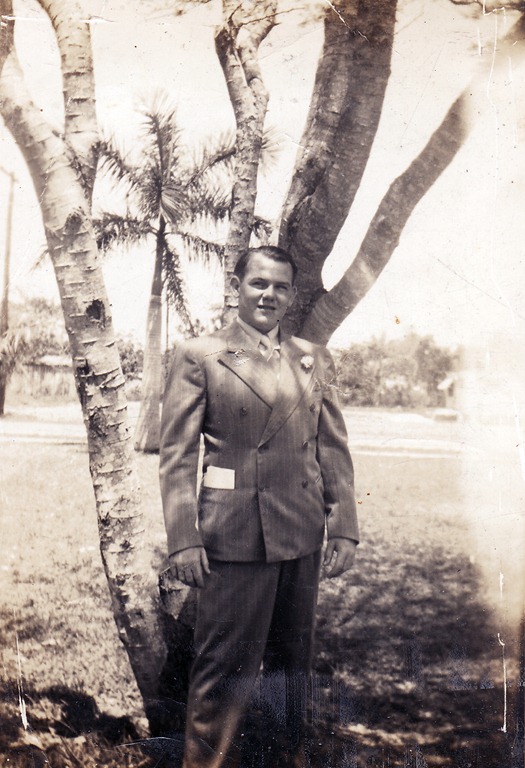
1939-05 - Dad at Homestead FL

Most people don’t have eidetic memories.  Have you ever wondered how biographers could write gigantic biographies of people who lived a hundred or two hundred years ago?  George Washington and Abraham Lincoln left big historical trails to follow, but most people leave few clues to piece together.  My father died when I was 19 and it took me years to realize that I knew nothing about him.  I had memories and a handful of photos, which I thought was all I needed, but when I finally got around to examining those memories I realized I had zip, nada, nothing.  I have no idea what was going on inside his head.  Like, what was he thinking on his graduation day in the photo above?  What did he hope to get out of life?

Recently I threw out decades of credit card bills, medical statements, receipts on big purchases, bank statements.  I knew if I wanted to I could recreate at least my spending and medical history with those clues, but in the end, I chose to throw them all away.

Who are we?  Are we what we think?  Are we what we own?  Are we what we did?  Are we what we love?  Are we what we hate?  I’m not a believer in the afterlife, but I wonder what it would be like, because if we went some place new do we throw out who we were on Earth?  Memories of my Dad are defined by Camel cigarettes and Seagram 7 bottles.  If my Dad can’t have his cigs and booze, can he be my Dad in heaven?  Or do they have bars and ashtrays on the other side?

And is that how the young man in the photo above expected to be remembered?  By his bad dying habits?

There was a period in my life where I fanatically collect LPs.  I had over a thousand of them.  Collecting and listening to music is what made my life good and meaningful.  I eventually sold or gave them all alway.  I only have one LP now.  Last year I had a fit of nostalgia for an album I heard in 1971 called Never Going Back to Georgia by The Blues Magoos.  It was never reprinted on CD.  I ordered a used copy off the internet and a friend gave me a turntable and I played that album a couple of times.   What I heard was not what I remembered from forty years ago.

It takes a great effort to recapture the past once you throw it away.  I know many people who never throw anything a way.  I knew a guy who claimed he had every book he ever bought and read.  I know that’s not true because he lent me a book and I never gave it back, and I’m sure I’m not the first.  I have a piece of his past – sorry about that Bob.  But is it a piece that matters?  And which pieces do?

Does the past matter?  I can go long periods of time without thinking about the past, but boy do I hate it when a memory pops up and I can’t place when and where I was.  It bums me out that I can’t remember one face or name from kindergarten through third grade.  I do remember returning to Lake Forest Elementary in my fourth grade year and meeting a girl name Helen and how it upset her that I didn’t remember knowing her from when we went to second grade together.  I can remember a few people from 5th and 6th grade.  That’s pitiful, ain’t it?  In all my K-12 years I can barely remember and name more than a dozen classmates.  Where did all those people go, I spent years with them.

Religious people agonize over being reborn after death – they just don’t want to let go, they’re just afraid of dying.  But I think we die every day, every moment, I think we’re constantly throwing away the past.  We’re new people every day.  We go to sleep every night and our brains housecleans the day’s memories and throws out most of them.  If we kept all our memories we’d be like hoarders buried under piles of useless crap.

But each night, and maybe not every night, the old noggin decides to keep a few bits of the past, so there’s a precedence for keeping some stuff.  I wish I had kept a diary and took more photographs throughout my life.  A case could be made that we should each be our own biographer, and maybe that’s the right amount of past to keep, what we could keep in one big book.  Our brains aren’t very good with details, so we should jot the important ones down and take a few snaps to document our lives.

Now here’s my wish.  I wish The Library of Congress would create a national digital archive where we could store our memoires, like a permanent blogging site that historians can depend on for mining memories about all of us.  I know most of our autobiographies will go unread, but they’d be there.  I’d love to read my father’s thoughts, and his father’s, and his father’s father, and so on.

There are things we do want to remember.  Most of the past we throw away, but maybe we should start throwing away a little less.

JWH – 3/16/12

The Last Bruce Springsteen Song I Ever Loved

This is not a review of Wrecking Ball, the new Bruce Springsteen album, but I’m listening to it as I write this.  Nothing in this essay is a about Mr. Springsteen, this story is about me.  At one time I was passionately in love with Bruce Springsteen songs but I haven’t felt that passion since Darkness on the Edge of Town in 1978.  All of Springsteen’s most successful albums were after that, so it’s me and not him.  What I want to know is why did his music and my life intersect in 1975-1978 so well, but hasn’t since?

Romantics love to believe that love is eternal – but is that ever the case?  Many will question my comparison of love for songs to being in love with people, but I wonder if love is love, and any passion we feel is based on the same laws of attractions.  Buddhism shows us that desire is the cause of all suffering.  But isn’t that just another description of lost love?

When we meet people with the right characteristics that set fire to our passions, we are driven to keep those passions burning as long as possible.  Love is a drug with a painful withdrawal.  Whether we fall in love with the girl next door or a new song on the radio all we can think about is how to keep pushing those buttons.

In 1975 I don’t know how many times I played Born to Run.  I first heard the album while living in Dallas, but I moved back to Memphis to catch Springsteen in concert in a small auditorium, and it was like being in a hurricane of rock and roll.  Of course I bought his two earlier albums, and in the years after that, before seeing him again for the Darkness on the Edge of Town tour, I got into buying all the Springsteen bootlegs I could find.  I couldn’t get enough of his music.  It was around this time I gave up getting high with drugs, and music was a positive addiction I used to fight the craving of a negative addiction.  In 1977 I met my wife and we got married in 1978, so this was a very intense time for me, and Springsteen’s music provided the soundtrack.

I also loved Darkness on the Edge of Town with the same passion I did for Born to Run but something happen after that.  When The River came out in 1980 my romance with Springsteen’s music was over.  I kept buying Springsteen albums but the magic was gone.  Except for a couple live albums that returned to the 75-78 years, I don’t think I ever played them more than once.  The passion was over.  Why?

That’s what I want to know, why doesn’t love last?  I’ve been married for 34 years and love my wife Susan dearly, but we’ve changed, and things now aren’t like when we had to spend every day with each other.  I think long-term love is a different kind of love.  It’s almost as if the long-term love isn’t about pushing buttons but learning to live with the life between the button presses.

And that explains our modern world.  We spend our lives always looking for new highs or trying to find our way back to old ones.  And there are exceptions.  Some thrills do last.  Some songs keep firing those synapses and take us back in time.  That’s the difference between human lovers and artistic loves.  Art is static, people change.  With art we’re constantly time traveling to the past to recapture an old feeling.  We want to do that with the people we love, but we grow and change and it just doesn’t work.  We can’t ever become young again.

I wished I kept a diary so I could chronicle all the things that turned me on during those years 1975-1978.  Those were hard, lonely years for me.  I had left the friends I had made during the 1971-1974 behind, to break away from drugs.  I dated a series of girls that didn’t work out.  I was making friends with a New Age crowd and trying to become religious without any success.  I worked a bunch of different jobs, none of which I stuck with for more than a few months.  I was still getting high but struggled to quit, and I read tons of books looking for answers.  Music made me feel great.  Springsteen’s songs weren’t the only ones pushing my buttons, I bought hundreds of albums during those years, but I think his music was the music I loved best then.

I’ve had two peak music times in my life, 1965-1968 and 1975-1978.  I don’t understand the symmetry.   Each peak involved a passion for dozens of groups and artists, but each peak had a central figure.  In the 60s it was Bob Dylan, and in the 70s it was Springsteen.  And yes, both of those peaks were during very stressed out years.  I needed music during those years to survive.  Maybe I’ve never been as passionate about music since because I gave up drugs, got a job, got married, finished college and settled down to a happy life.

Because I loved Bob Dylan and Bruce Springsteen songs so strongly during those troubled years you’d think the words meant something to me, but they don’t.  I admired the words, but it was the music that ignited my passions.  It was the music that made me play the songs over and over again.  It was the music that made me feel alive.

I’ve often wondered if being fanatic over a song is like being a vampire, an emotional vampire.  That the high we get listening to music comes from the emotion the artist felt achieving success and fame, and those powerful emotions come through the music, with fans living off their transmitted feelings.  I’ve always felt the songs with the most emotional power are those when the artists are rocketing up with success.  Born to Run is an ecstatic album.  It’s the album that took Springsteen into orbit.  Springsteen matured for Darkness on the Edge of Town, but he was still aiming at the Moon.  To me, The River was like a master at work but the excitement of success was over.

The same is true with Dylan.   Dylan feels like he had the world by the tail on Highway 61 Revisited and Blonde on Blonde, and then on John Wesley Harding, he’s painting his masterpiece with a new kind of maturity.  I can like and admire the mature artist, but it’s the clawing to the top artist whose songs I want to feed off like a musical vampire.

The last Bruce Springsteen song I ever loved was “The Fever” which was recorded before Born to Run, but I didn’t hear until after Darkness on the Edge of Town, on a bootleg.  It was officially released in 1998 on 18 Tracks.  “The Fever” is the only Springsteen song I still play often.  I never tire of it.  It’s the Springsteen song I live with.  Thematically, I wished it had been the last song on the Darkness on the Edge of Town album.

JWH – 3/12/12

Should We Preach Science to the Faithful?

Now there are two ways to interpret my question:  Should we preach science to the faithful?  First, the religious right in America already believe atheists are trying to convert them through liberal education, so the question becomes:  Should we not teach science to protect people’s faith?  The second way to look at that question is to assume the faithful have a war on science which turns the question into:  Should we teach science so everyone will understand that faith is fantasy?

Evangelical America already knows secular American has declared war on them.  Liberals say, “Oh no, not us,” but I think they are avoiding the issue.  Most liberals are not atheists, or even agnostics, and cling to bits of religion, mysticism and theism.  They want to be modern, educated and embrace science, but deep down they want God and heaven to exist.  They want everything science can give them, like brain surgery, GPS, television,  computers, cell phones, antibiotics, and so on, but they don’t want to let go of God.  The conservative religious right have always known deep down that science invalidates religion.  That’s why they want to do away with The Department of Education, change goals for higher education and rewrite K-12 textbooks.

For decades liberals have embraced the idea that all we need to do is embrace the separation of church and state and the religious will be protected and the liberals can keep science and education.  They see this as fair, ethical, legal and most of all high minded.  Sadly, this is completely clueless as to what the faithful want.  They want America to be a Christian nation.  Liberals have no idea what this means, or what it implies.

It would be fantastic if religion was a personal belief that was never political and always personal, but that’s not the case.  For decades the religious have wanted to take over politics to get what they want.  They are pushing their agenda so I’m asking should liberals push back?  Of course, the faithful will claim we’ve been pushing them for decades and they are only defending themselves.  It’s a complicated issue.

Nevertheless, we have to ask:  How hard should we teach science, skeptical thinking, and evidence based reasoning?  Essentially, the faithful are saying, “God says things are like this…” and we’re saying “There’s no God, but science tells us this….”  As much as some people want to believe that God and Science can coexist that’s just not true.  Early humans embraced metaphysical fantasies long ago and it’s taken millennia for some people to break out of those fantasies.  Our choice is accept the fantasies or accept the truth about reality – there is no sitting on the fence.

I’ve never liked proselytizing.   I’ve always thought the idea of missionaries traveling to other cultures to convert those people away from their own religion as offensive.  I’ve always been a skeptic, an unbeliever, an atheist, and I’ve never wanted to go convert the faithful to my way of thinking – until now.  What’s the harm in letting people believe in God, or believing they will go to heaven and meet all their old relatives and friends.  It’s a wonderful dream to dream.  What harm could there be in leaving people alone to believe in religion and all the things religion promises them?

But the Republicans are forcing me to make a choice.  They have made their religious goals political.  They have put education and science in their gun sights.  They have essentially made the two political parties Democrats=Science and Republicans=Religion.

I use to believe it was important to let people believe whatever they wanted until I realized the faithful had begun an anti-Education campaign.  Conservatives believe liberals are pushing education as a way of destroying their religious beliefs.  Many liberals disagree with this, and even I don’t think it’s a conscious agenda, but I do think a good education tends to dispel religious beliefs.  It’s natural for the faithful to fear higher education and to want to control the K-12 curriculum.  I think liberals are being disingenuous not to recognize that a good education does erode religious belief.

But I think the faithful and conservatives need to realize that attacking the Department of Education, Higher Education, and the money we spend on K-12 schools is equal to the idea of liberals wanting to do away with Churches.  The educational system is essentially the secular church of liberal beliefs.  Now fundamentalists know this and that’s why they are attacking the educational system.  Liberals have their heads in the sand if they don’t see this.  Atheists believe in science and education, it’s not a religion, but it a belief system.

I know conservatives can’t understand this, but liberals and most atheists are very big believers in the freedom of religion, and they don’t want to challenge religious thinking directly, and especially not politically.  But conservatives don’t see that, and they have decided to attack the educational system.

The faithful feel its their duty to spread the word of their faith and to attack evil where they see it.  Of course, Muslims and Mormons believe this too, and they are growing faster than Christianity.   All the aggressive faiths are in a battle for the hearts and minds of the people of Earth.  My question is:  Should atheists, skeptics, free thinkers, and other non-believers get in on the action by converting new recruits?  Among the religious the war for souls is really a battle for who describes God best.  Even though most Christians and Muslims hate each other, they do share the concept of God. 

If atheists become missionaries for science, it will become a battle for God versus Science, and that could lead all religions to band together, and they’d have a big majority.  Lucky for believers in science the faithful don’t get along.  However, does that mean we need to make scientific converts to win the battle for scientific thinking?

When you think about it though, isn’t that what’s already happened around the world?  Fundamentalism is pushing back against the secular all across the globe, in a disunited front?  I think the recent rise of atheism is a retaliation to that movement.  Maybe it’s time we all put our cards on the table and be honest.  There are many Christians out there that want America to be a Christian theocracy.  I think they are jealous of Islam innate relationship with politics.  I want politics that’s based on reality and science.

On the surface Republican politics appears to be about reducing taxes, especially for the rich.  And the rich members of the party see reducing the size of the Federal government as the best method to this goal.  Below the surface are the religious members of the Republicans, and they’ve latched on to making a smaller Federal government as their method to undermine liberal education.   The reason all candidates fall all over themselves claiming to be the one true conservative and the reason why they fear being called a moderate is because they are united in in their goals even though they want to achieve different outcomes.

For 2012, the question becomes:  Are there enough pro small government voters to elect a small government president?  Conservative politicians think they represent the majority of Americans but I can’t believe that.  We’ll find out in November.  Who are you going to vote for – the Party of God or the Party of Science?

JWH – 3/11/12