Cable TV–Why Isn’t the Customer Always Right?

Millions of people have dropped cable and satellite TV in the last few years.  Some have done it to save money during a recession, and others because they are tired of ever increasing cable bills, or being forced to buy TV channels the don’t watch.  Recent news reports say the average American is paying $100 a month for TV, that it will be $123 by 2015, and $200 a month by 2020.

Even the people who continue to subscribe to cable and satellite services complain about too many channels, bad service and growing bills.  When will the pay TV industry wake up and think, “Hey, the customer is always right!”  A friend of mine got mad when his cable company charged him $50 to fix his cable service he was paying over $100 a month to use – shouldn’t something you buy be in working order?  He wasn’t ready to quit cable completely, so he took his service down to the $29.95 basic rate.  He’s still mad and thinks of giving up cable completely.

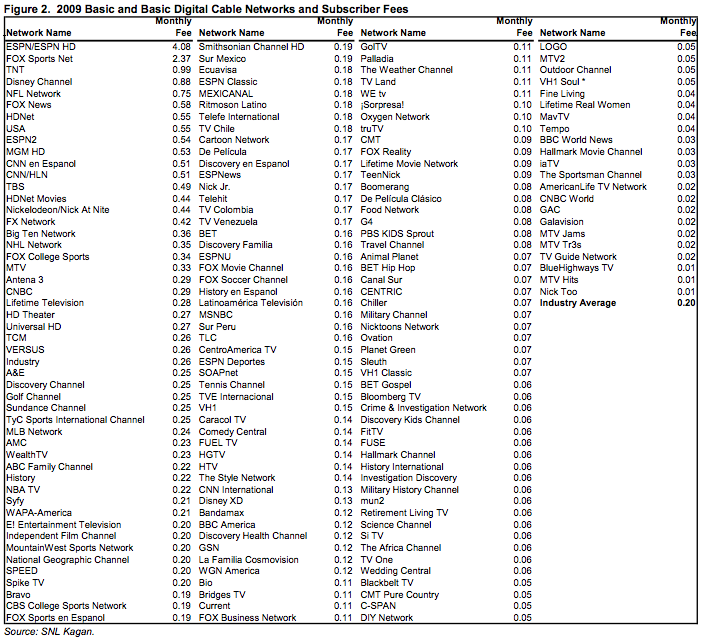
I gave up cable because I got tired of paying for a zillion channels I didn’t watch.  I wanted a la carte pricing but cable companies want to bundle their services.  If you want to know why, look at this chart I got from “Hate Paying for Cable? Here’s Why.”  You’ll probably need to click on the image to see the larger version to read it.  This is an example of what cable/satellite companies pay for each network to get all those channels they offer.
cable-sub-fees

I don’t watch sports, so I would be paying over seven dollars a month for sports channels I don’t watch.  WTF!!!  I recently tried to get U-verse to sell me just Turner Classic Movies (TCM) which this chart says this cabled company pays 26 cents a month per subscriber, but I’d have to pay AT&T $80 a month to watch the one channel I wanted.  Sure I’d get 200 other channels, but I only wanted TCM.

By the way, that chart is old.  A newer article says ESPN is $4.69 and TNT $1.16 (“How ESPN Is Making Your Monthly Cable Bill More and More Expensive”).  This is like going to Target to buy toilet paper and being forced to buy a pair of pants, a quart of motor oil, a bottle of shampoo, a comb, a gallon of Clorox, and 200 other items just to be able to leave the store with butt wipes.

But you can see why cable networks want cable companies to bundle their stations.  Take ESPN.  For each million homes forced to buy ESPN, they contribute $4.69 million per month to ESPN.  However, if we went to a la carte pricing and only 500,000 per million wanted ESPN, and ESPN wanted to make the same amount of money, then they would have to charge $8.38 a month to the people who wanted it.  Which would probably make many of those 500,000 subscribers think even more about if they really wanted ESPN.

If we have a la carte pricing, I doubt Comcast or U-verse would sell me TCM for 26 cents.  But I’d be willing to pay $10 a month for TCM, but I’m not sure how many other TCM fans would be willing to pay that much.  But for a la carte to work, instead of shaking everyone down for 26 cents a month, TCM fans would have to pony up more, maybe a lot more, or TCM would go out of business.

If we had a la carte pricing, many cable stations would go out of business.  Bundled pricing is keeping  these channels afloat.  If the goal is to have hundreds of television networks, bundling is the way to go.  But most cable customers bitterly complain about buying channels they do not want, and it’s the reason why cable bills keep growing and growing.

Cable and satellite companies need to get right by their customers.  What they need to do is provide a base service, say $19.95 that provides a  HD DVR/modem box and the local stations.  HD is standard with free over the air stations, so quit being a dick and charging extra – and it will simplify things for both the customers and you.

DVRs should be standard too.  Quit finding ways to charge extra for what should be standard, that only annoys the customer.   And don’t charge for fixing the system when it’s broke.  We’re renting a service from you, it should be reliable and high quality.  Even at $19.95 a month for the base system with just local channels, pay TV services should be able to make a profit at this level.

Then offer an onscreen menu that customer’s can control from home that shows all the channels, pay-per-view, on-demand channels and other services with the monthly costs for each.  Let them sign up with their clickers – no annoying phone calls.  I bet you can make the same profits or more by pricing the channels individually.  The only downside will be that the total channels will go from 200-300 to maybe 50-100.

Since I gave up cable TV I learned just how good 1 channel can be.  I have a home built DVR (HTPC) and what I mainly record is PBS.  It offers more top quality TV than I can watch.  If you distilled hundreds of channels, with mostly crappy content, into dozens of channels with mostly quality content, the perception of your product will vastly improve.

I think most homes will be happy with 10-20 “a la carte pay” channels.  Having fewer channels makes watching TV less stressful.  To much choice can be painful.  Their cable bill could be as high or higher than it is now, but it would reflect exactly what they wanted.

If such a system was available I’d go back to being a cable subscriber.

In the future there are other changes cable companies could make to make their customers happier.  Get rid of the cable box.  That would reduce clutter and a clicker.  Work with TV manufacturers to make smart TVs work with cable/satellite feeds and develop standards.  DVRs should be built into TVs.  A SSD drive would not take up much space.  It could be user replaceable.  Or make TVs with 128-256gb SSDs built-in, with a slot for customer’s to add an additional drive.

A TV could be built to do TV, Internet, video games and music that uses one clicker plus game controllers.  One cable, from a cable/satellite/broadband company could provide all content.  And build your systems with self-diagnostic awareness so we won’t have the aggravation of feuding with your company over intermittent problems.  There should be no reason to send a cable guy to see what’s wrong.  Your system should know what’s wrong, and if it’s involves something in the house, notify us to pick a time for your guy to come by – otherwise fix the outside stuff without bothering us.

And why fight Netflix – make it part of your lineup.  Right now I have over-the-air stations I use the TV clicker to manage, and then HTPC content, which I use a wireless keyboard, and then Amazon and Netflix through a Roku box with another clicker, and watch Blu-Ray/DVDs with another box and clicker.  Plus I manage sound with a receiver and another clicker.  That’s a HUGE PAIN IN THE ASS!  The next TV I buy should have all that crap built-in, requiring only one clicker.

If Netflix, Hulu, Amazon, and other Internet TV services can work with TV manufacturers to get their content  built right into the TV, why can’t cable/satellite/broadband companies?  Sorry Roku, but it’s obvious that your 2 ounces of electronics could easily be added to a TV set.  And why not a computer and stereo receiver?  If such integration happens, and TVs are moving that way now, having an external cable box is just stupid.  I’m not an inventor but I can see which way the electronic wind is blowing.

Lastly, Hey TCM, go the Netflix/Hulu Plus route and set up your own Internet TV service.  I’d gladly pay you $9.99 a month, but you might get more subscribers at $4.99 or $7.99.

JWH – 4/15/12

How Will the Future See Us in the Art of Our Times?

When I go to a museum, like the National Gallery in Washington, DC, I look at their collection as a doorway into time.  I know when I look at a Titian or Rembrandt I’m not seeing an actual view of the past, but an artistic view.  Art works on many levels, but the level that is most important to me is what it communicates across centuries.

What I want to see when I look at a great work of art is communiqué from the past  .  When you look at this painting what does it say to you about 1659?  Scroll through Rembrandt’s paintings on Google Image Search, or his gallery at the Google Art Project, or read his entry at Wikipedia.  The more you study, the more you are pulled into the past.  If you become hooked you’ll even start reading history books.

[Click on photos for larger views.]

rembrandt-van-rijn-self-portrait

Rembrandt’s self portrait says so much.  He’s looking at us looking at him.  He knows we’ll see his world through his eyes, the ones that stare eternally from this painting.

Here is a photograph by Miru Kim.  In four hundred years what will people make of it and our times?  Will they think that was when humans discovered their cruelty to animals?  That early the 21st century was when we began to identify and empathize with our fellow creatures?

Miru-Kim

But what does this work by Mark Handforth say about our lives?

vespa-by-mark-handforth

Now I’m not criticizing modern art.  Contemporary art is very successful, as Morley Safer reported on 60 Minutes recently, and written up as “Even n tough times, contemporary art sells.”  If the future will look into our souls from the art we leave behind, what will they see?

In our times art is about about how much it’s worth in dollars.  Art speculation is big business.  That’s a dimension of art that I’m not interested in, nor want to analyze.  I doubt “Vespa” will survive 400 years to be seen – pop sculptures look fragile to me.  I tend to think contemporary painting has been overshadowed by photography and film.  The future will know us through our documentaries.  But I think the Miru Kim photograph will communicate something to humans centuries from now if it survives.

Today I was reading in Anna Karenina, at the part where Anna and Vronsky are visiting the Russian artist, Mikhailov living in Italy.  They study his painting of Jesus Christ and Pontius Pilate.  Mikailov is trying to capture history, but tell the story from his unique time and place.  This scene allows Tolstoy to express his views on art, and he sends a literary message across time about the timeless of art.

Most of the art that Morley Safer showed us on 60 Minutes won’t last no matter how much people pay for it.  It either doesn’t send a message or sends the wrong message.  I’m not even saying it has to be a coherent message, it just needs to convey a piece of our collective soul in some way.  I think this one says a lot, but I can’t put it into words.

trippy-5-modern-art

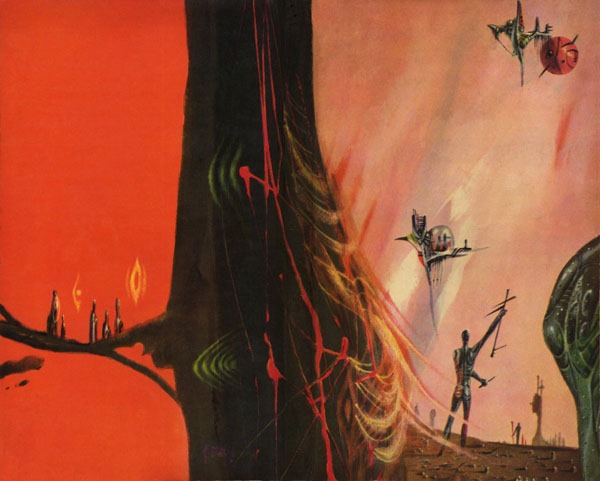
Then we have the problem of science fiction art.  It’s about the future, but is really about the present.  What do you make of this Richard Powers painting?  What does it say about the 1950s?

Pwrs_3from

When I looked at the 60 Minutes piece I felt tremendously disappointed by most of the art is saw.  I worry that the future won’t look kindly on us because our art is so lacking in beauty and imagination, and it says so little about our times.  Like Mikhailov in Anna Karenina trying to paint something that’s been painted thousands of times before, the struggle to be unique is a dangerous quest.

Which takes me back to Rembrandt.  Why don’t artists paint more faces?  Why is the 20th and 21st century so faceless?

Rembrandt

The art I like best features people.  Modern art seems to have moved away from people.  I guess painters think photographers have people covered, but I actually preferred painted people.  Here’s one of my favorites.

caillebotte-paris-a-rainy-day

JWH – 4/12/12

SETI: What Can Aliens Tell Us That We Don’t Know?

First off, decoding any messages from the stars will be difficult.  Just think about what aliens would have to figure out if they received Morse Code from us?  First, there’s the code, and then there’s the language behind the code.  Any kind of pattern recognition program would figure out the code quickly enough, and even discover the alphabet behind the code, but then what?  They might number our alphabet 1-26.  So they end up with a word like 7-18-5-5-14.   Of course, they don’t know that A=1, so the sequence 7-18-5-5-14 could be 26 different words if they knew the order of our alphabet without the starting point, and a whole lot more if they don’t the order at all.  But isn’t alphabetical order even an illusion for us?  Words are far more than letters.  Writing itself is a code, and language is hardwired in our brains.  Could we ever communicate with a differently evolved life form?

Would it be any easier if they got a radio signal with our voices without any kind of coding?  If they heard us say “green” would that be any use to them?  Okay, let’s go to video and have someone point to a color chart and say green.  Now we’re getting somewhere, we need video to have a visual Rosetta Stone.

Now imagine we get TV from the stars, what can aliens tell us that we don’t know?

Religion

Unless our bug eyed friends tell us about a God that’s just like one of ours, we’re going to think anything they say about religion to be just another one.  But what if they smugly inform us they rejected religion 100,000 years ago?  Or they draw a complete blank when we ask about their gods?  After thousands of years, we’re discovering that religion is make-believe, so any religion we hear about from the stars will probably be just as make believed.  But what if they try to convert us to some big-ass wild and wooly story about a creator that looks like living 1955 Buick?

If you want to read about alien religions there’s plenty you can hear about from anthropologists.  But if birdmen from Arcturus  emphatically state that metaphysical realms don’t exist, and neither do metaphysical beings, will the people of Earth believe them?

Ultimately, there are only so many outcomes to expect in this area, here are a quick handful of replies we might get over our SETI TV.

  • There is no God
  • There is a God, but our God is better than your God
  • Our God is much like your God
  • Our God says you should serve us or be destroyed
  • Hello God, you finally answered our call
  • Who do you think you’re talking to, we are God
  • What the heck are you guys talking about, we don’t comprehend

Philosophy

Like religion, philosophy is on the decline in our world, so why would we value the works of an alien Plato?  Would we embrace highly developed alien works of rhetoric, logic and ethics?  Wouldn’t it be bizarre if our new friends have a philosophical tradition that went through similar phases as our philosophers?

What if our new alien buddies give us something to think about that we’ve never thought about before?  Is that even possible?  What if their philosophy only works in the context of their biological framework and environment?  Has anything imagined on Star Trek for alien ways of thinking ever been new?  Earth people have thought of some crazy shit over the centuries.

And how many philosophical practices and disciplines do you follow now?  How often do you read Northrup Frye, Michel Foucault or Ludwig Wittgenstein?  Compared to what you know now, to what you could know if you studied, you could make many quantum leaps in your knowledge without SETI.

Mathematics

This is one area that scientists expect us to be in full agreement.  Will we become depressed if we find all the answers to the mathematical puzzles we hoped to solve ourselves for the next thousand years on an interstellar web site?  What if they give us the answer to the grand unified theory of the universe, and we can’t understand it, ever!

Again, is any BEM math we could get from SETI any less far out than all the math you ignore now?

Science

Shouldn’t their science just correlate our science and vice versa?  The whole idea of science is it should be reproducible anywhere.  To the average citizen of the Earth that pays no attention to science now, will it matter that our science will be validated by alien science?

If our new friends have been around millions of years longer than we have,  should we expect them to have science that makes us feel like dinosaurs?

Technology

Alien technology is what we want.  Movies like Contact (1997) and This Island Earth (1955) imagine getting a signal from another star with blueprints that tell us how to build super-science gadgets that will help us travel to the stars.  Would our far away friends trade the specs for a spaceship for the design for the iPad?  We want the tech to hotrod it out of the solar system.  Will we be disappointed if we don’t get it, either because it doesn’t exist or because their Federation bars them from giving it to us?

Art

Will the creatures from afar care about Monet or Breaking Bad?  Will they want to groove to Lady Gaga and Arcade Fire?  Will we want to read their version of Anna Karenina?  How many Japanese pop hits do you play while reading Vietnamese novels?

Does it Matter?

I think it will matter greatly when we discover we’re not alone in this universe, but beyond that, I tend to think we concentrate on very immediate surroundings and ignore the far away, so will stuff that’s very far away really matter that much?  Most Americans pay little attention to illegal aliens from Mexico, so why care about creatures from Epsilon Eridani?  Think about it, we have excellent science for global warming and evolution but most Americans reject those ideas for some stories they heard as kids at Sunday school.

Our world is full of alien concepts we’ve never explored, far out science and math we’ve never learned, mind blowing technology that’s beyond our current comprehension.  What do we do with this cornucopia of knowledge now?  Yeah, I thought so.  We spend most of our time figuring out how to rub genitals or some other physical impulse programmed into our DNA, so do we really expect to be uplifted by video from the stars by super beings?

Science Fiction

And if we do find SETI pen pals, what will they make of our science fiction?  Our dreams are so much bigger than our beings.  If intelligent life on nearby planets pick up this video on their SETI dishes, what will they think?  What if they don’t know it’s fiction.  What if the SETI signals we receive are their science fiction?

What if the most exciting stuff we get from the stars will be alien Sci-Fi?

JWH – 4/10/12

Losing My Faith in Space Travel

Science fiction promised children growing up in the 1950s something different than what it does to our children today.  The innocent expectations of tomorrow culminated in the 1964 World’s Fair which seemed all about the future and the promise of space travel?  Was there ever another time in history where kids truly believed they would walk on the Moon or Mars when they grew up?  Between 1961 and 1972 NASA always went further and faster with Mercury, Gemini and Apollo space programs.  For the forty years since 1972 we’ve been retracing old orbital paths below those reached in Project Gemini in 1965.  Now, the U.S. can’t even launch men and women into orbit.  When did the final frontier fizzle out?  I’m sure the budget bean counters know.

It’s not like we don’t have the technology to travel to the planets, we just don’t have the desire, or at least the desire to spend the money.

Like religion, science fiction promised true believers life in the heavens.  As long as NASA kept rocketing to new heights it was easy to believe the faith of space travel.  Like religion, space travel has failed to answer the prayers of its devoted – nobody leaves Earth.  Could it be that humans are meant to stay on Earth?  Forever?

What if it becomes obvious we’re not going to the planets and stars, and humans must live for thousands, if not millions of year here on planet Earth?  How does that change science fiction and the faith in the final frontier?  What if we come to realize that travel in space isn’t practical or even desirable?  What if we come to realize that alien spaceships will never visit us either?  That gulf between the stars is too vast for travel by biological creatures.  Robots might go, but not us.  How will that change our faith in science fiction?

We won’t know our limits in space until we hit them.  So far, we’ve only hit the money barrier!

I always believed science fiction was the sacred writing of the space travel faithful, but again like other belief systems, tenets of the faithful change.  If humans aren’t meant to travel to the stars, what is our destiny?  Science fiction, instead of selling space travel, promotes turning inward with artificial intelligence, cybernetic worlds, brain downloading, biological immortality, and other fabulous speculation about living on Earth.   I can accept the confinement if there are real limitations to humans traveling in space, but I’d sure hate it if we’ve just reached the limits of our vision.

Oh sure, there are still true believers who can’t give up the idea there’s a world just 35 million miles away that’s ripe for terraforming.  They keep preaching their gospel hoping to convert enough believers to make their visions come true, but their creed dwindles.

Yes, there is another time when kids grow up thinking they will walk on the Moon and Mars.  It’s now, and those kids live in China.  Do they dream my old 1950s dreams?  Will their dreams come true this time for all us humans?

This is what we get for cutting taxes.

A small government leads to smaller dreams.

China will get bigger with bigger dreams, while we grow small, clutching our tax dollars.

Thank you, Republicans.

New_York_Worlds_Fair_1964

JWH – 4/9/12

Will Sugar Become as Evil as Cigarettes?

If you haven’t seen the 60 Minutes piece “Is Sugar Toxic?”  Watch it here.

It’s inspired from this lecture, “Sugar: The Bitter Truth,” from Robert H. Lusting, MD, that’s had over 2 million views on YouTube.

Health food gurus have been telling us sugar is toxic for generations, but now the scientific evidence is becoming overwhelming.  Will we ban sugar like we’re banning smoking?  Will eating sugar attain the same negative social stigma as lighting up?  Will most people give up sweets to live longer?  Should sugar abusers become targets for healthcare reform?

On the same day I saw the sugar report, I saw a news report that said young women are getting skin cancer at 8x the normal rate because of using tanning salons.  They said this was especially true for women who have used a tanning bed more than 30 times.   I asked several young women at work about this and they all said they had used a tanning bed more than 30 times.  I asked them if they were going to stop.  None of them said they would.  One said, “Everything is bad for you, so what can you do?”

It took decades of public awareness messages to really put a dent in smoking.  Even now with all the evidence and costs of smoking, lots of kids still take up the habit.

There are many big health food movements going on in our country right now, including vegan, vegetarian, eating local, organic, eating unprocessed foods, raw foods, and a zillion different weight-loss diets.  Many of these diets still try to incorporate sweets and deserts, but Dr. Lustig is saying all sweets are bad.  Other than having an orange or apple, you’re hurting yourself when you eat sweets.

The medical evidence he gives is rather overwhelming, and a lot of it goes back decades, with studies using very large test populations.  I’m not doubting that he’s right.  I’ve abused sugar all my life and now I’m paying for it.  I could do testimonials for the guy.  However, I just don’t see an anti-sugar movement catching on like the anti-smoking movement.  But could it?

If you watch these videos you’ll see that a case could be made that sugar is actually more harmful than cigarettes.  I can see an anti-sweets movement snowballing into something big.  There is one thing about the anti-sweet case that’s different from cigarettes – sugar makes us fat.  It’s very visible.  Unless being fat becomes sexy, anti-sugar sentiment might catch on faster than the anti-smoking movement did.  Taking decades to get cancer just isn’t the same scare tactic as you’ll get fat and won’t get laid.

It’s been obvious for decades now that Americans are getting fatter, but the assumption was we’re overeating everything.  That’s a bit different than learning that sugar is the real problem.  If they prove that sugar, and even artificial sweeteners, are the culprits, will we start to pay attention?  Will Coca-Cola and pop disappear?  And candy bars?  And cakes, pies and cookies?

Dr. Lusting suggests that men can get buy eating 150 calories a day from sugar and women just 100, and that’s counting the hidden sugar.  Is anyone that disciplined?

JWH – 4/4/12