Simplified Tax Plans and Flat Tax Rates

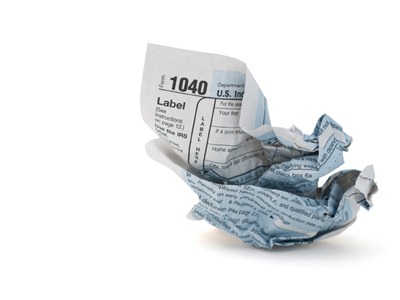
Many Republicans are drawn to simplified tax plans that use graduated flat tax rates for federal income taxes.  I’m a liberal, but I also find the idea interesting.  Now the chance of such a system being implemented is very close to zero, but it’s still an interesting topic.
flat-tax-fair-tax-1

Why do simplified tax systems have no chance?  Well, if we had a flat tax, there would be no deductions.  Levying tax breaks gives lawmakers power.  Law makers have various forms of power.  They can regulate and not regulate, they can tax and not tax, they can spend and not spend.  If we went to a flat tax our leaders would lose one-third of their tools of power.  Can you imagine that?

If we went to a flat tax system think of how many millions of people we’d put out of work.  First, many that work at the IRS would be added to the unemployment rolls.  But then think of all those bean counters and lawyers that work at corporations whose careers depend on finding tax loopholes, those people wouldn’t be needed either.  Then companies like Turbo Tax and HR Block would go out of business too.  And think of all those little people who do people’s taxes every year would also be out of work.  And what about lobbyists?  There would be less work for them too.

All-in-all, if we went to a flat tax system it would put millions out of work.  Our complicated system of federal taxes is a never-ending economic stimulus package.  Is getting rid of it even possible?

The government could enact a flat tax so we didn’t even have to prepare annual tax forms – just take their cut in every income transaction.  They could come up with a graduated flat tax so most people would end up paying the same or less than what they do now and the government would earn just as much money without all the complications.  Most advocates hope they would pay less and that tax cheaters would pay more, and the privilege would pay the same as the those people without influence.  Of course that means those with connection to power would pay a lot more.  Are they really going to back such a system?

Theoretically, a flat tax would be fairer, until lawmakers tried to reintroduce the first exception, then it would get complicated all over again.  A flat tax depends on lawmakers giving up their power to help certain groups or endeavors with tax breaks.  Will that ever happen?  I don’t think so.  Can you imagine such a world?  Businesses couldn’t wheel and deal for favors.

And what if this extended to states and cities.  One tax for all.  How could states entice companies into their borders without tax break incentives?  But wouldn’t that also be fairer for competition if everyone had to pay the same taxes?  Could we survive in a society where all individuals and corporations were treated absolutely the same by the taxman?

People get home mortgage deductions because the government wants people to own homes.  That kind of social influence would be over.  Is that good or bad?

What if the government eliminated tax havens and all other forms of “legal” tax evasions so there was no way to to skip out on taxes.  Just kill off accounting chicanery, tax-law loopholes, or off-shore three-card Monte, and the issue of how much people or corporations paid in taxes were no longer an issue for debate – could we handle such a society?

For people who take the standard deduction every year a flat tax wouldn’t be a big deal, but for those people delight in adding up their deductions and lowering their tax bill, a flat tax might be a bummer.  Some people hate to pay taxes and will do anything they can to lower their tax bills.  If they can’t shoot for zero taxes I doubt they will be happy.  What happens if everyone pays the same?  I think a certain percentage of the population would revolt at such egalitarianism.

And should everyone pay the same?  Do some people do things for society that merits lowering their taxes?  Will the go-getters of society be happy if their efforts are taxed in a higher bracket than the indolent?  All flat tax proposals depend on the idea that the poor pay a flat rate less than the rich.  Could we come up with a rate and rational that will satisfied the rich?  Currently the rich live in higher tax brackets, but they get the chance to lower their taxes with our complicated tax system.  If we had a simple system, there would be no hope for them.

Right now the rich protest they pay at a higher tax rate than the poor, so they are being penalized as individuals.  We could think of that in another way, we could create a flat tax saying that norm for all humans is to make $100,000 a year.  If you are unfortunate enough to make less we’ll put you in a lesser tax rate for your suffering.  But should someone making $250,000,000 a year pay at a different rate than someone making $100,000 or $10,000?  Are we taxing the person or the income?  Is a rich person different form a poor person in the eyes of the law?  We could consider income like pollution.  The bigger the impact you have on the environment, the more taxes you pay.  It’s actually very hard to justify how to tax people.  If a person only makes $14,000 and the government makes them pay $1,400, is that the same as someone who makes $140,000 and has to pay $14,000, or someone who makes $140,000,000 and has to pay $14,000,000.  Does 14 million hurt as much to a super-rich person as $1,400 hurt someone on minimum wages?  But if the super-rich have a 20% flat tax, they’d be paying $28,000,000.  They’d still have $112,000,000 to spend that year, whereas the poor person would only have $11,200.

See how hard it is to make a fair tax system.  I suppose we could add up all the expenses for the country and then divide by the 313,000,000 people who live here, and everyone pay their fair share.  But then many people would owe more than they earn.  That’s why the rich have to pay more.

As far as I can foresee, I can’t imagine a flat income tax system ever passing Congress.

JWH 5/5/12
Rethinking Magazines on the iPad 2 and Kindle 3

Since I’m a gadget freak I wanted to love reading magazines on the iPad and Kindle.  It wasn’t love at first sight though.  Reading a digital magazine takes different skills than reading a paper magazine, and at 60 it’s not always easy to teach an old dog new tricks.  However, I’m an old dog that’s become very near sighted, and having a tablet is like having a handicap device that helps me with my physical failings.

Because I can make the font larger, and the photos larger and brighter, the experience of reading on a tablet wins out over paper, but I’m not saying it’s magical.  Zite, a reading app for the iPad, is magical.  Think Pandora for articles instead of playing songs, because I can’t show you what Zite looks like.  Zite isn’t on the web, it’s only for iOS, Android and webOS mobile devices.  But even Zite is just a start.

We need a new paradigm for magazine reading.

Right now publishers are working hard to make magazines look identical to their printed versions on the tablet screen, but that’s ignoring the power of the computer built into the tablet.  And I’ve got to wonder why I have to page through ads when I pay more for the iPad version of magazine than I do for a printed subscription.  For example I could get Rolling Stone for $20 on paper, but I’m paying $36 for the digital.  WTF? 

If I’m going to pay more, why not make reading easier and forget the printed layout and ads?  But I doubt that will happen.  Zite usually jettisons the ads, and its free.  So, how does that business model work?  It won’t for long.  What’s needed is a paid Zite subscription.

I get The New Yorker on my Kindle 3 and it does leave out the printed formatting and ads.  It’s pure text reading.  The Kindle 3 is much lighter and easier to hold than the iPad, so reading The New Yorker is a pleasure, but not visually exciting.  A step backward, although it’s much easier on the eyes.

When I’m reading just words, whether for a book or magazine, I much prefer reading them on the Kindle e-ink screen, or the retinal display of my iPod touch.  The damn iPad is a pain to hold.  But if I want to see photos I need the iPad.  This is probably why the Kindle Fire is a 7” tablet.  But none of these devices are perfect.  In fact, reading nirvana is nowhere to be seen.

It’s like that new ad on TV for the Microsoft phone that claims up till now all smart phones have been beta devices.  Well, we’re still in beta when it come to tablets and magazine reading.

In fact, I’m ready to give up magazines altogether, either print or digital.  Zite has taught me that, as well as the Best American series of anthologies that come out each year collecting the best magazine magazine writing into ebooks to read on the Kindle.

Magazines have a lot of content I just don’t want to read or look at.  When I could flip through a paper copy it was easy to ignore the crap, but with a digital edition the easiest way to read a magazine is to start at the beginning and flip pages till the end.  That just reminds me of how much content I don’t want to see.

How often have you paid several dollars to read one article in a magazine?  How often have you paid several dollars for a magazine and read none of the articles, just flip through the pages, reading snatches here and there and looked at some pictures?  Magazines are like cable TV, 200 channels when you really only want 8.

What we need is magazine article singles, like buying songs at iTunes.  Articles should be 99 cents for long meaty ones, and less for shorter ones.

Like I said, this transition from paper to digital is making me rethink magazines.  Either digital magazines need to become a whole lot better at providing just what I want for a fair price, or I’m going to either give up on reading magazines altogether, or just go back to paper editions that I only buy with very cheapo subscription deals.

I’m not sure the iPad is the wonder gadget that I thought it was.  Except for Words with Friends and Zite, most of my dozens of app icons go untapped.  I’ve bought some of those fancy multimedia books and never read them.  They are neat for a few minutes, but not for hours.  Most of the digital magazines I’ve bought haven’t been read.  In fact, my New Yorker issues pile up in my Kindle 3 just like how the paper copies used to pile up unread.

JWH – 5/2/12   

The Things I’m Learning From Getting Older

Today I was at Sports Authority buying a bicycle, which I hope to ride for exercise and lose weight.  I have a bad back because of spinal stenosis and arthritis, and can’t walk for exercise, so the idea is to bicycle instead.  My theory is losing weight will help my back so I can do more, which is really a wish to be younger.  We all want to turn the clock back.   But, those delusional desires are so instructive.

I think women want to look younger, and men want to act younger.  While waiting for the salesman to prep the bike I bought, two strikingly beautiful young women came into the store.  Is there anything more educational about aging than envying the young?

I try hard not be be resentful.  I don’t feel bitter.  I pretty much laugh at the failures of my brain and body, but there is a fair amount of resentment of having to grow old.  I try to keep it wistful, but sometimes it gets heavy.

I noticed that most of the people in the store were young, and obviously pursuing different physical activities, activities I can’t pursue anymore because of my age and condition.  It really made me feel old and crippled.  Although I’m only 60 and can still walk to a degree, I feel very limited physically, but I know plenty of people that have far more limitations, so I can’t bitch.  At 60 I can see the future of doing less and less.

By writing about my growing list of age related restrictions, I hope I’m being philosophical and not whinny.  At 60, I’m only getting a hint at what it means to be really old, so I think I need to psychologically prepare myself for being a decrepit old dude that can’t remember shit.

While waiting for my bike to be tuned up, I found a kiosk with this film for extreme sports advertising the GoPro Hero video camera, and it really made me think about being young again.  The youth in these films below are pushing the envelope of youthful vitality.  It would be totally pointless to wish I could do stuff like this, but I’ve got to ask, what are the activities that I could pursue that would push the limit of my fading vitality?

What if I strapped on a helmet with a HERO 2 camera, can I do anything worth filming?

I highly recommend you play these videos in full screen at the highest resolution.  I love these videos.  They’re dazzling, beautiful, and exciting – a cruel reminder of all my resentments about getting old.  It’s also a reminder of my own personal failings, and the limitations I’ve imposed on myself.

This doesn’t mean I’m ready to call it quits, I’m just hard-pressed to imagine doing anything Hero 2 worthy.  But what if I was 90 watching myself write this blog while listening to music, would I impress my older self with an activity I won’t be able to do then?

Now, I know few people pursue these extreme sports – I think these people must have a gene for thrill-seeking which I obviously don’t have.  I also assume they have a lot more money than I ever had.  I think we all resent beautiful, rich, jetsetters, unless we’re beautiful and rich, so that’s not the resentment I’m talking about.

I’m sure there are plenty of twenty-five-year olds that would envy the folks in these films.

My issue is with myself, for not trying harder, for not making more of the time and the opportunities I had when I was young.  I have the genes to be a bookworm that loves quiet indoor life.  I think if I magically got to live life over I think I’d trade TV and movie watching for several hours a week of being active outside.  I’d still keep books, writing, science and computers – in a do-over I’d just try to find a balance, maybe two-thirds geek and one-third jock, instead of 100% geek.

Most of my friends who are my age think I dwell on getting old, and that I just need to act younger.  They tell me I’m getting old because I think I’m old.  They think they are still young because they believe it to be so.  I think they’ve forgotten what it’s really like to be young and are refusing to accept the reality of aging.  But then I’ve always been a Puritanical Buddhist Atheist that’s enjoys the grimness of reality and acceptance.

I think age is relative, but until your body starts failing in some serious way, you can continue to believe that youthfulness is a state of mind.  Once you experience real body failures then you know youthful state of mind is bullshit.  Getting old is so goddamn instructive of how reality works.  This is why one of my all-time favorite stories is “The Star Pit” by Samuel R. Delany.  It’s a multi-level story where we get to see the limitations faced by each character as they struggle to fight through their own personal barriers.

Getting older and learning about the value of youth is like that old saying, “You don’t know what you’re missing until it’s gone.”  We all feel immortal when we’re young.  We all feel like we’ve got plenty of time, time enough to waste.  You won’t sense the reality of getting older until that sense of immortality goes away, and you realize time is running out, with none to waste.

Now, I don’t mean this to sound like, “Oh no, poor pitiful me.”   No, what I expect is to scare the crap out of you about getting older.  Don’t waste time, you have less than you think.  Fight through the barriers you face because when you get older you’ll resent you didn’t try harder.  What I’m learning about being 60 is I wished I had known what it would have been like when I was in my teens and twenties.

What I need to do now is imagine what being 90 is like to inspire me at 60.  At 90, 60 would be an envious youth, and a 90’s mind would know how I wasted my time in my 60’s.

My back pain limits how much I can do.  And my memory is also going, and I’m realizing the limitations that will mean too.  Don’t get me wrong, I’m still functional, I just function differently.  I’m getting some insights on what it means to get old and frail.  My next door neighbor is 93, and can’t walk much because of a stroke.  She spends her days sitting in a chair watching TV.  I can now see a path from where I’m at, to where she’s at.  I know I’ve got to be prepared for a lot more limitations.  Maybe it’s lucky that I have all that practice at watching TV, because if I had been an extreme sports kind of guy it would have been much harder to give it all up.

When you’re a kid all the old people ask you what you want to be when you grow up.  As a kid, you feel you have this potential to be anything and it’s a really hard decision to make up your mind what to do.  Well, it feels the same way when you’re older.  People ask you what you’re going to do when you retire, and you think of all the possibilities.  Whether you are young or old, the key is learning to deal with reality and it’s limitations.  Those dark-haired beauties I saw at Sports Authority today would never have given me the time of day, even when I was their age.  And there’s never been an age that I could have been an extreme sports guy.  If you’re going to be regretful, you need to be realistically regretful.

Don’t resent what never could have been real.  Resent what you failed to do that you realistically could have achieved.

JWH – 4/29/12

The mood for this essay was provided by Donovan and “Ferris Wheel.”

http://rd.io/x/QJhDK0JdaZ4

Living in Real Time

If you’ve ever gotten used to having a DVR (digital video recorder) for your TV, you’ll know what I mean about living in real time.  The HTPC (home theater PC) I built to record TV shows stopped working the other night.  I went out to the living room to watch the news and my computer was dead.  No news.  No electronic TV guide.  I had to watch TV in real time by clicking around the channels to see what was on.  I ordered a new power supply, but that apparently wasn’t the problem.  I took everything apart and put it back together and it started working again.  Then it stopped again.  Maybe the memory is flaky – I don’t know.

Every now and then, the electricity goes out and I’ll have to live without power for a few hours, and on some occasions a few days.  Sometimes I’ve had to live without internet.  Time seems to flow at a different rate when you live without electricity, the internet, cable TV, or TV without a DVR.  Some people go crazy when they don’t have their smartphones. 

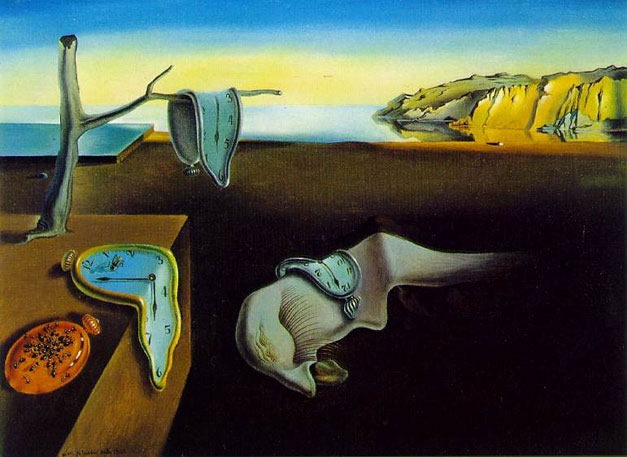
All our gadgets alter our sense of time.

dali-persistence-of-time (1)

I recently read Anna Karenina by Leo Tolstoy and I was struck by how little technology they had in their lives, and how slow information flowed.  The Russians were having a war with the Turks and the news came by telegram to newspapers.  Each day people waited for new news of the war, and discussed the latest telegram.  People in the 1870s Russian traveled by train, horse, cart and carriage.  If they wanted to know what a friend was doing they had to wait days for a letter.  It took weeks and even months to travel from one place on Earth to another.

Time works different when I have to be in my den chair at a specific time to watch a TV show.  Normally I like to watch TV starting after 10pm, until about 11:30pm.  I watch recorded shows, Netflix or a DVD/BD disc.  I rarely watch TV live.  Watching TV in real time is a total pain.

Now there is Netflix/DVD/BD time, DVR time and real time.  Netflix and discs are old stuff just waiting to be watch whenever I feel like it.  DVR is recent stuff, waiting to be watched when I feel like it.  And real time is always now.  DVR time lets me time shift and actual watch more TV.  I seldom feel like watching TV in real time, but PBS has several amazing documentaries every week I want to watch.  I’m over 100 documentaries behind in my DVR watching because they produce them faster than I can watch.  Those shows just wait for me on my 1.5 terabyte hard drive.  My HTPC watches TV for me.  Watching TV on my time schedule seems to make time go faster.  I never have enough.

I’m wondering what my life would be like if I don’t fix my HTPC.  Will I confirm to TV time, or will I just abandon the TV and only watch Netflix and discs?  When I was young this would have been an impossible situation.  Young people have to see movies opening night.  They have to watch new TV shows when they air.  There’s an impatience to see things first.  Years ago I had to be home Sunday nights to watch shows like The Sopranos and Deadwood live on HBO.  Then I gave up HBO and waited about a year for them to come to DVDs.  I think I could do that because I had gotten older and had the patience to wait.  I no longer had to live in TV time, in real time.

Are DVDs real time, or slower than real time?  The illusion is all this technology is speeding up time and real time is slow.  That’s how it feels, but is it really?  Is watching 2 hours of TV really any different if you’re watching it live, DVR, DVD or Netflix?  It’s still two hours of TV?  Somehow watching TV with commercials in real time seems very slow.

I remember when I got my first punch-the-clock job when I was 16, and had to work after school and didn’t get home until around 10pm.  This was back in the second year of the original Star Trek and I hated missing that show.  But work broke me of the TV habit for many years.  The DVR allows us to maintain the TV habit without having to show up on time.  Maybe I just need to kick the habit completely and live in real time.

JWH – 4/26/12 

Can Any One Novel Be More Valuable Than Another?

People love to create Best of Lists for what they think are the greatest novels of all time, but I’ve got to ask:  What is the value of one novel?  Is any one novel really more valuable than any other novel?  I’m reading Anna Karenina (1877) because it was the #1 novel chosen from 125 writers voting for their all-time favorite novels in the book The Top Ten ed. by J. Peder Zane.  Can I say Anna Karenina is really more valuable than any other novel?  It might be more valuable to the people who contributed to the Top Ten, but is it more valuable to any reader than any other book?

Can professors of literature definitively say one list of novels is more valuable than other because of their worth to culture?

What do we get out of a novel?  What makes a novel valuable?  What makes a novel loved, or inspiring, or artistic?

I have a degree in English Literature, and I’ve been a lifelong bookworm, and I maintain a site about The Classics of Science Fiction, and yet I know nothing that proves a novel as value other than any one reader’s fondness for a particular novel.

I’m almost finished with Anna Karenina and it’s been very enjoyable, but I wouldn’t rank it #1 on any list I’d create.  But let’s compare it to some other novels from the 1870s I’ve read:  The Way We Live Now by Anthony Trollope (1875), Middlemarch by George Elliot (1874), The Mysterious Island by Jules Verne (1874) and The Adventures of Tom Sawyer by Mark Twain (1876).  I’ve give them in the reverse order of when I read them, because I think that matters.

Of these, I currently rate The Way We Live Now the highest, but that’s because it was the most entertaining, most engrossing, most diverting book I read in a long time.  But I have talked some of my friends into reading it and they found it boring.  And if I had read it when I was young I would have found it boring too.  And if I had been made to read it in school I would have hated it.

How often do we read a novel other than to be entertained?  Is entertainment value the only real criteria for evaluating a novel?  School teachers and college professors think reading is good for us, and good people read good books.  They imply that the novels they make us study in school are more worthy than novels we’d choose ourselves, but is that true?

Can society qualitatively prove that Pride and Prejudice is superior Pride and Prejudice and Zombies?  What educators want is a literate society, and that’s understandable because scientific studies show that a literate population is more successful.  But can science prove reading one book is better than reading another?  Or can we, with mere logic?

I think a kid who has read To Kill a Mockingbird by Harper Lee (1960) should learn something important about race relations.  I wish I had read and understood Pride and Prejudice when I was a teen because it would have helped me understand girls better.  Reading Slaughterhouse Five and Catch-22 taught me about the absurdity of war.  But is social awareness why educators want us to read books?  I don’t know.  It is a kind of value.  I thought I learned a lot about Asperger’s from reading The Curious Incident of the Dog in the Night-Time by Mark Haddon (2003).

I think we can safely assume books have value for broadening our horizons, to help us empathize with people different from us, to virtually visit foreign countries and distant times.  If you read the books on The Top Ten list, you will be educated in a way that’s different from a normal classroom education.  Of the 1870s books I mention above, they will teach you about life in England, America and Russia during that decade and what people were like.  Of do they?  And what about the Jules Verne book?  It wasn’t real at all, but it was one of the most fun books I read as a kid.

And do we really want to put a value on novels based on how much daily-life historical information it might contain?  And do we get information from the novel, or does it merely reinforce what we already know?  Do you learn about racial injustice from To Kill a Mockingbird, or do you learn about racial injustice and then admire To Kill a Mockingbird?

For me to admire Anna Karenina, I think it took me 60 years of growing up and gaining the experience so I could admire it.  I think that novels only mirror our current state of development and you can’t give children wisdom by giving them novels to read.

A list of great books are only great if you’re ready to perceive their greatness.  We can’t share shared culture, but we can share being at the same psychic place with other people.  That’s why it’s so great to talk with another reader about a book they just discovered and loved and you’re in the same place too.

So, then is the value of a book it’s ability to be an emotional or intellectual trigger?  Then to make a list of Top Ten favorites really is saying, if you’re been where I’ve been, then these books might work for you.

While working on The Classics of Science Fiction I learned several things about books and their lovers.  If you’ve only read five books, then those are the five best books in the world, and if you loved one more than the others, it’s the most mind blowing book ever.  I’d often get emails from kids asking why a particular book wasn’t on the list because in their mind it’s the most far out book they know about and it deserves to be recognized.  Are there books I could give these kids to read that are absolutely superior to what they’ve already discovered?  I can’t guarantee that.  My list is based on the consensus of twenty-eight other lists.  I was trying to be scientific about building a best of list.  But even the weight of my statistical method is no proof of value.

If you look at the final rankings, three books were on 25 of 28 previous best of lists.  They were Dune by Frank Herbert (1965), The Demolished Man by Alfred Bester (1953) and More than Human by Theodore Sturgeon (1953).  Statistically the odds are good that any science fiction fan reading these books should like them, but that’s not true.  Most kids today would be blown away by The Hunger Games, and maybe Dune, but would probably find the other two dated, even though old-timers who grew up reading science fiction in the 1950s and 1960s love those two books.

Again, I think this is because what makes a book valuable is what’s inside us when we come to the book.  It’s very difficult to be young and time shift.  Contemporary books mean more to the young than old books.

In my science fiction book club we’re all listing our all-time favorite ten science fiction books in a database.  There is very little consistency.  It’s my theory that we each define science fiction differently.  That there is no 10 great science fiction books that define the genre, but there are 10 books that define science fiction for each of us.  My Classics of Science Fiction list is merely a statistical sample of how many baby boomers define themselves with their favorite books.  There is a lot of overlap for a handful of books, and then we wildly diverge.

It’s like how most baby boomers loved The Beatles, but not all, and how there is no consensus at all about which groups would fill the #2-10 slots for the top bands of the 1960s.  I still love The Beatles, I just don’t listen to them anymore.  I still play Bob Dylan songs from the 1960s every day.  Why is that?  I still reread a handful of books I discovered as a teen in the 1960s.  But the rest, even the ones I loved then, I don’t care for anymore.  Again, how books are valued is by something inside us, and it changes.

I’d love it if we could get every bookworm in the world to put their all time favorite 100 books into a worldwide database, with each numbered by rank preference, and tagged by the year and age they read them.  Then I’d like to see the meta results.  How many books would become universal favorites?  How many would be teen favorites?  How many would be old age favorites?  How many books are loved outside of their generation.  This would be a fabulous experiment.  But it’s about the only scientific way I can think of to put a value on a book, and compare them.

JWH – 4/24/12