Why Hasn’t Hollywood Made More Films From Popular Science Fiction Novels?

Hollywood obviously loves the science fiction of comic books, but why doesn’t it also love the science fiction of novels?  Admittedly, Hollywood doesn’t make films of all popular literary novels either, or mystery books.  Hollywood releases about 500-700 films a year.  Russia and China is in a similar pall park.  India produces about a 1,000 flicks each year.  It’s hard to get exact numbers.  Figures are also hard to find for the number of novels published each year, but I’d guess between 50,000-75,000 from numbers I’ve seen.

And even though science fiction is very popular at the movies, movie makers aren’t going to make science fiction movies all the time.  When movie makers do make science fiction movies they swing for major hits, hoping to make hundreds of millions of dollars, or even billions.  Evidently the mentality of comic book science fiction fits the bill better than science fiction novels when it comes to making a lot of money and appealing to a vast audience.  Science fiction books actually have a very limited appeal on their own.  Science fiction is less popular than mysteries and romances as a genre, and much less popular than general best sellers.  And most single story science fictional films are usually original screenplays.  In other words, science fiction novels don’t get enough attention to be noticed by film makers.
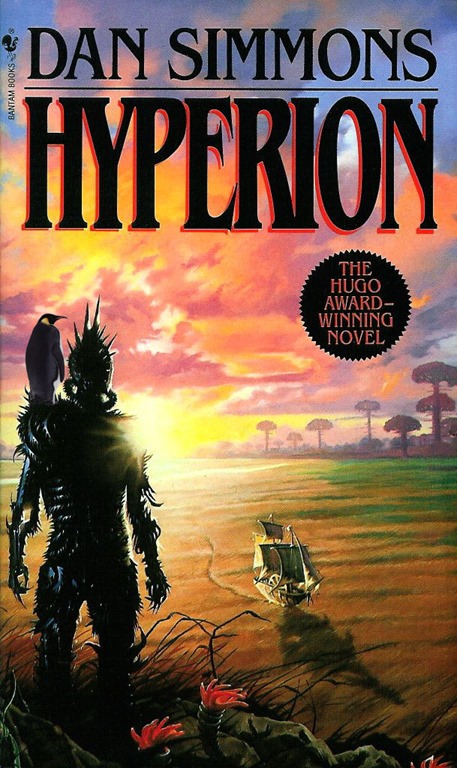
Hyperion

Obviously bestsellers like The Hunger Games do get their attention.  But science fiction novels that merely win the Hugo or Nebula awards don’t garnish enough notice by producers with money to spend.  All my life I’ve heard stories about Hollywood sniffing around certain famous science fiction novels, even buying the rights, but they seldom get a film through production.  Of course, that’s also true of all kinds of books and screenplays.  The process is quite an obstacle course.

I’m sure I’m like tens of millions of bookworms out there who wish Hollywood would make movies out of their favorite books.  The trouble is, unless ten million bookworms are all wishing for the same book, Hollywood isn’t interested.  Dune by Frank Herbert is probably one of the most famous science fiction novels ever, and it’s gotten the film treatment twice and there are rumors filmmakers want to try again.  Hollywood isn’t against trying to turn SF books into gold.  Just look at what they’ve done with Tolkien and Rowling.  Or the success George  R. R. Martin has had with HBO, or the new series based on the Outlander series.  Hollywood knows bestsellers can make big hits, but they also know they need the right book.   Producers know series books work better than single volume stories.  Series show fan commitment.   Yet, some popular series like The Golden Compass crashed and burned at the movies and none of the sequels were filmed.

Also notice, those stories from Tolkien, Rowling, Martin and Gabaldon weren’t science fiction either.  Box office favors fantasy.  Hollywood seems to love Philip K. Dick but few other science fiction writers.  Ender’s Game didn’t make that much of a splash with worldwide audiences, so I wonder if we’ll ever see Speaker for the Dead on the big screen.  David Brin was blessed by Hollywood when they made The Postman, so why haven’t they tried The Uplift series?  Heinlein got decent notice with Starship Troopers and The Puppet Masters, but other than talk all his other novels are ignored.  Heinlein should get some credit for every space marine type film though.  Clarke made it huge back in the 1960s with 2001: A Space Odyssey but why didn’t Hollywood try to win again with one of his other novels?  Childhood’s End would seem like an obvious choice for the big screen.

I guess the question becomes:  What science fiction novels deserve the Hollywood treatment?  Which great science fiction stories have the potential to enchant tens of millions of people?  Or even a hundred million?  As fans of our favorite books, we have to be honest with ourselves, do the books we love have the potential to be loved by a significant percentage of the population?  I love a lot of small films that probably don’t get more ticket buyers in the theaters than a modest bestseller.  Are there classic science fiction novels that could be filmed within the budgets of independent filmmakers? 

My first thought is to recommend the Hyperion Cantos books by Dan Simmons.  Can you imagine what those books would look like visualized on the big screen – it would be tremendous!  And the $$$s to make would be tremendous too.  The Hyperion Cantos films would need the audience of the Marvel comic films to break even.  Are there enough people on Earth interested in that story to make it a worthy film investment?  Or could a series of films made from the Hyperion Cantos stories attract such an audience?  I have no idea.

My favorite science fiction novel is Have Space Suit-Will Travel by Robert A. Heinlein.  It was announced in 2010 that Harry Kloor had adapted HSS-WT for the screen, but the last word on the project was it was still in development.  I can’t find any recent news, so I assume the project is dead.  This Heinlein story could have been filmed relatively cheap, and it does have a great fan base.

WWEnd-most-read-books  

Looking at Worlds Without End list of most read books it’s interesting that among the top 24 books, 15 have been filmed.  These are both SF and fantasy.  Of the ones not filmed, they are:

  • American Gods by Neil Gaiman
  • Neuromancer by William Gibson
  • The Forever War by Joe Haldeman
  • Rendezvous with Rama by Arthur C. Clarke
  • Stranger in a Strange Land by Robert A. Heinlein
  • Speaker for the Dead by Orson Scott Card
  • Hyperion by Dan Simmons
  • Ringworld by Larry Niven
  • The Left Hand of Darkness by Ursula K. Le Guinn

I’d like to see films of all nine of those books.  The next 24 books, only 12 have been filmed, leaving:
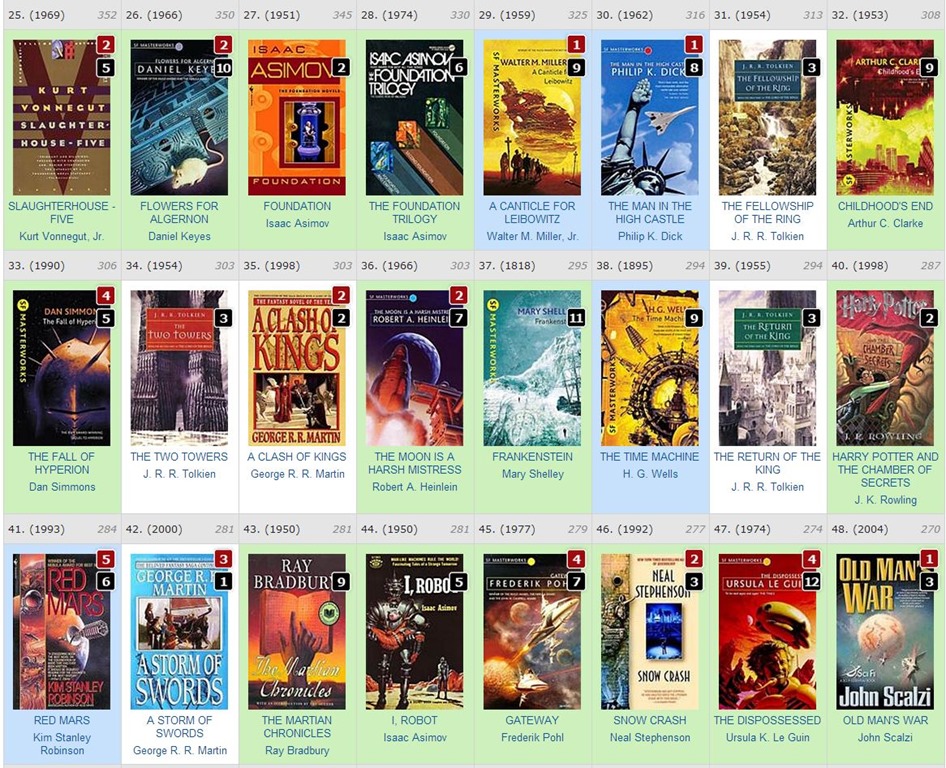
WWEnd-most-read-books-2

  • Foundation/Foundation Trilogy by Isaac Asimov
  • A Canticle for Leibowitz by Walter M. Miller Jr.
  • The Man in the High Castle by Philip K. Dick
  • Childhood’s End by Arthur C. Clarke
  • The Fall of Hyperion by Dan Simmons
  • The Moon is a Harsh Mistress by Robert A. Heinlein
  • Red Mars by Kim Stanley Robinson
  • Gateway by Frederik Pohl
  • Snow Crash by Neal Stephenson
  • The Dispossessed by Ursula K. Le Guin
  • Old Man War by John Scalzi

More great science fiction books that need filming.  In the next 24, only 11 have been filmed, leaving:

WWEnd-most-read-books-3

  • Foundation’s Edge by Isaac Asimov
  • Xenocide by Orson Scott Card
  • Perdido Street Station by China Miéville
  • Jonathan Strange & Mr. Norrell by Susanna Clakre
  • The Demolished Man by Alfred Bester
  • The Diamond Age by Neal Stephenson
  • The Windup Girl by Paolo Bacigalupi
  • The Graveyard Book by Neil Gaiman
  • Doomsday Book by Connie Willis
  • Children of Dune by Frank Herbert
  • A Fire Upon the Deep by Vernor Vinge
  • The Stars my Destination by Alfred Bester
  • A Wizard of Earthsea by Ursula K. Le Guin

If you’re paying attention you’ll notice that many of these books are part of a series, something Hollywood loves.  And these books are among the most popular SF/F books read right now.  Because so many have been filmed, it suggests that the others might be film worthy too.  If you read the entire list at Worlds Without End you’ll see that many other popular books have been filmed, but more that haven’t.  But what about less popular science fiction books, ones that are the real classics of the science fiction genre?

City by Clifford Simak is a book that is probably not well known by young science fiction fans today, but it was much loved when I was growing up.  City is a fix-up novel of several short stories, so it would be hard to film, but it’s theme ties them together so wonderful that I wish they could make a film out of it.  The gimmick is humans no longer live on Earth and all that’s left are intelligent robots and uplifted dogs, who tell stories about humans they used to know.  I can’t believe a creative screen writer couldn’t do something with such a fantastic idea.

Sadly, so many great science fiction novels of the past have become dated not only by science, but by changing attitudes.  I think it would be extremely hard to film More Than Human, the great classic by Theodore Sturgeon.  It feels like something Carson McCullers would have written after hanging out with a bunch of New Age hippies brought up on reading Stranger in a Strange Land.  Many people have dreamed of seeing Stranger in a Strange Land at their favorite movie theater, but I just don’t think it will ever happen.  I’d love to see an extremely true-to-the-novel version, but I think seeing Stranger on the big screen would only make it all too obvious how fucking weird it really is.  I’m not sure an army of psychiatrists and English professors could make out what Heinlein is unconsciously saying with this novel.

If they had made Stand on Zanzibar as a movie back in 1968, it might creepily look like the news today.

I wish Pixar would make Hothouse by Brian Aldiss, because it’s so damn dazzlingly beautiful to imagine.  And I think they should give the film the American book title, The Long Afternoon of Earth.   I think people leaving the theater would be saying “WTF!” to each other, but it would haunt them for days to think about the far distant future and what might become of humanity.

Because people are so paranoid about robots and artificial intelligence, I think a hit could be made from The Humanoids by Jack Williamson.  Although I’d be afraid Hollywood would turn it into a shoot-em-up like they did I, Robot.  It’s very disappointing to me that Hollywood sees science fiction as a source of video game violence to put on the screen, and make every plot about saving the world.

It seems to me that Ready Player One and Little Brother should be obvious movie hits.

If they could pull it off, Lord of Light by Roger Zelazny might generate some good word of mouth movie buzz.  And what would America think of the dark vision of Dhalgren by Samuel R. Delany?  Is there the film technology to pull off Uplift series by David Brin, or make The Rediscovery of Man stories by Cordwainer Smith, or Eleanor Arnason’s uber-exotic The Woman of the Iron People?  And what would modern people make of the feminist science fiction novels like The Female Man by Joanna Russ, The Left Hand of Darkness by Ursula K. Le Guin, Herland by Charlotte Perkins Gilman, A Door Into Ocean by Joan Slonczewski, or Dawn by Octavia Butler?

And is it too late to film such vast comic weirdness as Mindswap and A Dimension of Miracles by Robert Sheckley?

I could go on and on and on, because science fiction has so many wonderful, far out,  sense of wonder inspiring stories that should be filmed.  And I’ve only been talking of novels.  I’d film “A Rose for Ecclesiastes” by Roger Zelazny even though it’s clearly scientifically wrong and outdated.  There are probably hundreds of great SF novelettes and novellas out there would would film perfectly for a two hour movie.  The next Heinlein movie should be “A Menace from Earth.”

Fans of great science fiction stories can hope that the technology, talent and costs of movie making will come down so more classic science fiction stories can be filmed.  I was given hope for this the other day when I saw an article about a Star Trek movie Ananar being made by movie makers not through regular channels.  Maybe it won’t always take hundreds of millions to make an epic science fiction movie.  Let’s hope.

JWH – 8/23/14
Finding The Best Science Fiction Books To Read

Why read an average book when you could read a great book?  With so little time to read, why waste time on a so-so book?  But how do you find the best books to read?  Most people read whatever they stumble across at the moment.  Other folks read book reviews and get recommendations from friends.  Even fewer join book clubs.  About 25-30 years ago I pondered this problem for finding the best science fiction books to read when I developed my Classics of Science Fiction list.  It was first published in a fanzine, then on a gopher server, and finally at a series of web sites.  That was one solution.  Since then I have found a number of web sites that offer other solutions.

worlds-without-end

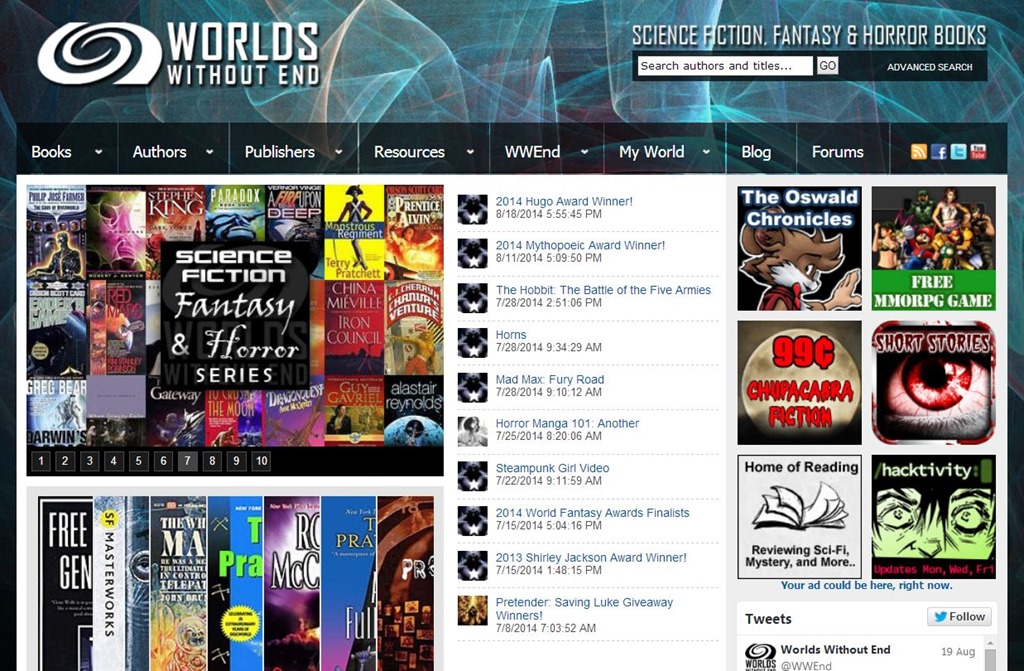
Worlds Without End

Worlds Without End is a reader database discussion site that’s pretty much like GoodReads, but focuses exclusively on science fiction, fantasy and horror.

Worlds Without End collects lists like my Classics of Science Fiction, fan polls, awards lists, author recommended lists, and puts them in one location and then links the titles to a database.  If you join their site – it’s free – you can tag books on the lists to monitor your reading progress, or even add your SF/F/H books to their database.  You can create your own reader challenge in their Roll-Your-Own reader challenge.  Right now they have 32 challenges for 560 members having read 1077 books and reviewed 527 of them.

If you’re a blogger who reviews SF/F/H books, you can join Worlds Without End, tag the books you review, add an introductory review to their site, and then link to the full review on your site.  If you’re a reader you can read the reviews, or discuss the books on their forum.  All the book lists, forums, and reader challenges link back to the books which allow you to track your reading habits, and even measure your progress reading through the reading and awards lists. Since everything is linked to everything else, it makes researching a potential book to read a snap.

Here are my reading stats for Awards lists and Book lists.  Click to enlarge.

Award Books Read


Book Lists Read

You can also look up books by publisher.  For example their site lists 256 authors for Tor covering 1,056 titles, of which 335 have been nominated for awards with 55 of those books winning an award.

You can quickly call up an author and easily check off which books you own, read or want to read, and mark whether or not it’s one of your all time favorites.  You can also rate your reads, and then list them, or see how your ratings compares to other members.

Another way to find books to read is see which members have rated books you also rated high and then look at other books they’ve rated high that you haven’t read.  There are many ways to use this site, and the social aspects are very good at helping you find like minded readers.

Best Science Fiction Books

Best Science Fiction Books

BestScienceFictionBooks.com is a newer site that’s not even completed, but has some features to start working with now.  It looks like they hope to compete directly with Worlds Without End, but for now they have mostly lists up.  Some of their lists are pretty good, others are questionable.  But I assume over time they will be refined.  For example their list for Best Alternate History books is pretty good.  Unfortunately most of their features link to file Not Found pages, which is a bad sign.  There was another site, SFFMeta that was going for a couple of years, that wanted to identify the best SF/F/H books and has recently disappeared.

I wish the people at BestScienceFictionBooks.com luck because building a big site like this takes a tremendous amount of work, and even building a great site doesn’t always draw in readers.  I mention this site to mainly give them some attention that might boost their efforts.

Good Reads

GoodReads

GoodReads has been around a very long time, and now that Amazon has bought them, they’ve become the 800-pound gorilla of reader reviews/book database sites.  Just look at the numbers attached to the books on the Time Travel book list.  The #1 book is The Time Traveler’s Wife by Audrey Niffenegger which has 899,564 ratings that average 3.93 stars out of 5.  #2 is Outlander by Diana Gabaldon with 285,187 ratings.  The Time Traveler’s Wife has just 73 ratings and 141 reads at Worlds Without End.

This brings up the problem which site to use.  Worlds Without End is a site for hardcore science fiction fans.  GoodReads is a massive site for all bookworms, so science fiction has to compete with many other kinds of books.  All the time travel books you find on GoodReads will be on Worlds Without End, but the reverse won’t be true.  Logic sort of dictates to go with GoodReads, but I find it more appealing to consider Worlds Without End.

Sometimes its better to be a small fish in a small pond.

I have reviewed other book database sites before, and directly compared LibraryThing to GoodRead.  It took a lot of work to get my collection entered into LibraryThing, but then I didn’t maintain it.  I exported my LibraryThing data and imported it into GoodReads.  I like GoodReads, but didn’t maintain my data there either.  By now I realize that I’m not that interested in maintaining a database of my books.  The value of these sites is for finding out what books other people like.  So the appeal shifts to social media.  I’m in two online book clubs at Yahoo Groups, each with a small number of members.  That works out well for a discussion group.  That’s why I’m leaning more to working with Worlds Without End than GoodReads.  About one quarter of my reading is science fiction.  So hanging out with a small group of people who read a lot of science fiction is an attractive idea at the moment.

However, taking the time to list my favorite SF books will help me meet other members that share the same reading tastes.  I will take that time to enter in my favorite books, but not all my books, or even all the books I’ve read.  Spending any time on so-so books is just a waste of time, especially reading time.

GoodReads is very enticing, as is LibraryThing.  I’m tempted to use Worlds Without End for science fiction, GoodReads for classic and literary books, and LibraryThing for nonfiction.  And in each case just focus on my favorites.

One thing I’d really like is to discover a way to find the best new books to read.  Every year when I write my reading summary I wish I had read more books published new in that year.  What I’d like is a Rotten Tomatoes for various kinds of books, especially for nonfiction.  SFFMeta.com used to do that for science fiction, but they are now out of business – a reminder that new sites will have a hard time making it, because SFFMeta was a well designed site.  Amazon with GoodReads might knock out all competitors like they are doing to local bookstores, but I don’t know.

There are other book listing sites that cover the “best books ever” concept which I wrote about in “Identifying the Greatest Books of All Time.”  These are the true classics, and not just science fiction books.  It’s also fascinating to see which few science fiction books make it to the general classic lists.  Here is the Top 10 site for fantasy and science fiction.  The only SF genre title is Dune.  It’s amazing how few SF books are recognized by the literary world at large.

A List of Books is one of my favorite sites for identifying all-time classics.  It uses the same methodology I used to create the Classics of Science Fiction, but allows members to track their reading.  I’m using it to track all the books I’ve read on the 100 Best Novels by Modern Library.  That list contains just three SF novels.

And what I’ve found out over the years is the books considered classics by literary scholars and readers really are some of the best books I’ve ever read.  Few science fiction books come up to their level.  Another site that does this is The Greatest Books.  Just glance at their page about Ulysses by James Joyce, and look at the lists that pick Ulysses.  When you consider all books, the competition for the best gets tough.  Right now science fiction books are in the minor leagues, so it will be fascinating to see if I live long enough to see if more science fiction books get recognized to general classics.

If you study these sites its possible to pick books to read that have a much greater chance of wowing you than randomly buying a book at the bookstore, or taking a friend’s recommendation of what to read.  And even if you don’t like these classics, you’ve at least educated yourself about science fiction history.

JWH – 8/21/14

Making Things in America Again

Good news on Wall Street does not equal good news on Main Street.  America is recovering from the recession, but not the middle class America.  There’s an old saying, “When the going gets tough, the tough get going.”  Factory Man by Beth Macy is a book about John D. Bassett III, the history of Bassett Furniture, and JBIII’s fight against globalization.  In one chapter, the tough old Bassett who fights tooth and claw to keep his factories and workers in America, says you don’t fight globalization with MBAs but with coaches who know how to compete.  His company Vaughan Bassett Furniture came out with the Cottage Collection line of furniture that was easy to manufacture, quick to ship, designed making it hard to import, competed on price and was stylistically more appealing than the competition coming in on container ships.  He had to use higher tech machines and fewer workers, but it was made in America and it sold like crazy.

Factory Man by Beth Macy

There are businessmen, historians and economists that teach for a country to thrive it must have a robust middle class and it must make things.  America has stopped making things, losing 5 million manufacturing jobs in a decade, and our middle class has been shrinking since the 1970s.  The relentless drive to increase the bottom line by selling cheap has forced corporations to chase low cost labor around the globe.  As Beth Macy reports, globalization means Americans can buy lower cost furniture that may even be better made, but overall more Americans can’t afford globalized bargains because their jobs at making things went overseas to make those bargains.  And we’re talking about people fighting to keep $13 an hour jobs, not union wages.  Now they are trying to find part-time work at minimal wage, or even catch-as-catch can work for $4 an hour.

Factory Man provides several pieces of the puzzle I’ve found lately that illustrates the current economic landscape.  Capital in the Twenty-First Century offers many more revealing pieces, and books like The Unwinding by George Packer offer other significant pieces.  Plus I’m reading hundreds of articles on the internet about business and economics that fill in holes too.  I’ve put together enough pieces that I think I can see a general outline, and it’s not good.

I am reminded of a lesson I learned from a SF book back in the 1960s, Empire Star by Samuel R. Delany.  A kid from a backward planet wants to run off and see the galaxy, and he is given advice by an old man.  The kid is told there are three kinds of thinking:

  • Simplex
  • Complex
  • Multiplex

People who grow up in a homogenous society are taught rules, mores, etiquette, customs, beliefs that are simple, easy to understand and are often black and white in their exactness.  Think of ISIS in Iraq.  If you don’t pray a certain way, off with your head.  If a simplex person then travels to another culture they will find many rules, mores, etiquette, customs and beliefs that conflict with their simplex beliefs.  To survive requires thinking in a complex way.  Living becomes hard, especially if you want to keep your old ways of thinking, yet let others live with their ways of thinking.  Multiplex thinking is when you can believe two things that on the surface appears to be polar opposites.  For example, being an atheist that supports freedom of religion in the separation of the church and state.  It is multiplex thinking to hold the belief that all religions and non religions are better supported if the government doesn’t endorse any one religion.

Factory Man is a very multiplex thinking book.  We never know if John Bassett III is a hero or asshole, but is shown in countless roles, often conflicting.  Macy doesn’t say if globalization is good or evil, but she provides many examples of pro and con impacts.  The book doesn’t tell us if exporting jobs was right or wrong, but Macy provides many personal stories about what happens when globalization changes peoples lives.  What Macy shows us is the impact of these people and ideas on other people, and as the reader, we must come up with our own multiplex view of the book.  But to understand a true multiplex view of Factory Man requires reading many other books.  It helps to have read The World is Flat by Thomas Friedman, the guru for globalism.  If you think simplex and only worry about what’s good for America you will fail just as fast as accepting globalism as a complex solution.

Macy’s multiplex take on globalism still tends to lend towards one side, since her sympathy is with millions of American workers who have lost their jobs.  Marc Levinson, who wrote another view of globalism in The Box:  How the Shipping Container Made the World Smaller and the World Economy Bigger reviews Factory Man at the Wall Street Journal.  He concludes:

Globalization takes the blame for many ills these days. But the implosion that Ms. Macy chronicles owes less to import competition than to executives in a sheltered industry who failed to keep up with a changing world. It is to his credit that John D. Bassett III thought differently. It is the country’s loss that so many of his counterparts did not.

I tend to agree Levinson and JBIII, and think “Made in America” must compete by competing—that to counter the negative side of globalism there must be some localism that fights back with a passion, and JBIII was one such person.  Most of JBIII peers, economists, business journalists, business school PhDs hated his protectionist stance, but like JBIII points out over and over again, the laws were in place, and he had no trouble proving wrong doing.

As wages rise overseas, some manufacturing has trickled back to America.  Globalism of the 2020s will be far different than the 2000s.  To actually achieve multiplex thinking with global economics will require getting beyond the philosophy that low cost is the only way to compete.  Consumers need to stop buying by the cheapest price.  There’s another book to read on that subject, Cheap: The High Cost of Discount Culture by Ellen Ruppel Shell.

We need to consider many factors in our buying decisions.  First and foremost, what does making this product do to the Earth?  Second is to ask how it will improve our life.  Third is to consider how the success of this product will improve the lives of others and the economy.  And finally, we need to consider the price.  Will paying 25% more help the Earth, get you a better product,  and put someone in the middle class?  Then paying more means getting a lot more.

We don’t need more rich people, we have plenty of them, what we need is more middle class people and fewer poor people.  Achieving that goal will actually create even more rich people.  That’s multiplex thinking.  It’s too bad our business leaders think so simplex and compete by price alone, never considering the impact to the Earth, the economy and their customers.

Factory Man is actually a very emotional book, that often made me laugh and cry.  It’s down right inspiring too.  Which is pretty weird when you think it’s about furniture manufacturing.  The New York Times even reviews it suggesting it would be a great movie.  Tom Hanks actually tweeted the author that he gave it 142 stars.

JWH – 8/20/14 

Why The Selfie Is Significant

I was in the middle of my physical therapy exercises this morning when I realized the significance of the selfie.  Most people think the selfie is silly, and so did I, until I realized how important a form of communication they were.  The selfie has reach the stage of pop-culture success that it’s now the subject of parodies.  It’s quite easy to dismiss the selfie as a narcissistic fad, but a flash of insight tells me that the selfie represents a breakthrough in language.

If you typed a text to a friend that said “I am at the beach” it conveys a certain amount of information.  But if you sent them a selfie of yourself with a beach and ocean in the background you’re sending them many magnitudes more information.  That old saying that a picture is worth a thousand words in quite true, and maybe even an understatement.  But the selfie goes beyond beating a few words with massive amounts of data.

pug at beach

Language is a code.  It’s symbolic.  Pictures are also symbolic.  They give the illusion of reality, but they aren’t.  But they are far closer to modeling reality than words.  And the most important aspect of the selfie is modeling the self – the I.  We all struggle throughout life to express ourselves, and we always fail.  We neither know ourselves, nor can we describe ourselves.  A photo does a pretty good stand-in, much better than words, especially if it also expresses action and place. 

If a photo captures an image of our self doing something in the moment it’s very close to expressing where we’re at.  Sure it’s not as deep as Proust, but it’s far better than the words the average person can express.  Not only does a selfie capture us in the moment, it becomes a much better memory than we can store by chemicals etching our neural pathways.

A selfie of yourself at the beach is proof that you were indeed at the beach, now, to your friends, and to yourself, in the future.

And I think the selfie portends more than that.  The history of the human race is really a history of language and information.  We didn’t become the crown of creation until we acquired language, but no matter how significant that accomplishment was, language has huge limitations as a form of communication.  Think of this way.  Let’s say you were at the beach and wanted to tell your grandmother about the experience.  You could send her a text, write a long email, call her on the phone, send her pictures or send her a videos of several events of your time at the beach.  Which mode of communication gives your granny the best sense of your time at the beach?

What smartphones are doing is allowing us to communicate in two new languages – images and videos.

Sadly, I’m not a smartphone person, or a selfie taker.  I live in the old world of words, and I realize I’m being passed by young people who speak in new languages that I have few skills at using.  Of course there are limits to every language.  Selfies show the outside of things, and even if they can infer a lot about our inner states, they can’t compete with words at expressing our thoughts.  I can’t help but wonder for those people who talk in selfies aren’t outer-world oriented.  One criticism I’ve read of the selfie is young people feel if they don’t have a picture of an experience it didn’t happen, that a selfie is a kind of proof they really did do something.

This is really a weird concept to explore.  It suggests that television and movies have influenced our sense of reality, so that if we aren’t in the picture or the video we’re not there.  It suggests our sense of self is shifting from inside our heads to the pages of Facebook, and that’s quite fascinating.

Some people have already begun to think of the selfie as an art form, but I’m thinking the selfie is a kind of language, one that communicates a sense of self, and says a lot about self image.  I don’t like my physical image, so I use an ugly dog as a stand in.  I see myself in words instead.

JWH – 8/17/14

Sailing Around the World Alone

How young is too young to sail around the world? The other night I watched Maidentrip about Laura Dekker, a Dutch girl who wanted to sail around the world by herself at age 14.  The Dutch courts intervene for ten months before Dekker finally got to sail when she was fifteen, completing her circumnavigation when she was sixteen.  It’s hard to say when a person is too young to do something.  We want to protect our children from harm, and we think of teenagers as being inexperienced and incapable of knowing what we know, but does that mean they shouldn’t do something if they have the ambition and the means to get what they want?  Wikipedia even has a list of teenagers who have sailed around the world.

The first person on this list on the list is Robin Lee Graham who was made famous by a serious of articles in National Geographic Magazine back in the 1960s when he set off to sail around the world at age 16.  They even made a movie about his trip named after his boat, The Dove.  Even today he is still remembered, and was recently asked what he thought about kids sailing around the world on their own.  As a teen in the 1960s I followed Graham’s story in National Geographic magazines with great interest.  I thought it would be a great adventure, and envied his freedom.  However, I wasn’t very enterprising, and had trouble keeping my old $150 Ford going when I was 16. 

The man who started it all was Joshua Slocum who was the first person to sail solo around the world starting in 1895.  There have been many solo souls to circumnavigate the world since.  I guess it was Slocum who started the whole mania for solo sailing around the world.  It takes a special kind of person to spend hundreds of days alone in a small boat by themselves away from human society, and to live so completely in the harsh elements of nature.  The ocean can be a very cruel place to be alone, both physically and psychologically.  It reminds me of the early days of spaceflight when men orbited the Earth in solitary capsules.

There’s two ways to sail around the world – port-to-port and nonstop.  Graham took five years to sail around the world, stopping for long periods in various ports, and eventually using two boats.  The nonstop sailors stay on the ocean the entire trip, never making port.  Those are the real loners of the sea.  And there’s something about the psychology of these solo sailors that make them want to stay at sea and not come back.  Laura Dekker, a port-to-port voyager, finished her round the world trip and then kept going, disappointed she hadn’t stopped at New Zealand on the first time around.  Bernard Moitessier, who was about to win the Sunday Times Golden Globe Race for fastest solo circumnavigation, turned around on his approach to the finish line and started another lap of the globe.

The dramatic Sunday Times Golden Globe Race was recently portrayed in the documentary Deep Water.  I beg you to watch this film, but also beg you not to read about the film or the race ahead of time if you don’t know the story.  It’s riveting as it unfolds, especially the human interest angle.  I’m not even going to link the trailer that spoils the story.  There were nine sailors that entered the race, and one, Donald Crowhurst, had no real experience.  It was the old salts versus the daydreamer.  Crowhurst’s story is so compelling that a fictional film account with Colin Firth and Kate Winslet is in the planning stages.

Since the Sunday Times race, there have been many round the world races and even more solo sailors.  Over the years I’ve read about various men and women sailing solo around the world and have been quite fascinated by two aspects of this sport.  First, why and how people can survive so long in self-imposed solitude.  Second, I’m fascinated by the details of outfitting a sailboat and the equipment it takes to navigate precisely around the world.  Most of the recent documentaries have focused on a quick overview of the trip, and spent little time on the details.  These films make me hunger for books with lots of how-to facts.

From watching Maidentrip it was pretty obvious that Laura Dekker was only marginally experienced at sailing, and her boat gave her little trouble, and her GPS did all the navigation work.  She said she knew how to use a sextant, and had the charts but we didn’t get to see her use them.  Her voyage was from port-to-port, and my worry for her as a teenager,  was more for when she was on land than at sea.  I thought a 15-year old girl would be an easy victim for crime and sexual assault.  But she made the trip and has kept going.  She evidently has a savvy and toughness that most teens lack.  Dekker is obviously a school dropout, and doesn’t seem to be interested in any subject other than sailing.  I tend to believe most parents would keep their kids away from round the world sailing because of school, and not because it’s a dangerous activity.

How dangerous is sailing around the world?  I haven’t heard of any kids being killed, but some have sailed into container ships.  Modern boats must be pretty well made compared to the old days, because old sailing stories are often endless tales of equipment failure.  And sailing from yacht club to yacht club has its own level of safety.  I don’t know how young a kid could sail around the world by themselves, but it’s probably dependent on them acquiring a good boat, and a decent amount of training.  Yet, how many kids would want to spend weeks and months totally by themselves?  Crewed sailing is far more popular.  Like I said, it takes a special kind of person to sail solo around the world.  I’m not sure if they want to get away from other people and society, or they love the feel of being completely in control of their own fate.

Sailing around the world has changed because of technology.  Jessica Watson is the youngest girl to sail around the world solo non-stop, although she didn’t meet the requirements to qualify for official records.   It’s not quite the solo experience it was in Slocum’s time.  With radio, cell phones, YouTube, and the Internet, fans can follow sailors almost in real time.  Jessica Watson’s voyage was well covered by YouTube reports and television.

Deep Water and Maidentrip are available on Netflix streaming.  The Dove is available on Netflix DVD and Amazon Prime Streaming.

JWH – 8/16/14