ISideWith.com is Match.com for Hooking Up with the Right Presidential Candidate

By James Wallace Harris, Friday, July 3, 2015

Go to ISideWith.com and take the quiz. Over 16 million people have used this site so far.

For the next year and a half we’re going to be bombarded with presidential campaigning. It’s all very confusing and boring. My friend Bill at That’s Interesting… sent me this computerized quiz that does all the work for us. It’s like Match.com for hooking up with the best candidate for your political personality. Here are my top results:

Top results

Be sure and expand all the subject areas to answer all the questions to get the most accurate results. Then when you get the results keep scrolling past the candidate rankings to see other demographic information about your political leanings.

In some ways the results matched what I already knew. Intuition told me I liked Sanders most and Cruz least, and the quiz confirmed it. I match with Ted Cruz only 1%. I am surprise I agree so much with Chris Christie, because my gut told me I liked Jeb Bush best of the Republicans. But evidently Christie and I agree a lot on environmental issues. Who knew?

One graphic I really liked:

Political graph

I aim to stay in the middle of things – to be a Centrist, but evidently I’m not. I’m more authoritarian than libertarian and I knew that, but I didn’t know I’d be equal with Ted Cruz. But I’m for legislated equality and he’s for legislated morality.

Taking this quiz concisely shows what issues we’re dealing with in this campaign. I think the quiz should be expanded as we get closer to voting, adding other issues.

JWH

How Conservatives and Liberals Rank Obama

By James Wallace Harris, Wednesday, July 1, 2015

Lately my conservatives friends have told me that Barrack Obama is the worst president the country has ever had. I ask them how they come to that conclusion. They just say he is the worst, and everyone knows it. I point out he did win two terms, so by that metric, he’s ahead of all the one term presidents. Most people think it’s much too early to judge Obama’s legacy, but I wondered if there are yardsticks by which we can measure on-going presidential success.

Some conservatives are quite hard on past presidents, such as this book, Recarving Rushmore. They judge presidents by very narrow value systems and personal opinions, and would remove Jefferson, Lincoln, and Roosevelt from Mt. Rushmore. I did find some conservative news sources basing their judgment of Obama on an opinion poll taken by Quinnipiac University. It has a sample size of 1,446 and a fair spread of demographic diversity. But is current opinion any real measure of actual performance? It would be better to say the poll showed Obama has low popularity at that moment. If the same poll was taken after the recent Supreme court rulings it might be very different.

If you search the web you’ll find two kinds of presidential evaluations. Opinions and numbers. That old saying about actions speak louder than words apply here. The only real measuring of reality is with numbers reflecting action.

Forbes Magazine took a numerical approach, effectively using statistics and graphs. By gathering a variety of economic measurements they showed Obama outperformed Reagan on job creation, economic growth and investing on Wall Street. Here’s just one of their charts – see all here.

Reagon v Obama investing

A personal way to numerically measure a president’s performance is to look at your retirement savings. Mine took a beating under Bush, but has rallied nicely under Obama.

Once we get away from opinions and into numbers, Obama’s track record looks much better. By using money as a measuring stick, Forbes also ran a story back in 2013 “Economically, Could Obama Be America’s Best President?” This makes me wonder how many quantitative yardsticks I could find. If we use health insurance as a measuring tool, millions more Americans are protected now. Just look at this article from New Republic, “7 Charts That Prove Obamacare Is Working.” Or this article from Vox,Barack Obama is officially one the most consequential presidents in American history.” Politicians have been trying to find a way to provide Americans with health insurance for over a hundred years, and Obama was the first to succeed.

We really should ask what we want from the captain of our political ship. For some requirements, we all want the same thing, whether conservative or liberal.

  • Economic Stability
  • Peace
  • Social Stability
  • Law and Order
  • Maximum freedom for all
  • Opportunity for all
  • The promise of a secure future

Economic stability means reasonable growth with no bursting economic bubbles or inflation. What conservatives want is unfettered growth that allow them to get rich quick. That has always led to disaster. What we really want is a stable steady-state growth and low unemployment. And it’s become very apparent that wealth equality is important to overall economic stability. Minimum wages that cover living expenses is good for long term economic stability.

We all want to live in a safe society, and a peaceful world. Law and order without corruption is the key to social order. Stable societies have corruption free police, national guards and armies. Societies where everyone is treated fairly have a great happiness index. As we bring political equality to all, we should have less social unrest in America. If we could stop arguing for a few years over what is marriage and how to give everyone health insurance, we might find less polarization in our society. If religious beliefs and sexual relationships were private affairs there’d be a lot less anger.

Many conservatives hate Obama for personal reasons. Because he’s black, or think he’s Muslim, or believe he was born outside the country, or he doesn’t support some pet personal belief. I also think a lot of conservatives hate Obama because of team mentality. Like rabid football fans who passionate hate rival teams, I feel some Republicans just can’t accept anyone who plays for the Democrats. Personal traits and party affiliation should not be considerations in evaluating a president’s performance.

In 2016 we want to elect a president that can keep the country peaceful and prosperous. Every four years we want to elect a president that will enact policies that will continue that security into the future, and even the far future. Refusing to deal with climate change now, puts future America at risk. If you think about the United States surviving for a thousand years, or even a million years, we can’t use up all the resources now, or destroy the environment or climate.

I think we need to get away from opinion polls. We need to start measuring political success impartially by statistical indicators in as many ways as we can find data to track. It would be great is we had a governmental site that had a whole range of graphs like this one from the Washington Post.

ConventionEconomy

The power of infographics is constantly improving. Just look at this one at Bloomberg Business. I can’t copy it here because it’s an animation. Go to the site, and then slowly scroll down and watch the show. I find the use of numbers more persuasive than opinion.

If you go to this Google search you’ll see hundreds of graphs that measure all kinds of indicators that prove Obama is not the worst president – not even close. In terms of creating a stable economy and providing more freedom, jobs, security and opportunity to the most people, Obama has done an extremely good job.

Table of Contents

The Beatles and Other Forgotten Bands

By James Wallace Harris, June 30, 2015

Now that Apple has entered the streaming music business it’s obvious that streaming is the future. After more than a century of wax cylinders, 78s, LPs, 45s, 8-tracks, cassettes, CDs, DATs, SACDs, MP3s, music will arrive by subscribing to bits and bytes. We’re now in a transition phase. Some people will listen to music they own, and others will listen to music they rent. As the advantages of subscription music become apparent to all, most listeners will forget about owning. If songs aren’t instantly available on their smartphones, they will be forgotten.

The_Beatles_-_Rubber_Soul

Because I listen to ninety-nine percent of my music through Spotify, The Beatles are becoming a forgotten band. I’m sure Apple hopes to make an exclusive deal to stream The Beatles like they did for selling their songs and albums by digital downloads. If The Beatles make such an agreement, I might forget them completely. I bought twelve of their thirteen re-mastered CDs when they came out a couple years ago, but I don’t play them. Some are still in the shrink wrap. Listening to music on Spotify is just too damn convenient.

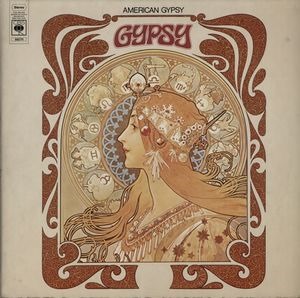
Gypsy

Most of the famous bands that held out against the subscription music tide have given in – AC/DC is the latest example. I have to admire that group for not making an exclusive deal. During the transition phase to a complete subscription music age, we will have to find ways to deal with forgotten bands. There are several reasons why music from the past isn’t offered today.

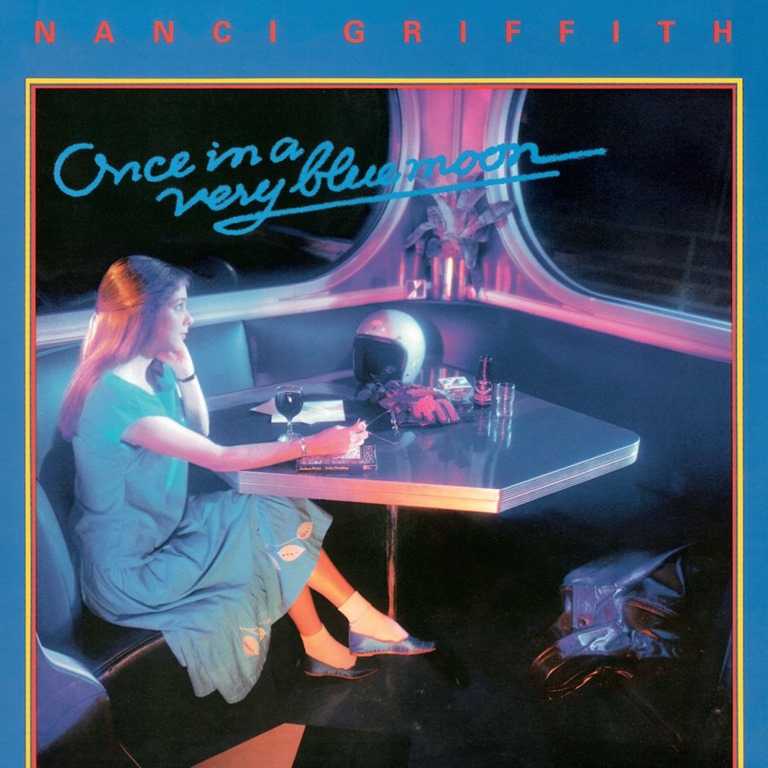
Once In a Very Blue Moon - Nanci Griffith

First, a band will refuse to allow their music to be streamed. That’s becoming less likely as people quit buying music. Second, music is often tied up in legal battles. Again, that will be resolved. There is a lot of music from the past that is forgotten because there’s no demand or its creators aren’t around to promote it. I assume this will change over time as those who still remember will complain. Finally, what we can hear will be limited by exclusive deals. There’s over a dozen subscription music services out there now with more coming on line all the time. The best way to capture subscribers is to promise the biggest catalog, especially catalogs with artists and albums that other services don’t contain. I find this mercenary practice a heinous aspect of the music business.

Willis Alan Ramsey

Right now the standard price for subscribing to a music library is $10 a month. If some services seek to dominate with exclusive deals, there will be a tendency towards monopolies and squeezing out the smaller services, or for people to subscribe to more than one music site. One solution to make subscribing to multiple libraries possible is to change the fee structure. For example, if Spotify and Apple charged $2.99 to be a subscriber, and then one penny a play, then fans could easily enjoy two sites and pay artists fairly.

quicksilver_what_about_me_lg

One reason why artists have avoided subscription services is the low royalty payments. Between the music publishers and subscription services, they seem to make the best deals for themselves. Apple almost got away with giving people three months of music to new subscribers without paying the artists. I think the artists would get a better deal if their payments were separated from subscription fees.

Rainbow Down the Road by B. W. Stevenson

One cent a play is the perfect payment. That cent should be divvied fairly between the composers, performers and record companies. The one cent fee should only be for specific playing of songs. For random background listening, artists should get a lesser fee paid out of the subscription service fee. That way, unless a fan plays specific songs all day long, most listeners will still stay close to the $10 a month bill.

Never Goin Back to Georgia by Blue Magoos

With better royalties I believe most music from the past will be unearthed and put online. Forgotten bands and their albums will show up in libraries, making subscription music nearly perfect. Right now there are many favorite songs from the past that I can’t add to my playlists. In the future, when everything I want to hear is in my subscription, I can’t imagine another system of music delivery ever replacing it.

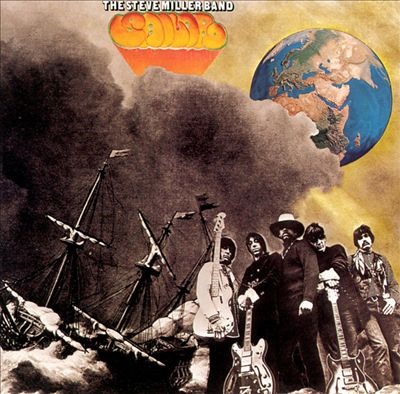
Sailer by The Steve Miller Band

Pictured are just some of the albums I can’t play on Spotify today. I hope they will all be available within a year.

JWH

Why Science is Not Myth

By James Wallace Harris, Monday, June 29, 2015

My book club was discussing Sapiens by Yuval Noah Harari when Linda said she liked how the author compared capitalism to religion. Tim replied that many things are like religion, including atheism. Cayce then added everything boils down to myths, including science. I knew what Tim and Cayce were getting at, that we all use our beliefs like a religion, and that we understand aspects of reality through stories, but I objected that science should be called another myth. Cayce then countered that I should show him a photograph of an electron. Tim then commented that science often gets corrupted and misused. Cayce then said that science can’t prove anything, and can only offer a probability that never approached certainty.

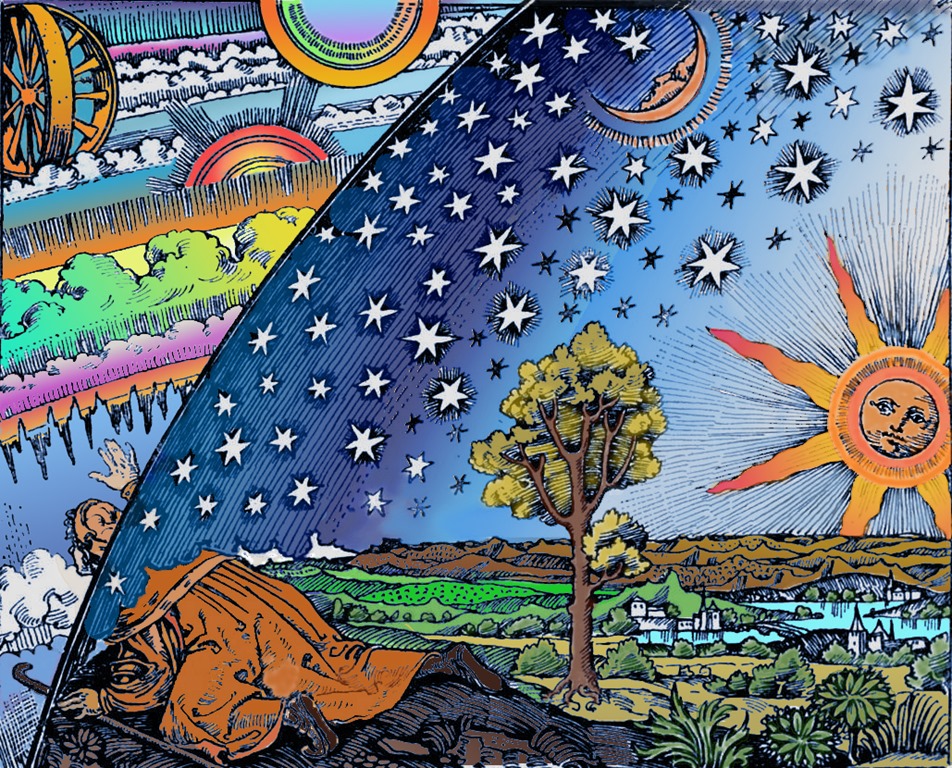
Flammarion_Woodcut

I wanted to argue more, but by then, it seemed like we were getting into a private discussion, boring the rest of the group. However, I think it’s extremely important to define why science is not myth. First I think we need to define the word myth. For our purposes I’d say myths are stories that explain reality. However, one definition of myth is a false story – “That’s just a myth.” I’m not sure if Cayce was arguing that science is a myth because it’s just another story explaining reality, or that no story can explain the absolute truth about reality, so they are all myths.

I believe it’s important to distinguish that science is not myth because it’s the only cognitive tool our species has developed to explain how reality works. Myths, religions and philosophy have failed at explaining reality, and what sets science apart is its success. Science is the only system of thought that has consistently worked even though it doesn’t offer absolute certainty, or answers to all questions.

One reason why myths sometimes appear to work is believers assume our reality is not the real reality, that we live in an illusion, and a higher reality contains the truth to our existence. Some believers in myths believe reality is mutable and thought can shape reality. However, I’m working on the assumption that there is an external reality, that it’s part of a single reality, and reality can be understood by observation.

To assume science is just another myth, is to suggest that reality is unknowable. It implies that the knowledge we’ve gained from science is just another illusion. I reject that for two reasons. First, science is a method, not a belief. Second, the results of science is too consistent.

Myths impose concepts on reality. Science reveals patterns in reality. Myths come from the inner world of our subjective minds. Science studies objective reality outside our brains. Science and myth are polar opposites.

Too many people today think the data collected by the process of scientific research as something you can accept or reject. There are two problems here. One, the current results of science can be uncertain, and two, people want to believe what they want to believe. It’s unfair to judge science because people don’t like the results, or the results are inconclusive. Science constantly refines what we know about reality because it never stops gatherings new information. Myths never do that.

Myths are popular memes. We keep myths going because people like them. For instance the idea of heaven. There has never been on shred of evidence that heaven exists, but most people believe in it.

Myths are ideas we want to be true. Scientific ideas are ones we prove to be true. Myths require no evidence. Science does.

The reason science is not myth is because science is a technique not an idea. The results of the scientific method are statistical data. Mythology produces infinite possibilities. Science shows us consistent patterns.

Science does not depend on belief. Gravity works whether you believe in it or not. So does evolution and climate change. Electrons exist without us seeing them. Seven billion plus people use electrons every day. Electrons are immensely dependable and predictable. Cayce was holding an iPhone when he asked for a photograph of an electron. I should have pointed out that an iPhone is better evidence of electrons than any picture.

Mythology produced countless human cultures before the advent of science. Since the advent of science culture is homogenizing around consistent scientific results. The Comanche of North America, the Australian aborigines, or even the Israelites of the Old Testament could imagine living in any kind of reality they wanted, but they could never have built a Boeing 777 or IMAX theater. Citizens around the Earth are seeing a consistent reality because science showed us how to build cars, computers, cell phones and CT scanners.

Humans around the globe rebel against science because they want their myths. This is why I’m making such a fuss about refusing to accept science as myth. We have a clear choice. We can live in the illusion of what we want to believe, or we can use science to study how reality actually works and adapt our minds and culture to what’s real.

JWH

When Does Nonfiction Go Stale?

By James Wallace Harris, Friday, June 19, 2015

When does a newspaper transform from news to wastepaper?  How old do the magazines at your dentist office have to be before you sneer at reading them? When does a science book become a history book? Why don’t we have classic nonfiction books like we have classic novels? What’s so important about new information as opposed to old information? If you found a two week old newspaper in your house you’d immediately throw it away, but if you found a 1832 newspaper in your attic you’d treasure it. How many bestselling novels from 1955 are still read today versus the nonfiction bestsellers from that year? When The Bible and The Iliad were written there was no distinction between fiction and nonfiction.

Sometimes it seems the books I enjoy reading the most are novels from the 19th century and the nonfiction books just published that are getting a lot of buzz. The only nonfiction book I can remember reading from the 19th century is Walden; or Life in the Woods  by Henry David Thoreau. I’ve always meant to read On the Origins of Species by Charles Darwin.

I started reading Darwin Among the Machines: The Evolution of Global Intelligence by George B. Dyson, a book I bought new back in 1997, but just now getting around to reading. Dyson is the son of Freeman Dyson, and the author of the more recent book Turing’s Cathedral (2012), which I bought and is also lying around here waiting to be read. I wonder if I’ve waited too long to read Darwin Among the Machines, because I’ve read The Information (2011) by James Gleick and The Innovators (2014) by Walter Isaacson, as well as many other books about artificial intelligence and information theory since 1997. However, Dyson has a unique approach to the history of thinking machines, starting his story with Thomas Hobbes and his book Leviathan. Dyson even ties in H. G. Wells and Olaf Stapledon. This is the kind of book I would write if I had the discipline to write books.
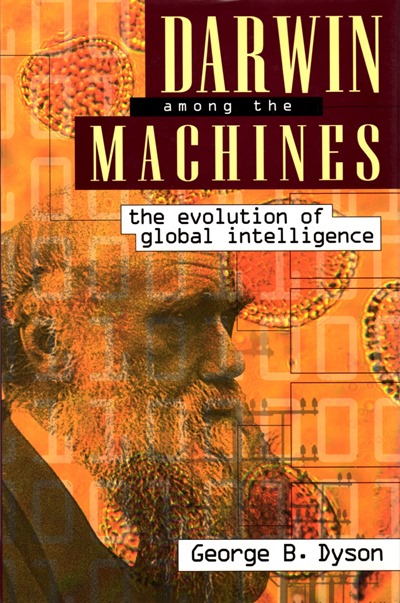
Darwin Among The Machines by George Dyson 1997 1st printing

Yet, I wonder about reading such an old book when there are so many newer books waiting to be read. Is there a Read By date for nonfiction books?

Dyson opens with,

“Nature (the Art whereby God hath made and governes the World) is by the Art of man, as in many other things, so in this also imitated, that it can make an Artificial Animal,” wrote Thomas Hobbes (1588–1679) on the first page of his Leviathan; or, The Matter, Forme, and Power of a Common-wealth Ecclesiasticall and Civill, published to great disturbance in 1651. “For seeing life is but a motion of Limbs, the beginning whereof is in the principall part within; why may we not say that all Automata (Engines that move themselves by springs and wheeles as doth a watch) have an artificiall life?”¹ Hobbes believed that the human commonwealth, given substance by the power of its institutions and the ingenuity of its machines, would coalesce to form that Leviathan described in the Old Testament, when the Lord, speaking to Job out of the whirlwind, had warned, “Upon earth there is not his like, who is made without fear.”

Three centuries after Hobbes, automata are multiplying with an agility that no vision formed in the seventeenth century could have foretold. Artificial intelligence flickers on the desktop and artificial life has become a respectable pursuit. But the artificial life and artificial intelligence that so animated Hobbes’s outlook on the world was not the discrete, autonomous mechanical intelligence conceived by the architects of digital processing in the twentieth century. Hobbes’s Leviathan was a diffuse, distributed, artificial organism more characteristic of the technologies and computational architectures approaching with the arrival of the twenty-first.

The trouble is Dyson wrote this sometime before 1997, and artificial intelligence has come a long way since then, beyond what Dyson could imagine eighteen years ago. Yet, what he’s really writing about are the centuries of thought before the 20th century on the subject – and that is mostly new to me. The common starting place seems to be with Babbage and Ada Lovelace, so it’s rather interesting that Dyson starts with Hobbes.

I guess it depends on what I’m enjoying learning. I seem to have two modes of interest. First is, what’s happening right now. The second is, how did we get here. Should I spend my time reading about the current state of global intelligence, or study the history of how someone imagined it would be hundreds of years ago?

I could be reading The Fourth Revolution: How the Infosphere is Reshaping Human Reality published 9/1/14 by Luciano Floridi. The Fourth Revolution is a book Hobbes would have found very interesting.

I wish I could read, digest and summarize a book in my blog in three or four hours. It takes me one or two weeks to read a book, and often longer to digest. If I really get caught up into a book I want to follow its leads and tangents. Just reading the first chapter of the Dyson book makes me want to go read about Thomas Hobbes. But do I need to spend so much time thinking about the 17th century when I live in the 21st? Tim Urban claims in “The AI Revolution” that the years 2000-2014 experienced as much progress as all the progress in the 20th century, and that the years 2015-2021 will speed even faster through that same amount of new information.

I am reminded of an old play title – Stop the World I Want To Get Off. Of course, I’m also reminded of that bestseller of the 1970s, Future Shock. Maybe it would easier on my mind to read Thomas Hobbes than Luciano Floridi. Yet, isn’t it sort of sad, that whatever nonfiction book I’ll read will be out-of-date in just a few years. If I had a good memory, I could tally up a very long list of nonfiction books that promoted some kind of far out idea as a possible understanding of how reality works yet has since been forgotten. How many people remember The Naked Ape by Desmond Morris or The Origins of Consciousness if the Breakdown of the Bicameral Mind by Julian Jaynes?

Not only do we surf the web, but we surf the current state of knowledge by reading the latest nonfiction books. New information flows into creation far faster than we can gain wisdom from processing that data. Is it practical for me to stop and read a book from 1997? Dyson was working to make sense of 1996.

Quite often new popular science books rephrase the same histories the older books covered. How many popular physics books have I read that summarized Einstein’s discovery of general relativity or  Kurt Gödel’s incompleteness theorems? Generally my knowledge of science lags far behind it’s discovery. At least I gave up on String Theory before The Big Bang  characters did.

I read for fun, so does it matter when a book is published if it’s fun to read? I’m not a scientist, so I don’t need to be up on the latest theories. I can never understand science at anything more than a popular science level, which is essentially at a philosophical level. And at a philosophical level, Darwin Among the Machines is still a fun read.

The problem that continues to nag me is whether or not I’m being the most efficient reader I can be. I only have a few more years left to live, and I want to cram in as much knowledge as possible. I know it leaks out my brain as fast as I consume it, but overall, a little residue remains and it feels like I’m progressing in my understanding of reality.

The decision to read an old nonfiction book versus a new nonfiction book must be made on how much knowledge will it add to my overall collection. That means I must choose between a writer who is carefully digesting a lot of historical information versus a writer who is reporting a lot of new information.

JWH