Science Fiction and Human Evolution

by James Wallace Harris, Friday, July 13, 2018

Are homo sapiens not quite intelligent enough to survive? Did you know the poor Neanderthal made the same stone tools for hundreds of thousands of years without discovering innovation? Homo sapiens have always assumed we had endless potential because we constantly create better technology. Is that true, or just hubris?

Most dreams of science fiction will remain fantasies. It’s unlikely we’ll ever have faster-than-light spaceships, or any kind of interstellar travel, time travel, matter transporters, brain downloading, living in virtual worlds, or become immortal. There are limits to our hopes.

But what about dreams that could still come true?

Our current reality reveals we’re a species that have so overpopulated the planet that we’re about to destroy our shared ecosystem with all other species, that we’re now bringing about the sixth mass extinction event, and we’re dismantling the first global civilization. We’ve amassed a pile of problems we can’t solve. Is there any hope we can smarten up before it’s too late? I doubt it, but let’s explore the possibilities of change.

Science fiction has often assumed humans becoming a new species, but usually, it’s rather far-fetched, involving new people with psychic powers or comic book mutations and superpowers. A great deal of current science and science fiction explores the idea of post-humanism or transhumanism, but I think that’s mostly hopeful fantasy too. If we were realistic, how would a new species emerge and what traits would define it? Is there enough time to transform ourselves before the clock runs out? Prophets, philosophers, scientists, and science fiction writers have suggested many methods that humans might evolve.

  • Spiritual discipline. Yogis, fakirs, mystics, priests, and self-improvement gurus have taught us for thousands of years that we already possess the potential to be superior beings.
  • Medical technology. We’ve already expanded our lifespan and improved our bodies. Could we deploy the same research to expand the brain?
  • Eugenics. Is it possible to intentionally breed humans like farm animals to improve the species? It’s a vile idea that’s been thoroughly rejected but people still think about it.
  • Genetic engineering. We’re getting closer to manipulating our own genes. If CRISPR can edit out genetic diseases could it delete genes for dumbassness and add some for wisdom?
  • Accelerating evolution. What if we could use technology to physically change our brains? Such devices pop up in the news all the time. Will they always be sold by snake oil salesmen?
  • Cyborg technology. Can we enhance who we are by bolting on machines to our bodies and minds? What if we could embed smartphone technology directly into our skulls? I guess that’s one kind of evolved telepathy.
  • Uplift. Science fiction has often imagined humanity being improved with the help of superior aliens. I doubt aliens will visit us anytime soon but what if we build AI machines that bootstrap this process?

We know our species, homo sapiens evolved out of older species, but will a new kind of people ever evolve out of us? Modern humans have been around 300,000 years and maybe 500,000 years by some estimates. The “average” lifetime of a species of mammals is around 1 million years, although some species have been around for millions of years. We split from the lineage containing chimpanzees and gorillas about 6 or 7 million years ago, and 400,000 – 500,000 years ago Neanderthals and homo sapiens took forking paths. Modern humans and Neanderthal coexisted for over 200,000 years.

Here’s an illustration I borrowed from Wikipedia:

Human family tree

Imagine if the top of this chart extended into the future, would we see new offshoots from homo sapiens coexisting with us and eventually leaving us behind? Generally, species are defined as a group of individuals that reproduce. But is a new species one where individuals can’t interbreed with the old one? In recent years we’ve learned that Neanderthals and humans interbred. Could we have already produced a new species that won’t reveal it’s obviousness for thousands of years?

We don’t have the time to evolve better humans naturally, although our collapse could provide the evolutionary breeding ground for a new species. We have to consider that homo sapiens might be the end of the line. Maybe intelligence isn’t a trait that’s sustainable. Maybe our descendants will be less smart and less destructive? Why do we assume more intelligence is what’s needed? Can you imagine the Earth evolving countless species for billions of years and never reinventing self-aware conscious intelligence?

I tend to believe our replacements will be machines with artificial intelligence. But let’s explore the possibility a new species will descend from us biologically. Right off the bat, I want to exclude any speculation about psychic abilities or superpowers. Evolution isn’t magic. In fact, I want to suggest that one of the singular traits of the new people is a complete disbelief in magic. Embracing make-believe has held humans back like some powerful drug addiction. I define magic as any hope to alter reality by any means unexplainable by science. All theology evolved out of magical beliefs. Humans have always worked to reshape reality, either with tools or prayers. The next species needs to give up on wishing to make it so.

Let’s assume the new people reject magic, mysticism, religion, theology, metaphysics, and make-believe. Of course, if you’re a believer in magic then my suggestion is going to outrage you. But this is my essay, so go along with me for a while. I’m going to assume that new people will be completely in touch with reality. Scientific thinking will be their cognitive foundation. They will only be concerned with what they can perceive with their senses, scientific instruments, and confirm with statistical scientific analysis. I will assume their use of language will evolve out of this too. Their success will be a society that’s ecologically sustainable and embraces everything we learn from reality.

Let’s assume the new people will be like Mr. Spock in Star Trek and the next species of humans will be sort of like Vulcans, except they won’t be able to do mind melds or any of that other silly mumbo-jumbo. They will be very logical beings, clear thinkers, with precise language. They won’t have psychic powers but they could have technological augmentations like the Borg. Let’s assume they have an extra neocortical layer that allows them greater pattern recognition than we have. They will have better memories and better cognitive strengths. They could look the same as us or maybe have slightly larger heads, or have brains that are neurally denser.

How Will the New People Emerge?

Science fiction has already explored many possibilities? This is the prime virtue of science fiction, to speculate about possibilities. Some of what I’ve read include:

  • 1895 – The Time Machine by H. G. Wells. Just decades after Darwin’s famous books, Wells imagines the human race splitting into two new species, the Eloi, and Morlocks.
  • 1911 – The Hampdenshire Wonder by J. D. Beresford. The story of a child prodigy that nature produced randomly.
  • 1930 – Gladiator by Philip Wylie. A medical serum is developed that gives people superhuman powers. Probably the inspiration for Superman.
  • 1930 – Last and First Men by Olaf Stapledon. A story that describes 18 species of humans over the next two billion years.
  • 1931 – Brave New World by Aldous Huxley. Eugenics creates superior beings and society.
  • 1931 – “The Man Who Evolved” by Edmond Hamilton. A scientist invents a cosmic-ray-machine that stimulates 50 million years of evolution every 15 minutes of exposure.
  • 1940 – Slan by A. E. van Vogt. A story about a race of scientifically evolved humans that must hide or be killed by jealous normal humans.
  • 1948-53 – Children of the Atom by Wilmar H. Shiras. Radiation causes some children to have superior minds.
  • 1952-53 – More Than Human by Theodore Sturgeon. Sixth strange people with various psychic skills form a gestalt being.
  • 1953 – Childhood’s End by Arthur C. Clarke. Aliens come to Earth to uplift us to our next stage of existence.
  • 1955 – The Chrysalids by John Wyndham. Mutations are showing up in plants, animals, and humans, and they are rejected by humanity, but the hope is on the side of the new.
  • 1959 – The Fourth “R” by George O. Smith.  In this story, teaching machines are invented that accelerates education in the brain.
  • 1959-66 – Flowers for Algernon by Daniel Keyes. A medical procedure is developed that accelerates intelligence.
  • 1961 – Stranger in a Strange Land by Robert A. Heinlein. A human child is raised by Martians proves that humans already have the capacity to be more powerful beings. This is the culmination of a decade of psi-stories in science fiction.
  • 1963 – “The Sixth Finger” is an episode of The Outer Limits. A scientist invents a machine that accelerates human evolution.
  • 1993 – Beggars in Spain by Nancy Kress. Humans are genetically engineered not to need sleep thus giving them 30% more time to be productive. The new humans out-compete humans who need sleep.
  • 1997 – Gattaca. Genetic engineering creates a new generation of humans that out-compete the older generation.
  • 1999 – Darwin’s Radio by Greg Bear. A retrovirus alters human reproduction causing a new species to emerge.
  • 2012 – 2312 by Kim Stanley Robinson. Humanity alters both itself and the solar system.

Science fiction has seldom dealt with subtle ways in which new people might evolve. The best example I can think of is a 1953 fix-up novel Children of the Atom by Wilmar H. Shiras, which is long out-of-print. Shiras was an early woman science fiction writer, and she imagined normal looking children with greater intelligence created by radiation exposure. Her special children did not have wild talents like all the silly comic books. However, some writers have suggested her book might have influenced the Marvel comics and their explosion of mutants with superpowers in the mid-1950s.

But let’s not think in terms of unrealistic 1950s science fiction. We’re getting close to real genetic engineering. In the 1990s Nancy Kress imagined in the Beggars in Spain series a future where genetic engineering creates a race of humans that don’t need sleep. This one advantage gives the sleepless a tremendous edge over sleepers. Or the film Gattaca where society allows parents to select the genes of their children creating a division in society between enhanced humans and normals.

If you think about it, we’ve already altered our species several times in the last 17,000 years. Switching from hunting and gathering to agriculture did a huge uplift to our kind. Writing did another. Then the printing press accelerated our progress tremendously again. Universal public education made a huge change to our species. The American Constitution altered our species too. Computers and networking are giving us another makeover. What’s interesting, if you pay attention to it, is society changes, but not us. Humans are basically the same throughout the times, just reprogrammed by outside forces. We’re very adaptable. In fact, we’re too adaptable, because we’ve taken over all the environmental niches on this planet, pushing out other species.

I believe society is programming us more and more, overriding our genetic code. Feminism is a great example. Our genes want to treat females as possessions. Society is convincing us they are individuals. How we shape society will determine how people will behave. This gives us a chance to evolve ourselves, and not have to wait on biology.

Religion and then politics has tried to codify behavior for thousands of years, but both systems have always failed to be universally successful. Science fiction writers have often explored utopian and dystopian societies that worked to impose a new way of living on our species. The lesson from these stories is utopias universally fail. But is that really true? Could we create a society that brings out the best in people?

As individuals, we are naturally greedy, self-serving, resentful, and xenophobic. I’m not sure genetic engineering can do away with those faults. The current return to conservative philosophy emerging around the globe is nationalistic, racist, protective, greedy, “I’ve got mine, fuck everyone else” Ayn Randian. How can we be sure the next stage human won’t follow those traits?

As a species, we have to worry about fractional groups running the whole show. Theocracy and plutocracy allow a minority to dominate the majority. What we need is a system that benefits all, including the other species. Right now, we can’t choose to evolve our physical bodies, but we can choose a society that shapes our minds.

I believe we need to apply the highest aspirations of religion, philosophy, politics, and science in creating a technological society that brings out our best traits. This Pollyannish hope is being crushed by our worst traits making all our political decisions right now. Donald Trump and politicians like him represent the election of leaders based on our worse qualities and fears. We’re reverting to wanting strong tribal leaders rather than globally enlightened ones. I can’t help but believe that’s happening because homo sapiens just aren’t up to the challenge. However, I want to be proven wrong.

Most species don’t adapt to change, they just die out. We were just about to create a global society. Then with recent political changes sprouting the globe, it feels like we’re de-evolving. Hopefully, if the past is a predictor, we’ll swing back to progressing.

JWH


Remembering and Rating Pop Culture

by James Wallace Harris, Wednesday, July 11, 2018

I began keeping a reading log back in 1983 where I record every book I finish reading. I wished I had started this log in the third grade when my mother read me Treasure Island. That was 1960, I was eight, and the first book I remember. The first book I read myself, was Down Periscope, but in an abridged version for kids. That was probably 1961. I figured I finished over a thousand books that I don’t remember between 1961 and 1983.

As you might guess, I’m hung-up on memory. Just remember, this blog is called Auxiliary Memory. My memory has never been great, and now it’s in obvious decline. My reading log has proved valuable on countless occasions and in many ways. Over the years I’ve often regretted not maintaining a movie log.

Recently I began a Pop Culture Log, where I record the short stories, essays, albums, TV shows, movies that I finish each day. In the sixties we had a phrase, you are what you eat. Well, I believe we are the pop culture we consume.

I keep my new pop culture log on a Google spreadsheet online. I now wish I had logged every pop culture work I consumed in my lifetime. Recording all my brain food takes a bit of effort, but is revealing. More and more when I tell my friends about shows or stories I enjoyed I can’t recall their titles. That’s very frustrating.

Aging and struggling with memory reveal details about my identity in those logs. In Westworld season 2 they show different approaches to creating artificial immortality. One method involves teaching an android all the memories and habits of a person until the android can’t be distinguished from the real person. Who we are, often comes from our attitudes towards the pop culture we’ve experienced in our lifetime. On Facebook, I see more and more groups formed around pop culture memories with tens of thousands of baby boomers participating in each. My identity can be partially defined by those groups I joined. (That’s why Facebook is so powerful to advertisers and political pollsters.)

Here’s a snippet of the last couple days. If I tried to record them from memory the day after tomorrow all of them would have been forgotten except maybe The Admirable Crichton. That’s the work that’s given me the most pleasure this week, but it would only take another couple days and I’d forget it too.

Pop Culture Log


I’ve tried to devise the most useful columns. I added a link column, something I don’t have on my reading log of books. That gives me actual details about the work, and is very educational, often expanding my reaction to the work.  Just collecting the entries for the spreadsheet helps me remember more.

My friend Janis recently gave me a box of vinyl LPs she had stored away at her father’s house for decades, mostly from the 1970s and early 1980s. I’ve been playing a couple each day. As you can see, I’ve rated them all three stars. But I wonder what I would have rated them back when they were new. Most stuff from decades ago seems kind of mediocre and blah, but I bet some of those albums sparkled when they first appeared. I know I liked some of them much better then than I do now.  I’ve decided to rate my current reaction rather than trying to discern absolute artistic quality, it’s context in history or its lasting value. The links do that. It would have been enlightening to see how my ratings changed over time.

Rating Systems

There’s all kind of rating systems. The classic school grade (A+ through F). The test score (0 – 100). The 10 scale (0 – 10). Various 3-star, 4-star, and 5-star ratings. I liked what Rocket Stack Rank uses, a 5-star system that’s less judgmental and more practical. I’ve amended their system for my use:

  • 1-star (*) – Technical flaws that annoy. Can’t finish.
  • 2-star (**) – Storytelling flaws ruin the flow. Can’t finish.
  • 3-star (***) – Average. Good. Competent. Even well done. Once is enough.
  • 4-star (****) – Will recommend to friends. Would reread/rewatch. Hope to remember probably won’t.
  • 5-star (*****) – Should win awards, be remembered, and become a classic. Would buy to have permanently. Would want to study and remember.

This system avoids judging art by objective criteria. A graph counting all the ratings should show 80% falling into the 3-star rating, 18% for 2-star or 4-star, and 2% for 1-star and 5-star. Because I only record what I finish, I shouldn’t be listing 1-star and 2-star titles.

The Admirable Crichton - 1957

Of the works rated above only the English film The Admirable Crichton (Paradise Lagoon in the U.S.) based on the J. M. Barrie play (he also wrote Peter Pan) is rated 4-stars. I gave it 4-stars because it’s one I’d recommend to my friends. It was so much fun that I’ve ordered two other film editions of the story, one a silent, Male and Female (1919) that stars Gloria Swanson directed by Cecille B. DeMille, and 1934 pre-Code screwball comedy starring Bing Crosby, We’re Not Dressing.

Rating a work is hard. Janis, who is also my TV watching buddy, and I, both greatly enjoy Glow, a show about lady wrestlers in the 1980s. It gets good reviews, and I know other people who like it too. However, the quality of streaming TV is so great compared to the older broadcast TV that it’s hard to say when a show is worthy of 4-stars. I would definitely say Breaking Bad, The Handmaid’s Tale, The Marvelous Mrs. MaiselThe Crown, Downton Abbey are 5-star shows. And I would say Anne with an E, Humans, FargoWestworld, The Duece are 4-star shows. But really good shows like Glow and Killing Eve aren’t in their class. A 3-star rating includes a lot of very entertaining shows because there’s really a great number of entertaining well-made shows. 3-stars doesn’t mean something isn’t very good. Well-made entertainment is very common today.

My concern is more about memory than artistic judgment. I want just enough information in my logs to trigger hidden memories. I’ve never been sure if bad memory is due to lost memories or poor memory retrieval. If I had kept logs of all the artistic works I consumed in my lifetime it would help me remember, but also it would also describe who I was, something I’m still learning myself.

JWH


Will the Real Charles Dickens, Please Stand Up?

by James Wallace Harris, Saturday, July 7, 2018

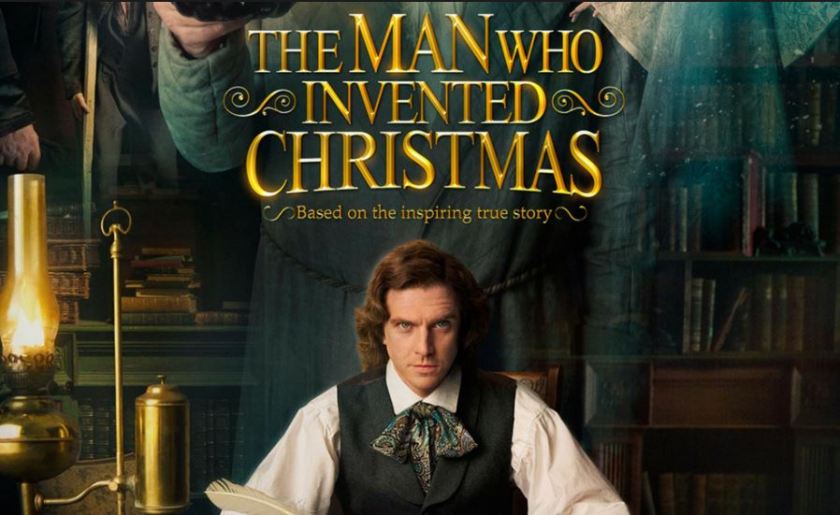
The other night I saw The Man Who Invented Christmas, a delightful film about how Charles Dickens wrote A Christmas Carol. When it was over I asked myself: How much of it was true? I’ve read one short biography of Dickens in the past, Charles Dickens: A Life by Jane Smiley. So I knew some details in the movie were based on truth. But I doubted its facts fit history in the same way the screenwriter presented them.

The Man Who Invented Christmas

After watching the film, I read Mr. Dickens and His Carol, a novel by Samantha Silva. Silva spent fifteen years working on this story, originally written as a screenplay. Her novel featured a more complicated story than the film The Man Who Invented Christmas but invents and fictionalizes a great deal more. The movie is lighthearted and fun, focusing on Dickens’ economic problems and how they inspired him to write A Christmas Carol in a few weeks. The film shows Dickens being haunted by the imaginary characters he created, and I’m sure that’s how many readers picture writers discovering their characters.

Silva’s novel creates a made-up fantasy life for Dickens, that worked to explain the psychological needs that drove him to write A Christmas CarolMr. Dickens and His Carol by Samantha Silva does not even attempt to be historically accurate, creating a fantasy about writing a fantasy. Although her novel was entertaining enough to keep me reading, I was never sure if it was ethical just to make up a fictional alternate history for a real person. Isn’t it a kind of flattering libel? Isn’t it just cashing in on another writer’s fame? Dickens might have loved it, and he might not, but I believe he’d likely want a cut of the royalties.

The film had questionable points too. Over the last decade, I’ve noticed a growing number of novels and movies based on real lives. I find them both compelling and disturbing. I feel we need to ask hard questions about fictionalize biographies?

  • Should we expect biographical fiction to be essentially true?
  • Aren’t these writers just cashing in on famous names?
  • What responsibilities do historical fiction writers have for teaching history?
  • Should we assume all fictional history is just fun fantasy?
  • Is it fair to historical people to remember them as fantasy characters?
  • How do we verify the fictional facts?

With two competing fictional biographies covering the same event, I felt compelled to hunt down facts.

The film, The Man Who Invented Christmas is based on a non-fiction book, The Man Who Invented Christmas: How Charles Dicken’s A Christmas Carol Rescued His Career and Revived Our Holiday Spirits by Les Standiford. This book covers recorded history. But should we assume since the movie is based on it, the movie will be historically accurate? Like novelists, screenwriters invent, and both are selling entertainment to make a buck. My guess is most of the movie is made up.

Now I needed real history to judge my fictional histories. I got out my unread copy of Charles Dickens: A Life by Claire Tomalin, a substantial biography. The Dickens I found here for 1843 was completely unlike to two fictional Dickens in 2018. Sure, some of its details were sprinkled in the two fictional stories but Tomalin’s black and white facts did not paint either colorful Dickens I saw in the film or novel. And each of the colorful Dickens is distinctly different too. For example, in one Dickens confides to his groom, and in another to a young maid. In one, his wife is part of the story, and in the other Dickens’ wife is conveniently shuttled off to Scotland. In each, we meet two different inspirations for Tiny Tim. In one, Dickens is the spendthrift, in the other, Dickens blames his wife.

I’d like to think when I read a historical novel or watch a historical film, I’m actually learning history. But whenever I read history books after imbibing a fictional version of the past, I’m always disappointed. Last year, both Dunkirk and The Crown felt very real historically, but were they? I haven’t read anything to verify them yet.

My memory of Dickens will always be historically corrupted by the visual Dickens of the film, played by a charming Dan Stevens (Matthew of Downton Abbey fame). Silva’s fantasy Dickens will always intrude when I reread Great Expectations and David Copperfield. Is either fair to the real Charles Dickens? Don’t I have a duty to study the recorded facts we have on Charles Dickens? Will the real Charles Dickens, please stand up? Or will we always create an endless parade of make-believe Charles Dickens?

I found both Inventing Scrooge by Carlo DeVito, a well-reviewed book on the specific subject, and the non-fiction book version of The Man Who Invented Christmas by Les Standiford, to be more digestible than the Tomalin biography for knowing how Dickens wrote his most famous story. Her biography was too large, complex, and detailed. I’m not ready for her graduate course just yet, but what I read was damn impressive.

I do want to know the real Charles Dickens. But I found comparing the two nonfiction books on the writing of A Christmas Carol to be revealing about the struggle to understand history. Nonfiction writers must speculate too, even if it’s just in the way they present their facts. When reading nonfiction we must also distrust what we read. We should always be skeptical.

I found the two fictionalize Dickens very entertaining. I don’t think they shouldn’t exist. However, I would say we should never enjoy a fictional account without balancing it with a nonfictional account. To answer my questions:

  • Never assume any fact in fiction is true.
  • Yes, writers are cashing in by using ready-made, well-known characters.
  • Novelists who write historical fiction should always produce an afterward that explain their research and delineate their speculation.
  • Assume all historical fiction is fun and we should get real history from nonfiction.
  • I bet most historical figures would be horrified and amused by how they are remembered. Many would be mad enough to sue if we time traveled them to the present. Which probably explains why so many want their letters and papers burned, or why they work so hard to preserve them.
  • The only way to verify fictional facts is to read multiple nonfictional sources. We can never know what historically happened. There are real people that I’ve read many biographies written about them, and I’d say four is the minimum to start getting a decent feeling for what they might have been like. And that’s only a might of.

Then, I saw another historical film, Mary Shelley (2017). Even though this was a bomb at the box office, I greatly admired it. I really wanted to believe it was true. My wife and I both enjoyed the movie thoroughly, and we didn’t fathom why it’s gotten such a low Rotten Tomato score of 36%.

I want to believe Mary Shelley accurately portrayed Mary Shelley because it shows her as a determined, strong-willed woman, that succeeds against a culture that wanted to crush her. If we love a story about history, we want it to be the truth, don’t we? The film makes me want to know more about the real creator of Frankenstein’s monster and the author of the first real science fiction novel. I guess that impulse is a credit to historical fiction.

Now I need to go read In Search of Mary Shelley, a new biography by Fiona Sampson.

In Search of Mary Shelley by Fiona Sampson

Mary Shelley 2017

JWH


Am I Too Old To Ride My Bike?

by James Wallace Harris, Thursday, July 5, 2018

The other day I nearly fell off a ladder. A tree limb had fallen, spearing a hole in my workshop roof. I got out my ladder, climbed up and leaned over to pull out the limb. The ladder started falling away, and I caught myself on the edge of the roof using my elbows. Luckily, I was able to catch the ladder with my foot and pull it back. I would have been in a pickle hanging the edge of the roof without a ladder.

When I told my wife about this she told me I couldn’t climb on ladders anymore unless she was there. I doubt she could have caught me if I had fallen. I’m thinking my ladder climbing days are over, at least for my two tallest ladders. Maybe I’m okay for my little 4-foot step ladder. But I’m not sure.

I’m 66 and will be 67 in a few months, and I’m beginning to notice incidents of being clumsy or losing my balance. Lately, I’m been bumping into things too. Twice this week I’ve knocked my left shin quite hard. I was shocked. I’ve always had good balance and spatial awareness. What’s wrong with my body?

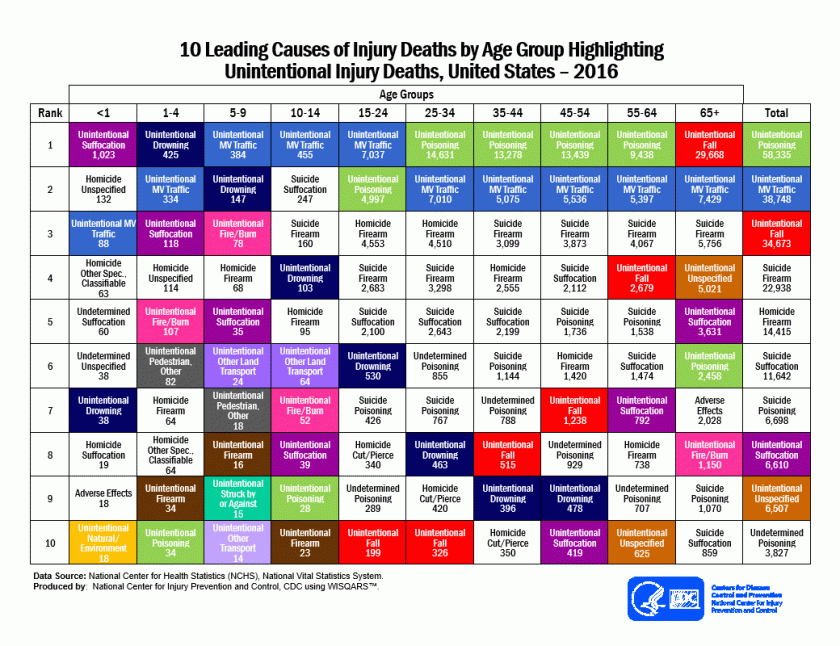
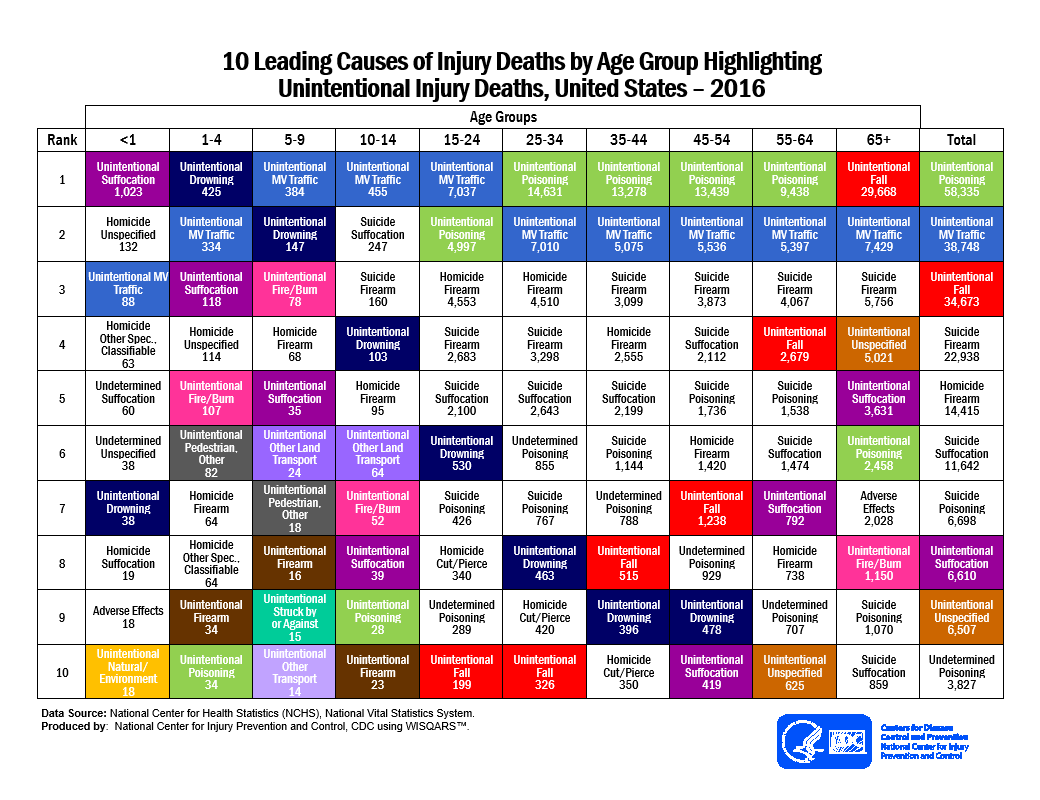
When I was younger I used to tell old guys they shouldn’t climb a ladder and let me do it for them. Now I’m wondering if I’m one of those old guys who shouldn’t climb ladders. I found this very revealing chart at the CDC about causes of deaths by various kinds of accidents. For folks over 65, it’s falling. I hope they don’t mind me copying it here:

leading_causes_of_death_highlighting_unintentional_2016_1040w800h

Notice how “Unintentional Fall” isn’t even in the Top 10 for people under 15? It’s only #10 for ages 15-34. Then it starts climbing up the charts, making #4 for 55-64, and then #1 for 65+. Is there a correlation to declining balance, spatial awareness and reaction times?

I tried to find statistics for bike accidents, but couldn’t.

I’ve been really enjoying biking this year until my bike broke. I was trying to decide if I should get it repaired or buy a new one when I nearly fell off the ladder and wondered if biking was as dangerous as ladder climbing. My biggest worry is falling off my bike and not being hit by a car. I ride in a very safe neighborhood away from traffic. But I’ve occasionally slipped on wet leaves or sand, and I’ve had to do some last minute veering because of squirrels, dogs, kids, and cars backing out of driveways. So far I’ve always recovered without falling, but I’ve had a couple close shaves this year. When I’m zooming along on my bike I’ve often wondered what it would feel like if my 230-pound body flew over the handlebars and smashed into the pavement. Would my blubber protect me? (I do wear a helmet.)

I feel I’m still young enough to bike, but then I recalled three people my age who’ve had bad biking accidents recently. One broke a collarbone when he veered to avoid a woman stepping in front his bike, one who got two front teeth knocked out, had a bunch of stitches, a concussion, and lost 30 minutes of memory so doesn’t remember how it happened, and finally, and one who lost his brakes, hit a sign, punctured his pancreas, damaged his liver, and ended up in ICU for four days.

I love biking for exercise. It’s the only aerobic exercise I can handle. I do have an indoor bike, but it’s not as fun. I thought about getting a 3-wheeler, but I don’t have a garage, and getting a 3-wheeler in and out of the house would be difficult.

Up till my ladder incident, I was thinking I’d bike until I had an accident. But I figured having an accident would only involve cuts and bruises, and maybe a broken arm or leg. Those other bike accidents are making me think that waiting until I have an accident to know when to quit isn’t a great plan.

I had to make my mother stop driving. I’ve had friends that had to step in and make their parents stop driving. I want to believe I’ll know when it’s time to give up car driving, but now I’m getting a taste of that decision with bike riding.

I believe I’m healthy enough to bike ride for many years. But I’m starting to realize that my reflexes are not what they used to be, and my spatial awareness and reaction times are dwindling. I’m trying to place my bet where I don’t seriously injure myself, but I’m not sure of the odds. I wish I could find statistics on biking accidents. What are the common injuries for a 65+ person falling off a bike? I’d gamble on stitches, maybe a broken arm, but I don’t want to lose teeth, and my brain is already acting rather iffy, so I probably shouldn’t risk a concussion.

JWH


How Do You Buy Your Science Fiction in 2018?

by James Wallace Harris, Monday, July 2, 2018

Special thanks go to Chuck Litka for directing me to “2018 SFWA Nebula Conference Presentation” at Author Earningsa website devoted to helping writers find marketing information. This SFWA presentation is a slideshow with an impressive amount of sales data that readers generally don’t get to see. Anyone who writes science fiction, or hopes to be a science fiction writer, should study these slides carefully. Fans of science fiction should find it interesting to know what other fans are buying and how.

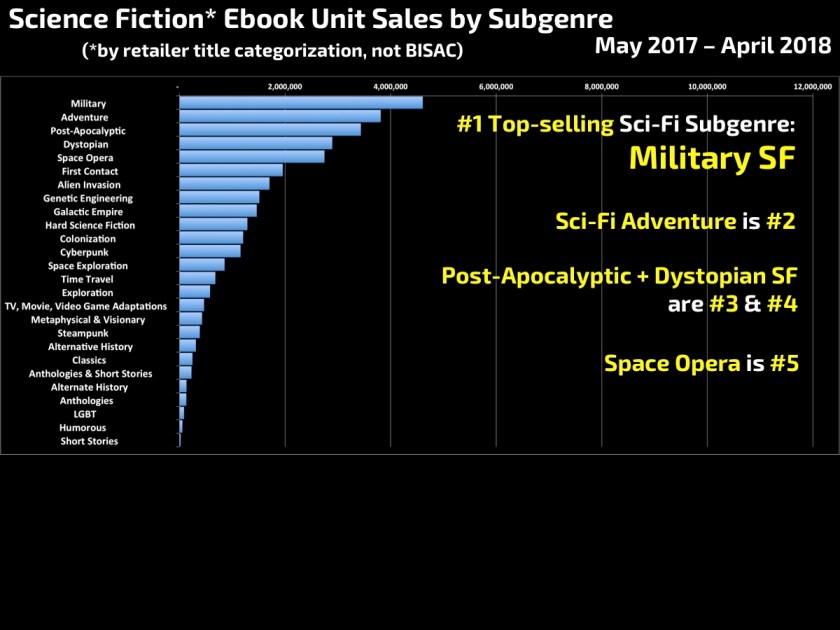
The slideshow by Data Guy is mostly focused on sales numbers, but the slide I liked best is #35 – Science Fiction Ebook Unit Sales by Subgenre. Hope Data Guy doesn’t mind if I copy a couple here.

Slide35

It is disheartening to me that short story collections and anthologies sell so damn little. I’m guessing “Short Stories” means single-author collections. I don’t know why “Anthologies & Short Stories” and “Anthologies” have two separate categories. My other favorite category is “Classics,” and it has sales barely above anthologies.

By the way, “Military SF” is my least favorite kind of science fiction. Growing up in the 1960s I felt like an oddball because I read science fiction. Few people read science fiction before Star Trek and Star Wars. Fans were considered dorks. And when folks did admit they were a science fiction fan, it meant reading science fiction, not watching.

Now I feel like an oddball because I read the least popular kinds of science fiction. Of course, I do love all the sub-genres from “Post-Apocalyptic” to “Exploration.” But I consume them in short stories, novelettes, and novellas. I seldom buy new SF novels anymore. I get the latest Kim Stanley Robinson or the Hugo winners, or the odd SF bestseller like The Martian by Andy Weir. And when I do buy a new science fiction novel, 98% of the time it’s an audiobook.

The impact of audiobooks and ebooks is the main point of Data Guy’s slideshow and the fact that self-publishing is making a huge impact on the genre. Since I’m older, retired, and spend a lot of my reading time consuming mid-20th-century science fiction, I’m not a typical buyer. But it does make me old enough to remember how vastly different book buying was half-a-century ago.

In the 1960s, most science fiction novels came out in paperback. They were mass-market papers, but we didn’t call them that. I don’t think trade paperbacks existed then. At least I don’t remember any. More often than not, paperbacks were purchased from twirling racks in drugstores than bookstores.

Few people bought hardbacks. I joined the Science Fiction Book Club (SFBC) in 1967 to collect cheap hardbacks. They’d weren’t bound in cloth, but a thin vinyl-like plastic. Today collectors prize the paperbacks from this era for their covers. True cloth-bound 1st editions are also loved. But are rare. I often end up with old SFBC editions when I order from ABEBooks. (Or I end up with library discards. That’s another cause for depression, that classic SF is so little read that libraries discard them.)

The first new bookstore I shopped at when I was 16, had three shelves of science fiction books, a mix of hardbacks and paperbacks. It was pretty easy to keep up with the genre, and most of it was reprints. My favorite library then only had 8 shelves of SF books tucked away in a dark corner. I would guess less than 200 SF/F titles were published yearly back then. Today it’s well over 2,000.

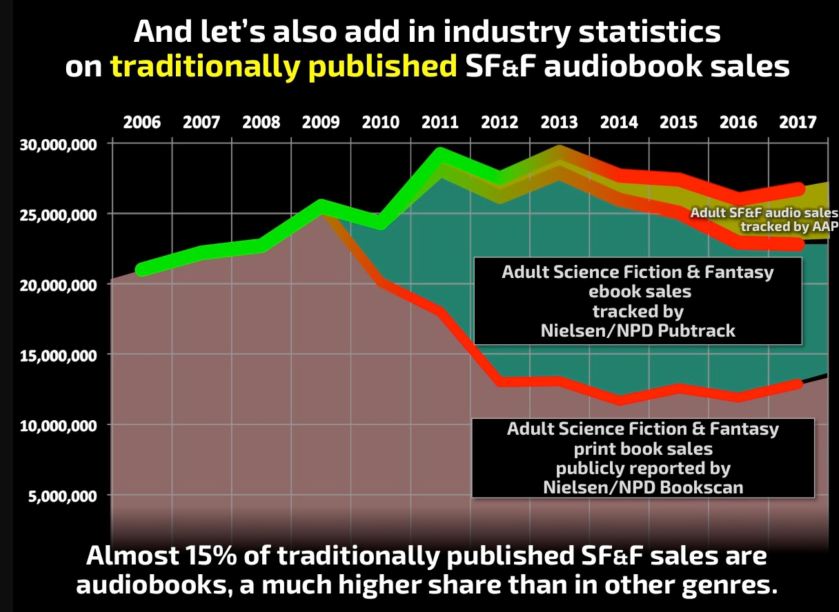
Science fiction selling in hardback is something that’s evolved over the course of my lifetime. I was middle-aged before they started getting on the bestseller lists. My library in 2018 has 8 ranges of bookshelves for SF/F. In recent years we’ve seen more trade paperback editions and fewer mass market books. Now ebooks and audiobooks are wiping out the mass market book and have made a huge dent into trade and hardback sales. See slide #13.

Slide 13

My personal book buying habits reflect this chart, but instead of new print books, half of my book buying is used print books. When buying new books, I’d say 95% are ebooks and audiobooks. The last new print book I bought was Lost Mars: The Golden Age of the Red Planet edited by Mike Ashley, and I had to special order it from England.

I’m now renting more books, via Scribd.com, another distribution type that’s not in the data. I’m reading/listening to books from this service that previously I would have bought as ebooks or audiobooks. And most of the ebooks I buy are the bargain $1.99 editions. I’ve collected a huge library of classic science fiction at that price by watching the daily deals. Generally, any book I really love in audio is one I’ll also buy in ebook. I like having a reading copy for reference and reviewing.

I’m mostly a guy that looks backward to the future. I wonder what young people today who are looking forward to the future are buying? The data in these slides reveal buying decisions in format and sub-genre, but I actually think that view of science fiction has changed.

The futures I hoped for and feared are different from the futures that young people read about today. Readers are reading more fantasy, and much of the science fiction is unbelievable, not based on hard science. I read science fiction in the 1960s hoping it would shape the future, but I don’t think people do that today.

Science fiction has always been an escapist lit but was tinged with hubris. Much of that hubris has faded away. But Data Guy couldn’t document that in his slides. Today, science fiction is more like medical marijuana than project management software. This is why I spend most of my science fiction reading time on the shorter forms. Science fiction writers are more likely to speculate and extrapolate in short fiction than long.

Another area that Data Guy didn’t document is series. Writers are devoting more of their efforts to writing book series. Many of my science fiction reading friends love book series. Series might be comfy books, but to me, they are vast wastelands of words because they have so little science fiction speculation in them. If they have clever ideas, they’re all in the first book.

I wish Data Guy had the numbers on sales by age groups. I wonder how many over-65 science fiction readers are like me – focussed on the past? I’ve recently rediscovered that exciting science fiction is still being written in the shorter forms. It always has, I just lost my way.

My current SF reading involves jumping back and forth from new and old anthologies. The annual best-of-the-year anthologies are new books I do buy, usually in ebook format, but also as audiobooks when they are available. These large collections are actually easier to read electronically.

I wonder how much of the sales Data Guy tracked involved books, ebooks, and audiobooks found in libraries? More and more my library is offering to let me to check out via download rather than visit. To me, Scribd.com is merely a public library where I’m fined $8.99 a month to use.

Finally, one more sad note to contemplate. If book sales move to ebooks and audiobooks, what will collectors collect in the future? You can’t go to musty old bookshops hoping to find lost treasures when they never existed in the physical world to begin with. But there is a practicality to ebooks. The beautiful old paperbacks I find in pristine condition today really aren’t readable. They are collectible, but often they’re too fragile for eye tracks and page flipping. Most of the classic novels of science fiction are easily found today as ebooks, and usually well priced. Audible.com has republished nearly all the classic science fiction novels I grew up reading.

And I’m starting to see more and more classic short stories show up in ebook format. I’ve been collecting Robert Sheckley and Clifford Simak stories that way. What I hope is all of classic science fiction short stories will eventually show up in audiobook too, read by great narrators. That’s how I really love to “read” today.

JWH