by James Wallace Harris, 8/19/24
Composing an essay makes me clarify my thoughts. We don’t think in sentences and paragraphs, but in vague words and images. It’s hard to write a sentence that says exactly what you mean the first time. The act of constructing a sentence helps us find out what we’re thinking.
Every day I watch videos on YouTube, and it’s become obvious that expressing an idea with both words and pictures can convey an idea more precisely. Have you noticed how infographics are being used more often in print and online?
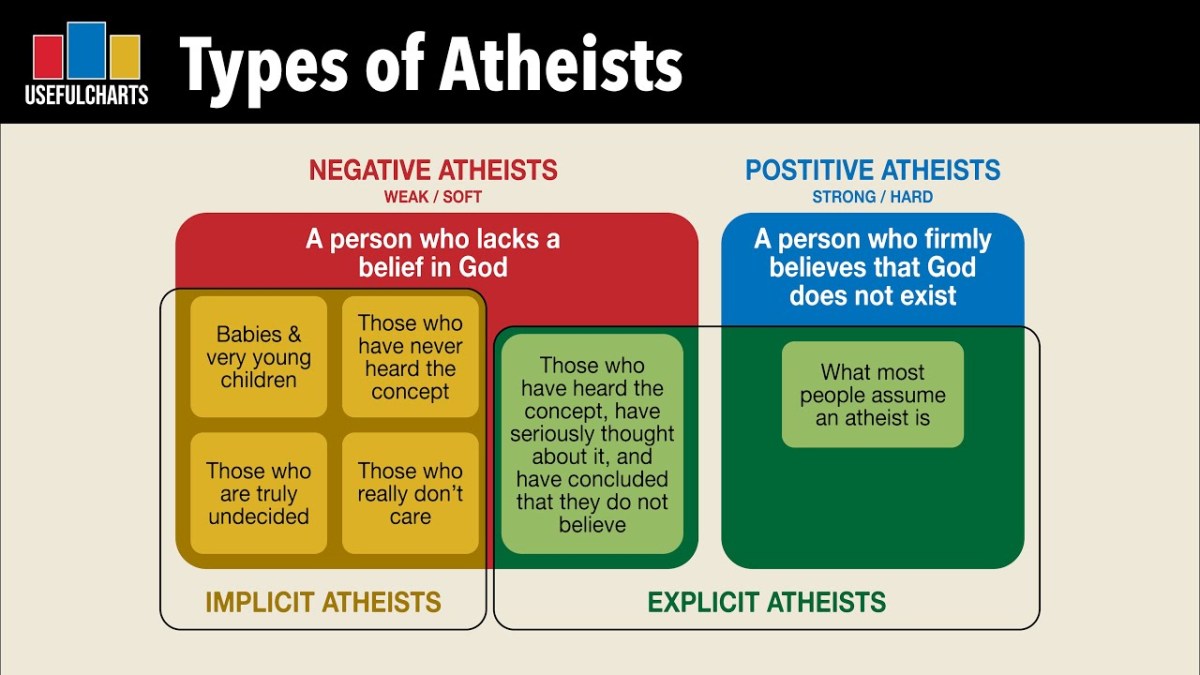
I find this particularly true with the channel Useful Charts created by Matt Baker. Baker’s three videos explaining the types of atheists struct me as particularly clear and insightful. You should watch the series to see exactly what I mean, but I’m going to point out several things he did I thought were particularly good at making his ideas concrete.
I think the chart at the top of the page makes his point far better than if we were to just listen to the video or read the transcript. Of course, if he had written the information in an outline, it might have worked just as well.
- Implicit Atheists – A person who lacks a belief in God
- Babies & very young children
- Those who have never heard of the concept
- Those who are truly undecided
- Those who really don’t care
- Explicit Atheists – A person who firmly believes God does not exist
- Those who have heard the concept, have seriously thought about it, and have concluded that they do not believe
- What most people assume an atheist is.
But if you had to choose which form, words without graphics, or words with graphics, which helped you to see Baker’s points the easiest and fastest?
Later, Baker works to prove that people who think being an agnostic is different from being an atheist are wrong. Agnostic refers to a lack of knowledge, while atheist refers to a lack of belief. By Baker’s definition, most agnostics are atheists.
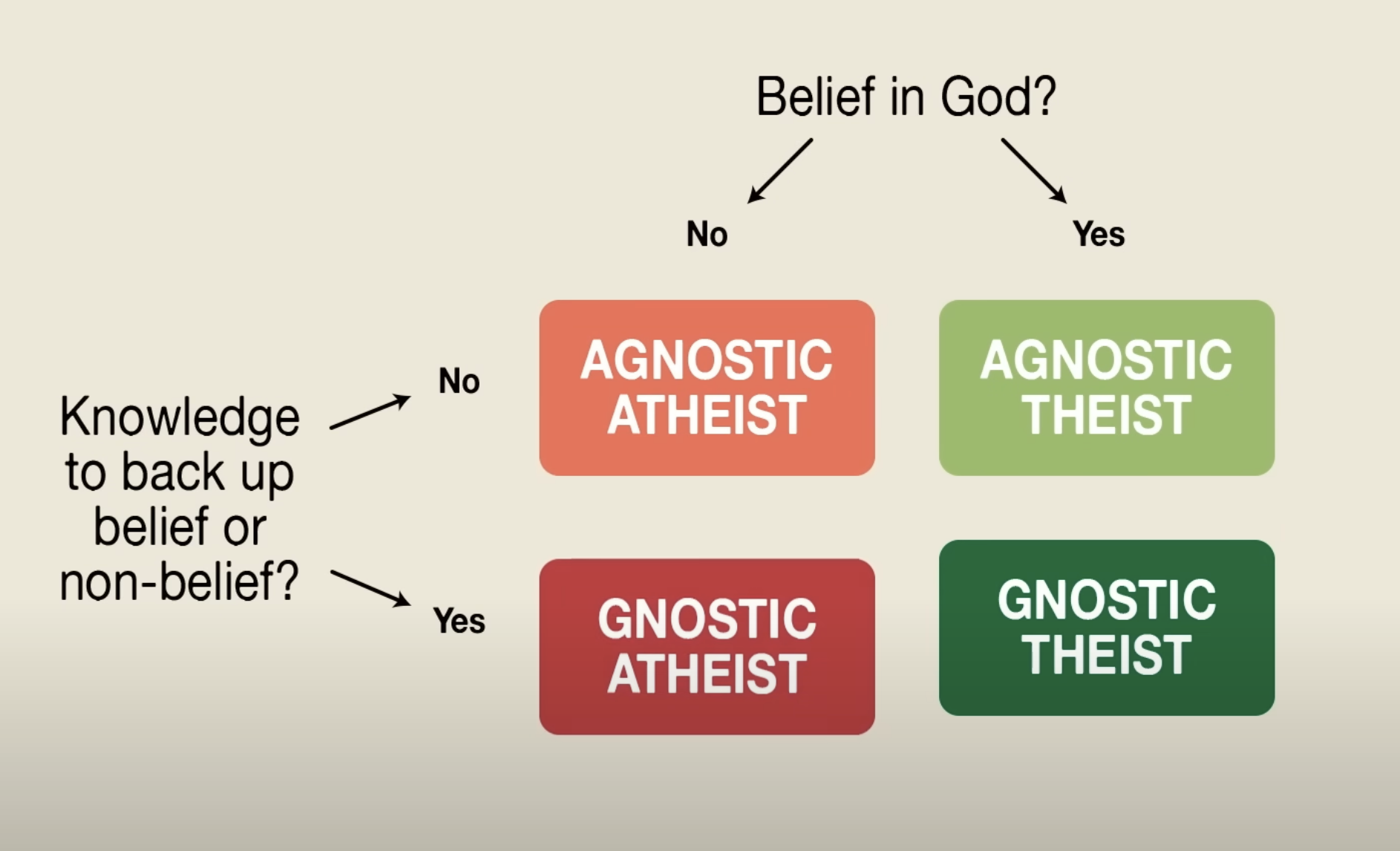
However, as the video progresses, Baker makes a good case that the term atheist isn’t especially useful because it doesn’t convey a worldview. That surprised me. I always tell people I’m an atheist, but Baker is right, the term doesn’t say much. The term atheist only says I’ve rejected the hypothesis that God created reality. It doesn’t say what I believe.
Baker claims that a worldview has three factors, ontology, epistemology, and axiology. From that I see my ontology is naturalism, my epistemology is science and reason, and my axiology is ethics. That particular combination is generally a humanistic worldview.
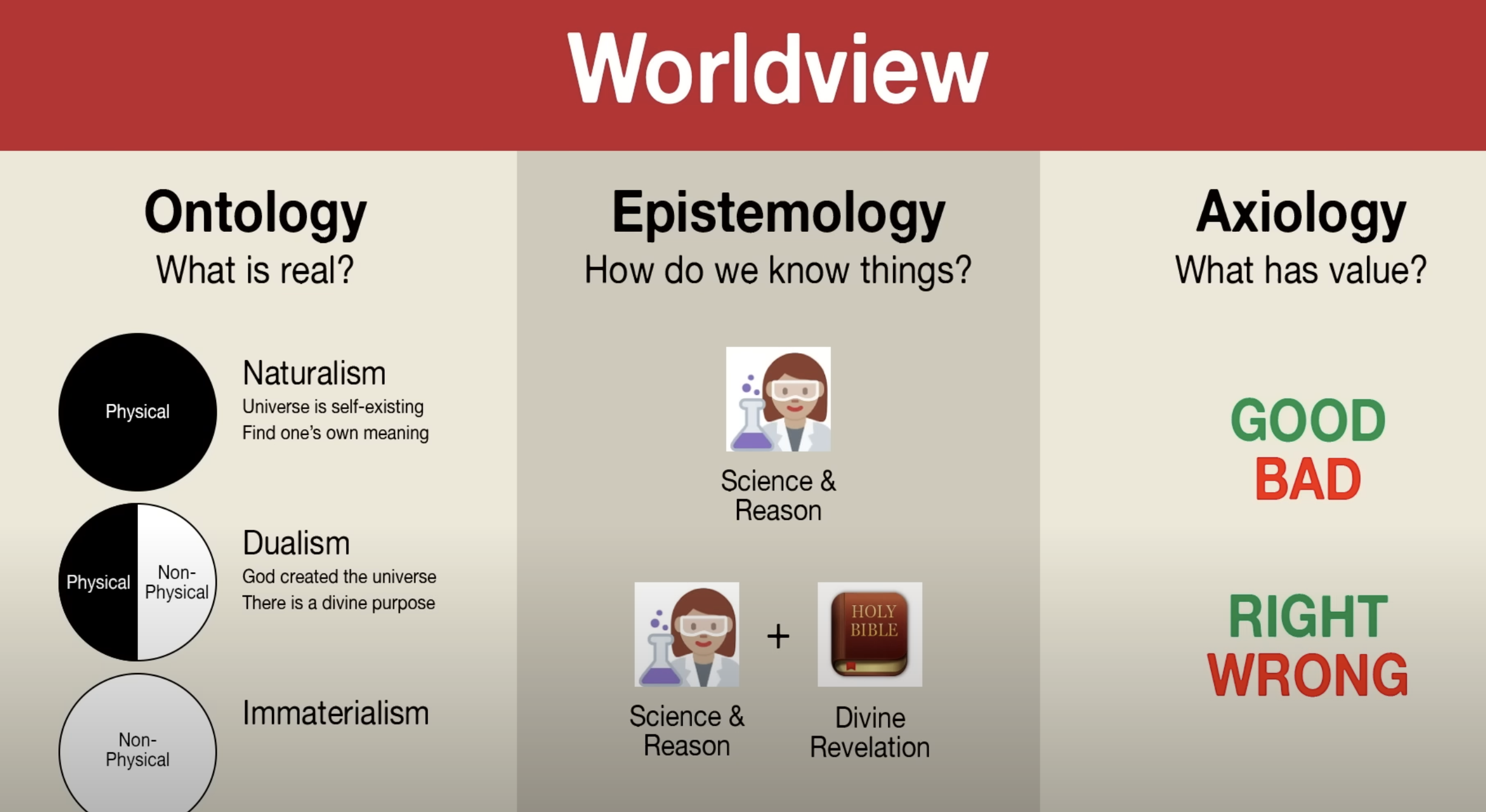
I should not tell people I’m an atheist but say I’m a humanist. But then, if people don’t understand the definitions Baker is presenting in his video, is that term any more informative? Baker goes into explain humanism and its history and says that humanists are naturalists aligned with science and reason interested in improving the world. That gives me a lot to think about.
The worldview image above is a mini lesson in philosophy, but the whole video is a mini lesson in how to classify your feelings about religion and philosophy.
In part 2 of the series, Baker goes into classifying atheists by personality types. For his dissertation he used the Meyers-Briggs classification system. Glancing through his dissertation, the information seems dense. It would take a bit of work to digest it. I bet the three videos explain his research far easier for most people to understand.
I’m left wondering if I should try to write my blog essays with more infographics. Or even try to write a whole essay in infographics.
Baker’s video on explaining atheists is minor compared to those where he explains larger subjects. Here’s his video on “37 Bible Characters Found Through Archaeology.” Don’t be put off that it’s about The Bible. It’s about how we know things. For example, most of the characters in The Bible that we can connect to history were from the Iron Age. And most of the characters that are considered myths come from the Bronze Age. Seeing that laid out graphically is very impressive.
I highly recommend spending some time watching the videos on Useful Charts. It’s making me rethink how to express ideas and concepts. Baker makes a wonderful video comparing commercial DNA tests people use for genealogy.
I was particularly impressed with his video on the “Western Esotericism Family Tree.” It explains a lot about people I’ve read about over the years.
JWH
 Auxiliary Memory
Amazing.
Isn’t YouTube wonderful! I spend way to many hours watching YouTube videos. They’re perfect for someone like me who is curious, lazy, and has a limited attention span. Really, they are what the internet promised to be back in the day – people sharing things that they are passionate and knowledgeable about. I’ve watched, learned, and enjoyed a lot of Useful Charts videos, but I haven’t seen these yet. Thanks for the heads up.