
by James Wallace Harris, 9/13/23
Do you ever think about why you watch movies? Do you ever think about why people make movies? The obvious answer is people want to be entertained and diverted and other people want to make money off those impulses. However, there are filmmakers with something to say, and audiences who want more than to be just entertained.
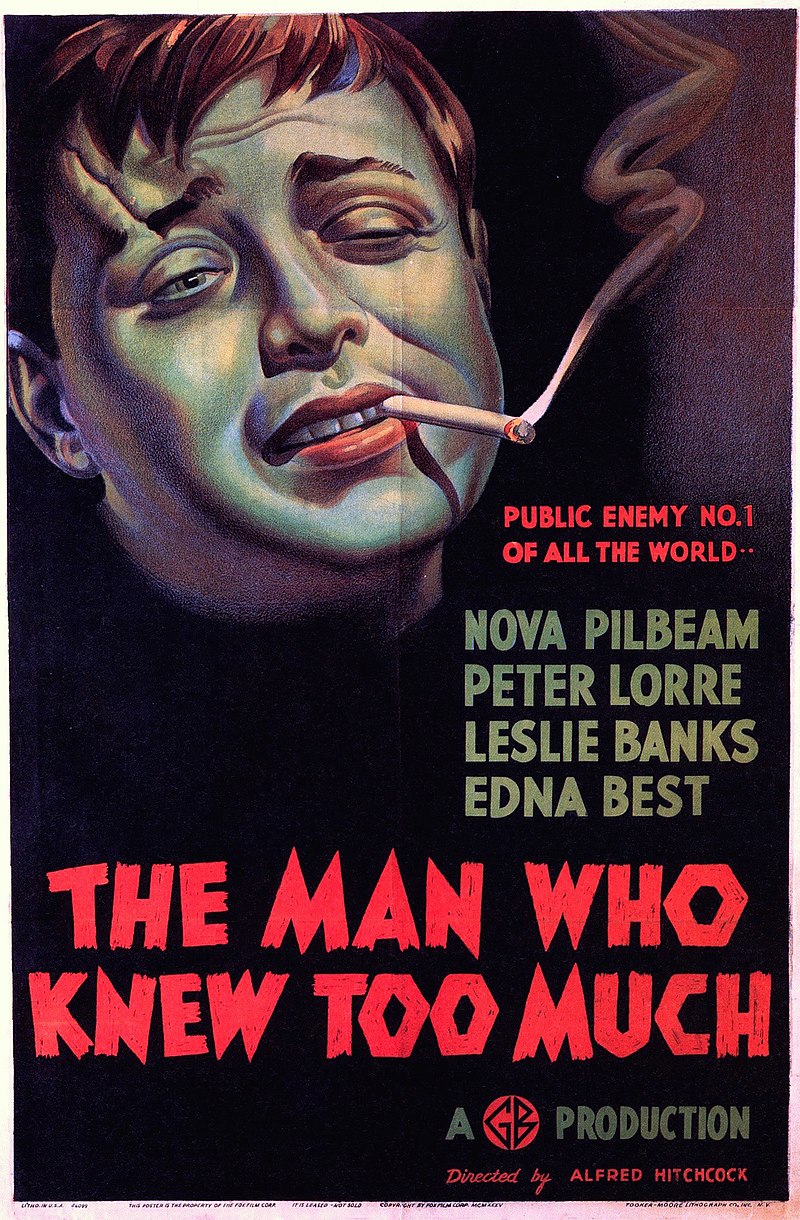
Alfred Hitchcock aims at pure entertainment. I don’t believe his films are philosophical, uplifting, meaningful, spiritual, or have anything specific to communicate. Hitchcock shows an evolution in the artistry over time, and his 1934 film The Man Who Knew Too Much is not as creative as his on 1956 remake. However, I don’t want to compare the two, I want to consider the 1934 film on its own.
The Man Who Knew Too Much is based on book title, a collection of detective stories by G. K. Chesterton. The film uses nothing of the stories.
The plot of the film is basic. Foreign agents plan to assassinate a prominent figure in London. A British couple vacationing in Switzerland with their adolescent daughter intercept a warning for the British consul. The agents kidnap the daughter and tell the couple if they relay the message to the police, they will kill their daughter. The couple return to London where British officials meet them. They have guessed the situation. They tell the couple they must tell them the message or else the assassination could cause a war like WWI. The couple refused, saying they only care about their daughter.
This hostage setup is common in thrillers. Hitchcock uses it clumsily. The criminals are willing to kill anyone at any time. Why didn’t they just kill the parents and leave the child? And why do the parents find the criminals almost instantly, faster than the police? And what’s with the silliness of the dentist scenes? Or the silliness of the cult of sun worshippers (nudists)?
Hitchcock switches between humor, violence, humor, violence, throughout the film. And for modern audiences, the stage and special effects are crude. They are on par with movies from 1934, but most modern film viewers won’t know that.
Hitchcock has said he was an amateur filmmaker when he made the 1934 version of The Man Who Knew Too Much, but a professional when he made the 1956 version. To me, the only reason to watch the 1934 version is if you want to have seen all of Hitchcock’s films.
My favorite film of 1934 is Treasure Island with Wallace Beery, Jackie Cooper, Lewis Stone, and Lionel Barrymore. Even still, most modern movie watchers will find it crudely made. Treasure Island is superior to The Man Who Knew Too Much in every way, plot, acting, costumes, sets, and special effects, but Treasure Island probably had five times the budget, and was made in Hollywood. The Man Who Knew Too Much is more comparable in quality to Charlie Chan in London from 1934.
The best thing about The Man Who Knew Too Much (1934) is Peter Lorre. He couldn’t speak English yet and had to memorize his lines phonetically. He’s not particularly evil or menacing in this film, but he does stand out as a fun bad guy.
However, as I watch these Hitchcock films, I’m disappointed that they never try to rise above just being thrilling or funny. They give no sense of place, history, or society. They offer no psychological insights. Later Hitchcock films offer style, but not this early one.
Comparing it to Rebecca made just six years later in 1940, but in Hollywood, Hitchcock shows a tremendous evolution in filmmaking. It offered so much more, but then Rebecca was based on an impressive book. Then six more years, in 1946 Hitchcock made Notorious, which I found problematic. It wasn’t based on a book and the plot seemed silly.
My current hunch is Hitchcock on his own or working closely with a screenwriter, focuses on pushing just a few kinds of emotional buttons. He likes to create suspense and tension and uses comedy to keep things within control. That’s what we see in The Man Who Knew Too Much (1934).
It’s okay if that’s what you like, but I wanted more.
JWH
 Auxiliary Memory
Many thanks for this feature, as always, Jim! I haven’t seen the movie or read the book by Chesterton, but I read another book by him–The Man Who Was Thursday, a fascinating work which is nominally a detective story, but verges on fantasy, even surrealism. It might make a good movie by Tim Burton or Guillermo del Toro.
I’ve read THE MAN WHO WAS THURSDAY, and it is a strange little tale.