Have You Ever Wanted to Paint?

by James Wallace Harris, 9/27/23

I spend my days grazing on ideas. I listen to music, watch television or movies, read books, articles, or short stories, look at art books, browse the internet, read history, study popular science, and consume a lot of YouTube videos. All of it is about idea processing.

For breakfast, this morning I read “Painting of Hannah” by Lan Samantha Chang in the September 2023 issue of Harper’s Magazine. Follow the link if you want to read the story too.

“Painting of Hannah” is a short story about a young American, Jacob, studying art in France. Jacob stays at an atelier, apprentice to Thomas Gaugnot, a master painter who is trained in the naturalist technique, a student of Rennes, who was a student of Renoir, with a lineage all the back to Leonardo.

Gaugnot comes across like a Zen master, not saying much but tricking Jacob into seeing. Jacob must sacrifice both his ego and his desire for the beautiful artist’s model, Hannah, who he paints every day. Hannah, a young woman, lives with the older Gaugnot, and is Gaugnot’s muse. Gaugnot tells Jacob:

“They say my technique is obsolete,” Gaugnot said. “That is true. It is secret. It became a secret because no one cared. The attention of the world turned away from this kind of painting, what you call naturalism. You—­” His gaze pushed Jacob back; the chair creaked. “You are here to learn the techniques of this secret.” He smiled a small, triumphant smile. “You think it is romantic.”

We watch as Jacob learns to see. I’ve made a few lame attempts to learn to draw, but I’ve never stuck with it. I’ve even had some classes. I’ve learned with a few hours of work I can show some improvement, but I know becoming an artist takes years. That’s why I gave up, but that was lame of me.

I have several friends who are currently studying various kinds of painting. I admire them for not giving up. You don’t have to compete with John Singer Sargent to enjoy learning to draw and paint. You don’t have to move to France and study with a master for years. Ten thousand hours might make you a master, but thirty hours is enough to produce amazing results. Yet knowing that doesn’t allow me to apply myself at learning to draw. I hate that.

I wish I had that discipline because what I really want is to learn to see like an artist. That’s what the story hints at. That us ordinary folk are blind to most of the visual world. Gaugnot pushes Jacob into seeing what’s in front of the rest of us that we ignore.

The human eye can only see a tiny portion of the visual spectrum or hear a sliver of the audio spectrum. and there are other wavelengths of electromagnetic spectrum that are even beyond our senses. So, it’s a shame we don’t even make the most of what we can perceive.

Evidently, learning to paint means learning to see what we’ve never bothered to look at. I like that. I like that because that’s what I do all day long with my information grazing.

I feel reading and watching helps me discern finer shades of ideas, and learning to write is learning to paint with words. Writing these blogs is learning to see more into the spectrum of language.

But I wonder about Gaugnot and Jacob. They learn to put what they see on a canvas, but do we see what they saw when looking at their paintings? We might see beauty but without understanding the insight. And if I read something written by someone discerning something specific in the reality of ideas, can I discern it too by reading their writing? Or is it only telling me that I need to go look for myself?

There was something in this story, “Painting of Hannah” about Nietzsche that intrigued me. It was the concept of “Eternal return.” It hints at a Groundhog Day existence. That’s the thing about learning to discern all there is from the firehose of information we live with daily; it would take several lifetimes to learn how to perceive everything. Are we Bill Murray living the same life over and over? Are the Hindus right about reincarnation?

I don’t think I’m coming back, so I want to distinguish details as I can before I die, both visually and cognitively. I wonder if I shouldn’t study drawing again. Would the discipline I got from learning about light also apply to studying the perception of ideas?

All my life I’ve wished I had more self-discipline, but if a genie from a magic lamp offered me three wishes, what would be the downside if I asked for more discipline? There’s always a downside in those tales. Maybe I’ve already been granted that wish and I’m living the existence of eternal return.

Tonight, I might snack on “Painting of Hannah” again and reread the story before I go to bed. Reading short stories is like learning to paint, you must keep looking to see everything.

Tomorrow I will wake up and find something else to inspire me for the day. Jacob worked on the same painting daily for months. Is that the key? Maybe I should stay with one concept for months. Maybe the secret is not accumulating more information but studying the same information repeatedly.

JWH

Hitting a Cognitive Barrier

by James W. Harris, 9/24/23

I crashed into a cognitive barrier trying to write my reactions to The Trouble with Harry and To Catch a Thief, two Alfred Hitchcock movies from 1955. After two drafts I realized I wasn’t getting where I wanted to go. I know I don’t want to write movie reviews — the perfect place to find them is Rotten Tomatoes. Nor did I want to describe a film — just go to Wikipedia or IMDB. I wanted to write an essay that captured what I got out of watching those films at age 71.

Time is running out, so I need to make the most of every experience. That involves understanding myself at a deeper cognitive level. One I’m finding harder to reach as I age. On the other hand, aging is giving me more wisdom. The cognitive barrier is being able to express what I’m learning by getting older. But aging is also wearing down my brain. What one hand giveth, another takes away.

Writing is thinking outside of the head. Thoughts are generated inside the head from emotional reactions. Thoughts are fleeting. Thoughts are like cream stirred into coffee, creating little patterns that quickly dissipate. Writing is about capturing that initial pattern and making sense of it by showing how it relates to the memories of millions of past patterns.

Very few people can describe exactly how they feel, and few of those people can explain why they feel the way they do. There are rare individuals that can compose their thoughts inside their heads and eloquently convey the results in speech. Most of us need to think outside our minds via writing and editing.

Even when we feel our written words are clear, readers seldom find clarity. Communicating with words is difficult at best and often impossible. What we think we’re expressing can often take a different path to each reader like those spaghetti strings we see in hurricane reports. I might believe I’m writing about Jacksonville, while some readers think I’m writing about Bermuda while others Miami and Charleston.

I enjoyed The Trouble with Harry better than all the other Hitchcock films we’ve watched this month, including Rebecca, Notorious, To Catch a Thief, and Strangers on a Train, films most critics admire a great deal more. However, I thought The Trouble with Harry had many flaws, but then Hitchcock is a flawed filmmaker.

How can I admire a movie that doesn’t measure well against the best movies I’ve seen over a lifetime? This gets into complexity and even multiplexity. I need to relate several reactions that contradict each other. The three films I admired and enjoyed the most this month have been The Trouble with Harry, Twelve O’Clock High, and Mr. Belvedere Rings the Bell. All three were feel-good movies to me, but they each made me feel good in a unique way. Is the word “feel-good” even useful? Many moviegoers might interpret the term “feel-good” so differently that these three movies would not fit their definition.

Should I even use the term? Shouldn’t I just describe exactly what I felt? Will that be clearer?

In my second draft I had a breakthrough. I realized to understand how I react to films I’d need to understand what I expected from them. But my expectations have changed widely over the years. And will my readers have the same expectations? It was then I realized that what I’m expecting from movies at 71 is different from my younger self. Even describing my own emotional experiences is a moving target. But explaining why that’s so hits another cognitive barrier.

I need to think about that.

Putting everything into words precisely is so difficult. Should I even try? I believe most people don’t because all they value is personal experience. Why tell anyone about our perceptions when they have their own?

Do you see why writing that essay became such a black hole?

JWH

Books Do Furnish a Room by Anthony Powell

by James Wallace Harris, 9/16/23

Books Do Furnish a Room is book ten in Anthony Powell’s series A Dance to the Music of Time covering the years 1945-1947 in the fictional life of Nick Jenkins. After the war, England is rebuilding, food is rationed, liquor is scarce, and Nick is trying to make a living by reviewing books. I’ve read in Powell’s biography, Anthony Powell: Dancing to the Music of Time by Hilary Spurling that Powell was reviewing as many as twenty books a month to make ends meet. Sometimes I wish that A Dance to the Music of Time was a series of memoirs rather than novels because I’d love to know the basis for all the satire in Nick’s life.

For instance, two of the main characters in Books Do Furnish a Room are Pamela Widmerpool and X. Trapnel. Powell supposedly based them on Barbara Skelton and Julian Maclaren-Ross. They aren’t nice characters either. Pamela is a notorious emasculator of men, yet men can’t resist her. Trapnel is a talented posser who sponges off everyone he meets. Pamela is married to Kenneth Widmerpool, a character who is in all twelve novels of the series.

Nick met Widmerpool at school, where he was despised by the other boys for being fat, poor, and a loser. Yet throughout the novels, Widmerpool keeps climbing higher on the social ladder until he’s a member of Parliament. It is quite strange that he ends up with Pamela, an extremely beautiful woman.

Books Do Furnish a Room is about Fission magazine that Nick, Kenneth, and X. Trapnel all write for. It was backed by Erridge, Earl of Warminster, Nick’s brother-in-law, who dies at the beginning of the story. One of the founders of Fission is J. G. Quiggin who has been in earlier novels and is a Marxist. In fact, many of the characters in these books are left leaning. Powell suggests England was full of fellow travelers, communists, and Marxists, even Kenneth Widmerpool.

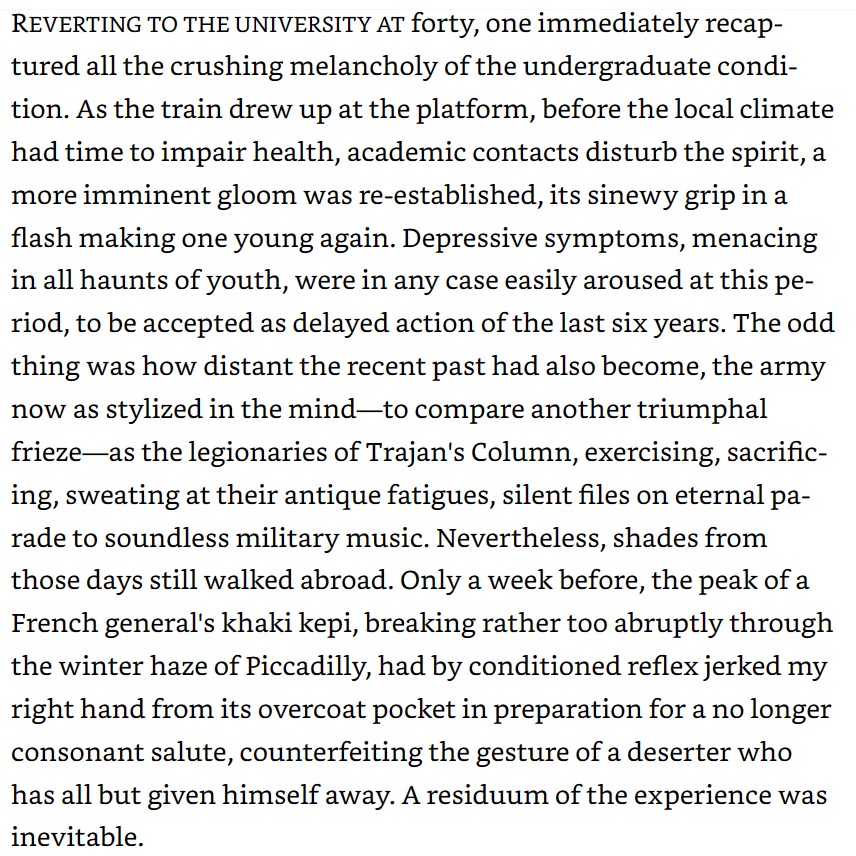
The hardest thing to describe about this story is the humor. It’s very dry. I remember hearing Powell’s prose being described as a cross between Evelyn Waugh and P. G. Wodehouse. In one of the opening scenes Pamela flees a funeral service during a bout of nausea, almost knocking down the pallbearers of Erridge. Later she vomits into a five-foot tall Chinese vase that may or may not be rare, and there’s a funny seen of several men trying to wash it out. But Powell’s slapstick scenes are rare. Most of his prose is like the opening paragraph:

Books do Furnish a Room begins the final trilogy of books in A Dance to the Music of Time, and it deals with the academic and literary world. The story begins with Nick meeting Sillery, his old school master again. Nick is also researching a book he’s writing on The Anatomy of Melancholy, a 1621 book by Robert Burton. This was a real book, and maybe if I knew it better, it might relate to this story. Throughout Books do Furnish a Room, Nick mentions many books, most of which are fictional. It’s a challenge to discern references to real works and works that belong only in Nick Jenkins’ reality. The most important made-up novel is Camel Ride to the Tomb by X. Trapnel. In the eleventh novel, Nick meets Trapnel’s biographer, so its importance stretches over two books.

There was a 1997 4-part miniseries based on A Dance to the Music of Time. You can get them on YouTube. It’s quite a rush job to cram twelve novels into four TV episodes that are less than two hours each. However, they do cover the highlights of the entire series. I’ve seen it twice and I’m watching parts of it for a third time. You can get a feel for Books Do Furnish a Room by watching the first third of this episode. (By the way, the actress that plays Pamela looks nothing like how I imagined her from the novel. But the scene I mentioned above is in this sequence.)

JWH

What is Education in Old Age?

by James Wallace Harris

Is grazing on knowledge the same as an education?

I regularly read nonfiction books, watch news shows and documentaries, and read informative magazines, but is that getting an education? What exactly is an education?

When we are young, we go to school. We have the goal of graduating high school. A high school degree claims to give everyone a well-rounded basic education. After that we can seek a college degree because we’re told it will raise our status in society. Then we’re enticed to take graduate degrees with promises of better jobs and prestige. And for those people who didn’t go to college, earning technical certificates tempts us with more money and better job titles.

Education was related to specific goals. Is it the goal that defines an education? Let’s say you play chess. Is studying chess to beat your friends an education? What about studying chess to become a Grand Master? I think there must be a difference between learning and getting an education.

Next month with be my tenth anniversary of retiring from work. Before I retired, I thought I would have goals for my life after work. It hasn’t worked out that way. It’s been one long downward slide into inactivity. Having to go to school, college, and then work, imposed goals on me. Susan and I have minimum demands on us – stay healthy, don’t get sick, keep up the house, pay the bills, and take care of each other. It’s all about maintaining, there’s no planning for the future.

Before I retired, I thought I’d get a master’s degree in computer science, or some other subject in my free time. But after I retired, going back to school seemed pointless. Do we only go to school to get a job?

Why do I need an education if I’m not going to use it in some way? We talk about life-long learning, but is that the same as an education? I’m learning new things every day, but I don’t think that’s an education.

Because I love reading books written by English authors, I could make that into a goal of getting a master’s degree in English literature. The Wizard of Oz gave the Scarecrow a diploma to prove he had brains. Would that be meaningful to me now that I’m old?

Chess players use various rating systems to rank themselves. It’s mainly used for arranging matches in competitions, but it allows players to judge the depth of their knowledge.

I like to think I know a little bit about English literature, but I have no idea how much I know. What if there were standardized tests that measured knowledge of English literature and ranked the test takers, would that be meaningful stimulus to get better educated? Would learning to compete in rankings be an education?

Most people think of themselves as knowledgeable about their favorite subjects and hobbies. What if there was a way to rank that knowledge? Earning a living is the incentive for most people to go to school. Could competition be another incentive to seek an education? What if there were more than just Pub Trivia contests to prove our knowledge in old age?

I’ve thought about studying math in my old age to see how much I’m capable of still learning. I got on the Khan Academy right after I retired and discovered I had forgotten nearly all the math I had taken in school and college. I had to start over with grade school mathematics. I gave up while still taking lessons at the fifth-grade level. I gave up because I didn’t feel like I needed what I was learning. However, I’ve been wondering lately if I could get further just to prove I was still able to learn at 71. Is that another incentive to get an education late in life?

There are subjects that I should study in old age. Things like how to use the healthcare system, where to invest my retirement savings, household maintenance for future climate change, how to live with failing bodies, or financially planning for death. Most of us just fumble our way through these things. What if there were degrees to earn in these topics, or ranking systems to measure our progress?

It seems to be an education is some kind of validated learning for a purpose. Since so many of us are getting old, maybe society needs to develop educational systems for the last third of life.

JWH

Strangers on a Train (1951)

by James Wallace Harris, 9/13/23

Annie and I got together this afternoon to watch our second Alfred Hitchcock film together, Strangers on a Train. Of the four Hitchcock films I’ve seen this month, it’s the one I liked best by far. See my reactions to Notorious, Rebecca, and The Man Who Knew Too Much. I say reactions, because these essays aren’t reviews, they chronicle how I felt and come with spoilers.

I had some problems with Strangers on a Train, but this 1951 film showed Hitchcock had evolved creatively since Notorious in 1946. Visually, it was much more exciting, and the plot was far more believable — until the end. The acting felt deeper too.

Tennis star Guy Haines (Farley Granger) is recognized by a fan, Bruno Antony (Robert Walker) on a train. Bruno comes on very friendly and forward, and admits he knows a lot about Guy because of what’s in the newspapers. Bruno knows Guy is married and wants a divorce so he can marry Anne Morton (Ruth Roman), a daughter of a senator. Eventually, Bruno tells him his theory of how to get away with murder. He offers to kill Guy’s wife if Guy will kill his father. He says each of them won’t be a suspect because neither will have a motive. Guy thinks Bruno is nuts and goes on his way.

But Bruno does kills Miriam Joyce Haines (Kasey Rogers) assuming he and Guy had a deal. The film hits high gear when Guy learns his wife has been murdered and Bruno starts pestering him to fulfill his part of the bargain.

This is a perfect setup for a Hitchcock film. It’s based on a 1950 novel of the same name by Patricia Highsmith, which has a significantly different plot. It’s a psychological thriller, and the reason the film Strangers on the Train is so good. Of the four Hitchcock films I’ve seen this month, two were based on successful novels, Rebecca, and Strangers on a Train. From my small sample, I assume Hitchcock creates his best work from a tightly plotted story. The two other films, The Man Who Knew Too Much (1934) and Notorious felt like they were a succession of scenes that tied together a plot but weren’t tightly integrated into a seamless interconnected whole. The two films based on books were both brilliantly plotted.

Bruno is a realistic portrayal of a psychopath. His character is quite believable, living in his own fantasy reality. The idea of Bruno shanghaiing a sane person is fascinating, and believable. I wish Strangers on a Train had maintained that believability until the end. Unfortunately, the plot derails when Guy and Anne hatch a plot to catch Bruno planting evidence.

Hitchcock loves generating tension, but I thought the tension turned up too high at the end, and the action sped up too fast with it. The whole rushed tennis match didn’t work for me. And I thought the Merry-Go-Round scene was silly. The Merry-Go-Round went too fast to be believed, and seeing it crash to pieces hurt the whole experience. I figured Hitchcock wanted a BIG climax, but it was too big.

I wish the realistic pacing had stayed constant throughout. The film lost control of the characterization. Even the cinematography fell apart as the pacing increased. I have not read the Highsmith novel, but I might. From what it says on Wikipedia it’s a much different story.

After Annie and I finished with Strangers on a Train, we watched two little shorts about Hitchcock that were quite informative. I have a feeling that the more I learn about Hitchcock the more I’ll like his movies. I also expect to be more forgiving of his films when I rewatch them. There’s a chance that I need to learn how to watch Hitchcock.

Even though I’m complaining a lot about the Hitchcock films we’re watching, I ended up buying two collections of his films. This gives me twenty of his most famous films to study. Many of Hitchcock’s films are on YouTube. TCM showed several of them this week. And many are available for rent on Amazon Prime. The Blu-ray box set was exceptionally nice with its packaging and extras.

JWH