by James Wallace Harris, 12/8/22
I almost became a librarian. This was a long time ago. What kept me from that career was having to move to another city to get an MLS degree. Susan and I had been married for a few years, and we didn’t want to move. I worked in the Periodicals Department at Memphis State University (now the University of Memphis). I was a Periodicals clerk, which was an hourly position. I was working on my English degree and taking some undergraduate courses in library science in a program designed to produce librarians for K-12 schools. I didn’t want to work in a school, but at a university, and most universities require a Master’s of Library Science. In fact, my university required an MLS to get the job, but a second master’s in a useful subject to aid in working in a library to keep the job. This was also true of the public library at the time. And even with two master’s degrees, the pay would never be much, but I’d work in the environment I loved best.
Instead, I took a job at the College of Education setting up their network and creating a student database system to track student teaching experience. I worked there for the rest of my life, but I’ve always wished I had gotten that MLS degree and spent my 9-to-5 life in a library. When I was young I worked at the Memphis Public Library for a few months, and later at the university library for six years. I love periodicals. And I love how magazines have become available on the internet as digital scans. I have quite a collection of them. I believe my compulsive acquisition of books and magazines is caused by a gene for librarianship.
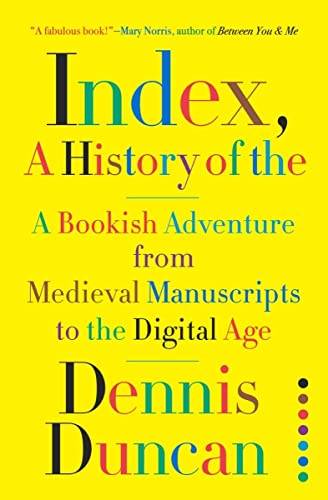
Reading Index, A History of the: A Bookish Adventure From Medieval Manuscripts to the Digital Age by Dennis Duncan has brought back my desire to work in a library. I’m not sure I can recommend this book to everyone, but if you love books and libraries it might be for you. Its subject is somewhat esoteric. Did you know that the idea of alphabetizing had to be invented? That made me wonder who came up with the idea that letters of the alphabet should have an order? Duncan didn’t cover that.
Books haven’t always been like the books we read today. When books were scrolls they didn’t have covers or even titles. A book might be written over several scrolls of paper, so if you had a bunch of scrolls, finding the one you wanted, and the part you wanted to read, could be very difficult. So early librarians started tying the scrolls together and putting them in bins. Then they learned to glue little tags of paper to the end of scrolls to identify what was in the scroll. That’s the beginning of the index. As I said, this book won’t be for everyone, but if you have the library gene it might.
What most people think of as an index, that section of the book at the back with a list of keywords and page numbers wasn’t invented right away either. When books began to be printed people got the idea of helping people find specific places in them, and the index as we know it was born. At first, the index was published separately. Then when they started being published with the book they were put in the front. It took centuries before they standardized on placing the index in the back of the book.
David Duncan’s book is mostly an amusing look at all this. He was especially delighted by discovering what I call index wars. For example, Richard Bently satirized a 1695 book by Charles Boyle by publishing an index that ridiculed Boyle’s book by how he indexed the keywords. This led to all kinds of indexing shenanigans including dirty politics. Duncan found quite of bit of indexing history in the line, “Let no damned Tory index my History!” by Whig historian Laurence Echard whose three-volume History of England was indexed by Tory sympathizer John Oldmixon.
Another bit of off-the-road history Duncan discovered was that very scholarly accused the lesser scholarly that their poor thoughts were due to reading just the index rather than the whole book when composing their writing. That’s because indexers use to put more information into their indexes.
Duncan shows many photographs of the fine art of indexing satire but it’s hard to read them because they were being written at a time before standardized spelling. Luckily he translates historical English into modern English. And the historical humor has become very dry. You’ve got to enjoy a good three-hundred-year-old in-joke to really appreciate this book, but Duncan is good at explaining them. Sometimes the humor was as crude as the silliest of Saturday Night Live skits.
Duncan eventually works his history through the centuries up until the age of Google and online indexes. This is where I wished I had worked, using computers to organize information, periodicals, and libraries. In a way, our website Classics of Science Fiction is a kind of index. We index the popularity of science fiction short stories and novels. I’m all the time thinking of things I’d like to put into databases that deal with books and magazines. Reading Duncan’s book showed me there have been bookworms with the same kind of bibliographic urges for thousands of years.
But Index, A History of the also inspired two very specific librarian-type desires. The first was triggered by Duncan’s coverage of The Spectator, a very influential publication.
Many of the journals of the eighteenth century fall into this intermediary zone, and none more so than the Spectator. Founded in 1711 – and no direct relation of modern magazine of the same name – the Spectator was a cheap, daily, single-sheet paper that featured brief essays on literature, philosophy or whatever took its writers’ fancies. Its editors were Richard Steele and Joseph Addison (whom we met in the last chapter having his Italian travelogue mauled by ironic indexers), and, although it ran only for a couple of years, it was immensely popular. The Spectator started off in a print run of 555 copies; by its tenth issue, this had ballooned to 3,000. This, however, was only a fraction of the true readership. The editors claimed that there were twenty readers to every copy, and deemed that even this was a ‘modest Computation’. The Spectator was a paper designed for the emerging public sphere, a conversation piece to be read at ‘Clubs and Assemblies, at Tea-tables, and in Coffee-Houses’.2 A paper to be read and passed on.

What’s more, the Spectator was only the best known in a long list of similar sheets. The Tatler, the Free-Thinker, the Examiner, the Guardian, the Plain Dealer, the Flying Post – papers like these were able to capitalize on a perfect storm of rising literacy rates, the emergence of coffee-house culture, the relaxation of formerly strict printing laws, and a growing middle-class with enough leisure time to read. The eighteenth century was gearing up to be what scholars now call the age of print saturation.3 That term saturation has some interesting suggestions. Certainly, it implies excess – too much to read – but also something else: too much to keep hold of, a new disposability of printed matter. Our poor, abused quire of paper was born at the wrong time. Flicking through original copies of the Spectator preserved in the British Library, one certainly sees the signs of coffee-house use. You won’t find stains like this in a Gutenberg Bible. And yet the essays are among the finest in English: wryly elegant, impeccably learned. If you had bought the paper for self-improvement you might well want to come back to it.

And so it was that the news-sheets found themselves being republished, almost immediately, in book form. These editions, appearing within months of their broadsheet originals, anticipated how the kind of reader who would want the full run of the Spectator would want to use it: not simply as a single sheet – a single thought – for a few minutes’ entertainment with one’s coffee, but as an archive of ideas that one might return to. Benjamin Franklin, for example, describes coming across a collected edition of the Spectator as a boy and reading it ‘over and over’, jotting down notes from it and trying to imitate its style in his own writing.4 The movement from coffee-table to bookshelf implies a different mode of reading, one of reference, reuse, of finding the thought, the phrase, the image, and bringing it into the light again. If the Spectator was to be a book it would need an index.

The indexes to the early volumes of the Spectator, along with those of its older sister the Tatler, are a joy in themselves, full of the same ranging, generous wit as the essays they serve. Rifling through them, a century later, Leigh Hunt would compare them to ‘jolly fellows bringing burgundy out of a cellar’, giving us ‘a taste of the quintessence of [the papers’] humour’.5 Who, indeed, would not want to sample more after reading a tantalizing entry like ‘Gigglers in Church, reproved, 158’ or ‘Grinning: A Grinning Prize, 137’ or ‘Wine, not proper to be drunk by everyone that can swallow, 140’. The Tatler, meanwhile, offers us ‘Evergreen, Anthony, his collection of fig-leaves for the ladies, 100’, or ‘Love of enemies, not constitutional, 20’, or ‘Machines, modern free thinkers are such, 130’. Elsewhere, two entries run on together, oblivious to the strictures of alphabetical order:

     Dull Fellows, who, 43
     Naturally turn their Heads to Politics or Poetry, ibid.

There is something at once both useless and compelling about these indexes. Is ‘Dull Fellows’, listed under the ds, really a helpful headword? Of course not. But it catches our attention, makes us want to find out more. This is as much about performance as about quick reference. Each entry is a little advertisement for the essay it points to, a sample of the wit we will find there. The Tatler and Spectator indexes belong to the same moment as the satirical indexes we saw in the last chapter, but unlike William King’s work there is nothing cruel or pointed about them. Instead, they are zany, absurd, light. ‘Let anyone read [them],’ declares Leigh Hunt, ‘and then call an index a dry thing if he can.’ The index has made itself at home in the journals of the early eighteenth century, adapting to suit their manners, their tone. Moreover, it signals the elevation of these essays produced at a gallop for the daily coffee-house sheet to something more durable, to a format that connotes value, perhaps even status. At the midpoint of the second decade of the eighteenth century, the index is primed to offer the same sheen to other genres, to epic poetry, to drama, to the emerging form of the novel. And yet, we know how this story ends. In the twenty-first century novels do not have indexes. Nor do plays. Poetry books are indexed by first line, not by subject. Why, then, was the index to fiction a short-lived phenomenon? Why did it not take? To shed some light on this question, let us turn briefly to two literary figures from the late nineteenth century, both still indexing novels long after the embers had died down on that particular experiment. What can these latecomers tell us about the problems of indexing when it comes to works of the imagination?

Duncan, Dennis. Index, A History of the: A Bookish Adventure from Medieval Manuscripts to the Digital Age (pp. 173-177). W. W. Norton & Company. Kindle Edition.
Reading about The Spectator makes me wish I was sitting in a library compiling information from old magazines. Of course, this is partially what Duncan has done by writing his book. By the way, The Spectator can be read online at Project Gutenberg.
Another example of how Index, A History of inspires my bookish ways is when Duncan wrote about Sherlock Holmes, and how Holmes built a massive index to help him be a detective. Did Doyle/Holmes know about the zettlekasten method? Just reading this bit of Sherlock Holmes history makes me want to do an annotation of a Sherlock Holmes story to find all the hidden clues — not to solve the crime, but to see how Arthur Conan Doyle created his characters and stories. I don’t remember ever getting excited about Holmes keeping an index when I read some of the Sherlock Holmes short stories. I need to go reread them.
Some people define themselves by exotic travel, others by the gourmet meals they consume, but I find purpose in connecting words in books to words in other books. Just note the interesting details quoted from the story and what Duncan made of them.
‘Kindly look her up in my index, Doctor,’ murmured Holmes, without opening his eyes. For many years he had adopted a system of docketing all paragraphs concerning men and things, so that it was difficult to name a subject or a person on which he could not at once furnish information. In this case I found her biography sandwiched between that of a Hebrew Rabbi and a staff commander who had written a monograph upon the deep sea fishes.

The year is 1891, the story ‘A Scandal in Bohemia’, and the person Holmes is searching for, sandwiched between the rabbi and the amateur marine biologist, is Irene Adler, opera singer, adventuress and lover of the man now standing in Holmes’ drawing room, one Wilhelm Gottsreich Sigismond von Ormstein, Grand Duke of Cassel-Felstein and hereditary King of Bohemia. The tale will find Holmes outsmarted and chastened by Adler. ‘Beaten by a woman’s wit,’ as Watson puts it. It begins, however, with Holmes coolly in control, seated in his armchair and not deigning to open his eyes, not even for a grand duke.

It is probably no surprise that Sherlock Holmes should be an indexer. His schtick, after all, his superpower, is his encyclopedic learning, the world’s arcana: a human Google, or a walking Notes and Queries. But that would be preposterous. Besides, from the very first adventure, A Study in Scarlet, we have been informed that, in Watson’s appraisal, Holmes’ general knowledge is severely limited: ‘Knowledge of literature – nil; Philosophy – nil; Astronomy – nil; Politics – feeble . . .’ So occasionally Conan Doyle offers us a glimpse behind the curtain, a look at the system which allows Holmes his universal recall. Every now and again we see him pruning and tending his index, ‘arranging and indexing some of his recent materials’, or ‘sat moodily at one side of the fire, cross-indexing his records of crime’. It is, naturally, an alphabetical system, with a ‘great index volume’ for each letter of the alphabet. When he wants to check something on, say, vampires, he is, characteristically, too lazy to get up himself: ‘Make a long arm, Watson, and see what V has to say.’ As a line of dialogue, incidentally, isn’t this a minor masterpiece of characterization? The asymmetry of the pair’s relationship is smoothed over with chummy slang: make a long arm. Watson, the gopher, will take the book down from the shelf, but he will not be the one to see what V has to say; Holmes, of course, will do the reading, balancing the book on his knee and gazing ‘slowly and lovingly over the record of old cases, mixed with the accumulated information of a lifetime’:

‘Voyage of the Gloria Scott’, he read. ‘That was a bad business. I have some recollection that you made a record of it, Watson, though I was unable to congratulate you upon the result. Victor Lynch, the forger. Venomous lizard or gila. Remarkable case, that! Vittoria, the circus belle. Vanderbilt and the Yeggman. Vipers. Vigor, the Hammersmith wonder.’

‘Good old index,’ he purrs. ‘You can’t beat it.’ The index – his index, with its smattering of everything – is the source of his mastery.

Holmes’ alphabetical volumes represent the index unbound, not confined to a single work but looking outwards, docketing anything that might be noteworthy. It is by no means a new idea; Robert Grosseteste was practising something similar six-and-a-half centuries previously. In the Victorian period, however, it is taken up with a new intensity. Co-ordinated, resource heavy: the universal index is becoming industrialized. Looking closely at Holmes’ index, there is something charmingly, inescapably homespun about it. Victor Lynch, venomous lizard, Vittoria the circus belle: this is a rattlebag of headers: patchy, piecemeal. Like Grosseteste’s Tabula, Holmes’ index brings together the collected readings and experiences of a single, albeit extraordinary, figure – the index as personal history. But Holmes, in his way, represents the last of a kind. Not long after ‘A Scandal in Bohemia’ first appeared in the Strand Magazine, Holmes would come to be indexed himself, a recurring entry in the annual Index to Periodicals, which trawled the year’s papers, magazines and journals, keeping a record of every article. The efforts of even a Holmes or a Grosseteste appear paltry alongside a venture of this scale, available to anyone with access to a subscribing library. But how to bring such a thing into existence? That will be a three-pipe problem.

Duncan, Dennis. Index, A History of the: A Bookish Adventure from Medieval Manuscripts to the Digital Age (pp. 203-205). W. W. Norton & Company. Kindle Edition.
JWH






 Auxiliary Memory