Am I Too Old To Ride My Bike?

by James Wallace Harris, Thursday, July 5, 2018

The other day I nearly fell off a ladder. A tree limb had fallen, spearing a hole in my workshop roof. I got out my ladder, climbed up and leaned over to pull out the limb. The ladder started falling away, and I caught myself on the edge of the roof using my elbows. Luckily, I was able to catch the ladder with my foot and pull it back. I would have been in a pickle hanging the edge of the roof without a ladder.

When I told my wife about this she told me I couldn’t climb on ladders anymore unless she was there. I doubt she could have caught me if I had fallen. I’m thinking my ladder climbing days are over, at least for my two tallest ladders. Maybe I’m okay for my little 4-foot step ladder. But I’m not sure.

I’m 66 and will be 67 in a few months, and I’m beginning to notice incidents of being clumsy or losing my balance. Lately, I’m been bumping into things too. Twice this week I’ve knocked my left shin quite hard. I was shocked. I’ve always had good balance and spatial awareness. What’s wrong with my body?

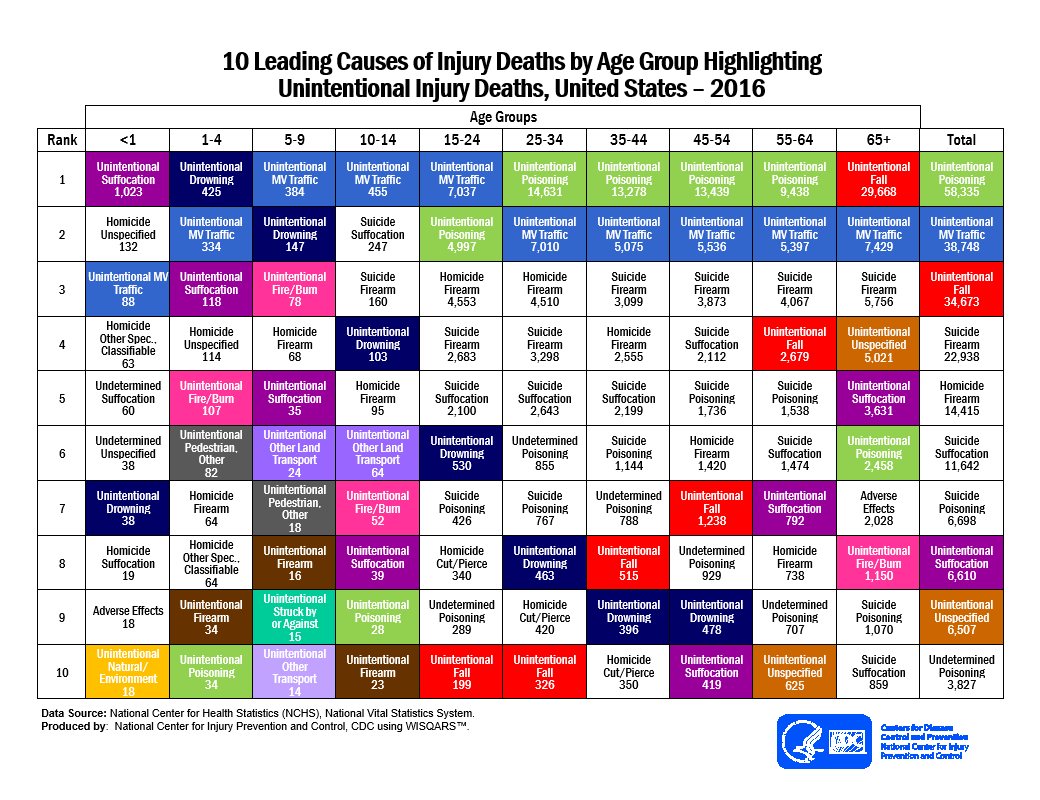
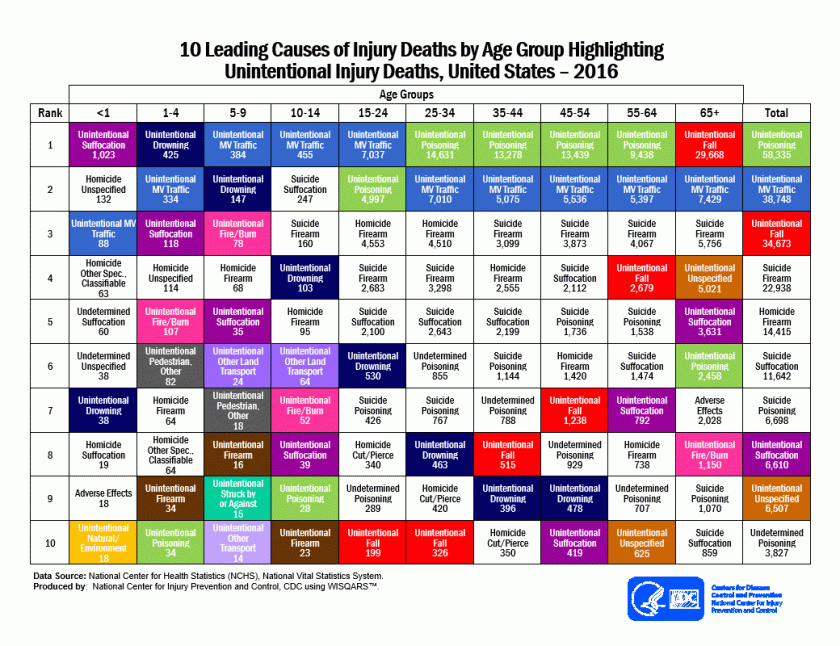
When I was younger I used to tell old guys they shouldn’t climb a ladder and let me do it for them. Now I’m wondering if I’m one of those old guys who shouldn’t climb ladders. I found this very revealing chart at the CDC about causes of deaths by various kinds of accidents. For folks over 65, it’s falling. I hope they don’t mind me copying it here:
leading_causes_of_death_highlighting_unintentional_2016_1040w800h

Notice how “Unintentional Fall” isn’t even in the Top 10 for people under 15? It’s only #10 for ages 15-34. Then it starts climbing up the charts, making #4 for 55-64, and then #1 for 65+. Is there a correlation to declining balance, spatial awareness and reaction times?

I tried to find statistics for bike accidents, but couldn’t.

I’ve been really enjoying biking this year until my bike broke. I was trying to decide if I should get it repaired or buy a new one when I nearly fell off the ladder and wondered if biking was as dangerous as ladder climbing. My biggest worry is falling off my bike and not being hit by a car. I ride in a very safe neighborhood away from traffic. But I’ve occasionally slipped on wet leaves or sand, and I’ve had to do some last minute veering because of squirrels, dogs, kids, and cars backing out of driveways. So far I’ve always recovered without falling, but I’ve had a couple close shaves this year. When I’m zooming along on my bike I’ve often wondered what it would feel like if my 230-pound body flew over the handlebars and smashed into the pavement. Would my blubber protect me? (I do wear a helmet.)

I feel I’m still young enough to bike, but then I recalled three people my age who’ve had bad biking accidents recently. One broke a collarbone when he veered to avoid a woman stepping in front his bike, one who got two front teeth knocked out, had a bunch of stitches, a concussion, and lost 30 minutes of memory so doesn’t remember how it happened, and finally, and one who lost his brakes, hit a sign, punctured his pancreas, damaged his liver, and ended up in ICU for four days.

I love biking for exercise. It’s the only aerobic exercise I can handle. I do have an indoor bike, but it’s not as fun. I thought about getting a 3-wheeler, but I don’t have a garage, and getting a 3-wheeler in and out of the house would be difficult.

Up till my ladder incident, I was thinking I’d bike until I had an accident. But I figured having an accident would only involve cuts and bruises, and maybe a broken arm or leg. Those other bike accidents are making me think that waiting until I have an accident to know when to quit isn’t a great plan.

I had to make my mother stop driving. I’ve had friends that had to step in and make their parents stop driving. I want to believe I’ll know when it’s time to give up car driving, but now I’m getting a taste of that decision with bike riding.

I believe I’m healthy enough to bike ride for many years. But I’m starting to realize that my reflexes are not what they used to be, and my spatial awareness and reaction times are dwindling. I’m trying to place my bet where I don’t seriously injure myself, but I’m not sure of the odds. I wish I could find statistics on biking accidents. What are the common injuries for a 65+ person falling off a bike? I’d gamble on stitches, maybe a broken arm, but I don’t want to lose teeth, and my brain is already acting rather iffy, so I probably shouldn’t risk a concussion.

JWH


How Do You Buy Your Science Fiction in 2018?

by James Wallace Harris, Monday, July 2, 2018

Special thanks go to Chuck Litka for directing me to “2018 SFWA Nebula Conference Presentation” at Author Earningsa website devoted to helping writers find marketing information. This SFWA presentation is a slideshow with an impressive amount of sales data that readers generally don’t get to see. Anyone who writes science fiction, or hopes to be a science fiction writer, should study these slides carefully. Fans of science fiction should find it interesting to know what other fans are buying and how.

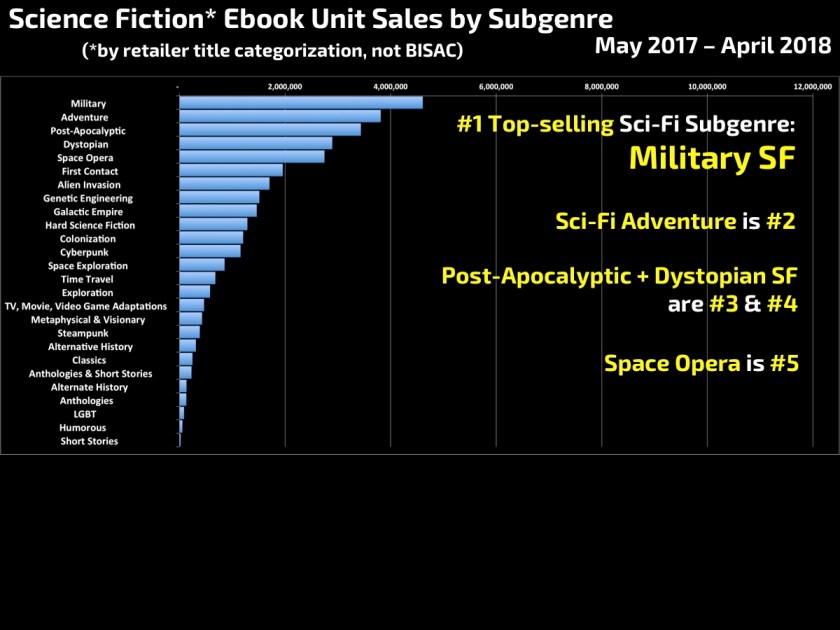
The slideshow by Data Guy is mostly focused on sales numbers, but the slide I liked best is #35 – Science Fiction Ebook Unit Sales by Subgenre. Hope Data Guy doesn’t mind if I copy a couple here.

Slide35

It is disheartening to me that short story collections and anthologies sell so damn little. I’m guessing “Short Stories” means single-author collections. I don’t know why “Anthologies & Short Stories” and “Anthologies” have two separate categories. My other favorite category is “Classics,” and it has sales barely above anthologies.

By the way, “Military SF” is my least favorite kind of science fiction. Growing up in the 1960s I felt like an oddball because I read science fiction. Few people read science fiction before Star Trek and Star Wars. Fans were considered dorks. And when folks did admit they were a science fiction fan, it meant reading science fiction, not watching.

Now I feel like an oddball because I read the least popular kinds of science fiction. Of course, I do love all the sub-genres from “Post-Apocalyptic” to “Exploration.” But I consume them in short stories, novelettes, and novellas. I seldom buy new SF novels anymore. I get the latest Kim Stanley Robinson or the Hugo winners, or the odd SF bestseller like The Martian by Andy Weir. And when I do buy a new science fiction novel, 98% of the time it’s an audiobook.

The impact of audiobooks and ebooks is the main point of Data Guy’s slideshow and the fact that self-publishing is making a huge impact on the genre. Since I’m older, retired, and spend a lot of my reading time consuming mid-20th-century science fiction, I’m not a typical buyer. But it does make me old enough to remember how vastly different book buying was half-a-century ago.

In the 1960s, most science fiction novels came out in paperback. They were mass-market papers, but we didn’t call them that. I don’t think trade paperbacks existed then. At least I don’t remember any. More often than not, paperbacks were purchased from twirling racks in drugstores than bookstores.

Few people bought hardbacks. I joined the Science Fiction Book Club (SFBC) in 1967 to collect cheap hardbacks. They’d weren’t bound in cloth, but a thin vinyl-like plastic. Today collectors prize the paperbacks from this era for their covers. True cloth-bound 1st editions are also loved. But are rare. I often end up with old SFBC editions when I order from ABEBooks. (Or I end up with library discards. That’s another cause for depression, that classic SF is so little read that libraries discard them.)

The first new bookstore I shopped at when I was 16, had three shelves of science fiction books, a mix of hardbacks and paperbacks. It was pretty easy to keep up with the genre, and most of it was reprints. My favorite library then only had 8 shelves of SF books tucked away in a dark corner. I would guess less than 200 SF/F titles were published yearly back then. Today it’s well over 2,000.

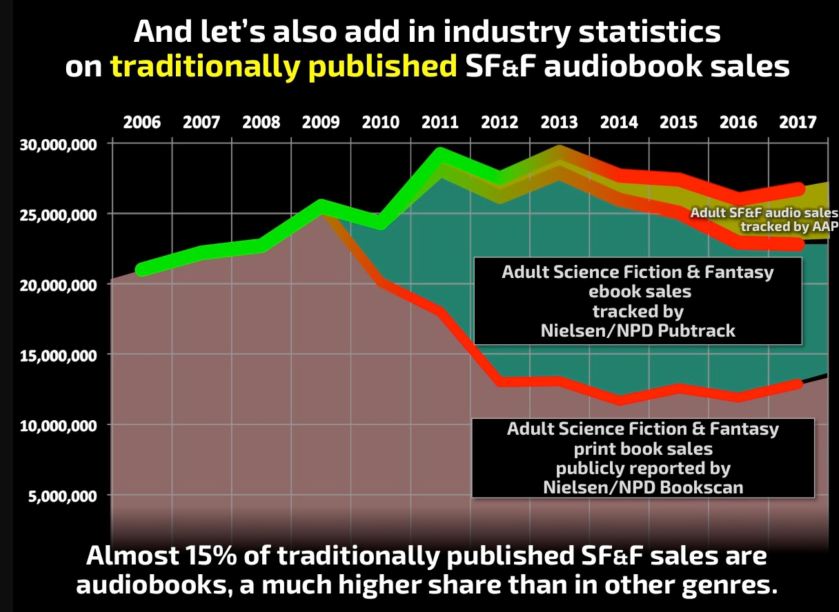
Science fiction selling in hardback is something that’s evolved over the course of my lifetime. I was middle-aged before they started getting on the bestseller lists. My library in 2018 has 8 ranges of bookshelves for SF/F. In recent years we’ve seen more trade paperback editions and fewer mass market books. Now ebooks and audiobooks are wiping out the mass market book and have made a huge dent into trade and hardback sales. See slide #13.

Slide 13

My personal book buying habits reflect this chart, but instead of new print books, half of my book buying is used print books. When buying new books, I’d say 95% are ebooks and audiobooks. The last new print book I bought was Lost Mars: The Golden Age of the Red Planet edited by Mike Ashley, and I had to special order it from England.

I’m now renting more books, via Scribd.com, another distribution type that’s not in the data. I’m reading/listening to books from this service that previously I would have bought as ebooks or audiobooks. And most of the ebooks I buy are the bargain $1.99 editions. I’ve collected a huge library of classic science fiction at that price by watching the daily deals. Generally, any book I really love in audio is one I’ll also buy in ebook. I like having a reading copy for reference and reviewing.

I’m mostly a guy that looks backward to the future. I wonder what young people today who are looking forward to the future are buying? The data in these slides reveal buying decisions in format and sub-genre, but I actually think that view of science fiction has changed.

The futures I hoped for and feared are different from the futures that young people read about today. Readers are reading more fantasy, and much of the science fiction is unbelievable, not based on hard science. I read science fiction in the 1960s hoping it would shape the future, but I don’t think people do that today.

Science fiction has always been an escapist lit but was tinged with hubris. Much of that hubris has faded away. But Data Guy couldn’t document that in his slides. Today, science fiction is more like medical marijuana than project management software. This is why I spend most of my science fiction reading time on the shorter forms. Science fiction writers are more likely to speculate and extrapolate in short fiction than long.

Another area that Data Guy didn’t document is series. Writers are devoting more of their efforts to writing book series. Many of my science fiction reading friends love book series. Series might be comfy books, but to me, they are vast wastelands of words because they have so little science fiction speculation in them. If they have clever ideas, they’re all in the first book.

I wish Data Guy had the numbers on sales by age groups. I wonder how many over-65 science fiction readers are like me – focussed on the past? I’ve recently rediscovered that exciting science fiction is still being written in the shorter forms. It always has, I just lost my way.

My current SF reading involves jumping back and forth from new and old anthologies. The annual best-of-the-year anthologies are new books I do buy, usually in ebook format, but also as audiobooks when they are available. These large collections are actually easier to read electronically.

I wonder how much of the sales Data Guy tracked involved books, ebooks, and audiobooks found in libraries? More and more my library is offering to let me to check out via download rather than visit. To me, Scribd.com is merely a public library where I’m fined $8.99 a month to use.

Finally, one more sad note to contemplate. If book sales move to ebooks and audiobooks, what will collectors collect in the future? You can’t go to musty old bookshops hoping to find lost treasures when they never existed in the physical world to begin with. But there is a practicality to ebooks. The beautiful old paperbacks I find in pristine condition today really aren’t readable. They are collectible, but often they’re too fragile for eye tracks and page flipping. Most of the classic novels of science fiction are easily found today as ebooks, and usually well priced. Audible.com has republished nearly all the classic science fiction novels I grew up reading.

And I’m starting to see more and more classic short stories show up in ebook format. I’ve been collecting Robert Sheckley and Clifford Simak stories that way. What I hope is all of classic science fiction short stories will eventually show up in audiobook too, read by great narrators. That’s how I really love to “read” today.

JWH