How to Take Notes in the Shower?

For some reason my mind just races in the shower and I get all kinds of good ideas for blog essays while scrub-a-dub-dubbing in the shower.  However, I forget most of them.  I try to hang onto at least one idea, so that after I get out of the shower, dry off, get partly dressed, exercise, get completely dressed, eat breakfast and back at the computer, I can write it down.  Often even that single idea doesn’t make it to the more permanent memory of  my word processor.  I really should learn to type in the nude while wet.

So I did a couple of Google searches, “writing notes in the shower” and “how to write in the shower?”

As you can see, I’m not the only one with this problem of wanting to take notes in the shower.  It seems showering is well known for stimulating ideas for writers.  Karen Woodward made a homemade scuba writing tablet with materials from Staples in “How To Write In The Shower.”  However, Amazon has a ready made Scuba slate that’s cheaper than Karen’s put together solution.  The problem with both solutions is erasing the board.  But one of the customer reviews at Amazon suggested a Mr Clean Magic Eraser, which my wife has been buying lately, erases the slate well.  Amazon also offers a larger Scuba slate.  I ordered the smaller one for $7.78 with free Prime shipping.

The little scuba slate turned out to be good enough for now.  Capturing my thoughts usually only takes 2-3 lines, and the small slate, about the size of of a trade paperback, can handle 4-5 notes on each side.  I write with water streaming all over me and what I’m writing.  Pretty cool.  Problem solved.

However, I noticed there were other good solutions, include Aqua Notes, a waterproof notepad specifically designed for the shower.  It’s $7.00 plus $3.99 shipping at the site for a 40 page pad, or $10 at Amazon.  I’m going to try this next if the slate doesn’t work out in the long run.  This solution could get expensive.  However it has an advantage over the slate in that you can pull off a page and take it to the computer.

I expect the scuba slate to solve my immediate problem, but I’d like more elaborate permanent solution.  I need a system for taking notes all the time, and from any location.  My iPod touch has a good voice recorder app called Recorder.  I used to own an Olympus digital recorder for dictating notes until I rocked on it with my La-Z-Boy.  Digital recorders are great for in the middle of the night note taking, but I wouldn’t want to take one into the shower, or even a steamy bathroom.

But wouldn’t it be cool to have a smart home that constantly listened to me?  Or even talked to me?  Over the years I’ve seen various science fiction movies where houses had AI butlers built into them.  Now wouldn’t that be cool?  Of course I might go crazy talking to my house all the time.  In the future they might have personal robots that I could chat with and they’d take notes, and be my very own Dr. Watson, but I can’t count on that now.

I created this blog to record my thoughts and called it Auxiliary Memory because I wanted to record my thoughts.  I forget too easily, and I’m forgetting more all the time.   I often reread my older blog posts amazed at forgetting ever writing them.  There is even a movement called lifelogging to record everything a person does in their life, see “Lifelogging 101:  How to record your life digitally.”

Gordon Bell and Jim Gemmell wrote a book Total Recall:  How the E-Memory Revolution Will Change Everything.  Bell was a researcher for Microsoft that became the subject of MyLifeBits, an early lifelogging project.

Now, I’m not actually interested in recording my whole life.  I want to record ideas.  I often write in my head thinking I’ll get up and write it all down later, but I don’t.  What I’d really like is a brainstorming recorder.  I just searched “brainstorming recording” on Google and got hits.  See, everything I think about has already been thought of before.  It’s nice to know I’m not the only one with these crazy ideas.

Ultimately I’d like a transparent way to record my thoughts, then mind map them with XMind, research and collect additional information and store that research in Evernote, and finally write it all up in an essay.  Sooner or later some savvy young inventor will invent an app that does all those things at once.

JWH – 9/26/12

Defining Science Fiction by Analyzing NBC’s New Show Revolution

It’s very hard to define the term “science fiction,” a topic often discussed in my science fiction book club.  Searching the web reveals endless essays on the topic.  It’s not possible to come up with a one-size-fits all definition for science fiction.  I’m going to take another approach.  I’m going to analyze the new show Revolution point by point, and say which parts I think are science fiction and which I think are fantasy.

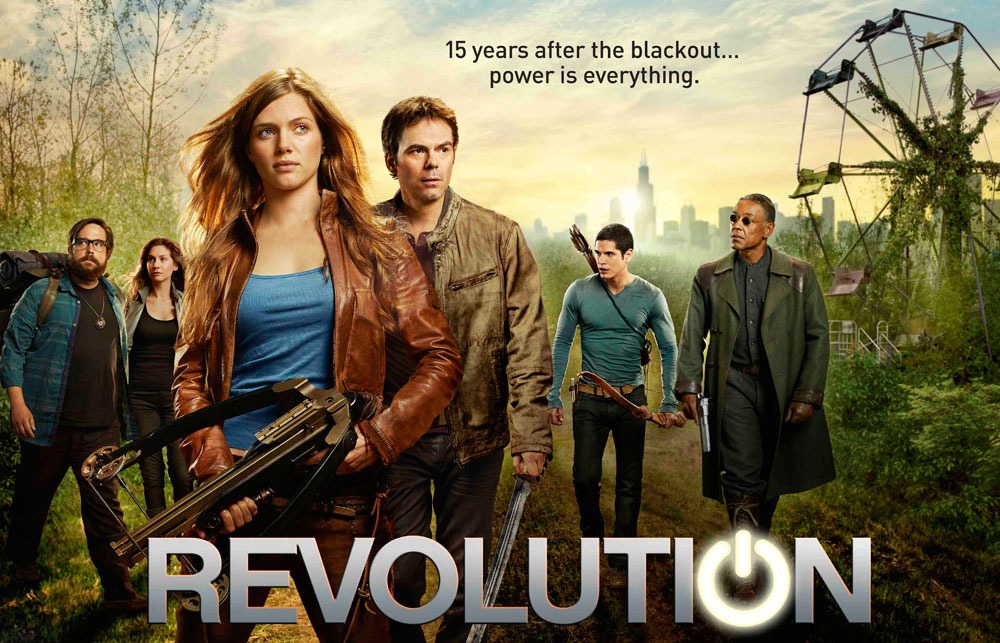
revolution

Revolution is about a family thrown into a dark world of a collapsed civilization.  The show begins 15 years after a worldwide blackout with a father dying, a son being kidnapped and the daughter seeking her long lost uncle Miles to help her rescue her brother.  The daughter, Charlie Matheson, played by Tracy Spiridakos is a kind of less hard, less savvy, Katniss Everdeen, so the story carries on the current vogue of girl action heroes.  Miles Matheson is played by Billy Burke and he’s your standard action guy.  This is why I loved Breaking Bad so much, none of the characters were cookie cutter clichés.

Strangely enough, the medium level bad guy in Revolution is Giancarlo Espositio playing Tom Neville, a ruthless, but sometimes coldly kind, captain of a militia, who previously played a ground breaking character in Breaking Bad, Gustavo “Gus” Fring, who was also ruthless with a strange tinge of cold kindness.  You’d think Espositio would have tipped the Revolution writers not to go for the obvious, and make him different.  I fear such a wonderful actor will get typecast.

Premise

Revolution pictures our world without electrical power or electronic gadgets – a powerful “What if…” scenario.  We’re all so depended on computers and electricity that it’s an intellectual adventure to pretend to live in a time of 18th century technology.   Revolution hints that some kind of force field is capable of dampening all electronics, and even electricity production.  Science knows solid state electronics are vulnerable to electromagnetic pulses (EMP) that are generated as a byproduct of nuclear explosions.  However, mechanical turbines should continue to work, and even old fashioned tube electronics might continue to work with EMP fields.

There is no science to suggest that such a energy dampening force field is possible.  It’s just a writer’s gimmick to advance the story.  Does that make Revolution a fantasy?  It’s a damn cool idea, but so is a school for wizards.  In other words, I have to say the premise of Revolution is fantasy.

In Revolution, there is a reason why and how the power got turned off. Revolution’s creators are holding that back as a mystery, like the mystery of the island in Lost. Mystery is one of the prime movers of fiction, so you can’t blame them for holding back, but I’m worried I’m going to be disappointed, like I did with Lost. Unless they come up with other mysteries, I doubt I’ll keep watching.  Bad Robot Productions, the company that made Lost, and produces Revolution, does have a track record for upping the mystery ante every week.

The mystery of who has killed off the power isn’t very science fictional to me. For it to be really science fictional, it has to be plausible, so we think, “Could this really happen?” When Jules Verne and H. G. Wells wrote stories about men traveling to the Moon, people did think, “Hey, that might be possible, what will it be like, and how will they do it?” That’s science fiction.

Contrast Revolution with The Windup Girl by Paolo Bacigalupi which is set in the 22nd century after fossil fuels have been used up, after global warming has changed every thing, and after crop monoculture and genetically modified agriculture has failed.  In The Windup Girl Bacigalupi develops kinetic energy machines using springs.  This same technology would work in the world of Revolution, but so far we haven’t seen any ideas like this, and I’m not sure the Bad Robot people think this way.

If the Bad Robot Production people had been truly creative, they would have taken the same scenario and come up with a totally new post apocalyptic society – one without electricity, but very creative.  They would have envisioned new forms of mechanical power, the return of sailing ships and dirigibles, funky new bicycles, rocket powered airships, and new forms of animal power.  They could have had computers like Babbage dreamed about, and new art forms not depended on digital media.  That’s what science fiction is about.  What they gave us is Mad Max Lite.

Post Apocalyptic World

Post apocalyptic fiction is one of my favorite sub-genres of science fiction, and for two reasons.  First, I love how an author imagines people surviving the collapse of civilization.  Second, thinking about how to rebuild civilization offers countless intellectual puzzles for my mind.  Now that’s some good clean science fictional fun.

Revolution is just a post apocalyptic fantasy that allows guys to fight with swords.  At least so far.  Why are guns rare but swords plentiful?  How did they gear up for sword production so fast?  I know I’ve only seen two episodes and the science fiction world building has been slight – mostly using stock after-the-collapse imagery.  In fact, they seem to have gotten most of their imagery from Life Without People.

Apocalyptic and post-apocalyptic fiction has a very long history which Revolution must be judged against.  When I saw the show announced this summer I had hoped for a television version of Earth Abides or The Day of the Triffids, or the British TV series SurvivorsRevolution is closer to The Postman by David Brin, more about adventure and less about the details of survival, or efforts to rebuild civilization.  Both feature a ruthless militia leader trying to start a post-civilization empire.

Now, this political subject is a honest science fictional topic.  Rebuilding our society after we’ve mined all the easily available resources is a scientific challenge worthy of much speculation.  However, in the first two episodes, Revolution hasn’t dealt with scarcity.  At one point Charlie’s Uncle Miles, tries to bribe someone with a small chunk of metal, which I assume we’re to think of as gold.  Gold nuggets are very rare, what gold we mine nowadays is molecules of gold processed from tons of ore.

What people use for money in Revolution’s apocalyptic world is a fascinating idea to explore, but so far the show ignores the issue, other than this one transaction with a tiny lump of yellow metal.  Good science fiction will explore all aspects of a possible future.  Revolution takes a Indiana Jones approach to the story, using slight of hand on facts, and diverting viewer’s mind with action and violence.

We have to ask ourselves:  Is a story science fiction if it’s set in a science fictional setting?  I don’t think so.  We are told Miles Matheson is a man who is good at killing people.  Miles’ abilities to fight are so unbelievable that they remind me of the recent Sylvester Stallone action flick, The Expendables 2.  That makes me think Revolution is more inspired by video games than science fiction books.  It’s appeal is to would-be first person shooters than folks who like to read speculative fiction about possible futures.

I wish Revolution’s level of violence was more like Breaking Bad’s, and it focused more on clever plots with interesting science fiction speculation.

Population Dying Off

If the power went off all over our world, how long could we support 7 billion people?  Revolution doesn’t even try to answer that question.  It skips 15 years immediately.  There’s some flashbacks, but no explanations.  The starting point of most collapse of civilization stories are a plague that kills off most of the population, or nuclear war that kills off most of the population, or aliens from space that kill off most of the people, or some kind of natural or cosmic calamity that kills off most everyone.  Revolution looks like the population took a major beating, but we’re not shown how.

I’m currently reading The Dog Stars by Peter Heller, another literary look at the end of the world, much like The Road by Cormac McCarthy.  Now this is real science fiction in my mind.  The Dog Stars is serious, philosophical, speculative, and worthy to be called science fiction in my book.  Revolution is decent fun without any real thinking involved.  That’s a shame.  For a story to kill off billions of people there should be more details.

In Revolution most of the population has disappeared and we don’t know why.  The writers obviously wanted a low population Earth for the story but hasn’t explained how everyone died.  In other words, after the collapse stories are so common in the mundane world that the producers don’t even feel the need to explain.  They are using a post apocalyptic world as a setting, just like Star Wars used a galactic empire as a setting.  There’s no science fiction speculation in either, so just accept the premise.  Revolution is an action adventure story set in a realistic but unscientific world.

Surviving the Collapse

I’m disappointed with Revolution because it makes no effort to show people surviving.  Everyone has plenty to eat, clean clothes without having to wash them, there’s no worry about diseases or bad water.  After 15 years, how good will clothes look?  There’s no effort to show how people make new clothes.  I don’t expect Mad Max fashions, but the show should speculate some, at least.

The plot is driven by Danny Matheson’s kidnapping.  Our characters don’t seemed challenged by any other problem.  The two episodes involved plots to set the stage so Miles can kill a bunch of people, and convince Charlie that killing is the way to operate.  The only survival going on is whether the audience won’t be killed off watching Billy Burke kill a dozen tough guys every episode.

Cliché Science Fiction

Whenever I read a new science fiction novel, or watch a new science fiction show I hope to discover a new idea or perspective. It’s hard to come up with a totally original idea nowadays. There just are too many fiction factories out there.  Barring originality I look for creative style – if you can’t deliver a new idea, at least present a mash-up old ideas in a new way.

Science fiction has become as formulaic as a murder mystery. I believe most SF fans find comfort by embracing their favorite sub-genres so writers cater to ever more baroque presentations of the same old ideas, creating Über-clichés. Revolution is merely the current incarnation of a long line of stories about the breakdown of civilization. Some reviewers call it dystopian, but I disagree. The original meaning of dystopia was an anti-utopia. In modern parlance dystopian has come to mean any unpleasant future. That’s a corruption of the original intent of the world. Nineteen Eighty-Four was a dystopian novel because the government of Big Brother was suppose to represent a view of communism, which before Stalin was seen by many intellectuals as a utopian ideal, but Orwell speculated communism would be hell instead of heaven.

Nineteen Eighty-Four was dystopian because it was anti-utopian. Revolution isn’t anti anything. Revolution uses a cliché science fictional setting to create an action adventure story. Collapsed civilizations are a good way to create a setting for rationalized violence, like westerns.  Post apocalyptic stories are good for creating situations where your character can kill a lot of people.  Audiences can’t seem to get enough of that kind of violence.

The proper categorization of Revolution is post-apocalyptic science fiction, which covers stories about the aftermath of collapse of our current civilization.  A common cliché within apocalyptic fiction is freemen versus brutal militias.   So Revolution is a sub-sub-genre.

To further complicate the problem all new fictional creations must compete with the most creative works at the moment. Taking on a new TV show for me, means finding something to watch that competes with my recent favorites, Breaking Bad, Friday Night Lights and Glee.

Watching the first episode of Revolution was a big letdown for me. Oh, it still has possibilities. But most great shows have fantastic first episodes, and Revolution’s was just ho-hum.  I did watch the 2nd episode and will watch the 3rd.  I have hope.  Revolution does have possibilities.

On the big screen they usually go for bigger and bigger action, usually involving saving the world. That’s an expensive proposition for a TV show, but Revolution has a very large scope.  There’s room for lots of action and speculation.  Let’s hope there is less of the former and more of the latter.

JWH – 9/25/12

Robot and Frank–The Best Science Fiction Film Since Gattaca

When I was growing up in the 1950s I was sure flying in a spaceship would be in my future.

Now that I’m getting old, I wondering if a robot will be my companion for my waning days of life.

Robot and Frank is a little movie about a man coming undone.  That’s what getting old and dying is all about, coming undone.  Whether we spend our last days in dementia is a matter of luck.  Frank, an ex-con and jewel thief, played by Frank Langella, is not so lucky.  His mind is unraveling too.  Frank lives alone and barely makes do.  Frank’s son, played by James Marsden, must drive ten hours to check up on Frank every weekend, neglecting his own family.  His solution?  Give Frank a robot.

robot-and-frank-poster001f-730x365

Most science fiction fans will not think Robot and Frank much of a science fiction movie, there are no explosions, chases, superheroes or saving the world.  No one even saves Frank from dementia.  So why do I claim this is the best science fiction film since Gattaca?  This is a story Isaac Asimov could have written for Astounding Science Fiction in the 1940s.  As far as I can tell, this little robot, which is never given a name other than robot, follows all the three laws of robotics.

But Robot and Frank is more than a modern day Asimovian tale.  The film explores what it means to be a human losing his intelligence while a robot is gaining its awareness.  Robot and Frank is not sentimental, or even particularly cute.  This is an adult story.  I wonder if anyone under 50 will even understand it.  Unless you’ve experienced memory loss, unless you’ve cared for a dying parent, unless you have first hand experience of becoming helpless,  I doubt you’ll empathize much with Frank.  Robot and Frank is for an audience that has often said, “I’m having a senior moment.”

Oh, don’t worry, there’s enough of a story for a person of any age to enjoy this delightful movie, but I tend to think, only those of a certain age will feel deeply moved.  Middle age viewers might be horrified by the fear they will one day have to care for their aging parents, and I bet some of them might watch the film and think about opening a savings account to start collecting money to buy a robot.  I know I wondered if saving for a robot might be a better use of money than paying into nursing home insurance.  The Japanese are working full steam ahead on developing androids.

Robot and Frank is set only slightly in the future.  The closing credits shows clips of real robots being tested.  However, the mind of the robot in this film is very far from what we can create now.  That’s why the film is science fiction.  The robot is halfway to Data from Star Trek.  Somewhere between R2D2 and 3CPO.  I don’t know if we need to reach the Singularity to get this kind of intelligence in a helper bot, but I don’t think it’s in the near near future.  Maybe 2025?  I’ll turn 74 that year.

When you watch Robot and Frank, you’ll have to ask yourself, “Will I be happier with a robot or human caretaker?”  At first you think the son and daughter are shirking their duty but by the end of the film, you might change your mind.  Frank gets quite attached to robot, and spends a lot of time talking to it.  But who or what is he talking to?  But who or what is Frank talking to when his son or daughter is with him?  What is consciousness?  When we’re alone, and our days are dwindling, what kind of companion do we really want?  Are we wanting to listen, or are we wanting to be listened to?

Yes, what we want is a spouse we’ve spent our whole life with.  After that we want our children.  But what if we don’t have children, or a spouse?  Is a personal robot better than an impersonal nurse?  Robot is able to observe and understand Frank.  And isn’t that what we’ll want?  Someone to know where we’re at, no matter how Swiss cheesy our memory becomes?

I found Robot and Frank tremendously uplifting.  I left the theater feeling mentally accelerated and physically better than when I walked in.   We will all come undone.  We will all have to deal with it.  Suicide is one way to avoid the issue, but this movie doesn’t consider that path.  Frank’s mind keeps unraveling, but he lives for moments of being himself.  The movie suggests a robot might help find those moments.

JWH – 9/17/12

Rethinking the Great Books of History

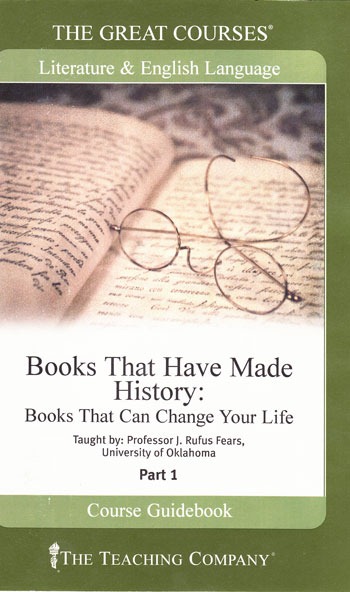
I am listening to “Books That Have Made History:  Books That Can Change Your Life” from The Teaching Company, taught by Professor J. Rufus Fears and I’m wondering if the “classic” books of history are being oversold.

great-courses

I’m a life-long bookworm.  I got my degree in English Literature.  I study books about books, such as those by Harold Bloom, and I even study the Bible as literature although I’m an atheist.  I wish I had the time to master the great books.  And I started listening to these lectures expecting to expand on my knowledge of the great books of history.  However, Dr. Fears is making me think otherwise.

Books That Have Made History is a popular course for The Great Courses, but I think it has a fatal flaw.  And I’m not the only one to criticize this series, just read the customer reviews at the site.

Dr. Fears approaches these 36 lessons with the assumption the greatest books of history have great moral lessons to teach.  He expects great books to explore and answer four questions:

  • Does God or do gods exist?
  • What is fate?
  • What do we mean by good and evil?
  • How should we live?

Dr. Fears teaches these books with a firm belief in the answers.  He teaches each title by fitting them into his own theological beliefs.  In his opening lecture he discusses Dietrich Bonhoeffer and how he was imprisoned by the Nazi’s and hanged on April 9, 1945.  Dr. Fears said Bonhoeffer and the judge that sentenced him to die both read and studied the same classic books of history, and asks:  How did they come to such morally different conclusions?

Dr. Fears assumes the great books of history have answers to the great questions of history.  I think he’s wrong. 

Dr. Fears assumes there is a God, there is good and evil, that we’re expected to live by definite rules, and we have a fate or destiny in our lives.  I think he’s wrong.

Dr. Fears refuses to believe that the universe is accidental, that there is no good or evil, that there are no moral laws embedded in the universe, and the universe expects nothing from us.   I think he’s wrong.

Dr. Fears advocates The Iliad was the Bible for the ancient Greeks like the Christian Bible is for the western world, and that Homer was a singular real person.  I disagree.

Dr. Fears believe Moses was a real historical figure and there’s amble historical and anthropological evidence to support his story.  I disagree and even think many Jewish scholars disagree.

Now my point is not to say I dislike this lecture series because I disagree with the professor.  I’m asking why we should read the great books of history?  If they exist for the reasons Dr. Fears suggests, then I say, let’s forget them.  I’m dead tired of trying to puzzle out truth about reality from ancient thinkers.  I’m willing to read their books to understand the evolution of mankind and its history, but I have no interest in acquiring their beliefs.

Dr. Fears believes studying these books are valuable and relevant to teaching modern people how to think and act.  I think that’s wrong.  I think that’s why our world is confused and full of conflicting belief systems.

Great books make you think about life and reality, but they should give no answers.  Explicit answers are dangerous.  We live in the 21st century and we need to study the moment.  Now it’s actually impossible to study the current “now” in books, since books take years to write.  But for example, if you are studying cosmology, anthropology, or geology, or another other science, you really need to be reading books written in the last five years, and no more than 10 year old.

History and biographies can have a trailing edge of maybe 25 years, but that’s because some topics don’t get written about all that often.

If you’re studying the great books of history, I believe they should be read as primary sources to supplement current historical research.  Your research efforts should go into studying how and why they were written in context of their times, and not use them for acquiring personal beliefs.

This represents a schism in approaching reality.  If you believe that science has been the only consistent human endeavor to answer questions about reality, ancient knowledge will only be superstitious beliefs and endless philosophizing.  If you believe in God, then ancient writings are a goldmine of potentially revealed secrets.  Books That Have Made History falls in the later category.  My thinking falls in the former, so these lectures have little value to me.

However, they do make me ask:  Should or can we write current books that summarize good and ethical behavior for people to study?  If people are wanting to read books about how to live their lives in a “proper” manner, can’t we come up with something a little more current and based on contemporary knowledge?

JWH – 9/12/12

The Tyranny of Hormones

Why are tits so much more dazzling than anything else in reality?  I mean women’s tits.  And how do molecules in our brain make us think human breasts are the epitome of beauty, while convincing us that all other mammalian glands are gross?  Why aren’t guys mesmerized by cow udders?  Those hormones are some pretty amazing chemicals.

Thursday, a young women leaned over right in front of me to get something out of her backpack and a large vista of hanging breasts bulged in front of my eyes.  Evidently my heart is strong, because I didn’t have a heart attack.  As an old man of sixty, I am quite grateful for such unexpected revelations of evenly tanned globes of fatty flesh, but I have to wonder why my hormones are still active.  What’s the point?

My age, physical appearance and lack of wealth preclude any success with young women, or even women of my own age, and even though my hormones are more than willing, my equipment is unreliable at best, and my little swimmers are old and tired and probably couldn’t make it all the way to the egg anyway.  I’m sure my DNA can’t replicate like it once did.

Why won’t my reproductive hormones leave me alone?  I’ve been looking down women’s dresses for 60 years, why hasn’t it gotten old?

If my appetite hormones didn’t insist that weighing 235 pounds was so wonderful, maybe the tools of my sexual hormones would work better and I could at least attract sixty-year-old women.  But what’s the point?  I have no need of children, so why do my hormones keep insisting I reproduce?

Why do our hormones torment us so?  They make us moody and angry, or depressed and lethargic, or jumpy and nervous.  I suppose there might have been a time in my life when all my hormones worked in harmony, but that was long ago.  It’s just so pathetic to be old, bald and fat and having my hormones constantly whispering to my mind that I should go make some babies.  Even my sperm are laughing at that.

Why can’t I have reasonable hormones.  Why can’t I have sensible old man hormones instead of dirty old man chemistry?

And if I’m not having sex fantasies, I’ll be fantasizing about chocolate chip cookies.  Isn’t that bizarre?   It’s like being possessed by  demons.

Think of all the hormones it would be wonderful to have?  I want to be horny to write great novels.  Now that would be a useful urge for an old man.  It doesn’t require a lot of energy or sarcastic rejecting females.

My body is breaking down and I seriously need to lose some weight.  Yet, my inner chemistry insists on staying fat.  Where’s the biological logic in that?

Wouldn’t it be great if we were born with little knobs that allowed us to adjust our hormone levels.  I got two useless nipples.  Imagine if they had been dials for sex and hunger hormone levels.  Our whole culture has indoctrinated us to think sex is the most wonderful experience in all of nature.  But if we could turn off that urge would we think it so wonderful?  If we could turn down the sex dial to zero would we be miserable, or would we think, “Wow, peace of mind is better than a piece of ass.”

And how anorexic would we all be if we could dial down our hunger hormones?

Or if we could dial down the sex, would we all settle for being happy and fat?

JWH – 9/8/12